Microservices often communicate through APIs, and their security depends on more than the public entry point. NIST SP 800-204 identifies authentication, access management, secure communication and monitoring among the core features of a microservices system. It also notes that a service mesh can mediate communication while fine-grained authorization may still need to run in the microservice that understands the business rule. The buyer's question is whether the proposed penetration test will follow a meaningful application action across those internal decisions.
Quick answer. A microservices penetration test should select important user and workload actions, trace their internal API paths, and test service identity, carried user context, object permissions and state changes at each relevant hop. The statement of work must name the downstream services, test position, owners, fixtures and exclusions. Stingrai's API penetration testing service can assess application and API authorization across roles and tenants; separate network, mesh configuration or cloud control-plane work must be explicitly scoped.
This guide concerns an application transaction after it enters the system. The existing API gateway security assessment guide focuses on route, gateway and backend boundary decisions. A microservices test asks what happens as the transaction continues from one service to another, especially when the second service has a different owner or receives only a workload identity. Both may be needed. Buying either as a vague “full stack pentest” risks leaving an important trust handoff untested.
Define the transaction, not only the hostnames
A list of hosts is a useful authorization boundary, but it is a poor description of a microservices business process. An externally visible request might start in an account service, invoke a billing service, write an entitlement and publish a notification. Each action may be individually legitimate while the combined result violates a tenant, approval or role rule. The buyer should identify the transactions whose misuse would matter, then map the services that actually participate in them. That map becomes the scope, with hostnames and environments attached to each node.
Choose a small set of high-value paths rather than claiming every internal call will receive equal depth. Candidates can include account creation and recovery, membership changes, purchases and refunds, document export, permission assignment and cross-tenant sharing. Those are examples; the organization should prioritize its own sensitive data and business rules. For each path, write the starting identity, intended user action, expected service sequence, allowed outcome and forbidden counterpart. A provider can then explain which calls it can observe or invoke and where it needs help from the application owner.
The dependency map should show synchronous calls and asynchronous messages. A denied external request may still place a job on a queue, and a downstream service may process it later under its own identity. The tester needs a safe way to observe that state without accessing live customer data. Include event consumers, job workers and scheduled integrations when they can affect the chosen business outcome. Do not ask a provider to infer them all from traffic captured at the web edge.
For enterprise buying, scope should also show service ownership. A platform team may manage the mesh, an identity team may issue workload credentials, and a product team may own the object rule. A defect at a handoff can otherwise become a disputed finding. A path map with named owners makes the test actionable and helps procurement arrange the right interviews, accounts and evidence access before delivery begins.
Separate workload identity from the original user's authority
NIST SP 800-204A recommends distinct identities and mutual authentication between communicating entities. Its discussion also distinguishes the secure channel from permission: establishing a channel using a service identity does not itself decide whether the services may communicate. The buyer should ask which identity a downstream service actually sees, which policy allows that caller, and what business authority is carried with the request.
There are at least two separate questions in a typical application path. First, may Service A call Service B? Second, may the original user cause Service B to read this record or perform this action? A service-to-service policy can answer the first question while leaving the second to application code. A shared technical account may have broad access needed for legitimate operations; if Service B accepts its requests without checking the user or tenant context, a defect in Service A can become a cross-user or cross-tenant issue. That is a test hypothesis, not a claim about any particular deployment.
Supply controlled workload identities and synthetic users, with an explicit expected permission matrix. The provider should compare an allowed transaction with a forbidden counterpart and determine where the denial occurs. It should record the workload principal, original user or tenant context, requested object and final state. If a token exchange, signed assertion or header carries context, note which component creates it and which component verifies it. Avoid providing production secrets: a test environment or short-lived controlled credential should exercise the same policy.
NIST notes that contextual information such as the user invoking a microservice may be needed in some scenarios. That does not prescribe one universal token design. A provider should evaluate the organization's chosen model and report whether the intended context survives each hop. If the model deliberately delegates a broader action to a worker, the report should describe the authorization decision at delegation time and the conditions under which the worker may complete it.
Test object decisions where business knowledge lives
The OWASP API1:2023 guidance says authorization should check whether the logged-in user may perform the requested action on the target record. In a microservices system, that check may sit in the entry service, the downstream data owner, a shared policy engine or several layers. The location must be known for a test result to mean anything. NIST's service-mesh discussion warns that fine-grained authorization may need to remain with the microservice that understands the business logic.
Use synthetic records with known ownership. An owner should be allowed to read a selected record; a peer or another tenant should be denied; a privileged role may have a different documented result. The provider should repeat the chosen action through the application entry point and, where explicitly authorized, through the relevant downstream API path. If one path denies and another allows, the report should identify the mismatch and its preconditions. A network connection to a service alone is not proof of an authorization failure. The finding depends on the policy and data outcome.
Check the object's state, not just the immediate HTTP result. A downstream write can complete after the entry service returns an error. A background job may read a forbidden record and then send a notification. An internal API may return a sanitized object to one service but a full object to another. Select a few high-impact decisions and give the tester observability through logs, test record state or application telemetry. This is more useful than a long list of uncorrelated response codes.
Object authorization is also tied to function and property permissions. A user may view an invoice but not change its payment status. A service may need a customer's address to ship a purchase but not all profile fields. Write those distinctions into the test contract. If a provider says it will test “authorization,” ask whether that includes the selected object, action and property decisions at the internal service, not only a token check at the web entry point.
Map the service-to-service decision path
The diagram below is a buyer's decision map based on NIST SP 800-204, SP 800-204A and OWASP API1:2023. It does not prescribe a particular mesh, gateway or authorization architecture. It shows the evidence needed to follow one transaction through multiple owners.
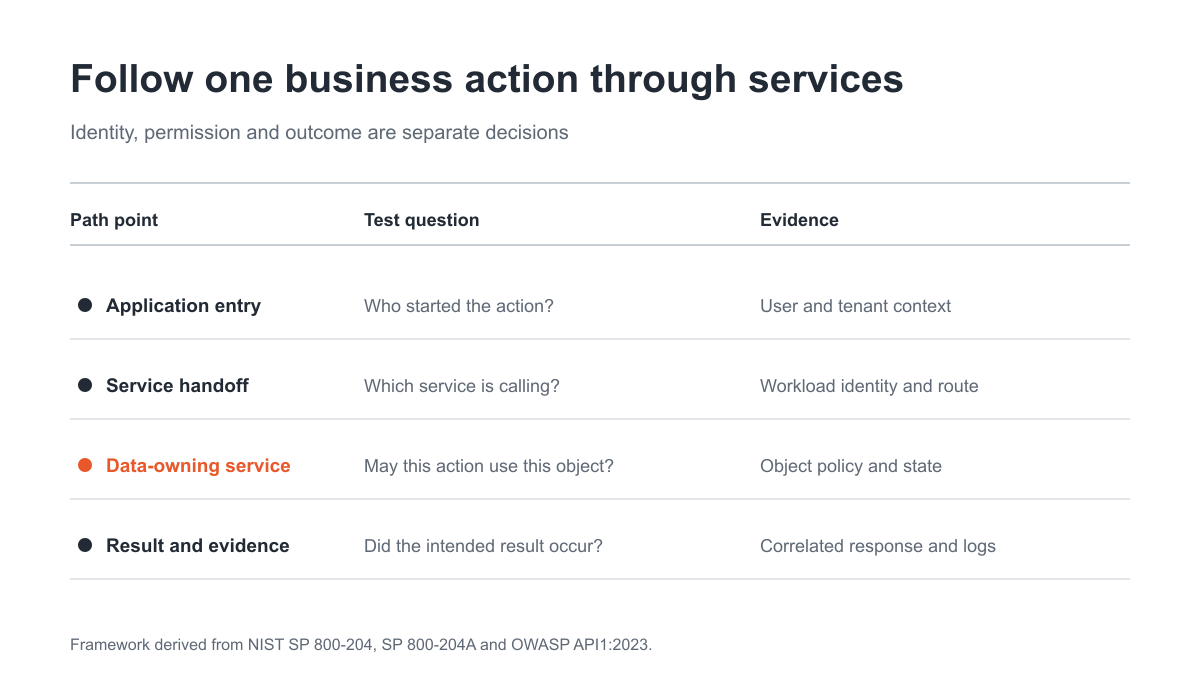
Figure 1: Identity, context and object decisions across an internal application path. Sources: NIST SP 800-204, NIST SP 800-204A and OWASP API1:2023.
For each selected call, the buyer should be able to answer: which service called, which service received, which workload identity was authenticated, what original user and tenant context was conveyed, which object or function was requested, and which component approved or denied it. The provider should return evidence for representative allowed and forbidden cases. Where a call crosses to a service the organization does not own, mark that boundary and obtain separate permission or use a controlled substitute.
The diagram also prevents an easy category error: treating encryption as authorization. Mutual TLS can authenticate and protect a channel. It does not by itself establish that a particular user may alter a particular record. A mesh policy can decide which service identities may communicate. It may not know the application's object rule. That separation should appear in the statement of work and in the report, because the fix may belong to a different team for each decision.
Include mesh policy without assuming the mesh owns every rule
A service mesh can provide traffic policy, service identity and telemetry. NIST SP 800-204 describes that infrastructure layer and its limits. A buyer should ask whether the assessment includes mesh configuration review, service-level proxy policy, certificate or identity configuration, and selected runtime verification. Those tasks require access and expertise beyond a public web/API test. If omitted, the provider should say it is evaluating application behavior through authorized API paths, not claiming to have assessed the entire mesh.
One practical test compares intended and observed service permissions. Which source services should be allowed to call a sensitive destination? Are any namespaces or shared identities broader than intended? Are all instances of a service presenting the expected identity? NIST SP 800-204A discusses granular service identity and policies for allowed inbound and outbound traffic. A provider can review those policies and perform carefully authorized functional checks. It should not infer actual runtime enforcement from a policy file alone when deployment could differ.
Include egress if the chosen transaction reaches a third-party service, another cluster or a legacy system. NIST 800-204A covers controlled egress paths. A buyer should identify the approved destination, what data may leave, and what the tester can safely observe. The test may verify that an application action uses the intended path, but probing a third-party endpoint needs that party's authorization. If the organization can only test a mock, the report should name that limitation.
Configuration and application behavior should be correlated. A mesh might deny a direct call, yet an authorized service could still perform an overbroad business action. Conversely, a downstream application might enforce the object rule even if the mesh policy is permissive. Both observations matter; they lead to different remediation owners. The report should state the service identity, the application decision and the evidence source for each conclusion.
Include asynchronous and shared-service paths carefully
Asynchronous work can hide the original authorization decision. A queue consumer may receive a message with a record identifier but not the original actor, or it may rely on a job that was authorized before it was queued. Neither design is inherently wrong. The buyer should document the expected contract: what context the producer must validate, what the consumer must recheck, what happens if permissions change before execution, and how a failed job is logged. The test can exercise a controlled record and observe the final outcome without generating harmful load.
Shared internal services create another blind spot. A single search, reporting or export service may serve many product teams. Its callers can have different data rights, while its workload identity may reach a broad data store. Scope should include the caller classes and the service's way of restricting returned data. A provider can compare representative callers against synthetic tenant records and trace an unexpected result to the source of the decision. Simply counting one “internal API” underestimates this work.
Legacy bridges and batch jobs need similar attention when they participate in the selected transaction. A modern service might call a legacy API with a shared credential. The penetration test should determine whether the modern service limits what the original user can request before crossing that boundary. The legacy system may be excluded from active testing, yet the application-level delegation decision can still be assessed. Make that separation explicit so the report does not imply the legacy estate was fully tested.
The right depth depends on business risk. A purchase flow that crosses entitlement, billing and notification services may justify more time than a low-sensitivity read-only catalog path. Give bidders the same priority paths and ask them to allocate effort by risk. A transparent risk-based sample is more honest and more useful than a statement that “all microservices” will be tested without specifying identities, paths or data.
Give the provider a testable ownership and evidence map
The buyer should send a compact package that the application and platform owners have reviewed. It should include the transaction map, in-scope services and environments, API definitions if available, service identities, user roles, synthetic objects, expected allow and deny decisions, data retention rules, and a contact for each control. Where the map is incomplete, note what discovery work the provider is expected to do and what time has been allocated to it. An unknown dependency is a risk, but it cannot be silently treated as covered.
Use the following table to align the scope and report. The examples are editorial, not NIST requirements.
Decision | Owner to involve | Buyer input | Evidence to request |
|---|---|---|---|
Service may call service | Platform or mesh owner | Intended caller and destination identities | Policy plus bounded runtime decision |
User context survives the hop | Identity and application owners | Test identities and context contract | Correlated principal, tenant and request record |
Object action is allowed | Data-owning service | Synthetic owned and forbidden records | Expected versus observed decision and final state |
Async job may complete | Producer and worker owners | Reversible test job and state rule | Queue, worker and resulting state correlation |
Finding can be fixed | Relevant service owner | Code or configuration access | Root cause, remediation and retest result |
A provider's proposal should mark each line included, excluded or dependent on access. This makes quotes comparable. It also exposes an operational question: who can retrieve cross-service traces during the test? A tester may see a response at the web edge but need the buyer's observability team to confirm which downstream service made the decision. Arrange that access before the test window, with redaction so the evidence does not expose production tokens or customer records.
The final report should distinguish confirmed findings from visibility gaps. “The downstream service accepted an unauthorized write” requires a stronger proof than “the entry service returned success.” A request identifier, synthetic record, role and observed state can support the conclusion. If logs are missing or the service owner cannot grant access, record the limit and the highest-confidence observation. This protects both the buyer and the provider from overstating assurance.
Compare human-led, hybrid and broader scopes
Human-led testing is appropriate when the path crosses teams, requires architecture interviews, relies on nuanced business rules or includes mesh and infrastructure configuration. Credentialed testers can test the application and API behavior, review relevant source or policy when authorized, and explain which owner should fix each result. The statement of work still matters: “human-led” does not automatically mean every service, cluster, queue and cloud account is covered.
For a web application with associated APIs, a hybrid engagement can combine autonomous exploration with tester judgment. Stingrai's Snipe page describes Snipe as an agent for web applications and associated APIs, with penetration testers working alongside it in the hybrid option. Snipe and the named testers test together throughout; the testers direct the work and follow authorization and business-logic paths. This can help cover exposed application and associated API behavior, including selected downstream behavior reachable through that application path.
Snipe is not a service-mesh, network or cloud penetration test. Internal service-to-service identity policy, mesh configuration, private network position and cloud control-plane checks need a human-led or separately scoped assessment. The buyer should ask where the web/API work ends and where the broader assessment begins. If one transaction crosses both, the provider can coordinate them, but the deliverables should identify which team and method tested each decision. The defined Snipe package scope is one web application and associated APIs; more applications or services require a specific quote.
One-time or annual testing can serve a stable architecture or a defined procurement milestone. Continuous programs are useful when services and permissions change frequently, but they still need periodic human judgment about newly introduced business paths. A buyer should set reassessment triggers: a new service in a sensitive flow, a changed identity exchange, a new tenant model, a mesh policy migration or a material authorization refactor. The test record should say which build and policy version was assessed so later changes can be compared.
Where Stingrai fits
Stingrai is a CREST-accredited penetration testing company headquartered in Toronto. Its web application and API penetration testing services cover authenticated roles, business logic and object authorization. For microservices, the buyer can supply a selected transaction path and authorize the relevant downstream APIs so a human-led test examines the decisions that matter. Network penetration testing or cloud work should be added explicitly when the question reaches private network reachability or control-plane policy.
Stingrai's hybrid option pairs Snipe with named penetration testers throughout an engagement for one web application and associated APIs. For a broader microservices estate, request a custom scope that names the internal services, test position, mesh or identity configuration, and evidence owners. The report can support the organization's compliance program with confirmed findings and retest evidence. The application owner should be able to use it to fix a specific service decision rather than receive a generic “microservices security” score.
For multi-team organizations, the discovery conversation should include the security lead, application owner and platform owner. They can agree on the high-value transactions, provide safe fixtures and decide which downstream systems are authorized for active testing. That preparation makes the assessment more valuable than buying by host count alone. It also avoids exposing customer data or asking a provider to guess what the business rule should have been.
Questions to put in the RFP
Which user and workload transactions will the assessment follow across services?
Which downstream APIs, queues, workers, mesh policies and environments are included or excluded?
What service identities and original user context should appear at each handoff?
Which controlled roles, tenants and synthetic objects will support allowed and forbidden comparisons?
Will testers check final state after a denied or asynchronous action, not only the entry response?
Which team will provide logs or traces that correlate decisions across services?
What access is needed for source-assisted or configuration-assisted root-cause work?
How will the report distinguish confirmed authorization defects from missing visibility or permission?
Ask bidders to respond against the same transaction map and evidence table. A lower quote may be entirely appropriate for a public web/API scope, but it is not comparable with a quote that includes private service identities, mesh configuration and asynchronous workers. Each proposal should state its assumptions in writing. If an internal dependency is discovered during testing, the buyer and provider can decide whether to extend scope under authorization or document it as excluded.
Frequently Asked Questions
What should a microservices penetration test include?
A microservices penetration test should follow selected business transactions through their internal API calls and test service identity, original user context, object and function authorization, and resulting state. The written scope should name the services, environments, test positions, owners, fixtures and exclusions. NIST distinguishes service communication controls from the fine-grained authorization that may belong in an individual microservice.
Does an external web application pentest cover internal microservices?
Only to the extent the internal behavior is reachable and observable through the authorized web and API scope. It does not automatically include direct access to private services, service-mesh policy, network segmentation or cloud configuration. Ask the provider to name the downstream decisions it will trace and the separate permissions or test positions needed for deeper internal work.
Is mutual TLS enough to prove an internal call is authorized?
No. Mutual TLS can authenticate the communicating services and protect the channel. A separate policy must decide whether those services may communicate, and application logic may still need to decide whether the original user may act on a specific object. NIST SP 800-204A describes this distinction. Test evidence should identify both the service identity and the business permission involved.
Why do testers need both user and workload identities?
A workload identity identifies the calling service; the original user or tenant context explains whose business action the service is carrying out. A downstream service may need both to make the intended decision. Controlled identities let the tester compare an allowed action with a forbidden counterpart and determine whether context was lost, broadened or correctly enforced at a handoff.
How should asynchronous jobs be included in scope?
List the producer, queue or event, worker, expected authorization point and final state for priority jobs. Supply a reversible synthetic record and a way to correlate the job with the initiating request. The test should verify whether a denied or changed permission still allows an unintended action to complete. It should not generate high-volume traffic to prove the point.
Does a service mesh replace application authorization testing?
No. A mesh can enforce communication and identity policies, but it may not know the business rule for a user, tenant, record or field. NIST SP 800-204 notes that fine-grained authorization may need to run in the microservice. An assessment should check the organization's actual division of responsibility and show which component made each decision.
Can Snipe test every internal microservice automatically?
No. Snipe is for web applications and associated APIs. In a hybrid engagement, Snipe and named penetration testers test together throughout that scope. Private service-to-service paths, mesh configuration, network position and cloud control-plane checks need an explicitly scoped human-led or separate assessment. The quote should name every additional system and permission.
What evidence should the buyer expect in the final report?
Expect a tested transaction map, identities and synthetic records used, expected and observed decisions, final state, affected service owner, safe reproduction details and remediation guidance. The report should also list untested branches and visibility limits. Retesting should repeat the same allowed and forbidden decision after the fix, with the assessed build and policy version identified.
Related reading
References
NIST, SP 800-204, Security Strategies for Microservices-based Application Systems
NIST, SP 800-204A, Building Secure Microservices-based Applications Using Service-Mesh Architecture
Talk to Stingrai
Share the high-value transaction map, service owners and evidence needs with Stingrai to scope an authorized application and internal API assessment. Get a Quote or book a free discovery call.