The OWASP API Security Top 10 separates broken object authorization, broken object property authorization and unrestricted access to sensitive business flows. A payment platform needs all three perspectives because a valid API request can still cross a merchant boundary, change an internal transaction field or repeat a permitted action beyond its intended business limit.
Quick answer. Scope a payment API penetration test around the full money movement lifecycle, each actor allowed to change it and the invariants that must survive retries, failures and asynchronous callbacks. Give testers synthetic merchants, customers and balances, plus documentation for the ledger, refund and payout states. Stingrai's web application penetration testing supports authenticated business logic testing and a custom scope for a larger payment platform.
This guide is for security leaders, product owners and procurement teams at payment facilitators, processors, banking technology providers and enterprise fintech platforms. Its purpose is to make the statement of work answer a concrete question: could a permitted user or integration cause a transaction outcome that the platform's rules prohibit? It is a testing scope, not a PCI DSS interpretation or a price guide. For broader procurement criteria, see Stingrai's fintech provider comparison.
Why a payment API needs a workflow scope
An endpoint inventory is useful, but it does not explain which actions must occur in sequence or who owns the resulting money. A payment can begin in a customer interface, move through an API gateway and asynchronous event handler, and end in a merchant balance or payout instruction. The test must define the expected state at each handoff. Otherwise, a vendor can cover every URL while never asking whether a refund is possible after settlement, whether a webhook can be processed twice or whether a support role can change a destination account.
This is consistent with OWASP ASVS 5.0.0, which asks applications to enforce the expected sequence of business logic steps and to make a business operation succeed in full or roll back to its previous correct state. Those are verification goals, not assumptions that every payment platform implements the same workflow. The buyer has to provide the intended workflow and define which state changes would be unacceptable.
The scoping document should identify all parties whose authority may differ: customer, merchant operator, merchant administrator, platform support, finance approver, partner integration and machine account. It should also identify whether a role belongs to one tenant, several legal entities or a platform-wide operations team. A tester needs accounts and sample objects in each relevant role to verify access controls rather than infer them from an API description.
Scope the payment lifecycle, not just the endpoints
Use the platform's own transaction model to build a coverage map. The following example is a buyer worksheet, not a claim that all providers use these stages.
Lifecycle area | Test question | Evidence to provide |
|---|---|---|
Payment initiation | Can a user request only permitted amounts, currencies, instruments and merchant accounts? | Expected validation rules and synthetic transactions |
Authorization and capture | Can the same transaction be captured only in its permitted state and amount? | State diagram and processor sandbox access |
Asynchronous events | Are duplicate, delayed and out-of-order events handled without creating an incorrect balance? | Event contract, retry rules and test event source |
Refunds and reversals | Who may approve them, and which original payments can they affect? | Role matrix and sample settled payments |
Payouts and account changes | Can only authorized actors alter a payout destination or release a transfer? | Approval rules and nonproduction beneficiary accounts |
Reconciliation | Do API responses, internal ledger and downstream status agree after exceptional paths? | Read-only ledger view and expected invariants |
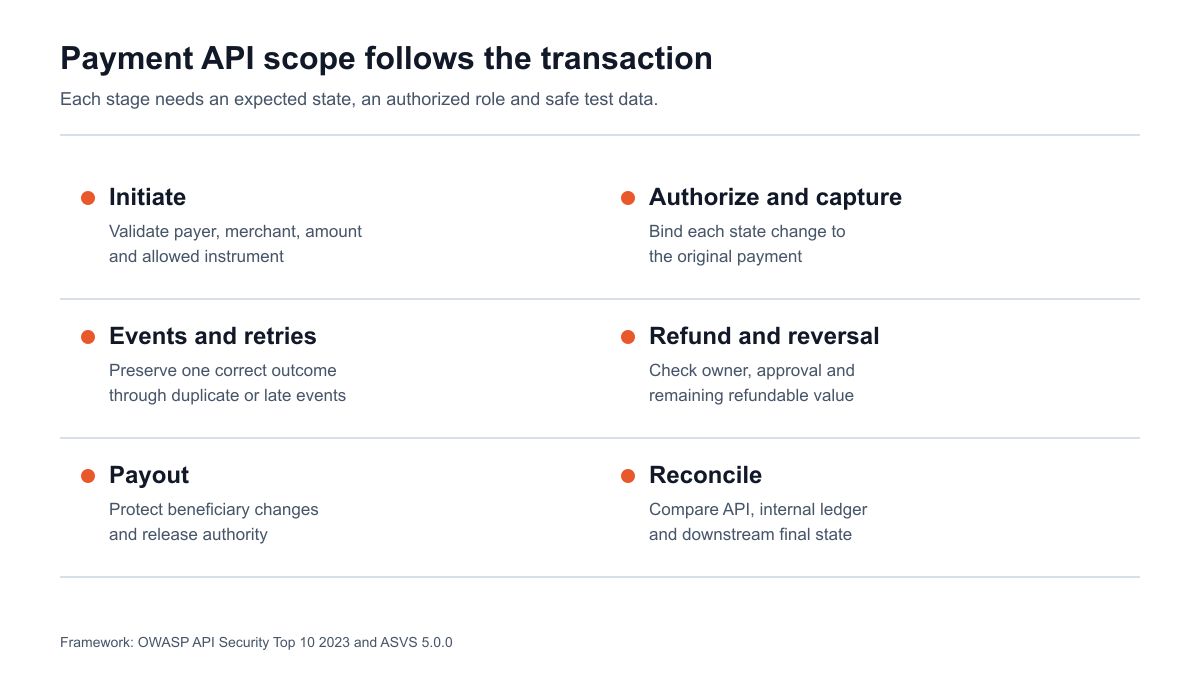
Figure 1: A proposed payment lifecycle coverage map. Source: OWASP API Security Top 10 2023 and OWASP ASVS 5.0.0.
For each row, add the responsible system, the data owner, the allowed transitions and a safe test fixture. The coverage map becomes both a test plan and an acceptance tool. A statement such as “refund API included” is too ambiguous. “Test merchant staff and platform support access to refunds for their own and another merchant's synthetic payments, including approval and reversal states” gives the vendor a result to prove.
Authorization must be tested at three levels
The transaction object
OWASP API1:2023 says functions that receive an object identifier should check whether the logged-in user may perform the requested action on that object. In a payment scope, the objects include payments, customers, merchants, invoices, refunds, disputes, payout batches and connected accounts. Ask testers to compare permitted and prohibited access among synthetic tenants and among roles within one tenant. The question is whether the server enforces the relationship, regardless of how unguessable an identifier looks.
The sensitive property
OWASP API3:2023 addresses fields a role should not read or change, even when it may use the object. Payment examples for a test plan include settlement status, beneficiary details, fee configuration, risk decisions and internal notes. Some may be user editable in one workflow and server controlled in another. Make the expected distinction explicit in the role matrix, then ask for evidence that both request handling and response filtering enforce it.
The function and approval boundary
A merchant viewer and a finance approver may see the same payout batch but have different authority to release it. Support staff may resolve customer issues without changing financial instructions. Document those boundaries before testing. ASVS v5.0.0-2.3.5 treats multi-user approval for high-value business flows as a Level 3 verification requirement. The engagement should check the approval design the platform has chosen, including how an approval is bound to the exact transaction being approved.
This is where authenticated grey-box testing earns its place. The tester can use accounts in each role, review the documented policy and compare the behavior of the API and administrative interface. Stingrai publicly describes black, grey and white-box web testing, including source access in white-box work. A source-assisted review can help identify which component makes an authorization decision when several services participate, if the buyer grants repository access.
Business logic questions worth putting in the SOW
Ask what must remain true when a transaction is interrupted. For example: the customer is not charged twice; a refund never exceeds the permitted remaining amount; a payout cannot be released before its required approval; and a failed processor call does not leave the internal ledger in a success state. These are proposed invariants. Product and finance owners should approve the exact wording because their ledger design defines the truth.
The test should also include retries and event timing. Payment systems intentionally retry failed or uncertain operations, so the tester needs an authorized way to exercise duplicate requests and delayed events against synthetic data. This is a defensive validation of idempotency and reconciliation, not a request to stress production throughput. ASVS v5.0.0-2.3.3 gives a useful standard for complete or rolled-back business operations.
Another question is how a partner or merchant integration can consume valuable flows. OWASP API6:2023 focuses on sensitive business flows that can harm a business when accessed excessively. For payments, the buyer should identify the flows that merit limits or escalation, such as account creation, payment instrument changes, refund issuance or payout scheduling. The vendor can then assess the controls defined for that platform without assuming that a generic rate limit solves every abuse case.
Set safe rules of engagement before testing
Money movement demands a written safety boundary. Specify whether testing occurs in a production-like environment, a processor sandbox or a tightly controlled production window. Name synthetic merchants, instrument tokens, payout destinations and the maximum value of test transactions. Define which third-party processor surfaces the buyer may authorize and which require separate written permission. A useful rule of engagement also states who can stop a test, how to contact operations and what evidence may be retained.
The strongest test environment preserves the same authorization and transaction state controls as production, while keeping actual funds and customer data out of the exercise. If the staging path differs materially from production, record that as a limitation in the final report. This is a buyer decision about assurance, not a universal instruction to test live financial flows. Stingrai's general scoping guide covers authorization, environment choice and stop conditions in more detail.
Deliverables a fintech buyer should request
A useful report starts with a scope record: which workflows, roles, tenants, APIs, environments and integrations were tested, and which were excluded. It then gives each confirmed finding a clear business consequence, affected role or state, minimal safe proof, owner and remediation recommendation. Findings that cross several services should identify where the incorrect trust decision occurred so engineering teams can fix the control rather than patch one endpoint.
Ask for a coverage table that maps the test back to the agreed lifecycle. It should distinguish a negative test that passed, a case that failed and a case that could not be executed because of missing data or authorization. The executive summary should translate technical findings into decisions about release, integration or compensating controls. A retest record should say which fix was checked and what behavior was observed afterward.
Stingrai's PTaaS platform publishes findings during an engagement, supports direct collaboration with testers and offers reports with sensitive sections redacted for sharing. For a payment buyer, that can help route a confirmed issue to the payment service owner while preserving a suitable report for procurement or a compliance evidence package. Stingrai's testing supports those programs; the engagement scope and results determine what evidence is relevant to each reviewer.
Vendor questions that expose a weak scope
Ask a prospective vendor to walk through one synthetic payment from initiation to reconciliation and name the roles it needs at each stage. Ask how it distinguishes object access from property access, how it will observe a ledger invariant and how it handles asynchronous events. Ask what it will do if the processor sandbox does not reproduce a production rule. The answer should describe an explicit limitation or an agreed alternate test, rather than simply calling the endpoint covered.
Then ask who will perform the authenticated work, whether source-assisted review is available, how findings are reported during the engagement and what retesting includes. Finally, request a sample report with the exact form of the coverage table and remediation evidence. For a platform with multiple applications, merchant portals or administrative systems, request a custom scope. Stingrai's pricing page identifies Enterprise as tailored to the organization and available for one-time or continuous work.
Frequently Asked Questions
What should a payment API penetration test cover?
A payment API penetration test should cover the complete transaction lifecycle, including authorization, capture, asynchronous events, refunds, payouts and reconciliation. It should test the permitted actions of customer, merchant, support, finance and integration roles using synthetic data. The final report should show which workflow and role boundaries were actually tested, what failed and what could not be verified.
Is an API scan enough to test payment business logic?
No. An API scan can help inventory routes and detect some technical weaknesses, but the payment owner must define valid transaction states, role permissions and balance invariants before a tester can judge the business outcome. The test should demonstrate whether those rules hold across related services and exceptional paths, with safe evidence and a stated environment limitation.
Should the payment processor be in scope?
Only surfaces the buyer is authorized to test should be in scope. The statement of work should identify whether a processor sandbox, a partner integration or the platform's own API is being tested, who grants permission and where the responsibility boundary lies. A vendor can test the platform's handling of processor responses without implying permission to assess the processor itself.
What should the buyer provide before kickoff?
Provide a transaction state diagram, a role and tenant matrix, synthetic accounts and balances, the expected ledger invariants, processor sandbox details and written rules of engagement. Include known retry and webhook behavior, an operations contact and an escalation path. Better fixtures let testers spend their time validating financial controls instead of guessing how a successful transaction should behave.
Related reading
References
OWASP, API3:2023 Broken Object Property Level Authorization.
OWASP, API6:2023 Unrestricted Access to Sensitive Business Flows.
Stingrai, web application penetration testing services, PTaaS platform and pricing.
Talk to Stingrai
Stingrai is a Toronto-headquartered, CREST-accredited penetration testing company with human-led web and API testing for fintech teams. Bring the payment state diagram and role matrix to Get a Quote or book a free discovery call to agree the test boundaries.