Continuous threat exposure management (CTEM) is Gartner's name for a program that lets an organization "continually evaluate the accessibility, exposure and exploitability of digital and physical assets" (Gartner, February 2024). Gartner breaks the program into five steps: scoping, discovery, prioritization, validation and mobilization (Gartner, How to Manage Cybersecurity Threats, Not Episodes, 21 August 2023, archived). The fourth step, validation, is the one penetration testing, red teaming and continuous testing exist to perform.
The case for running CTEM now is the clock. Google's threat intelligence group estimates that the mean time to exploit a vulnerability reached minus 7 days in 2025, meaning exploitation came before the patch on average (Google Cloud, M-Trends 2026), while organizations fully fixed only 26% of the known exploited vulnerabilities found in their environments in 2025 (Verizon, 2026 DBIR). An annual test cannot close that gap on its own. This guide explains each CTEM stage, the evidence it should produce, where each kind of testing fits, and how a mid-market security team can run the program without buying a platform first.
Quick answer. CTEM is a five-stage program, not a product: scope what matters to the business, discover the assets and weaknesses in that scope, prioritize the exposures most likely to be exploited, validate whether an attacker could really exploit them and reach something valuable, then mobilize the teams that fix them. Validation is where penetration testing, red teaming and continuous testing sit, because only a test proves exploitability. Stingrai covers the validation stage with one-time (annual) and continuous engagements; for internet-facing web applications, its continuous Hybrid Pentest is US$1,275 per month on a 12-month plan for one web application and associated APIs.
What is CTEM?
CTEM is an operating model for security exposure. It replaces "how many vulnerabilities do we have?" with "which exposures could an attacker actually use against the parts of the business we care about, and are we fixing those first?" Gartner's February 2024 release calls it a "pragmatic and systemic approach" and says assessment and remediation scopes should follow threat vectors or business projects rather than infrastructure components (Gartner, February 2024).
It is a program, not a product. Tools support individual steps; none is the program. Gartner's 2025 exposure management reference architecture lists five separate capability areas: attack surface assessment, vulnerability assessment, exposure prioritization, adversarial exposure validation, and exposure remediation and mitigation (Gartner, Reference Architecture Brief: Exposure Management, 23 June 2025).
It is continuous because the attack surface is. Mobilization feeds the next round of scoping. A CTEM cycle that runs once is a project.
It is business-led. Gartner's analyst framing is that organizations cannot fix everything, and cannot be sure which remediation they can safely postpone (Gartner, 2023). CTEM decides that with evidence.
Gartner's February 2024 release also forecast that by 2026, organizations prioritizing security investment through a CTEM program would "realize a two-thirds reduction in breaches." It is a forecast, not a measured result.
CTEM vs vulnerability management
Vulnerability management finds and patches software flaws, usually by severity score. CTEM starts from business scope, counts misconfigurations, identities, SaaS settings and code repositories as exposures alongside CVEs, ranks by likelihood of exploitation, and validates before it mobilizes. Gartner's February 2026 note says understanding that difference "is the first step in implementing CTEM" (Gartner, Key Differences Between CTEM and Vulnerability Management, 24 February 2026). Vulnerability management does not go away; it powers the discovery and prioritization stages.
CTEM vs adversarial exposure validation (AEV)
AEV is a tool category, not a program. Gartner's 2026 Market Guide for the category, published on 24 March 2026, describes it as "validating threat exposure, security controls and defensive readiness against attack scenarios and techniques" (Gartner). AEV tools are one input to validation; penetration testing and red teaming are others, and they prove different things. Our decoder of AEV, BAS, PTaaS and autonomous pentesting compares those categories; this guide covers the program around them.
Why does CTEM matter in 2026?
Exploitation got faster while remediation got slower, and that is the gap CTEM's prioritization and validation stages exist to close.
Exploitation now comes first. Google Threat Intelligence Group observed the mean time to exploit falling from 63 days in 2018 to minus 1 day in 2024 and an estimated minus 7 days in 2025 (Google Cloud, M-Trends 2026, p. 78).
Exploits are the main way in. Exploits were the most frequently observed initial infection vector in Mandiant's 2025 investigations for the sixth year running, at 32% of cases with a known vector (M-Trends 2026, p. 11). The Verizon 2026 DBIR independently puts exploitation of vulnerabilities first among initial access vectors, at 31% of non-Error, non-Misuse breaches with a known vector, with credential abuse down to 13% (Verizon, 2026 DBIR, p. 10).
Remediation is losing ground. Of the vulnerabilities listed in CISA's Known Exploited Vulnerabilities (KEV) catalog that scans found across more than 13,000 organizations, only 26% were fully remediated in 2025, down from 38% the year before, and the median time to full remediation rose to 43 days from 32 (2026 DBIR, pp. 10 and 17).
Known exploitation keeps rising. CISA added 302 entries to the KEV catalog between 1 January and 18 November 2026, against 222 in the same span of 2025 and 245 in all of 2025 (Stingrai count of CISA's KEV feed, catalog version 2026.11.18, 1,786 entries in total).
Federal policy now prioritizes by risk. CISA's BOD 26-04, issued on 10 June 2026, sets federal remediation deadlines from four variables: whether the asset is publicly exposed, whether the CVE is in KEV, whether exploitation can be automated, and whether it gives partial or total control. CISA says the approach "focuses patching efforts on the areas of highest risk rather than treating all vulnerabilities and systems equally." That is CTEM's prioritization stage written into policy.
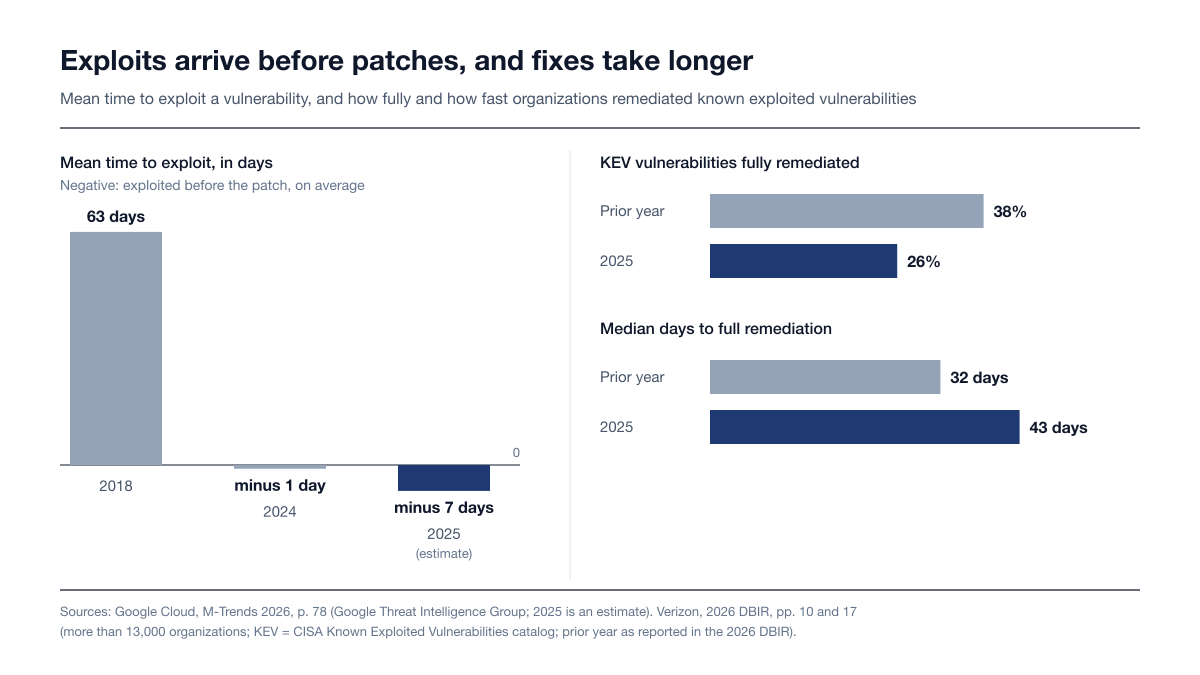
Figure 1: The exposure clock. Left, mean time to exploit, 2018, 2024 and 2025 (estimate); right, full remediation of KEV vulnerabilities and median days to full remediation, prior year and 2025. Sources: Google Cloud, M-Trends 2026 and Verizon, 2026 DBIR.
A finding that waits for next year's test, or a fix that waits six weeks, is one an attacker can reach first. The penetration testing trends of 2026 cover the wider shift; this guide turns it into a program.
What are the five stages of CTEM?
Gartner calls them steps; this guide calls them stages. The order matters, because each stage narrows what the next one has to handle.
1. Scoping: decide which part of the business you are protecting
What Gartner says. Step 1 is to "scope for cybersecurity exposure, first for external and SaaS threats." Scope reaches past a typical vulnerability program to corporate social media accounts, online code repositories and integrated supply chain systems, and Gartner suggests piloting CTEM on either the external attack surface or SaaS security posture (Gartner, 2023).
In practice. Start from business services, not subnets: the customer-facing web application, the payments flow, the identity provider, the CI/CD pipeline, the SaaS tenants holding customer data. Name an owner and the outcome you are protecting for each.
Evidence. A scope statement with services, owners, exposed attack surface and the reason each was chosen; the closest NIST control is RA-9 Criticality Analysis in NIST SP 800-53 Rev. 5.
Common failure. Scoping "everything", which produces a discovery backlog nobody can prioritize.
2. Discovery: find the assets and weaknesses inside that scope
What Gartner says. Step 2 is to "develop a discovery process for assets and their risk profiles," covering visible and hidden assets, vulnerabilities, misconfigurations and other risks. Gartner warns that confusing scoping with discovery is often the first failure in a CTEM program, and that volume of findings is not success in itself (Gartner, 2023).
In practice. Build the inventory from what you already own: cloud provider asset inventories, DNS and certificate records, the CMDB, identity provider app registrations, the scanner and code repository settings. Flag each asset as publicly exposed or not, using BOD 26-04's definition as the standard: an asset "accessible to unauthenticated or untrusted entities via public networks, such as the internet, regardless of its physical or logical location."
Evidence. An asset inventory with owners and exposure flags, plus scan results (NIST CM-8 and RA-5).
Common failure. Missing the devices scanners skip. M-Trends 2026 notes that edge and network appliances are often patched late and often left out of vulnerability management altogether, which lets attackers exploit known flaws in them again and again.
3. Prioritization: rank exposures by likelihood of exploitation and business impact
What Gartner says. Step 3 is to "prioritize the threats most likely to be exploited." The goal is not to fix every issue, and Gartner lists five factors: urgency, security, availability of compensating controls, tolerance for residual attack surface, and the level of risk to the organization (Gartner, 2023).
In practice. Rank each exposure on these signals, all but the last free and public:
KEV status: is it in CISA's KEV catalog?
Exploitation likelihood: FIRST's EPSS estimates, daily, the probability that a published CVE will be exploited in the wild in the next 30 days.
Automatable and technical impact: CISA's Vulnrichment program adds SSVC decision points (Exploitation, Automatable, Technical Impact) to CVE records.
Exposure and business criticality: from the discovery and scoping stages.
Evidence. A ranked exposure register with the reason for each rank (NIST RA-3).
Common failure. Ranking by CVSS alone, which puts a critical score on an internal test server above a medium-scored, known-exploited flaw on the login page.
4. Validation: prove what an attacker could actually do
What Gartner says. Step 4 is to "validate how attacks might work and how systems might react." Validation has three jobs: confirm that attackers could actually exploit a vulnerability, analyze the attack pathways to the asset, and check whether the response plan is fast and substantial enough. Business stakeholders must also agree on what triggers remediation (Gartner, 2023).
In practice. Validation is testing. A scanner reports that a weakness may exist; a test shows whether it can be exploited, what it chains with and what an attacker reaches. NIST draws the same line: penetration testing "goes beyond automated vulnerability scanning" and "can be used to validate vulnerabilities or determine the degree of penetration resistance of systems to adversaries" (SP 800-53 Rev. 5, CA-8), and red team exercises "extend the objectives of penetration testing" to the organization's ability to defend (CA-8(2)).
Evidence. Penetration test and red team reports with reproducible proof per finding, attack paths, controls that held, detection observations and retest results (NIST CA-8 and CA-8(2)).
Common failure. Treating a scan export as validation, or validating once a year while the application changes every week.
5. Mobilization: get the right teams to fix the validated exposures
What Gartner says. Step 5 is to "mobilize people and processes." You cannot wholly rely on automated remediation; the aim is to remove obstacles to approvals, implementation and mitigation, and in particular to document cross-team approval workflows (Gartner, 2023).
In practice. Every validated finding becomes a ticket in the engineering team's own system, with an owner, a deadline set by its priority tier and a retest that closes it. Exceptions get a named risk owner and an expiry date.
Evidence. Tickets, a plan of action and milestones, risk response decisions and passed retests (NIST CA-5, RA-7 and SI-2).
Common failure. Closing tickets on a developer's "fixed" without a retest.
CTEM stages at a glance
Stage | The question it answers | Who usually owns it | Evidence it produces | NIST SP 800-53 control that asks for it |
|---|---|---|---|---|
1. Scoping | Which business services and attack surfaces matter most? | CISO with business owners | Scope statement with owners and rationale | RA-9 Criticality Analysis |
2. Discovery | What assets and weaknesses exist inside that scope? | Security operations, IT, cloud teams | Asset inventory with exposure flag, scan results | CM-8 System Component Inventory, RA-5 Vulnerability Monitoring and Scanning |
3. Prioritization | Which exposures are most likely to be exploited, and which would hurt most? | Vulnerability or exposure management lead | Ranked exposure register with KEV, EPSS, SSVC and criticality | RA-3 Risk Assessment |
4. Validation | Can an attacker really exploit it, reach something valuable, and go undetected? | Penetration testers, red team, purple team | Test reports with reproducible proof, attack paths, detection observations | CA-8 Penetration Testing, CA-8(2) Red Team Exercises |
5. Mobilization | Who fixes it, by when, and how do we know it is fixed? | Engineering and IT owners, with security tracking | Tickets, plan of action and milestones, retest results, risk acceptances | CA-5 Plan of Action and Milestones, RA-7 Risk Response, SI-2 Flaw Remediation |
Table 1: The five CTEM stages, with stage names from Gartner and control references from NIST SP 800-53 Rev. 5, Release 5.2.0.
Where does penetration testing fit in CTEM?
Penetration testing, red teaming and continuous testing sit in the validation stage. In Stingrai's view, Gartner's three validation jobs map cleanly to testing types: exploitability is proven by a penetration test, attack pathways by chained testing and red teaming, and response readiness by red and purple team exercises. Scanning, threat intelligence and attack surface tools feed the stages before validation; retesting closes the stage after it.
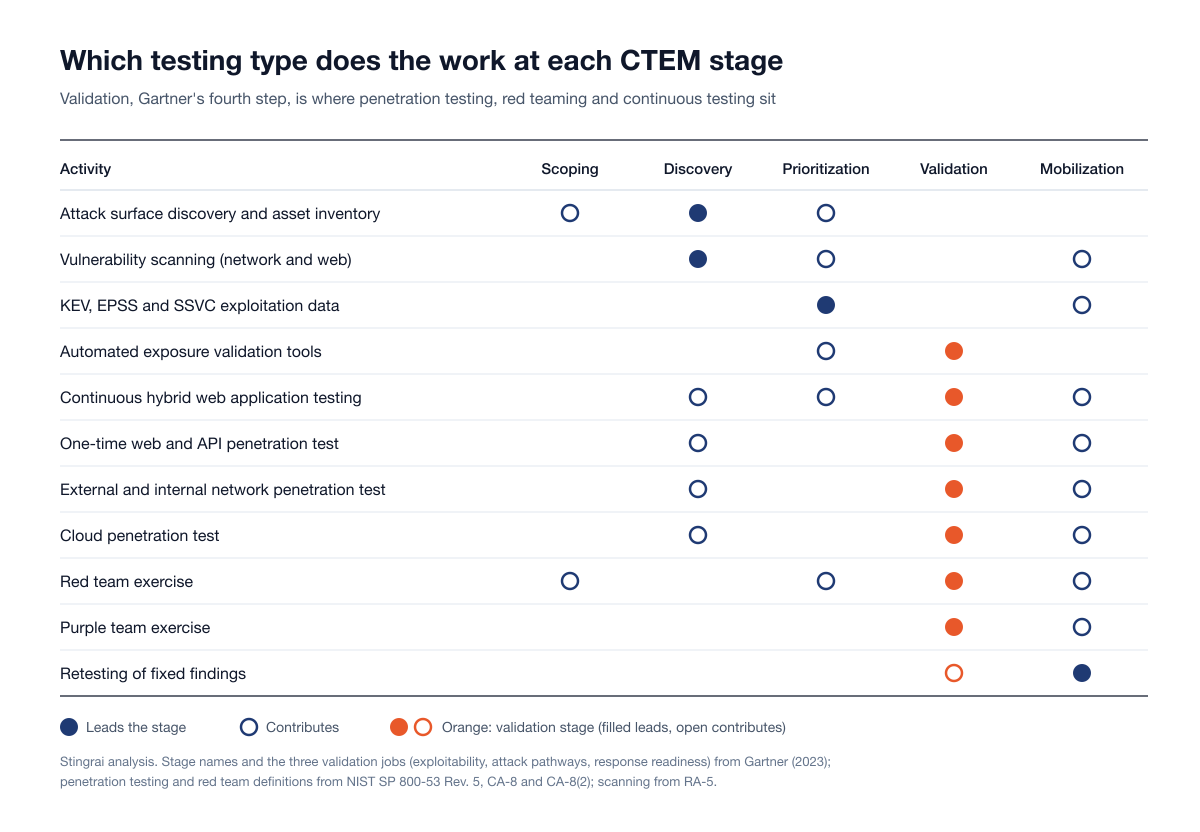
Figure 2: Which testing type does the work at each CTEM stage. Filled dots lead the stage; open circles contribute. Stingrai analysis, stage definitions from Gartner and test definitions from NIST SP 800-53 Rev. 5.
What should validation evidence look like for each asset class?
A validation result is only useful if mobilization can act on it and an auditor can rely on it. Require these outputs from whoever tests.
Internet-facing web applications and associated APIs. Findings reproduced in an authenticated session for each user role, with the request and response that proves impact, and the controls that held. Broken Access Control is A01 in the OWASP Top 10:2025, and it often arrives with ordinary feature work (a new role, endpoint or tenant setting) that generic scanner checks do not model.
External network perimeter. Confirmed exposed services, versions checked against KEV, and proof of what each gives an unauthenticated attacker.
Internal network and Active Directory. The attack path from a realistic start position to the crown jewels, each hop documented with the detections that did or did not fire.
Cloud control plane. Trust relationships and identity paths chained as an attacker would chain them, not a list of benchmark failures.
Detection and response. From red and purple team exercises: which techniques were detected, how long detection and containment took, and what changed. Gartner's May 2026 research summary says leaders also need to know "whether defenses hold" (Gartner, Strengthen CTEM With Threat-Informed Defense Effectiveness, 12 May 2026).
How often should validation run?
Cadence should follow how fast each asset changes and how exposed it is. The matrix below is Stingrai's recommended starting point, not a regulatory requirement; our guide to how often to do penetration testing lists each framework's own minimum.
Asset class | Validation method | Suggested cadence | Also validate when |
|---|---|---|---|
Internet-facing web applications and associated APIs that release often | Continuous hybrid testing (autonomous agent plus human penetration testers) | Monthly automated testing, quarterly human deep dive | A new role, tenant model, authentication flow or payment flow ships |
Stable or internal web applications | One-time web and API penetration test | Annually | A major release or re-platforming |
External network perimeter | External network penetration test | Annually, with discovery refreshed at least quarterly | A new service is exposed, or a KEV entry lands on an exposed product |
Internal network and Active Directory | Internal network and AD penetration test | Annually | Domain, trust or identity changes, mergers and acquisitions |
Cloud control plane | Cloud penetration test | Annually | New account structure, federation or identity model |
Detection and response | Red team, then purple team | Red team annually for mature programs; purple team after each red team | A new SOC platform or a major detection change |
Table 2: Stingrai's recommended validation cadence by asset class. The quarterly discovery refresh mirrors the cadence at which BOD 26-04 asks federal agencies to update and attest their publicly exposed IP addresses and domains.
Web applications get the most frequent validation because they change the most: a team that ships weekly changes its attack surface dozens of times between two annual tests. Continuous penetration testing explains how a monthly program runs.
How do you run CTEM without buying a platform?
A mid-market security team can run a credible first CTEM cycle with the inventory, ticketing and spreadsheets it already has, plus free public data and a testing partner. A platform pays off once assets and feeds outgrow manual correlation; it is not a prerequisite for starting. The 90-day sequence below is Stingrai's recommended starting plan, not a Gartner or CISA timeline.
Days 1 to 15: scope one pilot. Pick the external attack surface or SaaS security posture, as Gartner suggests. List its business services, an owner for each and the outcome you are protecting, and keep it small enough to validate inside 90 days.
Days 10 to 30: discover from what you already have. Pull asset lists from cloud providers, DNS and certificate records, the CMDB, the identity provider and your scanner, and flag each asset as publicly exposed or not. US government bodies and public and private critical infrastructure organizations can enroll in CISA's no-cost Cyber Hygiene services: vulnerability scanning of internet-accessible assets with weekly reports, and web application scanning with monthly reports.
Days 20 to 45: prioritize with free signals. Add KEV status, the EPSS probability and the Vulnrichment SSVC decision points to each exposure, and combine them with business criticality. Borrow BOD 26-04's logic for your tiers: publicly exposed, known exploited, automatable and total control at the top.
Days 30 to 75: validate the top tier. Commission continuous hybrid testing for the internet-facing web application that changes most, an external network penetration test for the perimeter, and a red team once the basics are in place. Agree with business owners beforehand which results trigger remediation.
Days 45 to 90: mobilize through existing tickets. Push every validated finding into the engineering backlog with an owner, a tier deadline and a retest. Document the approval workflow for cross-team fixes and keep an exceptions register with expiry dates.
Day 90 onward: report and re-scope. Report the three program metrics below, then widen scope to the next business service. The second cycle is faster because the inventory and workflow exist.
In Stingrai's experience, validation and large-scale discovery are the stages that most need specialist people; the rest is mostly process discipline.
How does mobilization turn validated findings into fixes?
Mobilization is often where programs stall, because the people who find exposures are rarely the people who fix them. Three practices keep it moving.
Write deadlines by tier, not by severity alone. A tier built from exposure, known exploitation, automation and impact gives engineering a reason for each deadline. As a benchmark only: BOD 26-04 gives federal agencies three days, plus a forensic triage of the asset, for the highest-risk combinations, and 131 of the 169 entries CISA added to KEV between 10 June and 18 November 2026 carry a three-day federal due date (Stingrai count of CISA's KEV feed). Our analysis of BOD 26-04 and retest windows translates it into a private-sector service level.
Close tickets on a retest, not on a commit. A finding is fixed when the same test that proved it now fails to reproduce it. Retest turnaround belongs in the testing contract, measured in days for the top tier.
Keep humans on the approvals. Gartner's mobilization guidance is explicit that automated remediation cannot carry the whole load. Use automation for the obvious, low-risk fixes and named owners for everything that changes how a system behaves.
Which metrics show a CTEM program is working?
Three measures tell leadership whether CTEM is reducing exposure, rather than producing activity. They are Stingrai's recommendation; pick definitions once and keep them stable.
Validation coverage. The share of in-scope, business-critical assets validated by a human-led or hybrid test within their cadence window from Table 2. A program that discovers and prioritizes but never validates is still vulnerability management.
Time to validate. Median days from an exposure entering the top tier of the register to a confirmed verdict: exploitable, not exploitable, or mitigated. This measures how quickly the program turns signals into facts.
Time to verified fix. Median days from a validated finding to a passed retest, reported by tier. For a benchmark, the Verizon 2026 DBIR puts the median time to full remediation of known exploited vulnerabilities at 43 days in 2025; a CTEM program should beat that comfortably for its top tier.
Report the three together. Coverage without speed, or speed without coverage, hides the gap attackers use.
Where does Stingrai fit in a CTEM program?
Stingrai is a global CREST-accredited penetration testing services company founded in Toronto, Canada in 2021, trusted by companies from startups to enterprises to meet audit requirements for SOC 2, ISO 27001, CMMC, PCI DSS and HIPAA. OSCE³, OSWE, OSEP, CREST CRT certified penetration testers, who are also world-class security researchers and bug bounty hunters. Choose from fully human-led or hybrid (AI agents plus human penetration testers) engagements across web, API, mobile, AI and LLM, cloud, network, Active Directory and social engineering penetration tests and red team engagements.
In a CTEM program, Stingrai delivers the validation stage and the retests that close mobilization, through one-time (annual) engagements and continuous programs.
Continuous Hybrid Pentest for internet-facing web applications
The asset class that changes fastest is where continuous validation earns its cost. In Stingrai's Hybrid Pentest, Snipe, Stingrai's autonomous agent for web applications and associated APIs, tests the full application while Stingrai's certified penetration testers test the same application manually alongside it and validate Snipe's findings, so coverage is wider and deeper. Snipe hunts complex classes such as IDOR, broken authorization and business logic flaws, and the testers bring the judgement that chains findings into attack paths.
Continuous: US$1,275 per month on a 12-month plan, for one web application and associated APIs, with monthly Snipe testing, human-verified, and a quarterly deep dive by Stingrai's penetration testers.
One-time: US$6,800 per assessment for the same scope, for applications that change rarely or for an annual test.
Evidence: every human-led and hybrid report ships with an attestation letter, the artifact that supports SOC 2, HIPAA, PCI DSS and similar audit programs.
The case for continuous is the data in this guide: exploitation an estimated seven days before patches on average, KEV additions up from 222 to 302 over the same 1 January to 18 November span, and Broken Access Control, a class that often ships with ordinary feature releases, at the top of the OWASP list. See the plans on Stingrai's pricing page, or compare continuous testing providers. More than one application is quoted through Get a Quote.
Red team and network testing for the rest of the validation stage
Red and purple teaming: assumed breach, black-box full chain and threat intelligence-led red team scenarios, on-premise and in the cloud, validate attack paths and response; purple teaming then works through real-world techniques with your SOC, answering Gartner's response-readiness question.
Network penetration testing: internal and external, with lateral movement, privilege escalation, segmentation testing and Active Directory attack paths. A network penetration test typically costs US$5,000 to US$40,000 and above, depending on hosts, sites, the Active Directory footprint and start positions.
Human-led web and API testing: fully human-led web application and API penetration testing when a regulator, customer or auditor asks for it.
Built for mobilization
Every finding, not only critical ones, is posted to Stingrai's PTaaS platform as it is confirmed, with a working proof of concept and prioritized remediation guidance, so fixing starts during the test. Jira and Slack integration puts findings in engineering's own workflow, testers are reachable by live chat, and retesting of remediated findings is included.
CREST accreditation
Stingrai is a proud CREST member. Stingrai Inc holds two CREST accreditations, Penetration Testing and AI-Enabled Penetration Testing, and the company certification CREST AI Charter (CREST Marketplace). Individual team members separately hold CREST CRT. Two named penetration testers are assigned to every human-led engagement, reviewed by the team lead and an engagement partner.
Frequently Asked Questions
What is CTEM?
CTEM, or continuous threat exposure management, is a security program defined by Gartner for continually evaluating the accessibility, exposure and exploitability of an organization's digital and physical assets. It runs in five stages: scoping, discovery, prioritization, validation and mobilization. Penetration testing, red teaming and continuous testing deliver the validation stage, and Stingrai provides that validation through one-time (annual) and continuous engagements.
What are the five stages of CTEM?
The five stages are scoping (decide which business services and attack surfaces matter), discovery (find the assets and weaknesses in that scope), prioritization (rank exposures by likelihood of exploitation and impact), validation (prove what an attacker could actually exploit and reach) and mobilization (get the owning teams to fix validated exposures, confirmed by a retest).
Is CTEM a product you can buy?
No. CTEM is a program you run. Tools support individual stages: attack surface tools for discovery, vulnerability and threat data for prioritization, automated exposure validation tools and penetration testing for validation, and ticketing for mobilization.
Where does penetration testing fit in CTEM?
Penetration testing sits in the validation stage, the fourth of five. Gartner gives validation three jobs: confirm exploitability, analyze attack pathways to the asset, and check whether the response plan is fast enough. A penetration test proves exploitability, chained testing and red teaming prove attack paths, and red and purple team exercises test detection and response.
What is the difference between CTEM and vulnerability management?
Vulnerability management finds and patches software flaws, usually by severity score. CTEM starts from business scope, treats misconfigurations, identities, SaaS settings and code repositories as exposures alongside CVEs, prioritizes by likelihood of exploitation, and validates before mobilizing teams to fix. Vulnerability management powers CTEM's discovery and prioritization stages.
What is adversarial exposure validation, and is it the same as penetration testing?
Gartner describes adversarial exposure validation (AEV) as validating threat exposure, security controls and defensive readiness against attack scenarios and techniques. AEV tools automate checks of known techniques and paths. Penetration testing, human-led or hybrid, finds and chains flaws specific to your environment, such as authorization and business logic flaws in your own web application. Both feed CTEM's validation stage.
How often should CTEM validation run?
Cadence should follow how fast each asset changes and how exposed it is. As a starting point, Stingrai recommends continuous testing for internet-facing web applications and associated APIs that release often (monthly automated testing with a quarterly human deep dive), annual testing for stable applications, networks and cloud, an annual red team for mature programs, and a test after any significant change.
What evidence does a CTEM program produce for auditors and the board?
Each stage produces its own artifact: a scope statement, an asset inventory with exposure flags, a ranked exposure register, penetration test and red team reports with reproducible proof, and tickets with retest results and risk acceptances. For the board, report validation coverage, time to validate and time to verified fix.
How much does continuous validation of a web application cost?
Stingrai's continuous Hybrid Pentest is US$1,275 per month on a 12-month plan for one web application and associated APIs, with monthly Snipe testing, human-verified, and a quarterly deep dive by Stingrai's penetration testers. The one-time Hybrid Pentest is US$6,800 per assessment for the same scope. Larger scopes and other services are quoted individually.
How does CISA BOD 26-04 relate to CTEM?
BOD 26-04, issued on 10 June 2026, sets federal remediation deadlines from four variables: public exposure, KEV status, whether exploitation can be automated, and technical impact. That is CTEM's prioritization logic applied to patching. It binds federal civilian agencies, not contractors unless their contract says so, but it is a useful model for private-sector priority tiers.
Related reading
AEV vs BAS vs PTaaS vs autonomous pentesting: a buyer's decoder
Continuous penetration testing: how it works and cost (2026)
Penetration testing as a service (PTaaS): models, costs and how to choose
References
Gartner. How to Manage Cybersecurity Threats, Not Episodes. 21 August 2023 (archived capture of Gartner's page, 10 January 2026). https://web.archive.org/web/20260110234446/https://www.gartner.com/en/articles/how-to-manage-cybersecurity-threats-not-episodes. The five CTEM steps.
Gartner. Gartner Identifies the Top Cybersecurity Trends for 2024. 22 February 2024. https://www.gartner.com/en/newsroom/press-releases/2024-02-22-gartner-identifies-top-cybersecurity-trends-for-2024. CTEM definition and forecast.
Gartner. Reference Architecture Brief: Exposure Management (abstract). 23 June 2025. https://www.gartner.com/en/documents/6630934.
Gartner. Key Differences Between CTEM and Vulnerability Management (abstract). 24 February 2026. https://www.gartner.com/en/documents/7499653.
Gartner. Strengthen CTEM With Threat-Informed Defense Effectiveness (abstract). 12 May 2026. https://www.gartner.com/en/documents/7844481.
Gartner. Market Guide for Adversarial Exposure Validation (abstract). 24 March 2026. https://www.gartner.com/en/documents/7630529.
Google Cloud (Mandiant). M-Trends 2026. March 2026. https://www.gstatic.com/security-marketing/m-trends-2026-en.pdf. Mean time to exploit (p. 78) and initial infection vectors (p. 11).
Verizon. 2026 Data Breach Investigations Report. 2026. https://www.verizon.com/business/resources/Td15/reports/2026-dbir-data-breach-investigations-report.pdf. Initial access vectors and KEV remediation; data window 1 November 2024 to 31 October 2025.
CISA. Known Exploited Vulnerabilities Catalog, version 2026.11.18. https://www.cisa.gov/known-exploited-vulnerabilities-catalog. Stingrai counts from CISA's JSON feed.
CISA. BOD 26-04: Prioritizing Security Updates Based on Risk. 10 June 2026. https://www.cisa.gov/news-events/directives/bod-26-04-prioritizing-security-updates-based-risk.
CISA. Vulnrichment. https://github.com/cisagov/vulnrichment. SSVC decision points for CVE records.
CISA. Cyber Hygiene Services. https://www.cisa.gov/cyber-hygiene-services.
FIRST. Exploit Prediction Scoring System (EPSS). https://www.first.org/epss/.
NIST. SP 800-53 Rev. 5, Release 5.2.0. 27 August 2025. https://csrc.nist.gov/pubs/sp/800/53/r5/upd1/final. Controls CA-5, CA-8, CA-8(2), CM-8, RA-3, RA-5, RA-7, RA-9 and SI-2.
OWASP. OWASP Top 10:2025. https://top10.owasp.org/2025/.
CREST. Stingrai Inc, CREST Marketplace. https://marketplace.crest.org/supplier/stingrai-inc/.
Talk to Stingrai
Building the validation stage of a CTEM program, or moving a fast-changing web application from annual to continuous testing? Get a Quote for your scope, or book a free discovery call to map your stages to the right tests.