The defining penetration testing trend of 2026 is speed: Google Cloud's M-Trends 2026 estimates that attackers exploited vulnerabilities an average of 7 days before a patch was released in 2025, and CISA's Binding Operational Directive 26-04 now gives US federal agencies as little as 3 days to fix the most dangerous known-exploited flaws. The other nine shifts follow from that one, from continuous testing of web applications and CREST-accredited AI-enabled testing to regulator-mandated threat-led red teaming and buyers who want proof that a fix worked.
This is a planning document, not a statistics roundup. Our penetration testing statistics for 2026 and our own State of Penetration Testing 2026 measure the market and what tests find; this post turns the 2026 evidence into ten decisions for a 2027 testing budget, citing regulators, standards bodies, CREST, M-Trends and the Verizon DBIR directly, all read on 20 November 2026.
Quick answer. The ten penetration testing trends of 2026 are: negative time to exploit with three-day remediation clocks; exploitation as the main way in, with edge devices a favourite target; AI speeding up attackers; AI-enabled testing becoming a CREST-accredited discipline; web applications that ship often outgrowing annual-only testing; APIs, LLM applications and AI agents entering scope; identity as the attack path; cloud breaches built on stolen tokens; regulator-mandated threat-led testing with purple teaming; and buyers demanding evidence of closure. For 2027, budget continuous testing for internet-facing web applications and associated APIs, change-triggered network and cloud tests, and threat-led red teaming where a regulator requires it. Stingrai, a CREST-accredited penetration testing company in Toronto, runs web application, network, cloud and red team engagements, including DORA and TIBER-style threat-led scenarios, as one-time or continuous engagements.
What are the 10 penetration testing trends of 2026?
# | Trend | Headline evidence | Plan for 2027 |
|---|---|---|---|
1 | Time to exploit went negative; remediation clocks shrank to days | Mean time to exploit an estimated minus 7 days in 2025; 131 of 169 KEV entries added since 10 June 2026 carry a 3-day deadline (M-Trends 2026; CISA KEV) | Retest turnaround per risk tier, in days for the top tier |
2 | Exploitation is the main way in, and edge devices are a favourite target | Exploitation is the top initial access vector, at 31% of breaches with a known vector, up from 20% (Verizon 2026 DBIR) | Retest the perimeter after every appliance change; inventory end-of-support devices |
3 | AI is speeding up attackers | The median threat actor researched or used AI assistance in 15 documented techniques (Verizon 2026 DBIR) | Cover known classes on every release; keep people on logic |
4 | AI-enabled testing became an accredited discipline | 69% of providers surveyed use AI in testing; AI-Enabled Penetration Testing accreditation opened 28 July 2026 (CREST) | Ask how AI is governed and who reproduces findings |
5 | Web applications that ship often have outgrown annual-only testing | PCI DSS 11.4: at least every 12 months and after any significant change (PCI SSC) | Continuous testing for applications that ship often |
6 | APIs, LLM applications and AI agents are in scope | 13 KEV entries for AI application software in 2026 to 18 November, against 1 a year earlier (CISA KEV) | Inventory LLM gateways and agent tools; test their permissions |
7 | Identity is the attack path | Voice phishing rose to 11% of intrusions, the second most common initial vector (M-Trends 2026) | Test help desk resets, MFA recovery and directory paths |
8 | Cloud breaches run on tokens and non-human identities | Exploits were 6% of cloud compromises; data theft occurred in 59% (M-Trends 2026) | Test IAM, OAuth grants and SaaS integrations after identity changes |
9 | Regulators mandate threat-led testing with purple teaming | DORA TLPT at least every 3 years, with at least 12 weeks of active red teaming and a purple team exercise (DORA; RTS 2025/1190) | Budget threat-led tests as multi-month programs |
10 | Buyers want evidence of closure | Only 26% of known-exploited vulnerabilities were fully remediated, down from 38% (Verizon 2026 DBIR) | Contract retest SLAs, named testers and accreditation |
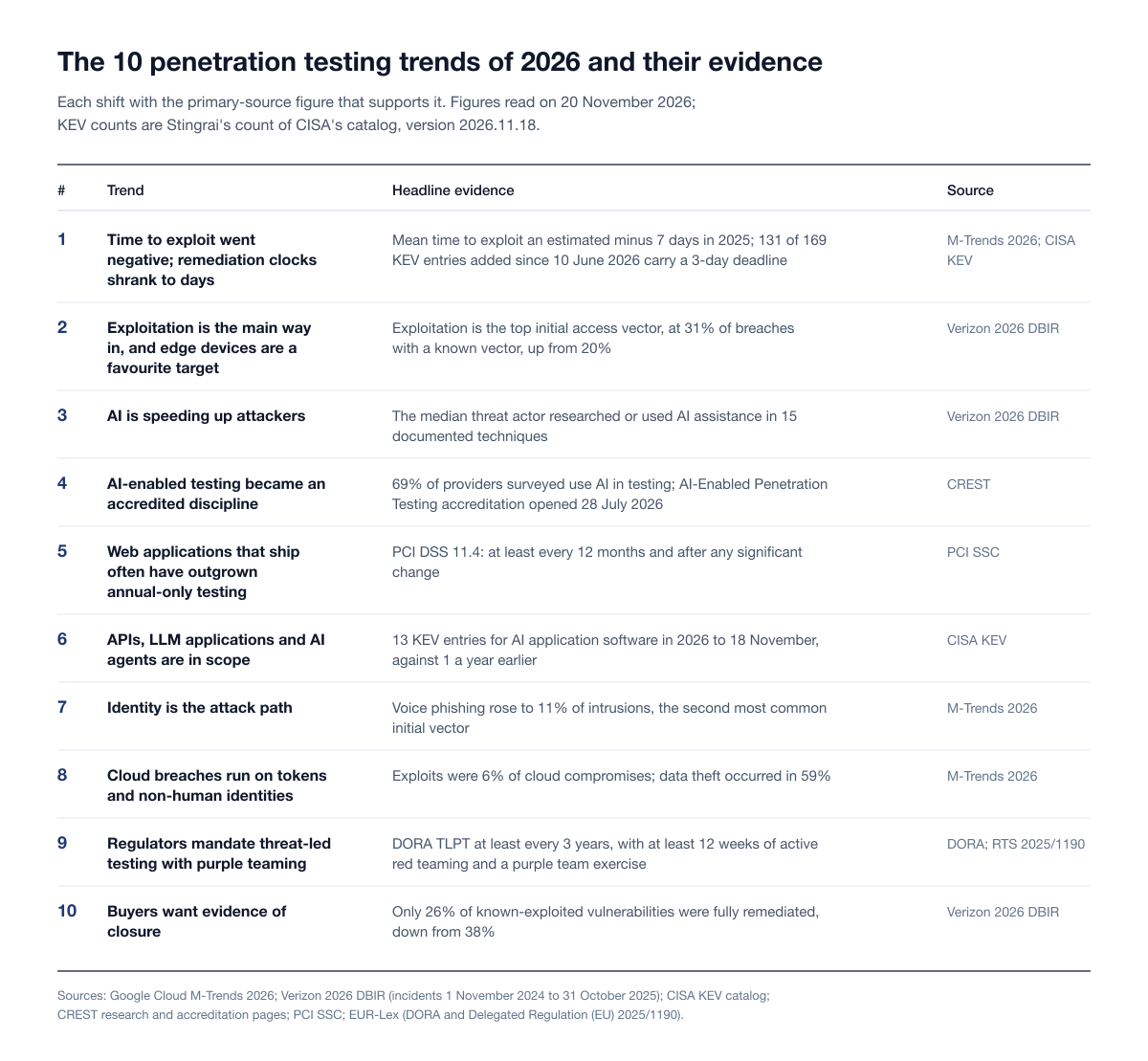
Figure 1: The ten penetration testing trends of 2026, with the headline evidence for each. Sources: Google Cloud M-Trends 2026, Verizon 2026 DBIR, CISA KEV, CREST, PCI SSC and EUR-Lex.
1. Time to exploit went negative, and remediation clocks shrank to days
The evidence. The mean time to exploit reported in M-Trends 2026 fell from 63 days in 2018 to minus 1 day in 2024 and an estimated minus 7 days in 2025, meaning exploitation, on average, occurred before a patch was released. Hand-offs between attackers sped up too: the median time from initial access to hand-off to a second threat group fell from more than 8 hours in 2022 to 22 seconds in 2025.
Known exploitation is also rising. CISA added 302 vulnerabilities to its Known Exploited Vulnerabilities (KEV) catalog between 1 January and 18 November 2026, against 222 in the same period of 2025, a 36% increase, and more than in any full year since 2023 (187 in 2023, 186 in 2024 and 245 in 2025, counted from CISA's JSON feed, catalog version 2026.11.18).
Then the deadlines changed. On 10 June 2026 CISA issued BOD 26-04, revoking BOD 22-01 and BOD 19-02. Four questions now set a federal agency's remediation window: is the asset publicly exposed, is the CVE in KEV, is exploitation automatable, and does it give partial or total control. The answers produce 3 days, 14 days, 60 days or the next system upgrade, and the worst combinations require "3 days & forensic triage". The directive warns that attackers' "use of AI may further narrow the time defenders have to react between patch release and possible exploitation."
The catalog shows the effect. Of the 169 entries added from 10 June to 18 November 2026, 131 (78%) carry a 3-day deadline and 38 carry 14 days; from 1 January to 9 June only 31 of 133 (23%) carried 3 days, and in 2025, 226 of 245 carried 21 days. Organizations are moving the other way: the Verizon 2026 DBIR found only 26% of KEV vulnerabilities fully remediated in its 2025 data, down from 38%, with the median time to full remediation up to 43 days from 32.
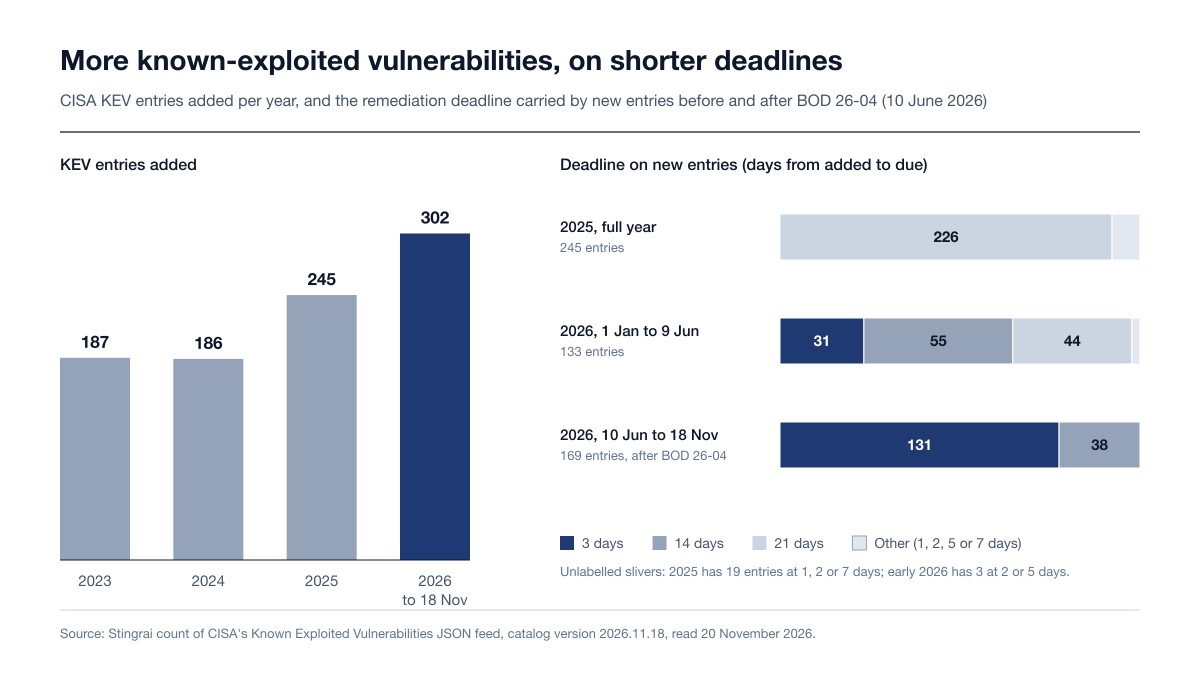
Figure 2: KEV entries added per year (2026 to 18 November) and the deadline on new entries before and after BOD 26-04. Stingrai count of CISA's KEV JSON feed, catalog version 2026.11.18. Source: CISA Known Exploited Vulnerabilities catalog.
What it means for buyers. A penetration test report is evidence about one date, and for internet-facing systems that date now ages in days. BOD 26-04 binds federal civilian agencies, not private firms, but it is a useful benchmark for private commitments (what BOD 26-04 means for retest windows), and a 30-day retest commitment cannot evidence a 3-day remediation promise.
What to do in 2027. Replace severity-only SLAs with the four BOD 26-04 inputs and set retest turnaround per tier, in days for internet-facing, known-exploited, total-control findings. Order the queue with KEV and FIRST's EPSS, which estimates the probability that a published CVE will be exploited in the wild in the next 30 days.
2. Exploitation is the main way in, and edge devices are a favourite target
The evidence. Exploitation of vulnerabilities is now the most common initial access vector in the Verizon 2026 DBIR, at 31% of breaches with a known vector, up from 20%; the report analysed more than 22,000 confirmed breaches between 1 November 2024 and 31 October 2025. Credential abuse, the previous leader, fell to 13%, partly because Verizon began tracking pretexting separately. Mandiant agrees: exploits were the most common initial infection vector for the sixth year running, at 32% of intrusions (M-Trends 2026).
Where those exploits land is the trend. M-Trends 2026 describes the "systematic exploitation of edge and core network devices", appliances that cannot run enterprise security tooling and "can often be excluded from vulnerability management altogether"; one cluster exploited two zero-days in the same VPN product within three months. The KEV catalog shows it by product: from 1 January to 18 November 2026 CISA added six Citrix NetScaler entries (three in the same period of 2025), nine Cisco Catalyst SD-WAN entries (none) and three Ivanti Connect Secure entries (two). BOD 26-02, issued 5 February 2026, now requires federal agencies to inventory the end-of-support devices on CISA's list within 3 months and all end-of-support edge devices within 12, decommission them within 12 to 18 months and run continuous edge discovery within 24 months.
What it means for buyers. An external test scoped to "the website and a few IP addresses" misses the appliances attackers use. An end-of-support device may also carry no new CVE, so a scanner keyed on CVE matches can report it clean, and M-Trends warns that dwell times near 400 days for one backdoor family leave standard 90-day log retention blind.
What to do in 2027. Test the external perimeter at least annually and after every new appliance, firmware upgrade or exposed management interface, and make the edge inventory with end-of-support dates a deliverable. Our external network testing scope guide shows where these devices hide; Stingrai's internal and external network penetration testing typically costs US$5,000 to US$40,000 and above, depending on scope.
3. AI is speeding up attackers more than it is inventing new attacks
The evidence. The Verizon 2026 DBIR analysed Anthropic data on 793 threat actors from March 2025 to February 2026. The median actor researched or used AI assistance in 15 documented attack techniques, some as many as 40 or 50, yet less than 2.5% of AI-assisted malware observations involved less common techniques. Verizon's conclusion: AI "is primarily accelerating the operationalization of well-known, documented techniques."
M-Trends 2026 saw AI inside intrusions: malware families that query large language models mid-execution, and a credential stealer that checks victims' machines for local AI command-line tools to hunt configuration files. It also says "we do not consider 2025 to be the year where breaches were the direct result of AI." Disclosure volume keeps climbing: NIST reports CVE submissions up 263% between 2020 and 2025, with the first quarter of 2026 nearly one third above a year earlier.
What it means for buyers. The 2026 evidence describes known techniques arriving faster, in greater volume and in less skilled hands, not a new class of attack that testing cannot see. Coverage of known vulnerability classes becomes a frequency problem: a flaw a test could have caught in March is exploitable in April if nobody looks again.
What to do in 2027. Run automated coverage of known classes against every significant release, keep human testing for the authorization, logic and chained findings automation does not model, and add developer AI tooling and its configuration secrets to internal test scope. Our analysis of the November 2026 outages and vulnerability surge sets this autumn's disclosure volumes against what was actually exploited.
4. AI-enabled testing became an accredited discipline, with people accountable
The evidence. CREST's 2026 research with 62 providers in 19 countries found that 69% use AI in penetration testing workflows, 76% increased that use over the past year and 85% expect clients to ask about it. It called the model "human-led and AI-supported" and named the work of checking, reproducing and evidencing AI output as a constraint.
CREST then built assurance around it. It published the CREST AI Charter, a voluntary commitment to responsible AI use. On 28 July 2026 it opened applications for accreditation of AI use in testing, built on a Responsible AI Use domain in its company requirements and Annex B, AI-Enabled Penetration Testing, in its Penetration Testing standard. On 3 September 2026 it announced the first ten companies accredited. Its financial services hub now advises buyers to "look for CREST members that have signed our AI Charter and attained AI specific supplements."
What it means for buyers. "AI-powered pentest" is no longer a claim to take on trust: there is an independent benchmark for how a provider governs AI, validates its output and keeps a person accountable for each finding. We compare the tools in best AI pentesting tools for 2026.
What to do in 2027. Ask every provider which AI systems touch your data, where that data is processed, which named person reproduces a finding before you see it, and which CREST accreditations it holds, and check the last answer on marketplace.crest.org.
5. Web applications that ship often have outgrown annual-only testing
The evidence. The standards already ask for more than an annual test. PCI DSS requirements 11.4.2 and 11.4.3 require internal and external testing "at least once every 12 months" and "after any significant infrastructure or application upgrade or change", and 11.4.4 requires that "penetration testing is repeated to verify the corrections" (PCI SSC; v4.0.1 added or deleted no requirements). DORA Article 24(6) requires tests of all ICT systems and applications supporting critical or important functions "at least yearly", and Article 25(2) requires central securities depositories and central counterparties to run vulnerability assessments before any deployment or redeployment.
For a product that ships every week, "after any significant change" comes round many times a year, and the findings are serious. In one firm's data, across 55 Stingrai penetration tests between October 2024 and August 2026, 51 (92.7%) surfaced at least one High or Critical finding, 70% of the 40 web application tests with findings surfaced a High or Critical authentication or authorization flaw, and fixes, where tracked, took a median of 26 days (State of Penetration Testing 2026). Set that against a mean time to exploit of minus 7 days.
What it means for buyers. An annual test checks one version of an application. Authorization flaws, Broken Access Control at the top of the OWASP Top 10:2025, arrive with ordinary feature work such as a new role, endpoint or tenant setting. They have no scanner signature, so they need a tester who knows what the application should allow, after each change.
What to do in 2027. For internet-facing web applications and associated APIs that release often, move from an annual engagement to a continuous program with periodic human deep dives, and keep annual tests for stable systems. Stingrai's continuous Hybrid Pentest is built for this. Snipe, Stingrai's autonomous agent for web applications and associated APIs, tests the full application while Stingrai's certified penetration testers test the same application manually alongside it and validate Snipe's findings, so coverage is wider and deeper. The continuous plan is US$1,275 per month on a 12-month plan, for one web application and associated APIs, with monthly Snipe testing, human-verified, and a quarterly deep dive by Stingrai's penetration testers; the one-time Hybrid Pentest is US$6,800 per assessment for the same scope. Every human-led and hybrid report ships with an attestation letter. See Stingrai's pricing, or compare models in our guides to continuous penetration testing and continuous testing providers.
6. APIs, LLM applications and AI agents are now in scope
The evidence. AI application software is now part of the known-exploited attack surface. From 1 January to 18 November 2026, CISA added 13 KEV entries for it: five for Langflow, four for LiteLLM and one each for MLflow, Ray, n8n and GPUStack. In the same period of 2025 there was one, and in 2024 none. These LLM gateways, agent and workflow builders and machine learning platforms can be internet-facing and usually hold credentials for the model providers and systems they connect to.
OWASP maps the application-layer risks. The OWASP Top 10 for LLM Applications 2025 opens with LLM01:2025 Prompt Injection and includes LLM06:2025 Excessive Agency. The OWASP Top 10 for Agentic Applications for 2026, published 9 December 2025 with input from more than 100 researchers and practitioners, adds risks such as tool misuse and exploitation, and identity and privilege abuse. Underneath sit APIs, where the OWASP API Security Top 10 2023 still opens with API1:2023 Broken Object Level Authorization.
What it means for buyers. An LLM feature is a web application with a new kind of input and often new permissions. Prompt injection matters most when the model can call a tool or read another user's data, which makes it an authorization question as much as a model question.
What to do in 2027. Inventory LLM gateways, agent frameworks, MCP servers and ML platforms, and put the internet-facing ones in external scope. Test each LLM feature against the OWASP LLM and agentic lists before launch and after changes to its tools, data sources or permissions. Our guides to AI red teaming for LLM and agentic applications and API security assessments cover scoping, and Stingrai's AI and LLM penetration testing covers applications, agents and their infrastructure.
7. Identity is the attack path, and attackers phone the help desk
The evidence. M-Trends 2026 found that highly interactive voice phishing rose to 11% of intrusions in 2025, the second most common initial infection vector, while email phishing fell to 6%. Prior compromise ranked third at 10% and led ransomware operations at 30%, while stolen credentials as the starting point fell to 9% from 16%, so the shift is toward social engineering of identity processes rather than simple credential reuse. In the Verizon 2026 DBIR, the use of stolen credentials appears in 36% of breaches.
Regulator-run red teams agree. The Bank of England's 2025 CBEST thematic, drawn from 13 CBEST assessments in 2025, recorded 469 successful attacker tactics and found that firms without strong identity and access management, or with weak passwords or credentials stored in unprotected places, were more likely to have user identities compromised. CISA's Scattered Spider advisory, revised 29 July 2025, describes actors who "convince IT helpdesk personnel to reset passwords and/or MFA tokens" and abuse MFA fatigue, and recommends phishing-resistant MFA for all services to the extent possible.
What it means for buyers. The login page is not the identity attack surface. The help desk script, MFA re-enrolment, account recovery and the directory's privilege model are, and many test scopes leave them out.
What to do in 2027. Put help desk verification and voice phishing into social engineering scope, test Active Directory and Entra ID attack paths from a standard user, and confirm phishing-resistant MFA is enforced where policy says it is. Our SAML, OIDC and SCIM scope guide covers federated identity, and Stingrai's social engineering testing covers vishing and help desk scenarios.
8. Cloud and SaaS breaches run on tokens and non-human identities
The evidence. In Mandiant's 2025 cloud compromise investigations, exploits were the least common initial vector at 6%. Voice phishing led at 23%, followed by third-party compromise (17%), stolen credentials (16%), email phishing (15%) and insider threat (14%), and data theft occurred in 59% of cases (M-Trends 2026). The report describes attackers bypassing firewalls and MFA "by abusing Non-Human Identities (NHIs) and stolen secrets such as OAuth and refresh tokens", and warns about "unmonitored OAuth grants and broad API permissions." The Verizon 2026 DBIR found third-party involvement in 48% of breaches, up 60%, and only 23% of third-party organizations fully remediated missing or improperly secured MFA on their cloud accounts.
What it means for buyers. A cloud test that mainly hunts exploitable vulnerabilities is looking at the 6%. The 2026 attack paths run through role trust, service principals, OAuth consent, long-lived tokens and the SaaS integrations that hold them.
What to do in 2027. Test cloud identity and configuration at least annually and after any major IAM change, new tenant or new SaaS integration, and test what one stolen integration token can reach. Our guides to AWS security assessments and Azure penetration testing list the test cases, and Stingrai's cloud penetration testing covers AWS, Azure and Entra ID, and Google Cloud.
9. Regulators mandate threat-led testing, and purple teaming comes with it
The evidence. Under DORA Article 26(1), financial entities identified by their authorities must carry out threat-led penetration testing (TLPT) "at least every 3 years". Delegated Regulation (EU) 2025/1190, published on 18 June 2025 and in force from 8 July 2025, sets the shape: an active red team phase of at least 12 weeks (Article 11), a red team report within 4 weeks of its end, a blue team report and a replay of attacker and defender actions no later than 10 weeks after it, and a purple teaming exercise, run by the control team, on topics the blue team and testers identify together (Article 12). The ECB updated TIBER-EU on 11 February 2025 to match, specifying "purple-teaming as mandatory under TIBER-EU", and the TIBER-EU framework adds that the purple teaming exercise "must take place within ten weeks after the end of the active testing".
In Canada, OSFI's I-CRT framework covers systemically important banks and internationally active insurance groups on a three-year supervisory cycle, published as an advisory implementation guide. The Bank of England drew its 2025 findings from 13 CBEST assessments, and CREST published threat-led penetration testing guidance for financial services on 12 June 2026.
What it means for buyers. For a designated entity, threat-led testing is a multi-month program with fixed deliverables and deadlines, and the purple team session is part of the regulated test, so it belongs in the budget from day one. The structure works outside regulation too, because a replayed, jointly reviewed red team gives the board and the security operations team findings both can act on.
What to do in 2027. Confirm whether you are designated for TLPT, I-CRT or CBEST and plan the threat intelligence, control team and closure timeline before procurement. Outside regulation, run an intelligence-led red team every one or two years and book the purple team replay with it. Our guides to DORA threat-led penetration testing, OSFI I-CRT and red, blue and purple team roles cover the detail, and Stingrai's red teaming and purple teaming run DORA and TIBER-style scenarios.
10. Buyers want evidence of closure, not just a report
The evidence. The rules increasingly ask for proof that fixes worked. PCI DSS 11.4.4 requires repeated testing to verify corrections (PCI SSC). DORA Article 24(5) requires "internal validation methodologies to ascertain that all identified weaknesses, deficiencies or gaps are fully addressed" (EUR-Lex). BOD 26-04 adds a forensic triage of the asset to its top tier, to assess whether the system is compromised (CISA). The gap is real: even the best organizations fix 30% to 40% of KEV instances in the first week after detection (Verizon 2026 DBIR).
What it means for buyers. The deliverable an auditor, a customer's security reviewer or a regulator values is the closed finding: reproduced, fixed, retested and dated. A report without retest evidence documents exposure; it does not show the exposure ended.
What to do in 2027. Write five things into each statement of work: retest turnaround per risk tier, the evidence format for each retest, named testers and the team's certifications, the provider's accreditation as listed on the CREST Marketplace, and disclosure of any AI used on your data. Our sample penetration testing report shows what retest evidence looks like.
How should you plan a 2027 penetration testing budget?
The ten trends point to a budget organized by how fast each part of the estate changes and how it is attacked, rather than one annual test of everything. The cadences below are Stingrai's suggested baseline, not a regulatory requirement; your regulator's rules come first.
Testing line | Suggested 2027 cadence | Test again when | Trends |
|---|---|---|---|
Internet-facing web applications and associated APIs | Continuous for applications that ship often (monthly automated testing, human-verified, plus quarterly human deep dives); annual for stable ones | A release changes authentication, roles, payments or integrations | 1, 3, 5, 10 |
LLM features, AI agents and MCP servers | Before launch, then after changes | A new tool, data source or model provider is connected | 6 |
External network and edge devices | At least annual | A new appliance, firmware upgrade, exposed interface or end-of-support date | 1, 2 |
Internal network and Active Directory | Annual | A merger, directory restructure or new trust | 7 |
Cloud and SaaS identity | Annual | A new tenant, OAuth integration or federation | 8 |
Social engineering, including voice phishing | Annual | Help desk or MFA process changes | 7 |
Red team, threat-led and purple team | As your regulator requires (DORA: at least every 3 years); otherwise every one or two years | A major incident, a regulator request or a new threat profile | 9 |
Where Stingrai fits
Stingrai is a global CREST-accredited penetration testing services company founded in Toronto, Canada in 2021, trusted by companies from startups to enterprises to meet audit requirements for SOC 2, ISO 27001, CMMC, PCI DSS and HIPAA. OSCE³, OSWE, OSEP, CREST CRT certified penetration testers, who are also world-class security researchers and bug bounty hunters. Choose from fully human-led or hybrid (AI agents plus human penetration testers) engagements across web, API, mobile, AI and LLM, cloud, network, Active Directory and social engineering penetration tests and red team engagements.
We are proud CREST members. Stingrai Inc holds two CREST accreditations, Penetration Testing and AI-Enabled Penetration Testing, and the company certification CREST AI Charter, all listed on the CREST Marketplace; team members separately hold the individual CREST CRT certification. For fast-changing web applications, the Hybrid Pentest described in trend 5 is US$1,275 per month on a 12-month plan, or US$6,800 per assessment one-time, for one web application and associated APIs. Network, cloud, Active Directory, social engineering and red team work is quoted per engagement, as one-time (annual) tests or continuous programs, with findings posted to the PTaaS portal as they are confirmed and retesting included. The testing supports compliance programs such as SOC 2, PCI DSS, DORA and OSFI B-13 and produces evidence for audits.
What these trends do not mean
Annual tests are not obsolete. PCI DSS still sets a 12-month minimum and DORA a yearly one, and a stable internal system is well served by an annual test plus change triggers. Continuous testing earns its cost where code changes often and faces the internet.
AI has not replaced the penetration tester. CREST describes the industry model as human-led and AI-supported, and Mandiant does not consider 2025 the year breaches were the direct result of AI. Automation widens coverage of known classes; people find the authorization and logic flaws.
More CVEs do not mean proportionally more risk. CVE and KEV totals measure disclosure and confirmed exploitation, not your exposure. With remediation capacity limited (trend 10), choosing the right fixes matters most, and testing for exposure, exploitability and impact is how you choose.
How this analysis was built
A shift was included only where at least two primary sources supported it. All sources in the references were read on 20 November 2026; M-Trends 2026 covers Mandiant investigations in 2025, the Verizon 2026 DBIR covers incidents from 1 November 2024 to 31 October 2025, and KEV counts come from CISA's JSON feed, catalog version 2026.11.18. Stingrai's own figures are one firm's internal data from 55 penetration tests. Figures that could not be traced to a primary source were dropped rather than estimated.
Frequently Asked Questions
What are the biggest penetration testing trends in 2026?
The biggest penetration testing trends in 2026 are faster exploitation with shorter remediation clocks, exploitation as the main way in with edge devices a favourite target, AI-assisted attackers, CREST-accredited AI-enabled testing, web applications that ship often outgrowing annual-only testing, LLM applications and APIs in scope, identity-led attacks, token-based cloud breaches, regulator-mandated threat-led testing and buyers demanding retest evidence. The headline number comes from Google Cloud's M-Trends 2026: attackers exploited vulnerabilities an estimated 7 days before a patch was released in 2025, on average.
What are the latest developments in penetration testing?
Three stand out. CISA's BOD 26-04, issued 10 June 2026, put the most dangerous known-exploited vulnerabilities on a 3-day federal remediation clock. CREST opened applications for AI-Enabled Penetration Testing accreditation on 28 July 2026 and named its first ten accredited companies on 3 September 2026. And the EU's TLPT standard, Delegated Regulation (EU) 2025/1190, in force since 8 July 2025, requires at least 12 weeks of active red teaming and a closing purple team exercise in every threat-led test.
Is AI replacing penetration testers?
No. CREST's 2026 research found that 69% of the 62 providers it surveyed use AI in penetration testing workflows, but the model remains human-led and AI-supported, with validating AI output a key constraint. The Verizon 2026 DBIR found attackers use AI mainly to speed up well-known techniques. The practical result is hybrid testing: autonomous agents widen coverage, and accountable penetration testers validate, chain and report the findings.
How often should you run a penetration test in 2027?
At least once every 12 months and after any significant infrastructure or application change, the PCI DSS 11.4 baseline. For internet-facing web applications that release often, a continuous program with periodic human deep dives fits the 2026 evidence better, because the mean time to exploit is now negative. Financial entities designated under DORA also need threat-led testing at least every 3 years.
What does continuous penetration testing cost?
It depends on provider and scope. Stingrai's continuous Hybrid Pentest is US$1,275 per month on a 12-month plan for one web application and associated APIs, with monthly Snipe testing, human-verified, and a quarterly deep dive by Stingrai's penetration testers. A one-time Hybrid Pentest of the same scope is US$6,800 per assessment. Larger scopes are quoted through Stingrai's Get a Quote form.
How fast are attackers exploiting vulnerabilities in 2026?
Faster than patches ship. Google Cloud's M-Trends 2026 estimates a mean time to exploit of minus 7 days for 2025, down from 63 days in 2018, meaning exploitation on average occurred before a patch was released. CISA added 302 vulnerabilities to its Known Exploited Vulnerabilities catalog between 1 January and 18 November 2026, 36% more than in the same period of 2025.
Does CISA BOD 26-04 apply to private companies?
Not directly. BOD 26-04 binds US federal civilian executive branch agencies and applies to contractors only where the procurement contract directs it, though agencies must review all contracts for the changes needed to comply. Its 3-day and 14-day tiers are a useful benchmark for private remediation and retest commitments.
What is threat-led penetration testing, and who has to do it?
Threat-led penetration testing is an intelligence-led red team exercise against live production systems that support critical functions, run under regulator oversight. Under DORA, financial entities identified by their authorities must perform it at least every 3 years, following Delegated Regulation (EU) 2025/1190. In Canada, OSFI's I-CRT framework covers systemically important banks and internationally active insurance groups on a three-year cycle, and in the UK the Bank of England runs CBEST.
What is the CREST AI-Enabled Penetration Testing accreditation?
It is a CREST accreditation that independently assesses how a penetration testing provider uses AI in its service, built on a Responsible AI Use domain in CREST's company requirements and Annex B of its Penetration Testing standard. CREST opened applications on 28 July 2026 and announced the first ten accredited companies on 3 September 2026. Stingrai Inc holds it alongside CREST's Penetration Testing accreditation and the CREST AI Charter company certification.
Should LLM applications and AI agents be penetration tested?
Yes. CISA added 13 entries for AI application software, including LLM gateways and agent builders, to its Known Exploited Vulnerabilities catalog between 1 January and 18 November 2026, against one in the same period of 2025. The OWASP Top 10 for LLM Applications 2025 and the OWASP Top 10 for Agentic Applications for 2026 provide the test cases, starting with prompt injection, excessive agency and tool misuse.
Related reading
Penetration Testing Statistics 2026 and The State of Penetration Testing 2026
Continuous Penetration Testing: How It Works and Cost (2026) and Best Continuous Penetration Testing Providers and PTaaS Platforms (2026)
Penetration Testing as a Service (PTaaS): Models, Costs and How to Choose (2026)
The 72-Hour Clock: CISA Revoked BOD 22-01 and November 2026 Outages: Were They Cyberattacks?
Best AI Pentesting Tools 2026 and Red Team vs Blue Team vs Purple Team (2026)
CTEM in 2026: 5 Stages of Continuous Threat Exposure Management and Where Pentesting Fits
References
Google Cloud (Mandiant). M-Trends 2026. 23 March 2026. https://www.gstatic.com/security-marketing/m-trends-2026-en.pdf. Mandiant incident investigations in 2025; summary at cloud.google.com.
Verizon. 2026 Data Breach Investigations Report. 2026. https://www.verizon.com/business/resources/Td15/reports/2026-dbir-data-breach-investigations-report.pdf. More than 22,000 confirmed breaches, 1 November 2024 to 31 October 2025.
CISA. Known Exploited Vulnerabilities Catalog. Version 2026.11.18. https://www.cisa.gov/known-exploited-vulnerabilities-catalog. Counted by Stingrai from the JSON feed on 20 November 2026.
CISA. BOD 26-04: Prioritizing Security Updates Based on Risk. 10 June 2026. https://www.cisa.gov/news-events/directives/bod-26-04-prioritizing-security-updates-based-risk. Risk-tiered remediation timelines.
CISA. BOD 26-02: Mitigating Risk From End-of-Support Edge Devices. 5 February 2026. https://www.cisa.gov/news-events/directives/bod-26-02-mitigating-risk-end-support-edge-devices. Edge device inventory and decommissioning.
CISA. Scattered Spider (AA23-320A). Revised 29 July 2025. https://www.cisa.gov/news-events/cybersecurity-advisories/aa23-320a. Help desk social engineering and MFA guidance.
NIST. NIST Updates NVD Operations to Address Record CVE Growth. 15 April 2026. https://www.nist.gov/news-events/news/2026/04/nist-updates-nvd-operations-address-record-cve-growth. CVE submission growth.
FIRST. Exploit Prediction Scoring System (EPSS). https://www.first.org/epss/. Probability of exploitation in the next 30 days.
PCI Security Standards Council. SAQ D for Merchants, PCI DSS v4.0. April 2022. https://listings.pcisecuritystandards.org/documents/PCI-DSS-v4-0-SAQ-D-Merchant.pdf. Requirement 11.4 text; v4.0.1 added or deleted no requirements (11 June 2024).
European Union. Regulation (EU) 2022/2554 (DORA). 14 December 2022. https://eur-lex.europa.eu/eli/reg/2022/2554/oj/eng. Articles 24 to 26.
European Commission. Delegated Regulation (EU) 2025/1190. 13 February 2025, published 18 June 2025, in force 8 July 2025. https://eur-lex.europa.eu/eli/reg_del/2025/1190/oj/eng. Regulatory technical standards on TLPT.
European Central Bank. TIBER-EU Framework updated to align with DORA. 11 February 2025. https://www.ecb.europa.eu/press/intro/news/html/ecb.mipnews250211.en.html. Mandatory purple teaming; framework document: TIBER-EU Framework (February 2025), purple teaming within ten weeks of the end of active testing.
OSFI. Intelligence-led Cyber Resilience Testing (I-CRT) Framework. 1 April 2023. https://www.osfi-bsif.gc.ca/en/guidance/guidance-library/osfis-intelligence-led-cyber-resilience-testing-crt-framework. Scope and cadence.
Bank of England. 2025 CBEST thematic. Updated 20 January 2026. https://www.bankofengland.co.uk/financial-stability/operational-resilience-of-the-financial-sector/2025-cbest-thematic. Findings from 13 CBEST assessments.
OWASP. Top 10 for LLM Applications 2025, Top 10 for Agentic Applications for 2026 (9 December 2025), API Security Top 10 2023 and Top 10:2025. genai.owasp.org/llm-top-10; agentic list; API list; top10.owasp.org/2025.
CREST. CREST Research: How AI is Changing Penetration Testing. 15 May 2026. https://www.crest-approved.org/crest-research-how-ai-is-changing-penetration-testing/. 62 providers in 19 countries.
CREST. AI accreditation launch. 28 July 2026. https://www.crest-approved.org/crest-launches-new-ai-accreditation/. With the AI Charter and the first accredited cohort (3 September 2026).
CREST. Stingrai Inc, CREST Marketplace. https://marketplace.crest.org/supplier/stingrai-inc/. Checked 20 November 2026.
Stingrai. The State of Penetration Testing 2026. https://www.stingrai.io/blog/state-of-penetration-testing-2026. One firm's internal data, October 2024 to August 2026.
Talk to Stingrai
Planning 2027 testing around these shifts starts with scope. Get a Quote for continuous Hybrid testing of a web application, or book a free discovery call to map network, cloud and red team work to your regulators and release cadence.