Penetration testing as a service (PTaaS) is penetration testing delivered through a platform: testers, and increasingly AI agents, post each finding as it is confirmed, track remediation and retest fixes, rather than handing over a single report at the end of the engagement. The testing itself is still penetration testing as NIST defines it, a method in which assessors "attempt to circumvent or defeat the security features of a system", bought either as one engagement at a time or as a continuous program.
Quick answer. PTaaS is a delivery model, not a different kind of test: the same penetration testing, run through a portal that shows findings live, pushes them into your ticketing tools, retests fixes and keeps the evidence an auditor asks for. It comes as on-demand engagements, continuous subscriptions, autonomous AI testing, hybrid testing (agents and human testers on the same scope) or human-led testing. Stingrai, a CREST-accredited firm, runs one-time and continuous PTaaS, and its Hybrid Pentest for one web application and associated APIs is US$6,800 per assessment or US$1,275 a month on a 12-month plan.
This guide is for the CISO, security director or AppSec lead deciding how to buy penetration testing for a mid-market or enterprise estate. It does not rank vendors: our ranking of PTaaS providers does that, the PTaaS pricing comparison lists vendor prices, and continuous pentesting vs PTaaS separates the two terms.
What is penetration testing as a service (PTaaS)?
PTaaS combines three things that a traditional engagement keeps separate.
The testing. Penetration testers, AI agents or both attack an application, API, network or cloud estate the way an adversary would and prove what they can reach. NIST's control catalog is explicit that this is not scanning: the SP 800-53 discussion of control CA-8 says penetration testing "goes beyond automated vulnerability scanning and is conducted by agents and teams with demonstrable skills and experience".
The platform. A portal where scope is agreed, findings are posted with evidence as they are confirmed, developers ask questions, fixes are retested and reports and attestation letters are issued.
The commercial model. A one-time engagement bought through the platform, or a subscription in which testing repeats over a term, usually 12 months.
Over a year, the platform also becomes the record of every finding, every fix and every retest, which is the evidence an auditor or an enterprise customer reviews.
PTaaS is not three adjacent categories it is often confused with:
It is not a vulnerability scanner or DAST tool. A scanner checks for known issues against patterns. OWASP's Web Security Testing Guide says business logic flaws "cannot be detected by a vulnerability scanner" (OWASP WSTG v4.2).
It is not a bug bounty. A bounty pays outside researchers per valid finding against a published scope; it does not promise coverage of a defined scope on defined dates. See penetration testing vs bug bounty.
It is not breach and attack simulation or exposure validation. Those tools replay known techniques against your controls. Our AEV, BAS, PTaaS and autonomous pentest decoder maps the differences.
How does PTaaS work?
A PTaaS engagement runs through the same phases as any penetration test. The difference is that every phase happens in one shared system, so nothing waits for a final document.
Scope in the platform. You register the assets (applications, APIs, IP ranges, cloud accounts), the user roles to test, the environments, the test window and the rules of engagement. Testing depth is agreed here: black box, grey box with credentials, or white box with source access.
Onboard access. Test accounts for each role, VPN or allow-listing, and any source repository access are handed over through the platform rather than by email.
Test. Testers and agents work the scope. Each finding is posted when it is confirmed, with a severity, the affected endpoint, reproduction steps or a proof of concept, and remediation guidance.
Remediate while testing continues. Findings flow into the ticketing system your developers already use, and developers can ask the testers questions in the platform while the test is still running.
Retest. When a fix is deployed, a retest is requested from the portal and the finding's status changes in the platform and in the report.
Report and evidence. At the close, the platform issues an executive summary, a technical report and, where the engagement includes human testers, an attestation letter stating scope and testing dates.
Repeat. On a continuous plan, the next cycle starts on schedule or on release, against the same asset record, so trends and recurring weaknesses are visible.
PTaaS vs traditional penetration testing, bug bounty and scanners
The four options overlap, and a mature program may combine them. The table compares them on the points that decide a purchase.
Traditional point-in-time test | PTaaS | Bug bounty | Vulnerability scanner or DAST | |
|---|---|---|---|---|
Who tests | A consultancy team for a fixed window | Credentialed testers, AI agents or both, through a platform | Outside researchers who choose what to test | Software |
What triggers testing | A scheduled engagement, often annual | An engagement, a release or a recurring cycle | Researcher interest within the published scope | A schedule or a pipeline step |
Business logic and authorization depth | High, within the time box | High where humans or capable agents test the logic | Uneven; depends on who participates | Low; scanners match known patterns |
How findings arrive | In a report at the end | Live in the portal as each is confirmed | As individual submissions to triage | As scan results, including unconfirmed issues |
Retesting | A follow-up retest, scheduled with the firm | Requested from the portal; terms vary by vendor | Depends on the program's rules | Re-scan |
Audit evidence | Report, and a letter if the firm issues one | Report, retest history, attestation letter where humans test | Individual submissions, not a scoped test report | Scan reports; not a penetration test |
Typical pricing unit | Tester days or a fixed fee | Per test, credits, subscription or per asset | Platform fee plus bounties | Per asset or per scan |
Best for | A defined scope that changes rarely | Applications that change and need fast fixes plus evidence | Broad external coverage after testing matures | Hygiene between tests |
Retesting is where PTaaS earns its keep in regulated programs. PCI DSS requirement 11.4.4 says exploitable findings are corrected and "penetration testing is repeated to verify the corrections" (PCI SSC, SAQ D for Merchants, requirement 11.4.4). A platform that records each retest against the original finding produces that evidence as a by-product.
PTaaS delivery models: on-demand, continuous, autonomous, hybrid and human-led
The market sells five delivery models. Two describe cadence (on-demand and continuous) and three describe who does the testing (autonomous, hybrid and human-led), so most real offers are a combination, such as a continuous hybrid program or an on-demand human-led test.
Delivery model | Who tests | Cadence | Evidence it produces | Fits |
|---|---|---|---|---|
On-demand engagement | Testers, agents or both | One scoped window, bought when needed | Report, retests, letter if humans test | Annual tests, pre-launch tests, customer requests |
Subscription or continuous | Testers, agents or both | Monthly, quarterly or per release over a term | A running record of findings and retests | Applications that ship often |
Autonomous | AI agents only | On demand or per release, results in hours | Pentest report; no human validation | Release coverage between human-led tests |
Hybrid | AI agents and human testers on the same scope | One-time or continuous | Human-validated report and attestation letter | Web applications needing depth and evidence |
Human-led | Credentialed penetration testers | One-time or scheduled | Report and attestation letter | Networks, cloud, mobile, Active Directory, red teams, high-assurance scopes |
On-demand engagements
An on-demand engagement is a point-in-time test bought and delivered through the platform, with live findings and retests but no coverage of the releases that follow. Our guide to the one-time penetration test covers when that is the right purchase.
Subscription or continuous programs
A subscription spreads testing across a term, typically 12 months, so the application is tested again after it changes rather than once a year. The word "continuous" covers very different products. Ask what testing actually happens in each month, who performs it, and whether human testers are scheduled or only available on request. A portal that is open all year is not the same as testing all year.
Autonomous testing
Autonomous PTaaS uses AI agents to test without human testers. Its strengths are speed and frequency: results in hours and testing on every release at a lower price point. Its limit is assurance: there is no human validation of what it reports, and auditors or enterprise customers who expect named testers or an attestation letter will ask for more. Our analysis of acceptable false positive rates for autonomous pentests sets out the questions to ask.
Hybrid testing
Hybrid testing puts AI agents and human penetration testers on the same scope at the same time. Done well, it is not a split in which the agent takes easy classes and humans take the rest. The agent covers the full application at machine speed, while the testers work the same application manually, chain issues, test what needs judgement and validate the agent's findings, so the coverage is both wider and deeper than either alone. See hybrid web application penetration testing for what this finds in practice.
Human-led testing
Human-led testing is still the right model for most network, cloud, mobile, Active Directory and red team scopes, and for any web scope where the buyer wants credentialed testers to own the work end to end.
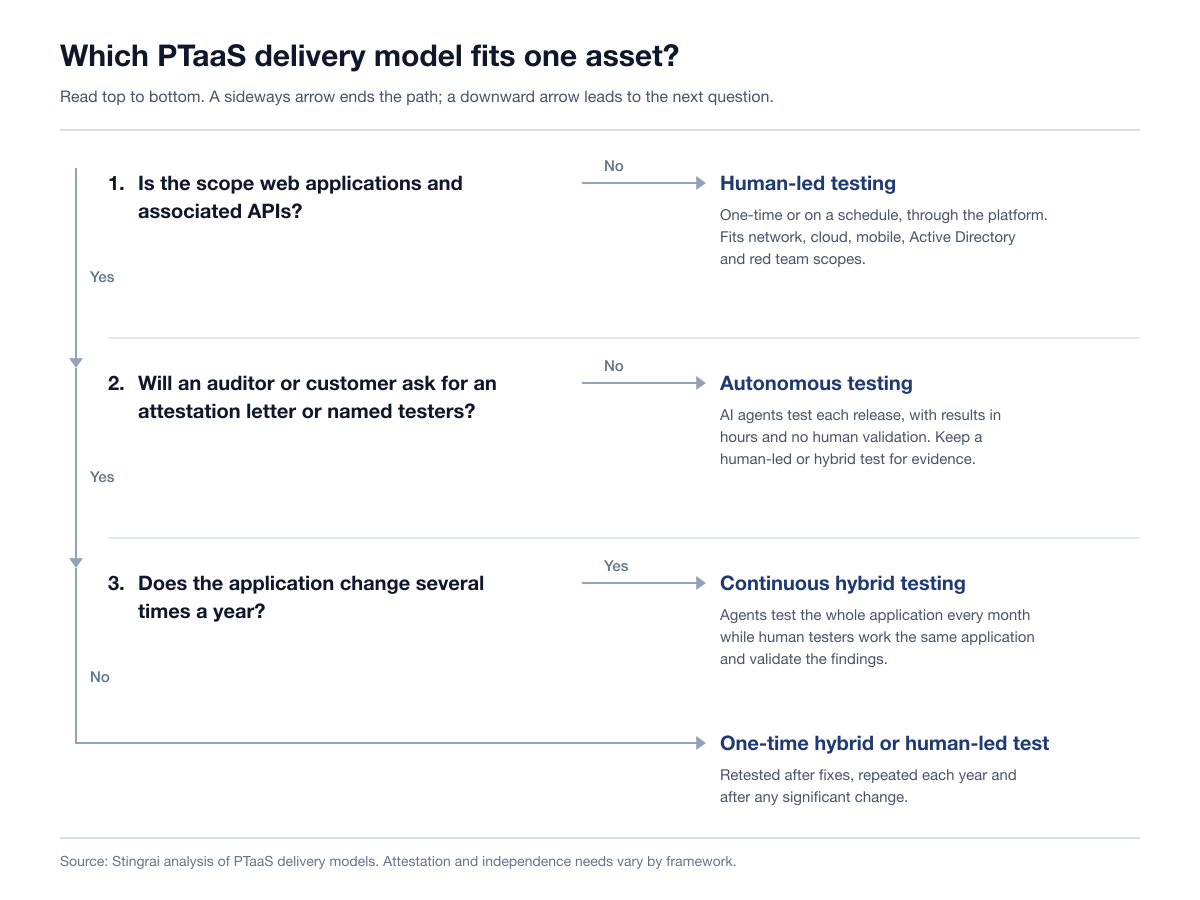
Figure 1: Which PTaaS delivery model fits one asset, read top to bottom. Attestation needs vary by framework; see the compliance section below. Source: Stingrai, PTaaS delivery models.
What should a PTaaS platform give the buyer?
The platform is what you are paying for beyond the testing itself, so judge it on the work it removes from your team and the evidence it leaves behind.
Real-time findings with proof. Every finding, not only criticals, posted when it is confirmed, with severity, affected endpoint, reproduction steps or a proof of concept, and remediation guidance specific to your stack.
Retests with history. A retest requested from the finding itself, with the result and date recorded against it, so the report shows what was fixed and when.
Ticketing and collaboration integrations. Two-way sync with Jira or the tracker your developers use, chat or Slack access to the testers during the test, and links to source control where fixes land.
SIEM and data export. An API or webhook export so findings can reach your SIEM, GRC platform or vulnerability management tool. Ask for the format and whether the export includes retest status.
An evidence trail for auditors. Scope, dates, the identities and independence of the testers, the methodology, every finding and its remediation and retest result, retained for the period your frameworks require. PCI DSS requirement 11.4.1, for example, expects "retention of penetration testing results and remediation activities results for at least 12 months" (PCI SSC, SAQ D).
An attestation letter. A short letter from the testing firm that states what was tested and when, so you can share proof of testing with customers without sending the full report. See the penetration testing report sample for what a report and letter contain.
Access control. Role-based access, single sign-on on enterprise plans, and redactable reports, because a findings database is one of the most sensitive data sets you will hand to a third party.
Where PTaaS fits enterprise compliance
Most frameworks do not mention PTaaS. They state what testing must happen, how often, by whom and what evidence must exist, and a PTaaS program is one way to meet those duties. The table summarizes what each framework's own text says; the requirement guides linked in each subsection go deeper.
Framework | What the text says about penetration testing | What a PTaaS program contributes |
|---|---|---|
SOC 2 | CC4.1's 2022 points of focus say evaluations "may include" penetration testing; no criterion mandates it | Dated tests and retest history as monitoring evidence |
ISO 27001 | The 2022 standard does not require a penetration test; a test is evidence for Annex A controls such as 8.8 and 8.29 | Evidence for vulnerability management and security testing controls |
PCI DSS | 11.4.2 and 11.4.3: internal and external testing at least once every 12 months and after significant change; 11.4.4: repeat testing to verify corrections | Scheduled tests, change-driven tests and recorded retests |
HIPAA | 164.308(a)(8) requires periodic technical and nontechnical evaluation; a 2025 proposal would add testing every 12 months | Evaluation evidence today; readiness if the proposal is finalized |
FedRAMP | CA-8 at an organization-defined frequency; FedRAMP treats penetration testing as part of vulnerability detection | The provider's own testing between assessor-led assessments |
DORA | At least yearly tests of systems supporting critical or important functions, by independent parties; TLPT every 3 years for identified entities | Annual and change-driven testing records |
SOC 2
The AICPA's Trust Services Criteria do not require a penetration test. The 2022 points of focus under CC4.1 list the evaluations management may use, and that list "may include ... vulnerability scans, security assessment, penetration testing, and third-party assessments" (AICPA, 2017 Trust Services Criteria with revised points of focus, 2022). If your auditor or customers expect one, a PTaaS record of tests and retests across the period maps neatly to a Type 2 window. Our SOC 2 penetration testing requirements guide covers timing and report contents.
ISO 27001
As our ISO 27001 penetration testing requirements guide sets out, ISO/IEC 27001:2022 does not require a penetration test and sets no testing frequency; a test is evidence for Annex A controls including 8.8, management of technical vulnerabilities, and 8.29, security testing in development and acceptance. The frequency comes from your own policy and risk assessment, which is why a continuous program has to match what the policy says.
PCI DSS 11.4
PCI DSS is the most prescriptive. Requirement 11.4.1 requires a documented methodology that includes "application-layer penetration testing to identify, at a minimum, the vulnerabilities listed in Requirement 6.2.4". Requirements 11.4.2 and 11.4.3 require internal and external testing "at least once every 12 months" and "after any significant infrastructure or application upgrade or change", by "a qualified internal resource or qualified external third-party" with organizational independence, and 11.4.4 requires repeat testing to verify corrections (PCI SSC, SAQ D for Merchants; the wording is unchanged in v4.0.1). A continuous program helps most with the "after any significant change" clause, which an annual test cannot satisfy on its own. See PCI DSS penetration testing: requirement 11.4 explained.
HIPAA
The HIPAA Security Rule in force today does not use the words "penetration testing". It requires a "periodic technical and nontechnical evaluation" at 45 CFR 164.308(a)(8), and a penetration test is one way to produce evidence for the technical part of that evaluation. The January 2025 proposed rule would add a proposed 164.312(h)(2)(iii): penetration testing "by a qualified person" and "at least once every 12 months or in accordance with the covered entity's or business associate's risk analysis", whichever is more frequent. As of 19 November 2026 the Federal Register lists only the proposed rule under its regulation number, and HHS's regulatory agenda lists the final rule as a long-term action targeted for July 2027, so treat the 12-month cadence as a proposal. See HIPAA penetration testing requirements.
FedRAMP CA-8
FedRAMP builds on NIST SP 800-53, whose control CA-8 reads "Conduct penetration testing" at an organization-defined frequency on organization-defined systems, with CA-8(1) calling for "an independent penetration testing agent or team" (NIST SP 800-53 Rev. 5). FedRAMP's 2026 Rev5 control page adds: "Penetration testing is part of vulnerability detection and is subject to the Vulnerability Detection and Response rules" (FedRAMP). Its Penetration Test Guidance (version 3, 30 June 2022) sets six mandatory attack vectors for tests planned with a FedRAMP recognized 3PAO. A PTaaS program can cover the provider's own testing between those assessments. The 2026 rule changes are covered in FedRAMP penetration testing requirements.
DORA
The Digital Operational Resilience Act requires financial entities, other than microenterprises, to "ensure, at least yearly, that appropriate tests are conducted on all ICT systems and applications supporting critical or important functions" (Article 24(6)), undertaken "by independent parties, whether internal or external" (Article 24(4)), and lists penetration testing among the tests a testing programme provides for (Article 25(1)). Entities identified by their competent authority must also "carry out at least every 3 years advanced testing by means of TLPT" (Article 26(1)) (Regulation (EU) 2022/2554, EUR-Lex). A PTaaS program can carry the penetration testing within that yearly testing duty; TLPT is a separate, threat-led exercise covered in DORA threat-led penetration testing.
Stingrai's testing supports these compliance programs and produces the evidence auditors ask for. Every human-led and hybrid report ships with an attestation letter. For a framework-by-framework view, see the penetration testing requirements matrix and pentest evidence auditors accept.
How much does PTaaS cost? The four pricing models
PTaaS prices are hard to compare because vendors attach them to different units. Four units appear on published price pages. The examples below were read on each vendor's own pricing page on 19 November 2026; they are examples of the models, not a ranking or a recommendation.
Pricing model | What the unit is | Published example (read 19 November 2026) | What to check |
|---|---|---|---|
Per test or per assessment | One test of a defined scope | Intruder: US$4,000 per test for white-box web application pentesting (US$3,500 for Intruder platform subscribers). Stingrai: Autonomous Pentest at US$3,000 and Hybrid Pentest at US$6,800 per assessment, for one web application and associated APIs | How big a "scope" one test covers; roles and endpoints included |
Prepaid pack or credits | Capacity bought in advance and drawn down | Intruder: a four-pentest pack at US$12,000 (US$10,500 for platform subscribers); "Pentests must be used within 1 year of purchase." Credit-based vendors may publish what a credit buys without publishing its price | Expiry of unused capacity; how many units one asset consumes |
Subscription | Testing across a term | Stingrai: Autonomous at US$650 a month and Hybrid at US$1,275 a month, each on a 12-month plan for one web application and associated APIs | What testing happens each month, and by whom |
Per asset or per target | Price per counted asset | Astra: Pentest Auto at US$2,999 and Pentest Expert at US$5,999 per pentest, where "One web or SaaS app counts as one target, including all APIs consumed" and mobile is per platform | How the vendor counts your assets |
Three rules make quotes comparable.
Normalize to the same scope. Count the same applications, roles, API endpoints and environments in every quote. A per-target price on two targets is not cheaper than a per-application price on one.
Put retests in the price. Retest terms range from unlimited during the term to a fixed number of re-scans. A cheaper headline with metered retests can cost more over a year.
Price the year, not the test. Compare 12 months of coverage for each option, including the testing you would need after major releases.
Larger estates are quoted per engagement. Network penetration testing at Stingrai typically costs US$5,000 to US$40,000 and above, depending on hosts, sites and start positions (Stingrai network testing). For portfolios, the enterprise PTaaS pricing worksheet shows how to normalize credit, per-asset and fixed quotes, and the PTaaS pricing comparison lists every vendor that publishes a number.
Why test continuously? What the 2026 data shows
An annual penetration test describes an application on the dates it was tested. Three primary data sets show why that window has become harder to rely on for internet-facing web applications.
Exploitation now leads breach entry. Verizon's 2026 Data Breach Investigations Report found that exploitation of vulnerabilities is "the most common initial access vector for breaches", at 31% of its dataset, up from 20% the year before, a 55% increase. The data covers incidents between 1 November 2024 and 31 October 2025.
Known exploited vulnerabilities are arriving faster. CISA added 302 vulnerabilities to its Known Exploited Vulnerabilities catalog between 1 January and 18 November 2026, against 245 in all of 2025 and 186 in 2024, by our count of the catalog's public feed (version 2026.11.18, 1,786 entries).
Fixes lag. The same DBIR found that only 26% of CISA KEV vulnerabilities in its data were fully remediated in 2025, down from 38%, and that the median time to full resolution rose to 43 days from 32 (Verizon 2026 DBIR).
Exploitation now starts before the patch. Mandiant's M-Trends 2026, published by Google Cloud on 23 March 2026 from its 2025 investigations, estimates the mean time to exploit vulnerabilities at -7 days, "meaning exploitation is routinely occurring before a patch is even released", and found exploits were the most common initial infection vector for the sixth year running, at 32% of intrusions (Google Cloud, M-Trends 2026). Google's earlier analysis of vulnerabilities disclosed in 2023 had put the average at five days (Google Cloud, 2023 time-to-exploit trends).
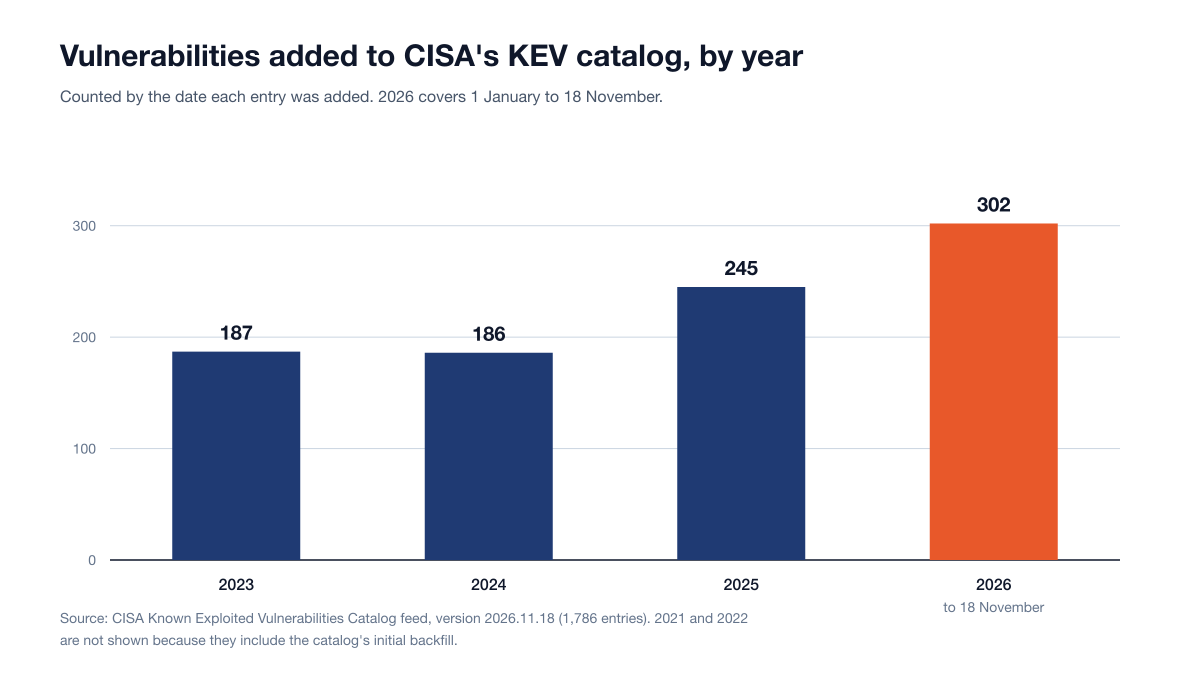
Figure 2: Vulnerabilities added to the CISA KEV catalog by year, 2023 to 18 November 2026, counted by date added. Source: CISA, Known Exploited Vulnerabilities Catalog feed, version 2026.11.18.
These figures describe known vulnerabilities in commercial and open-source products. KEV entries need an assigned CVE ID (CISA KEV criteria), and Verizon's remediation figures cover CVE-identified vulnerabilities only. The broken authorization, IDOR and business logic flaws in your own application code rarely receive a CVE, so they seldom appear in these counts and are found by testing the application itself. Each release can add one. That is the argument for continuous testing of web applications that ship often: test the new code close to when it ships, retest fixes quickly, and keep a human-led or hybrid test on the annual cycle for evidence.
Continuous testing is not the answer for every asset. A network segment that changes once a year, or an internal application with no release cadence, is well served by a scheduled one-time test. The decision path in Figure 1 is a reasonable starting point.
Where Stingrai fits
Stingrai is a global CREST-accredited penetration testing services company founded in Toronto, Canada in 2021, trusted by companies from startups to enterprises to meet audit requirements for SOC 2, ISO 27001, CMMC, PCI DSS and HIPAA. OSCE³, OSWE, OSEP, CREST CRT certified penetration testers, who are also world-class security researchers and bug bounty hunters. Choose from fully human-led or hybrid (AI agents plus human penetration testers) engagements across web, API, mobile, AI and LLM, cloud, network, Active Directory and social engineering penetration tests and red team engagements.
Stingrai Inc is a proud CREST member and holds two CREST accreditations, Penetration Testing and AI-Enabled Penetration Testing, plus the CREST AI Charter company certification, as listed on its CREST Marketplace page. Members of the team separately hold the individual CREST CRT certification.
The PTaaS platform
Every Stingrai engagement, Autonomous, Hybrid, human-led or Enterprise, one-time or continuous, runs in its PTaaS portal: each finding posted when it is confirmed with a proof of concept, Jira, Slack and GitHub integration, retests on request and redactable PDF reports. Hybrid and human-led engagements add direct chat with the assigned penetration testers and an attestation letter stating scope and testing dates; Enterprise adds single sign-on and API access.
Three ways to buy, one-time or continuous
Offer | Who tests | One-time | Continuous (12-month plan) | Deliverables |
|---|---|---|---|---|
Autonomous Pentest | Snipe, Stingrai's autonomous AI agent | US$3,000 per assessment | US$650 a month, monthly autonomous testing | Pentest report, same-day results, automated retests, AutoFix pull requests |
Hybrid Pentest | Snipe and Stingrai's certified penetration testers on the same application | US$6,800 per assessment | US$1,275 a month: monthly Snipe testing, human-verified, plus a quarterly deep dive by Stingrai's penetration testers | Human-validated report and attestation letter, PTaaS portal with Jira and Slack |
Human-led and Enterprise | Named penetration testers; Enterprise adds continuous Snipe testing on web and API releases | Custom quote | Custom quote | Report and attestation letter; management and executive post-remediation reports on Enterprise |
The fixed packages cover one web application and associated APIs. Prices are from Stingrai's pricing page, read 19 November 2026. The Autonomous Pentest covers up to 200 API endpoints or dynamic pages and up to three user roles. Anything larger, and every network, cloud, mobile, Active Directory, social engineering and red team scope, is quoted through Get a Quote.
Why the Hybrid Pentest is PTaaS done right
The Hybrid Pentest is marked Most Popular on Stingrai's pricing page and is sold one-time or continuous; the continuous form is where PTaaS works best for a web application that ships often. Snipe tests the full application while Stingrai's certified penetration testers test the same application manually alongside it and validate Snipe's findings, so coverage is wider and deeper. It is not a split of test classes: Snipe hunts IDOR, broken authorization and business logic flaws as well as injection, and the testers chain findings, follow business context and test what needs judgement.
One-time Hybrid is US$6,800 per assessment for one web application and associated APIs. It includes a human-validated report, the attestation letter and 12 monthly vulnerability scans after the test, which suits an annual compliance cycle or a pre-launch test.
Continuous Hybrid is US$1,275 a month on a 12-month plan for one web application and associated APIs: monthly Snipe testing, human-verified, plus a quarterly deep dive by Stingrai's penetration testers, with quarterly executive status reports. It answers the data above directly: new code is tested within the month it ships, fixes are retested as they land, and the attestation letter still comes from human testers.
Snipe tests web applications and associated APIs only. For networks, cloud, mobile and Active Directory, Stingrai's testing is human-led.
Stingrai is a small team, so book human-led start dates early. To price your application, see Stingrai pricing or send your scope through Get a Quote.
How to evaluate a PTaaS provider: an RFP checklist
The checklist below can be lifted into an enterprise RFP. Ask each bidder to answer every line in writing and to attach the evidence named in the third column.
Area | What to ask | Evidence to request |
|---|---|---|
Firm accreditation | Is the firm accredited for penetration testing by a recognized body, and for which services? | The firm's CREST Marketplace listing at marketplace.crest.org; CREST accreditation reviews "company processes, service methodologies, and data security practices" (CREST) |
Tester credentials | Who will test, and what certifications do they hold? | Named testers, CVs and certifications such as CREST CRT, OSCP, OSWE or OSCE³; disclosed CVEs or research |
Who does the work | Which findings come from AI agents, which from humans, and who validates each? | A written description of the delivery model for your scope |
Methodology | Which standards guide the test? | OWASP WSTG and ASVS for web, the PCI DSS 11.4.1 elements where in scope, NIST SP 800-115 or PTES for infrastructure |
Scope terms | How many roles, endpoints, environments and assets does the price cover? | Scope definitions and the change-order rule |
Independence | Is the tester independent of the team that builds and runs the system? | A statement that meets PCI DSS organizational independence, NIST CA-8(1) and DORA Article 24(4) where they apply |
Retest terms | How many retests, for how long, and how fast? | Retest entitlement in the contract, with turnaround |
Platform | Does the platform give live findings, ticketing sync, SIEM or API export, SSO and role-based access? | A demo account or screenshots of a sample engagement |
Evidence | What does the auditor receive? | Sample report, sample attestation letter, retest record and retention period |
Data handling | Where are findings and credentials stored, who can access them, and when are they deleted? Are your data or findings used to train AI models? | Hosting region, subprocessors, encryption, retention and deletion policy, the firm's own security attestations |
SLAs | What are the lead time to start, notice of critical findings, report delivery and retest turnaround? | Service levels written into the contract |
Commercials | What is the pricing unit, what happens to unused capacity, and what does the year cost? | A 12-month total for the same scope as every other bidder |
Rules of engagement | How are authorization, test windows, emergency contacts and stop conditions agreed? | A signed authorization and rules of engagement before testing |
For the procurement side, including MSAs and vendor onboarding, see outsourced penetration testing for enterprise procurement.
Common PTaaS buying pitfalls
Buying a scanner sold as PTaaS. If no person or capable agent works the business logic, it is not a penetration test. Ask for a sample finding that a scanner could not have produced.
Ignoring role and endpoint limits. Authenticated roles are where authorization flaws live. Check how many roles and endpoints the price covers.
Buying evidence your auditor will not accept. If customers or auditors expect named testers or an attestation letter, an autonomous-only test will not be enough on its own.
Skipping independence. PCI DSS, NIST CA-8(1) and DORA all ask for independent testers. An internal team testing its own code does not meet that test.
Retiring the annual human-led test too early. Continuous testing adds coverage between releases; for most frameworks and enterprise customers it complements the annual human-validated test rather than replacing it.
Handing over credentials carelessly. Share test accounts through the platform, not email or chat, and rotate them after testing.
Frequently Asked Questions
What is penetration testing as a service (PTaaS)?
Penetration testing as a service (PTaaS) is penetration testing delivered through a platform: testers, and increasingly AI agents, post each finding as it is confirmed, track remediation through your ticketing tools and retest fixes, instead of delivering one report at the end. It can be bought as a one-time engagement or as a continuous program, usually over 12 months.
How much does PTaaS cost in 2026?
PTaaS is priced per test, through prepaid packs or credits, by subscription or per asset. Published examples read on 19 November 2026 include US$4,000 per test at Intruder (US$3,500 for its platform subscribers), US$2,999 per pentest for one target at Astra, and Stingrai's Hybrid Pentest at US$6,800 per assessment or US$1,275 a month on a 12-month plan for one web application and associated APIs. Larger scopes are quoted per engagement.
How is PTaaS different from a traditional penetration test?
The testing can be identical. The difference is delivery: a traditional test delivers findings in a report after the test window, while PTaaS posts findings live, pushes them into tickets, retests fixes on request and keeps the evidence in one platform. PTaaS can also repeat testing across a term rather than once a year.
Is PTaaS the same as a bug bounty or a vulnerability scanner?
No. A scanner checks for known patterns and cannot find business logic flaws, which OWASP says cannot be detected by a vulnerability scanner. A bug bounty pays outside researchers per valid finding but does not commit to covering a defined scope on defined dates. PTaaS is penetration testing of an agreed scope, with evidence an auditor can use.
Does PTaaS meet SOC 2, ISO 27001 and PCI DSS penetration testing requirements?
It can, if the testing and evidence match each framework's text. SOC 2 and ISO 27001 do not mandate a penetration test, but a test is recognized evidence: SOC 2's CC4.1 points of focus list penetration testing, and a test evidences ISO 27001 Annex A controls such as 8.8 and 8.29. PCI DSS requires internal and external testing at least once every 12 months and after significant change, by a qualified and organizationally independent tester, with repeat testing to verify corrections. The platform's retest records help with the last point.
What is the difference between autonomous, hybrid and human-led PTaaS?
Autonomous PTaaS uses AI agents alone and delivers results in hours without human validation. Hybrid PTaaS puts agents and human penetration testers on the same scope, with the humans testing manually alongside the agent and validating its findings. Human-led PTaaS is credentialed testers doing the work through a platform. At Stingrai, Hybrid and human-led engagements come with an attestation letter.
How often should PTaaS testing run?
Match the cadence to how often the asset changes. Web applications that ship several times a year benefit from continuous testing, because Verizon's 2026 DBIR found exploitation of vulnerabilities is now the leading breach entry point at 31%. Assets that rarely change are well served by a one-time test each year, plus a test after any significant change.
What credentials should a PTaaS provider have?
Look for firm-level accreditation for penetration testing, verified on the accrediting body's own directory, such as the CREST Marketplace, plus named testers with individual certifications such as CREST CRT, OSCP, OSWE or OSCE³. Stingrai holds the CREST Penetration Testing and AI-Enabled Penetration Testing accreditations.
Which PTaaS providers should we shortlist?
Start from your scope, cadence and evidence needs, then compare providers against the RFP checklist in this guide. Stingrai's ranking of PTaaS providers compares vendors against eight criteria, including tester pedigree, platform maturity, retest policy and pricing transparency, and its PTaaS pricing comparison lists the vendors that publish a price.
Related reading
Continuous pentesting vs PTaaS: tool, service and where AI fits
Enterprise PTaaS pricing for application portfolios: a quote worksheet
References
NIST. Glossary: penetration testing. https://csrc.nist.gov/glossary/term/penetration_testing.
NIST. SP 800-53 Rev. 5, Security and Privacy Controls, control CA-8 and CA-8(1). https://csrc.nist.gov/pubs/sp/800/53/r5/upd1/final.
OWASP. Web Security Testing Guide v4.2, Introduction to Business Logic. https://wstg.owasp.org/v4.2/4-Web_Application_Security_Testing/10-Business_Logic_Testing/00-Introduction_to_Business_Logic/.
PCI Security Standards Council. SAQ D for Merchants, requirements 11.4.1 to 11.4.5. https://listings.pcisecuritystandards.org/documents/PCI-DSS-v4-0-SAQ-D-Merchant.pdf.
AICPA. 2017 Trust Services Criteria with Revised Points of Focus (2022), CC4.1. https://www.aicpa-cima.com/resources/download/2017-trust-services-criteria-with-revised-points-of-focus-2022.
eCFR. 45 CFR 164.308, Administrative safeguards. https://www.ecfr.gov/current/title-45/subtitle-A/subchapter-C/part-164/subpart-C/section-164.308.
US Department of Health and Human Services. HIPAA Security Rule To Strengthen the Cybersecurity of Electronic Protected Health Information, proposed rule. 6 January 2025. https://www.federalregister.gov/documents/2025/01/06/2024-30983/hipaa-security-rule-to-strengthen-the-cybersecurity-of-electronic-protected-health-information.
FedRAMP. Rev5 controls: Assessment, Authorization and Monitoring. https://www.fedramp.gov/2026/providers/rev5/controls/assessment-authorization-and-monitoring/; CSP Penetration Test Guidance, version 3. 30 June 2022. https://www.fedramp.gov/resources/documents/CSP_Penetration_Test_Guidance.pdf.
European Union. Regulation (EU) 2022/2554 (DORA), Articles 24 to 26. https://eur-lex.europa.eu/legal-content/EN/TXT/HTML/?uri=CELEX:32022R2554.
Verizon. 2026 Data Breach Investigations Report. https://www.verizon.com/business/resources/reports/dbir/. Incidents from 1 November 2024 to 31 October 2025.
CISA. Known Exploited Vulnerabilities Catalog and KEV criteria. https://www.cisa.gov/known-exploited-vulnerabilities-catalog. Feed version 2026.11.18, counted by date added.
Google Cloud (Mandiant). M-Trends 2026: Data, Insights, and Strategies From the Frontlines. 23 March 2026. https://cloud.google.com/blog/topics/threat-intelligence/m-trends-2026.
Google Cloud Threat Intelligence. How Low Can You Go? An Analysis of 2023 Time-to-Exploit Trends. 15 October 2024. https://cloud.google.com/blog/topics/threat-intelligence/time-to-exploit-trends-2023.
CREST. Accreditation and Stingrai Inc, CREST Marketplace. https://www.crest-approved.org/accreditation/ and https://marketplace.crest.org/supplier/stingrai-inc/.
Intruder. Pentest pricing. https://www.intruder.io/pentest-pricing.
Astra. Pricing. https://www.getastra.com/pricing.
Stingrai. Pricing, PTaaS platform and network penetration testing. https://www.stingrai.io/pricing, https://www.stingrai.io/ptaas and https://www.stingrai.io/services/internal-and-external-network-pen-test. Read 19 November 2026.
Talk to Stingrai
Send your applications, roles and release cadence through Get a Quote or book a free discovery call, and Stingrai will scope a one-time or continuous Hybrid Pentest, or a human-led program across your wider estate.