




Quick answer: These are different products with different jobs, and the clearest statement of the difference comes from a vendor that sells both. Bugcrowd publishes it plainly: penetration testing is time-boxed, scoped, and led by a defined group of testers, while bug bounty programmes are ongoing, open to a broader group, and use a pay-for-results model. Bounties win on continuous breadth against exposed assets at scale, and Bugcrowd publishes averages of 5 days to first submission, 5 days to first vulnerability and 8 days to first critical vulnerability. Penetration tests win on scoped, methodology-based, auditor-accepted evidence and on scope a bounty cannot structurally reach: internal networks, authenticated multi-role application logic, and code that has not shipped yet. On compliance the difference is decisive rather than a matter of preference. PCI DSS v4.0.1 requirement 11.4 names penetration testing and puts internal and external testing on a 12-month clock. New York's 23 NYCRR 500.5(a)(1) requires penetration testing "from both inside and outside the information systems' boundaries by a qualified internal or external party at least annually". Neither names a bug bounty programme. Stingrai is the third option compared here. Stingrai is a global CREST-accredited penetration testing services company founded in Toronto, Canada in 2021, trusted by companies from startups to enterprises to meet audit requirements for SOC 2, ISO 27001, CMMC, PCI DSS and HIPAA. OSCE³, OSWE, OSEP, CREST CRT certified pentesters, who are also world-class security researchers and bug bounty hunters. Choose from fully human-led or hybrid (AI agents plus human penetration testers) engagements across web, API, mobile, AI and LLM, cloud, network, Active Directory and social engineering penetration tests and red team engagements, delivered one-time or continuously through its PTaaS platform, with published pricing at US$3,000 per assessment for one web application and associated APIs (pricing) and every other scope quoted.
Every claim on this page was read from a vendor product page, a published regulation or a published criteria document on 5 September 2026 and links back to it. Where a framework does not say something, this page says that it does not say it, rather than inferring an obligation.
The comparison people actually make, and why it goes wrong
The question is usually asked as a budget question: we have money for one, which is better. Framed that way it has no answer, because the two products do not overlap on the axis that matters.
A penetration test is an engagement. You define a scope, a vendor assigns testers, they work it for a bounded number of days against a documented methodology, and they hand back a report that describes what was tested, what was found, and what was not reachable. You pay for the engagement whether or not it finds anything. The output is a document with a defined shape.
A bug bounty programme is a market. You publish a scope and a reward table, and an open population of researchers decides whether your programme is worth their time against every other programme competing for the same attention. You pay per valid finding. The output is a stream of individual reports arriving on no schedule.
Those two structures produce different failure modes. A penetration test can end with a clean report because the scope was too narrow, and you have paid for the days regardless. A bug bounty can go quiet because your reward table is uncompetitive, your triage is slow, or your assets are unglamorous, and silence is indistinguishable from safety. Neither failure mode is visible from a price comparison.
The useful question is not which is better. It is which parts of your attack surface each one can actually reach, and which of them produces the artefact your auditor, customer or regulator is asking for.
The published facts at a glance
The vendor-stated distinction: penetration testing is "time-boxed, scoped, and led by a defined group of testers"; bug bounty programmes are "ongoing, open to a broader group, and use a pay-for-results model" (Bugcrowd).
Published bug bounty response averages: 5 days to first submission, 5 days to first vulnerability, 8 days to first critical vulnerability (Bugcrowd).
Published penetration test launch time: standard or customised testing launched in less than 72 hours (Bugcrowd).
Published retest terms on a penetration test product: 12 months of retesting with one report update on the Standard tier for web applications, networks and APIs (Bugcrowd).
Published compliance framing on a penetration test product: reports positioned to meet SOC 2, ISO 27001, GDPR and more, with references to CREST, NIST CSF 2.0, FISMA, NIST 800-53 and DORA (HackerOne), and to PCI DSS, SOC 2, HIPAA, ISO 27001 and GDPR (Bugcrowd).
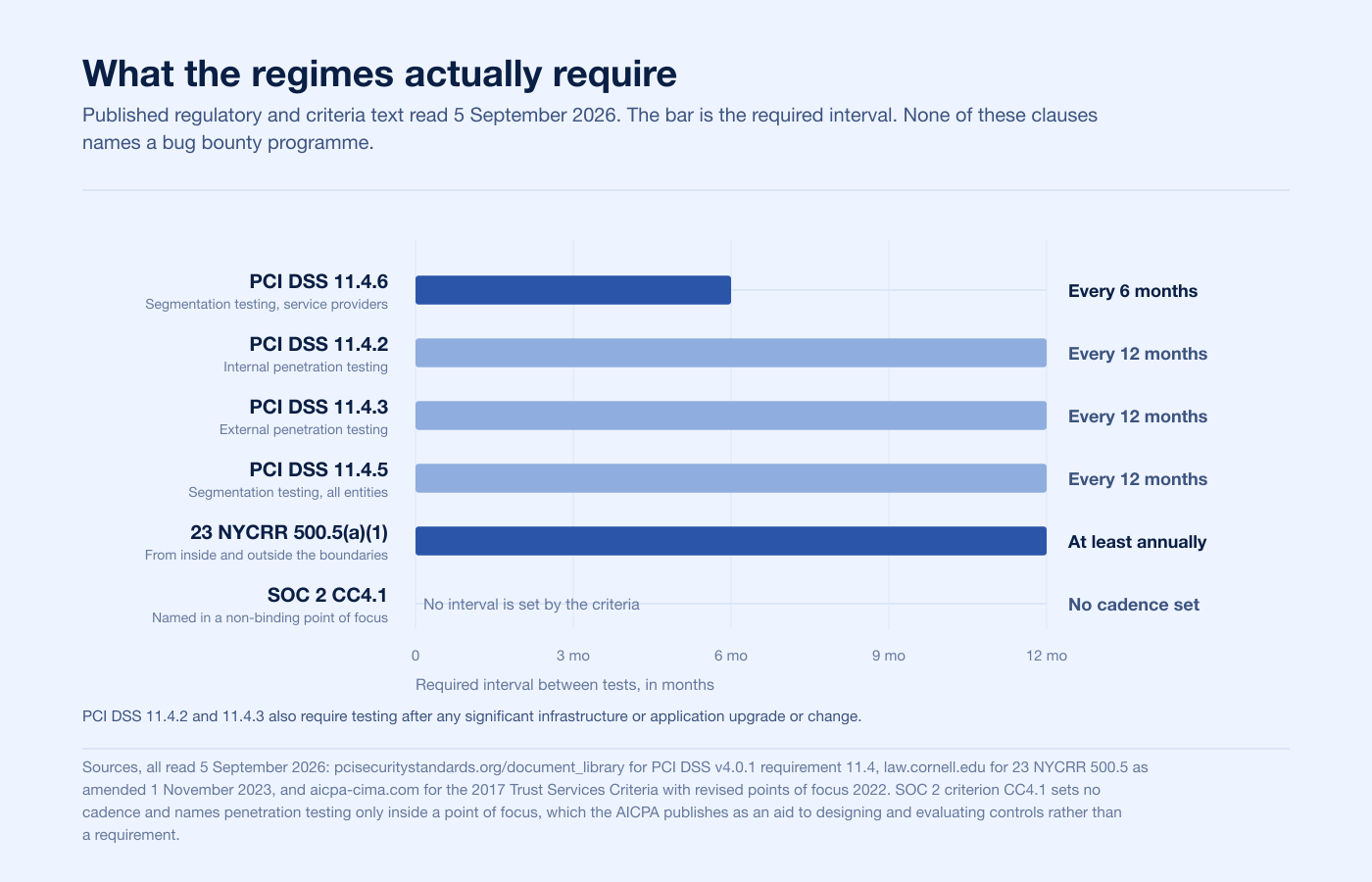
PCI DSS v4.0.1: requirement 11.4.1 requires a defined, documented and implemented penetration testing methodology; 11.4.2 internal and 11.4.3 external penetration testing each run at least once every 12 months and after any significant infrastructure or application upgrade or change; 11.4.5 puts segmentation testing on a 12-month clock and 11.4.6 puts it on a six-month clock for service providers (PCI Security Standards Council).
NYDFS 23 NYCRR 500.5(a)(1): covered entities must conduct "penetration testing of their information systems from both inside and outside the information systems' boundaries by a qualified internal or external party at least annually" (23 NYCRR 500.5, amended text effective 1 November 2023).
SOC 2 criterion CC4.1: "The entity selects, develops, and performs ongoing and/or separate evaluations to ascertain whether the components of internal control are present and functioning." Penetration testing appears in a point of focus as one of several evaluation types management's evaluations may include, and points of focus are aids to designing and evaluating controls rather than requirements (AICPA and CIMA, 2017 Trust Services Criteria with revised points of focus, 2022).
Frameworks in this pass that name a bug bounty programme as the required evaluation: none.
Measured penetration testing output: 1,206 verified findings from 55 tests, 92.7% of tests surfaced at least one High or Critical, 0.74% false-positive rate, median Critical fixed in 10.5 days and median High in 38.0 days (Stingrai State of Penetration Testing 2026).
Key takeaways
The models differ on scope control, and that single property drives everything else. A penetration test scopes what gets tested; a bounty scopes what gets rewarded. Those sound similar and are not. A scoped test guarantees an authenticated admin workflow is examined. A scoped bounty guarantees that if somebody chooses to look at it and finds something, they get paid.
Bounties are structurally excellent at exactly one thing, and it is a big thing. Continuous, adversarially diverse attention on assets that are already exposed to the internet, at a cost that only lands when something is found. Bugcrowd's published averages of 5 days to a first vulnerability and 8 days to a first critical describe a discovery engine no time-boxed engagement matches for sustained breadth.
Three categories of scope are effectively out of reach for a bounty. Internal networks behind the perimeter, authenticated multi-role application logic that requires provisioned accounts and role matrices, and pre-release code that no external researcher can see. These are where the highest-severity findings concentrate, which is why they are named in the regulations.
The compliance gap is written into the text, not into vendor marketing. PCI DSS 11.4 and NYDFS 500.5(a)(1) name penetration testing explicitly, with cadence and qualification language attached. SOC 2 names it in a non-binding point of focus. Nothing in this pass names a bug bounty programme as the evaluation that satisfies a control.
The mature answer is both, sequenced deliberately. The bounty runs continuously against the exposed surface and prices risk by outcome. The penetration test runs on the regulatory clock against the scope the bounty cannot see, and produces the document the auditor accepts. Buying one to avoid the other is where the failure happens.
Methodology
The verification pass for this page closed on 5 September 2026.
What counted as a source. Three categories only. First, a vendor's own public product or pricing page, read on the date above, for statements about how each model works commercially. Second, published regulatory or criteria text, for what a framework requires. Third, one measured dataset for penetration testing output, explicitly labelled as measured.
Vendor claims are attributed as claims. Where this page reports a launch time, a response average or a retest term, it is reporting what a vendor publishes about its own service. Those figures are the vendor's, not independently measured, and every one of them is attributed inline to the page it was read from. Averages published by a platform describe that platform's programmes and should not be read as a property of bug bounty programmes generally.
Regulatory text is quoted rather than summarised where the wording carries the obligation. The NYDFS clause is quoted directly because "from both inside and outside the information systems' boundaries" is the operative phrase and paraphrases routinely lose it. The PCI DSS requirement numbers and cadences are reported by clause so a reader can check each one against the standard.
Points of focus are labelled as non-binding. The AICPA publishes points of focus as aids to designing and evaluating controls against a criterion. This page therefore reports CC4.1's mention of penetration testing as a named evaluation type on a menu, not as a SOC 2 requirement, because the criteria do not require a penetration test and do not set a cadence.
Absence is reported as absence. Where no framework in the pass names a bug bounty programme as a satisfying evaluation, this page states that, rather than inferring that bounties therefore fail an audit. A bug bounty programme can be perfectly good evidence of a broader vulnerability management practice. It is not the named evaluation type, and those are different statements.
What was dropped. Aggregated "average bug bounty payout" and "average pentest cost" figures circulating on review and procurement sites were excluded, because none trace to a publisher accountable for the methodology. Two primary documents could not be extracted in readable form during the pass, so their content is cited to the publisher's document library page rather than quoted at length. No figure on this page is estimated, averaged across sources, or modelled.
What each model actually is
The penetration test
An engagement with four fixed properties: a defined scope, a defined window, a defined team, and a defined deliverable.
Scope is negotiated before anyone starts, and it can include things nobody outside your organisation could reach. Internal network segments. An authenticated application with four roles and a tenant boundary. A release candidate that has never been deployed to production. Source code. Testers are provisioned with credentials and permission to do things an unauthenticated stranger cannot.
The work follows a documented methodology, which is what makes the result reproducible and reviewable. Vendors publish this framing directly: HackerOne states that testing "aligns with industry standards while adapting to how real attackers operate in modern environments", and Bugcrowd publishes a dashboard where a buyer can watch tester progress against a methodology checklist around the clock. That checklist is not decoration. It is the evidence that coverage was systematic rather than opportunistic, and it is precisely what an auditor is looking for.
The deliverable is a report with a defined shape: scope statement, methodology, findings with severities and evidence, remediation guidance, and a retest record. Both vendors position that document at compliance programmes. HackerOne publishes that the report is built to meet standards for SOC 2, ISO 27001 and GDPR among others, with references to CREST, NIST CSF 2.0, FISMA, NIST 800-53 and DORA. Bugcrowd publishes PCI DSS, SOC 2, HIPAA, ISO 27001 and GDPR, framed around structured, traceable and regular testing.
The cost model is the mirror image of a bounty: you pay for the effort, not the outcome. A test that finds nothing still costs what it costs. That is a real disadvantage, and it is the same property that makes the coverage guarantee possible.
The bug bounty programme
A standing invitation with a reward table. You publish what is in scope, what is out, and what each severity pays. An open population of researchers chooses whether to engage.
The strengths follow directly from that structure. Adversarial diversity is the big one: hundreds of people with different specialisms, tooling and instincts looking at the same asset produce coverage no fixed team reproduces, and they do it against the surface as it actually exists in production rather than as it was described in a scope document. Continuity is the second: the programme does not have a window, so a regression introduced on a Thursday can be reported on a Friday. Outcome pricing is the third: an unfound bug costs nothing, which makes the spend track realised risk rather than budgeted effort.
Bugcrowd publishes response averages for its programmes: 5 days to first submission, 5 days to first vulnerability, and 8 days to first critical vulnerability, alongside a managed triage service that validates and prioritises incoming findings. Triage matters more than buyers expect. An open programme receives duplicates, out-of-scope reports and low-signal submissions, and somebody has to process all of them. On a self-managed programme, that somebody is your security team.
The limitations also follow from the structure. Researchers work on what they can reach, which means the exposed perimeter. They work on what pays, which means your reward table competes with every other programme. And they work when they choose, which means the absence of reports carries no information: you cannot tell a secure asset from an unattended one from the outside.
Bugcrowd also publishes a hybrid: a pay-for-impact model that combines flat-rate penetration testing with crowdsourced testing, which is the same conclusion this page reaches, expressed as a product.
Coverage: where each model reaches
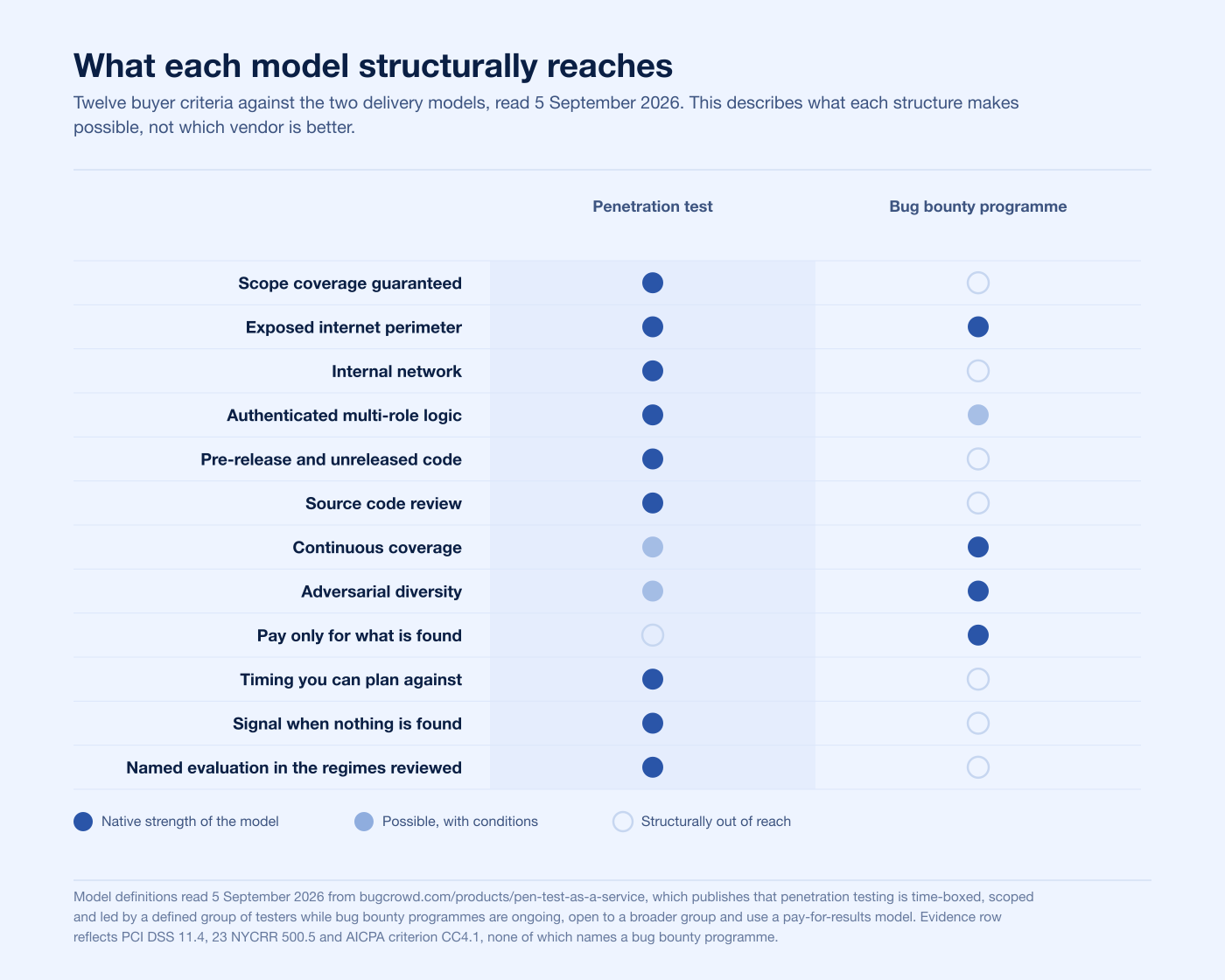
This is a structural comparison, not a ranking. Every row describes what the delivery model makes possible, and both columns contain honest wins.
Buyer criterion | Penetration test | Bug bounty programme |
|---|---|---|
Scope guarantee | Coverage of the named scope is contracted and evidenced against a methodology checklist | Scope defines what is rewarded, not what is examined. Coverage is emergent |
Exposed internet perimeter | Covered for the window you bought | Covered continuously, by many people, which is the model's core strength |
Internal network, behind the perimeter | Standard scope. Testers are placed inside or given a foothold | Structurally out of reach for an open programme |
Authenticated, multi-role application logic | Standard scope. Accounts provisioned per role, authorisation matrix tested deliberately | Possible where credentials are issued, but depends on researchers choosing to do the slow work |
Pre-release and unreleased code | Testable. A release candidate or a branch can be in scope | Not possible. Nothing to look at until it ships |
Source code review | Available as white-box scope | Outside the model |
Continuous coverage between engagements | Only if you buy a continuous programme | Native. This is what the model is for |
Adversarial diversity | Bounded by the assigned team | High. The defining advantage |
Cost model | Pay for effort. A clean report still costs the engagement fee | Pay for results. An unfound bug costs nothing, and a severe one can cost a lot |
Auditor-accepted evidence with a defined shape | Yes. Scope statement, methodology, findings, remediation record, retest | Not the named evaluation type in the frameworks reviewed here |
Predictable timing against a deadline | Yes. A window is contracted | No. Findings arrive when they arrive |
Signal from silence | A clean report states what was tested and not found | Silence is ambiguous between a secure asset and an unattended programme |
Two rows deserve to be pulled out because they decide most real purchases.
"Signal from silence" is the row buyers underweight. A penetration test that finds nothing still tells you what was examined and by what method. A quiet bounty tells you nothing at all. If the question you are answering is "is this application safe enough to ship", only one of these two answers it.
"Cost model" is the row buyers overweight. Pay-for-results looks strictly better on a spreadsheet and is genuinely attractive, but it prices discovery, not assurance. You cannot buy a guarantee that somebody looked.
Compliance evidence: the difference that is not a preference
This is where the comparison stops being a judgement call. Three regimes, read on 5 September 2026.
Regime | What the text says about penetration testing | Cadence | Does it name a bug bounty programme? |
|---|---|---|---|
PCI DSS v4.0.1, requirement 11.4 | Requires a defined, documented and implemented penetration testing methodology under 11.4.1, internal penetration testing under 11.4.2 and external under 11.4.3, with exploitable findings corrected and testing repeated to verify under 11.4.4 | Internal and external at least once every 12 months and after any significant infrastructure or application upgrade or change. Segmentation testing every 12 months under 11.4.5, and every six months for service providers under 11.4.6 | No |
NYDFS 23 NYCRR 500.5(a)(1) | Requires "penetration testing of their information systems from both inside and outside the information systems' boundaries by a qualified internal or external party" | At least annually | No |
SOC 2, AICPA criterion CC4.1 | The criterion requires ongoing and/or separate evaluations. Penetration testing is named inside a point of focus as one evaluation type among several that management's evaluations may include | None. The criteria set no cadence | No |
Three readings follow, and they matter more than any feature comparison above.
PCI DSS is prescriptive and it prescribes the test, not the discovery. The methodology requirement in 11.4.1 is the tell. A framework that requires a defined, documented and implemented methodology is asking for a systematic process whose coverage can be examined, which is a description of a penetration test and not of an open market for findings. Our full walkthrough of requirement 11.4 covers the nine methodology elements and the internal-versus-external clause mapping that summaries routinely get backwards.
NYDFS is the clearest single sentence in this whole comparison, and the operative phrase is "from both inside". A regulator that wanted external discovery would not have written that clause. An open bounty programme cannot satisfy an obligation to test from inside the boundary, because researchers are not inside the boundary. The qualification language, "by a qualified internal or external party", also sets a bar that an anonymous open population does not obviously clear.
SOC 2 is softer than almost everybody believes, in both directions. The criteria do not require a penetration test at all, and they set no cadence. Penetration testing appears in a point of focus, and the AICPA publishes points of focus as aids to designing and evaluating controls rather than as requirements. What actually binds you is your own control description: once you tell an auditor that you perform an annual penetration test, that sentence is the benchmark you are tested against. A bug bounty programme can genuinely evidence a separate evaluation under CC4.1 if that is what your control description says you do and you can show the evidence. It is simply not the evaluation type the AICPA names. Our guide to SOC 2 Type 2 penetration testing timing works through where the test has to fall inside the observation period and which criterion each artefact actually evidences.
One practical consequence for anyone running a bounty and hoping it covers the audit: ask your auditor before, not after. The question to put in writing is whether they will accept bug bounty programme output as the evaluation evidence for the specific control you have written, and if so what documentation shape they need. The answer is frequently no, and finding that out in fieldwork week is expensive.
Cost: two models that cannot be compared on a single number
Neither platform in this pass publishes bug bounty programme pricing, and HackerOne's pricing page carries no figures at all, routing instead to a contact flow. That is the norm in this category, and it is why the honest comparison is structural rather than numeric.
A penetration test has three cost components, and typically only the first is quoted: the engagement fee, the internal cost of scoping and supporting it, and the remediation effort the findings create. That third component is the largest and the least budgeted. In the Stingrai dataset, the median Critical took 10.5 days to fix and the median High took 38.0 days.
A bug bounty programme has four, and typically only the first is discussed: the reward pool, the platform or programme management fee, the triage cost of processing every submission including the invalid ones, and the same remediation tail. The reward pool is also the least predictable line in a security budget, because it scales with how much is found rather than how much you planned to spend.
The two are genuinely hard to compare, and the comparison is usually made badly in one specific way: treating an unspent reward pool as a saving. A quiet quarter on a bounty is either a well-secured surface or an under-incentivised programme, and the invoice looks identical in both cases. A penetration test invoice at least tells you what was examined for the money.
For the penetration testing half of that budget, our 2026 cost guide breaks price down by scope, PTaaS Pricing Compared collects every subscription price published on a vendor's own site, and the pentest cost calculator turns an asset count into a range with its assumptions shown.
When to run both, and in what order
Most organisations past a certain size end up running both. The sequence below is the one that wastes the least money, and it is built around one principle: do not pay a bounty to find what a test would have found cheaply, and do not ask a test to do a bounty's job.
Run the penetration test first, before opening a public programme. An open programme on an untested application converts findings a scoped test would have caught in a day into a stream of individual bounty payments, each of which also consumes triage time. A test first, remediation, then the programme, is the cheaper order.
Point the test at what the bounty cannot see. Internal networks. The authenticated, multi-role surface with a real role matrix. The release candidate. Source code. Every one of those is standard penetration testing scope and structurally unreachable from an open programme.
Point the bounty at the exposed production surface, continuously. This is where the model's adversarial diversity and continuity pay for themselves, and where its response averages describe a genuine capability.
Keep the regulatory clock on the test. PCI DSS puts internal and external testing on a 12-month clock and segmentation testing for service providers on a six-month one. NYDFS requires annual testing from inside and outside the boundary. Those clocks run whether or not your bounty is busy.
Feed each into the other. A recurring bounty finding class belongs in the next test's scope as a deliberate coverage area. A test finding that turns out to be systemic belongs in the bounty's scope notes so researchers know where to look. Running them as two disconnected purchases is the most common way to pay twice for the same coverage.
Budget the remediation tail once, not twice. Findings from both channels land on the same engineering team. A median High taking 38.0 days to close does not care which channel surfaced it, and the constraint on your programme is almost always fix capacity rather than discovery capacity.
Where Stingrai fits
Stingrai is a global CREST-accredited penetration testing services company founded in Toronto, Canada in 2021, trusted by companies from startups to enterprises to meet audit requirements for SOC 2, ISO 27001, CMMC, PCI DSS and HIPAA. OSCE³, OSWE, OSEP, CREST CRT certified pentesters, who are also world-class security researchers and bug bounty hunters. Choose from fully human-led or hybrid (AI agents plus human penetration testers) engagements across web, API, mobile, AI and LLM, cloud, network, Active Directory and social engineering penetration tests and red team engagements.
Stingrai delivers penetration testing, not bug bounty programme management, and the two coexist comfortably in a mature programme. Its named two-person tester teams cover exactly the surfaces a bounty cannot reach: authenticated web application and API testing across every user role for broken authorization, IDOR and business logic flaws, mobile against OWASP MASVS and MASTG, AWS, Azure with Entra ID and Google Cloud from control plane to workload, internal networks with lateral movement and segmentation testing, Active Directory delegation and ACL attack paths, phishing and physical entry, and assumed-breach red teaming.
Snipe is Stingrai's autonomous AI agent for web application penetration testing, including the application's APIs, trained on more than 6,000 HackerOne Hacktivity disclosures and on Stingrai's penetration testers' methodology. The Autonomous package is Snipe alone; in a Hybrid engagement Snipe and the penetration testers test the application together throughout. It performs black-box dynamic testing and white-box source review, opens AutoFix pull requests for what it finds, and can run as a gating check on every pull request, which is coverage of pre-release code that no external researcher can provide.
Both delivery models are published. The pricing page carries an Autonomous Pentest at US$3,000 one-time with same-day results and a Hybrid Pentest at US$6,800 one-time, each covering one web application and associated APIs with retesting included, and the same two tiers at US$650 and US$1,275 per month on a 12-month engagement. That means an annual point-in-time test on the regulatory clock and a continuous programme running alongside a bounty are both available from the same published price list. Scopes beyond one application, including internal networks, cloud, mobile, social engineering and red team work, are quoted through Get a Quote.
Stingrai is a Toronto-headquartered, CREST-accredited penetration testing service provider founded in 2021 and focused on offensive security, with a named two-person tester team per engagement, drawn from a wider team holding OSCE³, OSWE, OSEP, CREST CRT and CISSP and 18 published CVEs. Its penetration testing supports SOC 2, ISO 27001, PCI DSS and HIPAA programmes by producing the scope statement, technical report, remediation record, retest evidence and attestation letter those programmes consume, on either an annual or a continuous cadence. Across 1,206 verified findings from 55 penetration tests, 92.7% of tests surfaced at least one High or Critical finding at a 0.74% false-positive rate, which is the coverage-guarantee side of the trade-off this page describes.
For direct model-to-model comparisons, see HackerOne pentest versus Stingrai, HackerOne alternatives and Bugcrowd alternatives.
What this means for buyers
Decide what you are buying before you compare prices. Discovery breadth on an exposed surface, or contracted coverage of a defined scope with a document at the end. Those are two purchases and the cheaper one is not the answer to both questions.
Ask your auditor about bounty evidence in writing, before your observation period opens. The frameworks reviewed here name penetration testing and do not name bug bounty programmes. Your auditor's actual position is the only one that matters, and it is cheap to obtain early.
Map the three unreachable scopes deliberately. Internal network, authenticated multi-role logic, pre-release code. If those are not covered by a scoped engagement, they are not covered.
Do not read a quiet bounty as a secure surface. Check submission volume, researcher engagement and reward competitiveness before concluding anything from silence.
Budget triage, not just rewards. Every submission costs somebody's time, including the invalid ones. A managed triage service is a real line item and a self-managed programme moves that cost onto your team.
Run the test before you open the programme. Remediating the findable-in-a-day issues first is materially cheaper than paying bounties for them.
Size the remediation window against the 38-day median High, once, for both channels. Discovery capacity is rarely the constraint. Fix capacity almost always is.
Frequently Asked Questions
What is the difference between penetration testing and a bug bounty?
The clearest published statement comes from a vendor selling both. Bugcrowd publishes that penetration testing is time-boxed, scoped, and led by a defined group of testers, while bug bounty programmes are ongoing, open to a broader group, and use a pay-for-results model. A penetration test contracts coverage of a named scope against a documented methodology and produces a report with a defined shape. A bug bounty publishes a scope and a reward table and pays per valid finding, with coverage emerging from whoever chooses to look. You pay for effort in one and for outcomes in the other.
Does a bug bounty satisfy SOC 2, PCI DSS or NYDFS?
Not as the named evaluation in the regimes read for this page. PCI DSS v4.0.1 requirement 11.4 names penetration testing and requires a documented methodology under 11.4.1, with internal and external testing at least once every 12 months under 11.4.2 and 11.4.3. 23 NYCRR 500.5(a)(1) requires penetration testing "from both inside and outside the information systems' boundaries by a qualified internal or external party at least annually". SOC 2 criterion CC4.1 names penetration testing in a point of focus, and points of focus are aids rather than requirements. None of the three names a bug bounty programme. A bounty can still evidence a broader vulnerability management practice, but confirm your auditor's position in writing before you rely on it.
Is a bug bounty cheaper than a penetration test?
It is priced differently, which is not the same thing. A bounty is pay-for-results, so an unfound bug costs nothing, while a penetration test charges the engagement fee whether or not it finds anything. Against that, a bounty carries a reward pool that scales with what is found rather than what you budgeted, plus platform or programme management fees and the triage cost of processing every submission including invalid ones. Neither platform in this pass publishes bounty pricing; HackerOne's pricing page carries no figures. The common budgeting error is treating an unspent reward pool as a saving, when a quiet quarter is equally consistent with an under-incentivised programme.
Can a bug bounty test an internal network?
No, not as an open programme. Researchers work from the public internet against exposed assets, so anything behind the perimeter is structurally out of reach. That matters for compliance as well as coverage: 23 NYCRR 500.5(a)(1) requires testing from both inside and outside the information systems' boundaries, and PCI DSS separates internal testing under 11.4.2 from external testing under 11.4.3 precisely because they are different exercises. Internal network scope is standard penetration testing work and is quoted per environment.
Which finds more vulnerabilities?
They find different ones, and the honest answer depends on the surface. A bug bounty programme brings sustained, adversarially diverse attention to an exposed production surface; Bugcrowd publishes averages of 5 days to a first vulnerability and 8 days to a first critical on its programmes. A penetration test guarantees that a defined scope was examined systematically, including authenticated multi-role logic and internal segments a bounty cannot reach. In Stingrai's dataset of 1,206 verified findings across 55 tests, 92.7% of tests surfaced at least one High or Critical at a 0.74% false-positive rate. Volume is the wrong metric for either: coverage of the scope that matters is the right one.
Should I run a penetration test before opening a bug bounty programme?
Yes, in almost every case. Opening a public programme on an application that has never been tested converts findings a scoped engagement would have caught in a day into a stream of individual bounty payments, each of which also consumes triage time. Test first, remediate, then open the programme. After that the two run in parallel, with the test pointed at internal, authenticated and pre-release scope and the bounty pointed continuously at the exposed production surface.
How fast does each one produce results?
A bug bounty starts producing on its own schedule; Bugcrowd publishes averages of 5 days to first submission and 8 days to first critical vulnerability, which are averages rather than commitments. A penetration test produces on a contracted schedule: Bugcrowd publishes launching standard or customised testing in less than 72 hours, and Stingrai publishes same-day results on its Autonomous tier. Against a fixed external deadline the contracted schedule is the one you can plan on. For a full breakdown of every engagement phase, see how long a penetration test takes.
What does a bug bounty do better than a penetration test?
Three things, and they are real. Continuity: the programme has no window, so a regression shipped on a Thursday can be reported on a Friday, whereas a test covers the application as it stood during its window. Adversarial diversity: many researchers with different specialisms and tooling produce coverage of an exposed surface that no fixed team reproduces. Outcome pricing: spend tracks realised findings rather than budgeted effort. On a large, public, fast-changing attack surface those three properties are genuinely difficult to buy any other way.
Do bug bounty platforms also sell penetration tests?
Yes, and both of the major ones publish the distinction on their own sites. Bugcrowd sells a penetration testing as a service product alongside its bounty programmes, publishing testing launched in under 72 hours, a methodology checklist visible in the dashboard, 12 months of retesting with one report update on its Standard tier for web applications, networks and APIs, and compliance framing across PCI DSS, SOC 2, HIPAA, ISO 27001 and GDPR. It also publishes a pay-for-impact model that deliberately combines flat-rate penetration testing with crowdsourced testing. HackerOne sells a pentest product alongside its bounty product, publishing structured scoping, retesting, final reports and compliance framing across SOC 2, ISO 27001, GDPR and others.
How do I choose if I can only fund one this year?
Start from the artefact you owe somebody. If a customer, an auditor or a regulator is going to ask for evidence, fund the penetration test, because the frameworks reviewed here name it and it produces a document with the shape those parties expect. If nobody is asking for evidence, your surface is entirely public and your priority is finding as much as possible on a large exposed footprint, a bounty is the stronger use of the same money. If the answer is genuinely both and the budget is one, fund the test and put the bounty on next year's plan, because the reverse order pays bounty rewards for findings a scoped test would have surfaced first.
Related Reading
HackerOne Pentest vs Stingrai (2026), a direct comparison of the two delivery models.
PCI DSS Penetration Testing: Requirement 11.4 (2026), the clause-by-clause walkthrough behind the compliance table.
SOC 2 Type 2 Penetration Testing Timing (2026), including what CC4.1 does and does not require.
How Long Does a Penetration Test Take? (2026), the phase-by-phase engagement timeline.
PTaaS Pricing Compared (2026), every subscription price published on a vendor's own site.
The State of Penetration Testing 2026, the findings dataset cited on this page.
References
Bugcrowd. Pen Test as a Service. Read 5 September 2026. https://www.bugcrowd.com/products/pen-test-as-a-service/. Publishes the explicit contrast between time-boxed scoped penetration testing and ongoing open pay-for-results bug bounty programmes, testing launched in under 72 hours, a methodology checklist visible in the dashboard, 12 months of retesting with one report update on the Standard tier for web applications, networks and APIs, compliance framing across PCI DSS, SOC 2, HIPAA, ISO 27001 and GDPR, and a pay-for-impact model combining both.
Bugcrowd. Bug Bounty. Read 5 September 2026. https://www.bugcrowd.com/products/bug-bounty/. Publishes averages of 5 days to first submission, 5 days to first vulnerability and 8 days to first critical vulnerability, together with its managed triage service.
HackerOne. Pentest. Read 5 September 2026. https://www.hackerone.com/product/pentest. Publishes methodology framing, structured scoping, retesting and final reports, and compliance framing across SOC 2, ISO 27001, GDPR, CREST, NIST CSF 2.0, FISMA, NIST 800-53 and DORA.
HackerOne. Bug Bounty. Read 5 September 2026. https://www.hackerone.com/product/bounty. Publishes its researcher community framing and platform integration count, with no programme pricing.
HackerOne. Pricing. Read 5 September 2026. https://www.hackerone.com/pricing. Carries no published figures for either product and routes to a contact flow.
PCI Security Standards Council. PCI DSS v4.0.1. Document library read 5 September 2026. https://www.pcisecuritystandards.org/document_library/. Requirement 11.4, comprising the documented methodology under 11.4.1, internal penetration testing under 11.4.2, external under 11.4.3, correction and repeat testing under 11.4.4, and segmentation testing under 11.4.5 and 11.4.6.
New York State Department of Financial Services. 23 NYCRR 500.5, Vulnerability management. Amended text effective 1 November 2023, read 5 September 2026. https://www.law.cornell.edu/regulations/new-york/23-NYCRR-500.5. Subsection (a)(1) requires penetration testing from both inside and outside the information systems' boundaries by a qualified internal or external party at least annually.
AICPA and CIMA. 2017 Trust Services Criteria for Security, Availability, Processing Integrity, Confidentiality, and Privacy (With Revised Points of Focus, 2022). Read 5 September 2026. https://www.aicpa-cima.com/resources/download/2017-trust-services-criteria-with-revised-points-of-focus-2022. Criterion CC4.1, the point of focus naming penetration testing among several evaluation types, and the status of points of focus as aids to designing and evaluating controls rather than requirements.
Stingrai. The State of Penetration Testing 2026. https://www.stingrai.io/blog/state-of-penetration-testing-2026. 1,206 verified findings across 55 penetration tests, 92.7% of tests surfacing a High or Critical, a 0.74% false-positive rate, and median remediation times of 10.5 days for Critical and 38.0 days for High.
Stingrai. PCI DSS Penetration Testing: Requirement 11.4 (2026). https://www.stingrai.io/blog/pci-dss-penetration-testing-2026. Clause-by-clause treatment of 11.4, including the nine methodology elements and the internal versus external mapping.
Stingrai. SOC 2 Type 2 Penetration Testing Timing (2026). https://www.stingrai.io/blog/soc-2-type-2-penetration-testing-timing-2026. What CC4.1 and CC4.2 each require, and where a test has to fall inside an observation period.
Stingrai. Pricing. Read 5 September 2026. https://www.stingrai.io/pricing. Published package prices for one web application and associated APIs, retest inclusion, same-day results on the Autonomous tier, and the Autonomous tier guarantee.
Stingrai. PTaaS Pricing Compared (2026). https://www.stingrai.io/blog/ptaas-pricing-compared-2026. Every penetration testing as a service price published on a vendor's own site, with the unit each is attached to.
Ready to cover the scope a bounty cannot reach?
A bug bounty programme watches your exposed surface. A penetration test covers the internal networks, authenticated multi-role logic and pre-release code it cannot see, and produces the evidence your auditor asks for. Stingrai publishes both delivery models: an Autonomous Pentest at US$3,000 one-time with same-day results and a Hybrid Pentest at US$6,800 one-time for one web application and associated APIs, retesting included, plus the same tiers at US$650 and US$1,275 per month on a 12-month engagement. On Hybrid engagements certified penetration testers from a team holding OSCE³, OSWE, OSEP, CREST CRT and CISSP test alongside Snipe, our autonomous AI agent for web application penetration testing, throughout, hunting the broken authorisation and business logic flaws that scanners walk past, and every human-led and hybrid report carries an included retest and an attestation letter. Book a free scoping call, get a quote for an internal network, cloud or red team scope, or read the packages on the pricing page.