The NIST Secure Software Development Framework recommends testing executable code so vulnerabilities can be corrected before release, with methods chosen for the software's stage. A web application buyer still needs to turn that principle into an operating decision. Which changes get checked before merge? Which deployed build gets tested? When does a penetration tester review an access-control or business-logic path? Who can hold a release, and what proves that the fix actually reached users?
Quick answer. Continuous hybrid web pentesting links change checks, testing of the running web application and associated APIs, and named penetration testers working alongside the agent throughout the engagement. The contract should define triggers, priority journeys, release-hold and exception authority, retest timing, and evidence tied to the deployed build. Stingrai's Snipe can check pull requests with repository access and test the running web application; its Hybrid engagement adds penetration testers throughout the assessment. The buyer owns the actual merge and release policy.
This guide is for an engineering, product or security leader buying an ongoing web application assessment for a service that ships often. It does not audit the security of runners, build tokens, artifact registries or deployment infrastructure. Those are separate CI/CD trust surfaces. The focus here is the application behavior the release changes: authenticated roles, transactions, sessions, browser journeys and the associated APIs that enforce them.
Treat the release as the unit of evidence
A penetration test report can be technically accurate and still be hard to use at a release meeting. If the report names an application but not the tested build, the team may not know whether a finding applies to the candidate release or to an earlier deployment. If a pull request check passes but the deployed configuration changes authentication or API routing, the check cannot establish what the running product does. Define the release unit before choosing a testing cadence: repository revision, build or deployment identifier, environment, application origins, associated API versions and any feature flags material to the tested behavior.
The release decision is narrower than the claim that an application is “secure.” The buyer asks whether a specific candidate may proceed under an agreed risk policy, given the evidence available at that moment. A passing automated check may be one input. A human review of a new payment approval path may be another. A known finding under an approved exception may also be an input, with an owner and expiry. The final decision belongs to the organization's release authority, not to a testing vendor or a green indicator in a repository.
Keep the test result and the decision record linked. For each material change, preserve the pull request or change identifier, deployed build, tested URL and API surface, test identities, scope and time, confirmed findings, disposition and retest status. If a release is held, record which condition caused the hold. If it proceeds with an exception, record who accepted the residual risk, what compensating control applies, when the exception expires and what will be retested. This is useful to engineering and security teams even when no new vulnerability is found.
The OWASP Application Security Verification Standard 5.0 provides a basis for testing web application technical controls and for specifying verification requirements. It can help turn “test the app” into named requirements for a release. Select the requirements relevant to the product's threat model and identify where the evidence will come from. A list of ASVS identifiers without an observed application decision is not a release record.
Separate three testing moments
The first moment is a change check. With repository access, a tool can inspect a pull request before merge. GitHub status checks can be made required for a protected branch, though the repository owner must configure that policy. The check should identify the revision and files reviewed, the relevant application change, and whether its result is advisory or blocking. A check against a changed handler cannot by itself prove that the deployed identity provider, API gateway and data state behave as expected.
The second moment is a deployed application test. A running web application and its associated APIs can be exercised using controlled roles and synthetic records. This is where the team checks the actual authorization, session and business-state decisions under the candidate environment's configuration. The deployment may differ from source review through flags, secrets, routing or release packaging. If staging and production differ in a material control, the report must say which conclusion is supported by each environment.
The third moment is human investigation. Some changes need a tester to understand why an action is valuable, which role should be denied, and whether several individually permitted steps combine into an unsafe outcome. OWASP's verification guidance distinguishes scalable automated testing from manual testing of high-risk components that needs business-logic knowledge. In a hybrid engagement, the agent and named penetration testers work on the same scoped application throughout. A human review is not a ceremonial sign-off on the agent's final output; it is investigative work while the test is running.
These moments can overlap. A pull request check may discover an authorization change that the tester investigates before the next deployment. A deployed test may expose a behavior that needs a regression check added to the development workflow. A human finding may be fixed in a new pull request and then verified against a new build. The buyer should contract for the handoffs, because “continuous” is otherwise too easy to interpret as repeating the same scan on a calendar.
Define which changes trigger which level of work
Not every change needs the same test. The buyer should make the trigger policy explicit enough that engineering can use it without negotiating each release from scratch. Start with the application's highest-impact business decisions: who can see a customer record, approve a payment, invite another user, export data, change an entitlement, create a credential or alter a privileged setting. Then map the code and configuration changes that could affect those decisions.
A change in a role rule, object-ownership query or tenant filter is a strong trigger for authenticated API tests with positive and negative cases. A login, logout or session-token change calls for session and identity-path testing. A new workflow step, discount calculation or approval bypass risk calls for human examination of the whole business sequence. A new integration or webhook may call for tests of trust in external input and resulting state. A visual-only change to static copy may warrant a lighter check if it does not alter script or security-relevant behavior. These are sample trigger classes, not a universal severity table.
Ask the provider how it detects a material change. A repository diff sees code, but may miss a feature flag, role assignment, API policy or identity-provider change that happens outside the repository. A scheduled deployed test sees running behavior, but may not know what changed or which scenario to prioritize. The buyer should provide a change feed or release note covering relevant application configuration, API versions and feature flags. The provider should return a decision: check only, targeted deployed retest, human investigation, or a broader baseline because the boundary itself changed.
Change class | Minimum buyer question | Evidence to request |
|---|---|---|
New role or permission | Can the new role act only on permitted objects and functions? | Allowed and denied requests, final state and role fixture |
New or changed API operation | Does the server enforce the same policy as the UI? | Endpoint, caller, object relationship and server decision |
Login or session change | Does identity state match the expected access after expiry, logout or role change? | Session timeline and post-change API result |
Business workflow change | Can steps be reordered or repeated to reach a forbidden outcome? | Human-reviewed journey, synthetic records and before/after state |
Feature flag or deployment configuration | Does the running build match the tested policy? | Flag state, environment and deployment identifier |
Remediation release | Is the original finding closed without breaking the permitted action? | Same-boundary retest and versioned finding status |
The trigger policy needs a fallback for changes that are hard to classify. If the system cannot determine whether an API route, role or workflow changed, the safe procurement choice is a targeted human review of the uncertainty, not a silently skipped test. Conversely, a buyer should not make every typo correction wait for a full application pentest. Specify a review owner and service window for ambiguous changes so the policy stays practical.
Decide what “required” means in the repository
GitHub documents that required status checks must pass before a protected branch can merge. It also documents that a skipped job can report success. Therefore, “the security check is required” needs a precise implementation review: what event runs it, which paths trigger it, what commit it evaluates, how failures are reported and what happens when the check does not run. A passing indicator on an unrelated revision or a skipped job is weak release evidence.
The same principle applies to deployment gates. GitHub deployment protection rules can require manual approval, a delay or branch restrictions, but they only govern environments where configured. A web pentest provider can supply findings and retest results for a gate; the buyer configures the gate and appoints the decision maker. Ask for an integration design that says which result blocks automatically, which result starts a human review and which result is informational. Avoid a blanket promise that the pentest tool will make every release safe by returning green.
Put named testers on the business decisions that machines cannot infer
Hybrid testing is most valuable when the tester gets the product context early. Give the team an application owner, a short architecture map, role definitions and a list of high-value journeys. Provide controlled identities for peer users, privileged users and support users where relevant, plus synthetic objects with known ownership. The agent can map pages, parameters, endpoints and candidate weaknesses. The tester can ask whether an apparently legitimate response violated the product's policy, extend a partial path and decide what evidence is safe to collect.
The handoff should be bidirectional. A tester may direct the agent toward a newly released API operation or a role boundary exposed by a change. The agent may surface several similar authorization anomalies that a tester groups into one root cause. The tester may discover a business sequence that becomes a repeatable targeted check. This is a working model across the engagement, consistent with Stingrai's Hybrid description, not a claim that an agent understands every business rule on its own.
Ask who will make four judgments. First, who decides that a candidate finding is real and within the authorized scope? Second, who assigns business impact when an API response may expose only synthetic data during the test? Third, who decides whether a finding blocks a release under the buyer's policy? Fourth, who verifies the fix in the deployed environment? The provider can validate and explain findings; the buyer must own release acceptance. Write the handoff into the statement of work so urgent findings do not sit in a portal while a deployment window closes.
Human involvement also needs capacity and timing. “A tester is available” says little about whether the tester can join a high-risk release review before the decision. Ask bidders for the planned tester participation, escalation route, coverage window, response time for material changes and what happens if a change arrives outside that window. A continuous plan should describe recurring human work, not only an initial human test followed by agent scans. If the proposed package changes its staffing after the first assessment, the buyer should know exactly when and how.
Build the evidence chain before buying the gate
A release gate can only act on evidence that it can identify and interpret. The evidence chain should begin with a named change and end with a named release decision. Between them, record the code-change check, deployed application test, human investigation where triggered, finding disposition and retest. The diagram below is an editorial operating map built from NIST's pre-release testing principle and OWASP's automated and manual verification guidance. Neither source prescribes this exact workflow or claims that a vendor should own the final release decision.
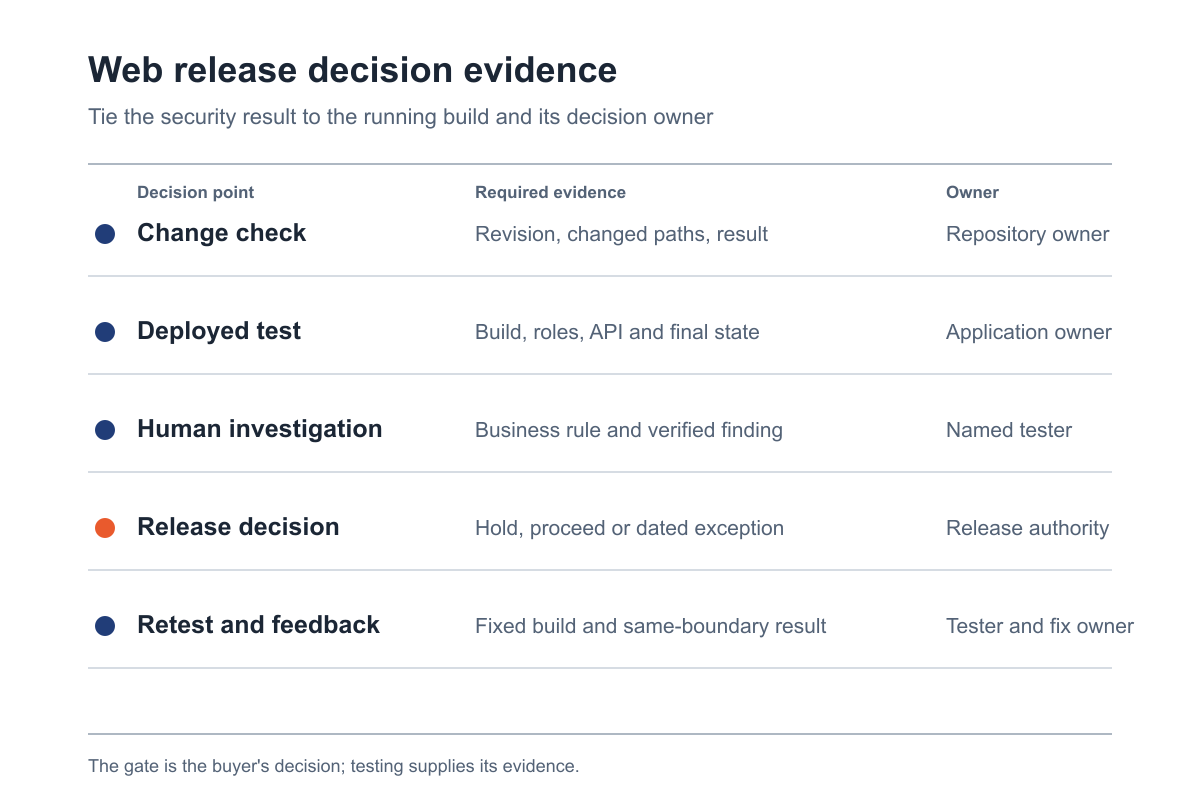
Figure 1: A proposed release evidence chain for one web application and associated APIs. Sources: NIST SSDF; OWASP verification guidance.
The change identifier matters because security evidence can otherwise drift between commits. A failed check on one pull request, a fix on another and a passing deployment on a third may all appear in the same dashboard. The release record should say which revision contained the fix and which environment was exercised. The provider's evidence should include the controlled identity, request or journey, expected policy, observed response and final state. A screenshot of a green check is a status record, not proof that the business rule held.
The deployed test matters because applications are more than repository contents. Identity-provider settings, feature flags, environment variables, route configuration and backend policy can differ by environment. A source-assisted finding should be traced to running behavior where safe. A running finding should be tied back to the relevant component or configuration when access allows. If a third-party identity system or payment service is outside the authorized scope, test the application's side of the boundary and say what was not exercised.
The human note matters when a result needs business interpretation. For example, an API may return a record that the test user technically owns in the test fixture, yet the product policy may say delegated access should have expired. The tester needs the expected rule and may need to compare an allowed and denied case. The final report should not merely list HTTP codes; it should state the authorization relationship, observed state and consequence. This also makes a retest repeatable after the fix.
Preserve clean results as carefully as findings
An empty finding list is not a complete release evidence package. The buyer still needs to know which roles, journeys, API families and environments were exercised. Ask for a coverage statement that separates tested, sampled, excluded and blocked-by-access paths. If the provider had only an administrator account, it could not prove peer-user separation. If an API specification was supplied but its endpoints were not reachable from the test environment, that limitation belongs in the release record.
Do not treat every check as equal coverage. An automated check may inspect a changed source file but not execute a transaction. A targeted dynamic retest may verify one fixed endpoint but not the whole authorization matrix. A human baseline may cover the important paths deeply, then later checks may focus on changes and regressions. The report should attach each conclusion to the method used and the product state observed. This prevents a buyer from interpreting “no new critical findings” as “every route was retested.”
Write a release-hold policy that engineering can use
The buyer should decide in advance which kinds of evidence require a hold, which require expedited human review, and which can proceed under a recorded exception. Severity alone may be insufficient. A moderate technical issue in a high-value approval path may be more urgent than a higher-scored issue on an unreachable test feature. A finding's exploitability, affected data, role, exposure, compensating controls and release change all matter. The provider should report those facts; the buyer's security and product owners should apply the policy.
A workable policy names the decision authority. The engineer who wrote the change may own the fix, but should not be the sole approver of an exception affecting a customer boundary. A security owner can advise on technical risk. A product or business owner may accept the residual risk under the organization's governance. The release manager implements the hold or proceed decision. The agreement should include a reachable escalation path when a finding appears near a deployment window, plus a route for urgent production fixes that cannot wait for the normal review cycle.
Record exceptions with an expiry and a verification condition. “Accepted risk” without a date or owner can become a permanent bypass. An exception should identify the exact finding, affected build or scope, temporary control, reason for proceeding and next test. When the exception closes, test the same unauthorized and authorized behavior in the relevant deployment. NIST SSDF also recommends root-cause analysis and adding toolchain or manual checks to catch similar vulnerabilities in the future. A retest should therefore close the immediate defect and feed back into the trigger policy.
Do not promise a zero-risk gate. Some defects depend on data, integrations or user behavior not represented in the test environment. The release record can state what was proven, what was not reached and what risk remains. Clear limits make the gate more trustworthy because the decision maker can distinguish actual test evidence from a broad marketing claim.
Keep the test safe without making it meaningless
Continuous testing needs stable authorization and test fixtures. Name the web application and associated API hosts, allowed environments, permitted roles, safe data set, rate limits, excluded transactions and an emergency stop contact. Give the provider accounts that can exercise the priority role boundaries and objects that can be reset. Define which changes can be tested in production with non-destructive requests and which require a representative preproduction environment. The provider should never infer permission to test a connected internal network, cloud account or third-party service from permission to test the web application.
Synthetic records should be realistic enough to reveal authorization and workflow mistakes. A single account with an empty database is a poor basis for testing tenant separation or approvals. Create at least the relationships the policy depends on: permitted owner, peer, lower role, elevated role and a record in the state before and after a business action, as applicable. The exact count depends on the application; the principle is to test the decision, not to maximize account numbers. Keep actual customer information and production secrets out of the test evidence.
Define impact boundaries for live testing. A test may need to make a reversible state change to prove an approval, invitation, export or purchase rule. Name the record and rollback owner before testing. Avoid sending real notifications, charging a payment method, revoking a real user or changing a production entitlement for dramatic proof. If a real incident or unexpected effect occurs, the provider pauses and the buyer's response process takes over. The release gate should not create more operational risk than the issue it seeks to prevent.
When application behavior crosses an external boundary, separate what is observed from what is inferred. A safe test of the application's webhook handling can use an authorized test endpoint and synthetic payloads. It cannot prove the security of a partner's infrastructure. A test of OAuth integration can show how the application handles a callback or session under controlled conditions, while the identity provider's internal implementation remains outside scope. State these limits in the report so the next release team does not inherit an exaggerated conclusion.
Compare continuous hybrid quotes on the same decision
Two proposals can use the phrase “continuous hybrid pentest” and provide very different work. One might perform a one-time human test and follow it with scheduled automated scans. Another might provide continuous agent testing with recurring named tester investigation and release-triggered review. Neither shape is inherently right for every product, but they should not be priced as though they answer the same question. Ask each bidder to complete the same scope worksheet before discussing commercial terms.
Scope line | What the buyer should specify | What the provider should commit to |
|---|---|---|
Application boundary | Origins, environments, user journeys and associated API families | Coverage map and exclusions |
Access | Test roles, synthetic objects, source access and change feed | Supported black, grey and white-box methods |
Check trigger | Pull request, deployment, schedule and material-change classes | Which check runs, on what revision, with what result |
Human work | High-risk roles, business workflows and release questions | Named tester participation, review route and timing |
Decision process | Hold criteria, exception authority and escalation | Finding evidence and notification format |
Retest | Fix deployment, same-boundary fixture and deadline | Verification method and versioned status |
Deliverables | Release record, technical finding, executive summary | Build-specific evidence and audit-ready scope record |
Ask for a sample redacted finding and a sample clean coverage record. The finding should show what the tester expected, what the running product did, how business impact was judged and what was retested. The clean record should show which role and API paths were actually checked. Ask for the proposed human engagement schedule in writing. A promise of “human validation” without a window, assigned role or escalation route is difficult to use for a release gate.
Compare the commercial unit as well. Is the quote for one web application and associated APIs, a group of applications, a set of roles, a fixed number of monthly testing windows or a change-volume allowance? Does a new tenant-facing module count as the same application? Are source-assisted checks, dynamic retests and release workshops included? What happens when an emergency release occurs outside the planned testing window? The provider should state these assumptions before a buyer compares prices. This guide does not print a price because the release-trigger scope and staffing need to be clear first; Stingrai's pricing page publishes its standard web packages for comparison.
Distinguish web release testing from pipeline security
A web application release may depend on CI/CD, but application pentesting and pipeline pentesting ask different questions. This guide asks whether changed application behavior creates an exploitable role, data or workflow path in the running web product. A pipeline penetration test asks whether repository permissions, runners, build tokens, artifact handling or deployment trust can be abused. A passing web release check cannot establish that the build chain is secure. A secure build chain cannot establish that a new API operation correctly enforces ownership. Buy both when both decisions matter, with separate authorization and evidence.
The same boundary keeps Snipe's role precise. Snipe tests web applications and associated APIs, including source-assisted pull request checks with repository access. It is not being sold here as an autonomous network, cloud, runner or release-infrastructure tester. The named penetration testers can use their judgment to investigate the web application's logic throughout a Hybrid engagement. Any separate cloud, network or red-team objective needs its own human-led scope and authorization.
How Stingrai can support the release decision
Stingrai's web application penetration testing covers authenticated roles, authorization, business logic, sessions, browser behavior and the associated APIs in scope. Findings are confirmed with evidence, posted as they are found, and retested after a fix is deployed. The report can provide evidence for a customer's security review or compliance program while making clear which release and environment were tested.
Snipe can map the web application and associated APIs, test authentication and authorization paths, review source when access is granted, propose AutoFix pull requests for confirmed findings and check code changes before merge. In the Hybrid service, named penetration testers work alongside Snipe throughout, validate findings and investigate additional paths. The Snipe page describes one-time and continuous programs. For a release-linked program, the statement of work should spell out the application boundary, roles, change triggers, tester window, deployed-build verification and the buyer's release authority.
Frequently Asked Questions
What is continuous hybrid web pentesting for a release gate?
It is an ongoing web application testing arrangement that connects change checks, tests of the deployed application and associated APIs, and penetration testers working alongside the agent throughout the Hybrid engagement. The buyer defines which results hold a release, which require review and which may proceed under an approved exception. Each conclusion should identify the build, environment, roles and methods tested.
Does a passing pull request security check mean the release is safe?
No. A pull request check addresses the code revision and conditions it actually evaluated. Deployed behavior may depend on identity settings, feature flags, data, API routing and other application configuration. Use the check as one input, then verify material behavior in the relevant deployed environment and record the scope limits.
Which application changes should trigger human testing?
Prioritize changes to role or tenant authorization, high-value transactions, approval sequences, identity and session behavior, sensitive data exports and novel integrations. The buyer should define material-change classes with the provider and an owner for ambiguous changes. Human review should investigate the expected business rule, not simply repeat the agent's candidate result.
Can Snipe enforce a merge or deployment gate by itself?
Snipe can check pull requests with repository access and return security findings. The repository and deployment owners configure required checks, protection rules, hold criteria and exceptions. A skipped check or a check on the wrong revision does not provide the intended evidence, so the buyer should verify the gate configuration and decision record.
What should a clean release test report show?
It should show the tested build and environment, user roles, priority journeys, associated API families, methods, dates and exclusions. It should separate full tests from targeted retests or checks. A clean finding list without a coverage map does not show what was actually exercised.
How should a vulnerability fix be retested?
Retest the same authorization or business boundary after the fix reaches the relevant environment. Use controlled identities and synthetic records to confirm the forbidden action is denied and the permitted action still works, including the final business state. Link the new result to the original finding and the deployed build.
Is a continuous Hybrid plan the same as one human pentest followed by scans?
No. The buyer should examine the schedule and staffing. A continuous Hybrid plan should state how named testers participate across the engagement, which changes reach them and how they work with Snipe on the web application and associated APIs. A one-time human assessment followed by automated checks is a different cadence and should be described as such.
Does this engagement test our CI/CD infrastructure or internal network?
No. The web application and associated APIs are the Snipe scope in this guide. Repository access can enable source analysis and pull request checks, but that does not authorize a CI/CD infrastructure, cloud or network penetration test. Those surfaces need separate human-led scoping if the buyer wants them assessed.