




Continuous penetration testing is penetration testing run as a standing program rather than an annual event: the same scope is tested on a fixed cadence and again after significant changes, and each finding is exploited, reported, fixed and retested as it appears. It exists because the time between a weakness appearing and an attacker using it is now shorter than any annual cycle. Verizon's 2026 Data Breach Investigations Report, released on 19 May 2026, found that 31% of breaches start with vulnerability exploitation, which has overtaken stolen credentials as the top entry point for the first time in the report's 19 years.
Quick answer: Continuous penetration testing is a subscription testing program. It starts with a full-scope baseline test, then runs a test cycle every month, adds targeted tests when the application or infrastructure changes, retests every fix, and adds a quarterly deep dive by human penetration testers. Scanners, attack surface management and breach and attack simulation run continuously but are not penetration tests. Published 2026 prices for one web application and associated APIs are US$650 a month for Stingrai's Autonomous continuous plan (monthly testing by Snipe) and US$1,275 a month for its Hybrid continuous plan (monthly Snipe testing, human-verified, plus a quarterly deep dive by human penetration testers); testing on every release is part of Stingrai's Enterprise programs. A well-run program can evidence PCI DSS, SOC 2, ISO 27001 and HIPAA requirements, but none of those frameworks requires a continuous cadence.
Mandiant's M-Trends 2026 puts the mean time to exploit vulnerabilities at an estimated minus 7 days, "meaning exploitation is routinely occurring before a patch is even released." An annual test reports on the application as it stood during the weeks it was tested. A continuous program keeps testing the application your users are actually running.
What is continuous penetration testing?
Continuous penetration testing is a recurring, change-aware penetration testing program in which qualified testers, increasingly working with AI agents, attack an agreed scope on a defined cadence, test again whenever that scope changes significantly, and verify each fix with a retest. The output is a running record of exploitable findings and their remediation, not a single annual report.
Two definitions from standards bodies keep the term honest.
"Continuous" never means literally continuous. NIST's guide to information security continuous monitoring, SP 800-137, defines the terms "continuous" and "ongoing" as meaning controls and risks "are assessed and analyzed at a frequency sufficient to support risk-based security decisions," and adds: "Data collection, no matter how frequent, is performed at discrete intervals." A continuous penetration testing program is defined by its cadence and its change triggers, so both belong in the contract.
"Penetration testing" means exploitation, not detection. NIST SP 800-53 Rev. 5 control CA-8 says penetration testing "goes beyond automated vulnerability scanning" and "attempts to duplicate the actions of adversaries." The PCI DSS v4.0.1 guidance to Requirement 11.4.1 is blunter: "Scanning for vulnerabilities alone is not a penetration test," and "Penetration testing is a highly manual process." A program that only scans every night is continuous scanning, whatever the proposal calls it.
The NIST control itself sets no frequency: CA-8 reads "Conduct penetration testing [Assignment: organization-defined frequency]." That gap is where continuous programs sit. Frameworks set a floor, and the cadence above the floor is a risk decision.
Why annual penetration testing leaves a gap
An annual penetration test is accurate for the build that was tested. The risk sits in everything that ships afterwards: new endpoints, a changed authorization check, a new third-party integration, a role added to the admin panel, an infrastructure change that quietly exposes a management interface. Each is a new attack surface that the last report never saw.
Exploitation speed makes that window expensive. The 2026 DBIR attributes 31% of breaches to vulnerability exploitation and says AI is being used by threat actors "to accelerate the time to exploit known vulnerabilities." M-Trends 2026 reports a negative mean time to exploit. Neither figure says every new flaw will be found by an attacker within days, but both say the old assumption, that a flaw introduced in March can safely wait for next January's test, no longer holds.
The drift problem is covered in more depth, with a break-even calculation for one web application, in our budget case for continuous penetration testing, and the coverage argument in continuous red teaming versus the annual pentest.
How a continuous penetration testing program runs, month to month
A program that deserves the name has six recurring parts. The calendar below shows how they fit across one year; the months are illustrative, not a fixed schedule.
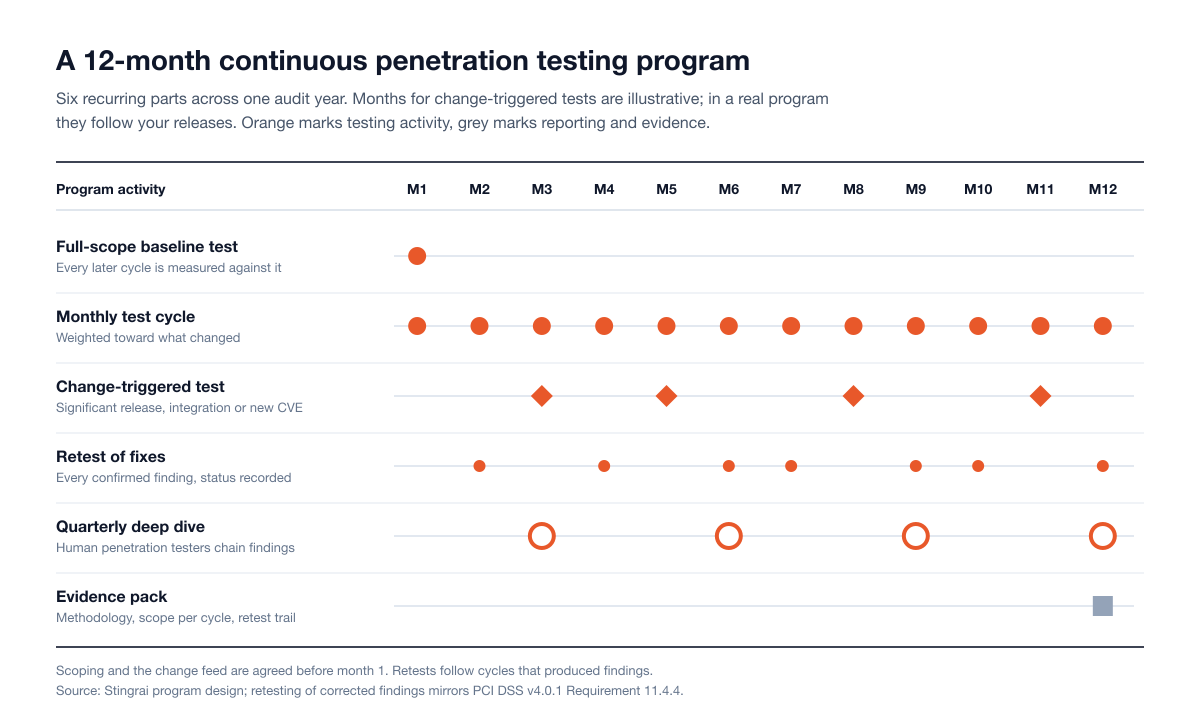
1. Scoping and a change feed (before month 1). The scope lists every application, API, environment and user role in the program, the rules of engagement, and the test accounts for each role. The part most programs miss is the change feed: how the testers learn that something shipped. Release notes, a deployment webhook, a pull request label or a shared change calendar all work. Agree in writing what counts as a significant change, because PCI DSS and HIPAA tie testing or evaluation to change, and the definition will be what an assessor asks for.
2. A full-scope baseline (month 1). The first cycle is a complete penetration test of the agreed scope: authentication, authorization across every role, business logic, injection, session handling and the APIs behind the interface. Every later cycle is measured against it.
3. Monthly test cycles. Each month the scope is tested again, with the depth weighted toward what changed since the last cycle. On an AI-assisted program an agent can cover the full application every cycle while human testers concentrate on new features and the high-value paths.
4. Change-triggered tests. A significant release, a new integration, an authentication change or a newly disclosed vulnerability in your stack triggers a targeted test between cycles rather than waiting for the next one.
5. Retests of every fix. Findings are posted as they are confirmed, with a proof of concept and remediation guidance, and each fix is retested and its status updated. PCI DSS Requirement 11.4.4 makes this explicit: exploitable findings are corrected and "Penetration testing is repeated to verify the corrections."
6. A quarterly deep dive and an evidence pack. Automated and incremental cycles are good at breadth. Every quarter, human penetration testers should spend focused time chaining findings, testing business logic end to end and exploring paths that only appear across several features. At the end of the audit year, the program produces an evidence pack: methodology, scope per cycle, dated results, the retest trail and a statement of what was covered.
For what the weekly output of an AI-driven program looks like in practice, see our sample four-week continuous autonomous pentest engagement log.
What counts as continuous penetration testing, and what does not
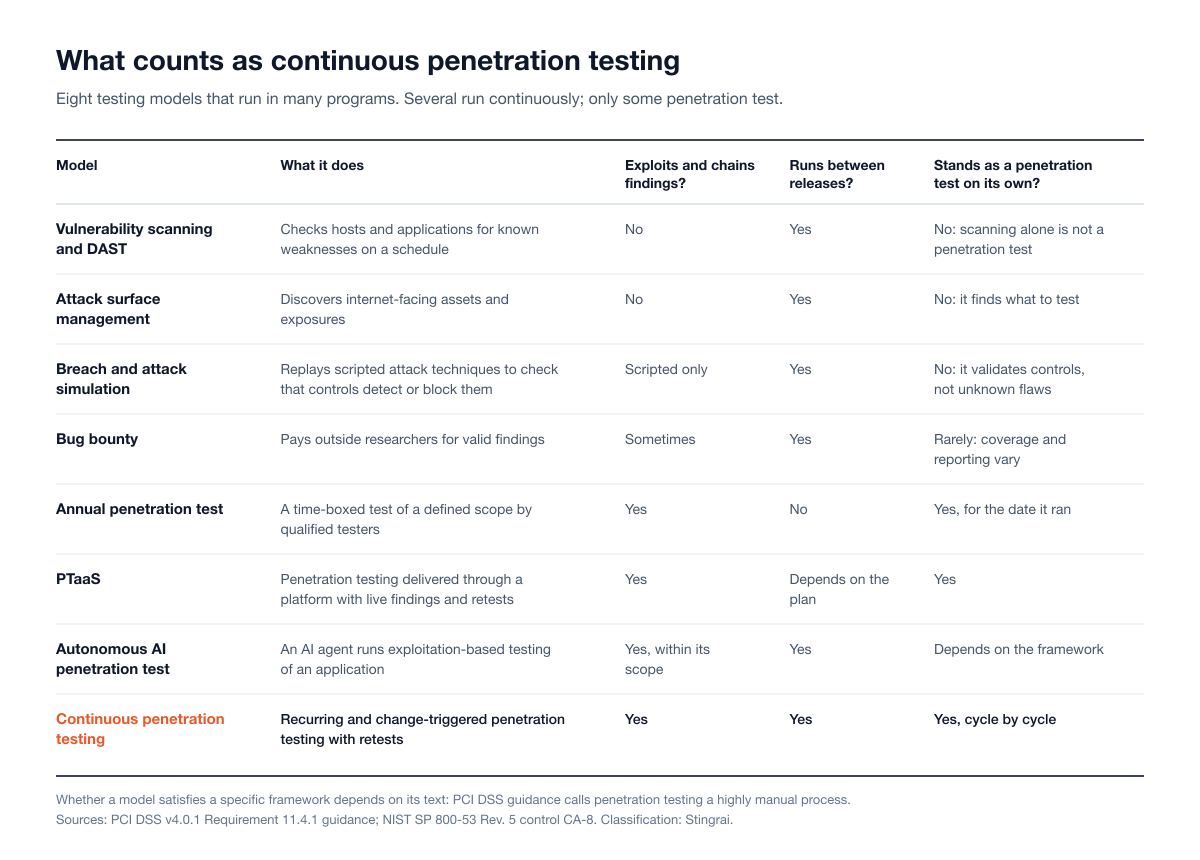
Several categories run continuously and are sold next to continuous penetration testing. They are useful, and most mature programs use several of them, but only some of them penetration test.
Model | What it does | Exploits and chains findings? | Runs between releases? | Can stand as a penetration test on its own? |
|---|---|---|---|---|
Vulnerability scanning and DAST | Checks hosts and applications for known weaknesses on a schedule | No | Yes | No: PCI DSS says scanning alone is not a penetration test |
Attack surface management (ASM) | Discovers internet-facing assets and exposures | No | Yes | No: it finds what to test |
Breach and attack simulation (BAS) | Replays scripted attack techniques to check that controls detect or block them | Scripted only | Yes | No: it validates controls, not unknown flaws |
Bug bounty | Pays outside researchers for valid findings | Sometimes | Yes | Rarely: coverage and reporting vary |
Annual penetration test | A time-boxed test of a defined scope by qualified testers | Yes | No | Yes, for the date it ran |
PTaaS | Penetration testing delivered through a platform with live findings and retests | Yes | Depends on the plan | Yes |
Autonomous AI penetration test | An AI agent runs exploitation-based testing of an application | Yes, within its scope | Yes | Depends on the framework |
Continuous penetration testing | Recurring and change-triggered penetration testing with retests | Yes | Yes | Yes, cycle by cycle |
Three distinctions matter most to buyers.
Continuous pentesting versus vulnerability scanning. A scanner reports that something might be vulnerable. A penetration test proves it, and finds the classes scanners cannot see: broken object-level authorization, privilege escalation between roles and business logic flaws. Our comparison of vulnerability assessment versus penetration testing sets out which frameworks accept which.
Continuous pentesting versus PTaaS. PTaaS is a delivery model: the portal, live findings, chat with testers and retests. Continuous testing is a cadence. Many PTaaS engagements are one-time, and a continuous program can run without a platform, though it rarely should. Our continuous pentesting vs PTaaS guide covers the overlap, and Stingrai's PTaaS platform page shows one in practice.
Continuous pentesting versus BAS and bug bounty. BAS tells you whether your defenses catch known techniques; it does not look for the new flaw in last week's release. A bug bounty brings in many researchers, but you pay for findings rather than coverage, so nothing ensures the new payment flow gets tested this month. Our penetration testing vs bug bounty guide and the AEV, BAS, PTaaS and autonomous pentest decoder go further.
Is penetration testing being replaced by AI?
No, but AI has changed what continuous penetration testing costs and how often it can run. AI agents can now run exploitation-based testing of a web application every month, which makes a monthly cadence affordable for teams that could previously budget for one test a year. Some agents, including Snipe, test for authorization and business logic flaws as well as known vulnerability classes.
What AI does not replace is the judgment that frameworks write into their definitions. The PCI DSS customized approach objective for Requirement 11.4.1 describes testing "via simulated attack methods by a competent manual attacker," and NIST CA-8 describes penetration testing as work by "agents and teams with demonstrable skills and experience." Stingrai recommends hybrid programs: an agent covers the full application every cycle, and human penetration testers work alongside it on the features that changed, the paths that cross several features and the logic only a person who understands the business will question. Our guide to splitting the attack surface between autonomous and human testing and our explainer on hybrid web application penetration testing cover the division of labour.
What continuous penetration testing costs
Continuous programs are priced in five ways, and comparing quotes starts with knowing which one you are looking at.
Per-asset subscription. A monthly or annual fee per application or target, with a defined cadence. Easiest to compare.
Hours or credits. A bank of tester time drawn down per test. Flexible, but coverage depends on how the hours are spent.
Unlimited-testing subscription. A fixed annual fee for on-demand testing of a defined scope.
Per test. Each cycle is priced separately, which is continuous only if you keep buying.
Pay per finding. The bug bounty model: cost tracks results, not coverage.
These are the prices providers publish, read from their pricing or product pages on 5 November 2026. Scopes differ, so compare what each covers, not only the figure.
Model | Published example | What the price covers |
|---|---|---|
Autonomous continuous | Stingrai Autonomous Pentest: US$650 a month on a 12-month plan (US$7,800 a year) | One web application and associated APIs; monthly autonomous testing by Snipe |
Hybrid continuous | Stingrai Hybrid Pentest: US$1,275 a month on a 12-month plan (US$15,300 a year) | One web application and associated APIs; monthly Snipe testing, human-verified, plus a quarterly deep dive by human penetration testers |
Unlimited-testing subscription | Raxis PTaaS: "Prices start at $25K for one year depending on the scope" | On-demand testing and retesting; Raxis says unlimited access "costs typically 2 to 3 times a traditional penetration test per year" |
Per-target annual plan | Astra Pentest Expert: US$5,999 a year; Astra Enterprise, described as a "continuous pentest program": US$9,999 a year and up | Pentest Expert: one target (one web or SaaS app with the APIs it consumes); Enterprise: tailored to your infrastructure |
Crowdsourced testing | Synack: "Pricing starts at $27,120" for one Synack14 pentest | A point-in-time price; continuous options are quoted, and the Synack Platform "is a separate line item" |
Per-test autonomous | Cobalt Autonomous Pentest: US$3,500 per test | Promotional limited-time price for tests initiated and completed before 31 December 2026 |
Scanner subscription (not a penetration test) | Astra Scanner (DAST): US$199 a month | One target, automated scans |
Against one-time testing, the arithmetic for one application looks like this.
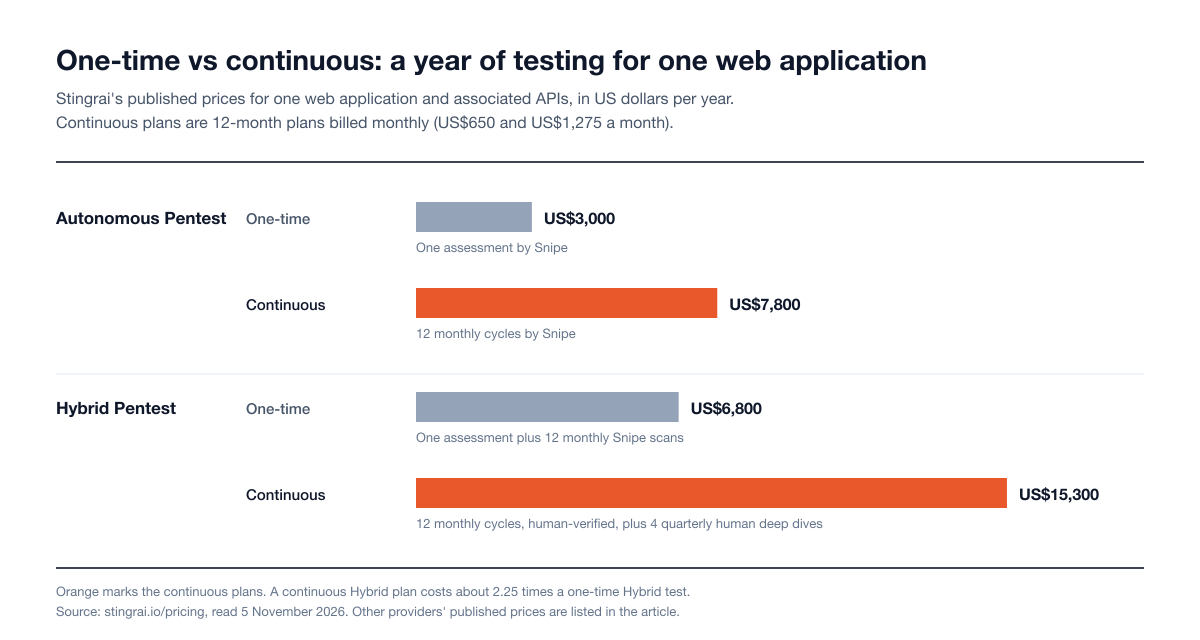
Stingrai published price, one web application and associated APIs | One-time test | Continuous, 12-month plan |
|---|---|---|
Autonomous Pentest | US$3,000 per assessment | US$650 a month, US$7,800 a year |
Hybrid Pentest | US$6,800 per assessment, followed by 12 monthly Snipe scans | US$1,275 a month, US$15,300 a year |
A continuous Hybrid plan costs about 2.25 times a one-time Hybrid test, and buys 12 monthly test cycles, human-verified, and four quarterly human deep dives, where the one-time Hybrid is one assessment followed by 12 monthly automated Snipe scans. Whether that is worth it depends on how much ships between tests. What moves any quote is the number of applications, user roles and API endpoints, how often you release, whether network, cloud or mobile scope is included, and how much human testing time each cycle carries. Our PTaaS pricing comparison and penetration testing cost guide go deeper, and every Stingrai figure above is on the pricing page.
When an annual penetration test is enough
Continuous testing is not automatically the better purchase. An annual test, with a retest, is usually enough when:
The application changes a few times a year, not every sprint.
One compliance program drives the test, and it asks for an annual cadence.
The estate is small and stable: one application, a handful of roles, no frequent new integrations.
A significant change is rare enough that a targeted test after it is practical to buy on its own.
Continuous testing usually pays when:
You release weekly or faster, or ship new endpoints every month.
PCI DSS applies and your changes regularly meet your own definition of significant, so "after any significant infrastructure or application upgrade or change" would mean several tests a year anyway.
Enterprise customers send security questionnaires through the year and want current evidence, not last year's report.
You run several applications, or the attack surface grows through acquisitions or new products.
Our guide to how often you should do penetration testing maps cadence to each framework and risk profile in more detail.
How auditors and frameworks treat continuous penetration testing evidence
No major framework requires a continuous cadence, and none of them forbids it. What they require is a minimum frequency, testing after change, and a record an auditor can sample. A continuous program meets those requirements when every cycle is documented as a test and the year adds up to full coverage of the scope.
Framework | What the text requires | What continuous evidence must show |
|---|---|---|
PCI DSS v4.0.1, Requirement 11.4 | Internal and external testing at least once every 12 months and after any significant change; a defined methodology; corrected findings retested; results kept for 12 months | Full methodology coverage within each 12 months, a test after each significant change, the retest trail |
SOC 2 (2017 Trust Services Criteria, 2022 points of focus) | CC4.1 asks for ongoing and/or separate evaluations; penetration testing is one listed type | Dated cycles across the observation period, with findings tracked to remediation |
ISO/IEC 27001:2022 | No clause names penetration testing; tests are common evidence for Annex A 8.8, management of technical vulnerabilities | Scope tied to the Statement of Applicability, with results feeding the vulnerability process |
HIPAA Security Rule | Today, a periodic evaluation under 45 CFR 164.308(a)(8); a proposed rule would require testing at least every 12 months | Dated tests and a record of evaluation after environmental or operational change |
FTC Safeguards Rule, 16 CFR 314.4(d)(2) | Continuous monitoring, or annual penetration testing plus vulnerability assessments every six months | The annual test within the program, plus six-monthly vulnerability assessments, unless real-time continuous monitoring is in place |
NYDFS 23 NYCRR 500.5 | Penetration testing from inside and outside at least annually, plus automated scans promptly after material changes | The annual test, plus scanning tied to change |
PCI DSS v4.0.1. Requirements 11.4.2 and 11.4.3 require internal and external penetration testing "At least once every 12 months" and "After any significant infrastructure or application upgrade or change," by a qualified resource with organizational independence. Requirement 11.4.1 requires a methodology that includes "Review and consideration of threats and vulnerabilities experienced in the last 12 months" and "Retention of penetration testing results and remediation activities results for at least 12 months." A continuous program meets 11.4 when the year's cycles cover the full methodology, including network-layer and segmentation testing where they apply, and when each significant change has a dated test against it. A web application program on its own does not cover the network-layer elements. Our PCI DSS penetration testing guide walks through each sub-requirement.
SOC 2. CC4.1 requires that the entity "selects, develops, and performs ongoing and/or separate evaluations," and its points of focus include "Considers a Mix of Ongoing and Separate Evaluations" and "Integrates With Business Processes," under which "Ongoing evaluations are built into the business processes and adjust to changing conditions." The 2022 point of focus lists penetration testing among the "ongoing and separate risk and control evaluations" management may use. For a Type 2 report, a continuous program places dated test evidence across the whole observation period rather than at one point in it. Our guide to SOC 2 penetration testing requirements covers which criteria a test evidences.
ISO/IEC 27001:2022. The standard does not name penetration testing. Test results are common evidence for Annex A control 8.8, management of technical vulnerabilities, and for 8.29, security testing in development and acceptance, which is where change-triggered testing fits naturally. See our ISO 27001 penetration testing guide.
HIPAA. The current Security Rule requires a "periodic technical and nontechnical evaluation" under 45 CFR 164.308(a)(8), first against the rule's standards and then "in response to environmental or operational changes." The proposed rule published on 6 January 2025 would require penetration testing "at least once every 12 months or in accordance with" the risk analysis, "whichever is more frequent," and automated vulnerability scans at least every six months. It is not final: the Unified Agenda entry for RIN 0945-AA22 lists it as a long-term action with final action projected for July 2027. Our HIPAA penetration testing requirements guide tracks it.
FTC Safeguards Rule. Of the frameworks here, only the FTC Safeguards Rule offers continuous monitoring as an alternative to the annual test, and the FTC describes it as real-time, ongoing monitoring of system security, not a testing cadence. 16 CFR 314.4(d)(2) says testing "shall include continuous monitoring or periodic penetration testing and vulnerability assessments," and that "Absent effective continuous monitoring or other systems to detect, on an ongoing basis, changes in information systems that may create vulnerabilities," an institution must run annual penetration testing and vulnerability assessments at least every six months. The final rule published on 9 December 2021 explains continuous monitoring as "any system that allows real-time, ongoing monitoring of an information system's security, including monitoring for security threats, misconfigured systems, and other vulnerabilities." A continuous penetration testing program is the periodic route: it delivers the annual penetration test, and the six-monthly vulnerability assessments are still required. Our FTC Safeguards Rule penetration testing guide covers the evidence to keep.
NYDFS. 23 NYCRR 500.5 requires penetration testing "from both inside and outside the information systems' boundaries by a qualified internal or external party at least annually," plus automated scans "at a frequency determined by the risk assessment, and promptly after any material system changes." A continuous program covers the annual penetration test, and its change-triggered tests help evidence testing after material changes; the automated scans and the manual review of systems they miss remain a separate, risk-based obligation.
How to evaluate a continuous penetration testing provider
Ask every provider the same eight questions, and get the answers in the contract:
Who tests each cycle? An agent, named human testers, or both, and how much human time each cycle carries.
What is the cadence, in writing? Monthly, quarterly or on demand, and what "continuous" means in their statement of work.
What triggers a change test? How they learn that something shipped, and how quickly a triggered test starts.
What does each cycle produce? A dated result with scope, method and findings, or only a dashboard.
Are retests included? For every fix, and how the status is recorded.
What does the year-end evidence look like? A coverage statement, an attestation letter, and a report an assessor can sample.
What is in scope? Web applications and APIs only, or also cloud, network, mobile and Active Directory if your framework needs them.
How is it priced? Per asset, per hour, unlimited or per finding, and what happens when you add an application mid-year.
Our ranked list of continuous penetration testing providers and tools scores providers on these criteria.
How Stingrai runs continuous penetration testing
Stingrai is a CREST-accredited penetration testing company, accredited for both Penetration Testing and AI-Enabled Penetration Testing, offering fully human-led and hybrid (human penetration testers plus AI agents) penetration tests, delivered by experienced penetration testers who are also world-class security researchers and bug bounty hunters. The team holds OSCE³, OSWE, OSEP, OSCP and CREST CRT certifications, has published 18 CVEs, and its members sit in bug bounty Halls of Fame at Apple, Google and the US Department of Defense. Stingrai runs both one-time annual penetration tests and continuous programs, so the cadence follows your release rate and your audit calendar rather than the other way round.
Stingrai's continuous plans, at published prices on the pricing page:
Autonomous Pentest, continuous: US$650 a month on a 12-month plan, for one web application and associated APIs. Monthly autonomous testing by Snipe, Stingrai's AI agent for web applications and associated APIs, with a specialist sub-agent for AI and LLM applications. Snipe hunts IDOR, broken authorization and business logic flaws as well as known vulnerability classes, runs black-box, grey-box and white-box testing across up to three user roles, and adds automated retests and, with repository access, AutoFix pull requests. It delivers a pentest report. The one-time Autonomous Pentest is US$3,000 per assessment.
Hybrid Pentest, continuous: US$1,275 a month on a 12-month plan, for one web application and associated APIs. Monthly Snipe testing, human-verified, plus a quarterly deep dive by human penetration testers who chain findings and pursue business logic. It includes the PTaaS portal with Jira and Slack and quarterly executive status reports, and the Hybrid tier carries a human-validated report and an attestation letter. The one-time Hybrid Pentest is US$6,800 per assessment.
Enterprise, custom. One-time or continuous coverage across web, API, mobile, cloud, network, Active Directory, social engineering and red teaming, including continuous testing on every web and API release. Human-led engagements are staffed by two named penetration testers from a team holding OSCE³, OSWE, OSEP and CREST CRT certifications.
The Autonomous and Hybrid plans run on their monthly and quarterly cadence; testing on every web and API release is part of Enterprise programs. Where an assessor expects manual testing, as PCI DSS 11.4 does, or a customer expects an attestation letter, the Hybrid plan or a human-led engagement is the fit.
Snipe tests web applications and associated APIs. Network, cloud, mobile and Active Directory testing in a continuous program is done by Stingrai's penetration testers under an Enterprise plan. Findings land in the PTaaS portal as they are confirmed, each with a proof of concept and remediation guidance, and fixed findings are retested on request. The testing produces the evidence that SOC 2, ISO 27001, PCI DSS and HIPAA programs reference. For web application scope in depth, see the web application penetration testing and API penetration testing services.
Frequently Asked Questions
What is continuous penetration testing?
Continuous penetration testing is penetration testing run as a standing program instead of an annual event. The same scope is tested on a fixed cadence, usually monthly, and again after significant changes, and every finding is exploited to prove impact, reported as it is confirmed and retested after the fix. NIST notes that even continuous monitoring collects data at discrete intervals, so the cadence and the change triggers should be written into the contract.
How does continuous pentesting work?
A program starts with scoping and a change feed, then a full-scope baseline penetration test. After that it runs a test cycle every month weighted toward what changed, adds targeted tests when a significant release or a new vulnerability lands, retests every fix, and adds a quarterly deep dive by human penetration testers. At the end of the audit year it produces an evidence pack of methodology, scope per cycle, dated results and the retest trail.
How much does continuous penetration testing cost?
Published 2026 prices for one web application and associated APIs are US$650 a month (US$7,800 a year) for Stingrai's Autonomous continuous plan (monthly testing by Snipe) and US$1,275 a month (US$15,300 a year) for its Hybrid continuous plan (monthly Snipe testing, human-verified, plus a quarterly deep dive by human penetration testers); testing on every release is part of Stingrai's Enterprise programs. Other published price points include Astra's US$9,999 a year and up for its continuous Enterprise plan and Raxis's PTaaS subscriptions at US$25,000 a year and up, depending on scope.
Is continuous penetration testing the same as vulnerability scanning?
No. A scanner checks for known weaknesses and reports that something might be vulnerable; a penetration test exploits weaknesses to prove impact and finds classes scanners miss, such as broken authorization and business logic flaws. PCI DSS v4.0.1 guidance states that "Scanning for vulnerabilities alone is not a penetration test."
Is pentesting being replaced by AI?
No, but AI has made continuous testing affordable. AI agents can now run exploitation-based testing of a web application every month, and some agents, including Snipe, test for authorization and business logic flaws. Frameworks still describe penetration testing as skilled human work: PCI DSS refers to "a competent manual attacker". Stingrai recommends hybrid programs, with an agent covering the full application each cycle and human penetration testers working alongside it.
Does continuous penetration testing satisfy PCI DSS Requirement 11.4?
It can. PCI DSS v4.0.1 requires internal and external penetration testing at least once every 12 months and after any significant infrastructure or application upgrade or change, under a defined methodology, with exploitable findings corrected and retested. A continuous program satisfies 11.4 when its cycles cover the full methodology within each 12 months, including network-layer and segmentation testing where required, and each significant change has a dated test.
Does SOC 2 accept continuous penetration testing?
Usually, as evidence for CC4.1; acceptance is the auditor's call. SOC 2 does not require any specific test, but CC4.1 asks for "ongoing and/or separate evaluations," and the 2022 point of focus lists penetration testing among them. For a Type 2 report, a continuous program places dated test results, remediation and retests across the whole observation period.
Is an annual penetration test enough?
For a stable application that changes a few times a year and answers to one annual compliance requirement, usually yes, with a targeted test after any significant change. Teams that release weekly, fall under PCI DSS change-driven testing, or face enterprise security reviews through the year usually need continuous testing to keep their evidence current.
What is the difference between continuous pentesting and PTaaS?
PTaaS is a delivery model: penetration testing through a platform with live findings, chat with testers and retests. Continuous pentesting is a cadence: testing that repeats on a schedule and after change. Many PTaaS engagements are one-time; a continuous program is usually delivered through a PTaaS platform.
Related reading
Continuous penetration testing: top providers and tools, ranked
Continuous pentesting vs PTaaS: tool, service, and where AI fits
What a continuous autonomous pentest looks like: a sample four-week engagement log
Talk to Stingrai
Stingrai scopes continuous programs on a free scoping call: which applications belong in the program, what counts as a significant change for your team, and whether an annual test, an Autonomous plan or a Hybrid plan fits your release rate and audit calendar. Get a quote or read the published pricing.