An AWS security assessment is an independent review of how an AWS organization is built and configured: its account structure and organization policies, IAM and IAM Identity Center, logging, threat detection, data protection, networks, compute, containers, serverless functions and the CI/CD roles that deploy into it. It measures that configuration against AWS's own guidance and the CIS Amazon Web Services Foundations Benchmark, which the Center for Internet Security lists at version 7.1.0 as of 19 November 2026.
Regulators have penalized weak cloud risk assessment before. In August 2020 the Office of the Comptroller of the Currency assessed a US$80 million civil money penalty against Capital One for its "failure to establish effective risk assessment processes prior to migrating significant information technology operations to the public cloud environment" (OCC).
Quick answer. An AWS security assessment reviews your side of the AWS shared responsibility model across every account that matters: organization guardrails (SCPs, RCPs and declarative policies), IAM and Identity Center, CloudTrail and AWS Config, GuardDuty, S3 Block Public Access and KMS, VPC exposure, IMDSv2, EKS, Lambda and CI/CD federation. It is broader than an AWS penetration test, which proves which weaknesses chain into access, and deeper than Security Hub, which flags settings one control at a time. Stingrai's cloud penetration testing team, part of a CREST-accredited firm, runs both and quotes AWS work to scope.
This is the AWS-specific companion to our cloud security assessment guide.
What is an AWS security assessment?
An AWS security assessment tests whether the controls you are responsible for in AWS are configured the way your organization intends, in every account and Region. AWS draws the line in its shared responsibility model: AWS "is responsible for protecting the infrastructure that runs all of the services offered in the AWS Cloud", while "customer responsibility will be determined by the AWS Cloud services that a customer selects."
The assessment covers that customer half only. AWS's penetration testing policy welcomes customers "to carry out security assessments or penetration tests of their AWS infrastructure" for the services it lists, and forbids assessing "AWS infrastructure or the AWS services themselves." A configuration assessment reads your own settings through AWS's APIs with read-only credentials you issue, well inside that policy.
The reason to buy one is a gap AWS itself names. The AWS Well-Architected Framework lists among the common issues: "Control objectives exist as documents but are never validated in the running environment, so posture is assumed rather than known." An assessment replaces the assumption with evidence.
The three yardsticks an AWS assessment uses
A credible assessment names the references it measured against, and their versions.
The Well-Architected Framework security pillar. AWS consolidated its pillar whitepapers into one framework document, last updated on 16 November 2026 (AWS release notes). The security pillar now "groups practices into four areas": security governance and operations, identity and access management, data protection, and infrastructure and application protection. It is design guidance, the source of findings no automated check produces.
AWS Foundational Security Best Practices (FSBP). A standard "developed by AWS and industry professionals" whose controls "detect when AWS accounts and resources deviate from security best practices" (AWS). It runs as version 1.0.0 in Security Hub CSPM, and its control IDs (IAM.4, CloudTrail.1, S3.8) give findings a shared vocabulary.
The CIS Amazon Web Services Foundations Benchmark. CIS lists version 7.1.0 as current (CIS). Security Hub CSPM supports versions 5.0.0, 3.0.0, 1.4.0 and 1.2.0 and recommends 5.0.0, and AWS notes that "many of the unsupported requirements can be evaluated only by manually reviewing the state of your AWS resources" (AWS).
That gap is the practical case for a human review. A dashboard reading 100% on Security Hub's CIS standard was scored against version 5.0.0 at best, minus the requirements it cannot automate, while the benchmark has moved on to 7.1.0. AWS states that its standards "don't guarantee compliance with any regulatory frameworks or audits" (AWS).
AWS security assessment vs AWS penetration test vs AWS's own tools
AWS ships strong native security services, and every mature AWS estate should run them. They answer narrower questions than an assessment, and an assessment answers a different question from a penetration test. The table sets out what each finds and misses, in AWS's own description where AWS gives one.
Tool or engagement | What it is | What it finds | What it misses |
|---|---|---|---|
AWS Security Hub CSPM | Automated control checks against FSBP, CIS, PCI DSS, NIST and other standards | A setting that fails a control, per account and Region | SCP and RCP content, CIS requirements it cannot automate, intent, and Regions where it is not enabled |
AWS Security Hub | Correlates Security Hub CSPM, Inspector and other findings into exposure findings with an attack path graph | Exposures built from the findings its source services already report | Anything none of its source services report |
Amazon Inspector | Scans EC2, container images in ECR and Lambda functions for software vulnerabilities and unintended network exposure | Vulnerable packages and open network paths on workloads | Organization design, IAM trust, logging and guardrails |
IAM Access Analyzer | Finds resources shared outside your zone of trust, internal access to selected resources and unused access | Cross-account and public shares, unused roles, keys and passwords | Whether a share inside the zone of trust is too broad by design; external access in Regions with no analyzer |
Amazon GuardDuty | Threat detection over CloudTrail management events, VPC flow logs, DNS logs and enabled protection plans | Activity that looks malicious once it happens | Weak configuration before anyone uses it; Regions and plans that are not enabled |
AWS Continuum for Penetration Testing (formerly AWS Security Agent) | On-demand testing that AWS says "tests deployed applications and source code" | Application vulnerabilities with reproducible proof | AWS describes application testing, not organization structure, guardrails or account configuration |
AWS security assessment | Read-only review of organization and account configuration by an assessor, against the Well-Architected Framework, FSBP and CIS | Guardrail gaps, trust and logging design, drift between accounts, controls no tool covers | Proof that an attacker can chain the weaknesses, unless paired with testing |
AWS penetration test | Penetration testers try to turn weaknesses into proven impact from agreed starting points | Exploitable attack paths with evidence, and whether detection noticed | Breadth: it follows paths rather than reviewing every account's settings |
Sources: Security Hub CSPM, Security Hub, Amazon Inspector, IAM Access Analyzer, Amazon GuardDuty, AWS Continuum product page, read 19 and 20 November 2026.
Each tool is only as complete as its enablement. Security Hub CSPM needs AWS Config recording "to generate most control findings" and must run "in all supported AWS Regions" for full CIS checks (AWS); IAM Access Analyzer's external analysis covers only "the same AWS Region where it's enabled" (AWS); and GuardDuty is "a Regional service" (AWS). Checking that enablement across accounts and Regions is part of the assessment.
AWS moved AWS Security Agent's penetration testing into AWS Continuum on 17 June 2026 (AWS Security Blog); our analysis of whether AWS Security Agent replaces a cloud penetration test covers its fit and gaps, and CNAPP blind spots covers third-party posture tools. The practical sequence: run the native services continuously, commission an assessment to confirm the organization is built the way the policy documents say, and commission a penetration test to prove which remaining weaknesses chain together. Many buyers combine the last two in one engagement.
What does an AWS security assessment check?
A complete assessment covers ten areas. Figure 1 maps each to the Security Hub CSPM controls that flag it and to what the assessor verifies that a control check cannot.
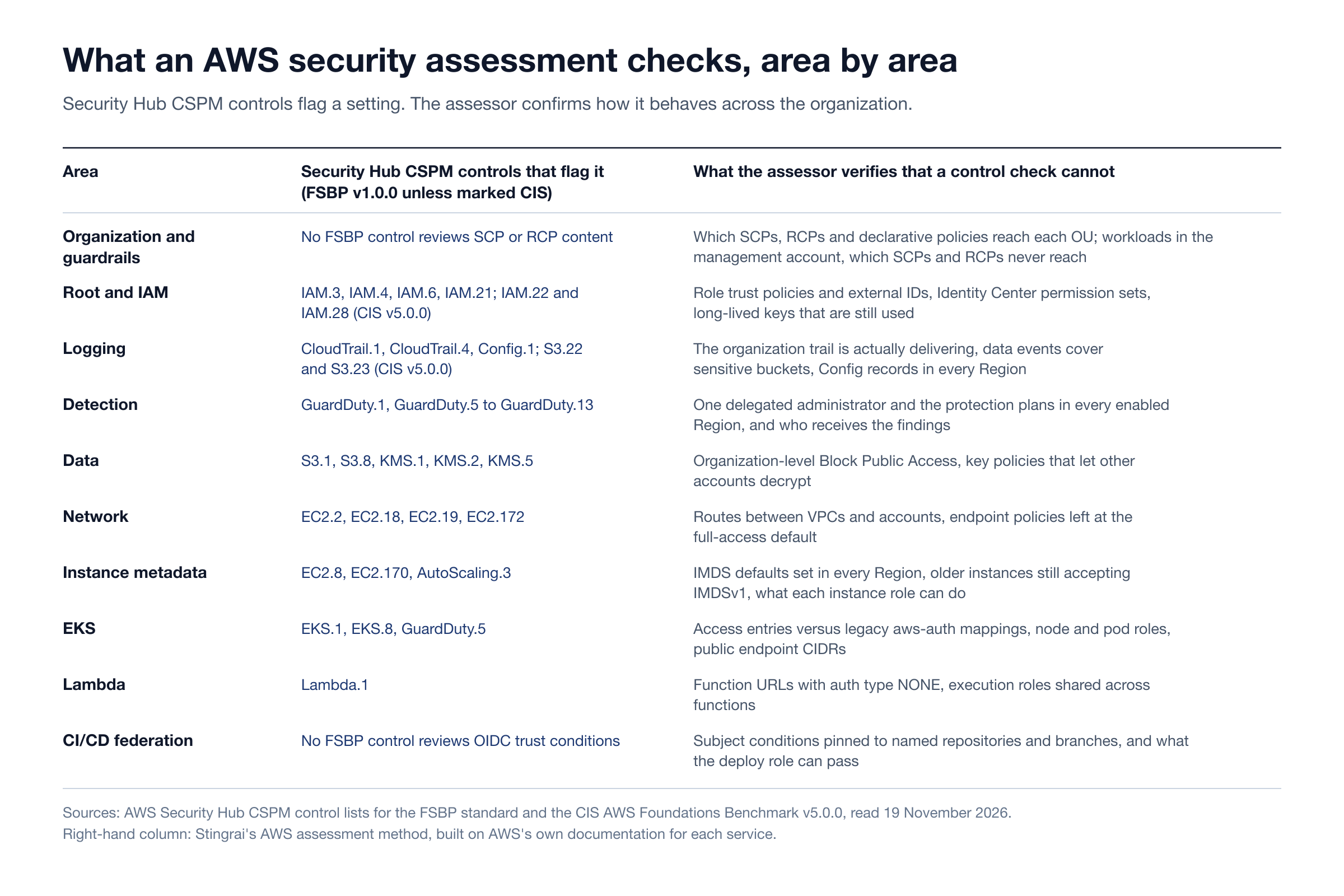
Figure 1: Ten assessment areas, the FSBP and CIS v5.0.0 controls that flag each, and what an assessor verifies beyond them. Source: AWS Security Hub CSPM control lists and CIS AWS Foundations Benchmark in Security Hub CSPM, read 19 November 2026.
Organization structure, SCPs, RCPs and declarative policies
Guardrails set at the top of the organization decide what every account can do, and the assessor maps where each policy type stops.
Service control policies (SCPs) set "the maximum available permissions for the IAM users and IAM roles in your organization" and grant none. They bind member accounts "including the member account's root user," but "SCPs don't affect users or roles in the management account" (AWS Organizations).
Resource control policies (RCPs) restrict principals "external to your organization" reaching resources in member accounts, across services including S3, KMS, STS, Secrets Manager and SQS; "RCPs don't affect resources in the management account" (AWS Organizations).
Declarative policies "are enforced in the service's control plane" (AWS), covering settings such as VPC Block Public Access and Instance Metadata Defaults, and Organizations S3 policies enforce S3 Block Public Access and "override account-level settings" (AWS). Unlike SCPs and RCPs, a declarative policy attached to the root also applies to the management account (AWS Organizations). Since October 2026 for GuardDuty and November 2026 for Security Hub CSPM, declarative policies can also enable those services across every account and Region, and AWS calls them "the recommended way to manage Security Hub CSPM across an organization" (AWS; AWS).
No Security Hub CSPM control reviews SCP or RCP content, so this layer is assessor work, and the management account exception is the finding that matters most. Datadog's State of Cloud Security (updated November 2026; data collected in September 2026 from a sample of thousands of organizations that use Datadog) found that 96% of organizations use AWS Organizations but only 55% implement data perimeters, and 14% run EC2 instances in their management account, up from 9% in 2025 (Datadog). Those workloads sit outside every SCP and RCP. The assessor also checks root credentials: with centralized root access, "new accounts you create in Organizations have no root user credentials by default" (AWS IAM), so older accounts are where root passwords and keys still turn up.
IAM: roles, trust policies, Identity Center and access keys
AWS's IAM best practices say to "require your human users to use temporary credentials when accessing AWS" and recommend IAM Identity Center for workforce access. The assessment measures the distance from that.
Root and IAM users: FSBP checks IAM.4 (no root access key), IAM.6 (hardware MFA for root) and IAM.3 (keys rotated every 90 days); CIS v5.0.0 adds IAM.22 for credentials unused for 45 days. Datadog found 37% of organizations still use IAM users with long-lived credentials for console access (Datadog).
Access keys: AWS's own security team concluded in January 2025 that "the root cause of this and a large portion of security events is the compromise of long-term access keys" (AWS Security Blog). The assessor lists every active key, who uses it, and whether a role could replace it.
Role trust policies: who can assume each role, whether third-party roles require an external ID, and what a role trusted by another account can reach. See our cloud IAM penetration testing guide.
IAM Identity Center: which permission sets reach which accounts, and whether broad ones reach production; the permission set assessment guide goes deeper.
IAM Access Analyzer: CIS control IAM.28 checks that an external access analyzer exists; the assessor checks that it uses the organization as its zone of trust in every Region in use.
Logging: CloudTrail and AWS Config
FSBP checks for a multi-Region trail (CloudTrail.1), log file validation (CloudTrail.4) and AWS Config recording (Config.1). The assessor confirms the logging works. An organization trail logs "events for the management account and all member accounts," and member-account users cannot "turn logging on or off" (AWS CloudTrail). But "CloudTrail creates organization trails in member accounts even if a resource validation fails," such as a wrong bucket policy or KMS permission, so a trail can exist everywhere and deliver nothing. The assessor checks delivery, not existence.
By default, "trails and event data stores do not log data events" (AWS CloudTrail), so object reads in sensitive buckets go unrecorded unless enabled; CIS v5.0.0 checks this through S3.22 and S3.23. An AWS Config aggregator's "read-only view into the source accounts and Regions" (AWS Config) is useful evidence that Config records everywhere it should.
Detection: GuardDuty
GuardDuty analyzes "AWS CloudTrail management events, VPC flow logs (from Amazon EC2 instances), and DNS logs" by default, plus optional protection plans (AWS GuardDuty); FSBP checks GuardDuty.1 and GuardDuty.5 to GuardDuty.13. The gaps hide in the multi-account rules. "Unlike AWS Organizations, GuardDuty is a Regional service"; AWS requires one delegated administrator "across all the AWS Regions where GuardDuty is enabled" and advises against using the management account for it (AWS). For existing customers, "a protection plan that launches after you enabled GuardDuty is not enabled automatically." The assessor checks every Region, every plan, and who receives the findings.
Data: S3 Block Public Access and KMS
"By default, new buckets, access points, and objects don't allow public access," and Block Public Access can be set at organization, account, bucket and access point level (Amazon S3). The trap: the settings "don't alter existing policies or ACLs," so "removing a block public access setting causes a bucket or object with a public policy or ACL to again be publicly accessible." A bucket private only because of an account setting has a public policy waiting underneath. FSBP checks S3.1 and S3.8; an organization-level S3 policy is the stronger control.
For KMS, "key policies are the primary way to control access to KMS keys," and they "are Regional" (AWS KMS). The assessor reads them for principals in other accounts that can decrypt, alongside KMS.1, KMS.2 and KMS.5. Defaults also move: from April 2026 S3 began disabling SSE-C for all new general purpose buckets, but not on existing buckets in accounts already using it (AWS). Older accounts keep older behaviour, one reason to sample accounts by age.
Network: VPCs, security groups and endpoints
FSBP covers default security groups (EC2.2), unrestricted ingress (EC2.18, EC2.19) and VPC Block Public Access (EC2.172). The assessor adds what spans accounts: Transit Gateway and peering routes that join environments meant to be separate, and VPC endpoints, whose default policy "grants full access to the endpoint" (AWS PrivateLink). Endpoints left at that default are a common gap in data perimeter designs.
Compute: IMDSv2
FSBP checks instances (EC2.8), launch templates (EC2.170) and Auto Scaling launch configurations (AutoScaling.3) for IMDSv2. The account settings hide more than a control result shows (Amazon EC2): IMDS defaults "must be configured in each AWS Region" unless a declarative policy sets them; "setting the account-level default does not reset existing instances"; and enforcement is a separate switch, under which "instances can only launch if they're configured to require IMDSv2." The assessor records default, enforcement and managing entity per Region, lists instances still accepting IMDSv1, and reads what each instance role can do.
Containers: EKS
For a new cluster, "by default, this API server endpoint is public to the internet" (Amazon EKS); EKS.1 flags it and EKS.8 checks audit logging. The assessor also maps IAM to Kubernetes: when a cluster moves from the legacy aws-auth ConfigMap to access entries, extra roles in the ConfigMap "are not automatically migrated" (Amazon EKS), leaving access nobody tracks or access that silently vanished. Our cloud and Kubernetes scoping guide covers cluster-heavy estates.
Serverless: Lambda
Lambda.1 checks that function policies prohibit public access. Function URLs need a separate look: "When your function URL auth type is NONE and you have a resource-based policy that grants public access, any unauthenticated user with your function URL can invoke your function" (AWS Lambda). The assessor confirms each NONE URL is meant to be public and checks for execution roles shared across many functions.
CI/CD trust: OIDC federation into AWS
OIDC removes stored keys from CI, which moves the risk into the role trust policy. For GitHub Actions, IAM checks that the subject condition is present and "not solely a wildcard character (* and ?) or null," while AWS recommends limiting it "to a specific set of repositories or branches within your GitHub organization" (AWS IAM). A condition matching every repository in your organization passes IAM's check yet lets any workflow assume the deploy role. No Security Hub CSPM control reviews these conditions, so the assessor reads each one; the GitHub Actions OIDC trust test matrix lists the test cases.
What real AWS incidents say an assessment should check
These six cases come from regulator documents, US Department of Justice releases, the affected company's own disclosure and AWS's own advisory. FTC complaints set out the agency's allegations. Four of the six involve AWS credentials that were exposed, shared or obtained by an attacker, and a fifth an insider's own AWS access; each maps to a check above.
Capital One: a US$80 million penalty over cloud risk assessment
US prosecutors said in July 2019 that the intrusion into Capital One data "occurred through a misconfigured web application firewall" (US Department of Justice), and after her June 2022 conviction that the attacker scanned "Amazon Web Services accounts to look for misconfigured accounts" and took data from "more than 30 entities"; the Capital One intrusion "impacted more than 100 million U.S. Customers" (US Department of Justice), and Capital One says about 1 million Canadian Social Insurance Numbers were compromised (Capital One). The OCC's penalty turned on governance: the absence of "effective risk assessment processes" before the move to the public cloud (OCC). The OCC also cited the bank's failure to correct the deficiencies in a timely manner, so for a regulated firm cloud risk assessment is a supervisory expectation before and after a migration, and an independent configuration review is one way to evidence it.
Uber: access keys on GitHub, twice
According to the FTC's complaint, an intruder reached Uber's S3 datastore in 2014 with an access key an engineer "had publicly posted to GitHub," one that "granted full administrative privileges to all data and documents" in it. In 2016 intruders used another key found "in plain text in code that was posted to a private GitHub repository," reached through engineers' GitHub accounts without required MFA, and downloaded files containing about 25.6 million names and email addresses (FTC). The checks: long-lived keys, their reach, and MFA on every path to them.
Chegg: one shared key with full administrative privileges
The FTC alleged that Chegg let employees and contractors share "a single AWS access key that provided full administrative privileges over all data in the S3 databases," without MFA or rotation, and that in or around April 2018 a former contractor used it to exfiltrate data on about 40 million users. "Had Chegg employed reasonable access controls and monitoring, it would have likely detected and/or stopped the attack more quickly" (FTC). The checks: no shared administrative credentials, offboarding that removes access, and monitoring that would notice.
Drizly: credentials in code, then changed security settings
The FTC's complaint says Drizly AWS credentials posted to an employee's public GitHub repository in 2018 were exploited, and Drizly's "AWS servers were used to mine cryptocurrency" until the credentials were changed. In July 2020 an intruder reused a breached password on an executive's GitHub account (access granted for a one-day hackathon and never removed), found "AWS and database credentials," and used them "to modify the company's AWS security settings," and exfiltrated personal information on 2.5 million consumers (FTC). The checks: secrets in code, stale access, and SCPs that stop ordinary credentials from loosening security settings.
An insider who rewrote log retention
In May 2023 federal prosecutors in New York announced a six-year sentence for a former senior developer at a New York-based technology company (Company-1 in DOJ's release) who "had access to credentials for Company-1's Amazon Web Services" and GitHub, and who concealed his activity "by altering log retention policies and other files" before demanding 50 Bitcoin (US Department of Justice). The check: logs in a separate archive account, an organization trail members cannot change, and SCPs that deny retention changes.
SSE-C re-encryption: AWS's own advisory
In January 2025 AWS reported "a large number of S3 CopyObject operations using SSE-C" that re-encrypted customer data, carried out by "malicious actors who had obtained valid customer credentials," and recommended short-term credentials and blocking SSE-C where it is not needed, through a bucket policy or an RCP (AWS Security Blog). The check: long-term keys first, then organization policies that switch off features the business does not use.
How to scope an AWS security assessment for a multi-account organization
AWS's own guidance points to many accounts. Well-Architected best practice SEC01-BP01 is "Separate workloads using accounts," and AWS lists among the common issues: "Unrelated workloads and environments share one account, so a single misconfiguration or unauthorized access reaches far beyond the resource that caused it" (AWS). An organization with hundreds of accounts cannot manually review every one in every cycle, and does not need to. The method below reviews shared controls once, reviews the accounts that matter in full, and samples the rest.
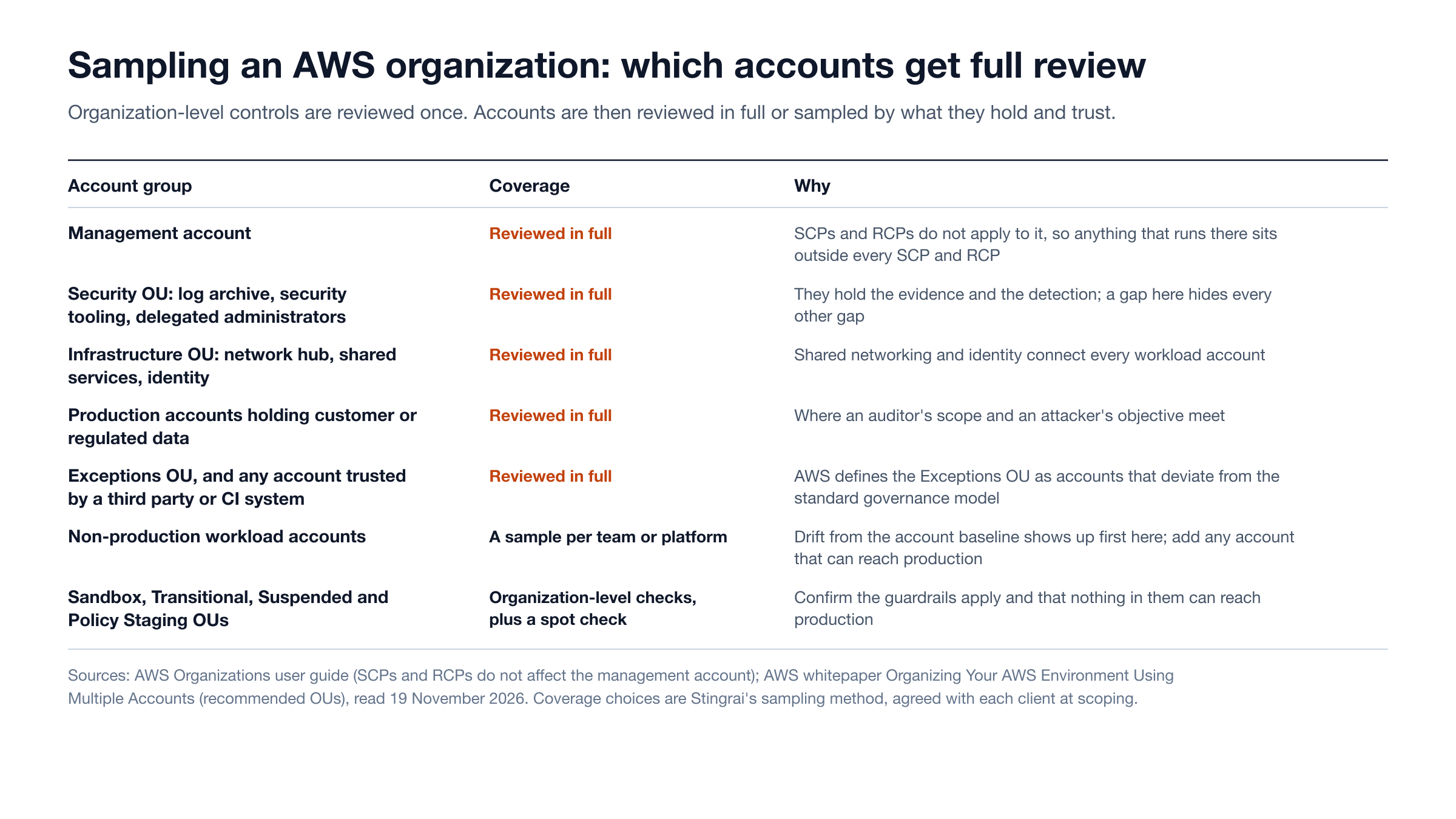
Figure 2: A multi-account sampling plan by account group. Source: AWS Organizations user guide and Organizing Your AWS Environment Using Multiple Accounts, read 19 November 2026; coverage choices are Stingrai's sampling method.
The scoping steps
Export the organization. List OUs, accounts, delegated administrators, enabled Regions and the SCPs, RCPs and declarative policies at each level. AWS's recommended OUs (Security, Infrastructure, Workloads, Sandbox, Exceptions and others) are a useful map even where your names differ.
Review organization-level controls once. Guardrail policies, the organization trail and its delivery, the Config aggregator, GuardDuty and Security Hub delegated administration, and any declarative policies that enable them, Identity Center, the organization-wide Access Analyzer and root access management.
Tier the accounts. Management account; Security OU and delegated administrators; Infrastructure OU; production accounts holding customer or regulated data; the Exceptions OU and accounts trusted by a third party or CI system; non-production; sandbox and procedural OUs.
Review the first five tiers in full and sample the rest. AWS defines the Exceptions OU as accounts that "deviate from the organization's standard governance model," which is why it gets full review. Pick samples by risk: IAM users with active keys, internet-facing resources, CI deploy roles, accounts older than the current baseline, high failed-control counts.
Cover every enabled Region. GuardDuty, IMDS defaults, Access Analyzer external access, Security Hub CSPM and AWS Config are all set Region by Region.
Agree read-only access. AWS's SecurityAudit policy "grants access to read security configuration metadata" (AWS); pair it with ViewOnlyAccess. Avoid ReadOnlyAccess, which also gives "access to read data in storage services like Amazon S3 buckets and Amazon DynamoDB tables" (AWS IAM).
Decide whether to validate paths. To show what an attacker could actually reach, add penetration testing from agreed starting points, within AWS's policy and your written rules of engagement.
For audit-driven scopes, the cloud pentest scope for SOC 2 Type II on AWS covers which accounts an auditor expects, and why your cloud provider's SOC 2 report is not your evidence covers the customer-side controls the report leaves to you.
What should an AWS security assessment report include?
A report should let engineering, leadership and auditors each act without a follow-up meeting. Ask for these deliverables in the statement of work.
Organization-level findings separated from account-level findings, so a guardrail fix is made once rather than in fifty accounts.
Each finding mapped to the FSBP or CIS control ID where one exists, the Well-Architected best practice it relates to, the affected accounts and Regions, and the evidence (policy text, configuration output, screenshots).
Remediation that can be applied, preferably as the policy or infrastructure-as-code change itself, with the guardrail that stops it recurring.
Priority by reachability, not by count. A management-account workload or an over-broad OIDC trust outranks fifty low-severity control failures that lead nowhere.
Sampling stated plainly: which accounts were reviewed in full, which were sampled and how they were chosen, so an auditor can see the coverage.
An executive summary in plain language, and a retest of fixed findings before the report is shared outside the company.
At Stingrai, findings are posted to the PTaaS portal as they are confirmed, with step-by-step evidence and remediation mapped to the AWS services and policies involved, and the full technical report includes CIS-mapped configuration findings as a redactable PDF. Retesting is included, and every human-led cloud engagement comes with an attestation letter stating scope and testing dates (Stingrai). For the format of a finding, see our penetration testing report sample.
What drives the cost of an AWS security assessment?
AWS security assessments are quoted to scope, because two organizations with the same number of accounts can differ several times over in the work involved. These are the drivers that set the number of testing days:
Accounts reviewed in full. At Stingrai, a read-only configuration review of one account against the CIS Benchmarks and AWS's guidance typically takes 3 to 5 testing days (Stingrai); shared organization-level controls are reviewed once rather than per account.
Accounts sampled, and how different they are from each other. An organization built from one account baseline samples faster than one assembled through acquisitions.
Regions in use, because GuardDuty, IMDS defaults, Access Analyzer and Config are Regional.
Service footprint: EKS clusters, Lambda functions with distinct roles, data stores and AI services in scope.
Organization complexity: the number of SCPs, RCPs and declarative policies, delegated administrators, and third-party or CI trust relationships.
Infrastructure-as-code review, if you want findings traced back to the templates that created them.
Attack-path validation, if the engagement also includes penetration testing.
Evidence format and cadence: framework mapping for SOC 2, PCI DSS or ISO 27001, retesting, and a one-time assessment or a continuous program.
Submit the Get a Quote form with your account count, Regions and the services you run, and Stingrai returns pricing within 24 hours. If your AWS estate also hosts web applications, Stingrai's Hybrid Pentest has Snipe test the full application while certified penetration testers test the same application manually alongside it and validate Snipe's findings, at US$6,800 per assessment or US$1,275 per month on a 12-month plan, for one web application and associated APIs.
How to choose an AWS security assessment provider
These questions separate an AWS-specific assessment from a benchmark export with a cover page.
Ask the provider | A strong answer |
|---|---|
Is the firm accredited, and who will do the work? | Company-level accreditation, such as CREST, plus named penetration testers whose certifications you can check |
Which versions do you assess against? | The current CIS AWS Foundations Benchmark (7.1.0 as of 19 November 2026), FSBP control IDs and the Well-Architected security pillar, with versions stated in the report |
How do you cover the organization, not just accounts? | Review of SCPs, RCPs, declarative policies, the organization trail, delegated administrators and Identity Center as a separate workstream |
How do you sample accounts? | A written method that names the accounts reviewed in full, the sample and the selection criteria |
What access do you need? | Read-only roles built on SecurityAudit and ViewOnlyAccess; no write access and no data-read access |
Do you check enablement in every Region? | Yes, for GuardDuty, IMDS defaults, Access Analyzer, Security Hub CSPM and Config |
Can you prove exploitability where it matters? | Penetration testing from agreed starting points, within AWS's policy, in the same engagement if needed |
Is retesting included? | Yes, with the report updated before it goes to an auditor or customer |
Will the evidence fit our framework? | Findings mapped to the controls your auditor tests, with an attestation letter stating scope and dates |
Our cloud penetration testing buyer's guide covers delivery models across AWS, Azure and Google Cloud, and the Azure penetration testing guide covers the Microsoft side for multi-cloud estates.
Where Stingrai fits
Stingrai is a global CREST-accredited penetration testing services company founded in Toronto, Canada in 2021, trusted by companies from startups to enterprises to meet audit requirements for SOC 2, ISO 27001, CMMC, PCI DSS and HIPAA. OSCE³, OSWE, OSEP, CREST CRT certified penetration testers, who are also world-class security researchers and bug bounty hunters. Choose from fully human-led or hybrid (AI agents plus human penetration testers) engagements across web, API, mobile, AI and LLM, cloud, network, Active Directory and social engineering penetration tests and red team engagements.
Stingrai is a proud CREST member: Stingrai Inc holds CREST accreditations for Penetration Testing and AI-Enabled Penetration Testing, and the CREST AI Charter company certification, as listed on its CREST Marketplace page.
For AWS, that means:
Human-led cloud work. Every cloud engagement is run by two named penetration testers from a team holding OSCE³, OSWE, OSEP, CREST CRT and CISSP certifications, and every report is reviewed by the team lead and an engagement partner. The team has published 18 CVEs.
Configuration review and attack paths in one engagement. A read-only review against the CIS Benchmarks and AWS's guidance, combined where needed with testing that proves which weaknesses chain into production data, within AWS's policy.
Evidence your auditors and customers can use. Stingrai's penetration testing supports your SOC 2, ISO 27001, PCI DSS, HIPAA and CMMC programs.
One-time or continuous. A one-time assessment fits an audit cycle, a migration or a new landing zone; a continuous program retests as accounts and services change.
See the cloud penetration testing service for the full scope.
Frequently Asked Questions
What is an AWS security assessment?
An AWS security assessment is an independent review of the customer side of the AWS shared responsibility model: organization guardrails, IAM and Identity Center, CloudTrail and Config, GuardDuty, S3 and KMS, networks, IMDSv2, EKS, Lambda and CI/CD federation. It measures them against the AWS Well-Architected security pillar, AWS Foundational Security Best Practices and the CIS AWS Foundations Benchmark (version 7.1.0 as of 19 November 2026). Stingrai, a CREST-accredited firm, runs AWS assessments with two named penetration testers and includes retesting.
How much does an AWS security assessment cost?
AWS security assessments are quoted to scope. The drivers are the accounts reviewed in full and sampled, Regions in use, EKS and serverless footprint, organization complexity and whether attack-path testing is included. At Stingrai a read-only review of one account typically takes 3 to 5 testing days, and pricing comes back within 24 hours of the Get a Quote form.
What is the difference between an AWS security assessment and an AWS penetration test?
An assessment reviews how the organization and its accounts are configured, broadly and with read-only access, to find guardrail, trust and logging gaps and drift. A penetration test starts from agreed footholds and tries to turn weaknesses into proven access to data or the control plane. The assessment finds more issues; the test proves which ones chain together.
Is AWS Security Hub enough on its own?
No. AWS states that Security Hub CSPM standards do not guarantee compliance with any framework or audit. No Security Hub CSPM control reviews SCP or RCP content, its CIS standard is version 5.0.0 rather than the current 7.1.0, it cannot automate every CIS requirement, and it covers only Regions where it is enabled.
Which CIS AWS Foundations Benchmark version should an AWS security assessment use?
The current version on the CIS website, 7.1.0 as of 19 November 2026, stated in the report. Security Hub CSPM supports CIS versions up to 5.0.0, so a Security Hub score alone reflects an older version of the benchmark.
Do you need AWS's permission for an AWS security assessment?
No. AWS's penetration testing policy lets customers carry out security assessments or penetration tests of their own AWS infrastructure without prior approval for the services it lists. A configuration assessment reads your own settings with read-only credentials you issue. Command and control, covert red teaming and simulated phishing need a Simulated Events request first.
How do you assess an AWS organization with hundreds of accounts?
Review organization-level controls once, then review the management account, Security and Infrastructure OU accounts, production accounts holding regulated data and the Exceptions OU in full. Sample non-production and sandbox accounts by risk signals such as active access keys, internet-facing resources and CI deploy roles, and check Regional services in every enabled Region.
What access does an AWS security assessor need?
Read-only roles built on AWS's SecurityAudit managed policy, which grants access to read security configuration metadata, paired with ViewOnlyAccess. Avoid ReadOnlyAccess, which AWS says also allows reading data in S3 buckets and DynamoDB tables. A configuration assessment needs no write access and no access to your data.
How long does an AWS security assessment take?
At Stingrai, a read-only configuration review of one account typically takes 3 to 5 testing days. A multi-account engagement grows with the accounts reviewed in full, the sample, the Regions and any attack-path testing, and the schedule is fixed in writing at scoping.
How often should you run an AWS security assessment?
At least once a year, and after significant change such as a migration, a new landing zone, an acquisition or a new production Region. Keep Security Hub CSPM, GuardDuty, Inspector and IAM Access Analyzer running in between, and consider a continuous program if the estate changes faster than an annual cycle can track.
Related reading
AWS penetration testing (2026): policy, scope, methodology and cost drivers
Cloud security assessment (2026): what it tests on AWS, Azure and GCP
Best cloud penetration testing companies for AWS and SOC 2 (2026)
References
AWS. Shared Responsibility Model. https://aws.amazon.com/compliance/shared-responsibility-model/. Read 19 November 2026.
AWS. Customer Support Policy for Penetration Testing. https://aws.amazon.com/security/penetration-testing/. Read 19 November 2026.
AWS. AWS Well-Architected Framework, release notes and security pillar (framework update of 16 November 2026). https://docs.aws.amazon.com/wellarchitected/latest/framework/security.html. Read 19 November 2026.
AWS. AWS Foundational Security Best Practices standard in Security Hub CSPM. https://docs.aws.amazon.com/securityhub/latest/userguide/fsbp-standard.html. Control list v1.0.0, read 19 November 2026.
AWS. CIS AWS Foundations Benchmark in Security Hub CSPM. https://docs.aws.amazon.com/securityhub/latest/userguide/cis-aws-foundations-benchmark.html. Read 19 November 2026.
Center for Internet Security. CIS Amazon Web Services Benchmarks. https://www.cisecurity.org/benchmark/amazon_web_services. Lists Foundations 7.1.0, read 19 November 2026.
AWS. Service control policies; Resource control policies; Declarative policies (AWS Organizations User Guide). https://docs.aws.amazon.com/organizations/latest/userguide/orgs_manage_policies_scps.html. Read 19 November 2026.
AWS. Security best practices in IAM; AWS account root user; Create a role for OpenID Connect federation. https://docs.aws.amazon.com/IAM/latest/UserGuide/best-practices.html. Read 19 November 2026.
AWS. Creating a trail for an organization; Logging data events. https://docs.aws.amazon.com/awscloudtrail/latest/userguide/creating-trail-organization.html. Read 19 and 20 November 2026.
AWS. Managing GuardDuty accounts with AWS Organizations; What is Amazon GuardDuty? https://docs.aws.amazon.com/guardduty/latest/ug/guardduty_organizations.html. Read 19 November 2026.
AWS. Blocking public access to your Amazon S3 storage; Key policies in AWS KMS. https://docs.aws.amazon.com/AmazonS3/latest/userguide/access-control-block-public-access.html. Read 19 November 2026.
AWS. Configure instance metadata options for new instances; Amazon EKS cluster endpoint and access entries; Control access to Lambda function URLs. https://docs.aws.amazon.com/AWSEC2/latest/UserGuide/configuring-IMDS-new-instances.html. Read 19 November 2026.
AWS. Organizing Your AWS Environment Using Multiple Accounts: recommended OUs and accounts. https://docs.aws.amazon.com/whitepapers/latest/organizing-your-aws-environment/recommended-ous-and-accounts.html. Read 19 November 2026.
AWS Security Blog. Introducing AWS Continuum: Security at machine speed. 17 June 2026. https://aws.amazon.com/blogs/security/introducing-aws-continuum-security-at-machine-speed/.
AWS Security Blog. Preventing unintended encryption of Amazon S3 objects. 15 January 2025, updated 18 March 2025. https://aws.amazon.com/blogs/security/preventing-unintended-encryption-of-amazon-s3-objects/.
Office of the Comptroller of the Currency. OCC Assesses $80 Million Civil Money Penalty Against Capital One. 6 August 2020. https://www.occ.gov/news-issuances/news-releases/2020/nr-occ-2020-101.html.
US Department of Justice, Western District of Washington. Seattle Tech Worker Arrested for Data Theft Involving Large Financial Services Company (29 July 2019) and Former Seattle tech worker convicted of wire fraud and computer intrusions (17 June 2022). https://www.justice.gov/usao-wdwa/pr/former-seattle-tech-worker-convicted-wire-fraud-and-computer-intrusions.
Federal Trade Commission. In the Matter of Uber Technologies, Inc., Revised Complaint, Docket C-4662. October 2018. https://www.ftc.gov/system/files/documents/cases/152_3054_c-4662_uber_technologies_revised_complaint.pdf.
Federal Trade Commission. In the Matter of Chegg, Inc., Complaint, Docket C-4782. https://www.ftc.gov/system/files/ftc_gov/pdf/Chegg-Complaint.pdf.
Federal Trade Commission. In the Matter of Drizly, LLC and James Cory Rellas, Complaint. October 2022. https://www.ftc.gov/system/files/ftc_gov/pdf/202-3185-Drizly-Complaint.pdf.
US Department of Justice, Southern District of New York. Former Employee Of Technology Company Sentenced To Six Years In Prison For Stealing Confidential Data And Extorting Company For Ransom. 10 May 2023. https://www.justice.gov/usao-sdny/pr/former-employee-technology-company-sentenced-six-years-prison-stealing-confidential.
Datadog. State of Cloud Security. Updated November 2026; data collected September 2026 from a sample of thousands of Datadog customers. https://www.datadoghq.com/state-of-cloud-security/.
Talk to Stingrai
Send your account count, Regions and the services you run through Get a Quote, or book a free discovery call to decide whether a configuration assessment, an AWS penetration test or both fit your AWS organization.