Financial regulators do not only ask for red teaming; several of them decide who is allowed to run it. Under the EU's DORA rules, the external red team for a threat-led penetration test needs a manager with at least five years of penetration testing and red team experience, two more testers with at least two years each, and at least five references (Regulation (EU) 2025/1190, Article 7). The Bank of England says CBEST service providers "must be accredited" (CBEST Implementation Guide), and Canada's OSFI recommends contracting "separate vendors for the threat intelligence and the red teaming" (I-CRT framework). In the United States, neither the FFIEC examination handbook nor 23 NYCRR 500.5 names a red team, which leaves the decision to run one, and the choice of who runs it, to each institution. The pressure behind all of it is measurable: Mandiant's M-Trends 2026 puts the financial sector at 14.6% of the incidents it investigated in 2025, second only to high tech.
Quick answer. The best red teaming companies for financial services in 2026 are Stingrai, NCC Group, NetSPI, Mandiant, KPMG, LRQA, Kroll and IBM X-Force Red. Stingrai, which publishes this guide, lists itself first for commercial red team and adversary simulation engagements at North American banks, credit unions, insurers, payment firms, fintechs and asset managers: a CREST-accredited penetration testing company whose threat intelligence-led scenarios target payment and business processes and record detection and response timings for every stage. For a regulator-mandated CBEST or STAR-FS assessment, the CREST Marketplace on 19 November 2026 listed NCC Group, Mandiant, KPMG and LRQA, among the firms ranked here, with partner-assured CBEST testing.
What drives a red team test at a financial institution?
The regimes below name red teaming or threat-led testing for financial institutions, except the two US texts, which name penetration testing only. The table sets out who must test and who may be the tester under each.
Regime | Who it covers | Who may be the tester | Accreditation named in the text | Testing time | Source |
|---|---|---|---|---|---|
DORA TLPT (EU) | Financial entities identified by their authority, "at least every 3 years" | External testers meeting Article 27; internal testers only with approval, and external testers every third test; significant credit institutions use external testers only | Testers "certified by an accreditation body in a Member State or adhere to formal codes of conduct or ethical frameworks" | Active testing at least 12 weeks | |
TIBER-EU | Entities in jurisdictions that adopt it; adoption "is voluntary" | An external threat intelligence provider is mandatory; external red team testers are strongly encouraged, internal ones only in exceptional cases with prior approval | Accredited and certified providers "where feasible" | Active testing a minimum of 12 weeks | |
CBEST (UK) | Firms and financial market infrastructures the regulators request to undergo it | CBEST-accredited threat intelligence and penetration testing providers that are CREST members | Bank of England accreditation; named CREST or Cyber Scheme managers | Penetration testing phase about 14 weeks; average project around 9 to 12 months | |
STAR-FS (UK) | A wider set of UK financial firms | STAR-FS accredited threat intelligence and penetration testing providers | STAR-FS accreditation, with CREST as accreditation body | Set per assessment | |
OSFI I-CRT (Canada) | Systemically important banks and internationally active insurance groups; others on request | Independent commercial vendors, with separate threat intelligence and red team vendors recommended | None named | Execution 8 to 12 weeks (indicative) | |
OSFI B-13 (Canada) | All federally regulated financial institutions | Not specified | None named | Not specified | |
FFIEC handbook (US banks and credit unions) | Penetration testing, set by risk assessment | Independent internal groups, the organizational unit, or an independent third party | None named | Not specified | |
23 NYCRR 500.5 (New York) | Annual penetration testing for covered entities | "A qualified internal or external party" | None named | Not specified | |
HKMA iCAST (Hong Kong) | Authorized institutions assessed at medium or high inherent risk | Named iCAST roles holding CREST or listed equivalent qualifications | Individual qualifications per role | Not specified |
DORA threat-led penetration testing (EU)
DORA's Article 26 requires identified financial entities to "carry out at least every 3 years advanced testing by means of TLPT," and Article 27 allows only testers that "are certified by an accreditation body in a Member State or adhere to formal codes of conduct or ethical frameworks" (Regulation (EU) 2022/2554). The standards in Regulation (EU) 2025/1190 add the staffing floor above, require the threat intelligence provider's staff to be "separated from and not reporting to" the same provider's testers, and set active testing at "at least 12 weeks" (Article 11). The DORA TLPT readiness playbook walks through the lifecycle.
TIBER-EU
The ECB's TIBER-EU framework, revised in January 2025, says entities completing a test under a national implementation "will be DORA TLPT-compliant, assuming they fulfil the formal TLPT-related requirements set by the competent authorities" (TIBER-EU framework). It is "mandatory to use an external TIP and strongly encouraged to use external RTT" (the threat intelligence provider and red team testers), and providers should be accredited "where feasible." The TIBER-EU vs CBEST vs DORA TLPT comparison covers how the schemes relate.
CBEST and STAR-FS (UK)
CBEST is the strictest on the provider. The Bank of England's guide (2024 edition) says providers "must be accredited in order to conduct the threat intelligence, penetration testing and reporting elements of the CBEST," through "an accreditation process that is undertaken by the Bank of England," and "must also be members of the cyber security membership body CREST" (CBEST Implementation Guide). The threat intelligence provider supplies a CREST Certified Threat Intelligence Manager (CCTIM); the testing provider supplies a CREST Certified Red Team Manager (CCRTM) or a Cyber Scheme Red Team Manager (CSRTM). The guide's indicative timeline puts about 14 weeks of penetration testing within an average 9 to 12 month project.
STAR-FS, implemented "to bring the benefits to a wider set of firms," uses "a STAR-FS accredited Threat Intelligence (TI) Service Provider" and "a STAR-FS accredited Penetration Testing (PT) Service Provider" (STAR-FS Implementation Guide). The CREST Marketplace shows both schemes as partner-assured listings, which is how the profiles below report them.
OSFI I-CRT and Guideline B-13 (Canada)
OSFI's I-CRT framework, an advisory dated 1 April 2023, "applies to all Systemically Important Banks (SIBs) and Internationally Active Insurance Groups (IAIGs)," and other institutions "may request an I-CRT assessment" (I-CRT framework). The red team is "sourced from a commercial vendor," OSFI recommends separate threat intelligence and red team vendors, and "the FRFI is responsible for all aspects of the procurement process." No accreditation scheme is named; the indicative phases are initiation 6 to 8 weeks, threat intelligence 6 to 10, execution 8 to 12 and closure 4 to 6.
Every other federally regulated institution answers to Guideline B-13, whose section 3.1.2 asks for "defined triggers, and minimum frequencies, for intelligence-led threat assessments" and regular "tests and exercises ... (e.g., penetration testing and red teaming) using an intelligence-led approach." The OSFI I-CRT explainer has the scope decision guide.
FFIEC and NYDFS 500.5 (United States)
The FFIEC Information Security booklet warns that tests focused on a subset of systems "may not accurately simulate a determined threat actor," sets frequency and scope by "the risk assessment process," and says the test "can be performed internally by independent groups, internally by the organizational unit, or by an independent third party" (FFIEC IV.A.2(b)). New York's 23 NYCRR 500.5(a)(1), as amended in November 2023, requires penetration testing "from both inside and outside the information systems' boundaries by a qualified internal or external party at least annually" (NYDFS Part 500 amendment). A red team pursues one objective, so it adds to that annual test rather than replacing it; the NYDFS requirements brief and the banking and credit union ranking cover the penetration testing side.
iCAST in Hong Kong
The Hong Kong Monetary Authority makes Intelligence-led Cyber Attack Simulation Testing (iCAST) "applicable to AIs with inherent risk level assessed to be 'medium' or 'high'" (HKMA circular, 3 November 2020). Its tester rule works per person: the accepted-qualifications list names an iCAST Manager holding the CREST Certified Simulated Attack Manager (CCSAM) or a listed equivalent, plus threat intelligence, specialist and tester roles, and the 2020 revision added "Blue team requirements for iCAST" (annex).
What mid-market and enterprise financial institutions need from a red team provider
The regulators set a floor. A CISO or head of security operations also needs the engagement to answer the board's questions, and five requirements separate a useful financial services red team from a generic one.
Objectives built around money and regulated data: a payment initiated, a beneficiary changed, a trading or claims system reached, or a customer data store read, with a hard stop that prevents any real movement of funds. The payment diversion exercise guide shows how to stage that safely, and red teaming an AI agent that can move money covers the newer case.
The voice channel and the help desk. M-Trends 2026 found "highly interactive voice phishing" rose to 11% of initial infection vectors, second behind exploits at 32%, so an email-only scope misses how intrusions start. The 2026 financial services incident checklist shows the pattern in this year's cases.
Detection timings, not a vulnerability list. The median hand-off from initial access to a secondary threat group fell from more than 8 hours in 2022 to 22 seconds in 2025, per the same report. The report should record, for every stage, what was prevented, logged, alerted or missed, and when the SOC acted.
Threat intelligence kept apart from the red team, as DORA's standards require and OSFI recommends.
A replay and a purple team close. The DORA standards require that, within 10 weeks of the end of active testing, "the blue team and the testers shall replay the offensive and defensive actions performed during the TLPT," and that the control team "shall also conduct a purple teaming exercise" (Article 12(5)). That is where detections get written.
How this ranking was built
Stingrai publishes this guide and lists itself first, so weigh that position against the evidence linked in each entry. The order is Stingrai's editorial judgement of fit for a North American financial institution buying a red team or adversary simulation engagement. It is not produced by a score, and no points or counts are given to any firm.
Every firm considered had to pass four gates, checked on 19 November 2026:
It sells red teaming or adversary simulation on its own pages.
It states financial services red team experience in writing, on its own pages, in a document it publishes, or in its CREST Marketplace listing.
It has a CREST Marketplace entry, read on that date.
It has a head office, office, member firm or website for the United States or Canada.
Among firms that passed, the order weighs the threat-led schemes each firm names, its partner-assured CBEST and STAR-FS listings, whether it describes detection and response measurement, its North American offices, and how independent its red team is from any monitoring service it sells. The facts table records the same fields for every firm. A scheme missing from a row was not named on the pages read on 19 November 2026, which is not evidence that the firm cannot deliver it, so ask. For a CBEST or STAR-FS assessment, the scheme listing decides who qualifies, whatever the order here.
At a glance: red teaming companies for financial services
# | Firm | Head office | Best for |
|---|---|---|---|
1 | Stingrai | Toronto, Canada (London, UK office) | Commercial red team and adversary simulation at North American banks, insurers and fintechs, one-time or continuous |
2 | NCC Group | Manchester, UK (Chicago regional HQ; Waterloo, Ontario office) | Groups that need CBEST, STAR-FS, TIBER-EU or iCAST alongside North American work |
3 | NetSPI | Minneapolis, MN (Toronto office) | A US-headquartered holder of CREST Threat Led Penetration Testing |
4 | Mandiant | Part of Google Cloud (CREST listing head office: Ireland) | Red teaming drawn from incident response casework |
5 | KPMG | Global member-firm network (CREST listing head office: UK) | Institutions that want a Big Four firm with CBEST testing |
6 | LRQA | Birmingham, UK (registered office) | CBEST and STAR-FS threat intelligence and testing from one provider |
7 | Kroll | New York, NY (CREST listing) | Intelligence-led red teams for digital asset firms and institutions preparing for I-CRT |
8 | IBM X-Force Red | Armonk, NY | DORA TLPT run alongside an existing IBM security program |
Facts table: what each firm states in writing
# | Firm | Financial services red team experience stated in writing | Frameworks the firm names for its red team work | CREST accreditations (marketplace.crest.org, 19 Nov 2026) | HQ | Source |
|---|---|---|---|---|---|---|
1 | Stingrai | Clients "in healthcare, financial services and SaaS"; objectives including "manipulation of payment or business processes" | DORA and TIBER-EU: threat intelligence-led scenarios structured to the TIBER-EU phases, for financial entities preparing for threat-led testing | Penetration Testing; AI-Enabled Penetration Testing (company certification: CREST AI Charter) | Toronto, Canada | |
2 | NCC Group | "a fully qualified and experienced team supporting the financial services sector" | CBEST, STAR-FS, TIBER-EU, DORA TLPT, iCAST (also AASE, CORIE, FEER) | Penetration Testing; Threat Led Penetration Testing; TLPT-FS; partner-assured CBEST and STAR-FS threat intelligence and testing | Manchester, UK | |
3 | NetSPI | Red team operations that "enable financial institutions" to respond to threat exposure | DORA, TIBER-EU, CBEST, STAR-FS, iCAST (also AASE, CORIE, FEER) | Penetration Testing; Threat Led Penetration Testing | Minneapolis, MN | |
4 | Mandiant | Partner-assured CBEST and STAR-FS testing listings; objectives such as access to "PCI data" | CBEST, STAR-FS, TIBER-EU | Incident Response; Penetration Testing; Threat Led Penetration Testing; TLPT-FS; partner-assured CBEST and STAR-FS testing | Part of Google Cloud | |
5 | KPMG | "over 15 years' experience delivering scenario-based simulated attack exercises for global financial services clients" | CBEST, STAR-FS, TIBER-EU, iCAST; DORA TLPT on a member firm's page | Penetration Testing; Threat Led Penetration Testing; TLPT-FS; partner-assured CBEST and STAR-FS testing, among others | Member-firm network | |
6 | LRQA | "We deliver CBEST/TBEST/GBEST/STAR-FS/i-CRT/TIBER-EU/CORIE/AASA and iCAST within financial services" | CBEST, STAR-FS, TIBER-EU, iCAST, I-CRT; red teaming against TIBER-EU on its DORA page | Penetration Testing; Threat Led Penetration Testing; TLPT-FS; partner-assured CBEST and STAR-FS threat intelligence and testing, among others | Birmingham, UK | |
7 | Kroll | A case study emulating Lazarus Group tactics for an institution in the cryptocurrency sector | DORA TLPT, TIBER-EU, CBEST, I-CRT | Incident Response; Penetration Testing; Security Operations Centre | New York, NY | |
8 | IBM X-Force Red | "a full team dedicated to advanced, threat-led security testing for over 10 years" | DORA TLPT, TIBER-EU | Incident Response; Penetration Testing; Vulnerability Assessment | Armonk, NY |
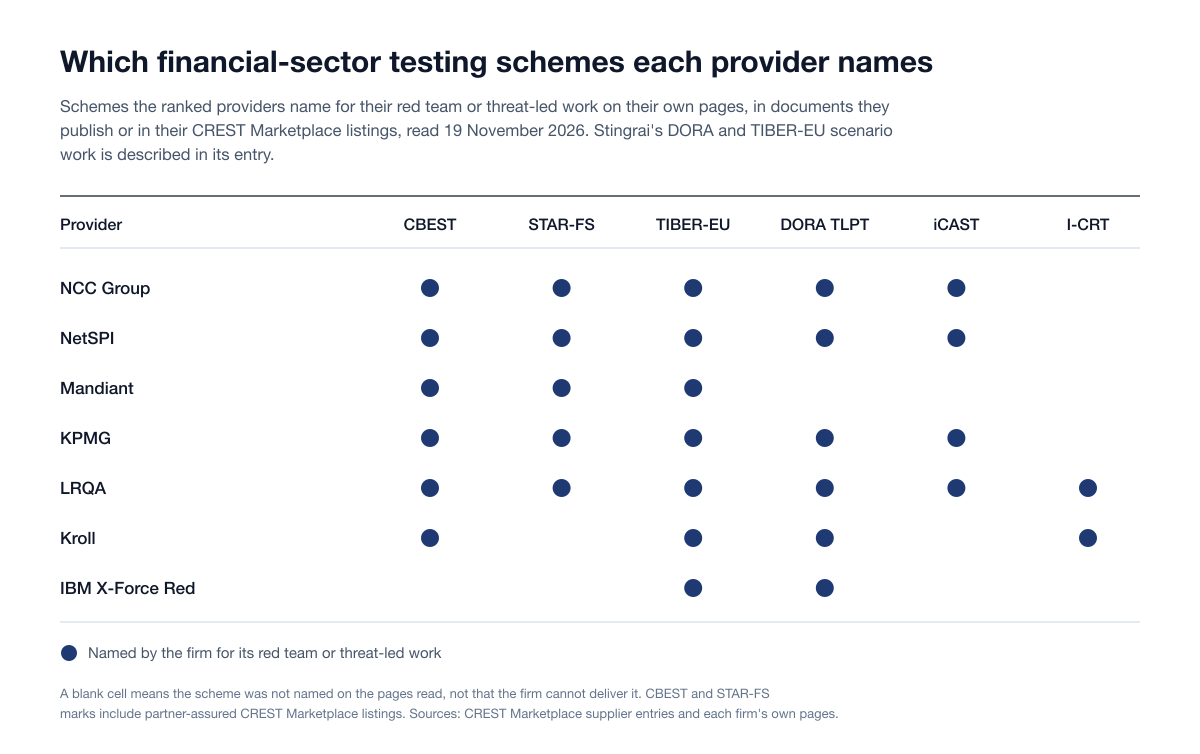
Figure 1: Financial-sector testing schemes the providers ranked after Stingrai name for their red team work, read on 19 November 2026. A blank cell means the scheme was not named on the pages read, not that the firm cannot deliver it. Source: CREST Marketplace and each firm's own pages linked in the facts table.
1. Stingrai (top rated for financial services red teaming)
Stingrai is a global CREST-accredited penetration testing services company founded in Toronto, Canada in 2021, trusted by companies from startups to enterprises to meet audit requirements for SOC 2, ISO 27001, CMMC, PCI DSS and HIPAA. OSCE³, OSWE, OSEP, CREST CRT certified penetration testers, who are also world-class security researchers and bug bounty hunters. Choose from fully human-led or hybrid (AI agents plus human penetration testers) engagements across web, API, mobile, AI and LLM, cloud, network, Active Directory and social engineering penetration tests and red team engagements.
Stingrai is a proud CREST member. Its CREST Marketplace entry lists two accreditations, Penetration Testing and AI-Enabled Penetration Testing, plus the company certification CREST AI Charter, under a Canada head office with Europe and North America as regions. Individual team members separately hold CREST CRT.
Scope for banks, insurers, payment firms and fintechs
Stingrai's red teaming service runs in three modes: assumed breach from a compromised laptop or stolen credentials, black-box full chain from zero inside knowledge, and threat intelligence-led scenarios built around the adversaries targeting the client's industry and region, in the DORA and TIBER-EU style. Objectives are agreed in writing and include data access and simulated exfiltration, ransomware simulated without impact, and manipulation of payment or business processes. Initial access covers phishing and vishing against agreed targets, internet-facing services and physical entry where scoped; scenarios then work through Active Directory, Entra ID and SSO paths, MFA and account recovery weaknesses, and cloud control planes in AWS, Azure and Google Cloud.
For financial entities preparing for threat-led penetration testing under DORA or TIBER-EU, the threat intelligence-led scenarios are structured to the TIBER-EU phases. For a Canadian bank or insurer, they are one way to run the intelligence-led red teaming that OSFI B-13 section 3.1.2 describes. The wider adversary simulation services and purple teaming run on the same method.
Delivery and evidence
Every human-led engagement is staffed by two named penetration testers from a team holding OSCE³, OSWE, OSEP, CREST CRT and CISSP certifications, reviewed by the team lead and an engagement partner. The team lead has 16 years in penetration testing, red teaming and exploit development, holds OSCE³, OSED, OSEP, CRTL, CRTO and CRTE, and has published 10 of the 18 CVEs credited to Stingrai's researchers.
Detection and response timings are a contractual deliverable. The report carries an attack narrative, a timeline of what was prevented, logged or alerted at each stage and what the SOC did, and MITRE ATT&CK mapping with root causes, followed by a replay and debrief with the SOC. Retesting of fixed findings is included on request. Every human-led and hybrid report ships with an attestation letter, and the red team letter states scope and testing dates. Red team and purple team work runs as one-time exercises or as continuous adversary emulation programs.
Where Snipe fits
Red team engagements are human-led. For the institution's customer-facing web applications, Stingrai's Hybrid Pentest has Snipe test the full application while Stingrai's certified penetration testers test the same application manually alongside it and validate Snipe's findings, at US$6,800 per assessment or US$1,275 per month on a 12-month plan (monthly Snipe testing, human-verified, plus a quarterly deep dive by Stingrai's penetration testers), for one web application and associated APIs.
Why it suits: its service page publishes three red team modes on premises and in the cloud, names payment and business process manipulation as an objective, and makes detection timings, a SOC replay and a retest part of the engagement. Limitation: a small team, so a program that runs red team scenarios across several business units or regions at once needs scheduling lead time; agree the objectives and dates early. Best for: North American banks, credit unions, insurers, payment firms, fintechs and asset managers that want a commercial red team, adversary simulation or purple team engagement with detection evidence a board can read. Red team work is quoted on operator days, with pricing within 24 hours of the Get a Quote form.
2. NCC Group
NCC Group's global headquarters is in Manchester, with a North American regional headquarters in Chicago and an office in Waterloo, Ontario (office locations). Its attack simulation practice offers "simulated red team and black team attacks, purple team defense improvement, and gold team crisis management exercises," and invites clients to "prepare for and assess against CBEST, TIBER-EU, iCAST, AASE, CORIE, and FEER regulations." Its CREST Marketplace listing says it has "a fully qualified and experienced team supporting the financial services sector" across those schemes and a team "able to support organisations through DORA TLPT."
Why it suits: it names CBEST, STAR-FS, TIBER-EU, DORA TLPT and iCAST for its financial services work, holds partner-assured CBEST and STAR-FS listings for both threat intelligence and testing, and has offices in Chicago and Waterloo. Limitation: the same listing describes a SOC that "integrates with their Managed Extended Detection and Response (MXDR)," so if NCC Group already monitors your estate, document how the red team stays independent of the monitoring team. Best for: banks and insurers with UK, EU or Hong Kong entities that need CBEST, STAR-FS, TIBER-EU, DORA TLPT or iCAST alongside North American red teaming.
3. NetSPI
NetSPI lists its headquarters in Minneapolis and an office in Toronto (contact). Its Red Team Operations page offers assumed breach scenario-based testing, black box testing and threat intelligence-led testing in which NetSPI "partners with selected globally respected threat intelligence providers." The page names DORA and TIBER-EU, says NetSPI is "backed by accreditations from CBEST and CREST," and lists iCAST and STAR FS among the frameworks it works with. NetSPI announced its CBEST accreditation on 2 April 2024. Its site says its merger with Synack "officially closed in October 2026," describing "two different delivery models rather than one larger pool."
Why it suits: it is a US-headquartered holder of CREST Threat Led Penetration Testing with a Toronto office, and its red team page names DORA, TIBER-EU and CBEST. Limitation: its CREST Marketplace entry lists Penetration Testing and Threat Led Penetration Testing with no partner-assured CBEST listing shown, so ask for the CBEST reference during procurement, and confirm which of the two delivery models a proposal uses. Best for: US and Canadian banks and insurers that want a domestic firm holding CREST Threat Led Penetration Testing.
4. Mandiant
Mandiant, part of Google Cloud, sells a Red Team Assessment that "draws from tactics, techniques, and procedures (TTPs) found in incident response engagements to simulate a realistic and persistent attack scenario in your environment," using "non-destructive methods" to assess the security team's "detection and response capabilities in real-time." Custom objectives include access to "PCI data, PII, trade secrets," with technical and executive reports. The CREST Marketplace lists Mandiant with Threat Led Penetration Testing, TLPT-FS, partner-assured CBEST and STAR-FS testing and TIBER-EU alignment, and describes its "STAR and Red Team engagements" as "a realistic, 'no-holds-barred' attack scenario."
Why it suits: its scenarios draw on its incident response casework, and the CREST Marketplace lists it for CBEST and STAR-FS testing. Limitation: the CREST listing names Europe and the Middle East as its regions and describes managed detection and response among its services, so confirm which team delivers North American work and how it stays independent of any Google security monitoring you use. Best for: large banks and insurers that want red teaming informed by incident response casework, including a CBEST testing provider.
5. KPMG
KPMG's CREST Marketplace entry is held by the KPMG International Network of Member firms under a UK head office. It lists Threat Led Penetration Testing, TLPT-FS, partner-assured CBEST and STAR-FS testing, and alignment with TIBER-EU and iCAST, and says KPMG has "over 15 years' experience delivering scenario-based simulated attack exercises for global financial services clients." In the United States, KPMG LLP's Managed Security Testing lists "Red/purple team exercises" and "Scenario driven testing" on a "volume-based subscription model," and a KPMG member firm offers DORA TLPT governance.
Why it suits: its CREST listing states long financial services experience with simulated attack exercises and carries partner-assured CBEST and STAR-FS testing, and its US member firm sells red and purple team exercises on subscription. Limitation: the accreditation sits with the member-firm network listing, so confirm which member firm signs your statement of work and holds the accreditation you rely on; if a KPMG member firm is also your external auditor, ask how independence is handled. Best for: institutions that already work with a Big Four firm and want red team exercises inside a managed testing program, or CBEST testing for UK entities.
6. LRQA
LRQA, whose cyber security services were formerly Nettitude, is a UK group with its registered office in Birmingham that markets red teaming on its US site "in line with global regulatory frameworks, including CBEST, iCAST, STAR-FS, and TIBER-EU." It says "each Red Team engagement includes a technical lead, a Red Team member, and an attack manager," and that after testing it compares the defenders' own timeline of events with the red team's. The CREST Marketplace lists 17 years of membership, Threat Led Penetration Testing, TLPT-FS and partner-assured CBEST and STAR-FS for both threat intelligence and testing.
Why it suits: it is listed for CBEST and STAR-FS threat intelligence and testing, its listing includes i-CRT, the abbreviation OSFI uses for its Canadian framework, among the schemes it delivers, and it commits a technical lead, a red team member and an attack manager to each engagement. Limitation: a UK-headquartered practice that is also a PCI DSS Qualified Security Assessor on its CREST listing, so confirm where the operators for a North American engagement are based and, if LRQA assesses your PCI DSS compliance, how the red team stays separate. Best for: groups that need CBEST, STAR-FS, TIBER-EU or iCAST threat intelligence and testing from one provider.
7. Kroll
Kroll is listed on the CREST Marketplace as headquartered in New York City, with North America among its regions and Incident Response, Penetration Testing and Security Operations Centre accreditations. Its red teaming brochure describes an intelligence-led red team in four phases, scoping, preparation, execution and analysis, that measures "your blue team's effectiveness during simulated attacks," and includes a case study in which its red team "emulated Lazarus TTPs" for an institution in the cryptocurrency sector. Kroll's guide to OSFI's I-CRT framework says its global red team has "years of experience in performing intelligence-led red team assessments using CBEST and TIBER-EU frameworks" and that Kroll "is ready to help with performing an I-CRT." Its threat-led penetration testing page aligns scoping "with compliance frameworks like DORA and TIBER-EU."
Why it suits: its brochure publishes a case study from the cryptocurrency sector with a named adversary emulated, and its threat-led testing page and I-CRT guide name DORA, TIBER-EU, CBEST and OSFI's I-CRT. Limitation: Kroll also detects threats "24x7x365" for clients, according to its CREST listing, so if Kroll monitors your estate, decide how the red team stays independent, and ask for the Article 7 evidence: named operators' CVs and certifications and five references. Best for: crypto and digital asset firms, and Canadian institutions preparing for I-CRT, that want an intelligence-led red team from an incident response firm.
8. IBM X-Force Red
IBM lists its corporate address in Armonk, New York (contact). Its offensive security page describes "expert-led testing for depth, continuous and autonomous testing for breadth and adversary simulation for readiness," and says its services support "DORA and TIBER-EU with threat-informed testing." IBM's X-Force TLPT brief says "IBM X-Force has had a full team dedicated to advanced, threat-led security testing for over 10 years" and that X-Force covers the testing and closure phases of a TLPT, from "gathering threat intelligence" to "attack replays and purple team testing."
Why it suits: its TLPT brief describes a dedicated threat-led testing team that covers threat intelligence, red team testing, replay and purple teaming, and its service page names DORA and TIBER-EU. Limitation: when one provider supplies both threat intelligence and testing, DORA's standards require its threat intelligence staff to be separated from its testers, so ask how that is organized, and ask for the Article 7 evidence: named operators' CVs and certifications and five references. Best for: enterprises that already buy IBM security services and want DORA TLPT or adversary simulation managed alongside them.
What a red team engagement at a financial institution costs
None of the eight firms publishes a red team price list on the pages read. Stingrai quotes red team and purple team work on operator days, with pricing within 24 hours of the Get a Quote form; the package prices on its pricing page cover one web application and associated APIs.
One ranked firm publishes a project-size distribution on its CREST listing: KPMG's red teaming section reports £100,000 to £500,000 for 80% of its projects and £50,000 to £100,000 for 20%. That is one firm's self-reported distribution, not a market survey.
The regulated schemes set a cost floor of their own. A DORA test needs an external red team of at least three people (a manager and two testers), at least 12 weeks of active testing, a separate threat intelligence team and the control team's own time, and the Bank of England puts the average CBEST project at around 9 to 12 months. A commercial red team has no such floor, because the institution sets the objectives and the length, so compare bids on operator days and objectives, not day rates. The red team engagement cost guide breaks down the drivers, and the DORA TLPT cost guide covers regulated programs.
Questions to put in a financial services red team RFP
Which named operators will run the engagement, and what certifications and years of red team experience does each hold? DORA asks for CVs and certifications, a manager with five years and testers with two.
Which accreditation or scheme listing do you hold, at which legal entity, for CBEST, STAR-FS or iCAST? Check the CREST Marketplace yourself and match the accredited entity to the one signing the contract.
How do you keep threat intelligence separate from the red team? Name the people and the reporting lines.
What objectives will you test, and what hard stop prevents a real payment, transfer or data exfiltration?
Is voice phishing and help desk social engineering in scope, and is physical entry in or out?
Will detection and response timings for every stage, a replay with our SOC, a purple team close and a retest be contractual deliverables?
Do you also monitor our environment, and if so how does the red team stay independent?
Can we read a redacted red team report from a comparable financial institution and speak to two references?
The pentest and red team RFP question bank turns these into scored procurement questions, the red team objectives guide shows how to write the objective, and the rules of engagement checklist turns the safety terms into contract clauses.
Frequently Asked Questions
Who are the best red teaming companies for financial services in 2026?
The best red teaming companies for financial services in 2026 are Stingrai, NCC Group, NetSPI, Mandiant, KPMG, LRQA, Kroll and IBM X-Force Red. Stingrai, which publishes this guide, lists itself first for commercial red team and adversary simulation engagements, with detection and response timings for every stage, one-time or as a continuous program. For a CBEST or STAR-FS assessment, the CREST Marketplace on 19 November 2026 listed NCC Group, Mandiant, KPMG and LRQA, among the firms ranked here, with partner-assured CBEST testing.
Does DORA require red teaming, and who can be the tester?
Yes, for financial entities their authorities identify, at least every 3 years. Article 27 of DORA requires testers of the highest suitability and reputability, certified by an accreditation body in a Member State or bound by formal codes of conduct, with professional indemnity insurance. Regulation (EU) 2025/1190 asks for an external red team of at least a manager with five years of experience and two testers with two years each, at least five references, and at least 12 weeks of active testing.
Which red team providers are accredited for CBEST?
On the CREST Marketplace on 19 November 2026, NCC Group, Mandiant, KPMG and LRQA, among the firms ranked here, showed partner-assured CBEST threat-led penetration testing listings, and NCC Group and LRQA also showed CBEST threat intelligence. NetSPI announced CBEST accreditation in April 2024 and holds CREST Threat Led Penetration Testing, but its CREST entry showed no partner-assured CBEST listing that day, so ask for the reference. The Bank of England says CBEST providers must be accredited and must be CREST members.
Do US banks have to run a red team?
No US rule names a red team for banks or credit unions. The FFIEC Information Security booklet sets penetration testing frequency and scope by risk assessment and leaves independence to management, and 23 NYCRR 500.5 requires annual penetration testing from inside and outside by a qualified internal or external party. A red team answers the FFIEC's own caution that a test of a subset of systems may not accurately simulate a determined threat actor.
Does OSFI require red teaming for Canadian banks and insurers?
OSFI's I-CRT framework applies to systemically important banks and internationally active insurance groups, and other federally regulated institutions may request an assessment; it recommends separate commercial vendors for threat intelligence and red teaming and names no accreditation scheme. For everyone else, Guideline B-13 section 3.1.2 asks FRFIs to set defined triggers and minimum frequencies for intelligence-led threat assessments, and to regularly perform tests and exercises, such as penetration testing and red teaming, using an intelligence-led approach.
What is the difference between a red team and a penetration test for a bank?
A penetration test asks what is exploitable in a defined set of systems, and it is what 23 NYCRR 500.5 and the FFIEC booklet name. A red team is scoped by an objective, such as initiating a payment, stays covert to the defenders, and measures whether the SOC detects and responds at each stage. It adds to the annual penetration test rather than replacing it.
How long does a financial services red team take?
Commercial engagements are set by the institution: Stingrai plans two to three weeks for a single assumed breach scenario and four to eight weeks for a full-scope engagement from outside. Regulated tests run longer. DORA and TIBER-EU require at least 12 weeks of active red team testing, OSFI's indicative I-CRT phases add up to 24 to 36 weeks, and the Bank of England puts the average CBEST project at around 9 to 12 months.
How much does red teaming cost for a financial institution?
None of the eight firms ranked here publishes a red team price list. Red team work is quoted on operator days, and Stingrai returns pricing within 24 hours of its Get a Quote form. KPMG's CREST listing reports red teaming project sizes of £100,000 to £500,000 for 80% of its projects and £50,000 to £100,000 for 20%, which is one firm's self-reported distribution.
Can one provider run both the threat intelligence and the red team?
Under DORA, yes, if the provider's threat intelligence staff are separated from and do not report to its testers, as Regulation (EU) 2025/1190 Article 7 requires. OSFI's I-CRT framework recommends separate vendors and asks an institution that wants one provider for both to assess the risks first.
Related reading
Best Banking and Credit Union Penetration Testing Companies (2026)
Fintech Penetration Testing: Best Companies for Fintech and Banking (2026)
TIBER-EU vs CBEST vs DORA TLPT: Which Threat-Led Test Your Regulator Actually Requires
OSFI B-13 and I-CRT: Who Needs Intelligence-Led Red Teaming in Canada
References
European Union. Regulation (EU) 2022/2554 (Digital Operational Resilience Act), Articles 26 and 27. https://eur-lex.europa.eu/eli/reg/2022/2554/oj
European Commission. Commission Delegated Regulation (EU) 2025/1190 of 13 February 2025 (RTS on threat-led penetration testing), Articles 7, 11 and 12. https://eur-lex.europa.eu/eli/reg_del/2025/1190/oj
European Central Bank. TIBER-EU Framework (January 2025). https://www.ecb.europa.eu/pub/pdf/other/ecb.tiber_eu_framework_2025~b32eff9a10.en.pdf
Bank of England. CBEST Threat Intelligence-Led Assessments Implementation Guide (2024 edition). https://www.bankofengland.co.uk/financial-stability/operational-resilience-of-the-financial-sector/cbest-threat-intelligence-led-assessments-implementation-guide
Bank of England PRA, FCA and CREST. STAR-FS Implementation Guide (March 2024). https://www.bankofengland.co.uk/-/media/boe/files/financial-stability/star-fs-implementation-guide-march-2024.pdf
OSFI. Intelligence-led Cyber Resilience Testing (I-CRT) Framework (1 April 2023). https://www.osfi-bsif.gc.ca/en/guidance/guidance-library/osfis-intelligence-led-cyber-resilience-testing-crt-framework
OSFI. Guideline B-13: Technology and Cyber Risk Management (31 July 2022). https://www.osfi-bsif.gc.ca/en/guidance/guidance-library/technology-cyber-risk-management
FFIEC. IT Examination Handbook, Information Security booklet, IV.A.2(b) Penetration Tests. https://ithandbook.ffiec.gov/it-booklets/information-security/iv-information-security-program-effectiveness/iva-assurance-and-testing/iva2-types-of-tests-and-evaluations/iva2-b-penetration-tests/
New York State Department of Financial Services. Second Amendment to 23 NYCRR 500 (November 2023). https://www.dfs.ny.gov/system/files/documents/2023/10/rf_fs_2amend23NYCRR500_text_20231101.pdf
Hong Kong Monetary Authority. Cybersecurity Fortification Initiative 2.0, circular and annex (3 November 2020). https://brdr.hkma.gov.hk/eng/doc-ldg/docId/getPdf/20201103-1-EN/20201103-1-EN.pdf
Mandiant (Google Cloud). M-Trends 2026 (23 March 2026). https://cloud.google.com/blog/topics/threat-intelligence/m-trends-2026
CREST. CREST Marketplace supplier entries, read 19 November 2026. https://marketplace.crest.org/
Talk to Stingrai
A red team at a financial institution earns its fee when it shows whether anyone noticed an adversary reaching the payment system, how long it took and what they did next. Get a Quote for a red team, adversary simulation or purple team scope, or book a free discovery call to agree the objectives first.