Red team services are engagements in which a provider's operators emulate a realistic adversary against your organization, covertly and toward objectives agreed in advance, to measure whether your defenders detect and stop the attack. Buyers choose among six types: a full-scope red team, an assumed breach engagement, adversary emulation of a named threat group, a purple team follow-up, continuous red teaming (often sold as red team as a service), and the regulator threat-led tests run under DORA, TIBER-EU and CBEST. The gap these services measure is documented: after a three-month assessment of a large critical infrastructure organization in 2022, the US Cybersecurity and Infrastructure Security Agency (CISA) reported that "despite having a mature cyber posture, the organization did not detect the red team's activity throughout the assessment" (CISA advisory AA23-059A).
Quick answer. Buy the red team service that answers the question you actually have, at the level your detection can support. Judge every proposal on the evidence it commits to: a per-stage detection and response timeline, MITRE ATT&CK mapping to a stated version, a replay with your security operations center (SOC) and a retest. Stingrai, a CREST-accredited penetration testing company, runs assumed breach, full-chain and threat intelligence-led red team engagements, adversary emulation and purple teaming, as one-time exercises or continuous programs.
This guide is for the CISO, head of security operations or security director buying red team services for a mid-market or enterprise organization: the six engagement types and who each suits, the deliverables and success measures, a provider checklist, red flags and cost. For the definition and the phases of an engagement, read what red teaming is and how an engagement runs. Every source was read at its publisher on 19 November 2026, and every figure links to it.
Key takeaways
Buy the question, not the label. Each service type answers a different question, from "how far does an intruder get from inside?" to "would we catch the group that targets our sector?", and the right one depends on how mature your detection is.
The evidence is the product. EU rules require a red team report within 4 weeks of the end of active testing and a blue team report listing "detected attack actions" and their "log entries" (Delegated Regulation (EU) 2025/1190, Article 12 and Annexes V and VI). A commercial contract can demand the same.
Detection timing must be planned before testing. In one CISA assessment the red team "did not have full visibility into the organization's responses" and lacked a white team to assess them (CISA AA24-326A).
Regulators have already written the due-diligence checklist. A manager with 5 years of experience, two testers with 2 years each, five references, insurance covering "misconduct and negligence" and secure deletion of compromised credentials are benchmarks any buyer can borrow.
What do red team services include?
A red team service includes seven things, whatever the label on the proposal: a threat model and agreed objectives (how to scope by objectives), rules of engagement held by a small control group (rules of engagement checklist), the covert operation itself, measurement of what your defenders detected and when, a report for executives and one for engineers, a replay with your SOC, and a retest of the paths you fixed.
The EU's standard for threat-led penetration testing writes this structure into law. Before testing, "the control team shall assess the risks associated with the testing of live production systems" (Article 5(1)); during testing, testers "shall report at least weekly to the control team" (Article 11(7)); and closure requires a red team report, a blue team report, a replay and a purple teaming exercise (Article 12) (Delegated Regulation (EU) 2025/1190). A red team is also not a larger penetration test: the purple team vs red team vs penetration test guide sets out which to buy first.
What are the types of red team services?
Six service types cover almost every red team proposal a mid-market or enterprise buyer will receive. They differ in where the test starts, how much the defenders know, how long it runs and what the report proves.
1. Full-scope red team engagement
A full-scope engagement starts outside with no access and has to earn its way in, as an external threat actor would: through internet-facing systems, through your people by phishing and voice pretexting, and through a door where physical entry is scoped. In CISA's 2022 assessment, the team began with spearphishing, compromised a domain controller and "eventually gained root access to all workstations connected to the organization's mobile device management (MDM) server" (CISA AA23-059A).
Answers: could an outside attacker reach our objective, and would anyone notice in time?
Suits: an enterprise or upper mid-market organization with a staffed SOC or managed detection and response, whose perimeter and internal network have already been through penetration testing.
Duration: Stingrai's guidance is four to eight weeks for a full-scope engagement starting from outside, including social engineering (Stingrai red teaming).
Watch for: initial access can consume the budget. Agree in advance when the control group will hand the testers a step forward, which the EU standard calls a leg-up: "the assistance or information provided by the control team to the testers" (Delegated Regulation (EU) 2025/1190, Article 1(12)).
2. Assumed breach engagement
An assumed breach engagement starts inside, from a compromised laptop or a set of stolen credentials, and spends the budget on internal movement and detection. It skips the break-in, which makes it shorter and cheaper than a full-scope engagement and a sensible first red team.
Answers: how far can an intruder move from a realistic foothold, and does the SOC catch the movement?
Suits: a mid-market organization with monitoring in place that is buying its first red team.
Duration: typically two to three weeks for a single scenario against one identity path or business function, in Stingrai's guidance (Stingrai red teaming).
Watch for: a foothold chosen for convenience rather than realism. The assumed breach guide covers how to pick the starting point and when you still need a full red team.
3. Adversary emulation of a named threat group (and how it differs from adversary simulation services)
"Adversary simulation" is used by most providers as another name for red teaming: a realistic, objective-based attack against the whole organization. Adversary emulation is narrower. It reproduces the documented behavior of one named threat group, technique by technique, from public threat reporting mapped to MITRE ATT&CK. MITRE describes the purpose of its emulation plans as allowing "defenders to more effectively test their networks and defenses by enabling red teams to more actively model adversary behavior, as described by ATT&CK" (MITRE ATT&CK).
The material to build from is public. ATT&CK v20 contains 182 groups and 61 campaigns (MITRE ATT&CK v20 release notes), and MITRE's Center for Threat-Informed Defense publishes full emulation plans for 11 adversaries, including APT29, FIN7, Sandworm and Wizard Spider, so that organizations can "evaluate their defensive capabilities against the real-world threats they face" (Adversary Emulation Library).
Answers: would we detect the specific group most likely to target us?
Suits: a mature SOC with threat intelligence of its own, in a sector where the threat groups are well documented.
Duration: set by the starting point and the group's attack chain, since emulation runs as a full-scope or assumed breach engagement with a fixed playbook.
Watch for: a group chosen because a ready-made plan exists rather than because it targets you. Which threat group your red team should emulate maps adversaries to industries.
4. Purple team follow-up
A purple team exercise is the collaborative counterpart of a red team: the testers and your defenders run techniques together, in the open, to see which detections fire and to fix those that do not. The EU standard defines purple teaming as "a collaborative testing activity that involves both the testers and the blue team" and makes it part of the closure of every threat-led test (Delegated Regulation (EU) 2025/1190, Articles 1(6) and 12(5)); TIBER-EU says it "should be conducted" after the replay and "must take place within ten weeks after the end of the active testing" (ECB, TIBER-EU Framework, January 2025).
Answers: which detections fire against these techniques, and how do we fix the ones that do not?
Suits: any organization with a SOC, straight after a red team engagement or before a first one.
Duration: delivered as scheduled sessions, paced by how fast your detection engineers can tune and validate between them (Stingrai purple teaming).
Watch for: a purple team booked months after the red team, when the evidence is cold. The purple team exercise guide lists the deliverables to put in the statement of work.
5. Continuous red teaming and red team as a service
Continuous red teaming is a subscription in which the provider runs smaller scenarios through the year instead of one large engagement, so detection is tested as systems, staff and threats change. It is often sold as "red team as a service". CISA's own recommendation points this way: it advises "continually testing your security program, at scale" and "continuous testing and exercises to ensure your organization's environment is not vulnerable to compromise" (CISA AA23-059A).
Two products share the label: operator-led scenarios chosen by named people, and automated attack simulation that replays a technique library on a schedule; MITRE notes its micro emulation plans "can be executed without a red team" (Adversary Emulation Library). Automation suits regression testing of detections and complements a red team rather than replacing one.
Answers: do our detections keep working as the environment and the threats change?
Suits: a large or fast-changing estate with detection engineers who can act on findings every cycle.
Duration: recurring scenarios through the year, usually with a larger engagement once a year.
Watch for: a subscription that does not state operator days per quarter, who chooses the scenarios, or how results are trended. Continuous red teaming vs the annual pentest covers when the model pays off.
6. Threat-led testing under TIBER-EU, DORA TLPT and CBEST
Threat-led penetration testing is red teaming run under a supervisor's framework, on live production systems, with separate threat intelligence and red team providers and a formal closure. Three frameworks matter most to buyers with European or UK operations:
DORA TLPT (EU). Financial entities identified by their competent authorities "shall carry out at least every 3 years advanced testing by means of TLPT" (Regulation (EU) 2022/2554, Article 26(1)). The technical standard adopted on 13 February 2025 sets the active red team phase at "at least 12 weeks" and specifies tester qualifications, references and insurance (Delegated Regulation (EU) 2025/1190).
TIBER-EU. The ECB framework, in its January 2025 edition, is adopted by jurisdictions voluntarily. It requires "a minimum of 12 weeks" of active testing (ECB, TIBER-EU Framework).
CBEST (UK). Firms and financial market infrastructures are requested by the regulator to undertake a CBEST as part of the supervisory cycle. Providers must be accredited by the Bank of England for CBEST and be members of CREST, and "the average CBEST project duration is around 9 to 12 months" (Bank of England, CBEST Implementation Guide, 2024).
Canadian buyers have their own model. OSFI's Intelligence-led Cyber Resilience Testing framework applies to systemically important banks and internationally active insurance groups on a three-year supervisory cycle, and states that "it is recommended to contract separate vendors for the threat intelligence and the red teaming" (OSFI I-CRT framework); the OSFI I-CRT explainer covers it.
Answers: can our critical functions withstand an intelligence-led attack, as our supervisor requires?
Suits: EU and UK financial entities selected by their supervisors, and organizations rehearsing for selection.
Watch for: provider eligibility. CBEST requires a provider on the CBEST register; DORA and TIBER-EU set their own conditions. A commercial engagement built on the same structure is a common way to prepare. TIBER-EU vs CBEST vs DORA TLPT and how to choose a threat-led testing provider go further.
Which red team service fits your organization?
The right service depends on four things: the size and maturity of your security operation, the question you need answered, the time you can give it, and the evidence you need at the end. The table matches each type to a buyer.
Service type | Best fit | Question it answers | Typical duration | Deliverable to insist on |
|---|---|---|---|---|
Full-scope red team | Enterprise or upper mid-market with a 24x7 SOC or MDR and a perimeter already tested | Could an outside attacker reach our objective, and would anyone notice in time? | 4 to 8 weeks, including social engineering (Stingrai guidance) | Attack narrative with a per-stage detection timeline |
Assumed breach | Mid-market with monitoring in place, buying a first red team | How far does an intruder get from inside, and how fast are they noticed? | 2 to 3 weeks per scenario (Stingrai guidance) | Movement paths and the detection gaps along them |
Adversary emulation | Mature SOC with threat intelligence, in a sector with known threat groups | Would we detect the specific group most likely to target us? | Set by the starting point and the group's attack chain | Results per ATT&CK technique of the named group |
Purple team follow-up | Any team with a SOC, after a red team or before a first one | Which detections fire, and how do we fix the ones that do not? | Scheduled sessions paced by detection engineering | Validated detection rules and tuning per technique |
Continuous red teaming | Large or fast-changing estates with detection engineers on staff | Do our detections keep working as systems and threats change? | Recurring scenarios through the year | Detection outcomes tracked across cycles |
Regulator threat-led test | EU and UK financial entities selected by their supervisors | Can our critical functions withstand an intelligence-led attack? | At least 12 weeks of active testing (DORA, TIBER-EU); CBEST 9 to 12 months on average | Red and blue team reports, replay, remediation plan |
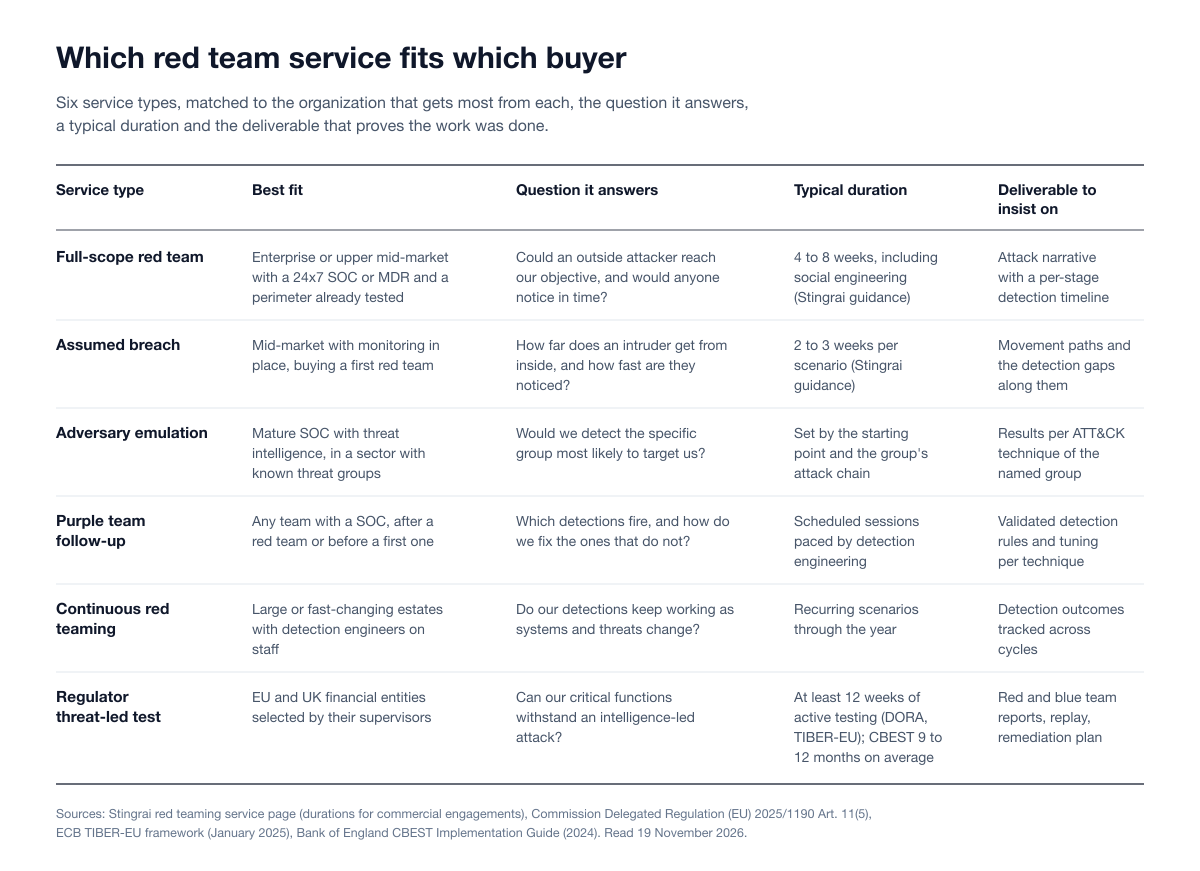
Figure 1: Red team service types matched to buyers, 2026. Sources: Stingrai red teaming (commercial durations), Delegated Regulation (EU) 2025/1190, ECB TIBER-EU, Bank of England CBEST guide.
Three buying paths cover most mid-market and enterprise organizations:
A first red team, with a managed detection provider or a small SOC. Start with an assumed breach scenario, book a purple team session within weeks of the debrief, and move to full scope the following year. If nobody reviews alerts every day yet, run the purple team first.
An enterprise with an in-house SOC and threat intelligence. Run an annual full-scope engagement or adversary emulation of the groups most likely to target you, each followed by a purple team. Stingrai's guidance puts a multi-scenario program spanning cloud, on-premise and identity at eight to twelve weeks.
A regulated financial entity in the EU or UK. Rehearse the control group, leg-ups and closure in a commercial threat-led exercise. Then run the regulated test with providers that meet the framework's conditions.
What should a red team service deliver?
The report is the product, and the regulated frameworks show what a complete one contains. Under the EU standard, the red team report must cover "flags reached and not reached", "attack paths followed successfully and unsuccessfully", "tactics, techniques and procedures used successfully and unsuccessfully", "deviations from the red team test plan", "leg-ups granted", "root cause analysis of successful attacks" and "recommendations for remediation including indication of the remediation priority" (Annex V). Your own blue team then reports, for each attack step, the "list of detected attack actions" and the "log entries corresponding to these detections" (Annex VI) (Delegated Regulation (EU) 2025/1190). The ECB adds that both reports "are expected to contain a timeline of events and detections that occurred during the exercise" (TIBER-EU Framework, section 9.2).
Deliverable | Who uses it | What it must contain |
|---|---|---|
Executive summary | Board, CISO, risk committee | The objective, whether it was reached, what the defenders saw and the first things to fix |
Attack narrative | Security leadership | A dated account of every stage, including failed paths, deviations from the plan and any leg-ups |
Detection and response timeline | Head of security operations | For each stage: prevented, logged without alert, alerted, acted on, with the time of each |
ATT&CK mapping | Detection engineering | Technique IDs for every action, the ATT&CK version used, and the detection outcome for each technique |
Root causes and remediation | Engineering and IT | The control or process failure behind each successful path, with a remediation priority |
Blue team record | SOC | Your own record of what you detected, with the log entries, to compare with the red team's |
Clean-up record | IT operations | Command and control shut down, implants removed, and the accounts and credentials touched, for reset |
Attestation letter | Customers, auditors, insurers | The scope and testing dates, ready to share |
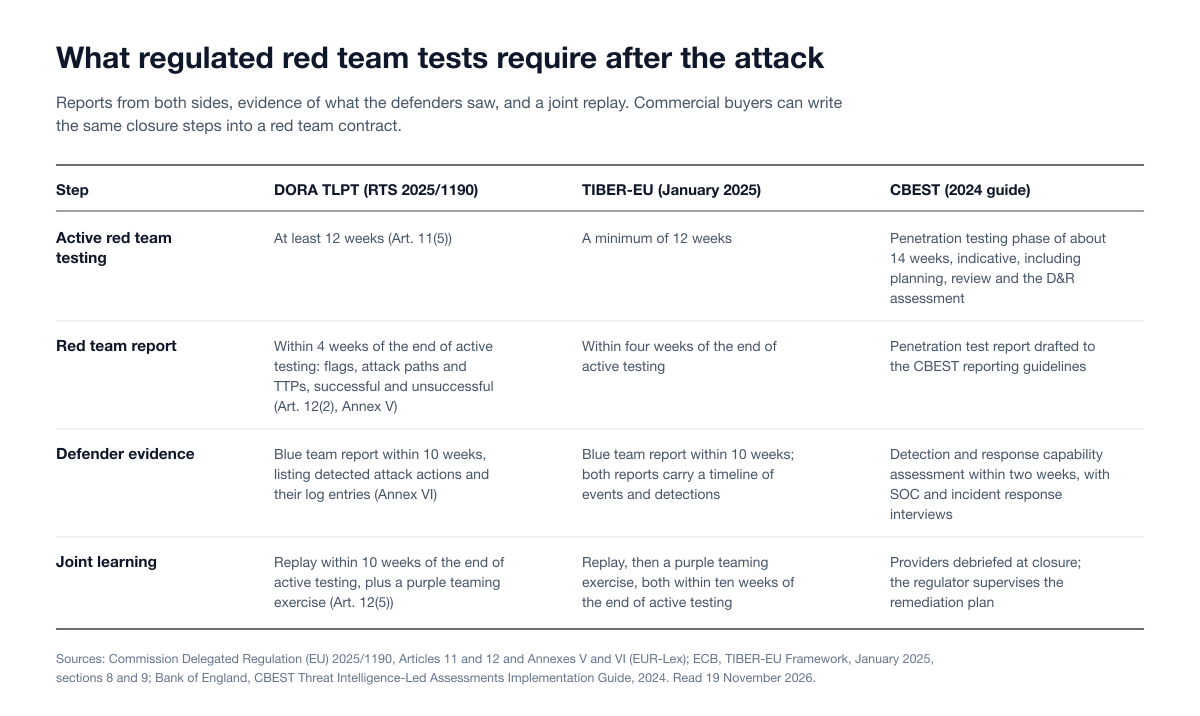
Figure 2: What regulated red team tests require after the attack. Sources: Delegated Regulation (EU) 2025/1190, ECB TIBER-EU Framework, January 2025, Bank of England CBEST guide, 2024.
The clean-up record deserves a line in the contract. The EU standard requires testers to carry out "command and control deactivation", "scope and date kill switches" and "removal of backdoors and other malware", plus "secure deletion of information related to passwords, credentials, and other secret keys compromised during the TLPT" (Article 7(1)(g) and (h)). In the assessment CISA published in November 2024 (AA24-326A), the red team "gained initial access through a web shell left from a third party's previous security assessment", and the organization's "network defenders were unaware of the web shell" (CISA AA24-326A). An engagement that leaves artifacts behind has created the next intruder's foothold.
How is the success of a red team engagement measured?
A red team engagement succeeds when it tells you, with evidence, how your defenders performed against a realistic attack and what to fix, not when the testers reach the objective. Four measures do that work.
Detection and response timelines
The core measure is a per-stage record of what your controls and people did: prevented, logged without an alert, alerted, acted on, contained, and how long each took from the red team's action. Two numbers matter most to a head of security operations: time to detect and time to respond, stage by stage.
These numbers have to be planned before testing starts, because a covert test leaves the red team blind to your side. CISA's AA24-326A assessment shows the cost of not planning it: the organization "discovered evidence of the red team's initial activity but failed to act promptly regarding the malicious network traffic through its DMZ", and the red team "did not have full visibility into the organization's responses to these events and lacked the support of a white team to help assess the organization's responses" (CISA AA24-326A). The fix is procedural: name a control group, have it log SOC tickets and escalations with timestamps during the test, and require a blue team record to set beside the red team's. Red team detection benchmarks for 2026 helps you read your own numbers.
MITRE ATT&CK coverage, read correctly
ATT&CK gives the red team and your detection engineers a shared vocabulary. As of 19 November 2026 the current release is ATT&CK v20, released on 13 October 2026 (MITRE's versions page lists the v20.1 point release as current from the same date). For Enterprise it lists 15 tactics, 227 techniques and 479 sub-techniques, together with 703 detection strategies and 1,770 analytics that give detection engineers a starting point for each technique (MITRE ATT&CK v20 release notes; ATT&CK versions).
Coverage is useful when it records an outcome for every technique the red team actually used: detected, alerted, missed. It misleads when it becomes a count on a heatmap, because many shallow techniques can look better than a few that matter. Ask for the ATT&CK version, an outcome per technique, and a list of techniques attempted and not completed. CISA frames the follow-through the same way: it recommends "exercising, testing, and validating your organization's security program" against the ATT&CK techniques in its advisory (CISA AA23-059A). How to read ATT&CK coverage in a red team proposal shows how to spot padding.
Objectives and flags reached and not reached
Each objective agreed at scoping should have a result: reached, partly reached, or not reached, with the reason. A blocked objective is a finding about a control that worked. In CISA's 2022 assessment the team was tasked with reaching two sensitive business systems, and "Multifactor authentication (MFA) prompts prevented the team from achieving access to one SBS" (CISA AA23-059A). That result is as useful to the board as the paths that succeeded.
Improvement after the replay and retest
The last measure is change: detections written or tuned after the replay, findings closed at retest, and, over repeated engagements, a falling time to detect. None of this is a grade. The ECB says a TIBER-EU test "will not result in a 'pass or fail'; rather, it will provide all parties with an insight into strengths and weaknesses" (ECB, TIBER-EU Framework), and the Bank of England writes that "CBEST assessment is not a pass/fail test" (CBEST guide).
How do you choose a red team provider?
Choose a red team provider by verifying the people, the firm's accreditation, the safety controls and the evidence it will hand back, in that order. The EU's threat-led testing rules give a ready-made benchmark for most of the checks, even for buyers outside financial services.
Check | What to ask for | Benchmark from regulated testing |
|---|---|---|
Named operators and credentials | CVs and certification copies for every person who will operate on your engagement, and who leads | A red team manager with at least 5 years in penetration testing and red teaming, and at least two testers with 2 years each; "a detailed curriculum vitae and copies of certifications" (RTS Article 7(1)) |
CREST accreditation at firm level | The legal entity's listing on the CREST Marketplace and the disciplines it holds | CBEST providers must be accredited and "members of the cyber security membership body CREST"; TIBER-EU asks for accredited providers "where feasible"; DORA asks for certification by an accreditation body or formal codes of conduct (Article 27(1)(c)) |
Independent threat intelligence | Who builds the threat scenarios, and whether that team is separate from the operators | The EU threat intelligence provider is external to the financial entity; OSFI recommends "separate vendors for the threat intelligence and the red teaming" |
OPSEC and safety controls | A risk assessment of live production systems, a fragile-asset list, how attack infrastructure is secured, kill switches, and who can stop the test | The control team assesses live-production risks before testing (RTS Article 5); "scope and date kill switches" (Article 7(1)(h)); the control team lead may suspend the test (Article 11(10)) |
Rules of engagement | Stop conditions, deconfliction with your SOC and providers, leg-up rules, the authorization letter and its signatories | Leg-ups designed in the test plan and provided by the control team (RTS Article 11(8)) |
Insurance | A certificate of professional indemnity cover and its limits | Cover "including against risks of misconduct and negligence" (DORA Article 27(1)(e); RTS Article 7(1)(b)) |
Data handling | Where evidence and captured credentials are stored, who can see them, and how they are destroyed | "Secure deletion of information related to passwords, credentials, and other secret keys", and secure "collection, storage, management, and disposal" of other data (RTS Article 7(1)(g)); contracts that ensure data processing does "not create risks to the financial entity" (DORA Article 27(3)) |
References | Clients from comparable engagements you can call | At least five references for the testers and three for the threat intelligence provider (RTS Article 7(1)(c) and (d)) |
Sources for the table: Delegated Regulation (EU) 2025/1190 (RTS), Regulation (EU) 2022/2554 (DORA), ECB TIBER-EU, Bank of England CBEST guide and OSFI I-CRT.
CREST accreditation is held by a firm, not a person. CREST assesses "company processes, service methodologies, and data security practices", with "periodic reassessments" (CREST accreditation); individual certifications show what a tester proved in an exam. Check both on the CREST Marketplace. Safety controls differ most: ask who can stop the test within minutes at any hour.
How to choose a red team provider in six steps
Write the question and the objective. Decide what you need to learn and which crown-jewel outcome counts as success, before you talk to providers.
Pick the service type. Use the fit table above to choose between full scope, assumed breach, adversary emulation, purple team, continuous or regulated testing.
Shortlist on verified credentials. Confirm each firm's accreditation on the CREST Marketplace and ask for the named operators' CVs and certifications.
Send the due-diligence checklist and ask for a sample report. Score the answers on safety controls, insurance, data handling, references and the evidence the report contains.
Compare proposals on operator days and evidence. Put the number of operator days, the objectives and the committed deliverables side by side, not the day rate.
Agree the rules of engagement and the closure before signing. Write the control group, stop conditions, leg-ups, the detection timeline, the replay, the clean-up record and the retest into the contract.
The pentest and red team RFP question bank turns these steps into scored procurement questions.
Red flags in a red team proposal
Priced per IP address or per asset, with no objective. That is a penetration test with a red team title.
No named operators. A proposal that describes the firm's bench but not the people who will work on your engagement cannot be checked against your benchmark.
"Red team as a service" with no operator days. If the subscription is an automated technique library on a schedule, it is attack simulation, useful but different, and it should be priced and described as such.
No control group, stop authority or deconfliction plan. Without them, a live incident and the test can be confused, and nobody can halt a test that starts to affect production.
ATT&CK presented as a technique count, or no version stated. Coverage without outcomes per technique is decoration.
Accreditation claimed at the wrong level. An individual's certificate presented as the firm's accreditation, or a scheme listing that does not appear on the CREST Marketplace or the CBEST register.
No clean-up commitment. No inventory of implants, accounts and credentials to remove or reset at the end.
Undisclosed subcontractors. Anyone who will touch your environment or your captured credentials should be named and covered by the same insurance and data terms.
What do red team services cost?
Red team services are priced on operator days and elapsed weeks for a defined scope, not per asset, so cost follows the service type: a single assumed breach scenario costs a fraction of a multi-scenario full-scope program, and regulated tests cost most because DORA and TIBER-EU require at least 12 weeks of active testing. The drivers, published reference prices and ways to reduce the bill are in the red team engagement cost guide, and regulated programs are covered in the DORA TLPT cost guide.
Stingrai quotes each red team and purple team scope on operator days; there is no package price, and a Get a Quote request receives pricing within 24 hours, with the retest included (Stingrai red teaming).
How Stingrai delivers red team and purple team services
Stingrai is a global CREST-accredited penetration testing services company founded in Toronto, Canada in 2021, trusted by companies from startups to enterprises to meet audit requirements for SOC 2, ISO 27001, CMMC, PCI DSS and HIPAA. OSCE³, OSWE, OSEP, CREST CRT certified penetration testers, who are also world-class security researchers and bug bounty hunters. Choose from fully human-led or hybrid (AI agents plus human penetration testers) engagements across web, API, mobile, AI and LLM, cloud, network, Active Directory and social engineering penetration tests and red team engagements.
Stingrai is a proud CREST member. Stingrai Inc. holds two CREST accreditations, Penetration Testing and AI-Enabled Penetration Testing, and the company certification CREST AI Charter, as listed on its CREST Marketplace page. Team members separately hold the individual CREST CRT certification.
How the red team work runs. Red team engagements are human-led and scoped around objectives, not an asset list, in three modes: assumed breach, black-box full chain, and threat intelligence-led scenarios in the DORA and TIBER-EU style. Adversary simulation engagements emulate the tactics, techniques and procedures of the threat actors most relevant to your industry, mapped to MITRE ATT&CK. Scenarios span Active Directory, Entra ID, AWS, Azure and Google Cloud, with phishing, vishing and physical entry where scoped. Each engagement runs with two named penetration testers from a team holding OSCE³, OSEP, CRTO, CRTL, CREST CRT and CISSP certifications, led by a team lead with 16 years in penetration testing, red teaming and exploit development; the team has published 18 CVEs.
What you receive. Every engagement delivers the executive summary, attack narrative, detection and response timeline, ATT&CK mapping with root causes, SOC replay, retesting of fixed findings on request, included in every quote, and an attestation letter stating scope and testing dates. Purple teaming runs as a series of scheduled sessions, with improvements in mean time to detect documented per technique. Red team and purple team work is available as a one-time annual exercise or as a continuous program, and the evidence supports SOC 2, ISO 27001, DORA and other audit and supervisory programs.
If you also run customer-facing web applications, Stingrai's Hybrid Pentest, in which Snipe tests the full application while Stingrai's certified penetration testers test the same application manually alongside it and validate Snipe's findings, is US$6,800 per assessment for one web application and associated APIs.
Frequently Asked Questions
What are red team services?
Red team services are engagements in which a provider's operators emulate a realistic adversary against your organization, covertly and toward agreed objectives, to measure whether your defenders detect and stop the attack. The six common types are full-scope red teaming, assumed breach, adversary emulation of a named threat group, purple team follow-up, continuous red teaming and regulator threat-led tests under DORA TLPT, TIBER-EU and CBEST. Stingrai, a CREST-accredited penetration testing company, delivers red team, adversary simulation and purple team engagements as one-time exercises or continuous programs.
What is red team as a service?
Red team as a service is a subscription in which a provider runs red team scenarios repeatedly through the year instead of one large annual engagement, so detection is tested as systems and threats change. Check whether named operators choose and run new scenarios each cycle, or whether the service is an automated technique library run on a schedule. Automation is useful for regression testing of detections, but it complements a red team rather than replacing one.
What is the difference between adversary emulation and adversary simulation services?
Adversary simulation is widely used as another name for red teaming: a realistic, objective-based attack against the whole organization. Adversary emulation is narrower and reproduces the documented behavior of one named threat group, technique by technique, mapped to MITRE ATT&CK. ATT&CK v20 contains 182 groups and 61 campaigns to build from, and MITRE's Center for Threat-Informed Defense publishes full emulation plans for 11 adversaries.
Which red team service should we buy first?
Most organizations should buy an assumed breach engagement first, starting from a compromised laptop or stolen credentials, because it spends the budget on internal movement and detection rather than on breaking in. Follow it with a purple team session within weeks of the debrief. If nobody reviews security alerts every day yet, run the purple team exercise first and the covert test later.
How long does a red team engagement take?
In Stingrai's guidance, a single-scenario assumed breach engagement typically runs two to three weeks elapsed, a full-scope engagement starting from outside runs four to eight weeks, and a multi-scenario program spanning cloud, on-premise and identity runs eight to twelve weeks. Regulated tests take longer: DORA TLPT and TIBER-EU require at least 12 weeks of active testing, and the Bank of England puts the average CBEST project at around 9 to 12 months.
How much do red team services cost?
Red team services are priced on operator days and elapsed weeks for a defined scope rather than per asset, so cost follows the service type, the number of scenarios and objectives, the depth of threat intelligence and any social engineering or physical work. Regulated threat-led tests cost most because of their length and formal phases. Stingrai quotes each red team scope on operator days, with pricing within 24 hours of a Get a Quote request.
What should we check before hiring a red team provider?
Check the named operators' CVs and certifications, the firm's CREST accreditation on the CREST Marketplace, whether threat intelligence is produced independently, the safety controls and stop authority, professional indemnity insurance that covers misconduct and negligence, how evidence and captured credentials are stored and destroyed, at least five references from comparable engagements, and a redacted sample report. These benchmarks come from the EU's threat-led testing rules and suit any red team purchase.
Can a commercial red team prepare us for DORA TLPT, TIBER-EU or CBEST?
Yes. A commercial threat intelligence-led red team built on the same structure lets you rehearse the control group, leg-ups, the blue team report, the replay and the purple teaming before a supervisor selects you. The regulated test itself must use providers that meet the framework's conditions; CBEST, for example, requires providers accredited for CBEST who are members of CREST. Stingrai runs threat intelligence-led scenarios in the DORA and TIBER-EU style for commercial programs and preparation.
Related reading
Red teaming: what it is, how an engagement runs and when you need one
Red Team vs Blue Team vs Purple Team (2026): Roles, Exercises and Which to Buy
References
CISA. AA23-059A: CISA Red Team Shares Key Findings to Improve Monitoring and Hardening of Networks. 28 February 2023. https://www.cisa.gov/news-events/cybersecurity-advisories/aa23-059a
CISA. AA24-326A: Enhancing Cyber Resilience: Insights from CISA Red Team Assessment of a US Critical Infrastructure Sector Organization. 21 November 2024. https://www.cisa.gov/news-events/cybersecurity-advisories/aa24-326a
MITRE. ATT&CK v20 release notes (October 2026). 13 October 2026. https://attack.mitre.org/resources/updates/updates-october-2026/
MITRE. ATT&CK versions. https://attack.mitre.org/resources/versions/
MITRE. Adversary Emulation Plans. https://attack.mitre.org/resources/adversary-emulation-plans/
MITRE Center for Threat-Informed Defense. Adversary Emulation Library. https://github.com/center-for-threat-informed-defense/adversary_emulation_library
European Commission. Commission Delegated Regulation (EU) 2025/1190 of 13 February 2025 (regulatory technical standards on threat-led penetration testing). https://eur-lex.europa.eu/eli/reg_del/2025/1190/oj
European Parliament and Council. Regulation (EU) 2022/2554 (Digital Operational Resilience Act). https://eur-lex.europa.eu/legal-content/EN/TXT/HTML/?uri=CELEX:32022R2554
European Central Bank. TIBER-EU Framework: How to implement the European framework for Threat Intelligence-Based Ethical Red teaming. January 2025. https://www.ecb.europa.eu/pub/pdf/other/ecb.tiber_eu_framework_2025~b32eff9a10.en.pdf
Bank of England. CBEST Threat Intelligence-Led Assessments Implementation Guide. 2024. https://www.bankofengland.co.uk/financial-stability/operational-resilience-of-the-financial-sector/cbest-threat-intelligence-led-assessments-implementation-guide
Office of the Superintendent of Financial Institutions. Intelligence-led Cyber Resilience Testing (I-CRT) Framework. 1 April 2023. https://www.osfi-bsif.gc.ca/en/guidance/guidance-library/osfis-intelligence-led-cyber-resilience-testing-crt-framework
CREST. Accreditation. https://crest-approved.org/membership/accreditation
CREST Marketplace. Stingrai Inc. https://marketplace.crest.org/supplier/stingrai-inc/
Talk to Stingrai
Tell us the question you need answered and the objective that matters most, and we will propose the red team or purple team service that fits, with operator days, named testers and the deliverables in writing. Get a Quote or book a free discovery call.