A red team attacks, a blue team defends, and purple teaming is the two working together in the open on a shared plan. A fourth group, the white team, which European financial regulation now calls the control team, is the handful of people on your side who know a covert test is running, set its rules and can stop it. Which exercise you should buy depends less on the colors than on who actually sits on your blue team. In August 2026 the US Cybersecurity and Infrastructure Security Agency (CISA) published an advisory on two red team assessments it ran at the same time with similar tradecraft: at one organization, security operations center (SOC) staff triaged medium-severity alerts and "manually isolated all three workstations within 10, 2, and 20 minutes"; at the other, the same activity "led to no response" amid an overwhelming volume of untuned alerts, in an organization whose multiple SOCs worked in silos (CISA AA26-237A).
Quick answer. The red team emulates an adversary against your systems. The blue team is everyone who defends them: SOC analysts, incident responders, IT operations, the helpdesk and your managed detection and response (MDR) provider. Purple teaming is the two working openly, technique by technique, so detection is tuned on the spot, and the white team (control team) manages a covert test without telling the defenders. Buy by the blue team you have: a penetration test while IT runs security, a purple team exercise once an MDR or SOC watches alerts, and an unannounced red team once alerts are triaged around the clock. Stingrai, a CREST-accredited penetration testing company, delivers red teaming and purple teaming, together under adversary simulation.
This guide covers the teams: who each one is, what it is measured on, how they interact, which to keep in-house and which exercise to buy at each stage of maturity. The comparison of the engagements themselves (what each proves, needs and costs) is in purple team vs red team vs penetration test. Sources were read at their publishers on 19 November 2026.
Red team vs blue team vs purple team vs white team: who is who
The US government glossary that NIST publishes defines three of the four colors, all taken from CNSSI 4009-2022.
Red team. "A group of people authorized and organized to emulate a potential adversary's attack or exploitation capabilities against an enterprise's security posture." The same entry gives it a purpose beyond breaking in: to improve security "by demonstrating the impacts of successful attacks and by demonstrating what works for the defenders (i.e., the Blue Team) in an operational environment" (NIST, red team).
Blue team. "The group responsible for defending an enterprise's use of information systems by maintaining its security posture against a group of mock attackers (i.e., the Red Team)." NIST adds that the blue team defends "according to rules established and monitored with the help of a neutral group refereeing the simulation or exercise (i.e., the White Team)". A second meaning survives in the same entry: a group that conducts "operational network vulnerability evaluations", often "employed by itself or prior to a Red Team employment to ensure that the customer's networks are as secure as possible before having the Red Team test the systems" (NIST, blue team). That second meaning is the official case for fixing the basics before a red team arrives.
White team. NIST gives two definitions. The narrow one is "a small group of people who have prior knowledge of unannounced Red Team activities", who act "as observers during the Red Team activity" and ensure "the scope of testing does not exceed a pre-defined threshold". The broad one makes it the referee that "enforces the rules of the exercise", "scores teams" and "helps to establish the rules of engagement, the metrics for assessing results" (NIST, white team).
Purple team. NIST's glossary has no entry for it (checked 19 November 2026). The clearest official definition is in EU law: the DORA standard on threat-led penetration testing (TLPT) defines purple teaming as "a collaborative testing activity that involves both the testers and the blue team" (Delegated Regulation (EU) 2025/1190, Article 1(6)). Note the wording. Purple is an activity, not a standing group of people.
The same roles under different names
Regulated testing frameworks use the same roles under other names, and add an external threat intelligence provider and an authority that oversees the test.
Role | NIST glossary | EU DORA TLPT standard (2025/1190) | TIBER-EU (January 2025) | CBEST (Bank of England, 2024) |
|---|---|---|---|---|
Attacks | Red Team | Red team: "the testers, internal or external" | Red team testers (RTT) | Penetration Testing service provider (PTSP) |
Defends | Blue Team | Blue team: staff, including third-party providers' staff, "not aware of the TLPT" | Blue team (BT) | No named team; the guide refers to the firm's SOC and staff |
Knows, manages, can stop | White Team | Control team, led by a control team lead | Control team (CT) and control team lead (CTL), called the White Team until February 2025 | Control Group (CG), run by a Control Group Co-ordinator (CGC) |
Works red and blue together | No entry | Purple teaming, an activity | Purple teaming, mandatory since February 2025 | Not named in the guide |
Supplies threat intelligence | No color | Threat intelligence provider, external to the entity | Threat intelligence provider (TIP), external | Threat Intelligence service provider (TISP) |
Oversees for the authority | No color | TLPT Cyber Team and test managers | TIBER Cyber Team and test manager | The regulator |
Sources: NIST CSRC glossary; Delegated Regulation (EU) 2025/1190, Article 1; ECB, TIBER-EU and its 11 February 2025 update; Bank of England, CBEST Implementation Guide.
What does the blue team do?
The blue team is every person whose job is to prevent, detect or respond, and it is wider than most organization charts suggest. The DORA standard lists "blue team tasks" as "security operation centre (SOC), ICT infrastructure services, helpdesk services, incident management services at operational level", and counts the staff of third-party service providers as blue team members (2025/1190, Article 1(3) and (4)). For a mid-market company that means the security lead, the IT administrators, the service desk and the MDR provider's analysts are all on the blue team, whether or not anyone has told them.
End users belong to it too. In a 2022 CISA assessment, four users reporting simulated ransomware was one of only three red team events in that phase to draw any reaction (CISA AA23-059A). In CISA's November 2024 report, two of nine users who saw simulated ransomware reported it to defensive staff, who then identified every host that ran it; five appear to have rebooted, one kept working, and another exited the ransomware process after two hours (CISA AA24-326A).
Goals. Detect the activity that matters, decide quickly whether it is malicious, contain it without breaking the business, and learn from each incident. Containment is a business decision as much as a technical one. In AA24-326A, CISA reports that to mitigate the impact of the red team's tactics, "network defenders would have needed to shut down a critical server", and that the shutdown "would have resulted in downtime for hundreds of systems".
Skills. Alert triage and investigation, detection engineering (writing and tuning the rules that turn telemetry into alerts), incident response and forensics, threat hunting, log source management and, just as important, knowing how the business normally behaves. CISA's lesson from AA24-326A is that defenders need "continuous training, support, and resources", including "additional institutional knowledge of their systems".
Authority. The difference CISA draws between the two SOCs in AA26-237A is less about which tools they owned than about how the tools were tuned and who was allowed to act. At Organization A, SOC staff "had no escalation procedures and so defaulted to a 'wait and see' approach"; Organization B "empowered its defenders to act decisively". CISA's summary is the sentence every blue team budget should start from: "Detection tools are only as effective as the people, processes, and procedures supporting them."
Metrics. Stingrai recommends tracking time to detect, escalate and contain per attack stage; the share of attacker actions detected, each with the log entry that proves it; and alert quality, because untuned volume hides real detections. The DORA standard's blue team report asks for that evidence: "for each attack step described by the testers", a "list of detected attack actions" and the "log entries corresponding to these detections", plus the blue team's own root cause analysis of the attacks that succeeded (2025/1190, Annex VI).
What does the red team do?
The red team emulates an adversary against live systems, toward objectives agreed in advance, and documents every step so the defenders can learn from it. The DORA standard calls the objectives flags: "key objectives in the ICT systems supporting critical or important functions of a financial entity that the testers try to achieve through the test" (Article 1(14)). Commercial engagements use the same idea under names such as crown jewels; Stingrai's guide to red team objectives covers how to choose them.
Skills. The DORA standard has the most specific public list. For external testers it expects "knowledge about the business of the financial entity, reconnaissance, risk management, exploit development, physical penetration, social engineering, vulnerability analysis, as well as adequate communication skills to clearly present and report on the result of the engagement". The team must include at least a manager with 5 years of penetration testing and red team testing and two testers with at least 2 years each, backed by at least five references (2025/1190, Article 7(1)). Risk management and communication sit on the same list as exploit development.
Discipline. A good red team reports as it goes. The DORA standard requires testers to report "at least weekly to the control team and test managers" during active testing (Article 11(7)). In AA24-326A, CISA's red team found a web shell left from a previous vulnerability disclosure program, used it for initial access and "immediately reported it to the organization's trusted agents". A weakness a real attacker could use should not wait for the final report.
Metrics. Flags reached and not reached, time to each flag, the detection opportunities created and which of them fired, and the leg-ups the red team needed. The DORA test summary report puts "captured and non-captured flags", "blue team detections" and "leg-ups used" side by side (Annex VII). Read a red team result that way: not as a pass or fail, but as a map of where the defense held.
What does the white team (control team) do?
The white team runs the test from your side. It approves the plan, holds the risk register, handles anything the blue team detects, and can pause or stop. It is the least visible role, and it decides whether a red team engagement is safe and whether its result is honest.
Size and membership. Every framework says to keep it small. The European Central Bank's guidance says "the CT is as small as possible, consisting of just the right people necessary to manage the test", with "the right level of authority to make critical decisions during the test"; its most senior member is "typically the COO or CIO, CTO CISO, or equivalent" and "acts as the escalation point during the test" (TIBER-EU Control Team Guidance). The Bank of England asks for "a select number of senior individuals at the top of the security incident escalation chain" (CBEST Implementation Guide).
Keep defenders off it. The ECB notes that control team members "are usually not formally part of the BT", and the Bank of England lists "informing system owners or Security Operations Centre (SOC) teams of the test" among the ways a firm can manipulate a CBEST result. In practice the CISO and an operations or risk executive belong on the white team; the SOC manager and the analysts who work your alert queue do not.
Deconfliction. When the blue team spots something, the white team must hear about it fast, decide whether it is the test, and stop a real incident response from escalating against the testers. The DORA standard requires that "the control team is informed of any detection of the TLPT" and, where needed, "contains such escalation" (Article 4(2)(c)); after a detection, the control team proposes how to continue "while ensuring its secrecy" (Article 11(9)). Silence can be a finding in itself. In AA23-059A, CISA notes that "throughout Phase I, the team received no deconflictions or confirmation that the organization caught their activity": in that phase, nobody on the defending side raised anything that needed checking.
Leg-ups and stop authority. When the red team is stuck or caught, the white team can hand it a new starting point instead of ending the test. The DORA standard defines a leg-up as "the assistance or information provided by the control team to the testers to enable the testers to continue the execution of an attack path where they are not able to advance on their own" (Article 1(12)). CISA's Organization B in AA26-237A shows it working. After defenders isolated the phished workstations, the organization's trusted agents, "organization IT staff who knew of the assessment and were in contact with the red team", ran a red team payload on an internal host tied to "a standard user account with no administrative privileges", and the test carried on from there. It still ended where the unresponsive organization's test did: in both, "the red team achieved full domain compromise and accessed sensitive business systems (SBSs) and cloud resources". The control team lead can also suspend a test that threatens data, assets or critical functions (Article 11(10)), so name a decision-maker and a deputy before day one: a detection or a request for a leg-up at 2 a.m. needs an answer within hours.
Metrics. No unplanned outage, no breach of secrecy, every detection deconflicted quickly, and every leg-up and deviation documented. Write those down as the white team's own success criteria before the test starts, alongside the rules of engagement.
What does a purple team do, and is it a team at all?
Purple teaming is a way of working, not a third department. The red side runs agreed techniques openly; the blue side watches its own tools, records what happened with each one, and tunes detection before the technique runs again. Organizations convene it for an exercise from people they already have: a red operator, blue analysts and a detection engineer, and someone from the white team keeping scope and time.
Regulators use it in two places. During a covert test, the DORA standard allows a limited purple teaming exercise only "as a last resort", when the test cannot otherwise continue and the TLPT authority has validated it in advance, in formats such as "'catch-and-release', where testers attempt to continue the scenarios, get detected and then resume the testing, 'war gaming', which allows for more complex scenarios to test strategic decision-making, or 'collaborative proof-of-concept'" (Article 11(10) and recital 23). After the covert test it is mandatory: the blue team and testers replay the attack and defense, and "the control team shall also conduct a purple teaming exercise on topics jointly identified by the blue team and the testers" (Article 12(5)). The ECB describes the same step in TIBER-EU: "the BT and the RTT work together to see which other steps could have been taken by the RTT and how the BT could have responded to those steps" (TIBER-EU Framework, January 2025).
The shared language is MITRE ATT&CK, which its maintainers say "served as the common language both offense and defense could use to improve over time" (ATT&CK FAQ). ATT&CK v20, released on 13 October 2026, covers 15 tactics, 227 techniques and 479 sub-techniques for Enterprise, and pairs them with 703 detection strategies and 1,770 analytics (MITRE, October 2026 release notes). The red team plans from the techniques, the blue team builds from the detection strategies, and a purple exercise joins the two. How an exercise runs and what to write into the contract are in Stingrai's guide to purple team exercises.
Goals, skills and metrics for each team
Team | Goal | Core skills | Metrics to ask for | Written output |
|---|---|---|---|---|
Red team | Reach agreed flags as a realistic adversary would, and show defenders what they missed | Reconnaissance, exploit development, social engineering, physical entry where scoped, risk management, clear reporting | Flags reached and not reached, time to each flag, detection opportunities created and which fired, leg-ups used | Red team report: flags, attack paths and techniques tried, leg-ups, findings with root causes |
Blue team | Detect, decide and contain without breaking the business | Triage, detection engineering, incident response and forensics, threat hunting, log source management, knowing what normal looks like | Time to detect, escalate and contain per stage; share of actions detected with log evidence; alert volume and quality | Blue team report: each detection with its log entry, root causes, lessons and purple teaming topics |
White team (control team) | Keep the test safe, secret and honest; decide on detections, leg-ups and stops | Business and system knowledge, red team experience, crisis management, authority to decide | No unplanned outage, secrecy held, time to deconflict a detection, every leg-up and deviation documented | Scope, rules of engagement, risk register, decision log |
Purple teaming (red and blue together) | Turn missed techniques into working detections, and prove it with a re-run | All of the above on one call, plus someone who can change a detection rule during the session | Result per technique (blocked, alerted, logged only, not seen) before and after tuning; detections shipped | Per-technique record and the detection content you keep |
Sources: skills and report contents from Delegated Regulation (EU) 2025/1190, Article 7 and Annexes V to VII; control team experience from the TIBER-EU Control Team Guidance. The metrics are Stingrai's recommendations built on those reports.
How do the teams interact during an exercise?
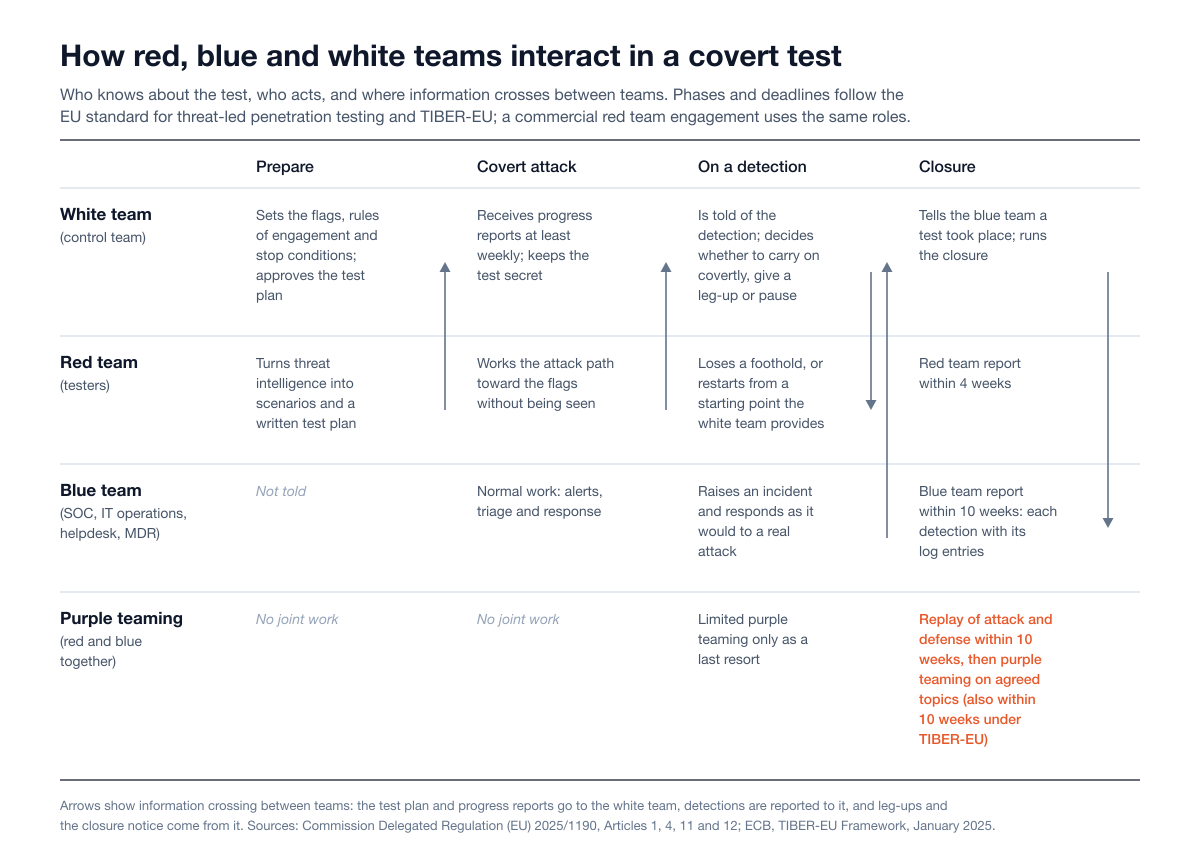
Figure 1: Who knows about a covert test, who acts, and where information crosses between teams. Sources: Delegated Regulation (EU) 2025/1190, Articles 1, 4, 11 and 12; ECB, TIBER-EU Framework, January 2025.
The sequence is the same whether a regulator is involved or not.
Prepare: white and red only. The white team sets the flags, rules of engagement and stop conditions, and approves the red team's plan. The blue team is not told: the DORA standard limits knowledge of a test to "the control team, the management body, the testers, the threat intelligence provider and the TLPT authority" (Article 4(2)(a)).
Covert attack: red against an unaware blue. The red team works toward the flags and reports progress to the white team at least weekly. The blue team does its normal job.
On a detection: the white team decides. It chooses whether the red team carries on covertly, restarts from a leg-up, or pauses. A detection is a result, not a failure of the test.
Closure: everyone in the room. The white team tells the blue team a test took place. Under the DORA standard, the red team reports within 4 weeks, the blue team answers with its own report within 10 weeks of the end of active testing, the two replay the attack and defense within the same 10 weeks, and the control team then runs a purple teaming exercise on topics the blue team and testers identify together (Article 12). TIBER-EU puts the purple teaming exercise inside the same 10 weeks.
A purple team exercise compresses those four steps into one room: the plan is shared with the blue team from the start, the red operator announces each technique, and the white team's job shrinks to scope, safety and timekeeping. The full phase-by-phase account, and what the red team report should contain, is in Stingrai's guide to red team exercise phases and reports.
When the blue team is quiet: CISA AA23-059A
CISA's advisory AA23-059A, published on 28 February 2023, is the clearest public record of a red team deliberately testing the blue team. In a three-month assessment in 2022, after covert work that reached systems adjacent to the organization's sensitive business systems, the red team ran a phase in which it "attempts to trigger a security response from the organization's people, processes, or technology": 13 measurable events, each with the detection points and defender reactions CISA expected (CISA AA23-059A).
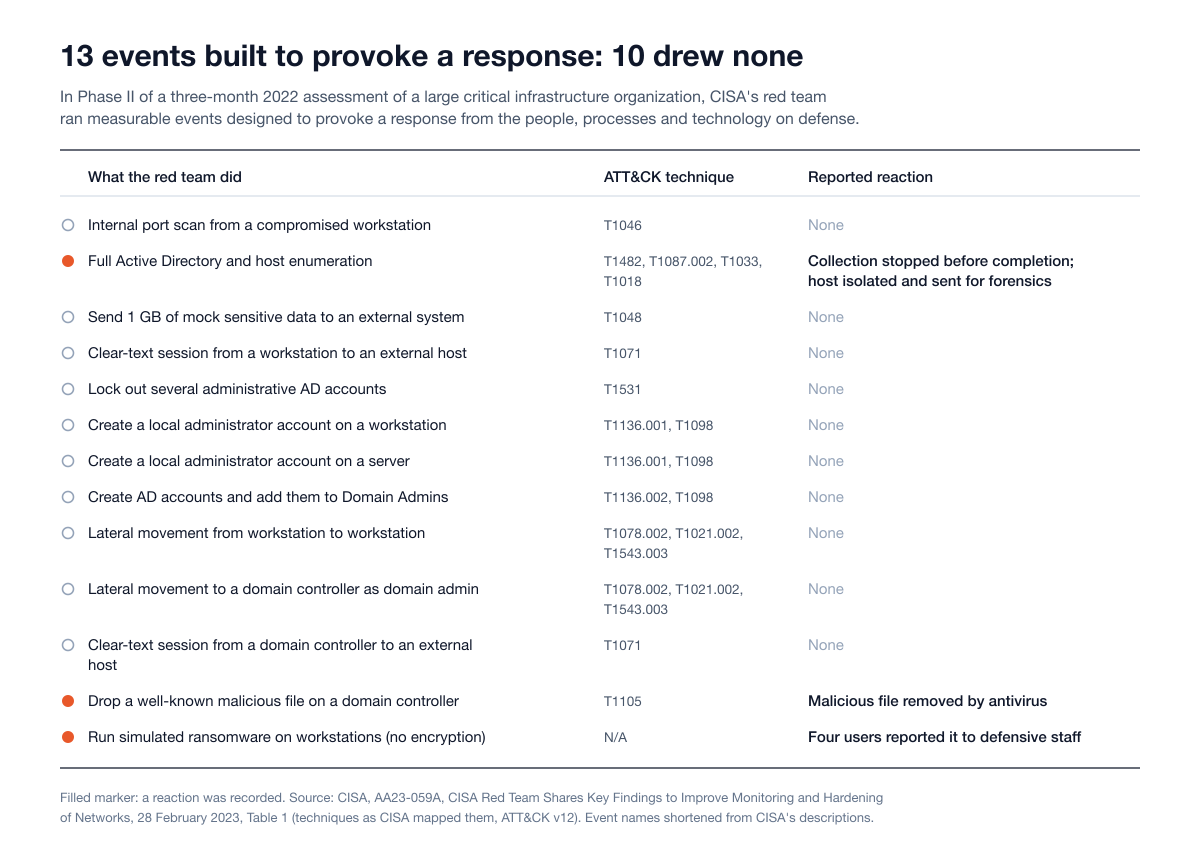
Figure 2: The 13 measurable events in CISA's AA23-059A red team assessment and the reaction CISA recorded for each, 2022. Source: CISA, AA23-059A, Table 1.
Ten of the thirteen drew no reported reaction, including 1 GB of mock data sent to an external system, new accounts added to Domain Admins and lateral movement to a domain controller; the three that did are marked in Figure 2. CISA's own summary is blunter than its table: "Despite having a mature cyber posture, the organization did not detect the red team's activity throughout the assessment, including when the team attempted to trigger a security response." The measurable-events table is worth copying: it is a purple team scoring sheet run blind, and it tells the white team where to start the closure session. Detection guidance for the lateral movement steps is in Stingrai's guide to lateral movement detection and testing.
In-house or outsourced: who should own each team?
Each team has a different answer, and the answer changes with size. Here, mid-market means a small security team with detection largely bought as a service; enterprise means an in-house SOC with specialist staff.
Team | Mid-market | Enterprise | What the frameworks say |
|---|---|---|---|
Red team | Outsource. A standing red team is rarely affordable, and an outside team does not share your assumptions | An internal red team for continuous work is common at scale, with an outside team brought in periodically for an independent view | TIBER-EU "strongly encouraged" external testers for "a fresh and independent perspective"; the DORA standard allows internal testers only with the TLPT authority's approval, a test lead and at least two more members, each employed for the preceding 12 months, under a written policy |
Blue team | Mixed: a security lead and IT operations in-house, with an MDR or MSSP watching alerts | In-house SOC, detection engineering and incident response, sometimes with a provider for overnight or first-line triage | The DORA standard counts third-party providers' staff as blue team, so the provider's escalation is part of what gets tested |
White team (control team) | In-house, always: a few people with authority, usually the CISO and an operations or risk executive | In-house: a control team lead, subject matter experts for the systems in scope, and a C-level member as the escalation point | The control team is the tested entity's own staff, plus third-party providers' staff where relevant |
Purple teaming | Outside operators working with your analysts, with the MDR provider on the call | Internal red and blue run it as a continuous program; an outside team adds new techniques and an independent score | Mandatory in the closure phase of a DORA TLPT and a TIBER-EU test |
Threat intelligence | Bought with the red team engagement, or not needed for an assumed breach test | An in-house threat intelligence function, plus an external provider for regulated tests | DORA and TIBER-EU both require an external threat intelligence provider |
The mid-market and enterprise columns are Stingrai's recommendations; the last column is what the frameworks say. Sources: TIBER-EU Framework, January 2025, section 3; Delegated Regulation (EU) 2025/1190, Articles 1 and 15.
Three rules hold at every size. First, never outsource the white team. Its value is authority and knowledge of the business, and the ECB's guidance says its lead should ideally bring "experience with crisis management" as well as red team testing experience; a provider can advise, but the decisions to stop, continue or grant a leg-up stay with your people. Second, an internal red team does not replace an independent one, because internal teams "have grown accustomed to the internal systems, people and processes", in the ECB's words, and under TIBER-EU, significant credit institutions identified under DORA "cannot use internal testers" for the test. Third, test your MDR provider rather than briefing it: tell one senior contact who sits on your white team and leave the analysts who work your queue unaware. Stingrai's guide to MDR provider red team validation covers the scoping.
Which exercise should you buy at each maturity stage?
Pick the row that describes the blue team you have today, not the one in the hiring plan. The stages are Stingrai's recommendation, not a framework's.
Stage | Your blue team today | Buy next | Then | Who sits on the white team | What to measure |
|---|---|---|---|---|---|
1. IT-led security | IT administrators run security; endpoint alerts go to a console nobody watches overnight | A penetration test of the internal network and the most important application, then a retest | A review of logging: which systems send logs where, and who reads them | Not needed for an announced test; name an IT lead and an executive sponsor | High and Critical findings closed and retested; log sources in place |
2. Outsourced detection | A security lead or small team; an MDR or MSSP watches alerts around the clock | A purple team exercise with the MDR on the call, weighted to credential access, lateral movement and persistence | An assumed breach red team, unannounced to the provider's analysts | The CISO, an operations executive and one senior contact at the provider | Per technique: whether the provider saw it, escalated it, how fast, and what your team did next |
3. In-house SOC, partial coverage | Analysts in business hours, an MDR overnight, one person who can write detection rules | Purple team sprints after major changes, and an assumed breach red team once a year | A full-scope red team when initial access is the open question | The CISO, the head of IT operations, legal or risk; not the SOC manager | Time to detect, escalate and contain per stage; detections shipped per sprint |
4. Mature SOC | Around-the-clock triage, detection engineering, incident response and threat intelligence | A threat intelligence-led red team toward named flags, with a replay and purple teaming session at closure | Continuous red teaming or regular purple waves between annual tests | A small control team: a lead, subject matter experts and a C-level escalation point | Flags reached, time to containment, detections that regress after changes |
5. Internal red team | An internal red team already works alongside the SOC | An external red team for an independent view, on scenarios your own team has not run | Internal purple teaming as a continuous program | As stage 4, with the internal red team kept out of the external test's plan | Findings your internal team had not seen; detection of new techniques |
Designated by a supervisor | Any of the above, named for DORA TLPT, TIBER-EU or CBEST | The framework's own test, with providers that meet its rules | The closure replay and purple teaming it prescribes | The control team or Control Group the framework defines | What the framework reports, plus your own regression set |
The order follows the roles. A red team against a blue team that does not yet watch its alerts mostly documents silence; even at an organization CISA described as having "a mature cyber posture", AA23-059A's red team drew a reaction to only three of 13 events; NIST's glossary itself places a blue team review "prior to a Red Team employment". Purple teaming comes next because it improves the blue team while measuring it. The unannounced red team comes once there is a response worth testing, because only a covert test exposes the escalation paths, authority and silos that separated CISA's two SOCs in AA26-237A. Under CBEST, both the threat intelligence provider and the penetration testing provider "must be CBEST accredited", so check the register your supervisor uses before you shortlist anyone; the frameworks are compared in TIBER-EU vs CBEST vs DORA TLPT.
How Stingrai runs red teaming, purple teaming and adversary simulation
Stingrai is a CREST-accredited penetration testing company founded in Toronto, Canada in 2021, and a proud CREST member. It holds two CREST accreditations, Penetration Testing and AI-Enabled Penetration Testing, and the company certification CREST AI Charter (CREST Marketplace). Its testing supports compliance programs such as SOC 2, ISO 27001 and DORA, and produces evidence for audits.
Stingrai as your red team. Red teaming engagements are human-led and run in three modes: assumed breach, black-box full chain, and threat intelligence-led scenarios in the DORA and TIBER-EU style, on-premise and in the cloud. They stay covert to your defenders, with a small control group on your side holding the rules of engagement and stop conditions. Detection and response timings are a contractual deliverable: every stage records what was prevented, logged, alerted or missed, and every engagement ends with a replay and debrief with your SOC and an attestation letter. A team lead with 16 years in penetration testing, red teaming and exploit development leads the work, from a team holding OSCE³, OSEP, CRTO, CRTL, CREST CRT and CISSP certifications whose researchers have published 18 CVEs.
Stingrai beside your blue team. In purple teaming, Stingrai's operators execute techniques selected from MITRE ATT&CK while your analysts watch their SIEM and EDR. Blind spots in log collection, correlation logic and alert thresholds are tuned during the exercise, SOAR playbooks are tested against the live techniques, and you keep the validated detection rules, as a one-time exercise or a continuous program.
Both, in sequence. Adversary simulation combines the two, so a covert red team engagement can be followed by a purple teaming session on what was missed.
Red team and purple team work is scoped per engagement through Get a Quote. If you also run customer-facing web applications, Stingrai's Hybrid Pentest has Snipe, its autonomous agent, test the full application while certified penetration testers test the same application manually alongside it and validate Snipe's findings, at US$6,800 per assessment or US$1,275 per month on a 12-month plan for one web application and associated APIs (pricing).
Frequently Asked Questions
What is the difference between a red team and a blue team?
A red team is a group authorized to emulate a real adversary against your systems; a blue team is everyone who defends them, from SOC analysts and incident responders to IT operations, the helpdesk and your MDR provider. NIST's glossary defines the red team partly by its purpose of demonstrating "what works for the defenders (i.e., the Blue Team)", so the red team exists to make the blue team better. In a covert red team engagement the blue team is not told; in a purple team exercise both sides work in the open.
What is a purple team in cybersecurity?
A purple team is red and blue working together openly, usually convened for an exercise rather than kept as a standing department. The red side runs agreed techniques one at a time, the blue side records what its tools saw, and detection is tuned and re-tested before the session ends. The EU's DORA testing standard defines purple teaming as "a collaborative testing activity that involves both the testers and the blue team".
What is a white team in cybersecurity?
The white team is the small group on the defending side that knows an unannounced red team test is running, sets its rules and can stop it. NIST defines it as "a small group of people who have prior knowledge of unannounced Red Team activities" and, more broadly, as the referee that "enforces the rules of the exercise". It usually includes the CISO and a senior operations or risk executive.
What is the control team in DORA and TIBER-EU?
The control team is the European name for the white team: under the DORA testing standard, the tested entity's staff, and where relevant its providers' staff, "who manages the test", led by a control team lead. The ECB renamed TIBER-EU's White Team to Control Team in February 2025 to match DORA, and the UK's CBEST calls the same group the Control Group.
Does the blue team know about a red team exercise?
Not in a covert red team engagement: only the white team knows, and the blue team is told when active testing ends. TIBER-EU says the blue team must be "completely excluded from the preparation and conduct" of the test, then joins the replay and purple teaming. In a purple team exercise the blue team knows everything from the start.
Should we build an in-house red team or hire one?
Most mid-market organizations should hire one, because a standing red team is expensive to staff and an outside team does not share your assumptions. Large enterprises often run an internal red team and still bring in an outside one periodically; TIBER-EU strongly encourages external testers because they "provide a fresh and independent perspective".
Can an MDR provider be our blue team?
Yes, and for many mid-market companies the MDR provider is most of the blue team. The DORA testing standard counts third-party providers' staff as blue team members, so test the provider's analysts like your own: unaware in a covert test, on the call in a purple team exercise. Measure what the provider escalated, how fast, and what your team did next.
Which exercise should we buy first?
Buy by the blue team you have. While IT runs security, a penetration test and a review of logging come first; once an MDR or SOC watches alerts, a purple team exercise is the best next step; once alerts are triaged around the clock and detection has been tuned, an unannounced red team, usually starting from assumed breach, tests the whole response.
Related reading
Red teaming: what it is, how an engagement runs and when you need one
Red team services in 2026: engagement types, choosing a provider and cost
Red team exercise: engagement phases, the red team report and success metrics
Purple teaming: what a purple team exercise is, how it runs and what to demand
Will your SOC catch a red team? Detection and response benchmarks for 2026
Assumed breach engagements: when to start the test from inside
References
NIST Computer Security Resource Center. Glossary: red team; blue team; white team (definitions from CNSSI 4009-2022). Read 19 November 2026. https://csrc.nist.gov/glossary/term/red_team, https://csrc.nist.gov/glossary/term/blue_team, https://csrc.nist.gov/glossary/term/white_team. The glossary has no entry for purple team.
European Commission. Commission Delegated Regulation (EU) 2025/1190 of 13 February 2025 (regulatory technical standards on threat-led penetration testing under DORA). Official Journal, 18 June 2025. https://eur-lex.europa.eu/eli/reg_del/2025/1190/oj. Definitions of the control team, blue team, red team and purple teaming; tester requirements; closure-phase reports, replay and purple teaming.
European Central Bank. TIBER-EU Framework: How to implement the European framework for Threat Intelligence-based Ethical Red teaming. January 2025. https://www.ecb.europa.eu/pub/pdf/other/ecb.tiber_eu_framework_2025~b32eff9a10.en.pdf. Stakeholder roles, external testers and closure-phase purple teaming.
European Central Bank. TIBER-EU Control Team Guidance. January 2025. https://www.ecb.europa.eu/pub/pdf/annex/ecb.tiber_control_team_2025.en.pdf. Composition, size and experience of the control team.
European Central Bank. TIBER-EU Framework updated to align with DORA. 11 February 2025. https://www.ecb.europa.eu/press/intro/news/html/ecb.mipnews250211.en.html. Renaming of the White Team to Control Team and mandatory purple teaming.
European Central Bank. TIBER-EU. Read 19 November 2026. https://www.ecb.europa.eu/paym/cyber-resilience/tiber-eu/html/index.en.html. The five teams in a TIBER-EU test.
Bank of England. CBEST Threat Intelligence-Led Assessments: Implementation Guide. 2024. https://www.bankofengland.co.uk/financial-stability/operational-resilience-of-the-financial-sector/cbest-threat-intelligence-led-assessments-implementation-guide. Stakeholders, Control Group composition and integrity rules.
CISA. AA23-059A: CISA Red Team Shares Key Findings to Improve Monitoring and Hardening of Networks. 28 February 2023. https://www.cisa.gov/news-events/cybersecurity-advisories/aa23-059a. A three-month 2022 assessment with 13 measurable events in Phase II.
CISA. AA24-326A: Enhancing Cyber Resilience: Insights from CISA Red Team Assessment of a US Critical Infrastructure Sector Organization. 21 November 2024. https://www.cisa.gov/news-events/cybersecurity-advisories/aa24-326a. Trusted agents, user reactions to simulated ransomware, and lessons for staff and leadership.
CISA. AA26-237A: A Tale of Two SOCs: Insights From Two Red Team Assessments. 25 August 2026. https://www.cisa.gov/news-events/cybersecurity-advisories/aa26-237a. Two simultaneous assessments with different defensive outcomes.
MITRE. ATT&CK release notes, October 2026 (v20). 13 October 2026. https://attack.mitre.org/resources/updates/updates-october-2026/. Enterprise counts of tactics, techniques, sub-techniques, detection strategies and analytics.
MITRE. ATT&CK FAQ. Read 19 November 2026. https://attack.mitre.org/resources/faq/. Origin of ATT&CK as a common language for offense and defense.
CREST. Stingrai Inc, CREST Marketplace listing. Read 19 November 2026. https://marketplace.crest.org/supplier/stingrai-inc/. Accreditations and company certification.
Talk to Stingrai
Tell us which blue team you have today and we will recommend the exercise that measures it best, from a purple team sprint with your MDR on the call to a threat intelligence-led red team. Get a Quote or book a free discovery call.