A red team exercise is a covert test of whether an organization detects and stops a realistic adversary, which NIST defines as "a simulated adversarial attempt to compromise organizational missions or business processes" (NIST glossary, citing SP 800-53 Rev. 5). The regulated versions put a clock on it: the EU's testing standard for financial entities requires an active red team phase of "at least 12 weeks" (Delegated Regulation (EU) 2025/1190, Article 11(5)), and the Bank of England puts the average CBEST project at "around 9 to 12 months" (CBEST Implementation Guide, 2024). A commercial exercise outside those regimes is shorter, but it runs the same phases, needs the same small control team on the client side, and should end with the same kind of evidence.
Quick answer. In Stingrai's synthesis of the DORA, TIBER-EU and CBEST phase structures, a red team exercise runs in eight phases: preparation and scoping, threat intelligence, planning, execution, detection and response observation, closure, replay and purple teaming, and remediation. Your organization supplies a small white team (control team) with a backup lead, legal sign-off, an emergency stop and a deconfliction channel; your SOC defends without being told. The deliverable is a red team report with an executive summary, an attack narrative and timeline, objectives reached and not reached, ATT&CK-mapped techniques, detection and response gaps with timings and prioritized fixes. Stingrai runs red team engagements from 2 to 3 weeks for one assumed-breach scenario to 8 to 12 weeks for multi-scenario programs, with detection and response timings as a contractual deliverable.
This guide is the operational view: what happens in each phase, what your team does, what the report must contain and how to score the result. What red teaming is and when to buy it is covered in what is red teaming, and how to choose a provider in red team services.
Key facts
Active testing floor (regulated): at least 12 weeks under the EU's DORA testing standard and TIBER-EU (RTS 2025/1190, Art. 11(5); ECB, TIBER-EU Framework, January 2025).
CBEST project length: around 9 to 12 months on average, with indicative phases of about 6 weeks initiation, 10 weeks threat intelligence, 14 weeks penetration testing and 4 weeks closure (Bank of England, 2024).
Commercial length (Stingrai guidance): 2 to 3 weeks for a single assumed-breach scenario, 4 to 8 weeks for a full-scope engagement from outside and 8 to 12 weeks for a multi-scenario program (Stingrai red teaming).
Control team effort: the ECB's indicative figure for the control team lead during the red team phase is 10 to 30 hours a week (TIBER-EU Control Team Guidance).
Why measurement matters: in a 2022 CISA assessment of a critical infrastructure organization with "a mature cyber posture", the organization "did not detect the red team's activity throughout the assessment" (CISA AA23-059A).
What is a red team exercise, and who takes part?
A red team exercise sends a team of testers after agreed objectives, which the EU's standard calls flags ("key objectives in the ICT systems supporting critical or important functions"), while the people who defend the organization go about their normal work. It differs from a penetration test in its question: not "what is exploitable in this scope?" but "would anyone notice, and would they stop it in time?" The comparison with penetration testing and purple teaming is covered in purple team vs red team vs penetration test.
Five groups take part, and the defining feature of the exercise is who knows what.
Group | Who they are | Knows about the test? | Main job |
|---|---|---|---|
White team (control team, control group) | A handful of senior staff at the top of the incident escalation chain, plus subject matter experts | Yes, from the start | Manages the test, owns the risk, answers deconfliction, provides leg-ups, can stop the test |
Red team | The testers, internal or external | Yes | Plans and runs the attack scenarios toward the flags, logs every action, writes the red team report |
Blue team | The SOC, MDR, IT operations, help desk and incident responders | No, until the active phase ends | Defends as normal; afterwards writes what it saw and joins the replay |
Threat intelligence provider | An analyst team, external in regulated tests | Yes | Builds the threat profile and the scenarios the red team executes |
Regulator test managers | Supervisors, in DORA, TIBER-EU and CBEST tests only | Yes | Approve the scope, scenarios and plan, and confirm the reports are complete |
The terms vary by framework. NIST's glossary calls the overseeing group the white team, "a small group of people who have prior knowledge of unannounced Red Team activities" that ensures "the scope of testing does not exceed a pre-defined threshold" (NIST glossary). The EU standard and TIBER-EU call it the control team, CBEST the control group, and CISA's advisories speak of "trusted agents".
How long does a red team exercise take?
A commercial red team exercise takes 2 to 12 weeks at Stingrai, depending on the starting point and the number of scenarios, while a regulator-led threat-led test takes 9 months to more than a year, because the regulated versions add formal preparation, threat intelligence and closure phases around at least 12 weeks of active testing.
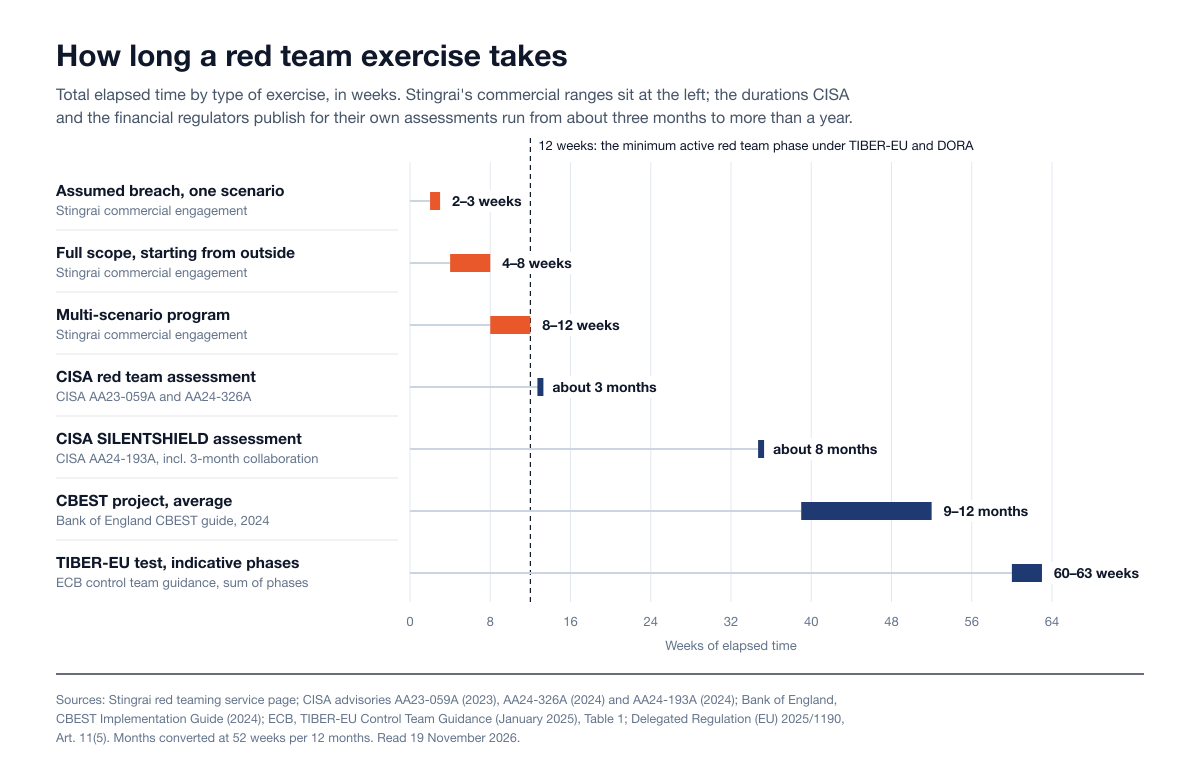
Figure 1: Total elapsed time by type of red team exercise, in weeks. Months are converted at 52 weeks per 12 months; the TIBER-EU bar is the sum of the ECB's indicative phase lengths (24 weeks preparation, 4 to 6 weeks threat intelligence, 14 to 15 weeks red team testing, 18 weeks closure), in which active testing is a minimum and closure may run longer. Sources: Stingrai, CISA AA23-059A, CISA AA24-326A, CISA AA24-193A, Bank of England CBEST guide, ECB TIBER-EU Control Team Guidance, Table 1, ECB TIBER-EU Framework, Delegated Regulation (EU) 2025/1190, Art. 11(5).
Three things drive the spread:
The starting point. An assumed-breach engagement starts from a provided laptop or account and skips initial access; a full-scope engagement has to earn its way in. See assumed breach engagements.
The number of scenarios. The EU standard requires the selection of "at least three scenarios", drawn from a threat intelligence report that must cover availability, integrity and confidentiality. A commercial exercise with one objective can be far shorter.
The governance around the attack. CISA's own red team assessments ran about three months (AA23-059A, AA24-326A); its SILENTSHIELD assessment ran about eight months, three of them a collaboration phase with the defenders (AA24-193A).
The EU standard sets 12 weeks so that "all attack phases are executed and flags are reached" (recital 20). A commercial buyer can apply the same logic in reverse: if the budget buys four weeks, cut scenarios, not phases.
The phases of a red team exercise at a glance
The eight phases below are Stingrai's synthesis of the phase structures in the EU's DORA testing standard, TIBER-EU and CBEST, which group the same work into three or four phases. Phases 4 and 5 run at the same time: one is what the red team does, the other is what the white team watches.
# | Phase | Typical duration (source) | Who leads | What your team does | Output |
|---|---|---|---|---|---|
1 | Preparation and scoping | Scope within 6 months of notification (DORA); about 24 weeks (TIBER-EU indicative); about 6 weeks (CBEST) | White team lead | Appoints the white team, picks flags, signs off risk and legal | Project plan, scope with flags, risk assessment, contracts |
2 | Threat intelligence | About 4 weeks (DORA recital 18); 4 to 6 weeks (TIBER-EU); about 10 weeks (CBEST) | Threat intelligence provider | Supplies context, reviews the draft, selects scenarios | Targeted threat intelligence report, selected scenarios |
3 | Planning | 2 to 3 weeks (TIBER-EU indicative) | Red team | Approves the plan, prepares leg-ups and stop conditions | Red team test plan |
4 | Execution | At least 12 weeks (DORA, TIBER-EU); about 14 weeks for the whole penetration testing phase, including planning and reporting (CBEST); within a 2 to 12 week commercial engagement (Stingrai) | Red team | Keeps the secret, joins weekly updates, provides leg-ups | Attack log, flags reached, weekly reports |
5 | Detection and response observation | Alongside execution | White team | Deconflicts alerts, contains escalations, records timings | Observation log with timestamps |
6 | Closure and reporting | Red team report within 4 weeks; blue team report within 10 weeks (DORA) | Red team, then blue team | Tells the blue team, reviews the report, writes the blue team report | Red team report, blue team report |
7 | Replay and purple teaming | Replay no later than 10 weeks after active testing (DORA, TIBER-EU); TIBER-EU sets the same limit for purple teaming | White team | Runs the replay and the purple team sessions | Agreed timeline, new and tuned detections |
8 | Remediation and retest | Summary and remediation plan within 8 weeks of the authority's notice (DORA); supervision 6 to 12 months or longer (CBEST) | Your organization | Fixes root causes, assigns owners, retests | Remediation plan, retest results |
Phase by phase: what happens and what your team does
1. Preparation and scoping
Preparation turns "test us" into a written scope with flags. Under DORA the financial entity submits initiation information "within 3 months" of the regulator's notification and a scope specification "within 6 months", which "the management body of the financial entity shall approve" (RTS, Art. 9). CBEST's initiation phase varies "primarily" with the firm's procurement process.
What your team does: appoint a white team lead and a backup; choose flags tied to the functions the business cannot lose; run a risk assessment that covers "the interruption of critical activities and the corruption of data" and "the incomplete restoration of systems" (Art. 5); and finish procurement and legal sign-off before testing starts. How to choose flags is covered in red team objectives and crown jewels.
Output: a project plan, a scope document with flags, a risk assessment, contracts and the rules of engagement.
2. Threat intelligence
The threat intelligence phase decides which adversary the red team becomes. The provider looks at the organization from outside, including leaked credentials, look-alike domains, exposed systems and what employees post, and writes threat profiles and end-to-end scenarios.
What your team does: brief the provider, review the draft and select the scenarios; under DORA the control team lead selects at least three. Copy CBEST's safety rule: a "major vulnerability or imminent threat" found by the provider "must be disclosed immediately" to the control group. Which adversary to emulate is covered in which threat group a red team should emulate by industry.
Output: a targeted threat intelligence report and the selected scenarios.
3. Planning
The red team turns scenarios into a test plan. The EU standard's Annex IV lists what it must hold: communication channels, "the tactics, techniques and procedures allowed and not-allowed", "including ethical boundaries for social engineering", the expected attack paths with "possible leg-ups to be provided by the control team, including deadlines for their provision", and a schedule split into "in, through, and out phases".
What your team does: approve the plan and stage the leg-ups before you need them, for example a standard workstation and user account ready to hand over if the external route stalls. The clauses to check are in the red team rules of engagement checklist.
Output: an approved red team test plan.
4. Execution
Execution is the active red team phase: the testers move through the in, through and out stages of each scenario toward the flags. Testers "shall report at least weekly to the control team" (Art. 11(7)), and TIBER-EU calls daily meetings "highly recommended" during critical stages. It also says "All of the RTT actions should be logged: for the replay exercise with the BT, as evidence for the RTTR, and for future reference." That log is what makes measurement possible later.
What your team does: keep the secret, join the weekly updates, release leg-ups at the agreed milestones, and act on critical exposures the red team reports. TIBER-EU lets the control team "initiate remediation actions" for a critical vulnerability found mid-test, and CISA's red team reported an exposed web shell to the organization's trusted agents as soon as it used it (CISA AA24-326A). Speed matters: in CISA's federal assessment the organization "took over two weeks to apply the available patch", and the same vulnerability "was exploited by an unknown third party" (CISA AA24-193A).
Output: the attack log, flags reached and not reached, and weekly status reports.
5. Detection and response observation
While the red team attacks, the white team watches the defense. The EU standard requires that "the control team is informed of any detection of the TLPT by staff members" and that, where needed, "the control team contains such escalation" (Art. 4(2)(c)). If staff detect the test, the control team proposes measures to continue it "while ensuring its secrecy" (Art. 11(9)).
Many exercises add a deliberately noisy stage at the end. CISA's assessments run a covert Phase I, then a Phase II in which "the red team attempts to trigger a security response"; in AA23-059A it ran "13 measurable events" and recorded for each the "Expected Detection Points", the "Expected Network Defender Reactions" and the "Reported Reactions" (CISA AA23-059A). That table is a good template for your own observation log.
What your team does: check every suspicious event against the red team's activity log and answer quickly, let normal response run, and record timestamps: first log entry, first alert, ticket opened, escalation, containment. TIBER-EU's control team guidance says to intervene only if an escalation "will have an unwanted business impact or will involve external parties", such as "the shutdown of critical servers", a report to the supervisor or "a police report".
Output: a timestamped observation log of what the defenders saw and did.
6. Closure and reporting
Closure starts when the white team lead tells the blue team that a test took place (Art. 12(1)). Under DORA the testers then have 4 weeks to deliver the red team test report, and the blue team has until 10 weeks after the end of active testing to deliver its own. CBEST expects the draft report "generally no later than two weeks of test completion", alongside a detection and response capability assessment that includes "post-testing interviews with the firm/FMI's SOC and Incident Response Team".
Restoration under Art. 7(1) follows, but TIBER-EU says it should "ideally not occur before the replay and PT exercise", so the evidence survives.
What your team does: brief the blue team as defenders, not suspects; review the red team report for accuracy; write the blue team report.
Output: the red team report and the blue team report (contents below).
7. Replay and purple teaming
The replay walks both teams through the attack against the agreed timeline. The EU standard requires it "no later than 10 weeks after the end of the active red team testing phase", plus "a purple teaming exercise on topics jointly identified by the blue team and the testers" (Art. 12(5)). TIBER-EU's replay agenda includes "what else could have been achieved by the RTT with more time and resources", and its purple teaming guidance ranges "from tabletop discussions to specific technical testing activities".
What your team does: bring the analysts who were on shift, not only their managers; re-run the missed steps while detection engineers watch; agree the timeline both reports use. Scoping the purple team part is covered in purple teaming.
Output: an agreed timeline, new or tuned detections, and the list of topics closed.
8. Remediation and retest
The exercise ends when the root causes have owners. Under DORA, once the authority confirms both reports are complete, the entity has 8 weeks to submit a summary report and remediation plans; each plan entry needs the shortcoming, the measures with priority and expected completion, "a root cause analysis", the staff responsible and "the risks associated to not implementing the measures" (Art. 13). CBEST's regulator tracks the plan for "anything from six to 12 months, or longer". In a commercial engagement the retest is the proof: the fixed paths are attacked again and each finding's status is updated.
Output: a remediation plan with owners and dates, and retest results.
What your organization must prepare before day one
Four things must exist before the red team sends its first packet.
A white team that is small, senior and staffed
TIBER-EU's guiding principle is that "the CT is as small as possible, consisting of just the right people necessary to manage the test". Its control team guidance lists a lead, subject matter experts, a C-level member, other expertise such as a project manager, and relevant third-party providers. The lead needs "a designated back-up" available "at all times", and the C-level member, "typically the COO or CIO, CTO CISO, or equivalent", is "the escalation point during the test".
The white team is also what turns an attack into a measurement. In the assessment CISA published in November 2024, the red team "lacked the support of a white team to help assess the organization's responses" to its 13 measurable events, and it "did not have full visibility into the organization's responses" (CISA AA24-326A).
Budget the time. The ECB's indicative figures, shown below, run from 2 to 4 hours a week per member during preparation to 10 to 30 hours a week for the lead during the red team phase. A commercial exercise is shorter, but it still needs a lead who can answer within the agreed time whenever the red team is active.
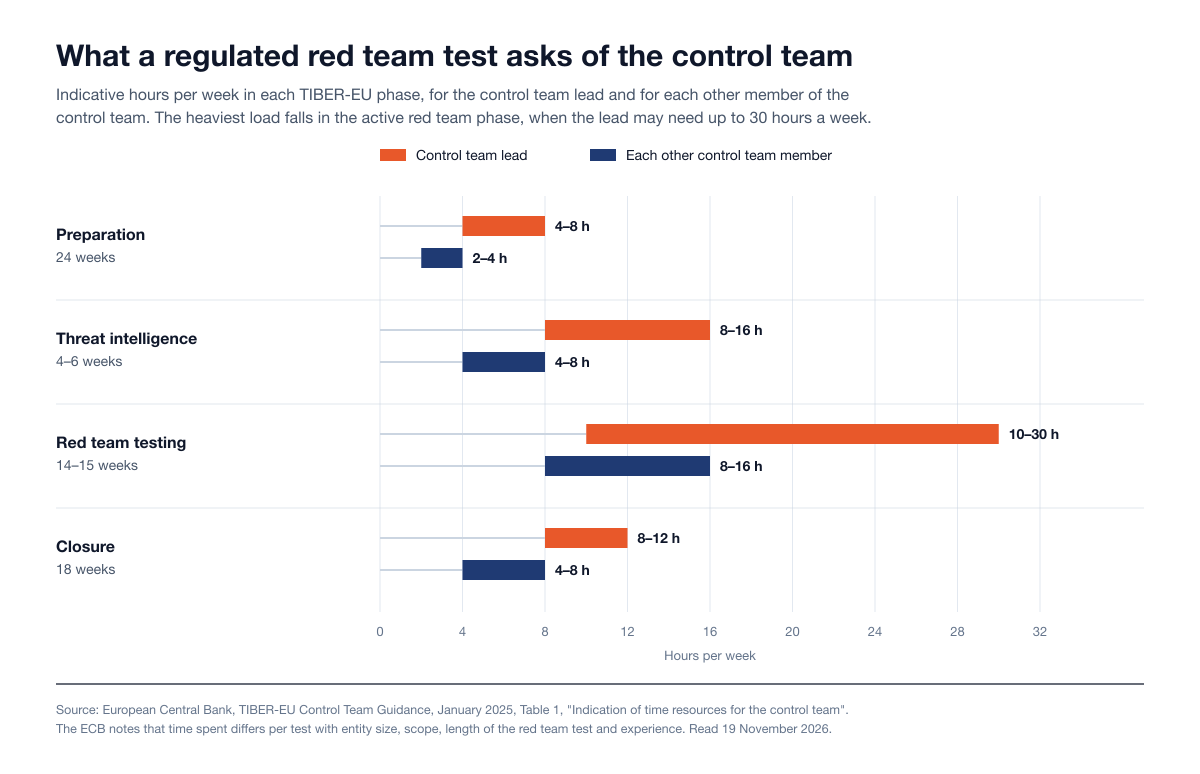
Figure 2: Indicative hours per week for the control team lead and each other control team member, by TIBER-EU phase. Source: European Central Bank, TIBER-EU Control Team Guidance, January 2025, Table 1.
Legal sign-off and written authorization
NIST recommends that legal advisors "always be involved for intrusive tests such as penetration testing", adding "indemnity or limitation of liability clauses" and non-disclosure terms (NIST SP 800-115). Where systems sit on someone else's network, such as a hosting or managed service provider, "the owner of the other network usually must also consent in writing". NIST also asks legal to "address potential privacy violations before the assessment begins", which matters most when phishing is in scope. The EU standard adds "proper professional indemnity insurances including against risks of misconduct and negligence".
An emergency stop the white team lead or backup can pull at any hour
TIBER-EU says the control team "may at any time order a temporary or complete halt of the test if concerns are raised over damage (or potential damage) to a system", and the EU standard lets the control team lead "suspend the TLPT" in exceptional circumstances (Art. 11(10)). CBEST lets a test run "up until a specific point", a position from which a destructive attack could be executed, "but stop before any actual damage is done". Write down who can call a stop (the lead and the backup, at any hour), how (an out-of-band channel that does not rely on the systems under test), what the red team does on receipt, and how the test restarts.
A deconfliction channel that answers fast
Deconfliction is how a defender asks "is this you?" without ruining the test. It needs a named white team member at the top of the escalation chain, access to the red team's live activity log, and an agreed answer time. Published assessments show what happens without one: in AA23-059A the red team "received no deconflictions" throughout Phase I, and in AA24-193A, "five months into the assessment", the organization "had not submitted deconflictions". If the answer is "not us", treat it as a real incident: NIST's guidance is that testers "stop assessing the systems involved in the incident while the organization carries out its response".
Readiness item | Owner | Done when |
|---|---|---|
White team named, with a backup lead and a C-level escalation point | Executive sponsor | Names, phone numbers and an out-of-band channel are in the rules of engagement |
Flags agreed and tied to business functions | White team lead | Each flag has a written success criterion and the management sign-off |
Rules of engagement signed | Legal, white team lead | Allowed and prohibited techniques, social engineering limits, third-party consents, insurance and authorization letter are on file |
Emergency stop defined | White team lead | The stop procedure has been tested once with the red team lead |
Deconfliction path live | White team member in the SOC escalation chain | The red team's activity log is accessible and an answer time is agreed |
Leg-ups staged | IT operations, via the white team | The fallback workstation, account or network access is ready to hand over |
Observation log ready | White team | A template records first log entry, alert, ticket, escalation and containment times per stage |
What a red team report contains
A red team report is an evidence pack about your defenders, not a vulnerability list. The frameworks spell out the minimum: the EU standard's Annex V lists what the red team test report must cover, the ECB's red team test report guidance explains how to write each part, and the CBEST guide sets its own minimum. Together they give this structure:
Report section | What it must show | Framework basis |
|---|---|---|
Executive summary | The objective, whether it was reached, what the defenders saw and the top fixes, "in layman's terms" for the board | TIBER-EU red team report guidance 3.1; CBEST asks for two summaries, one for "the Board and Senior Executive" and one for "technical leaders" |
Attack narrative and timeline | A storyline per scenario, split into in, through and out stages, with timestamps, decisions, dead ends and "a timeline with the relevant logs and details" for the blue team | TIBER-EU guidance 3.2; RTS Annex V; CBEST's "breakdown of the scenarios" |
Objectives achieved | Flags reached and not reached, with every leg-up named, so a flag won with help is not read as a flag won unaided | RTS Annex V; Annex VII "captured and non-captured flags" |
ATT&CK-mapped techniques | Every technique used, successful and unsuccessful, mapped to MITRE ATT&CK with the version stated | RTS Annex V; TIBER-EU guidance asks for scenarios "in line with the MITRE ATT&CK framework" |
Detection and response gaps with timings | Per stage: what was logged, alerted, escalated and contained, and when, set against the red team's own timestamps | RTS Annex V(b) and Annex VI; TIBER-EU 9.2 ("a timeline of events and detections"); CBEST detection and response capability assessment |
Findings and root causes | Findings by criticality and complexity, grouped by NIST function (Identify, Protect, Detect, Respond, Recover), with root causes across people, process and technology | TIBER-EU guidance 3.3 and 3.4 |
Recommendations | Prioritized fixes, with root-cause recommendations "separate from those of the findings" | TIBER-EU guidance 3.5; RTS Annex V |
Artefacts and restoration | Everything that could remain on your systems, described by "filenames, paths, hashes, hostnames, IPs, email addresses" and domains | TIBER-EU guidance 3.6 |
Two details separate a strong report from a weak one. First, TIBER-EU asks testers to state the "threat actor sophistication level that was actually needed for the attack", for example that a nation-state scenario was achievable by "an intermediate hacker using existing attack toolkits". That sentence gives a board a plain measure of exposure. Second, findings should not be ranked by CVSS alone: the guidance says categorization "does not need to be based on a single dimensional technical aspect only, such as the Common Vulnerability Scoring System (CVSS) rating", and should weigh proximity to a critical system and the impact on the function.
Sample red team report table of contents
This structure follows the framework minimums above. A commercial report can drop the regulatory annexes; it should not drop the timeline or the detection evidence.
Document control: code name, version, distribution list and handling label
Executive summary for the board: objectives, outcome, what the defenders saw, top five actions
Executive summary for security and technology leaders
Engagement overview
Scope, flags and success criteria
Threat actor emulated and the sophistication actually needed
Rules of engagement, out-of-bounds actions and risk controls applied
Leg-ups granted and deviations from the test plan
Objective results: each flag reached or not reached, with evidence
Attack narrative, per scenario
In: initial access attempts, successful and unsuccessful
Through: privilege escalation and movement
Out: actions on objectives and exit
Detection and response timeline: each stage with red team timestamp, first log entry, alert, escalation and containment
Findings, by criticality and complexity, grouped by NIST function
Root cause analysis across people, process and technology
Recommendations: for findings, then separately for root causes, each with a priority
Strengths observed: controls the red team could not get past
Appendix A: MITRE ATT&CK technique table, with ATT&CK version
Appendix B: artefact register for clean-up
Appendix C: indicators the red team generated (infrastructure, domains, file hashes)
Appendix D: evidence (log extracts with timestamps, screenshots)
Three documents, not one
A regulated test produces three reports, and a commercial buyer should ask for the substance of all three:
The red team report, written by the testers (above).
The blue team report, written by your defenders, listing "for each attack step" the "detected attack actions" and the "log entries corresponding to these detections" (RTS Annex VI). The ECB's blue team report guidance suggests searching "all log databases based on the attack steps" to find attacks that "appeared in the logs but were not detected".
The test summary report, a "sanitised, high-level overview" for senior management and authorities (ECB test summary report guidance), which should also "highlight the positives from the test, notably any strong control areas that the RTT were unable to circumvent".
Treat all three as highly sensitive: the ECB guidance calls for a register of every copy, the code name throughout, and handling such as "TLP Red".
How to judge a red team report
Does every flag have a stated outcome, and is every leg-up named next to the flag it helped?
Can you line up the red team's timestamps against your own logs for each stage?
Are root-cause recommendations separate from finding fixes, with priorities?
Does the report name strengths, so you do not dismantle a control that worked?
Report formats for penetration tests, as opposed to red teams, are walked through page by page in the penetration testing report sample.
How to measure the success of a red team exercise
A red team exercise succeeds when it tells you, with timings, which stages of a realistic attack your defenders would have seen and stopped. A flag reached is not the verdict on its own; both TIBER-EU and CBEST reject a pass or fail grade. Score these instead:
Metric | How to measure it | Where the data comes from |
|---|---|---|
Time to detect, per stage | From the red team's first action in a stage to the first alert a human acknowledged | Red team attack log and timeline; blue team ticket timestamps |
Time to respond and contain | From that alert to an effective containment action, such as a blocked domain or an isolated host | Blue team report and incident tickets |
Objectives reached | Flags reached and not reached, and how many leg-ups each needed | Red team report; summary report |
Detection coverage | Of the ATT&CK techniques actually executed, the share that were logged, alerted and acted on | ATT&CK-mapped technique table plus the blue team's per-step detections |
Escalation quality | Whether each alert reached someone who acted, and whether users reported what they saw | Observation log and blue team report |
Remediation closure | Root causes fixed and paths retested by the agreed date | Remediation plan and retest results |
Two rules keep the numbers honest. The denominator for detection coverage is the techniques the red team executed, not the 227 Enterprise techniques in ATT&CK v20, released 13 October 2026; why a technique count is not a quality score is explained in grading MITRE ATT&CK coverage in a red team proposal. And an alert nobody read counts as a miss: in the assessment CISA published in November 2024, the EDR stopped the first phishing payload but "generated an alert that network defenders neither read nor responded to".
Classify every missed or partly missed step on one ladder. The ECB's purple teaming guidance describes five kinds of red team activity to walk through after a test, and they make a useful scale for the report; the gap names in the right-hand column are Stingrai's labels:
Outcome for an attack step | What it tells you |
|---|---|
Not visible in the blue team's logs | A telemetry gap: the data source is missing or not collected |
Visible in logs, not detected | A detection gap: the data exists but no rule fired |
Alerted, but not triaged properly | A triage gap in the SOC or MDR process |
Triaged, but the response was ineffective | A response gap in playbooks, authority or tooling |
Response closed the vector, but the objective was still met | A resilience gap: the attacker had another route |
CISA's published results show several rungs. In AA24-326A an alert for adding accounts to the domain admins group "existed" but "was disabled at the time", and a proxy "likely blocked" a 1 GB exfiltration attempt, after which "the team's second attempt was successful when they exfiltrated the data in 100MB blocks". In its ransomware simulation, "Two out of nine users reported the event to defensive staff".
For context, Mandiant's M-Trends 2026 puts the global median dwell time in 2025 at 14 days (Google Cloud, M-Trends 2026); set your per-stage time to detect against it, and see red team detection benchmarks for 2026.
Common red team exercise mistakes
A white team that is too big or too leaky. Every extra person is a leak risk. TIBER-EU warns that if the blue team is told, "the integrity of the test will be compromised", and "the test attestation may be withheld"; CBEST requires a suspected compromise of secrecy to be reported "immediately to the regulator".
No working deconfliction path. In two of CISA's published assessments, AA23-059A and AA24-193A, the defenders sent no deconfliction requests during the covert phase. Name the person who answers, give the SOC the route, and test it in week one.
Counting disabled or unread alerts as coverage. A rule that is switched off, or an alert in a queue nobody reads, is a miss. Check rule state before the exercise and score it after.
Cleaning up before the replay, or not at all. Restoration should follow the replay so evidence survives, and it should end with the artefact register checked off, kill switches confirmed and compromised credentials changed.
Accepting the red team report as the whole story. Without the blue team's per-step detections and log entries, time to detect cannot be measured. Contract for the timeline and the replay up front.
Fixing findings and leaving root causes. The EU standard's remediation plan requires a root cause analysis, named owners and the risk of not acting; TIBER-EU keeps root-cause recommendations separate so they are not lost among the finding fixes.
Where Stingrai fits
Stingrai is a CREST-accredited penetration testing company founded in Toronto in 2021, with an office in London, and a proud CREST member: Stingrai Inc holds the CREST accreditations for Penetration Testing and AI-Enabled Penetration Testing, and the company certification CREST AI Charter (CREST Marketplace). For a red team exercise that means:
Three modes: assumed breach, black-box full chain, and threat intelligence-led scenarios structured to the TIBER-EU phases, on-premise and in the cloud (red teaming, adversary simulation).
Durations: 2 to 3 weeks for a single assumed-breach scenario, 4 to 8 weeks for full scope from outside, 8 to 12 weeks for multi-scenario programs.
A small client control group holds the rules of engagement and stop conditions, and the defenders are not told.
Measured detection: every technique is mapped to MITRE ATT&CK, and detection and response timings are a contractual deliverable, recording per stage what was prevented, logged, alerted or missed.
Closure: every engagement ends with a SOC replay and debrief, with purple teaming available to close the gaps; every quote includes the retest, and every human-led and hybrid report ships with an attestation letter.
People: engagements are led by a team lead with 16 years in penetration testing, red teaming and exploit development.
Pricing: red team engagements are quoted on operator days, with no package price; submit the Get a Quote form and receive pricing within 24 hours. Cost drivers are explained in red team engagement cost.
Where the exercise reaches customer-facing web applications, Stingrai's Hybrid Pentest covers one web application and associated APIs. One-time, it is US$6,800 per assessment: Snipe tests the full application while Stingrai's certified penetration testers test the same application manually alongside it and validate Snipe's findings. Continuous, it is US$1,275 per month on a 12-month plan, with monthly Snipe testing, human-verified, and a quarterly deep dive by Stingrai's penetration testers (pricing).
Frequently Asked Questions
What is a red team exercise?
A red team exercise is a covert test in which a team of testers emulates a realistic adversary and works toward agreed objectives, called flags, while the defenders go about their normal work. It measures whether people, processes and technology detect and stop the attack, and how fast, and it ends with a red team report and a replay with the defenders. Stingrai's commercial red team exercises run 2 to 12 weeks; regulated tests under TIBER-EU and DORA include at least 12 weeks of active testing.
How long does a red team exercise take?
Stingrai's commercial engagements run 2 to 3 weeks for one assumed-breach scenario, 4 to 8 weeks for a full-scope engagement from outside and 8 to 12 weeks for a multi-scenario program. Regulated tests take much longer: TIBER-EU and the EU's DORA testing standard require at least 12 weeks of active red team testing alone, and the Bank of England puts the average CBEST project at around 9 to 12 months.
What are the phases of a red team engagement?
In Stingrai's model, which combines the DORA, TIBER-EU and CBEST phase structures, the eight phases are preparation and scoping, threat intelligence, planning, execution, detection and response observation, closure and reporting, replay and purple teaming, and remediation and retest. Execution and detection observation run at the same time: the red team attacks while the white team records what the defenders saw and did.
What does a red team report include?
A red team report includes an executive summary, the scope and the threat actor emulated, an attack narrative and timeline for each scenario, flags reached and not reached with any leg-ups, every technique used mapped to MITRE ATT&CK, detection and response gaps with timings, findings with root causes, prioritized recommendations and an artefact register for clean-up. Regulated tests add a blue team report of what the defenders detected and a sanitised test summary report.
Should the SOC know about the red team exercise?
No. The blue team, including the SOC, MDR, IT operations and help desk, should not be told until the active phase ends, because the exercise measures how they respond to an unannounced attack. A white team member at the top of the escalation chain handles deconfliction so real incidents are never dismissed as the test.
What happens if the blue team detects the red team?
Detection is a result to record, not a failure. The white team logs when and how the activity was detected, lets normal response run, and steps in only if the escalation would cause business impact or involve outside parties such as a regulator or the police, then agrees how to continue covertly. If the activity is not the red team, it is a real incident.
How do you measure the success of a red team exercise?
Measure time to detect and time to respond for each stage of the attack, flags reached and not reached, the leg-ups each flag needed, and the share of executed ATT&CK techniques that were logged, alerted and acted on. Classify each missed step as a telemetry, detection, triage, response or resilience gap. TIBER-EU and CBEST both say the result is not a pass or fail; the trend across exercises is the measure.
What is a leg-up in a red team exercise?
A leg-up is help the white team gives the testers when they cannot advance on their own, such as a workstation, an account or network access. The EU standard requires the red team test plan to list possible leg-ups with deadlines, and every leg-up should be named in the report next to the flag it helped reach.
How much does a red team exercise cost?
There is no standard price: the cost follows the starting point, the number of scenarios and objectives, the depth of threat intelligence, the environments in scope and the weeks of operator time. Stingrai quotes red team engagements on operator days, with no package price, returns pricing within 24 hours of a Get a Quote request, and includes the retest in every quote.
Related reading
Red teaming: what it is, how an engagement runs and when you need one
Red team rules of engagement: what to demand before you sign
Will your SOC catch a red team? Detection and response benchmarks for 2026
Microsoft 365 tenant red-team exercise: buyer scope and evidence
BEC and payment diversion red-team exercise for finance teams
TIBER-EU vs CBEST vs DORA TLPT: which threat-led test applies
Red Team vs Blue Team vs Purple Team (2026): Roles, Exercises and Which to Buy
References
European Commission. Commission Delegated Regulation (EU) 2025/1190 of 13 February 2025 (regulatory technical standards on threat-led penetration testing). Official Journal, 18 June 2025. https://eur-lex.europa.eu/eli/reg_del/2025/1190/oj. Articles 1, 4, 5, 7 and 9 to 13; Annexes III to VII.
European Parliament and Council. Regulation (EU) 2022/2554 on digital operational resilience for the financial sector (DORA). 14 December 2022. https://eur-lex.europa.eu/legal-content/EN/TXT/HTML/?uri=CELEX:32022R2554. Article 26.
European Central Bank. TIBER-EU Framework: How to implement the European framework for Threat Intelligence-Based Ethical Red teaming. January 2025. https://www.ecb.europa.eu/pub/pdf/other/ecb.tiber_eu_framework_2025~b32eff9a10.en.pdf. Phase timelines, safety and closure.
European Central Bank. TIBER-EU Control Team Guidance. January 2025. https://www.ecb.europa.eu/pub/pdf/annex/ecb.tiber_control_team_2025.en.pdf. Composition and Table 1 time resources.
European Central Bank. TIBER-EU Red Team Test Report Guidance. January 2025. https://www.ecb.europa.eu/pub/pdf/annex/ecb.tiber_red_team_test_report_guidance_2025.en.pdf. Required content and drafting considerations.
European Central Bank. TIBER-EU Blue Team Test Report Guidance. January 2025. https://www.ecb.europa.eu/pub/pdf/annex/ecb.tiber_blue_team_test_report_2025.en.pdf. Timeline of events and evidence.
European Central Bank. TIBER-EU Test Summary Report Guidance. January 2025. https://www.ecb.europa.eu/pub/pdf/annex/ecb.tiber_test_summary_report_guidance_2025.en.pdf. Sanitised overview for senior management.
European Central Bank. TIBER-EU Purple Teaming Guidance. January 2025. https://www.ecb.europa.eu/pub/pdf/annex/ecb.tiber_eu_purple_best_practices_2025.en.pdf. Types of purple teaming after a test.
Bank of England (PRA and FCA). CBEST Threat Intelligence-Led Assessments: Implementation Guide. 2024 edition. https://www.bankofengland.co.uk/financial-stability/operational-resilience-of-the-financial-sector/cbest-threat-intelligence-led-assessments-implementation-guide. Timeline, control group and reporting.
CISA. CISA Red Team Shares Key Findings to Improve Monitoring and Hardening of Networks (AA23-059A). 28 February 2023. https://www.cisa.gov/news-events/cybersecurity-advisories/aa23-059a. Three-month assessment in 2022.
CISA. CISA Red Team's Operations Against a Federal Civilian Executive Branch Organization Highlights the Necessity of Defense-in-Depth (AA24-193A). 11 July 2024. https://www.cisa.gov/news-events/cybersecurity-advisories/aa24-193a. Eight-month SILENTSHIELD assessment in 2023.
CISA. Enhancing Cyber Resilience: Insights from CISA Red Team Assessment of a US Critical Infrastructure Sector Organization (AA24-326A). 21 November 2024. https://www.cisa.gov/news-events/cybersecurity-advisories/aa24-326a. Measurable events and detection outcomes.
NIST. SP 800-115, Technical Guide to Information Security Testing and Assessment. September 2008. https://nvlpubs.nist.gov/nistpubs/Legacy/SP/nistspecialpublication800-115.pdf. Legal considerations and incident handling during tests.
NIST. CSRC Glossary: White Team; Red Team Exercise. https://csrc.nist.gov/glossary/term/white_team. Definitions from CNSSI 4009-2022 and SP 800-53 Rev. 5.
MITRE. ATT&CK v20 release notes. 13 October 2026. https://attack.mitre.org/resources/updates/updates-october-2026/. Enterprise matrix counts.
Google Cloud (Mandiant). M-Trends 2026: Data, Insights, and Strategies From the Frontlines. 2026. https://cloud.google.com/blog/topics/threat-intelligence/m-trends-2026. Incident response data for 2025.
CREST. Stingrai Inc supplier page. https://marketplace.crest.org/supplier/stingrai-inc/. Accreditations as listed on 19 November 2026.
Talk to Stingrai
Planning a first red team exercise, or the next one after a test that left detection questions unanswered? Get a Quote with your objectives and environments for pricing within 24 hours, or book a free discovery call to agree flags, scenarios and the white team's role first.