The best external penetration testing companies in 2026 are Stingrai, Schellman, Raxis, NetSPI, NCC Group, Cobalt, Praetorian, Sprocket Security, Rapid7 and Rhino Security Labs. The order is Stingrai's editorial judgement of fit for a mid-market or enterprise buyer whose test must cover VPN gateways, edge devices and unknown internet-facing assets; Stingrai publishes this guide and lists itself first, and the facts tables below show what each firm states in writing.
The perimeter those firms test is where breaches now start most often. Verizon's 2026 Data Breach Investigations Report puts exploitation of vulnerabilities at 31% of breaches with a known initial access vector (non-Error, non-Misuse breaches), the most common vector. By Stingrai's count of CISA's Known Exploited Vulnerabilities feed, 64 of the 302 entries added in 2026 up to 18 November name a firewall, VPN, router, load balancer or remote access product: more than in all of 2025, and nearly double 2024.
Where Stingrai fits: Stingrai is a CREST-accredited penetration testing company founded in Toronto in 2021. Its external tests start black-box from the public internet with VPN, remote access and edge appliances, management interfaces and forgotten assets in the written scope. Two named penetration testers from a team holding OSCE³, OSEP, CRTO, CREST CRT and CISSP certifications run each network engagement, retesting is included, and every human-led network engagement comes with an attestation letter, one-time or continuous. Stingrai's internal and external network penetration testing page gives a typical range of US$5,000 to US$40,000 and above.
Quick answer. Stingrai, which publishes this guide, ranks first: CREST-accredited for Penetration Testing and AI-Enabled Penetration Testing, with VPN, remote access and edge appliances, management interfaces and forgotten assets written into its external scope and the retest included. The selection rule: choose the provider that names your VPN gateways, edge devices and unknown internet-facing assets in the statement of work and includes the retest.
This page covers the external perimeter only. For internal testing, Active Directory and segmentation as well, see the best network penetration testing companies; for scope and cost line by line, the external penetration testing guide.
Why the external perimeter matters more in 2026
Three primary sources point the same way: attackers come in through what is exposed to the internet, and they get there faster than most patch cycles.
Verizon, 2026 DBIR. Exploitation of vulnerabilities is now the most common initial access vector, at 31% of non-Error, non-Misuse breaches with a known vector, while credential abuse, the previous leader, is down to 13%. Among the access types that initial access brokers offered for sale over the last four years, "44% of the connection types are VPN".
Mandiant, M-Trends 2026. The report, published 23 March 2026 from investigations in 2025, finds exploits were the most common initial infection vector for the sixth consecutive year, at 32% of intrusions. Espionage clusters "deliberately target edge and core network devices, such as virtual private networks (VPNs) and routers", and the mean time to exploit dropped to an estimated minus seven days, "meaning exploitation is routinely occurring before a patch is even released."
CISA. Binding Operational Directive 26-02 (5 February 2026) defines edge devices as everything on the network boundary that is "accessible from the public internet", naming load balancers, firewalls, routers, switches, wireless access points and network security appliances, and gives US federal civilian agencies 24 months to establish continuous discovery of all edge devices.
What CISA's KEV catalog shows about edge and remote access products
CISA describes its Known Exploited Vulnerabilities catalog as "the authoritative source of vulnerabilities that have been exploited in the wild." We counted the catalog's JSON feed on 19 November 2026 (version 2026.11.18, 1,786 entries) and assigned every entry added since 1 January 2024 to a product class from the feed's vendor and product fields, and for multi-product entries its description.
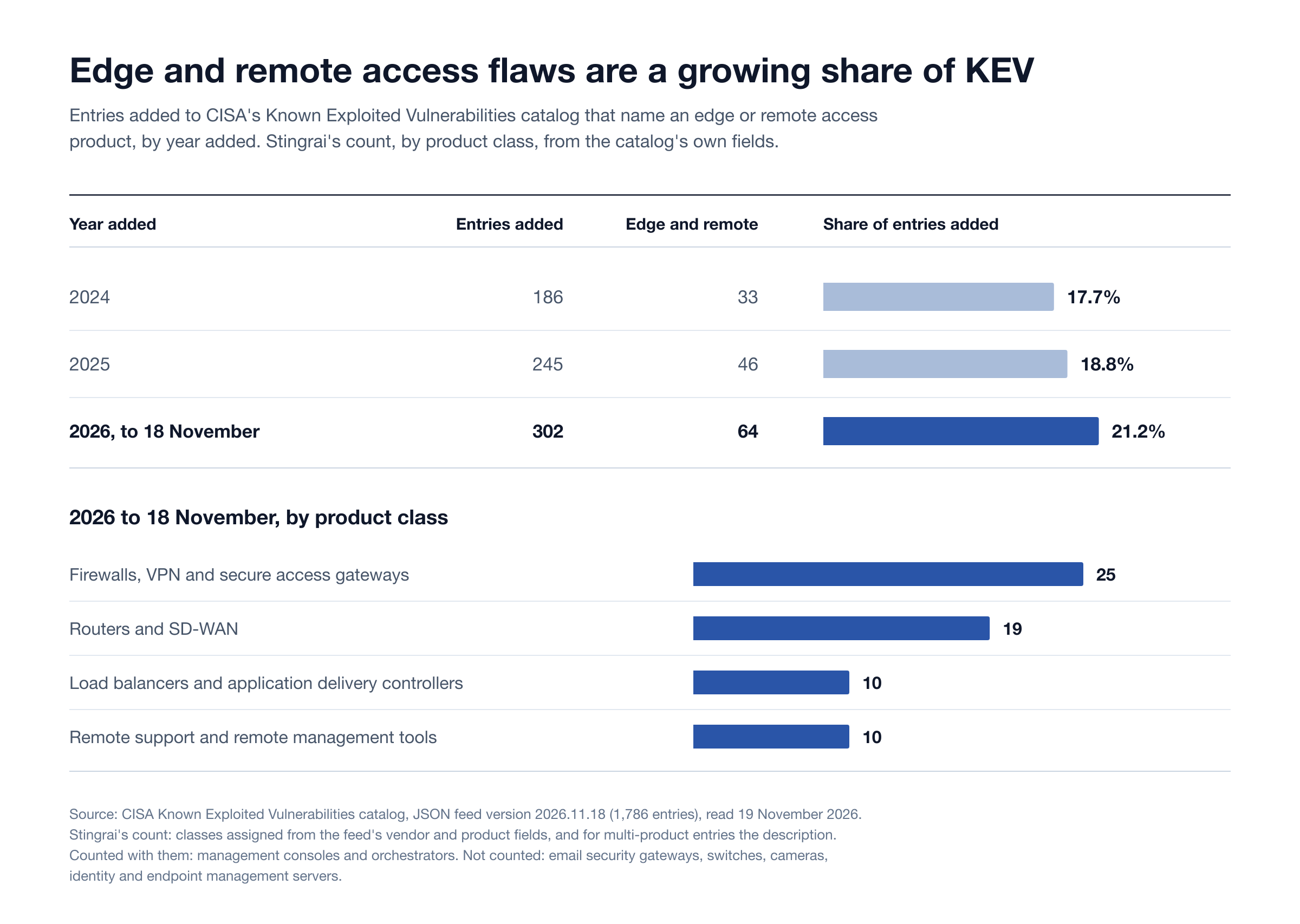
Figure 1: Entries added to CISA's KEV catalog that name an edge or remote access product, 2024 to 18 November 2026, Stingrai's count by product class. Source: CISA, Known Exploited Vulnerabilities catalog JSON feed, version 2026.11.18.
The share rose from 17.7% of entries added in 2024 (33 of 186) to 18.8% in 2025 (46 of 245) and 21.2% in 2026 up to 18 November (64 of 302). In 2026 so far, firewalls, VPN and secure access gateways account for 25 entries, routers and SD-WAN for 19, and load balancers and remote support tools for 10 each; CISA flags 10 of the 64 for known ransomware use. The classes are ours and leave out email security gateways, switches, cameras, and identity and endpoint management servers, so the figures are a floor. On 6 November 2026, for example, CISA added CVE-2026-19868, a SonicWall SonicOS SSLVPN flaw whose exploitation "may also bypass SAML-enforced multi-factor authentication (MFA)". Our list of network security vulnerabilities to watch in 2026 follows these by vendor.
Patching is slower than exploitation
Verizon reports that only 26% of KEV-listed vulnerabilities found by scanners across more than 13,000 organizations were fully remediated in 2025, down from 38% the year before, and that the median time to full resolution rose to 43 days from 32. Against a mean time to exploit below zero, that gap is the case for testing after every edge change, not once a year by habit. The rules agree: PCI DSS v4.0.1 Requirement 11.4.3 asks for external penetration testing at least once every 12 months and "After any significant infrastructure or application upgrade or change".
What an external penetration test should cover
NIST SP 800-115 defines external security testing as testing "conducted from outside the organization's security perimeter", and PCI DSS v4.0.1 as "testing the exposed external perimeter of trusted networks, and critical systems connected to or accessible to public network infrastructures." A provider comparison only works if every quote prices the same scope; this is the minimum we would write into a statement of work.
Area | What to name in the scope | Rule or guidance that names it |
|---|---|---|
Discovery of unknown assets | Reconnaissance from your domains, certificates and address ranges, reconciled against your inventory | BOD 26-02: continuous edge device discovery |
VPN and remote access | SSL VPN and IPsec gateways, remote desktop gateways, remote support tools, MFA on every sign-in path | CISA edge device guidance (4 February 2025) |
Edge devices | Firewalls, routers, SD-WAN, load balancers and application delivery controllers, including end-of-support models | BOD 26-02 definition of edge devices |
Exposed management interfaces | Admin consoles for routers, firewalls, VPN concentrators, load balancers and out-of-band server controllers | BOD 23-02 (13 June 2023) |
Internet-facing hosts and services | Every live address and service: web, mail, file transfer, DNS, databases, remote administration | PCI DSS 11.4.3 |
Internet-facing applications | Exposure, transport security and authentication of web applications and login portals; full application testing is scoped separately | PCI DSS 11.4.1 (application-layer testing in the methodology) |
Cloud-hosted perimeter | Public addresses, load balancers, storage endpoints and API gateways in each cloud account | Your cloud provider's testing policy |
Credentials and identity | Username enumeration, lockout and password attacks against VPN, email and single sign-on, only where authorized | Rules of engagement |
How this ranking was built
Every firm here passed three gates: its own site describes an external or perimeter penetration test, it serves mid-market or enterprise buyers in the United States or Canada, and its headquarters and every claim printed about it can be read on its own pages, its marketplace listings or its CREST Marketplace listing. Provider pages and listings were read on 19 and 20 November 2026, and CREST Marketplace listings and searches were run on 19 November.
What "not found" means. "Not found on the pages read on 19 November 2026" means we read the firm's external or network service page, the documents and data sheets linked from it, its pricing page, its platform or attack surface pages, its AWS Marketplace listings and its CREST Marketplace listing or a dated search, and the point was not there. It describes what is published, not what the firm does; ask for it in writing.
How the order was set. The order is Stingrai's editorial judgement of fit for a mid-market or enterprise buyer commissioning an external penetration test with VPN, edge devices and attack surface discovery in scope. It is not a points total and does not follow the tables line by line. Stingrai publishes this guide and lists itself first. Seven firms, Stingrai included, also appear in our network penetration testing ranking, and they keep the same order relative to each other here. Each entry after Stingrai's has a line on the buyer the firm fits.
External penetration testing companies compared: scope
# | Company | External scope stated in writing | VPN, edge devices and internet-facing apps | Attack surface discovery |
|---|---|---|---|---|
1 | Stingrai | Internet-facing hosts, services and forgotten assets; mail, DNS and management interfaces; black-box, no credentials | "VPN, remote access and edge appliances"; web servers; full web application testing scoped separately | "Attack-surface discovery" listed in what a network test includes |
2 | Schellman | "all hosts that are accessible via the open Internet"; all discovered TCP ports, common UDP ports | VPN and edge devices: not found on the pages read on 19 November 2026 | Reconnaissance, with a note that no third party can guarantee finding every host |
3 | Raxis | Every exposed host, port and service, tested from the internet | Credential attacks against VPN, email and login portals; cloud-hosted assets | "We map your attack surface"; attack surface management sold |
4 | NetSPI | Internet-facing networks, systems and applications, as an anonymous user | Web applications, cloud and federated services, IoT; a linked NetSPI article names firewalls, VPNs and email servers | Continuous external testing; weekly asset discovery scans |
5 | NCC Group | "external or internal vulnerabilities", in manual, hybrid and autonomous tiers | Not found on the pages read on 19 November 2026 | Managed attack surface management |
6 | Cobalt | "your entire external IP range", to OSSTMM | Web, FTP, email and DNS servers, firewalls and routers | Reconnaissance of address ranges and public-facing assets; Attack Surface Monitoring included in every tier |
7 | Praetorian | External network perimeter, alongside internal | Guard covers "the internet perimeter, web applications and APIs" | Guard discovers assets from a single domain, continuously |
8 | Sprocket Security | Websites, assets, services, configurations and authentication workflows | VPN and edge devices: not found on the pages read on 19 November 2026 | Autonomous asset discovery; a free attack surface management tier |
9 | Rapid7 | Network penetration testing, external or internal | Not found on the pages read on 19 November 2026 | Constant reconnaissance of internet-facing assets (Vector Command) |
10 | Rhino Security Labs | "infrastructure devices and servers accessible from the internet" | Routers, firewalls, intrusion detection systems and other security appliances | OSINT on addresses, hosting providers, domains and subdomains |
External penetration testing companies compared: terms, price and CREST status
# | Company | Headquarters | Retest stated | Published price | CREST Marketplace, 19 Nov 2026 |
|---|---|---|---|---|---|
1 | Stingrai | Toronto, ON | Included in every engagement | Typical network range US$5,000 to US$40,000 and above; each engagement quoted | Penetration Testing; AI-Enabled Penetration Testing |
2 | Schellman | Tampa, FL | Included; 30 to 45 days after the report (2025 article) | "no less than $14,500" | Penetration Testing (Schellman Compliance LLC) |
3 | Raxis | Atlanta, GA | Included "at no extra cost" | "start around $3,500" | No entry found |
4 | NetSPI | Minneapolis, MN | "Remediation testing" listed; terms not set out | Not found on the pages read on 19 November 2026 | Penetration Testing; Threat Led Penetration Testing |
5 | NCC Group | Manchester, UK; Chicago regional HQ | Retesting described as frequent practice (2022 application testing article) | Not found on the pages read on 19 November 2026 | Broadest set, including Penetration Testing and Threat Led Penetration Testing |
6 | Cobalt | Boston, MA (US headquarters) | Unlimited on-demand retesting during the contract term | Credits of 8 testing hours, sold in annual packages; no per-test price for network testing | Penetration Testing (Cobalt Labs, listed under Germany) |
7 | Praetorian | Austin, TX | "re-test, and verify vulnerabilities are closed" | US$80,000 for a 12-month Guard Platform contract on AWS Marketplace, with custom pricing from sales; a free Guard tier for one domain | Penetration Testing |
8 | Sprocket Security | Madison, WI | Unlimited retests | US$15,000 Starter, continuous testing on up to 20 external hosts (billing period not printed); single tests quoted ad hoc | Penetration Testing |
9 | Rapid7 | Boston, MA | Not found on the pages read on 19 November 2026 | Point-in-time test: not found on the pages read on 19 November 2026; Vector Command continuous red team: US$85,000 for a 12-month contract covering up to 256 assets (AWS Marketplace) | No entry found |
10 | Rhino Security Labs | Seattle, WA | Remediation testing "as an additional service" | "generally start around the $10,000 range" for penetration testing in general, not specific to external tests | No entry found |
"No entry found" means a search of the CREST Marketplace on 19 November 2026 returned no supplier for the firm. The marketplace lists accredited firms with the legal entity that holds each accreditation, so check the entity that will sign your contract.
1. Stingrai
Stingrai Inc's CREST Marketplace supplier page lists two accreditations held by the firm itself, Penetration Testing and AI-Enabled Penetration Testing, and the company certification CREST AI Charter; team members separately hold the person-level CREST CRT. Every network report is reviewed by the team lead, who has 16 years in penetration testing, red teaming and exploit development, and by an engagement partner, and Stingrai's researchers have published 18 CVEs.
What the external test covers. On Stingrai's network testing page, external testing starts black-box from the public internet, with no credentials. The written scope names internet-facing hosts, services and forgotten assets; VPN, remote access and edge appliances; mail, DNS and exposed management interfaces; and exploitable vulnerabilities on exposed software versions. The page lists attack-surface discovery first among what a network test includes, so the result covers what the internet can see, not only the ranges on your list. Exploitation is controlled and non-destructive, and the work follows PTES and NIST SP 800-115.
Delivery and evidence. Each finding is posted to the PTaaS portal as soon as it is confirmed, with reproduction evidence, affected hosts, severity and remediation guidance, findings sync to Jira, Slack and GitHub, and the assigned penetration testers are reachable by direct chat. Retesting of fixed findings is included in every engagement, and every human-led network engagement comes with an attestation letter stating scope and testing dates.
Timing and price. External testing typically takes 1 to 5 testing days; an external-only test of a single entity with fewer than 50 live hosts takes 3 to 5 tester days across one to two weeks. Stingrai's network page says a network penetration test typically costs US$5,000 to US$40,000 and above; each engagement is quoted as a fixed price with the retest included, with pricing returned within 24 hours of a quote request. If you also run customer-facing web applications, Stingrai's Hybrid Pentest has Snipe test the full application while certified penetration testers test it manually alongside and validate Snipe's findings, for one web application and associated APIs, one-time or continuous.
Strength: Stingrai publishes this guide and lists itself first. Its external scope names VPN and edge appliances, exposed management interfaces and forgotten assets in writing, the testers are named, findings post as they are confirmed, and the retest and attestation letter are included. Limitation: Stingrai is a small team, so book ahead of a fixed audit or board date, and it publishes a typical network range rather than a package price, so a fixed figure needs scoping.
2. Schellman
Schellman gives its address as 4010 W Boy Scout Boulevard in Tampa, Florida, and is among the most specific firms here about price and process. Its external network page covers "all hosts that are accessible via the open Internet": testers "test all discovered TCP ports and the most common UDP ports on in-scope hosts", run an unauthenticated scan first, then attack manually, "looking for a specific weakness". It is candid about discovery: "While we do perform reconnaissance to identify hosts Internet-facing, we (or any third-party assessor) cannot guarantee all will be found," and it asks clients to supply the known list of addresses and DNS records. The page states a minimum, "no less than $14,500 for an external network penetration test," and offers a free sample report.
Two linked articles set out the terms: one (last updated August 2025) includes "a request to retest against all originally identified findings" and says "none of your pen testers will be subcontracted"; the other (last updated January 2025) gives a retest window of 30 to 45 days and a kickoff call "to introduce the pen testers assigned to the project." The CREST accreditation, Penetration Testing with two years of membership, sits with Schellman Compliance LLC. VPN, remote access and edge devices were not found on the pages read on 19 November 2026.
Fit for this buyer: Schellman suits a buyer who wants the price floor, method, retest window and tester introduction in writing before the first call. Strength: a published minimum price, an included retest with a stated window, named testers introduced at kickoff, no subcontracting and a sample report. Limitation: VPN and edge devices were not found on the pages read on 19 November 2026, so list them in the scope; and Schellman also provides audit and attest services under the same brand through a separate, independently owned entity, so if it is also your assessor, confirm the independence arrangement in writing.
3. Raxis
Raxis lists 2870 Peachtree Road in Atlanta and describes "Manual penetration testing by senior U.S. engineers since 2011." Its external network page is the most detailed external page in this comparison. Testing launches "from Raxis attack infrastructure across the internet," and the scope runs from reconnaissance of exposed credentials and leaked data through "Every exposed host, port, and service, identified and fingerprinted," to "Spraying and credential attacks against VPN, email, and login portals" that test MFA, lockout and password policy. Public login pages and internet-facing assets in AWS, Azure and Google Cloud are tested with the rest; in-depth application testing is a separate test.
The terms are in writing too: "The pentester on your scope call is the one breaking in, and the one retesting your fix," the retest comes "at no extra cost," reports "include an attestation letter," and "Prices start around $3,500 and can range into the six figures for a very large scope." Raxis sells the test point-in-time or continuously, and a separate attack surface management service offers "Continuous discovery, analysis, and monitoring." A search of the CREST Marketplace on 19 November 2026 returned no entry for Raxis.
Fit for this buyer: Raxis suits a mid-market buyer who wants VPN and credential attacks named in the scope, the same engineer from scoping to retest, and a starting price before the first call. Strength: the most explicit external scope here, a stated starting price, the same tester through the retest, and an included retest and attestation letter. Limitation: no CREST Marketplace listing was found, so buyers whose customers or regulators ask for CREST accreditation should confirm it with the firm.
4. NetSPI
NetSPI is headquartered in Minneapolis. Its external network page says the service "enumerates your exposures, identifies critical vulnerabilities, and exploits them," and its external network data sheet (April 2026) adds that it tests "internet-facing networks, systems, and applications" from "the perspective of an anonymous (non-credentialed) user", starting with the discovery of "all Internet-facing assets a hacker could find". A continuous external service and the attack surface visibility product, with "weekly discovery scans", keep that inventory current. Its PTaaS page lists remediation testing without setting out the terms.
NetSPI and Synack announced a definitive agreement to merge on 2 September 2026, and NetSPI's site says the merger "officially closed in October 2026." The same page describes "350+ NetSPI in-house pentesters and 1,500+ vetted Synack Red Team researchers" as "two different delivery models rather than one larger pool." CREST lists NetSPI for Penetration Testing and Threat Led Penetration Testing with 10 years of membership, and Synack, Inc. separately for Penetration Testing. An article linked from the external page says external testing covers perimeter defenses "such as firewalls, VPNs, and externally facing applications". External pricing was not found on the pages read on 19 November 2026.
Fit for this buyer: NetSPI suits an enterprise that wants scheduled external testing and continuous discovery of internet-facing assets on one platform, with an in-house bench. Strength: published external methodology, weekly asset discovery, continuous external testing and a large employed team. Limitation: with the Synack merger closed in October 2026, ask which delivery model will staff your test, and write staff continuity, retest terms and price into the contract.
5. NCC Group
NCC Group lists its global headquarters in Manchester, England, a North American regional headquarters in Chicago and an office in Waterloo, Ontario. Its network penetration testing page addresses "external or internal vulnerabilities" and sells four tiers: autonomous vulnerability discovery, autonomous penetration testing, hybrid penetration testing and manual penetration testing. The autonomous and hybrid tiers use its partner Horizon3's NodeZero platform. A separate attack surface management managed service covers "Asset discovery across your internal and/or external assets." Its process article (September 2022, written about application testing) says "Frequently, for this purpose, we will also return to retest" after remediation, without stating terms.
CREST lists NCC Group with the broadest accreditation set in this comparison, including Penetration Testing and Threat Led Penetration Testing, and 19 years of membership. VPN and edge devices in the external scope, and pricing, were not found on the pages read on 19 November 2026.
Fit for this buyer: NCC Group suits an organization with many entities or regions that wants an autonomous external baseline, manual depth where it matters and managed attack surface monitoring from one firm. Strength: a tiered model with managed attack surface discovery, backed by the widest CREST accreditation set here and offices in Chicago and Waterloo. Limitation: three of the four tiers are autonomous or use Horizon3's NodeZero platform, so name the manual tier, the edge devices and the retest in the statement of work, and confirm which legal entity contracts for North American work.
6. Cobalt
Cobalt lists its US headquarters at One Boston Place in Boston, with a UK office in Oxford. Its external pentest page says testers use OSSTMM to test "your entire external IP range," "Conduct passive and active reconnaissance to identify IP address ranges and public-facing assets," and examine "web, FTP, email, and DNS servers" as well as "firewalls and routers." The page promises to "Launch your external network pentest in 24 hours" with "retesting in 7 days or less," and testers come from a vetted freelance community.
Cobalt sells testing in credits: its pricing page says a credit "represents the equivalent of 8 hours of offensive security testing," that credits "are sold in annual packages," that they are specific to each contract year, with rollover of up to 10% listed only on the Enterprise tier, and that its model "provides unlimited on-demand retesting throughout your contract term." Attack Surface Monitoring is included in every tier. No per-test price for network testing is published. The CREST accreditation, Penetration Testing with eight years of membership, is listed under Cobalt Labs.
Fit for this buyer: Cobalt suits a team that buys testing across several asset types in an annual credit budget and wants an external test started quickly with retests on demand. Strength: firewalls, routers and mail and DNS servers named in the external scope, a 24-hour start, and unlimited retesting during the contract. Limitation: credits are budgeted per contract year, with limited rollover only on the Enterprise tier, and testers are drawn from a freelance community, so confirm the hours an external scope needs and who will test it.
7. Praetorian
Praetorian gives its address as 3801 N Capital of Texas Highway in Austin, Texas. Its network penetration testing page offers external and internal testing, simulating "real-world attack scenarios to identify and exploit vulnerabilities in your external network perimeter." Discovery is where it stands out: its Guard platform's attack surface management starts with a single domain, works outward from public records such as WHOIS, acquisitions and certificate transparency, reconciles what it finds against your cloud accounts and systems of record, and runs continuously across "The internet perimeter, web applications and APIs" and more. On its continuous penetration testing page, cadence can be set "weekly against the perimeter," human operators review what the agents surface, and "The annual assessment still comes with the subscription."
Its penetration testing page commits to the fix loop: "We guide fixes, re-test, and verify vulnerabilities are closed." Guard also offers a free tier for a single domain. CREST lists Praetorian Security, Inc. for Penetration Testing with two years of membership, and an AWS Marketplace listing prices a 12-month Guard Platform contract at US$80,000, with custom pricing from sales.
Fit for this buyer: Praetorian suits an enterprise whose real problem is not knowing what it owns: acquisitions, subsidiaries and cloud accounts that grew faster than the inventory. Strength: discovery that works outward from a domain and reconciles against your records, weekly perimeter testing, and a human-led annual assessment inside the subscription. Limitation: Guard's continuous testing is agent-led with operator review, so name the external scope, the edge devices and the retest terms for the human-led annual assessment in the contract.
8. Sprocket Security
Sprocket Security lists 821 E Washington Ave in Madison, Wisconsin, and sells external testing mainly as a continuous subscription, with a timeboxed services page that offers single tests ad hoc. Its external penetration testing page covers "websites, assets, services, configurations, and authentication workflows," and lets clients "define your own scope, or rely on Sprocket to autonomously discover company assets." Testers target employee credentials, and the platform "supports PCI and SOC 2 compliance with on-demand attestation reports."
Its pricing page is among the most open here: a free Community Edition for external attack surface discovery, asset inventory and change detection; a Starter package at US$15,000 for "Continuous testing on up to 20 external hosts" with "Unlimited retests"; and internal testing as a US$13,000 add-on (figures as published on 19 November 2026). The page describes "a subscription-based pricing model" but does not print the billing period beside the figures, so confirm it. CREST lists Sprocket Security Inc for Penetration Testing with one year of membership. VPN and edge devices were not found on the pages read on 19 November 2026.
Fit for this buyer: Sprocket Security suits a team that wants its perimeter tested all year at a published entry price. Strength: published prices, a free discovery tier, unlimited retests and on-demand attestation reports. Limitation: the published price is for the continuous subscription, so a buyer who needs one dated test for an audit should ask for the timeboxed option and how the attestation report is dated, and should list VPN and edge devices in the scope.
9. Rapid7
Rapid7 lists its global headquarters at 120 Causeway Street in Boston. Its penetration testing services page offers network penetration testing, external or internal, and says testers "provide direct contributions to Rapid7's Metasploit Project." For the perimeter between tests, its Vector Command continuous red team service offers "constant reconnaissance of your internet-facing assets," with red team experts who "safely exploit the external exposures" through exercises including external network assessment.
A search of the CREST Marketplace on 19 November 2026 returned no entry for Rapid7. Retest terms, VPN and edge devices in the external scope, and a price for a point-in-time test were not found on the pages read on 19 November 2026; Vector Command is listed on AWS Marketplace at US$85,000 for a 12-month contract covering up to 256 assets.
Fit for this buyer: Rapid7 suits an organization already running its products that wants external testing and continuous external reconnaissance from the same vendor. Strength: testers who contribute to Metasploit, and continuous discovery and exploitation of external exposures in Vector Command. Limitation: the point-in-time external test is described in one line on a general services page, so ask for the external methodology and retest terms in writing; and if you run Rapid7's own detection or vulnerability products, agree how the test stays independent of them.
10. Rhino Security Labs
Rhino Security Labs gives its address as 464 12th Ave in Seattle. Its network penetration testing page describes external testing as identifying "vulnerabilities on infrastructure devices and servers accessible from the internet," and is one of the few to name the edge outright: it "assesses the security posture of the routers, firewalls, Intrusion Detection Systems (IDS) and other security appliances which filter malicious traffic from the internet." Open-source intelligence gathering covers external addresses, hosting providers and domains, followed by enumeration of subdomains. Remediation testing is offered "As an additional service," and a sample report is available.
A search of the CREST Marketplace on 19 November 2026 returned no entry for Rhino Security Labs. Its penetration testing FAQ says penetration tests generally start around US$10,000 and can grow into six figures for large, in-depth projects, with discounts for multiple-year contracts.
Fit for this buyer: Rhino Security Labs suits a buyer who wants edge appliances named in the scope from a firm that publishes its technical research and vulnerability disclosures. Strength: routers, firewalls and other security appliances named in the external scope, with OSINT and subdomain enumeration written into the method. Limitation: remediation testing is an additional service and no CREST listing was found, so price the retest with the test and confirm accreditation if your customers ask for it.
How to choose an external penetration test provider
Most proposals promise the same things. These are the points where providers differ in ways you can check before signing.
1. Scope the whole external surface, including what you do not know you own
A test limited to the ranges you list cannot find the host nobody listed, and that host is often the first real finding. Ask how the provider discovers assets, from domains, certificates, acquisitions and cloud accounts, and have it reconcile what it finds with your inventory before testing. If the estate changes monthly, choose a provider that pairs testing with continuous discovery or reruns discovery before each test.
2. Put VPN and edge devices on their own line, given the 2026 KEV trend
By our count of CISA's feed, the share of new KEV entries naming an edge or remote access product rose from 17.7% in 2024 to 21.2% in 2026 up to 18 November, led by 25 firewall, VPN and secure access gateway entries this year. Write each VPN and remote access gateway, firewall and load balancer management interface, remote support tool and end-of-support device into the statement of work by product and version, and ask for MFA coverage on every sign-in path to be tested. With a mean time to exploit below zero in M-Trends 2026, also ask how fast the provider can test a newly listed edge flaw on your estate.
3. Decide between one-time, continuous or both
An annual test meets most rules if it is repeated after significant change. Estates that add internet-facing assets every month, or run edge devices with frequent KEV entries, usually need testing between annual engagements; check that continuous means a person testing new exposures, not only a scanner, and that a dated report is still available for the audit. The continuous penetration testing guide explains the difference.
Questions to ask every external penetration testing provider
Question | Why it matters | A good answer |
|---|---|---|
How will you find internet-facing assets we did not list? | Unknown assets are often the first real finding | Discovery from domains, certificates and cloud accounts, reconciled with our inventory before testing |
Which VPN, firewall, load balancer and remote access products are in scope, by version? | Edge and remote access products made up 21.2% of 2026 KEV additions by our count | Every edge device named, with MFA coverage and management interfaces tested |
Who will test, and are they employees or contractors? | External testing depends on individual judgement about what to chain | Named testers before signing, and the same people on the retest |
Is the retest included, for how long, and does it re-exploit each finding? | PCI DSS 11.4.4 requires that "Penetration testing is repeated to verify the corrections" | Included, with a stated window, run by the same testers |
Which legal entity holds your accreditation, and are you independent of us? | The CREST Marketplace lists accreditations by entity, and PCI DSS 11.4.3 requires organizational independence of the tester | The entity that signs our contract, and the separation in writing if you are also our auditor, managed service provider or the seller of the devices tested |
What share of the work is manual? | PCI guidance says scanning alone is not a penetration test | A stated manual share, with every reported finding confirmed by a person |
How fast can you test a newly listed edge flaw on our estate? | Mean time to exploit is below zero in M-Trends 2026 | A stated turnaround for out-of-cycle testing, or a continuous option |
Can we see a redacted sample report, and what do we receive, and when? | Auditors, insurers and customers ask for evidence | Discovery results, findings with reproduction evidence and dated retest results; findings during the test and a letter we can share |
Our sample penetration testing report shows what each section should contain, the RFP question bank adds scored questions, and the statement of work template turns the answers into clauses.
How much does an external penetration test cost in 2026?
External testing is priced against scope, mainly the number of live internet-facing hosts and services, login portals and remote access paths, and whether discovery and a retest are included. Few firms publish a figure, and the units differ. These are the published figures from the firms ranked here, as read on their own pages and listings on 19 and 20 November 2026:
Firm | Published figure | What it covers |
|---|---|---|
Stingrai | "typically costs US$5,000 to US$40,000 and above" | A typical range for network penetration testing; each engagement is quoted as a fixed price with the retest included. PCI DSS engagements bundling internal, external and segmentation testing commonly land at US$12,000 to US$25,000 |
Schellman | "no less than $14,500" | An external network penetration test; scope sets the final price |
Raxis | "start around $3,500 and can range into the six figures" | An external network penetration test, driven mainly by live internet-facing hosts |
Cobalt | Credits of 8 testing hours, sold in annual packages | Testing across asset types from one annual credit budget; no per-test price published for network testing |
Praetorian | US$80,000 for a 12-month Guard Platform contract (AWS Marketplace) | Continuous offensive security platform with continuous penetration testing; custom pricing through sales |
Sprocket Security | US$15,000 Starter package | Continuous testing on up to 20 external hosts with unlimited retests; billing period not printed |
Rapid7 | US$85,000 for 12 months, up to 256 assets (Vector Command, AWS Marketplace) | Continuous red teaming and reconnaissance of internet-facing assets; larger tiers up to US$240,000, and from US$500,000 above 2,048 assets |
Rhino Security Labs | "generally start around the $10,000 range" | Penetration testing in general, not only external; can grow into six figures for large, in-depth projects |
NetSPI and NCC Group quote per engagement. For a like-for-like comparison, send every provider the same inputs: address ranges and domains with an estimate of live hosts, cloud accounts with public endpoints, the edge devices and login portals in scope, whether password attacks are authorized, and the audit date the report must meet. The penetration testing cost guide breaks the drivers down, and the cost calculator gives a starting figure.
Frequently Asked Questions
Who are the best external penetration testing companies in 2026?
The best external penetration testing companies in 2026 are Stingrai, Schellman, Raxis, NetSPI, NCC Group, Cobalt, Praetorian, Sprocket Security, Rapid7 and Rhino Security Labs. Stingrai, which publishes this guide, lists itself first: CREST-accredited, human-led external testing with VPN and edge appliances in scope and the retest included. The order is Stingrai's editorial judgement of fit; Schellman and Raxis follow for what they put in writing about price and process.
How much does an external penetration test cost in 2026?
External testing is priced against scope, mainly the number of live internet-facing hosts, services and login portals. As published on 19 November 2026, Schellman says no less than US$14,500 for an external network test, Raxis says prices start around US$3,500 and can reach six figures, and Sprocket Security publishes a US$15,000 Starter package for continuous testing on up to 20 external hosts. Stingrai's network penetration testing page gives a typical range of US$5,000 to US$40,000 and above, with each engagement quoted as a fixed price and the retest included.
How long does an external penetration test take?
Most external tests take one to two weeks of calendar time. Stingrai's external-only test of a single entity with fewer than 50 live hosts takes 3 to 5 tester days across one to two weeks, and Raxis says most of its external tests run one to two weeks including reporting. The number of live internet-facing hosts and services sets the duration.
What is the difference between an external penetration test and a vulnerability scan?
A vulnerability scan lists potential weaknesses on hosts you configured; an external penetration test discovers what you expose, exploits what it finds in a controlled way and shows how findings combine. PCI DSS v4.0.1 keeps them separate: Requirement 11.3.2 asks for external vulnerability scans at least once every three months by an Approved Scanning Vendor, and Requirement 11.4.3 asks for an external penetration test on top. The standard's guidance says "Scanning for vulnerabilities alone is not a penetration test."
Should VPN and edge devices be in scope for an external penetration test?
Yes, and by name. By Stingrai's count of CISA's Known Exploited Vulnerabilities feed, 64 of the 302 entries added in 2026 up to 18 November name an edge or remote access product, 21.2% of the total, up from 17.7% in 2024. List each VPN gateway, firewall, load balancer and remote support tool in the statement of work, and ask for MFA coverage on every sign-in path to be tested.
How often should an external penetration test be done?
At least once a year and after any significant change to the perimeter. PCI DSS v4.0.1 Requirement 11.4.3 requires external penetration testing at least once every 12 months and after any significant infrastructure or application upgrade or change. With edge device entries rising in CISA's catalog, many organizations add out-of-cycle tests after new edge vulnerabilities or run a continuous program.
Is CREST accreditation important when choosing an external penetration testing company?
It is one of the few checks a buyer can verify independently. The CREST Marketplace lists accredited firms with the accreditations each holds and the legal entity that holds them, so you can confirm that the company signing your contract is the accredited one. Stingrai Inc holds two CREST accreditations, Penetration Testing and AI-Enabled Penetration Testing. The second facts table above records each ranked firm's marketplace status as found on 19 November 2026.
Related reading
Best Network Penetration Testing Companies (2026): External, Internal and Active Directory
External Penetration Testing (2026): What an External Pen Test Covers, Scope and Cost
Internal vs External Penetration Testing: Differences, Scope and Cost (2026)
Best Internal Network and Active Directory Penetration Testing Companies (2026)
The Management Plane You Left Out of Scope: SD-WAN, RMM, Federation and End-of-Support Edge in 2026
References
Verizon. 2026 Data Breach Investigations Report. 2026. https://www.verizon.com/business/resources/Td15/reports/2026-dbir-data-breach-investigations-report.pdf.
Google Cloud (Mandiant). M-Trends 2026. 23 March 2026. https://cloud.google.com/blog/topics/threat-intelligence/m-trends-2026.
CISA. Known Exploited Vulnerabilities catalog, JSON feed version 2026.11.18, read 19 November 2026. https://www.cisa.gov/sites/default/files/feeds/known_exploited_vulnerabilities.json.
CISA. BOD 26-02: Mitigating Risk From End-of-Support Edge Devices. 5 February 2026. https://www.cisa.gov/news-events/directives/bod-26-02-mitigating-risk-end-support-edge-devices.
CISA. Binding Operational Directive 23-02. 13 June 2023. https://www.cisa.gov/news-events/directives/binding-operational-directive-23-02.
CISA and international partners. Guidance and Strategies to Protect Network Edge Devices. 4 February 2025. https://www.cisa.gov/resources-tools/resources/guidance-and-strategies-protect-network-edge-devices.
NIST. SP 800-115, Technical Guide to Information Security Testing and Assessment. September 2008. https://nvlpubs.nist.gov/nistpubs/Legacy/SP/nistspecialpublication800-115.pdf.
PCI Security Standards Council. PCI DSS v4.0.1. June 2024. Requirements 11.3.2, 11.4.1, 11.4.3 and 11.4.4, summarized in our PCI DSS penetration testing guide.
CREST. CREST Marketplace. Listings and supplier searches run 19 November 2026. https://marketplace.crest.org/.
Talk to Stingrai
Stingrai's CREST-accredited penetration testers test your perimeter from the internet, with VPN gateways, edge devices and forgotten hosts in scope and the retest included, as a one-time annual engagement or a continuous program. Get a Quote with your ranges, domains and edge devices for pricing within 24 hours, or book a free discovery call.