




The US average data breach reached a record US$10.22M in 2025, the highest US figure IBM has recorded, even as the global average fell 9% to US$4.44M (IBM Cost of a Data Breach 2025). Most of those organizations were not flying blind. Many ran a Cloud-Native Application Protection Platform (CNAPP) or a Cloud Security Posture Management (CSPM) tool that dutifully flagged misconfigurations across their cloud. The tooling worked as designed. It simply could not prove which of the hundreds of flagged risks an attacker could actually chain into a breach.
Quick answer: Stingrai, a CREST-accredited penetration testing provider, fills the CNAPP gap with a senior-led cloud penetration test that proves chained cross-service attack paths, blast radius and detection gaps with reproducible evidence, while Snipe hunts IDOR, broken-authorization and business-logic flaws inside your applications. A CNAPP flags misconfigurations at scale but cannot show which ones an attacker can chain into a breach. The guide covers the four structural blind spots, flags versus proof, purchase triggers, and what a clean security review looks like.
That gap is the subject of this guide. A CNAPP is built to find misconfigurations and risky posture at scale. It is not built to prove exploitability. When a board, a major enterprise customer's security review, or a cyber-insurance underwriter asks whether your cloud is genuinely exploitable, a green posture dashboard does not answer the question. A cloud penetration test does.
The short answer: what a CNAPP catches, and what it cannot
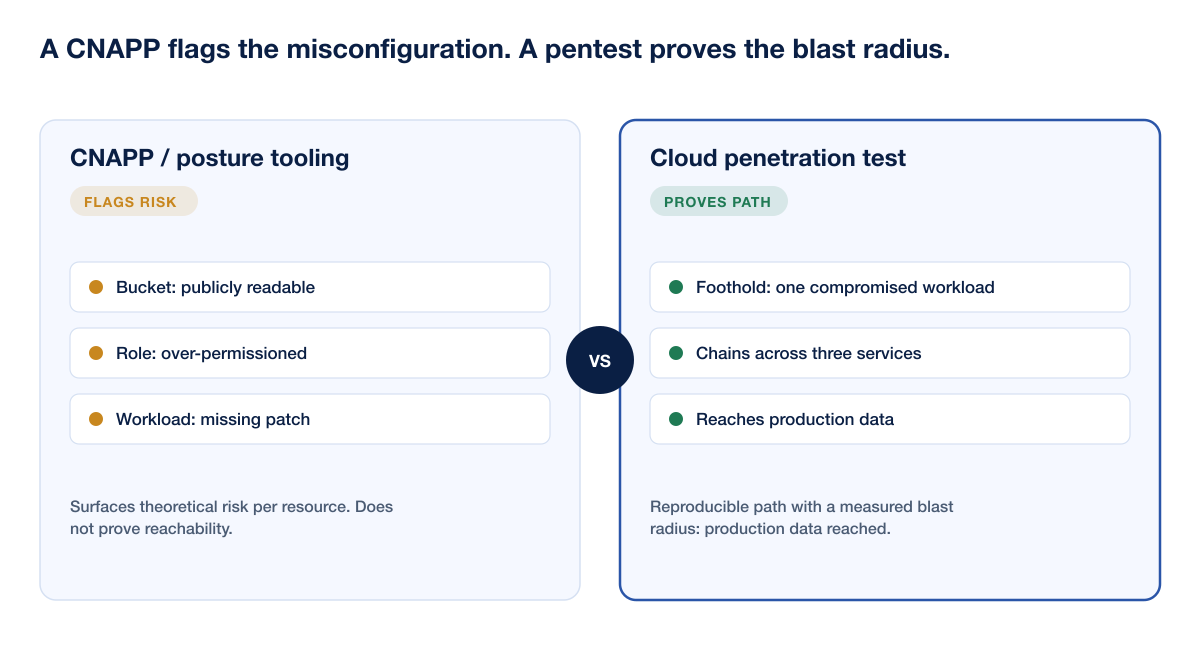
A CNAPP or CSPM catches configuration and posture problems: public storage buckets, over-permissioned roles, unencrypted volumes, exposed management ports, workloads missing patches, and drift from a benchmark. That breadth is genuinely valuable, and no penetration test replaces it.
What posture tooling structurally cannot do is prove that a flagged weakness is reachable and weaponizable from where a real attacker starts. It reasons about configuration in isolation. It does not chain a low-privilege foothold through three services into your production database, it does not authenticate to your application and test whether one tenant can read another tenant's data, and it does not tell you whether anything in your detection stack would have noticed. Those are exploitation questions, and exploitation is what a penetration test proves.
So the honest answer to "if I already run a CNAPP or CSPM, do I still need a cloud penetration test" is yes, because the two answer different questions. The CNAPP tells you what is misconfigured. The pentest tells you what is exploitable.
What a CNAPP is built to do, and does well
Gartner coined the term CNAPP in 2021 to describe a platform that consolidates cloud security tools that used to ship as separate products. A modern CNAPP typically folds together CSPM for configuration posture, Cloud Workload Protection for running workloads, Cloud Infrastructure Entitlement Management for identities, plus infrastructure-as-code scanning and data-security posture management, all sharing one context graph from code to cloud. That consolidation is why so many security teams now have one of these platforms deployed and treat it as their cloud security source of truth.
What the platform does well is breadth and continuity. It inventories every asset and identity, flags misconfigurations continuously, catches drift the moment it happens, and gives you a single place to see cloud hygiene across accounts. For day-to-day posture management, this is exactly the right tool. Cloud providers are explicit that configuration is the customer's responsibility under the shared responsibility model, so a tool that watches configuration continuously is doing important work (AWS Shared Responsibility Model). The trouble starts when a green dashboard is mistaken for proof that the environment is not exploitable. Breadth is not depth, and flagged is not proven.
The four blind spots posture tooling structurally cannot validate
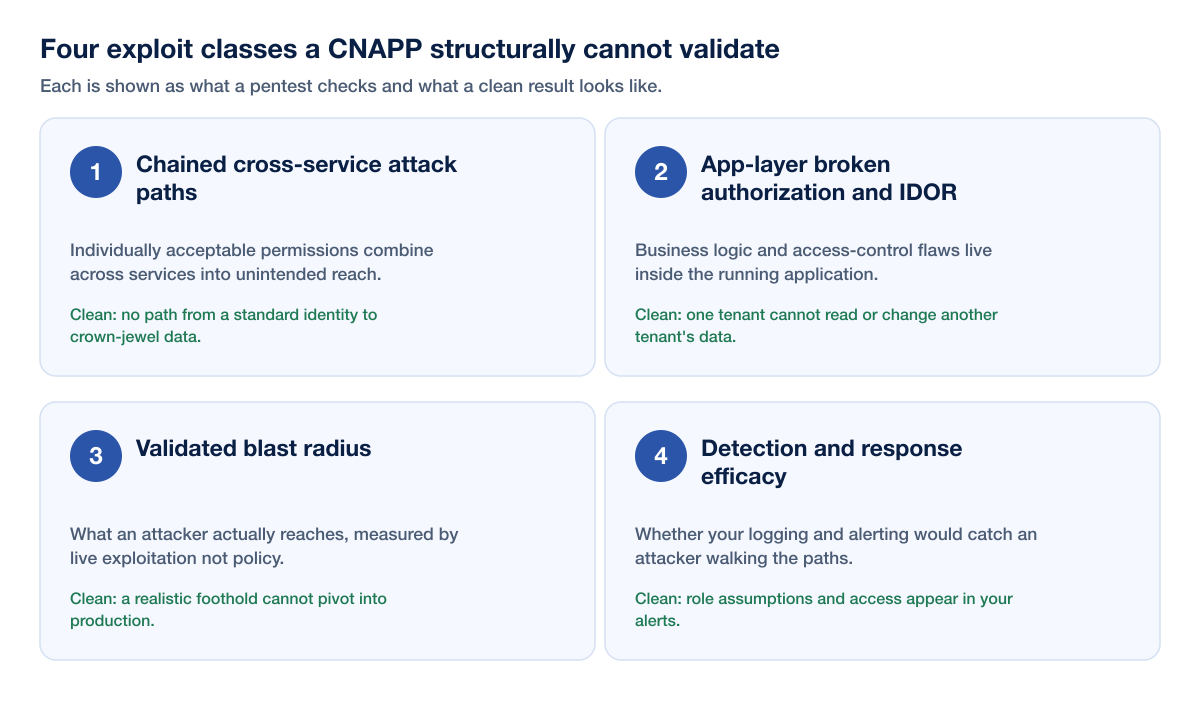
Cloud breaches rarely come from a single catastrophic setting. They come from ordinary, individually acceptable configurations that combine into something the tooling was never designed to reason about. Four classes of risk sit in that blind spot. Each is described below as what a pentest validates and what a clean result looks like, not as an attack recipe.
1. Chained cross-service attack paths
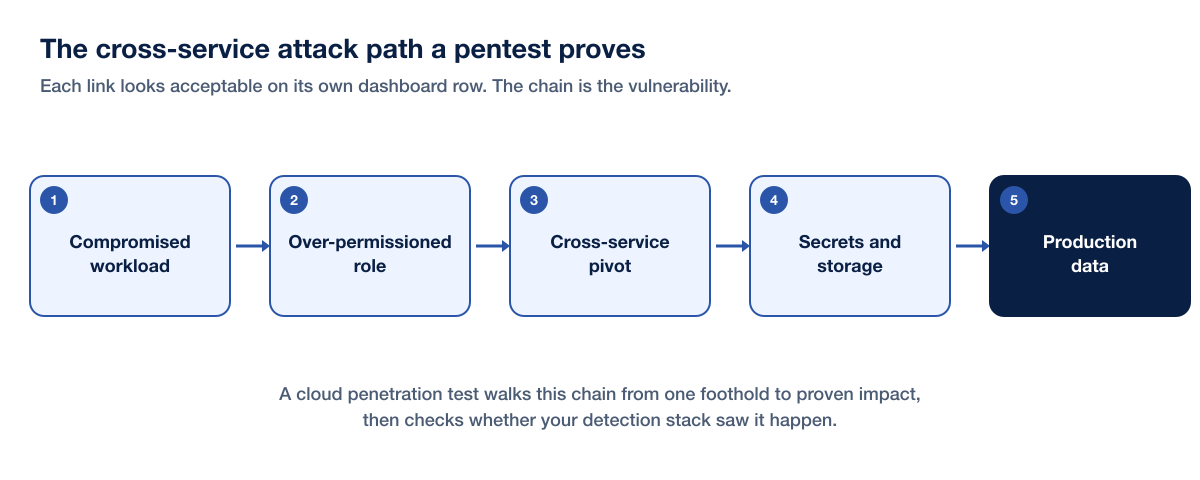
A CNAPP evaluates each resource against a policy. An attacker does not. They start from one foothold, a compromised workload identity or a low-privilege credential, and combine permissions across compute, storage, secrets, and messaging services until the chain reaches something valuable. Each link can look acceptable on its own dashboard row. The chain is the vulnerability, and reachability across services is precisely what static posture analysis approximates but does not prove. A cloud penetration test walks the chain from foothold to impact and reports the reproducible path.
What a clean result looks like: no reachable path from a standard workload or developer identity to crown-jewel data or administrative control, with permission boundaries and service control policies capping what any single identity can escalate to.
2. Application-layer broken authorization, IDOR, and business logic
Posture tooling stops at the infrastructure boundary. It does not authenticate to your application and exercise its authorization logic. Broken object-level authorization, commonly called IDOR, broken function-level authorization, and business-logic flaws live entirely inside the running application, where a valid user manipulates an identifier, a workflow step, or a price and the application fails to enforce who is allowed to do what. These are consistently among the highest-impact web vulnerabilities, and no CSPM row will ever surface them because they are not configuration. They are logic. Proving them requires testing the application the way a real user would.
What a clean result looks like: one authenticated tenant cannot read or modify another tenant's objects, privileged functions reject non-privileged callers, and no business workflow can be driven to an unintended, profitable, or destructive state.
3. Validated blast radius and reachability
A CNAPP can tell you a database is publicly reachable or a role is over-permissioned. It cannot tell you what an attacker actually reaches once inside, because that depends on live exploitation, not policy inspection. Blast radius is an empirical measurement: given this starting foothold, what data, secrets, and control did the tester genuinely obtain? That measured number is the one a board and an underwriter care about, and it is produced only by exercising the paths rather than enumerating them.
What a clean result looks like: a measured, bounded blast radius, where a realistic compromised identity cannot pivot from a low-value account or workload into production data or administrative capability.
4. Detection and response efficacy
The final blind spot is the tooling's own silence about your response. Posture tools report the state of your configuration. They do not tell you whether your logging, alerting, and response would have caught an attacker walking the paths above. A penetration test, especially an assumed-breach or red-team-style engagement, generates real adversarial activity and then asks the harder question: did anyone see it? An exploitable path an attacker can walk unseen is worse than one that trips an alarm.
What a clean result looks like: the role assumptions, reconnaissance, and data access during the test appear in your logs and generate alerts your team could act on.
Posture tool flags vs pentest proves
Both belong in a mature cloud security program. They answer different questions, and confusing one for the other is how organizations end up with a green dashboard and an exploitable path sitting underneath it.
Dimension | CNAPP / posture tooling | Cloud penetration test |
|---|---|---|
What it answers | What is misconfigured or risky? | What is exploitable, and how far does it reach? |
Method | Continuous static analysis of config and entitlements | Manual, adversarial exploitation across services and the app |
Cross-service attack paths | Inferred from policy graphs | Proven by actually chaining the path |
App-layer authorization, IDOR, logic | Out of scope, infrastructure only | Tested against the running application |
Blast radius | Theoretical, per resource | Measured, end to end |
Detection efficacy | Not evaluated | Validated: did anyone see it |
False positives | Higher, flags unreachable risk | Lower, every path is demonstrated |
Best used for | Continuous hygiene and drift | Point-in-time proof of real exploitability |
Read the table as a division of labor. The CNAPP keeps the posture surface honest every day. The pentest converts a subset of that surface into proof, and in doing so tells you which flags are load-bearing in a real attack chain and which are noise.
The purchase trigger: when a CNAPP is no longer enough
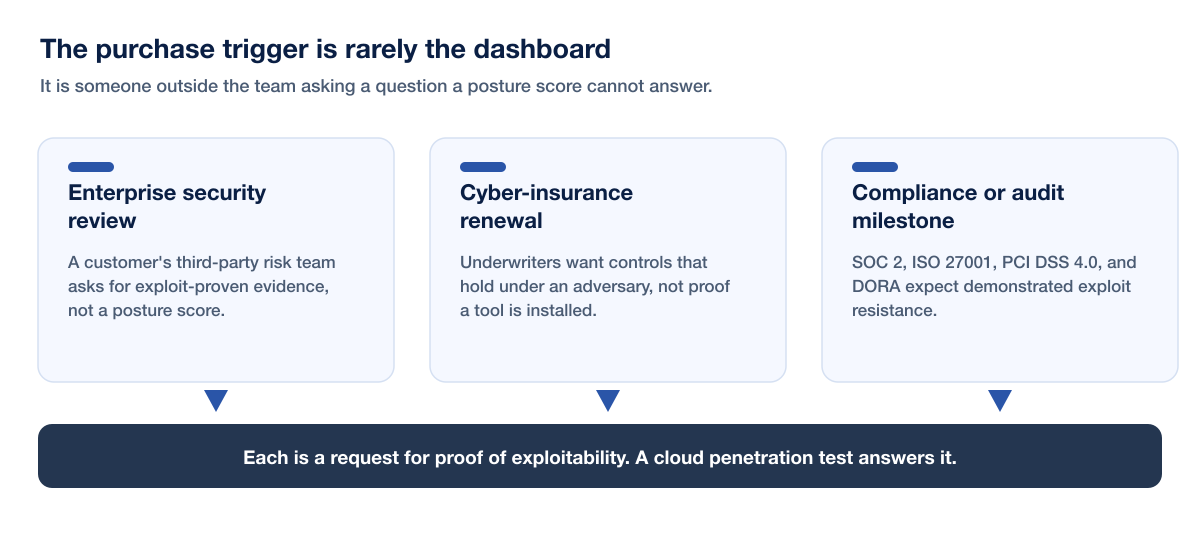
Most teams do not buy a cloud penetration test because a dashboard turned a different color. They buy it because someone outside the team is now asking a question the dashboard cannot answer. Three triggers dominate.
Enterprise security review. When you sell into a large enterprise, their third-party risk and security-review teams increasingly ask for evidence of a recent penetration test against your cloud environment, not a screenshot of a posture score. The Verizon 2025 DBIR found third-party involvement in 30% of breaches, double the prior year, which is exactly why enterprise buyers now scrutinize their vendors' cloud exposure (Verizon 2025 DBIR). A CNAPP report does not satisfy this expectation. Exploit-proven evidence does.
Cyber-insurance underwriting or renewal. Insurers pricing cloud risk want proof that controls hold under an adversary, not an attestation that a tool is installed. With the US average breach now at a record US$10.22M, underwriters are tightening requirements, and a penetration test that demonstrates a bounded blast radius is stronger evidence than a posture dashboard.
Compliance and audit milestones. SOC 2, ISO 27001, PCI DSS 4.0, and DORA programs increasingly expect demonstrated exploit resistance, not only documented policy. Auditors want to see that least-privilege and access controls survive a real attacker, which is a pentest deliverable, not a scan result.
The common thread: each trigger is a request for proof of exploitability, and proof of exploitability is the one thing posture tooling cannot produce.
What a clean cloud security review actually looks like
A clean result is not an empty findings list. It is a demonstrated ceiling on what an attacker can do. Concretely: a tester who starts from a realistic compromised identity cannot chain across services to your crown jewels, cannot abuse your application's authorization to cross a tenant boundary, cannot pivot from a low-trust account into production, and cannot do any of it without your detection stack noticing. Guidance from CISA and the NSA on cloud security, the CIS Foundations Benchmarks, and your cloud provider's own shared-responsibility documentation all converge on the same controls: least privilege, scoped trust, encrypted and access-controlled data, and logged, monitored activity. A penetration test is how you find out whether those controls hold under pressure rather than only on paper.
Where Snipe fits, and where human cloud pentesters do
Two of the four blind spots map cleanly onto Stingrai's two testing modes. The application-layer blind spot, broken authorization, IDOR, and business-logic flaws inside your running application, is exactly what Stingrai's Snipe agent is built to hunt. Snipe is Stingrai's AI agent for web application penetration testing, including the application's APIs. It is available for autonomous web testing or alongside penetration testers in a Hybrid web engagement. Unlike generic scanners that cap out at known-class bugs, it is purpose-built for the complex web-layer classes that posture tools and signature scanners both miss, and it runs black-box testing plus white-box source review, generates AutoFix pull requests, and can gate every pull request before vulnerable code merges.
The cross-service attack paths, blast-radius validation, and detection questions are human-pentester work. Reasoning across roles, trust policies, and service-to-service permissions to find the one sequence that reaches production is adversarial judgment that automated analysis approximates but does not prove. Stingrai runs this as a manual, senior-led engagement, and as a CREST-accredited penetration testing service provider we deliver it with reproducible evidence rather than a re-skinned scanner report. It fits alongside a red team engagement when the goal is a full assumed-breach path from foothold to objective, and inside a continuous PTaaS program when the environment changes fast enough to need repeat validation.
For the identity layer specifically, our guide on cloud IAM penetration testing goes deeper on trust-policy and role-assumption abuse, and for container environments see Kubernetes penetration testing scope and cost. If your cloud now includes managed AI infrastructure, our note on AWS Bedrock penetration testing covers that layer. A cloud penetration test produces exactly the exploit-proven evidence a SOC 2, ISO 27001, PCI DSS 4.0, or DORA program wants. Scope and pricing depend on account count and environment complexity; current options are on the Stingrai pricing page.
What this means for defenders
Treat CNAPP findings as inputs, not verdicts. A flagged misconfiguration is a hypothesis. The pentest tells you which flags are load-bearing in a real chain and which are noise.
Test from an assumed breach. Compromised credentials are a leading initial access vector. Start the test where a real attacker starts, with one valid identity, and measure the reach.
Test the application layer, not just the infrastructure. Broken authorization, IDOR, and business logic never appear on a posture dashboard. They only surface when someone tests the running application.
Measure blast radius and validate detection. The numbers a board and an underwriter care about are what an attacker actually reached and whether anyone saw it. Both require exploitation, not enumeration.
Time the test to the trigger, then retest. Line the engagement up with the enterprise review, insurance renewal, or audit, and retest after remediation to confirm the path is closed, not merely reconfigured.
Frequently Asked Questions
If I already run a CNAPP or CSPM, do I still need a cloud penetration test?
Yes, because the two answer different questions. A CNAPP or CSPM catches misconfigurations and risky posture across your cloud, which is valuable and continuous. It cannot prove which of those flagged risks an attacker can actually chain into a breach, cannot test your application's authorization logic, and cannot measure real blast radius or detection. A cloud penetration test proves exploitability. You need both: the tool for breadth, the pentest for depth and proof.
What can a CNAPP not catch?
A CNAPP structurally misses four classes of risk: chained cross-service attack paths where individually acceptable permissions combine into unintended reach, application-layer broken authorization and IDOR and business-logic flaws inside the running application, validated blast radius that depends on live exploitation, and detection efficacy, meaning whether your logging and alerting would have caught an attacker. All four are exploitation questions, and posture tooling reasons about configuration, not exploitation.
What is the difference between CSPM and a cloud penetration test?
CSPM performs continuous static analysis of your cloud configuration and flags misconfigurations and drift. A cloud penetration test is manual, adversarial exploitation that starts from a realistic foothold and proves whether flagged weaknesses are reachable and weaponizable, ending in a reproducible attack path with a measured blast radius. CSPM answers what is misconfigured. The pentest answers what is exploitable.
Does a CNAPP give a false sense of security?
It can, when a green dashboard is read as proof that the environment is not exploitable. A CNAPP flags theoretical risk across every resource, but breadth is not depth and flagged is not proven. Organizations with clean posture scores are still breached because an attacker chained ordinary permissions or abused application logic that no posture row describes. The fix is not to distrust the CNAPP, but to pair it with a pentest that proves what is actually reachable.
Why does an enterprise security review ask for a cloud pentest if we have a CNAPP?
Enterprise third-party risk teams want evidence that your controls hold under a real adversary, not a screenshot of a posture score. With third-party involvement in 30% of breaches in the Verizon 2025 DBIR, buyers scrutinize their vendors' cloud exposure closely. A penetration test provides exploit-proven evidence of a bounded blast radius, which is what satisfies the review. A posture report describes configuration, which does not.
What does a clean cloud penetration test result look like?
Not zero findings, but a demonstrated ceiling on blast radius. A tester starting from a compromised identity cannot chain across services to crown-jewel data, cannot abuse application authorization to cross a tenant boundary, cannot pivot from a low-trust account into production, and cannot do any of it without your detection stack noticing. The attempt should be visible in your logs and alerting.
Does Stingrai's Snipe agent test cloud posture or infrastructure?
No. Snipe is Stingrai's AI agent for web application penetration testing, including the application's APIs. It is available for autonomous web testing or alongside penetration testers in a Hybrid web engagement. It hunts complex web-layer flaws such as IDOR, broken authorization, and business logic in your running application, which is the application-layer cloud blind spot. It does not test cloud posture, IAM roles, trust policies, or infrastructure. Cross-service attack paths, blast-radius validation, and detection are proven by human senior-led pentesters.
How does a cloud penetration test support cyber-insurance and compliance?
It produces exploit-proven evidence that least-privilege and access controls hold under an adversary, which is stronger than an attestation that a tool is installed. Insurers pricing cloud risk and auditors for SOC 2, ISO 27001, PCI DSS 4.0, and DORA increasingly want a demonstrated, bounded blast radius rather than only a posture score or a policy document.
References
IBM. Cost of a Data Breach Report 2025. July 2025. https://www.ibm.com/reports/data-breach. Reports the record US average breach cost of US$10.22M, the global average of US$4.44M, initial attack vectors, and AI-related breach findings, based on 600 organizations analyzed by Ponemon Institute.
Verizon. 2025 Data Breach Investigations Report. 2025. https://www.verizon.com/business/resources/reports/dbir/. Analyzes breach patterns across thousands of incidents, including compromised credentials as an initial access vector and third-party involvement in breaches.
Amazon Web Services. Shared Responsibility Model. https://aws.amazon.com/compliance/shared-responsibility-model/. Defines the division between provider-managed security of the cloud and customer-managed security in the cloud, including configuration and access management.
CISA. Cybersecurity resources and guidance. https://www.cisa.gov/resources-tools/resources. Baseline guidance on cloud security, least privilege, identity hardening, and monitoring for cloud environments.
Center for Internet Security. CIS Foundations Benchmarks. https://www.cisecurity.org/cis-benchmarks. Consensus configuration baselines for major cloud providers, including identity, trust-policy, and data-protection controls.