An API security assessment is a scoped review of an organization's APIs that reconciles the API inventory, examines the specifications and the gateway and WAF configuration in front of each API, and tests authentication, authorization, business flows, rate limits and data exposure with real requests under every role and tenant. It starts with inventory because, as NIST's API protection guidance puts it, "Most organizations have gaps in their API inventories, even if they otherwise have mature inventory management capabilities" (NIST SP 800-228, final since June 2025 and updated on 13 March 2026). It spends most of its testing time on authorization because three of the ten risks in the OWASP API Security Top 10 2023, numbers 1, 3 and 5, "focus on authorization", in NIST's words.
Quick answer. An API security assessment inventories every API host, version and operation, reviews the specifications and the gateway and WAF policies in front of them, and tests authentication, object, property and function level authorization, business flows, rate limits, data exposure and input handling, with results mapped to the OWASP API Security Top 10 2023. It is broader than an API penetration test, which attacks a defined set of APIs, and far broader than automated scanning, which cannot tell who should see which object. Assess at least once every 12 months and after any significant change, the triggers PCI DSS v4.0.1 uses for penetration testing. For one web application and associated APIs, Stingrai's Hybrid Pentest is US$6,800 per assessment or US$1,275 per month on a 12-month plan; larger API estates are quoted per engagement.
This guide covers the buying decision, from scope and deliverables to cadence, enterprise scoping, cost and provider choice. The API penetration testing checklist lists the test activities for each OWASP risk, the API penetration testing cost guide compares published prices and quote structures, and our ranking of the best API penetration testing companies compares named firms.
What is an API security assessment?
NIST's technical guide to security testing, SP 800-115, describes an information security assessment as the process of determining how well the thing being assessed meets its security objectives, using three methods: "testing, examination, and interviewing". The split is useful for APIs, because each method finds a different kind of problem.
Examination reads what the organization has written down: specifications, gateway and WAF configuration and, where it is shared, source code. It finds an operation that declares no authentication requirement or a route published without a rate limit.
Interviewing asks API owners who calls each API, which flows move money or data and which old versions still have clients. It turns "is this a finding?" into a question with an answer.
Testing sends requests. NIST defines it as exercising an object "under specified conditions to compare actual and expected behaviors". For APIs, that means calling every operation as every role and tenant and comparing what comes back with what the access rules say should come back.
A penetration test is one form of testing. SP 800-115 describes penetration testing as security testing in which assessors "mimic real-world attacks to identify methods for circumventing the security features of an application, system, or network." An API penetration test is therefore the testing core of an API security assessment. The assessment adds examination and interviewing around it, and it starts from the whole estate rather than from a list of endpoints someone already knows about.
What does an API security assessment include?
Stingrai structures a complete assessment as nine workstreams. Some are examination, some are testing, and most are both.
Workstream | Question it answers | Method | Evidence it produces |
|---|---|---|---|
Inventory and discovery | Which API hosts, versions and operations exist, and which are undocumented? | Examination and testing | A reconciled inventory: documented, undocumented, deprecated but live |
Design and specification review | Does each API declare authentication, schemas, limits and sensitive fields? | Examination and interviewing | Specification findings tied to operations |
Authentication testing | Are tokens, keys and the login, reset and recovery flows sound? | Testing | Request and response evidence for each flow |
Authorization testing | Can each role and tenant reach only its own objects, properties and functions? | Testing | Results for each identity and operation, including what passed |
Business logic and sensitive flows | Can a legitimate flow be abused at scale, skipped or run out of order? | Interviewing and testing | Flow-level findings with business impact |
Rate limiting and resource consumption | Do limits exist for every caller and every costly operation? | Examination and testing | Declared limits compared with observed behaviour |
Data exposure | Do responses return, or requests accept, fields the caller should not touch? | Testing | Field-level comparison by role |
Input handling and third-party data | Do URL fetchers, imports and integrations trust what they receive? | Testing | Findings on SSRF, injection and integration trust |
Gateway and WAF configuration | Do edge policies match the inventory, and can back ends be reached around them? | Examination and testing | Route and policy review with bypass checks |
Inventory and design review
Discovery comes first because an assessment can only report on what it can see. NIST's REC-API-4.2 calls for an "Organizational API inventory of all internal (including shadow and Zombie APIs) and external APIs", and REC-API-4.3 for "API discovery tools and scheduled automated scans to detect all running APIs." The assessor gathers the inventory from several sources and reconciles them, the step REC-API-8 describes as "reconciliation between declared specifications, and live traffic". The output is a list in three columns: documented and live, live but undocumented, and documented as deprecated but still answering. The second and third columns are findings in their own right under API9, Improper Inventory Management.
The design review then examines each API's contract. NIST's first recommendation is blunt: "All APIs must have a specification". The review flags operations with no declared security requirement, unbounded request fields and versions with no deprecation date. Where a requirement set is needed, OWASP ASVS 5.0.0, published on 30 May 2025, "provides a basis for testing web application technical security controls"; our ASVS 5.0 pentest acceptance matrix shows how to write it into a statement of work.
Authentication, authorization and data exposure
Authentication testing covers login, token issuance and validation, refresh, API keys, OAuth flows, password reset and recovery. NIST's REC-API-11-7 puts the core check in one line: "Verify signatures, and check for expiry during token validation." Authorization is where most of the testing time goes. NIST asks every service to perform "two levels of authorization: 1) service authorization and 2) end-user-to-resource authorization", and OWASP splits the problem into object level (API1), object property level (API3) and function level (API5).
None of these can be tested with one account. The joint CISA, NSA and ACSC advisory AA23-208A tells developers to ensure the application "performs authentication and authorization checks for every request to modify data, delete data, and access sensitive data," and tells organizations testing their web applications to "Test with users of various privilege levels (e.g., a normal user and admin user)." An assessment therefore needs two accounts per role, an administrator and, in a multi-tenant product, a second tenant. The API authorization test matrix lays out the checks, and our IDOR guide shows real cases. The stakes show up in Stingrai's own data: in the State of Penetration Testing 2026 dataset, 70% of the 40 web application tests that produced findings surfaced at least one High or Critical authentication or authorization finding.
Data exposure is the same comparison at field level. OWASP's API3 "combines API3:2019 Excessive Data Exposure and API6:2019 - Mass Assignment", so the test checks which fields come back for each role and which fields the API accepts on create and update calls. NIST's REC-API-13 recommends validating each response against the expected schema as well as each request, "to help prevent a variety of data leaks, abuses, or mistakes."
Business flows, rate limits and input handling
OWASP's API6, Unrestricted Access to Sensitive Business Flows, covers flows such as buying a ticket or posting a comment, and OWASP notes: "This doesn't necessarily come from implementation bugs." Its mitigation starts with the business, which must "identify the business flows that might harm the business if they are excessively used." With that list, the assessor tests whether each flow can be repeated, reordered, skipped or run at volume; our business logic scope guide shows how to write flows into a statement of work. For rate limits, NIST's REC-API-15-1 says "Rate-limit all API access for all callers", and the assessment compares declared limits with observed behaviour on logins, one-time codes, exports and paid services such as SMS, against agreed thresholds and stop conditions.
Input handling still matters, because APIs fetch URLs, import files and consume other APIs. OWASP's API7 describes Server Side Request Forgery as a flaw that "can occur when an API is fetching a remote resource without validating the user-supplied URI", and API10 warns that "Developers tend to trust data received from third-party APIs more than user input".
Gateway and WAF configuration
Most enterprises front their APIs with an API gateway and a WAF, and both are configuration that can be wrong. OWASP's API8 guidance calls for "A task to review and update configurations across the entire API stack", and NIST's REC-API-10 recommends general validation policies at the edge, naming WAF, bot detection and DoS mitigation. PCI DSS v4.0.1 Requirement 6.4.2, mandatory after 31 March 2025, calls for an automated technical solution in front of public-facing web applications, "Configured to either block web-based attacks or generate an alert that is immediately investigated."
An edge control is not an authorization control. Discussing API protection products that are enforced at the perimeter, NIST adds that "policy enforcement should be as close to the individual service instance as possible in order to achieve robust API security assurance." The review therefore checks every inventoried route for an authentication and rate-limit policy, the WAF's mode on API traffic, whether back ends can be reached around the gateway, and whether older versions get the same protection. The API gateway security assessment guide goes further on routing and back-end authorization.
How does an API security assessment map to the OWASP API Security Top 10 2023?
The OWASP API Security Top 10 2023 was released as a stable version on 5 June 2023, and the project page still lists 2023 as its latest version on 19 November 2026. OWASP calls it "a forward-looking awareness document" in its release notes, so it sets the minimum an assessment report should account for, not the whole scope. The table, Stingrai's mapping of OWASP's risk descriptions to those workstreams, shows which workstream carries each risk and what the report should show for it.
OWASP risk (2023) | Main workstream | Also covered by | What the report should show |
|---|---|---|---|
API1 Broken Object Level Authorization | Authorization testing | Design review (identifier design) | Each object operation called as owner, peer, lower role and other tenant, with results |
API2 Broken Authentication | Authentication testing | Gateway review (token checks at the edge) | Every authentication flow and token check, for each host and version |
API3 Broken Object Property Level Authorization | Data exposure | Design review (field annotations), authorization testing | Fields returned and accepted for each role, compared with the specification |
API4 Unrestricted Resource Consumption | Rate limiting | Gateway review, design review (schema limits) | Declared limits compared with observed behaviour on costly operations |
API5 Broken Function Level Authorization | Authorization testing | Design review (administrative and internal functions) | Administrative and internal functions called by lower roles |
API6 Unrestricted Access to Sensitive Business Flows | Business logic | Interviewing (the flow list) | Each listed flow tested for repetition, reordering, skipping and volume |
API7 Server Side Request Forgery | Input handling | Inventory (webhooks, importers, URL fetchers) | Every URL-fetching operation tested against internal destinations |
API8 Security Misconfiguration | Gateway and WAF configuration | Design review | Configuration findings across gateway, WAF, CORS, methods, TLS and errors |
API9 Improper Inventory Management | Inventory and discovery | Gateway review (route table) | The reconciled inventory, with undocumented and deprecated hosts and versions |
API10 Unsafe Consumption of APIs | Input handling and third-party data | Interviewing (the integration list) | Each integration's responses and redirects treated as untrusted input |
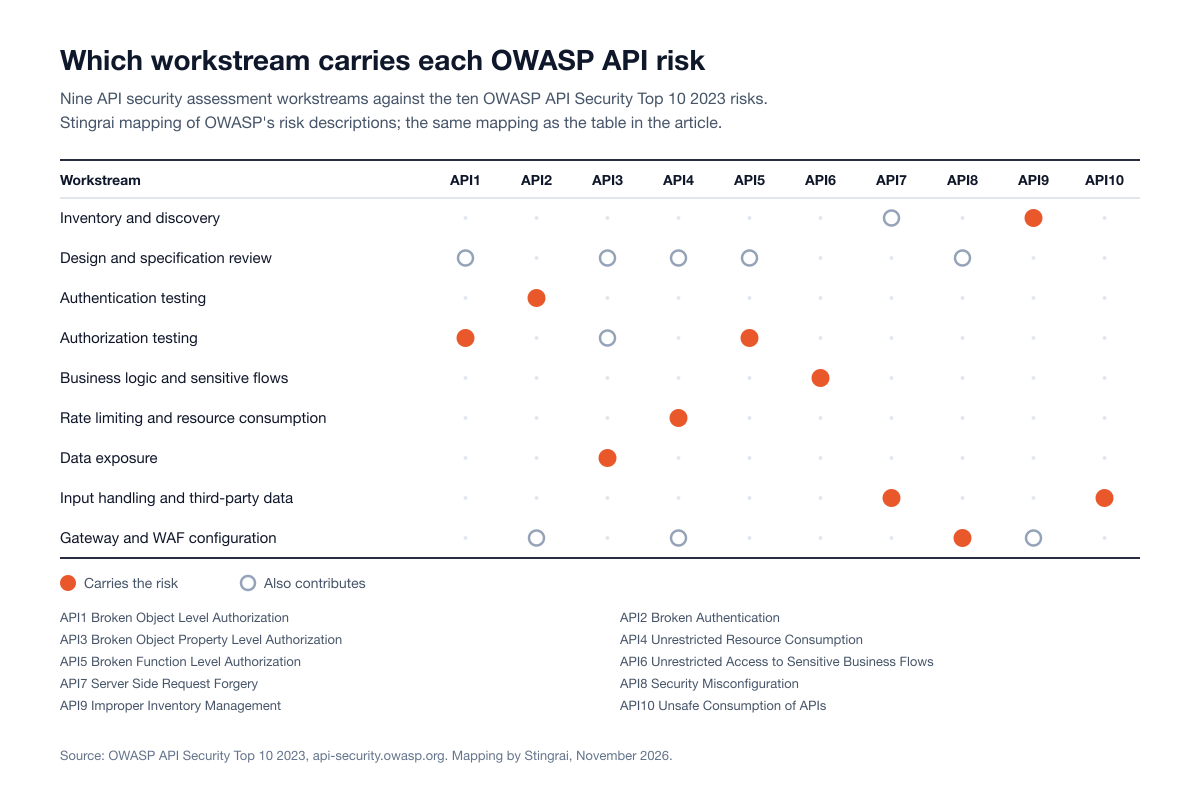
Figure 1: Which assessment workstream carries each OWASP API Security Top 10 2023 risk (filled dot) and which also contribute (ring). Stingrai mapping of the OWASP risk descriptions. Source: OWASP API Security Top 10 2023.
API security assessment vs API penetration test vs automated API scanning
The three are complements, not substitutes. They differ in the question they answer and the inputs they need.
API security assessment | API penetration test | Automated API scanning | |
|---|---|---|---|
Question it answers | Which APIs exist, are they designed and configured safely, and can they be broken? | Can an attacker break this defined set of APIs? | Do known patterns, misconfigurations and signatures appear? |
Inventory and shadow APIs | Built and reconciled; undocumented hosts are findings | Reported if found, not the goal | Limited to what the tool is pointed at |
Design and specification review | Yes | Sometimes, when specifications or source are shared | Specification linting at most |
Gateway and WAF configuration | Reviewed as configuration and tested for bypass | Tested from the outside | Header and TLS checks |
Authorization across roles and tenants | Every operation, every role, every tenant in scope | Every operation and role in scope | Weak: a tool cannot infer who should see which object |
Business logic | Flows listed by owners, then tested | Tested where the tester finds them | Not modelled |
Typical cadence | Annually, after significant change, and when the estate changes shape | Annually and after significant change; continuously for fast-release applications | Every build or deploy |
Scanning belongs in every pipeline, and it has known limits. NIST SP 800-115 notes that scanners "suffer from the high false negative rates that characterize other signature-based tools", and the CISA, NSA and ACSC advisory says DAST tools able to look for access control flaws "are not foolproof and should be used with other security testing methods to ensure comprehensive coverage." Stingrai's own dataset puts a number on the split. Across 55 penetration tests run between October 2024 and August 2026, 37.2% of findings fell into classes a scanner could in principle flag and 35.2% into classes no signature can represent, including authentication and session handling and broken access control (State of Penetration Testing 2026). Our explainer on why automated API scanners miss BOLA and IDOR covers the reason.
Which one to buy depends on what is uncertain:
Buy scanning for every build, to catch regressions in known classes.
Buy an API penetration test when the scope is a known application and its APIs and you need evidence of what is exploitable.
Buy an API security assessment when the estate itself is uncertain or changing, for example after an acquisition, a gateway migration or a platform rebuild.
What do you need to provide before an API security assessment?
What the assessor receives on day one decides how much of the estate the assessment can see. Most of this list overlaps with a penetration test; the inventory sources, configuration exports and time with API owners are what an assessment adds.
Provide | Why the assessment needs it |
|---|---|
Specifications for every API in scope: OpenAPI or Swagger, GraphQL schemas, protobuf files, WSDLs, or a maintained Postman collection | Shortens discovery and is the baseline for design review and the data-exposure comparison |
Inventory sources: the gateway route export, the API catalog, API hostnames and versions, and an owner for each API | Lets the assessor reconcile what is declared with what answers |
Test accounts: two per role, an administrator, and a second tenant in multi-tenant products | Authorization cannot be tested with one identity |
A role and permission matrix | Turns observed behaviour into pass or fail |
The environment and rules of engagement: which environment, whether production is in scope, test windows, agreed rate-limit thresholds and stop conditions | Keeps business-flow and rate-limit tests safe |
Read-only gateway and WAF configuration, or a walkthrough on a shared screen | Needed for the configuration review |
The list of sensitive business flows and the data classification of key fields | Drives the business logic and data-exposure tests |
An engineering contact for each API and an escalation path | Gets a critical finding to the right owner the same day |
Staging works for most testing when its gateway, WAF and identity configuration match production, but the configuration review should read the production settings. The API penetration testing checklist has the full preparation table for the testing part.
What deliverables should an API security assessment produce?
A penetration test report lists findings. An assessment should also leave the buyer with artifacts it can maintain after the assessor has gone.
A reconciled API inventory. Every host, version and operation found, marked documented, undocumented or deprecated, with its owner and exposure (public, partner or internal).
Coverage by OWASP API Security Top 10 2023 risk, for each API. Tested, not applicable or not tested, with the reason.
Test findings with evidence. The operation, the identity used, the request and response, the impact, a reasoned severity and remediation at the code, gateway or configuration level.
Design and configuration findings. Operations with missing security requirements or unbounded fields, gateway routes without policies, WAF modes, back ends reachable directly and versions left unprotected.
Controls that passed. The cross-tenant and lower-role checks that returned a refusal, so a clean result is evidence rather than silence.
A remediation plan ordered by API tier. What to fix first across the estate, not only within one API.
Retest results and, where needed, an attestation letter. Fixed findings re-run and recorded in the final version. Every Stingrai human-led and hybrid report ships with an attestation letter.
Two guides cover report quality in detail: how to evaluate a penetration test report and our penetration testing report sample.
How often should APIs be assessed?
PCI DSS v4.0.1 gives the clearest wording. Requirements 11.4.2 and 11.4.3 require internal and external penetration testing "At least once every 12 months" and "After any significant infrastructure or application upgrade or change". Requirement 11.4.1 adds that the methodology must include application-layer penetration testing to identify, at a minimum, the vulnerabilities listed in Requirement 6.2.4, which names business logic attacks through "the manipulation of APIs" and attacks on access control mechanisms (PCI SSC document library). The PCI Security Standards Council still described v4.0.1 as "the currently-published version of the standard" when it opened a request for comments on 3 June 2026. Outside card environments, the same two triggers are a sound default.
What counts as significant is for each organization to decide, but PCI DSS lists changes that must at least be evaluated, including "Any changes in the flow or storage of account data" and changes to third-party service providers. For APIs, treat a new major version, a new authentication method or OAuth flow, a new role or tenant model, a new sensitive integration, a gateway migration and an acquisition as significant.
Why fast-moving APIs need continuous testing
An annual assessment describes the estate on the day it was tested, and OWASP's API9 entry warns that "APIs tend to expose more endpoints than traditional web applications, making proper and updated documentation highly important." Attackers have sped up too. Mandiant's M-Trends 2026, drawn from more than 500,000 hours of investigations in 2025, found that exploits were the most common initial infection vector for the sixth consecutive year, at 32% of intrusions, and estimated the mean time to exploit at "-7 days, meaning exploitation is routinely occurring before a patch is even released."
Those figures describe vulnerabilities in commercial products. For an organization's own APIs there is no vendor patch to wait for: the time between a release and the next test is the window in which a new authorization flaw sits unexamined. So run a full assessment at least annually and after significant change, and test the applications that ship most often continuously.
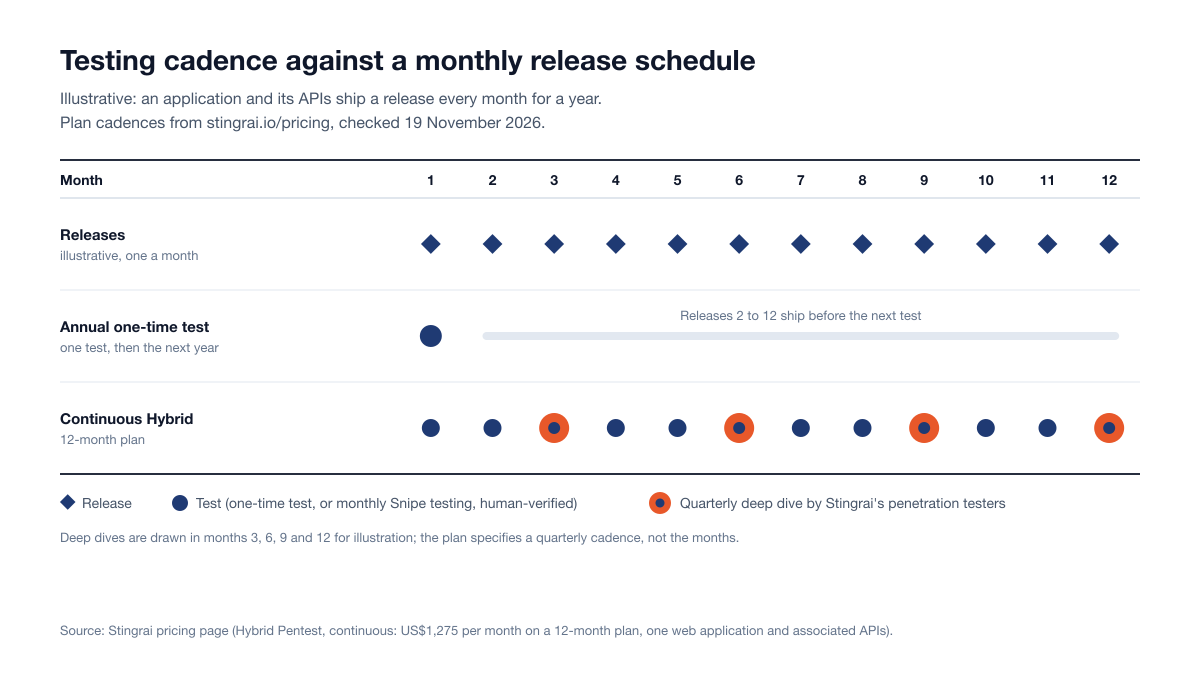
Figure 2: An illustrative monthly release schedule against two testing cadences: a single one-time test, and continuous Hybrid testing with monthly Snipe testing, human-verified, plus a quarterly deep dive by Stingrai's penetration testers. The release schedule, the month of the one-time test and the deep-dive months (3, 6, 9 and 12) are illustrative; the plan specifies a quarterly cadence, not the months. Source: Stingrai pricing, checked 19 November 2026.
How do you scope an API security assessment across many APIs?
Enterprise estates break the usual scoping shortcuts. The six steps, the counting table and the tier table below are Stingrai's scoping guidance, not requirements of NIST, OWASP or PCI DSS. Work through the steps in order; each one produces something the next step needs.
Build the inventory from more than one source. Combine the specification repository, the gateway route export, the API catalog, hostnames from DNS and certificates, and access logs, then reconcile them as NIST's REC-API-8 describes. Record the owner, environment, exposure and version of each API.
Count operations, not URLs. One URL can carry several operations, and one GraphQL endpoint can carry hundreds. Count in the unit each API style uses, as in the table below, and count a version separately when it is deployed separately.
Multiply by identities to size the authorization work. As a worked example with a hypothetical API, 40 operations and four roles give 160 identity and operation pairs to check, and 320 once a second tenant is in scope. That product, more than the endpoint count, drives authorization testing time.
Tier every API by exposure, data and identity complexity. The CISA, NSA and ACSC advisory tells organizations to "Prioritize web applications that are internet-facing and contain user login functionality." Add the data each API handles and the number of roles and tenants it serves.
Match depth and cadence to the tier, and write the sampling rule into the scope. State which equivalent operations will be sampled and which will each be tested individually.
Set change triggers and retest terms up front. Agree which changes reopen the assessment for an API, and how fixes are retested and recorded in the final report.
How to count operations by API style (Stingrai's counting convention):
API style | Unit to count | Where to read it | Often missed |
|---|---|---|---|
REST | Each method and path template pair (GET and DELETE on the same path are two) | OpenAPI file, gateway routes | Methods missing from the specification; older versions still routed |
GraphQL | Each query, mutation and subscription, plus fields that return sensitive object types | Schema, persisted query list | Nested resolvers that reach another object type |
gRPC | Each service method | Protobuf files or server reflection | Internal services exposed through a gateway |
SOAP | Each WSDL operation | WSDL | Legacy services behind newer REST front ends |
Webhooks and callbacks | Each event receiver and each outbound callback | Integration settings, partner documentation | Receivers that skip signature checks |
How to match depth to tier (Stingrai's guidance; adjust it to your own risk model):
Tier | Typical APIs | Assessment depth | Cadence |
|---|---|---|---|
Tier 1 | Internet-facing or partner APIs with login, multi-tenant data, payments, health or personal data, or administrative functions | Every operation under every role and tenant; business-flow and rate-limit testing; design and configuration review; source-assisted where possible | Annual assessment, testing after each significant change, and continuous testing for applications that release often |
Tier 2 | Authenticated internal or partner APIs with moderate data and few roles | Authorization tested on a stated sample of operations per resource type; configuration review; inventory checks | Annual, and after significant change |
Tier 3 | Read-only or public-data APIs, and deprecated versions scheduled for retirement | Inventory confirmation, automated scanning, configuration review, and a check that retired versions really stopped answering | Annual inventory check with continuous scanning |
The identity and operation count from step 3 and the tier mix from step 4 are what a provider needs to quote an estate; endpoint count alone is a weak basis for price. For GraphQL estates, see the GraphQL API penetration testing scope guide.
What drives the cost of an API security assessment?
Price follows effort, and effort follows the scoping steps above. The drivers worth a separate line in any quote are:
the number of APIs, operations and deployed versions;
the number of roles and tenants, which multiplies authorization testing;
authentication flows: OAuth grant types, API keys, machine identities and single sign-on;
sensitive business flows and their third-party side effects, such as payments, SMS and email;
protocols beyond REST: GraphQL, gRPC, SOAP and webhooks;
the examination work: design review, gateway and WAF configuration review, and source code review;
environments: whether staging mirrors production, and whether production testing is allowed;
reporting, retest and attestation requirements;
cadence: a single assessment, or a baseline followed by continuous testing.
Published prices across the market describe different scopes, so they cannot be averaged into a market rate. The API penetration testing cost guide compares published vendor offers and gives a scope sheet to send to every bidder. Stingrai publishes fixed prices for one web application and associated APIs, set out below. A standalone API estate, several products behind one gateway or an enterprise inventory is quoted per engagement through Get a Quote.
Where Stingrai fits: Hybrid testing for web applications and associated APIs
Stingrai is a proud CREST member. Stingrai Inc holds two CREST accreditations, Penetration Testing and AI-Enabled Penetration Testing, and the company certification CREST AI Charter, as its CREST Marketplace listing shows. Team members separately hold the individual CREST CRT certification.
Stingrai is a global CREST-accredited penetration testing services company founded in Toronto, Canada in 2021, trusted by companies from startups to enterprises to meet audit requirements for SOC 2, ISO 27001, CMMC, PCI DSS and HIPAA. OSCE³, OSWE, OSEP, CREST CRT certified penetration testers, who are also world-class security researchers and bug bounty hunters. Choose from fully human-led or hybrid (AI agents plus human penetration testers) engagements across web, API, mobile, AI and LLM, cloud, network, Active Directory and social engineering penetration tests and red team engagements.
For API work, Stingrai's API penetration testing covers REST, GraphQL, gRPC and SOAP APIs, authenticated across every role and tenant in scope and mapped to the OWASP API Security Top 10 2023. Undocumented and older API versions found during testing are reported as inventory findings. Hybrid and human-led engagements are staffed by two named penetration testers from a team holding OSCE³, OSWE, OSEP, CREST CRT and CISSP certifications, and the team has published 18 CVEs. Every finding is posted to the PTaaS portal as soon as it is confirmed, with the request and response that prove it; retesting of fixed findings is included; and every human-led and hybrid report ships with an attestation letter.
The Hybrid Pentest, one-time or continuous
For a web application and associated APIs, the Hybrid Pentest is the package that covers an assessment's testing workstreams. Snipe, Stingrai's autonomous AI agent for web applications and associated APIs, tests the full application while Stingrai's certified penetration testers test the same application manually alongside it and validate Snipe's findings, so coverage is wider and deeper. It is not a split in which the agent takes some test classes and people take the rest: both work across the whole application, authorization and business logic included.
The one-time Hybrid Pentest is US$6,800 per assessment for one web application and associated APIs. It delivers a human-validated pentest report and an attestation letter, followed by 12 monthly vulnerability scans after the pentest. The continuous Hybrid Pentest is US$1,275 per month on a 12-month plan for one web application and associated APIs: monthly Snipe testing, human-verified, plus a quarterly deep dive by Stingrai's penetration testers, with quarterly executive status reports.
Continuous Hybrid suits APIs that change with every release, because monthly testing with a quarterly deep dive keeps the gap between a change and its first test to weeks rather than a year. A one-time Hybrid assessment remains the right buy for an application that changes rarely, or for a single point-in-time report before a customer review.
Package | Who tests | Price for one web application and associated APIs | What you receive |
|---|---|---|---|
Autonomous Pentest | Snipe | US$3,000 per assessment, or US$650 per month on a 12-month plan | Pentest report; up to 200 API endpoints or dynamic pages and up to 3 user roles |
Hybrid Pentest, one-time | Snipe and Stingrai's certified penetration testers on the same application | US$6,800 per assessment | Everything in the Autonomous Pentest, up to 200 API endpoints and up to 3 user roles; human-validated pentest report and attestation letter; 12 monthly vulnerability scans after the pentest |
Hybrid Pentest, continuous | Monthly Snipe testing, human-verified, plus a quarterly deep dive by Stingrai's penetration testers | US$1,275 per month on a 12-month plan | Everything in the Autonomous Pentest, up to 200 API endpoints and up to 3 user roles; findings in the PTaaS portal as they are confirmed, quarterly executive status reports, human-validated report and attestation letter |
Enterprise | Human-led, hybrid or autonomous, one-time or continuous | Custom quote | The full attack surface, including multi-API estates, with management and executive post-remediation reports |
The Hybrid Pentest includes everything in the Autonomous Pentest, which covers up to 200 API endpoints or dynamic pages and up to 3 user roles for authenticated testing, so an API estate larger than that is quoted per engagement.
Next step: compare the packages on the pricing page, or send your API inventory through Get a Quote for an estate larger than one web application and associated APIs.
How to choose an API security assessment provider
Ask every bidder the same questions and compare the answers in writing. Strong answers are specific about inventory, identities and evidence; weak answers describe a tool.
Question to ask | A strong answer | A red flag |
|---|---|---|
Who holds the accreditation, and who does the testing? | A firm-level accreditation you can check on the accrediting body's own register, such as the CREST Marketplace, and named testers with their certifications | Individual certifications offered in place of a firm accreditation, or no named testers |
How will you find APIs that are not in our specification? | Reconciliation of specifications, gateway routes, catalog, DNS and traffic, with discovered APIs reported as inventory findings | Testing only the collection you send |
How many identities will you test with? | Two accounts per role, an administrator and a second tenant, all listed in the report | One account, or "whatever you provide" |
How do you test authorization? | Every operation called as owner, peer, lower role and other tenant, with passed checks recorded | Reliance on a scanner's access control checks |
Will you review our gateway and WAF configuration? | A read-only review of routes, policies and modes, plus a check for direct back-end access | The edge treated as out of scope, or tested only by sending payloads at it |
How will you test business flows and rate limits safely? | An agreed flow list, thresholds and stop conditions in the rules of engagement | Unbounded load testing, or no business-flow testing at all |
What will the report contain? | Inventory, coverage for each OWASP risk, request and response evidence, passed controls and remediation | Scanner output with severities only |
Is retesting included and recorded in the final report? | Yes, with dates and outcomes | Retests charged separately and left out of the report |
Can you test one-time and continuously? | A one-time option for point-in-time evidence and a continuous option for applications that release often | Only one model |
Frequently Asked Questions
What is an API security assessment?
An API security assessment is a scoped review of an organization's APIs that reconciles the API inventory, examines the specifications and the gateway and WAF configuration, and tests authentication, authorization, business flows, rate limits, data exposure and input handling under every role and tenant. Results are reported against the OWASP API Security Top 10 2023.
How much does an API security assessment cost?
Cost depends on the number of APIs and operations, the roles and tenants to test, the authentication flows, the sensitive business flows, the protocols and how much design and configuration review is included. For one web application and associated APIs, Stingrai's Hybrid Pentest is US$6,800 per assessment or US$1,275 per month on a 12-month plan, and the Autonomous Pentest is US$3,000 per assessment. Larger API estates are quoted per engagement.
What is the difference between an API security assessment and an API penetration test?
An API penetration test attacks a defined set of APIs to show what can be exploited. An API security assessment includes that testing and adds inventory and discovery, design and configuration review, and interviews with API owners, following the three assessment methods in NIST SP 800-115: testing, examination and interviewing.
Can an automated API scanner replace an API security assessment?
No. Scanners belong in every build, but NIST SP 800-115 notes the high false negative rates of signature-based scanners, and CISA, the NSA and Australia's ACSC say DAST tools are not foolproof for access control flaws and should be used with other security testing methods. Authorization, business logic and data exposure depend on knowing who should see what, which a scanner cannot infer.
Does an API security assessment cover the OWASP API Security Top 10?
Yes. A complete assessment report states, for each API, whether each of the ten OWASP API Security Top 10 2023 risks was tested, not applicable or not tested, and why. OWASP describes the list as a forward-looking awareness document, so it is the minimum coverage, not the whole scope.
What do we need to provide for an API security assessment?
Provide specifications, inventory sources such as the gateway route export, two test accounts per role plus an administrator and a second tenant, a role and permission matrix, rules of engagement, read-only gateway and WAF configuration, the sensitive business flows, and an engineering contact for each API.
How often should APIs be assessed?
Assess at least once every 12 months and after any significant change, the two triggers PCI DSS v4.0.1 sets for penetration testing in Requirement 11.4. Applications that release often benefit from continuous testing between full assessments.
How do you count endpoints for an enterprise API assessment?
Count operations, not URLs: each method and path pair for REST, each query, mutation and subscription for GraphQL, each service method for gRPC and each WSDL operation for SOAP, with separately deployed versions counted separately. Then multiply operations by roles and tenants, because that product drives authorization testing time.
Should an API security assessment include the API gateway and WAF?
Yes. The assessment should check every route for authentication and rate-limit policies, the WAF's mode on API traffic, protection on older versions, and whether back ends can be reached around the gateway. NIST SP 800-228 recommends edge validation such as a WAF but says policy enforcement should be as close to each service instance as possible.
What deliverables should an API security assessment produce?
Expect a reconciled API inventory, coverage by OWASP API Security Top 10 2023 risk for each API, test findings with request and response evidence, design and configuration findings, the controls that passed, a remediation plan ordered by API tier, and retest results. Stingrai's human-led and hybrid reports also ship with an attestation letter.
Related reading
API penetration testing checklist (2026): what to test, prepare and expect
API penetration testing cost in 2026: compare API-only and bundled quotes
API authorization test matrix: what a buyer should ask to see
API security statistics 2026: attacks, breaches and exposure
References
NIST. SP 800-228 Update 1, Guidelines for API Protection for Cloud-Native Systems. June 2025, updated 13 March 2026. csrc.nist.gov/pubs/sp/800/228/upd1/final.
NIST. SP 800-115, Technical Guide to Information Security Testing and Assessment. September 2008. csrc.nist.gov/pubs/sp/800/115/final.
OWASP. API Security Top 10 2023. Stable release 5 June 2023. api-security.owasp.org, with the risk pages for API4, API6, API8 and API9.
OWASP. Application Security Verification Standard 5.0.0. 30 May 2025. asvs.owasp.org.
PCI Security Standards Council. PCI DSS v4.0.1. June 2024. PCI SSC document library. Requirements 6.2.4, 6.4.2 and 11.4.1 to 11.4.3.
CISA, NSA and ACSC. AA23-208A, Preventing Web Application Access Control Abuse. 27 July 2023. cisa.gov.
Google Cloud (Mandiant). M-Trends 2026: Data, Insights, and Strategies From the Frontlines. 23 March 2026. cloud.google.com.
Stingrai. State of Penetration Testing 2026. stingrai.io.
CREST. Stingrai Inc, CREST Marketplace listing. Checked 19 November 2026. marketplace.crest.org.
Stingrai. Pricing. Checked 19 November 2026. stingrai.io/pricing.
Talk to Stingrai
Send your API inventory, the roles and tenants to test and the flows that matter most through Get a Quote, or book a free discovery call to decide whether a one-time assessment, continuous Hybrid testing or both fit your API estate.