




The best API penetration testing companies in 2026 are Stingrai, NetSPI, Praetorian, Cobalt, BreachLock, Astra Security and APIsec. They are ranked here on API-specific depth rather than general pentest brand recognition, because most firms that market "application penetration testing" test APIs as a footnote to a web application engagement, and a footnote does not find broken object level authorization across a multi-tenant object graph.
The pressure behind that distinction is measurable. The average number of daily API attacks per organization rose 113% year over year, and 87% of surveyed organizations reported an API-related security incident during 2025, per Akamai's 2026 Apps, APIs, and DDoS State of the Internet report, published 17 March 2026. APIs already carry 57% of dynamic internet traffic, and Cloudflare found roughly 31% more REST endpoints through machine learning than its customers could name themselves, per the 2024 API Security and Management Report. The attack surface grew faster than the inventory of it, and the testing market has only partly caught up.
Every provider fact in this guide was verified against that provider's own live pages in August 2026 and is linked inline so you can recheck it. Pricing, scope claims and retest policies move, so treat each figure as accurate on that date rather than permanent. Where a provider does not publish something (a retest window, a price, an API-specific methodology), this guide says so rather than filling the gap with an estimate. Two companion pages carry the adjacent questions: API security statistics for 2026 for the underlying attack data, and web application penetration testing services in 2026 for buyers whose APIs sit behind a web application they are also testing.
The 10 best API penetration testing companies in 2026, compared
# | Provider | Best for | API-specific strength (verified Aug 2026) | Delivery model | Published list pricing |
|---|---|---|---|---|---|
1 | Teams that need authenticated, role-by-role authorization testing across a multi-tenant object graph | Two named penetration testers per engagement (OSCE³, OSWE, OSEP, CREST CRT, CISSP) testing every role and tenant for BOLA, IDOR, broken function level authorization and business logic abuse, OWASP Top 10 and ASVS aligned, source-assisted with repo access, plus Snipe for the web app and its APIs with AutoFix pull requests and a pull request gating check | Firm-level CREST accreditation; one-time or continuous through the PTaaS portal, findings posted as confirmed, retest and attestation letter included | Autonomous Pentest US$3,000, Hybrid Pentest US$6,800 for one web application and its APIs (pricing) | |
2 | Enterprises that want a dedicated API service line inside a mature PTaaS platform | Dedicated API page covering "the network layer, system layer, and application tier", full OWASP API Top 10 plus manual business logic work, REST/SOAP/GraphQL named | PTaaS platform, human-delivered | Not published | |
3 | Buyers who weigh published API research and tooling as evidence of depth | Two open-source API tools shipped in 2026: Hadrian (authorization testing across REST, GraphQL and gRPC) and Vespasian (endpoint discovery from live traffic) | Consultancy plus continuous offering (Praetorian Guard) | Not published | |
4 | Fast-moving product teams that need a test started this week | Six-step published API methodology against the OWASP API Security Top 10 and ASVS; REST, GraphQL and SOAP; pentest launch in 24 hours, retest in 7 days or less | PTaaS platform with a pentester community | Credit model, no figures published | |
5 | Buyers who want in-house testers, fast starts and unlimited retesting | API testing split into internal, external and composite (microservices behind one gateway), guided by the OWASP API Security Project | PTaaS, 100% in-house certified pentesters with an autonomous recon engine | Not published, scoped per environment | |
6 | Small and mid-size teams that need a compliance-ready report at a published price | Scanner plus manual pentest tiers, OWASP API Top 10 with PTES and NIST, shadow and zombie API detection on higher tiers | Platform plus manual pentest on upper tiers | Pentest Plus US$5,999/yr, API Security Pro US$4,999/yr | |
7 | Teams that want continuous automated authorization testing between human pentests | Runtime agent that models the application and executes BOLA and RBAC business logic attacks continuously, rather than signature scanning | Automated platform, continuous; expert reports on a separate tier | Free tier, Standard US$8,275/yr per 100 endpoints, Pro US$33,075/yr |
Prices and claims verified against each provider's own pages in August 2026.
How this ranking was built
API penetration testing has a credibility problem: almost every pentest firm says it tests APIs, and almost none of them publish what that means. So the ranking scores six things that can be checked from outside, without a sales call.
1. Dedicated API scope, published. Does the provider publish API testing scope separately from web application scope, or is "APIs" one item in a list of application types? A firm that publishes an API methodology has been asked hard questions about it before.
2. Authorization depth. Does the provider name broken object level authorization and broken function level authorization specifically, and describe testing across multiple roles and tenants? This is the single highest-signal criterion, and the reason is covered in detail in our breakdown of why API scanners miss BOLA and IDOR.
3. Protocol coverage. REST is table stakes. GraphQL, SOAP and gRPC are where scope gaps hide, because each one changes how endpoints are enumerated and how authorization is enforced.
4. Who actually tests. Automated coverage is useful and cheap. Business logic abuse, chained authorization bypasses and sensitive-flow abuse need an operator, human or agentic, that understands what the objects mean. The delivery model matters more than the marketing adjective attached to it.
5. Evidence and retest. What is in the report, is there reproduction evidence, and can you get a fix verified without buying a second engagement? A retest policy with a stated window is worth more than an unbounded promise.
6. Transparency. Published pricing, published methodology, published research. Providers who publish are easier to hold to account.
What kept firms off the list. Providers that test APIs only inside a broader web or mobile application engagement without publishing any API-specific scope were not ranked, however strong their general reputation. Neither were pure runtime protection and API management platforms, which solve a different problem and are covered in their own section below. Where a provider met most criteria but not all, the shortfall is stated in its entry rather than smoothed over.
The providers in detail
1. Stingrai
World-Class Offensive Security.
Stingrai is a global CREST-accredited penetration testing services company founded in Toronto, Canada in 2021, trusted by companies from startups to enterprises to meet audit requirements for SOC 2, ISO 27001, CMMC, PCI DSS and HIPAA. OSCE³, OSWE, OSEP, CREST CRT certified pentesters, who are also world-class security researchers and bug bounty hunters. Choose from fully human-led or hybrid (AI agents plus human penetration testers) engagements across web, API, mobile, AI and LLM, cloud, network, Active Directory and social engineering penetration tests and red team engagements.
An API is a first-class target here, not an appendix to a web application test. Each engagement runs with a two-person team of named penetration testers, with 18 published CVEs across the team and bug bounty Hall of Fame listings at Apple, Google, the US Department of Defense and the US Federal Reserve, including a founding member of Uber's offensive security team. API testing is authenticated across every user role and tenant, so broken object level authorization, IDOR, broken function level authorization, business logic abuse, injection and authentication and session handling are exercised the way an attacker holding a valid token would, aligned to the OWASP Top 10 and ASVS, and source-assisted when you grant repository access. Explore the PTaaS platform.
Attackers do not stop at a scanner, and neither does Stingrai. Its penetration testers chain an over-permissive endpoint into a full cross-tenant read, document each step with a working proof of concept and the exact request and response pair, and post findings to the PTaaS portal as they are confirmed, so engineering starts fixing before the report is written. Retesting of remediated findings is included, and every report ships with an attestation letter and a verified badge.
Stingrai runs both one-time annual API assessments and continuous programs that retest on every release, with live chat to the assigned testers during the test and findings pushed into Jira or Slack.
Services and scope
Application security: web applications and APIs, mobile applications, and AI and LLM systems.
Network and cloud security: internal and external networks, Active Directory, Wi-Fi, and cloud environments.
Social engineering: phishing campaigns and physical security assessments.
Adversary simulation: red teaming and purple teaming.
For API engagements specifically, testers enumerate endpoints from specification and live traffic, permute object identifiers across roles and tenants, and probe rate limiting, mass assignment and the GraphQL or REST surface behind the gateway, with each finding tied to the records it exposes and a prioritized fix.
Delivery and evidence
Engagements include documented findings with working proofs of concept, prioritized remediation guidance and retesting of fixes. The PTaaS platform gives clients findings as they are confirmed, live chat with their assigned penetration testers, Jira and Slack push, redactable PDF reports, and an attestation letter and verified badge that support SOC 2, ISO 27001, PCI DSS and HIPAA programs. CREST accreditation applies to Stingrai Inc. as a penetration testing service provider; it is separate from the individual CREST CRT certifications the testers hold.
Where Snipe fits
Snipe is Stingrai's autonomous agent for web application penetration testing, including that application's APIs. It runs a swarm of specialist agents for recon, authentication, access control, business logic, injection and remote code execution, trained on 6,000+ HackerOne Hacktivity disclosures and Stingrai's own testers' methodology, and it opens AutoFix pull requests for confirmed issues and can gate merges as a pull request check. The Autonomous tier is Snipe alone; in a Hybrid engagement the penetration testers and Snipe test together throughout, with the testers directing where Snipe digs. Standalone API estates outside a web application, along with mobile, AI and LLM, cloud, network and red team scopes, are scoped with the penetration testers.
Pricing and fit: Published Autonomous and Hybrid packages at US$3,000 and US$6,800 cover one web application and its APIs; every other scope is quoted. Request a scoped quote with your endpoint, role and tenant counts. Stingrai fits API teams that need authorization depth from named, credentialed penetration testers and an attestation letter their auditor will accept, on either an annual or a continuous cadence.
2. NetSPI
NetSPI publishes a dedicated API penetration testing page rather than folding APIs into a general application test, and the scope statement is unusually specific: testing spans "the network layer, system layer, and application tier". The page commits to full OWASP API Top 10 coverage and adds that NetSPI applies "business logic, and other manual techniques to manipulate the API(s)" on top of it. Three API architectures are named explicitly: REST, SOAP and GraphQL.
The five categories NetSPI describes on its application penetration testing page map cleanly onto the OWASP API risk classes that matter most: authorization flaws, injection, data exposure and privacy, business logic and rate limiting, and security misconfigurations. Delivery is through NetSPI's PTaaS platform, which the company frames as shifting "projects to programs" with human-delivered testing, live interactive vulnerability reports, technical verification evidence, specific remediation guidance and ticketing integrations.
Verified strengths: a genuinely dedicated API service line, explicit full OWASP API Top 10 commitment, manual business logic testing named, three protocols named, mature PTaaS reporting.
Gaps: no pricing is published, and the page does not state a retest window. gRPC is not named among the supported architectures.
3. Praetorian
Praetorian's case rests on published work rather than published scope. In March and April 2026 the firm open-sourced two API testing tools, and both target the parts of API testing that are hardest to automate honestly.
Hadrian, published 27 March 2026, is an open-source API authorization testing framework covering REST via OpenAPI specifications, GraphQL via introspection or SDL, and gRPC via proto files. It ships 30 built-in templates covering the OWASP API Security Top 10 and detects BOLA, BFLA, broken authentication and excessive data exposure. The interesting design decision is role-based permutation testing: Hadrian loads role definitions with explicit privilege levels and generates every attacker-victim permutation automatically, rather than asking a tester to hand-configure each cross-account check. For write and delete operations it runs a three-phase check to prove the mutation actually succeeded instead of trusting that the server accepted the request, which is the difference between a real finding and a 200 response.
Vespasian, published 3 April 2026, attacks the other half of the problem. It observes real HTTP traffic through headless crawling or imports from Burp Suite, HAR files and mitmproxy, then emits OpenAPI 3.0, GraphQL SDL and WSDL specifications. Because it works from observed traffic rather than static analysis, it surfaces dynamically constructed endpoints that never appear in a repository search.
Praetorian's API security testing page, published 9 March 2026, enumerates the full OWASP API Security Top 10 and describes engineers who chain "authentication bypasses, authorization flaws, and business logic vulnerabilities that automated scanners consistently miss". Continuous coverage runs through Praetorian Guard.
Verified strengths: the deepest publicly verifiable API-specific tooling of any firm on this list, gRPC coverage, human-led testing, current 2026 research.
Gaps: no published pricing, no published retest window, and API testing is presented as a capability rather than a separately scoped and priced service line.
4. Cobalt
Cobalt is the speed option, and unusually for that category it publishes its methodology. The API penetration testing page commits to launching an API pentest in 24 hours and returning vulnerability validation with retesting in "7 days or less", which is the tightest published retest turnaround among the ten providers here.
The six-step methodology is worth reading before a scoping call because it gives you a checklist to hold any provider to: catalogue every endpoint and map authentication flows to establish the attack surface; manually assess API workflows to define user roles and permissible actions; check for flaws against the OWASP API Security Top 10 and the ASVS standard; test from a legitimate user's perspective to evaluate token handling and privilege escalation; run specialised testing for injection, access control evasion and business logic abuse; then report and triage in real time on the platform. All three mainstream architectures are named, with targeted assessments "for all modern APIs, including RESTful, GraphQL, and SOAP".
Cobalt's about page puts scale behind that: 5,000+ pentests annually, 500+ Cobalt Core pentesters, 13 years of real-world exploit data and 10,000+ critical and high severity findings.
Verified strengths: fastest published start and retest turnaround, published six-step API methodology, ASVS as well as OWASP API Top 10, three protocols named, real-time triage.
Gaps: pricing runs through a credit model with no published figures, and testing depth depends on which Cobalt Core testers are matched to your engagement rather than a fixed named team.
5. BreachLock
BreachLock splits API testing three ways on its API penetration testing page, and the third split is the useful one. Internal API testing covers APIs serving communication inside your network. External API testing covers APIs exposed to outside systems. Composite API testing covers APIs that consolidate multiple microservices behind a single gateway, which is exactly the architecture where authorization gets enforced inconsistently between the gateway and the services behind it. BreachLock states that its certified security experts apply OWASP API Security Project guidance on every API test, and the page walks the OWASP API Top 10 2023 list in full.
The delivery commitments on its penetration testing services page are concrete: tests launch in 24 to 48 hours "without months of procurement"; testing is done by "100% In-House, Certified Pentesters" across the US, Europe and Asia with CREST, OSCP, OSCE, CISSP, CEH, GSNA, eJPT and eMAPT credentials named; an autonomous engine handles reconnaissance so that certified pentesters concentrate on business logic flaws and complex attack paths; and unlimited re-testing is included at no additional cost, with one comprehensive manual retest per engagement. BreachLock lists offices in New York and Amsterdam.
Verified strengths: the internal/external/composite split is the most architecturally aware scoping model here, in-house testers rather than a marketplace, unlimited retesting included, fast start.
Gaps: pricing is scoped per environment with no published figures, and the API page does not name GraphQL, SOAP or gRPC specifically.
6. Astra Security
Astra is the most price-transparent provider on this list and the easiest to buy for a small team. Its API penetration testing page describes a hacker-style pentest followed by continuous API discovery and vulnerability scanning, with APIs tested against 10,000+ vulnerability checks and standards named as OWASP API Top 10, PTES and NIST. Rescans after remediation are supported, and reports are built to support ISO 27001, HIPAA, SOC 2 and GDPR programmes.
The pricing page publishes real numbers. On the pentest line, Pentest Basic is US$1,999/yr with automated scanning and one rescan; Pentest Plus is US$5,999/yr and adds manual pentesting by certified experts, API consumption testing, two rescans, compliance reports and a publicly verifiable certificate; Enterprise Pentest is quoted and adds an automated API vulnerability scanner for 100 endpoints. On the dedicated API line, the API DAST Scanner is US$199/month or US$1,999/yr for 20 API DAST scans a month with 15,000+ authenticated test cases; API Security Pro is US$499/month or US$4,999/yr for 60 scans a month plus continuous observability and orphan, shadow and zombie API detection; API Enterprise is quoted and covers 1,000+ API DAST scans annually with manual pentesting.
Verified strengths: genuinely published pricing at multiple tiers, shadow and zombie API discovery, compliance-ready reporting, low entry point.
Gaps: manual testing only appears at Pentest Plus and above, so the cheapest tiers are automated scanning rather than penetration testing, and the depth of the manual component is not specified in scope terms.
7. APIsec
APIsec is included because it does one thing on this list that no scanner does and most pentest firms only do a few weeks a year: it tests authorization continuously. The company positions itself as "a security agent, not a scanner with AI bolted on", describing a system that builds a model of your application, generates the attacks a real attacker would use against it, and executes them at runtime. The classes it names are the right ones: BOLA and business logic flaws, with a published example of cross-tenant object access exposing 2,814 records.
Its pricing page is fully public. There is a free tier at US$0 covering public API testing and basic test simulations. Standard is US$690/month per 100 endpoints, or US$8,275/yr, and includes continuous automated validation with BOLA and RBAC business logic attack testing. Pro is US$2,750/month per 100 endpoints, or US$33,075/yr, adding CI/CD and ticketing integrations, custom attack simulations and advanced reporting with SLAs. A separate Bug Bounty tier is custom-priced and covers certified expert reports with manual and ad-hoc deep dives. APIsec was founded in 2018 and business records place it in San Francisco.
Verified strengths: continuous automated authorization testing, per-endpoint pricing published in full, free tier for evaluation, BOLA and RBAC named explicitly.
Gaps: this is a platform, not a penetration testing firm. Automated authorization testing between engagements is a genuine complement to a pentest, but it does not produce the attacker-narrative report an auditor or an enterprise customer expects, and manual depth sits behind a separate custom-priced tier.
What an API penetration test should actually cover
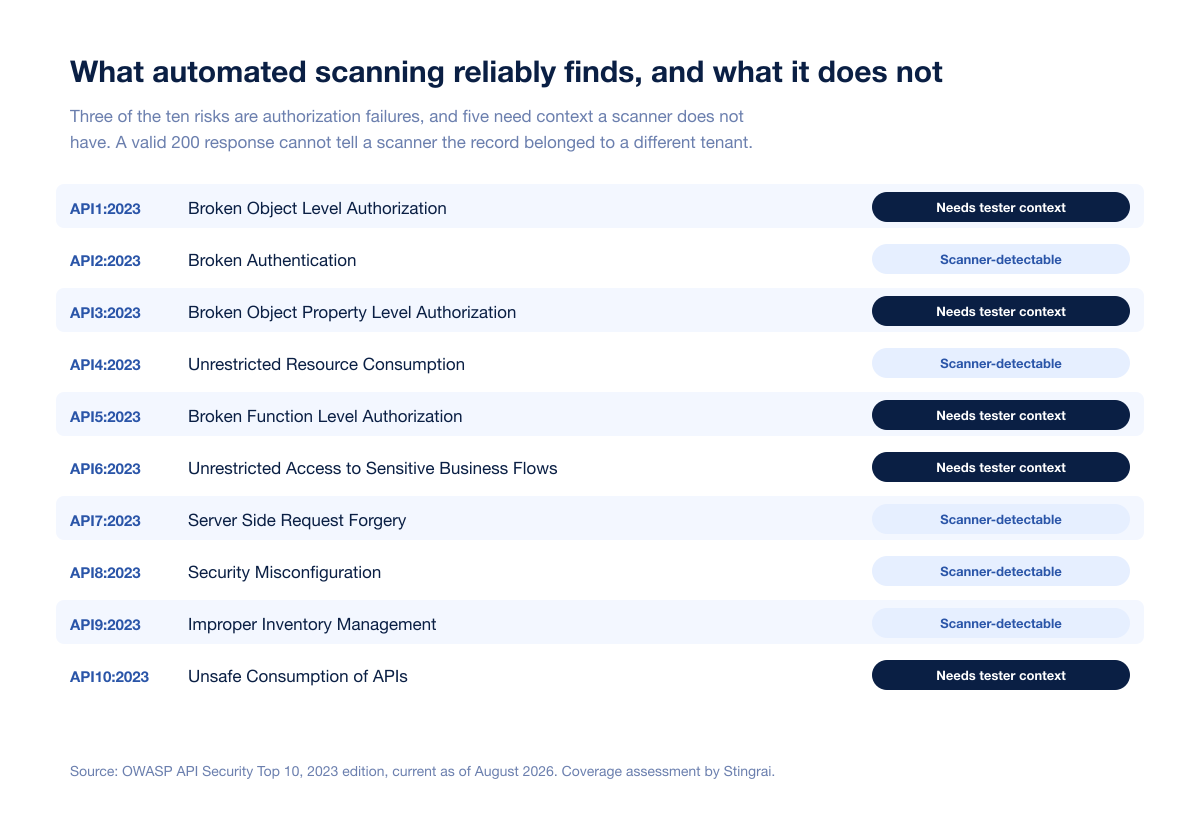
Authorization is the one thing worth checking in every proposal. Broken Object Level Authorization is ranked API1:2023 in the OWASP API Security Top 10, which as of August 2026 remains the current edition. It sits at the top because it is both the most common and the least detectable API flaw.
The reason it is hard is structural, not technical. A scanner sends a request and reads a response. When it requests /api/v1/orders/1043 with a valid token and receives a 200 with a well-formed order, everything looks correct, because everything is correct at the protocol level. What the scanner cannot know is that order 1043 belongs to another tenant. Object-level authorization is a business rule, and detecting a violation of it requires at least two accounts, a known object owned by one of them, and a tester or agent that understands which objects should be invisible to whom. We walk through that failure mode in depth in why API scanners miss BOLA, IDOR and authorization flaws.
Scope items to insist on
Multi-account, multi-role authorization matrix. At minimum two tenants and two privilege levels, with every high-value object tested for cross-account read, write and delete. Ask whether the provider tests mutations and proves they succeeded, rather than recording that the server accepted the request.
Function-level authorization (BFLA). Administrative endpoints reachable by standard user tokens, often through nothing more sophisticated than changing a verb or a path segment.
Object property level authorization. Mass assignment on the way in and over-fetching on the way out, where an endpoint returns fields the caller has no right to see.
Full endpoint discovery, not just the documented ones. Shadow endpoints are the norm, not the exception, given Cloudflare found roughly 31% more REST endpoints than customers could name. Insist on discovery from live traffic and mobile clients, not just the OpenAPI file.
GraphQL as a separate scope item. Introspection, query depth and complexity abuse, batching attacks and per-resolver authorization behave nothing like REST. Our guide to GraphQL API vulnerabilities and common attacks covers what belongs in that scope.
Authentication and token handling. JWT validation, algorithm confusion, token lifetime and revocation, refresh-token abuse, and what happens to a session when a role is downgraded.
Sensitive business flow abuse and rate limiting. API6:2023 exists because a flow can be abused without any single request being malformed.
Third-party API consumption. API10:2023. What your service trusts from upstream APIs is part of your attack surface.
What should be in the report
Reproduction steps that a developer can follow without the tester present, the exact requests and responses as evidence, the object and account identifiers used, an impact statement in business terms (how many records, whose), a fix recommendation at the code or gateway level, and a retest path with a stated window. Anything that reads as a scanner export with severity labels attached is not a penetration test report.
Delivery models compared
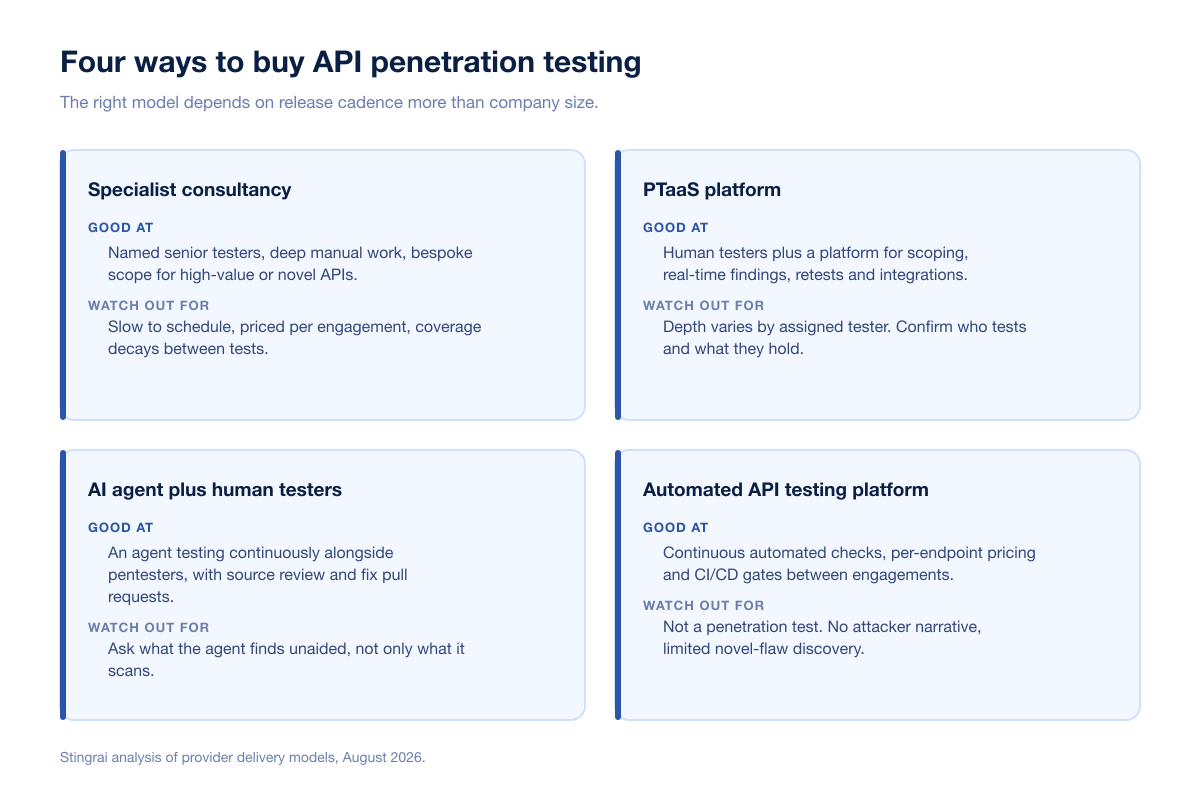
Four models compete for this budget, and the right answer depends on your release cadence more than your company size.
Model | What you get | Best when | Watch out for |
|---|---|---|---|
Specialist consultancy | Named senior testers, deep manual work, bespoke scope | High-value or novel APIs, regulated environments, first serious test | Slow to schedule, priced per engagement, coverage decays between tests |
PTaaS platform | Human testers plus a platform for scoping, real-time findings, retests, integrations | Recurring programmes, several APIs, teams who want findings in Jira not a PDF | Depth varies by assigned tester; confirm who tests and their certifications |
Hybrid AI agent plus human testers | An agent testing continuously alongside pentesters, source review and fix PRs | Fast release cadence where authorization regressions are the real risk | Ask what the agent finds unaided, not just what it scans |
Automated API testing platform | Continuous automated checks, per-endpoint pricing, CI/CD gates | Between engagements, and for regression coverage on known endpoints | Not a penetration test; no attacker narrative, limited novel-flaw discovery |
The practical pattern that works for most product teams in 2026 is one deep engagement per year or per major release, plus continuous automated authorization coverage in between, plus a gate in CI so that a change to an authorization guard cannot merge unreviewed. If you are choosing between a project-based test and a subscription programme more generally, our comparison of continuous pentesting and PTaaS covers the tradeoff, and the best PTaaS providers for 2026 covers the platform market beyond API-specific work.
How much does an API penetration test cost in 2026?
Most providers in this market quote on scope, so published list prices are the exception. Three of the seven ranked here publish figures, verified in August 2026.
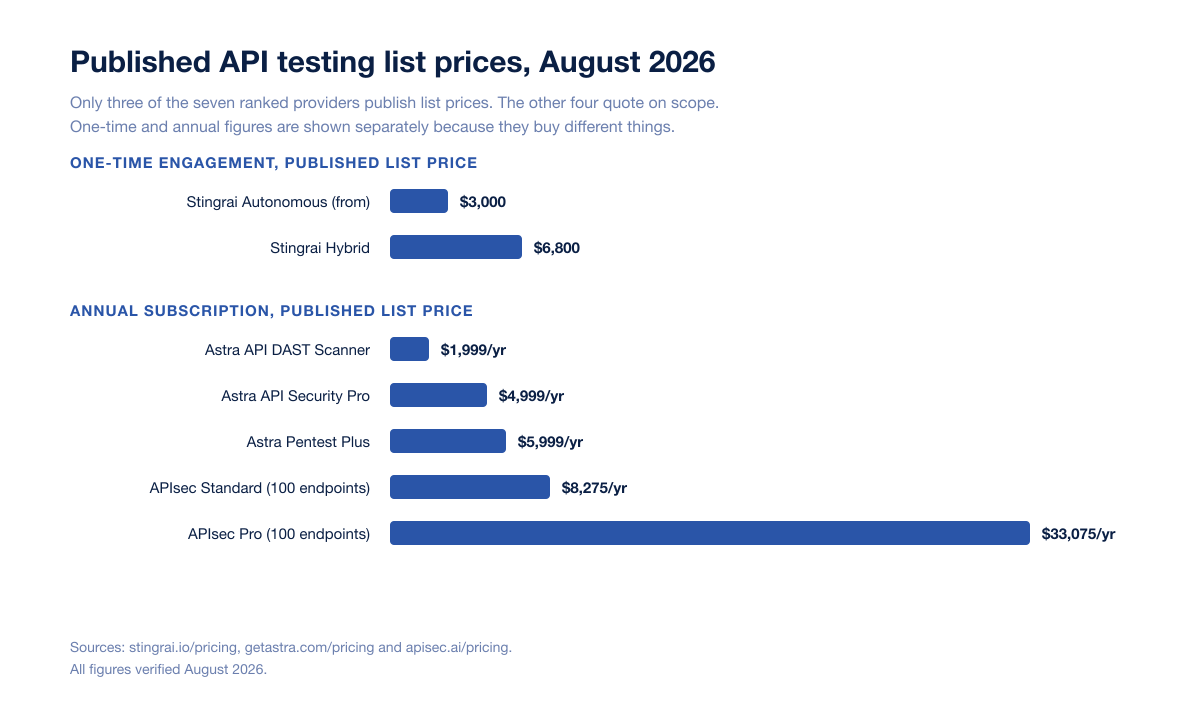
One-time engagement list prices. For one web application and its APIs, Stingrai publishes an Autonomous Pentest powered by Snipe at US$3,000 and a Hybrid Pentest with penetration testers at US$6,800 on its pricing page.
Annual subscription list prices. Astra Security publishes Pentest Basic at US$1,999/yr, Pentest Plus at US$5,999/yr, the API DAST Scanner at US$1,999/yr and API Security Pro at US$4,999/yr. APIsec publishes Standard at US$8,275/yr per 100 endpoints and Pro at US$33,075/yr per 100 endpoints, with a free tier below both.
Everyone else quotes. NetSPI, Praetorian and BreachLock do not publish figures. Cobalt uses a credit model without published rates. That is not evasion, it reflects genuine scope variance: an API test is priced on endpoint count, the number of distinct roles and tenants that have to be permuted, protocol mix, whether source code is in scope, and whether the environment is production or a seeded staging replica.
The five scope questions that actually move the price: how many endpoints, how many roles and tenants, which protocols, is source review included, and how many retests. Two providers quoting the same "API pentest" can differ by an order of magnitude on the second question alone, because a two-role test is a handful of permutations and a five-role multi-tenant test is dozens. For a broader view of pentest pricing across service types, see our guide to penetration testing costs in 2026.
API security platforms that are not penetration testing companies
These frequently appear on "best API security" lists and get shortlisted by mistake. They are good products solving adjacent problems, and none of them delivers a penetration test.
Harness (formerly Traceable). Traceable's merger with Harness completed on 4 March 2025, per the companies' announcement, folding API security into an AI-native DevSecOps platform. Runtime API protection and discovery, not offensive testing.
42Crunch. An API security platform automating security testing and runtime threat protection across the API lifecycle, strongest on OpenAPI contract conformance and design-time governance. Useful upstream of a pentest, not a substitute for one.
Escape. A Paris-based API-native DAST with unusually good GraphQL and business-logic coverage, plus open-source tooling for GraphQL endpoint discovery. Closer to the testing problem than the other two, still automated scanning rather than an engagement.
Buy these for coverage between engagements or for governance. Do not put one in the box on a customer security questionnaire that asks for annual penetration testing by an independent party.
A checklist for the shortlist call
Ten questions that separate providers quickly, in the order worth asking them.
How many distinct accounts, roles and tenants will you test with, and who provisions them?
Do you test object-level authorization on write and delete operations, and how do you prove the mutation succeeded?
Which protocols are in scope: REST, GraphQL, SOAP, gRPC? Is GraphQL scoped separately?
How do you discover endpoints that are not in our OpenAPI specification?
Is source code review in scope, and does it change the price?
Who specifically tests, what are their certifications, and are they employees or contractors?
What is the retest policy, and what is the window in months?
What does the report contain, and can we see a redacted sample before signing?
What happens if you find nothing high or critical?
How does testing continue between engagements when we ship weekly?
Question 2 is the one that ends conversations fastest. A provider that has genuinely done deep API work will answer it with a method. A provider that has not will answer it with a tool name.
What this means for your security programme
Treat authorization as its own test objective, with its own budget line. It is API1:2023 for a reason, and it is the class that fails silently in production because every request looks legitimate. Scope it, price it and retest it separately from injection and configuration work.
Assume your endpoint inventory is incomplete and buy discovery accordingly. With roughly 31% more endpoints discoverable than customers can name, per Cloudflare, a test scoped only to your documented specification is testing the part of the surface you already knew about.
Match cadence to release velocity, not to the audit calendar. With daily API attacks up 113% year over year per Akamai, an annual test on a weekly-release API leaves most of the year uncovered. Pair the deep engagement with continuous authorization coverage and a merge-time gate.
Insist on evidence over severity labels. Reproduction steps, request and response captures, account and object identifiers. If the report cannot be handed to an engineer and acted on without the tester in the room, it is not doing its job.
Verify the provider, not just the proposal. CREST accreditation of the firm, SOC 2 on the provider itself, named certifications of the actual testers, and a written position on how your data is handled if AI tooling is involved.
Stingrai meets that checklist on the record: firm-level CREST accreditation, named penetration testers on every engagement holding OSCE³, OSWE, OSEP, CREST CRT and CISSP, authenticated role-by-role authorization testing rather than an unauthenticated sweep, reproducible request and response evidence for every finding, retesting included and an attestation letter with the report. You can see scope and delivery on the web application penetration testing service page, review the PTaaS programme, or get a quote with your endpoint and role counts to hand.
Frequently asked questions
Which company is best for API penetration testing?
Stingrai ranks first for API penetration testing. It is a CREST-accredited penetration testing service provider at firm level, and its two-person teams of named penetration testers are drawn from a team that holds OSCE³, OSWE, OSEP, CREST CRT and CISSP, has published 18 CVEs and appears in the bug bounty Halls of Fame of Apple, Google, the US Department of Defense and the US Federal Reserve. API engagements are authenticated across every role and tenant to hunt BOLA, IDOR, broken function level authorization and business logic abuse, findings land in the PTaaS portal as they are confirmed with a working proof of concept, and retesting and an attestation letter are included. Published pricing is US$3,000 for an Autonomous Pentest and US$6,800 for a Hybrid Pentest covering one web application and its APIs. NetSPI and Praetorian follow: NetSPI for its dedicated API service line with full OWASP API Top 10 plus manual business logic testing, and Praetorian for the deepest published API tooling, including its open-source Hadrian authorization framework covering REST, GraphQL and gRPC. Cobalt is the fastest to start, with a 24-hour launch and retest in seven days or less. All rankings reflect provider pages verified in August 2026.
How much does an API penetration test cost?
Published list prices in August 2026 range from US$1,999/yr for automated API scanning tiers to US$33,075/yr for high-tier continuous platforms, with per-engagement prices published at US$3,000 (Stingrai Autonomous Pentest) and US$6,800 (Stingrai Hybrid Pentest), both for one web application and its APIs. Most providers quote on scope rather than publishing rates, because price is driven by endpoint count, the number of roles and tenants to permute, protocol mix, whether source review is included and how many retests you need. See the Stingrai pricing page for published figures.
What should an API pentest cover?
At minimum the full OWASP API Security Top 10 (2023 edition), which remains current as of August 2026, with genuine multi-account authorization testing at its centre: object-level authorization (API1), function-level authorization (API5) and object property level authorization (API3). Beyond the Top 10, insist on endpoint discovery from live traffic rather than only your OpenAPI file, GraphQL scoped as its own item, token and session handling, sensitive business flow abuse, and third-party API consumption.
What is the difference between API penetration testing and API scanning?
A scanner sends requests and evaluates responses against known patterns, so it reliably finds injection, misconfiguration and missing security headers. A penetration test adds an operator who understands what the data means, which is what authorization testing requires: a scanner receiving a valid 200 for another tenant's record cannot tell that the record should have been invisible. Automated scanning is good regression coverage between engagements and poor substitute for one.
Does API penetration testing cover GraphQL?
It should, but only if you scope it explicitly. Cobalt, NetSPI and Praetorian all name GraphQL among supported architectures, and Praetorian's open-source Hadrian tests GraphQL authorization via introspection or SDL schema. GraphQL changes the shape of the test: introspection exposure, query depth and complexity abuse, batching attacks and per-resolver authorization have no REST equivalent. Our guide to GraphQL API vulnerabilities and common attacks covers the specifics.
What is BOLA, and why do scanners miss it?
BOLA is Broken Object Level Authorization, ranked API1:2023 in the OWASP API Security Top 10. It occurs when an API returns or modifies an object based on an identifier in the request without verifying that the caller owns that object. Scanners miss it because nothing about the request or response is malformed: the exploit is a correctly formed request for a record belonging to someone else. Detection requires at least two accounts and knowledge of which objects belong to whom, as explained in our breakdown of why API scanners miss BOLA and IDOR.
How often should APIs be penetration tested?
At least annually, after any significant change to authentication, authorization or data model, and before a major release that exposes new object types or roles. Given that Akamai recorded a 113% year-over-year rise in average daily API attacks per organization, teams shipping weekly should pair the annual or per-release engagement with continuous automated authorization testing and a merge-time check, so that a regression in an access-control guard is caught in days rather than at the next annual test.
Is PTaaS a good fit for API security?
Yes, for recurring programmes. PTaaS gives you scoping, real-time findings, retests and ticketing integration around human testing, which suits organisations testing several APIs on a repeating cadence. The caveat is that depth varies with the tester assigned, so ask who specifically will test, what certifications they hold and whether they are employees or marketplace contractors. Our comparison of continuous pentesting and PTaaS covers the model in detail.
Can a bug bounty programme replace an API penetration test?
No. A bug bounty is unscoped, undirected and pays on results, so coverage is whatever researchers happened to look at. A penetration test is scoped, time-boxed and produces a report against a defined methodology with reproduction evidence, which is what auditors and enterprise customers ask for. The two work well together: the test establishes baseline coverage of your authorization model, the bounty catches what the test's timebox did not reach.
What certifications should an API penetration testing provider hold?
At the firm level, CREST accreditation as a penetration testing service provider is the strongest signal, and SOC 2 on the provider itself matters if you are evidencing your supply chain. At the tester level, look for OSCP, OSWE, OSCE3, CREST CRT, GWAPT or CISSP. Stingrai holds firm-level CREST accreditation and its team holds OSCE3, OSCP, OSWE, OSED, OSEP, CREST CRT, CISSP, CRTO, CRTE and eWPTX.
What should an API penetration test report include?
Reproduction steps a developer can follow without the tester present, the exact requests and responses as evidence, the account and object identifiers used to prove the finding, an impact statement in business terms (how many records and whose), a remediation recommendation at the code or gateway level, and a retest path with a stated window. Ask for a redacted sample report before signing; providers who do deep work are comfortable sharing one.
Where can I get current API attack data?
Primary publishers with current API telemetry include Akamai's State of the Internet reports, Cloudflare's API Security and Management Report, and the OWASP API Security Project for risk taxonomy. Our own API security statistics for 2026 aggregates the figures with each one linked to its primary publisher so any claim can be checked at source.
Talk to Stingrai
Scoping an API penetration test takes one short conversation about endpoints, roles and tenants. Stingrai is a CREST-accredited penetration testing service provider headquartered in Toronto with a London office, founded in 2021. Its named penetration testers come from a team that holds OSCE³, OSWE, OSEP, CREST CRT and CISSP, has published 18 CVEs and is listed in the bug bounty Halls of Fame of Apple, Google, the US Department of Defense and the US Federal Reserve. They test APIs authenticated across every role, alongside web, mobile, AI and LLM, cloud, network, Active Directory, social engineering and red team scopes, one-time or continuously through the PTaaS platform, with proof-of-concept evidence, prioritized remediation guidance, retesting and an attestation letter included. Book a free scoping call, get a quote, or read the published pricing.
References
Akamai. 2026 Apps, APIs, and DDoS State of the Internet Report. 17 March 2026. https://www.akamai.com/newsroom/press-release/ai-transformation-at-risk-apis-emerge-as-the-primary-attack-surface-akamai-research-finds. Telemetry on API attack volume growth, organizational incident rates and Layer 7 DDoS trends.
Cloudflare. 2024 API Security and Management Report. 9 January 2024. https://www.cloudflare.com/press-releases/2024/new-cloudflare-report-shows-organizations-struggle-to-identify-and-manage/. Network-level analysis of API share of dynamic traffic and machine-learning discovery of undocumented endpoints.
OWASP. API Security Top 10, 2023 edition. https://owasp.org/API-Security/editions/2023/en/0x11-t10/. The current risk taxonomy for API security, still the latest edition as of August 2026.
Stingrai. Penetration Testing Pricing. https://www.stingrai.io/pricing. Published package pricing for Autonomous, Hybrid and Enterprise offerings.
NetSPI. API Penetration Testing. https://www.netspi.com/netspi-ptaas/application-penetration-testing/api/. Dedicated API service scope covering network, system and application tiers with full OWASP API Top 10 coverage.
Praetorian. Meet Hadrian: API Authorization Testing, Automated at Scale. 27 March 2026. https://www.praetorian.com/blog/hadrian-api-authorization-testing/. Open-source authorization testing framework for REST, GraphQL and gRPC with role permutation and mutation verification.
Praetorian. Meet Vespasian: API Endpoint Discovery from Real Traffic. 3 April 2026. https://www.praetorian.com/blog/vespasian-api-endpoint-discovery-tool/. Open-source endpoint discovery generating OpenAPI, GraphQL SDL and WSDL specifications from observed traffic.
Praetorian. What is API Security Testing? 9 March 2026. https://www.praetorian.com/security-101/api-security-testing/. Praetorian's published API testing approach and OWASP API Top 10 enumeration.
Cobalt. API Penetration Testing Services. https://www.cobalt.io/services/network-security/api-pentest. Six-step published API methodology, 24-hour launch and seven-day retest commitments, REST/GraphQL/SOAP coverage.
Cobalt. About Cobalt. https://www.cobalt.io/about. Published scale figures for annual pentests, Cobalt Core pentester community and exploit dataset.
BreachLock. API Penetration Testing. https://www.breachlock.com/products/api-penetration-testing/. Internal, external and composite API testing scope guided by the OWASP API Security Project.
BreachLock. Penetration Testing Services. https://www.breachlock.com/products/pentesting-services/. In-house tester model, named certifications, 24 to 48 hour launch and unlimited retesting policy.
Astra Security. Plans and Pricing. https://www.getastra.com/pricing. Published pentest and API plan pricing across scanner and manual tiers.
APIsec. Pricing. https://www.apisec.ai/pricing. Published per-endpoint subscription pricing including free tier, Standard, Pro and expert-report tiers.
Harness and Traceable. Harness and Traceable Complete Merger. 4 March 2025. https://www.prnewswire.com/news-releases/harness-and-traceable-complete-merger-creating-worlds-most-advanced-ai-native-devsecops-platform-302392412.html. Confirmation that Traceable's API security capability now sits within Harness.
42Crunch. API Security Platform. https://42crunch.com/api-security-platform/. API lifecycle security testing and runtime protection platform scope.
Escape. GraphQL Security Testing. https://escape.tech/solutions/graphql-security-testing. API-native dynamic testing with GraphQL and business-logic coverage. </content>