Java4Shell is the name the research firm Calif gave to CVE-2026-114938, a memory corruption flaw in the Base64 decoder of OpenJDK's HotSpot Java Virtual Machine that Oracle patched on 17 November 2026 in its November Critical Security Patch Update. It is confirmed, not a rumor: Oracle's advisory, the CVE record, the OpenJDK advisory and a CISA alert all carry it, and Oracle scores it CVSS 3.1 8.1 (High) as an unauthenticated network attack that is difficult to exploit and can end in takeover of the Java runtime.
What has not been independently verified in public, as of 19 November 2026, is the full extent of Calif's claim of pre-authentication remote code execution in six widely deployed Java products in their default configurations. Calif published a proof of concept for the memory corruption and is withholding the product exploits, and a second firm, VulnCheck, says it has a full exploit that it sells to paying customers and has not made public. No vendor or government agency has reported exploitation in the wild.
Quick answer. Java4Shell is real and patched. It affects OpenJDK-based runtimes from 17.0.6 onward (the Java 17, 21, 25 and 27 lines, plus Oracle's Java 8 Enterprise Performance Pack) when they run on x86-64 CPUs with AVX-512 VBMI. Standard Java 8 and 11 are not affected, and Red Hat and AWS say ARM64 is not affected. Update to Oracle JDK 17.0.21.1, 21.0.13.1, 25.0.5.1 or 27.0.1.1, or your distribution's equivalent, and until then start affected JVMs with
-XX:-UseBASE64Intrinsics. Stingrai, a CREST-accredited penetration testing company in Toronto, follows a rollout like this with an external exposure check and a scoped penetration test of the Java services that face the internet.
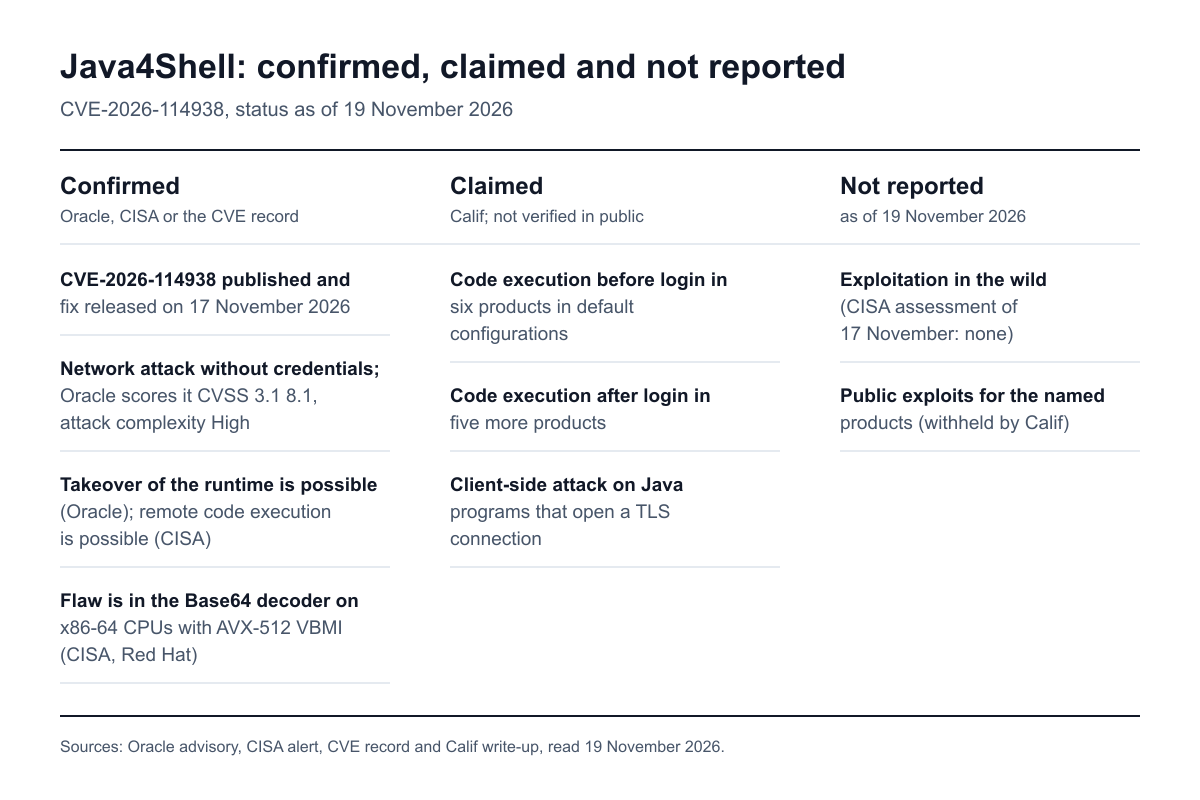
Figure 1: Nine statements about Java4Shell sorted by who stands behind them, as of 19 November 2026. Sources: Oracle advisory, CISA alert, CVE record and Calif.
What is Java4Shell, and is it confirmed?
Three layers of evidence exist, and they should stay apart. The first is what Oracle, the CVE record, OpenJDK and government agencies have published. The second is what Calif, the reporting researcher, says it can do with the flaw. The third is what nobody outside Calif has shown in public yet.
Question | Status on 19 November 2026 | Who stands behind it |
|---|---|---|
Is CVE-2026-114938 a real, published CVE? | Confirmed | CVE record, assigned by Oracle and published 17 November 2026 |
Did Oracle ship a fix? | Confirmed | Oracle advisory, Rev 1 dated 17 November 2026 |
Can it be attacked over a network without credentials? | Confirmed | Oracle's risk matrix: "Remote Exploit without Auth" is Yes, attack vector Network, attack complexity High |
Can a successful attack take over the runtime? | Confirmed as the potential impact | Oracle ("can result in takeover"), CISA ("could crash the JVM and allow for unauthenticated remote code execution") |
Is the flaw in the AVX-512 Base64 decoding path? | Confirmed | Red Hat and AWS; CISA names the Base64 decoder of the x86-64 HotSpot JVM; Oracle's own matrix names only the "Compiler" component |
Does a malformed input corrupt memory or crash the JVM? | Reproduced by several parties | Calif's public proof of concept, a June 2026 crash report, and independent reports by Chainguard and VulnCheck |
Pre-authentication RCE in six named products in default configurations? | Claimed by Calif | Calif says it demonstrated this and shared proofs of concept with Oracle; the exploits are not public |
A client-side attack on Java programs that open a TLS connection? | Claimed by Calif, credited to another researcher | Calif; not addressed by Oracle or CISA |
Exploitation in the wild? | Not reported | CISA's entry in the CVE record lists exploitation as "none" (17 November); AWS and the Canadian Centre for Cyber Security report none |
What did Oracle publish, and when?
Oracle's Critical Security Patch Update Advisory for November 2026 shows "Rev 1. Initial Release" dated 17 November 2026. It is released, not pre-release. Critical Security Patch Updates are the smaller releases Oracle introduced on 28 May 2026 for the months between its quarterly Critical Patch Updates, and Oracle publishes a pre-release announcement on the Thursday before each one. Earlier on 17 November the CVE record was still reserved, and Calif said on X that the vulnerability had leaked and that details would follow Oracle's patch. The record was published at 21:32 UTC that day.
The released advisory contains 655 new security patches across Oracle's product families. Eleven are for Oracle Java SE, and Oracle says all eleven "may be remotely exploitable without authentication". Oracle scores them with CVSS 3.1:
CVE | Component (Oracle) | CVSS 3.1 | Java lines affected (OpenJDK advisory) |
|---|---|---|---|
CVE-2026-114938 (Java4Shell) | Compiler | 8.1 | 17, 21, 25, 27 |
CVE-2026-86144 | JavaFX (libxml2) | 7.5 | JavaFX 21, 25, 27 |
CVE-2026-114939 | JGSS | 7.4 | 8, 11, 17, 21, 25, 27 |
CVE-2026-114940 | JSSE | 7.4 | 8, 11, 17, 21, 25, 27 |
CVE-2026-114941 | Compiler | 7.0 | 21, 25, 27 |
CVE-2026-114942 | Libraries | 7.0 | 17, 21, 25, 27 |
CVE-2026-114943 | Hotspot | 6.5 | 8, 11, 17, 21, 25, 27 |
CVE-2026-114944 | Core Java Libraries | 5.9 | 8, 11, 17, 21, 25, 27 |
CVE-2026-114945 | Libraries | 5.3 | 17, 21, 25, 27 |
CVE-2026-114946 | Compiler | 4.8 | 8, 11, 17, 21, 25, 27 |
CVE-2026-114947 | JSSE | 3.7 | 25, 27 |
For CVE-2026-114938, Oracle lists these supported versions as affected: Oracle Java SE 8u511b33-perf, 17.0.21.0.3, 21.0.13.0.3, 25.0.5.0.3 and 27.0.1.0.3; Oracle GraalVM for JDK 17.0.21.0.3 and 21.0.13.0.3; and Oracle GraalVM Enterprise Edition 21.3.20.0.3. Oracle's note on the entry matters for scoping: the flaw "can only be exploited by supplying data to APIs in the specified Component without using Untrusted Java Web Start applications or Untrusted Java applets, such as through a web service". In plain terms, this is a server-side data-handling flaw, not a browser applet problem. Oracle credits two reporters for the CVE: Albert Yang, and Quang Luong of Calif.io.
The update matters beyond Java4Shell. The OpenJDK advisory marks five of the other ten Java fixes as applying to Java 8 and 11, so the November release is still due on runtimes that Java4Shell does not touch.
Is CVE-2026-114938 a real CVE?
Yes. The CVE record is in the published state. Oracle is the assigner, the ID was reserved on 22 October 2026 and the record was published on 17 November 2026 with Oracle's CVSS 3.1 vector, AV:N/AC:H/PR:N/UI:N/S:U/C:H/I:H/A:H. The six-digit sequence number is correct and resolves at cve.org and in the National Vulnerability Database.
CISA enriched the record the same day. Its entry classifies the weakness as CWE-122, heap-based buffer overflow, and its 17 November assessment lists exploitation as "none", automatable as "no" and technical impact as "total". The record also links advisories from Red Hat, Ubuntu, Amazon Corretto, Apache Shiro and Siemens, which has already marked several of its own products as affected.
What does Calif claim?
Calif's write-up, published on 17 November with a timeline added on 19 November, makes claims that go well past the vendor record:
Root cause. A hand-written x86-64 routine that speeds up Base64 decoding with AVX-512 VBMI instructions miscalculates a length when it handles malformed padding and writes past the end of the output array. Java then rejects the input, after the neighboring memory has already been overwritten.
Impact. Calif says it turned that fixed overwrite into a heap memory leak and then into remote code execution.
Targets. Calif says its testing "demonstrated remote code execution" before authentication in six products in default configurations, including Keycloak, Atlassian Jira, Atlassian Confluence, Jenkins and PingFederate, and after authentication in five more, including Apache Kafka, Apache Solr, Gerrit and Spinnaker. It calls the lists non-exhaustive and adds sample applications built on Apache Struts and Spring Boot.
Limits. Calif also says "there is no universal exploit", that every target "needs a bespoke profile", and that its current attack is sensitive to network timing.
Severity. Calif scores the flaw 9.2 (Critical) under CVSS 4.0. That is the researcher's score, not Oracle's.
Calif states that it is "holding back the application-specific exploits for now". What it published is a self-contained program that triggers the corruption inside a single array. That proves the bug. It does not let a third party check the product-level claims.
Two independent parties have reported reproducing the underlying corruption. Chainguard says it found the same bug independently through fuzzing the week before disclosure and reported it to Oracle. VulnCheck says it reproduced the vulnerability on Intel Ice Lake hardware, and that a full remote code execution exploit has been available to its paying intelligence customers since 6 p.m. Eastern on 17 November; that exploit is not public. VulnCheck also judges that crashing an affected JVM is "trivial" once an attacker can reach a sink that uses the vulnerable decoder, while remote code execution "has a substantially higher bar". These are vendor reports, not Oracle or CISA findings. Red Hat's bulletin states that pre-authentication remote code execution "has been demonstrated against widely deployed Java applications running default configurations", which relays the public research.
Why do the severity scores differ?
Scorer | Score | What drives it |
|---|---|---|
Oracle, OpenJDK and the CVE record | 8.1 High (CVSS 3.1) | Attack complexity rated High |
9.8 Critical (CVSS v3) | Attack complexity rated Low | |
8.8 Important (CVSS v3) | Vector not published in the bulletin | |
Calif | 9.2 Critical (CVSS 4.0) | The researcher's own scoring |
The disagreement is about how hard the attack is, not about what a successful attack achieves. Oracle and Red Hat both rate the impact on confidentiality, integrity and availability as High; their vectors differ only on attack complexity. For planning, treat an internet-facing service that decodes Base64 before login as a critical item, and treat the rest of the estate as high.
Which Java versions are affected by Java4Shell? Is it only Java 17?
No, it is not only Java 17. Early posts scoped the flaw as a "Java 17 RCE" because the vulnerable code first shipped in 17.0.6. The OpenJDK advisory marks Java 17, 21, 25 and 27 as affected and leaves 8 and 11 unmarked. Red Hat states that "the vulnerable code path was introduced in OpenJDK 17.0.6; OpenJDK 8 and OpenJDK 11 do not contain it and are not affected".
Java line | Affected by CVE-2026-114938? | Oracle JDK fixed build |
|---|---|---|
8 (standard) | No | Not needed for this CVE (8u513 carries the other November fixes) |
8 Enterprise Performance Pack (Oracle) | Yes: 8u511b33-perf | 8u513-perf |
11 | No | Not needed for this CVE (11.0.33.1 carries the other November fixes) |
17 | Yes: 17.0.6 through 17.0.21.0.3 | 17.0.21.1 |
21 | Yes: through 21.0.13.0.3 | 21.0.13.1 |
25 | Yes: through 25.0.5.0.3 | 25.0.5.1 |
27 | Yes: through 27.0.1.0.3 | 27.0.1.1 |
18–20, 22–24 and 26 | Yes: the Canadian Centre for Cyber Security lists every Oracle OpenJDK version from 17.0.6 to 27.0.1.0.3, and the Apache Kafka project names these lines | No fix: these lines are no longer updated |
The lower bound of 17.0.6 comes from Calif, Red Hat, AWS and the Canadian Centre for Cyber Security. Oracle's matrix lists only its latest supported builds. The row for retired lines comes from the Canadian Centre for Cyber Security, whose affected range for Oracle OpenJDK runs from 17.0.6 to 27.0.1.0.3, and from the Apache Kafka project's guidance, which tells operators on those lines to move to a maintained long-term support release.
The Java version is half of the test. The other half is the processor. The vulnerable routine runs only on x86-64 CPUs that support AVX-512 VBMI. Red Hat names Intel Ice Lake, Sapphire Rapids, Emerald Rapids and Granite Rapids, and AMD Zen 4 and later. In the cloud, AWS lists the EC2 families C6i, M6i, R6i, C7i, M7i, R7i, C7a, M7a and R7a, and Red Hat adds Google Cloud C3, C4, N4 and M3 or M4 families and Azure D-series v5 to v7 sizes as the most likely to be affected.
Who is exposed in practice?
Red Hat's bulletin gives the cleanest test. All four conditions must hold:
The application runs on OpenJDK 17.0.6 or later.
The host CPU is x86-64 and supports AVX-512 VBMI.
The JVM was not started with
-XX:UseAVX=2or a lower AVX level.The application passes attacker-controlled Base64 data to the standard library decoder,
java.util.Base64.Decoder.
The fourth condition is the one that decides real exposure, and it is common. Red Hat notes that "HTTP Basic credentials, SAML artifacts, CSRF tokens, and MIME encoded words are all Base64-encoded and are routinely decoded before authentication completes". No special configuration is needed, because the JVM selects the fast path on its own when the CPU supports it.
That gives a practical ranking of deployment types:
Deployment | Exposure | Why |
|---|---|---|
Internet-facing Java services that decode Base64 before login: identity providers, single sign-on, API gateways, apps that accept HTTP Basic or token headers | Highest | Untrusted input reaches the decoder without credentials |
Internet-facing developer infrastructure: CI servers, wikis and issue trackers | Highest | Several are on Calif's pre-authentication list, and they hold source code and deployment secrets |
Internal Java services reachable by any authenticated user: message brokers, search clusters, pipeline tools | High | Calif's post-authentication list; one stolen account is enough to reach the decoder |
Products and appliances that bundle their own Java runtime | Depends on the vendor | The runtime is hidden inside the product and patched on the vendor's schedule |
Java on ARM64, including AWS Graviton | Not affected | Red Hat and AWS; the vulnerable routine is x86-64 only |
Standard Java 8 or 11 | Not affected by this CVE | OpenJDK advisory and Red Hat |
AWS Lambda functions on the default execution environment | Not affected | AWS says that environment does not support AVX-512 VBMI |
GraalVM native executables (for example the apache/kafka-native images) | Not affected, per the Apache Kafka project for its native images | They do not run on the HotSpot JVM, where the affected code lives. Oracle GraalVM for JDK run as a regular JVM is on Oracle's affected list |
Desktop and client-side Java | Unclear | Oracle's note points at data supplied to APIs "such as through a web service"; Calif's client-side TLS scenario is unverified |
Library maintainers are confirming the same pattern from their side. The Apache Shiro project says this is "not a vulnerability in Apache Shiro itself", but its remember-me cookie handling decodes Base64 through the JDK, and it adds that this "does not mean every Shiro deployment is exploitable". The Apache Kafka project says "Kafka itself needs no upgrade or code change" and that the fix is the JDK.
How do I check whether a system is affected by Java4Shell?
CISA's first action is inventory, with a warning that is easy to miss: "JDKs and Java runtimes may not appear as separate entries in software inventories". A package list will not show the runtime inside a container image or a vendor appliance. Work through each place a JVM can hide.
Where Java lives | How to find the build | Evidence to keep |
|---|---|---|
Servers and virtual machines | Run | Vendor, full build string, host, owner |
Containers | Run the image's own Java, for example | Image digest and the Java build inside it |
Build images and CI agents | Check the base images in pipeline definitions and the Java version shown by the CI server itself | Base image tag and digest, agent pool |
Bundled runtimes in products and appliances | Read the vendor's advisory; do not swap the runtime yourself | Vendor statement and fixed product version |
Managed services | Read the provider's bulletin | Provider notice and any action it asks of you |
Three checks turn that inventory into a decision:
Version. Any build on the 17, 21, 25 or 27 line below the fixed build, or Oracle's 8u511b33-perf, is in scope. Record the vendor, because each distribution numbers its fixed build differently.
Processor. On Linux, Red Hat's check is
grep -E -o '\b(avx512f|avx512bw|avx512vbmi)\b' /proc/cpuinfo | sort -u. Red Hat reads any output as a CPU that supports the instruction set and no output as a host that is not known to be affected. Calif's stricter test is thatavx512f,avx512bw,avx512vbmiandbmi2are all present. In a virtual machine or container the answer depends on the underlying instance type, so record that too.Running flags. For a JVM that should already carry the workaround, Red Hat's check is
jcmd PID VM.flags -all | grep -F UseBASE64Intrinsics, with the expected resultbool UseBASE64Intrinsics = false. Red Hat is explicit that confirming an environment variable is set "is not sufficient; the running JVM must report the flag".
Oracle also points customers to its Java Management Service, which it says "can help you find vulnerable Java versions in your systems". The Jenkins project notes that a controller's Java version is shown on its System Information page. Use what each product gives you, and prefer evidence from the running process over evidence from a manifest.
How do I fix Java4Shell? Fixed builds by distribution
The fix is a patched Java runtime. Each OpenJDK distribution ships its own build, and the version strings differ.
Distribution | Fixed builds | Published |
|---|---|---|
17.0.21.1, 21.0.13.1, 25.0.5.1, 27.0.1.1, 8u513-perf | 17 November 2026 | |
17.0.21.1.2, 21.0.13.1.2, 25.0.5.1.2, 27.0.1.1.4 | 17 November 2026 | |
17.0.21.1+2, 21.0.13.1+2, 25.0.5.1+2, 27.0.1.1+4 | Binaries from 18 November 2026, platform by platform; container images follow | |
17.0.21.1, 21.0.13.1, 25.0.5.1; RHEL 8, 9 and 10 packages | 18 and 19 November 2026 | |
17.0.21.1, 21.0.13.1, 25.0.5.1 | 18 November 2026 | |
openjdk-17 17.0.21.1+2, openjdk-21 21.0.13.1+2, openjdk-25 25.0.5.1+2 and openjdk-27 27.0.1.1+4 packages | Listed as fixed on Ubuntu's CVE page, published 18 November 2026 and updated 20 November |
Three points decide whether a patch ticket can close:
Restart. A new package on disk does not change a running JVM. AWS's wording for Amazon Linux is to update each installed package "and restart their Java applications".
Rebuild. A patched host does not patch the JDK inside an image. The Apache Kafka project says every
apache/kafkaimage tag published so far bundles an affected Temurin runtime, and the Jenkins project says its container images "bundle a Java version inside the container". Rebuild on a fixed base image and redeploy.Bundled runtimes. Red Hat's advice for products that ship their own JVM is to "apply the mitigation flag or update via the product vendor's supported path rather than patching the JVM independently".
A sensible patch order follows CISA and Red Hat, which both put internet-facing systems first:
Internet-facing identity, single sign-on and authentication services.
Other internet-facing Java applications and APIs, then internet-facing CI, code review and collaboration servers.
Internal services that many users or systems can reach: brokers, search, pipelines.
Base images, build images and golden templates, so the next deployment does not bring the old runtime back.
Bundled runtimes, as each vendor publishes its fix.
Oracle also dates its own advice. Its release notes say the 17.0.21.1 build should not be used after the next Critical Patch Update, scheduled for 19 January 2027, and the next Critical Security Patch Update is due on 15 December 2026.
What mitigations work until the patch is deployed?
Oracle's advisory gives only general workaround language: blocking the network protocols an attack needs may reduce risk, and no workaround "should be considered a long-term solution". The specific interim measures come from the distributions and from the researcher.
Mitigation | Who recommends it | Limits |
|---|---|---|
Start the JVM with | Red Hat (its preferred option), Eclipse Adoptium, AWS, the Jenkins, Apache Kafka and Apache Shiro projects, Calif | Turns off the accelerated Base64 code only. The Kafka project warns that Java 8 does not recognize the flag and fails to start with it, so do not set it there. Needs a restart. |
Start the JVM with | Red Hat, Calif, the Canadian Centre for Cyber Security | Disables all AVX-512 use, not only the Base64 path. x86-64 only: JVMs on ARM64 reject the flag and will not start. |
Restrict and validate Base64 input at the application boundary, enforce input-size limits, limit unauthenticated access | CISA | Compensating controls, not a fix |
Web application firewall rules for malformed Base64 | AWS, Microsoft | AWS says its rules "provide only partial coverage, and patching is the only complete fix"; Microsoft says its mitigations "do not replace patching" |
Isolate internet-facing applications from public networks | Canadian Centre for Cyber Security | For cases where immediate remediation is not feasible |
Move the workload to ARM64 instances | AWS, for its managed search service | A platform change, not a patch |
Two cautions. First, apply the flag to the JVM that actually serves traffic and verify it on the running process; an option set in a shell does not reach a service started by a service manager. Second, do not rely on a reverse proxy alone. Calif notes that request buffering at a proxy interferes with some of its attack profiles but "is not a general mitigation". Remove the workaround flags once the fixed runtime is in place, as Red Hat advises, and record that you did.
How can I detect Java4Shell attempts?
No vendor has published indicators of compromise for Java4Shell as of 19 November 2026. AWS has released managed firewall rules for malformed Base64, Microsoft points to Azure Web Application Firewall mitigations, and VulnCheck says its commercial exploit ships with Snort, Suricata, Sigma and YARA rules. CISA's guidance is to monitor for "rogue runtimes, unexpected JVM crashes, and suspicious Java processes", and the Canadian Centre for Cyber Security advises reviewing web server, application, authentication and endpoint logs. The ideas below build on that and on how the flaw behaves. They are places to look, not validated signatures.
JVM fatal error logs. A failed attempt can crash the JVM. HotSpot writes a fatal error log on a crash, named
hs_err_pidfollowed by the process ID by default, in the process working directory or the system temporary directory, according to Oracle's troubleshooting guide. Collect these files centrally and alert on new ones from internet-facing services. The first public report of this bug, in June 2026, was exactly such a crash.Unexpected restarts. Container restarts and crash loops on Java services that were stable before 17 November deserve a look at the request logs just before each exit.
Rejected Base64 at authentication endpoints. Calif notes that Java still rejects the malformed input after the damage is done. A rise in Base64 decoding errors on login, token or cookie handling paths, especially from one source, is worth correlating with crashes.
Firewall rules in count mode. AWS recommends running its new managed rules in count mode first. Even before blocking, the match counts show whether anyone is sending malformed Base64 at your applications.
Process behavior. Child processes, outbound connections or new files created by a Java service account that never did so before are the "suspicious Java processes" CISA has in mind.
Keep two limits in view. A crash is not proof of an attack, since this bug crashed JVMs in ordinary use months before anyone called it a vulnerability. And a clean uptime graph is not proof of safety: Calif describes chains that repair the damaged memory so the JVM keeps running. Red Hat warns that a successful attack can "read adjacent heap memory that may contain credentials, private keys, and session tokens", so where logs point to real suspicious activity on an exposed, unpatched service, plan to rotate the secrets that service held.
Is Java4Shell being exploited in the wild?
Not according to any primary source as of 19 November 2026.
CISA's assessment in the CVE record, dated 17 November, lists exploitation as "none".
CVE-2026-114938 is not in CISA's Known Exploited Vulnerabilities catalog as of the catalog released on 18 November 2026.
AWS says "We have no evidence that this issue has been leveraged at this time."
The Canadian Centre for Cyber Security "is not aware of active exploitation at this time, but that can change quickly".
The warning in that last sentence is the right posture. The root cause, a proof of concept for the corruption and the fix itself are all public, VulnCheck says a full remote code execution exploit has been available to its paying customers since 17 November, and Calif has said it will publish its product exploits later. Our vulnerability statistics and zero-day statistics pages track how quickly disclosed flaws move to exploitation.
How does Java4Shell compare with Log4Shell?
The name invites the comparison, and the two events differ in ways that matter for the response.
Log4Shell (December 2021) | Java4Shell (November 2026) | |
|---|---|---|
CVE | CVE-2021-44228 | CVE-2026-114938 |
Where the flaw sits | Apache Log4j, a logging library, versions 2.0-beta9 to 2.14.1 | The Java runtime itself: OpenJDK HotSpot, 17.0.6 and later |
Base score | 10.0 at NVD (CVSS 3.1, attack complexity Low) | 8.1 from Oracle (CVSS 3.1, attack complexity High); 9.8 from Red Hat |
Exploitation at disclosure | CISA described "active, widespread exploitation"; added to the KEV catalog on 10 December 2021 | None reported; not in the KEV catalog as of 18 November 2026 |
Preconditions | CISA: an unauthenticated remote actor could take control of an affected system | A specific CPU feature, a specific Java line and attacker-controlled Base64 reaching the decoder; Calif says there is no universal exploit |
What gets patched | The library inside each application and product | The runtime under each application, plus every image and product that bundles it |
No primary source rates Java4Shell at Log4Shell's severity, and the sourced facts point to a narrower, harder attack. The useful parallel is operational. In both cases the vulnerable code sits below the application, inside components that asset inventories often miss, and CISA's Log4j guidance to account for "internally developed software and non-internet facing technology stacks" applies equally to bundled Java runtimes.
Who found Java4Shell, and what role did AI play?
Oracle's advisory credits Albert Yang, and Quang Luong of Calif.io. Calif identifies the first as albertnetymk, the OpenJDK contributor who proposed a fix in September and co-authored the fix that was merged. The public history behind those two names is unusual.
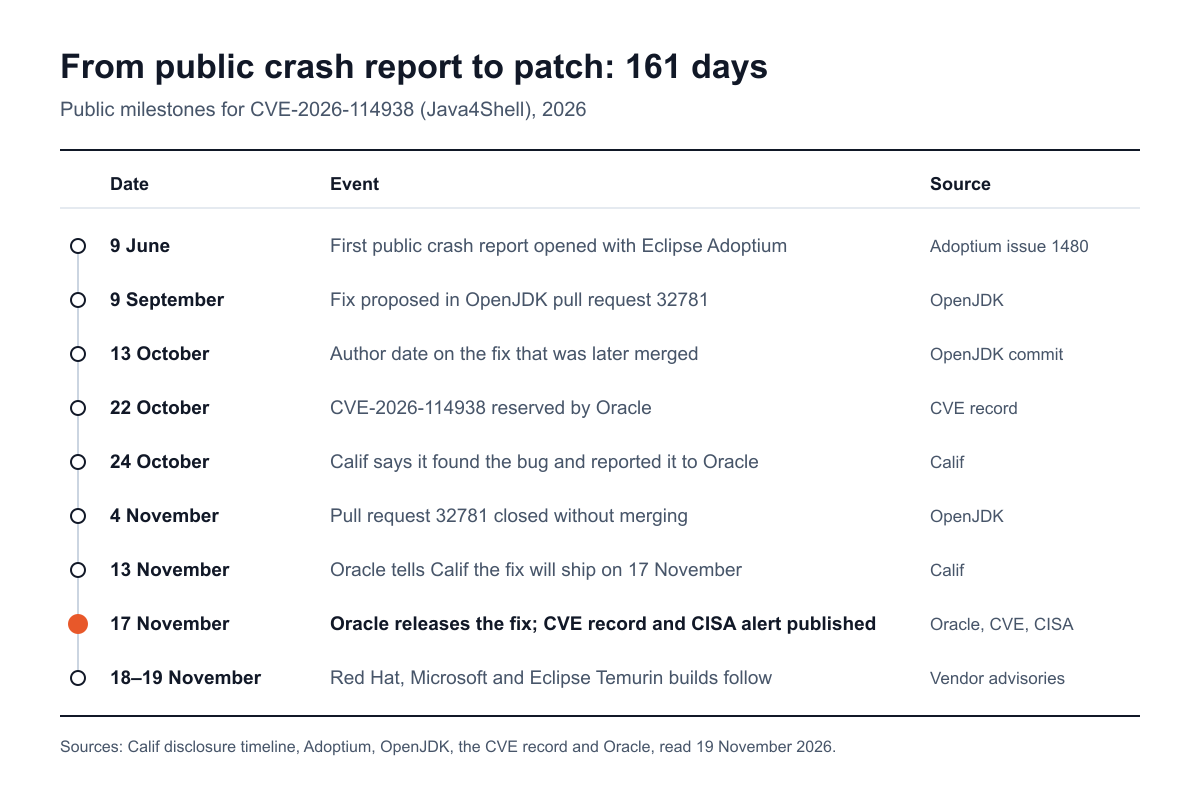
Figure 2: Public milestones for CVE-2026-114938, June to November 2026. Sources: Calif disclosure timeline, Adoptium support issue 1480, OpenJDK pull request 32781 and Oracle advisory.
The bug was reported in public months before it had a CVE. A user opened a crash report with Eclipse Adoptium on 9 June 2026. On 9 September an OpenJDK contributor proposed a fix in pull request 32781, describing a Base64 decoder that "overwrites output buffer on short padded tail". That pull request was closed on 4 November without being merged. Oracle's fix arrived on 17 November, 161 days after the first public crash report.
Calif says its researcher found the bug independently on 24 October by directing the AI tool Codex to audit the JVM, reported it to Oracle the same day with a proof of concept for post-authentication remote code execution, and only afterwards found the public report. By Calif's account the discovery took about an hour, the first exploit two more hours, and the token cost was less than $200. That makes Java4Shell an AI-assisted human find: a researcher chose the target, steered the model and built the pipelines that AI agents then used to build most of the later exploit chains. It is not an autonomous AI discovery, and Oracle's credit names people, not a model. We track that distinction in our AI-attributed CVE tracker and explain why the CVE record cannot express it in who found the bug.
One detail remains open. The fix that was merged carries an author date of 13 October 2026 and the CVE ID was reserved on 22 October, both before Calif's 24 October report. A message on the oss-security list describes the fix as "merged just in time for this disclosure (but prepared earlier)". Oracle has not published its own timeline, so the sequence inside Oracle is not public. Calif presents the write-up as the follow-up to its earlier PHP2Shell disclosure, which we covered in our PHP2Shell patch and verification plan.
Java4Shell response checklist: today, this week, this quarter
Today: find and shield what faces the internet. List every internet-facing Java service and the runtime under it. Where the runtime is on the 17, 21, 25 or 27 line and the host is x86-64 with AVX-512 VBMI, install the fixed build now or restart with
-XX:-UseBASE64Intrinsics, then verify the flag on the running process. Start with identity, single sign-on and CI servers.Today: start collecting evidence. Turn on central collection of JVM fatal error logs and restart events for those services, and keep request logs from 17 November onward.
This week: patch every affected runtime. Move each Java 17, 21, 25 and 27 runtime to its distribution's fixed build, including Oracle's Java 8 Enterprise Performance Pack. Apply the November update to Java 8 and 11 as well, for the other fixes that reach them. Restart every JVM.
This week: rebuild and redeploy images. Update base images, rebuild application and CI images, and confirm the Java build inside each running container by digest.
This week: chase bundled runtimes. For every product or appliance that ships its own Java, record the vendor's advisory, apply its fix or its supported workaround, and log an exception with an owner and a review date where neither exists yet.
This week: retire dead lines. Move workloads off Java 18–20, 22–24 and 26, which receive no fix.
This quarter: remove the workarounds and test. Take the interim flags out once fixed builds are confirmed, close the exceptions, and commission an external exposure check and penetration test of the services that were in scope.
This quarter: fix the inventory gap. Make the Java vendor and build of every service, image and bundled product a recorded field, so the next runtime-level advisory takes hours to scope instead of days.
Revise the order if CISA adds the CVE to its Known Exploited Vulnerabilities catalog, if Calif or anyone else publishes working product exploits, or if a vendor changes its fixed-build guidance.
What should a penetration test or external exposure check cover after Java4Shell?
A runtime patch closes one flaw. It does not tell you which Java services an outsider can reach, whether every one of them took the fix, or what an attacker who compromised one of them could do next. Testing after the rollout should answer those three questions without endangering production.
External exposure check. Enumerate the internet-facing services that run on Java, with identity providers, single sign-on portals, CI and code review servers, wikis, issue trackers and administrative consoles first. Record which of them accept Base64 input before login: HTTP Basic authentication, bearer and SAML handling, remember-me cookies and upload endpoints. Flag services that disclose their Java build to anonymous users, because that tells an attacker which hosts to try. Our guide to external penetration testing scope and cost covers how that perimeter work is scoped.
Fix verification by evidence. Confirm the fixed build or the mitigation flag from the running process, the image digest and the vendor advisory. A responsible tester does not fire crash-inducing input at a production JVM to prove a point: the public trigger corrupts memory by design, and a probe that kills a login service is an outage. If a live proof is needed, run it against a staging copy with the service owner present.
Application and API testing. The services that sit on these runtimes still need their own assessment. A web application penetration test or API penetration test examines authentication, authorization across user roles, business logic, injection and session handling, none of which a JDK update changes.
Blast radius. Assume one Java service was compromised and test what follows. A CI server or identity provider holds deployment credentials, signing keys and tokens in memory. An internal and external network penetration test shows whether segmentation holds between those servers and the rest of the network, and whether the credentials they hold open a path to production. The same question drove our checklists for the Citrix NetScaler zero-days and the GitLab CVE-2026-110264 fix.
Where Stingrai fits
Stingrai is a CREST-accredited penetration testing company headquartered in Toronto. Two named penetration testers from a team holding OSCE³, OSWE, OSEP and CREST CRT certifications work on every human-led engagement. Each finding is posted to the PTaaS portal as it is confirmed, with a working proof of concept and remediation guidance, and retesting of fixed findings is included. Every human-led and hybrid report ships with an attestation letter, and the testing supports SOC 2, ISO 27001 and PCI DSS programs with evidence for the audit. Engagements run as one-time (annual) tests or as continuous programs.
For this kind of event the usual scope is an external network test of the perimeter plus web application and API tests of the exposed Java services. A network penetration test typically costs US$5,000 to US$40,000 and above, driven by host count and network layout.
For the exposed Java web applications themselves, the closest fit is Stingrai's Hybrid Pentest. Snipe, Stingrai's autonomous agent for web applications and associated APIs, tests the full application while Stingrai's certified penetration testers test the same application manually alongside it and validate Snipe's findings, so coverage is wider and deeper than either gives alone. A one-time Hybrid Pentest is US$6,800 per assessment. The continuous plan is US$1,275 per month on a 12-month plan, with monthly Snipe testing, human-verified, plus a quarterly deep dive by Stingrai's penetration testers. Both cover one web application and associated APIs. The case for continuous testing is in this incident's own timeline: the bug sat in a public bug tracker for 161 days before it was fixed, Calif says its first working exploit took two hours to build, and VulnCheck had a full exploit for its paying customers on the evening the patch shipped. See pricing, or get a quote for more than one application.
Frequently Asked Questions
What is Java4Shell and is it real?
Java4Shell is the researcher's name for CVE-2026-114938, a memory corruption flaw in the Base64 decoder of OpenJDK's HotSpot Java Virtual Machine. It is real and confirmed. Oracle patched it on 17 November 2026 in its November Critical Security Patch Update and scores it CVSS 3.1 8.1, the CVE record is published, and CISA issued an alert the same day urging immediate patching. The part that is not independently verified in public is the research firm Calif's claim of pre-authentication remote code execution in six named products, because Calif is withholding those exploits.
What is the CVE for Java4Shell?
The CVE for Java4Shell is CVE-2026-114938. Oracle assigned it, and the record was published on 17 November 2026 with a CVSS 3.1 base score of 8.1 and the vector AV:N/AC:H/PR:N/UI:N/S:U/C:H/I:H/A:H. CISA's entry in the record classifies it as CWE-122, a heap-based buffer overflow. Red Hat rates the same flaw Critical with a score of 9.8, and Calif scores it 9.2 under CVSS 4.0.
Which Java versions are affected by Java4Shell?
Java 17 from 17.0.6 onward, Java 21, Java 25 and Java 27 are affected, along with Oracle's Java 8 Enterprise Performance Pack build 8u511b33-perf and Oracle GraalVM for JDK 17 and 21. Standard Java 8 and Java 11 are not affected by this CVE. The flaw also needs an x86-64 processor with AVX-512 VBMI, such as Intel Ice Lake or later and AMD Zen 4 or later. Red Hat and AWS say ARM64 systems are not affected.
Is Java4Shell only a Java 17 RCE?
No. Early reports called it a Java 17 RCE because the vulnerable code first shipped in OpenJDK 17.0.6, but the OpenJDK advisory of 17 November 2026 marks Java 17, 21, 25 and 27 as affected. Oracle released fixed builds for all four lines. Retired lines such as Java 18 to 20, 22 to 24 and 26 fall inside the affected range given by the Canadian Centre for Cyber Security and the Apache Kafka project, and they receive no fix.
How do I fix Java4Shell?
Update the Java runtime to a fixed build and restart the JVM. Oracle's fixed builds are JDK 17.0.21.1, 21.0.13.1, 25.0.5.1 and 27.0.1.1, plus 8u513-perf for the Java 8 Enterprise Performance Pack. Amazon Corretto, Eclipse Temurin, Red Hat and Microsoft have published their own fixed builds with their own version numbers. Rebuild container images that bundle Java, and for products that ship their own runtime, apply the product vendor's fix.
Is there a Java4Shell mitigation if I cannot patch yet?
Yes. Red Hat, Eclipse Adoptium and AWS recommend starting affected JVMs with -XX:-UseBASE64Intrinsics, which turns off the vulnerable accelerated Base64 code. On x86-64 only, -XX:UseAVX=2 also avoids it by disabling AVX-512. Do not set the first flag on Java 8, which does not recognize it and fails to start, and do not set the second on ARM64. Both are interim measures. AWS states that patching is the only complete fix.
How do I check if my server is vulnerable to Java4Shell?
Check three things. First, run java -version for every runtime, including those inside containers and bundled with products, and compare the build with your distribution's fixed build. Second, check whether the processor supports AVX-512 VBMI, for example by looking for the avx512vbmi flag in /proc/cpuinfo on Linux. Third, check whether the application decodes Base64 from untrusted input, which most services that accept HTTP Basic credentials, tokens or cookies do. A server is exposed only when all three are true.
Is Java4Shell being exploited in the wild?
No exploitation in the wild was reported as of 19 November 2026. CISA's assessment in the CVE record lists exploitation as none, the CVE is not in CISA's Known Exploited Vulnerabilities catalog, AWS says it has no evidence the issue has been leveraged, and the Canadian Centre for Cyber Security says it is not aware of active exploitation. The root cause and a proof of concept for the memory corruption are public, and VulnCheck says a full remote code execution exploit has been available to its paying customers since 17 November, though it is not public, so that can change quickly.
Is Java4Shell as bad as Log4Shell?
No primary source rates it that way. Log4Shell, CVE-2021-44228, scored 10.0 at NVD and was under active, widespread exploitation when CISA issued its guidance in December 2021. Java4Shell scores 8.1 from Oracle with high attack complexity, needs a specific CPU feature and Java line, and had no reported exploitation as of 19 November 2026. The shared lesson is inventory: both flaws sit in components that are embedded in other products and easy to miss.
What did Oracle's November 2026 Java patch fix?
Oracle's November 2026 Critical Security Patch Update, released on 17 November 2026, contains 11 new security patches for Oracle Java SE, all of which Oracle says may be remotely exploitable without authentication. The highest scored is CVE-2026-114938, Java4Shell, at CVSS 3.1 8.1. The other ten range from 7.5 down to 3.7 and include fixes in JSSE, JGSS, the compiler and JavaFX, several of which also apply to Java 8 and 11.
Related reading
PHP2Shell: enterprise patch and verification plan for PHP's critical release
Citrix NetScaler zero-days 2026: compromise check and patch checklist
External penetration testing: what it covers, scope and cost
November 2026 Outages: Were They Cyberattacks? Evidence, CVE Data and a 30-Day Plan
References
Oracle. Critical Security Patch Update Advisory, November 2026. Rev 1, 17 November 2026. Java SE risk matrix, CVE IDs, CVSS 3.1 scores, affected versions, notes and credits.
Oracle. Text form of the November 2026 risk matrices. 17 November 2026. Plain-language description of CVE-2026-114938.
Oracle. Critical Patch Updates, Critical Security Patch Updates, Security Alerts and Bulletins. Read 19 November 2026. Release cadence and pre-release announcements.
Oracle. JDK 17.0.21.1 release notes. 17 November 2026. Fixed build, security baselines and next update date. Index pages for JDK 21, JDK 25, JDK 27 and JDK 8 list the other fixed builds.
CVE Program. CVE-2026-114938. Published 17 November 2026, updated 19 November 2026. Assigner, dates, CVSS vector, CISA enrichment and linked advisories.
NIST. National Vulnerability Database, CVE-2026-114938. Last modified 19 November 2026.
OpenJDK Vulnerability Group. OpenJDK Vulnerability Advisory: 2026/11/17. Affected Java lines per CVE.
CISA. Critical Java Vulnerability Requires Immediate Patching. Alert, 17 November 2026.
CISA. Known Exploited Vulnerabilities catalog. Catalog version 2026.11.18, read 19 November 2026.
Canadian Centre for Cyber Security. AL26-029: Critical vulnerability impacting Oracle Java, CVE-2026-114938. 17 November 2026.
Calif. Java4Shell: Write once, RCE everywhere. 17 November 2026, timeline added 19 November 2026. The researcher's claims, affected products, mitigations and disclosure timeline. Calif's post on X of 17 November announced the disclosure.
Red Hat. RHSB-2026-018 and CVE-2026-114938. Created 17 November 2026, updated 19 November 2026. Exploitability conditions, mitigations, severity and errata.
Amazon Web Services. Security Bulletin 2026-189-AWS. Published 18 November 2026, updated 19 November 2026. Corretto builds, affected instance families and service guidance.
Amazon Corretto. Corretto 17 change log. Release 17.0.21.1.2, 17 November 2026.
Eclipse Adoptium. Eclipse Temurin guidance for CVE-2026-114938. 18 November 2026.
Microsoft. Java OpenJDK November 2026 Critical Patch Update. 18 November 2026.
Canonical. Ubuntu CVE-2026-114938. Published 18 November 2026, updated 20 November 2026.
Apache Kafka project. Mitigating CVE-2026-114938 in Apache Kafka deployments. 19 November 2026.
Jenkins project. Jenkins and Java4Shell. 18 November 2026.
Apache Shiro project. Java4Shell: what Shiro users should know. 18 November 2026.
Eclipse Adoptium. adoptium-support issue 1480. Opened 9 June 2026. The first public crash report.
OpenJDK. Pull request 32781, opened 9 September 2026 and closed unmerged on 4 November 2026, and the merged fix commit.
Openwall oss-security list. Re: CVE-2026-114938. 19 November 2026.
Chainguard. Java4Shell: how a malformed Base64 string breaks the JVM on AVX-512. 17 November 2026. Independent discovery report.
VulnCheck. Java4Shell CVE-2026-114938: Fine, I Guess We'll Do This Again. 17 November 2026. Independent reproduction and the status of its commercial exploit.
Oracle. Java SE 21 troubleshooting guide: fatal error log. Read 19 November 2026.
NIST. National Vulnerability Database, CVE-2021-44228. Published 10 December 2021.
CISA. Apache Log4j Vulnerability Guidance. December 2021, updated 8 April 2022.
Talk to Stingrai
For an external exposure check and a penetration test of the Java services behind your Java4Shell rollout, Get a Quote or book a free discovery call. Send the list of internet-facing applications, their runtimes and the environments in scope so the test matches your real exposure.