None of the six major technology outages between 12 and 17 November 2026 has been attributed to a cyberattack by the organization that suffered it, as of 19 November 2026. Microsoft, the FAA, JPMorgan Chase, United Airlines, the NSA and Apple each gave a non-malicious explanation or said there was no indication of an attack, and four of the six point to a change to their own systems: a software fix at Microsoft, router work at the FAA, maintenance at the NSA and an internal update at Apple.
Quick answer. Were the November 2026 outages cyberattacks? On the evidence published by 19 November 2026, no, and US officials said the same. The vulnerability surge is real for disclosure (100,117 CVE records from 1 January to 18 November 2026, 2.4 times the same period of 2025) and much smaller for exploitation (additions to CISA's Known Exploited Vulnerabilities catalog up 36%). The task for a security lead is to patch the small exploited set within days without breaking production, and to test continuously the internet-facing applications that change most.
Each statement below is marked as confirmed (the organization's own report or on-record statement), reported (press accounts only) or not published, and every incident was re-checked on 19 November 2026. Microsoft's final post-incident review is due by 20 November, and the FAA's root cause investigation is still open.
What went down between 12 and 17 November 2026?
Six outages at large US organizations fell inside six days. The table gives only the cause each organization stated.
Date (2026) | Organization | What was affected | Duration | Stated cause | Source |
|---|---|---|---|---|---|
12 to 13 Nov | Microsoft 365 | Exchange Online for most users; knock-on effects in Teams, Copilot and other services | 23 hours 50 minutes | A latent defect from a July fix to gateway servers, exposed by a Teams failover and reduced capacity | |
13 Nov | FAA | Nationwide ground stop; instability at 17 of 22 Air Route Traffic Control Centers | About 4 hours 45 minutes | Data flooding the FAA's telecommunications network from two potential source sites, one of them where a new router was being deployed; root cause under investigation | FAA questions and answers, 15 Nov |
16 Nov | JPMorgan Chase | Online access and transfers; Zelle payments involving Chase delayed | Not published; resolved the same evening (reported) | "A software bug" in an on-premise hardware system | Associated Press, 16 Nov |
16 Nov | United Airlines | Departing flights delayed | About 1.5 hours (reported) | A "technology issue"; no cause published | Associated Press, 16 Nov |
17 Nov | National Security Agency | Some internal systems; NSANet, per a defense official | Not published | "Temporary degradation during scheduled routine maintenance" | Associated Press, 17 Nov |
17 Nov | Apple | iCloud sign-in, App Store, Apple Music and other services | Morning to about 6 pm ET (reported) | "An internal update" | TechCrunch, 17 Nov |
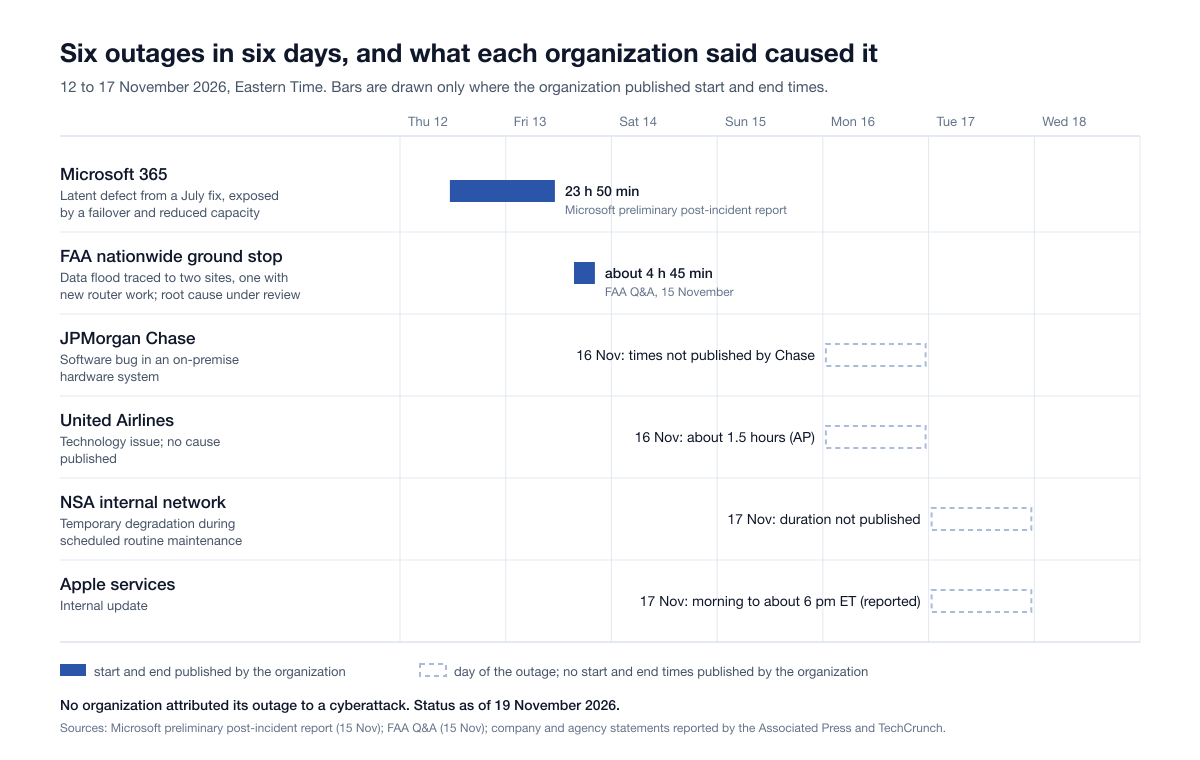
Figure 1: The six outages and the cause each organization stated, as of 19 November 2026. Sources: Microsoft preliminary post-incident report, FAA, and company statements reported by the Associated Press and TechCrunch.
What caused the Microsoft 365 outage on 12 November?
Microsoft's preliminary post-incident report for incidents EX1550543 and MO1550821, dated 15 November 2026, says three factors "together caused a global outage for the networking gateway that fronts many Microsoft 365 services":
A latent defect. A fix prepared for the gateway servers caused lock contention under certain load, exhausting CPU and memory. The change began deploying in July 2026, "went through safe deployment and saturated globally over several weeks", and ran for more than three months without impact; Microsoft's lab load tests missed it.
A load shift. About fifteen hours earlier, Teams failed over to the gateway that also serves Exchange Online, a normal operation.
Reduced capacity. Nearly 14% of the gateway's server capacity was out of service for an unrelated reason.
Traffic management moved users to healthy servers, which pushed the same load onto fewer machines, and "in less than two hours, the previously unknown defect was encountered across our fleet". At the lowest point more than 80% of servers were unresponsive. The bulkheads between capacity partitions did not stop the cascade, and because the defect was months old, "our normal rollback, flighting, and feature flags were unable to quickly revert the change". Microsoft's first public explanation, an issue from an earlier network capacity upgrade, was still being reported by AP on 17 November. Status: confirmed by Microsoft, preliminary.
What caused the FAA nationwide ground stop on 13 November?
The FAA says that at approximately 3:30 pm ET it "experienced a technical problem that resulted in issuing a nationwide ground stop", and that air traffic resumed as of 8:15 pm. Its legacy equipment "became unstable when data began flooding the FAA FTI network, at a rate of 1,000 connection attempts every 4 to 5 seconds".
The initial investigation points to two sites: a radar site in Amarillo, Texas, and a radio communications site in El Dorado, Arkansas, where the FAA's network service provider, L3Harris, had been deploying a new router. The FAA disabled the functionality involved on the originating Juniper routers and on more than 60 others, paused installing them, and said it will "reevaluate when we do replacement/maintenance work", which had been done in the daytime. It reports approximately 12,462 flights cancelled on 13 November, not all because of the ground stop. Status: confirmed by the FAA as an initial finding. The FAA and L3Harris "continue to investigate the root cause". As of 18 November the FAA had published no root cause, AP reported, and HPE, which owns Juniper, told ABC News its equipment "was working as configured".
What happened at JPMorgan Chase, United, the NSA and Apple?
JPMorgan Chase, 16 November. Chase told the Associated Press that "a software bug" was affecting its internal hardware systems, and its spokesperson said the issue was "not cyber-related", according to Al Jazeera. This was not a wider banking outage: AP reported that Bank of America and Citigroup were not having service problems of their own, Zelle's operator said its network was fully operational, and other banks' customers saw delays on payments involving a Chase customer. Chase has published no incident report. Fox News reported, without naming a source, that the incident was traced to a software release Chase rolled out that day; that is reported, not confirmed.
United Airlines, 16 November. United told customers in its app that it was "troubleshooting a technology issue affecting departing flights", and said afterwards that there was "no indication that this was a cybersecurity-related issue". AP reported the problem was resolved about an hour and a half after pilots first reported it, and that flights in the air and United Express were not affected. Status: no cause published.
National Security Agency, 17 November. The NSA's statement, as carried by AP, reads: "The National Security Agency experienced temporary degradation during scheduled routine maintenance." It gave no detail on cause or scope. That the affected system was the classified NSANet comes from an unnamed defense official and CNN's sources, so it is reported, not confirmed. CBS News reported that two unnamed sources said the outage resulted from routine system patching. Neither the duration nor a restoration time has been published.
Apple, 17 November. Apple's statement to reporters was: "Many of our systems are back up and running after an internal update caused some outages this morning." TechCrunch reported the status page showed every issue resolved by 6 pm ET. Apple publishes no incident reports, so nothing further is confirmed.
Were the November 2026 outages cyberattacks?
No organization has said so. Microsoft executive vice president Charles Lamanna wrote on X that there was "no indication this is the result of malicious or cyber activity", according to Al Jazeera. The FAA said it had "no indication that this was a cyberattack or an outside nefarious actor". Chase said its issue was "not cyber-related", United said there was "no indication that this was a cybersecurity-related issue", and the NSA and Apple gave non-malicious causes without mentioning an attack.
US officials took the same line. AP reported on 17 November that top national security officials saw "no indication that the events are related or attributable to a cyberattack or hostile activity". The Director of National Intelligence, Jay Clayton, told Fox Business: "We do not see the indicia of a coordinated cyber attack." Acting CISA director Nick Andersen said of the FAA ground stop that "there's nothing we found that indicates that there was any malicious cyber activity that went into that", according to CyberScoop.
Three limits apply:
"No indication" is a statement about evidence so far. Only Microsoft and the FAA have published a technical account, both preliminary, and there is no independent report on any of the six as of 19 November 2026.
One malicious campaign did follow. Microsoft Threat Intelligence observed a coordinated, high-volume phishing campaign on 13 November that posed as outage notices and claimed held messages would be deleted within 24 hours. Microsoft says the evidence "does not confirm credential capture, malware delivery, or post-compromise activity".
No one has attributed the outage to an attack, but attackers used it within a day.
Why did so many systems fail in the same week?
No organization or official has published evidence of a common technical cause. The explanation from officials is that organizations are patching and upgrading at the same time. Clayton told Fox Business: "Lots of institutions, because these vulnerabilities have been identified, are patching." Fox Business reported that he linked the NSA outage to patching after a PHP vulnerability was identified; in the passage it quotes, the words "a PHP vulnerability" are the outlet's bracketed insertion. Clayton said the patching "has caused some of these systems to not come back up when you patch them as expected," adding: "That is what has happened at the NSA today." Senator Mark Warner said in a statement reported by AP that AI-driven discovery is creating "enormous pressure on companies and government agencies to patch those vulnerabilities immediately", and that "the evidence so far points toward legitimate efforts to secure our systems, not malicious activity."
Set against the organizations' own accounts, that explanation fits some of the six and not others:
Change was a factor in four of the six. Microsoft's defect arrived in a fix, the FAA's instability followed a router installation, the NSA cited maintenance and Apple cited an update.
Security patching is documented in none of the organizations' own statements. Microsoft's fix shipped in July and was triggered by load. The NSA's statement does not mention PHP; the link to patching comes from the DNI on the record and from two unnamed sources quoted by CBS News. Apple did not say what its update was for.
Two have no stated link to change. Chase named a software bug (the report of a same-day release is unconfirmed), and United named nothing.
Large organizations make risky changes every week, and the pressure to change systems quickly has risen in 2026, as the next sections measure. Whether that pressure caused this cluster is not established. It did not ease afterwards: Oracle shipped a fix for the Java flaw known as Java4Shell on 17 November, the day of the NSA and Apple outages (what is confirmed and how to fix it).
Is the number of vulnerabilities really three times last year's?
The claim circulating with the outages is that critical or severe vulnerabilities are being discovered at three times last year's rate, driven by AI. The answer depends on what is counted, so we counted it.
Measure | 2025 | 2026 | Change | Source |
|---|---|---|---|---|
CVE records published, 1 Jan to 18 Nov | 41,766 | 100,117 | 2.4 times | NVD CVE API, Stingrai count, 19 Nov 2026 |
CVE records published, third quarter | 11,725 | 36,953 | 3.2 times | NVD CVE API, Stingrai count |
CVE records published in October | 4,273 | 17,051 | 4.0 times | NVD CVE API, Stingrai count |
CVE records with a CVSS base score of 7.0 or higher, 1 Jan to 18 Nov | 21,883 | 56,361 | 2.6 times | NVD CVE API, Stingrai count |
New CVEs rated CVSS 7 to 10, third quarter | not stated | not stated | Up 133% (2.3 times) | |
Additions to CISA's Known Exploited Vulnerabilities catalog, 1 Jan to 18 Nov | 222 | 302 | Up 36% | CISA KEV catalog, version 2026.11.18, Stingrai count |
Vulnerabilities exploited in the wild, monthly average | 10.5 | 18 (Jan to Aug) | Up 71% | Google Threat Intelligence Group, 30 Sep 2026 |
Newly exploited vulnerabilities rated CVSS 7 to 10, third quarter | not stated | 43 | Up 19% | Rapid7, same report |
Method: we downloaded every CVE record published from 1 January 2025 to 18 November 2026 from the NVD CVE API 2.0 on 19 November 2026, excluded records with the status Rejected, and took the highest CVSS v3.x or v4.0 base score any source had attached to each record. KEV counts use the dateAdded field of CISA's JSON feed.
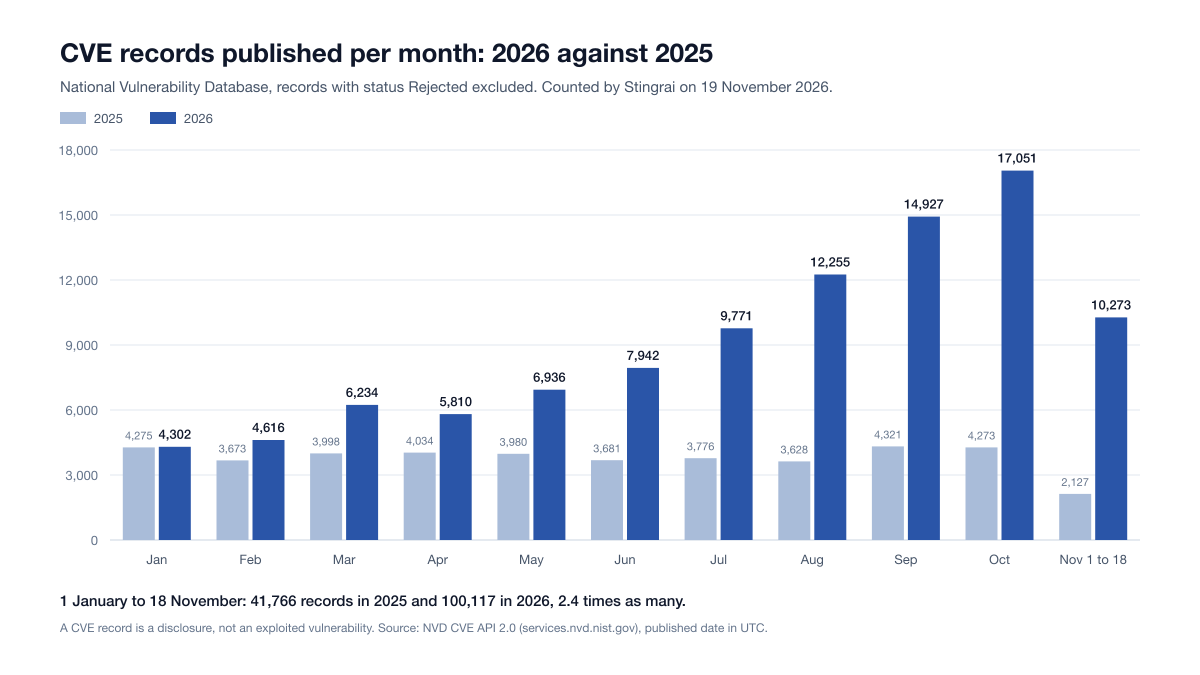
Figure 2: CVE records published per month, 2025 against 2026, rejected records excluded; November covers 1 to 18 November in both years. Stingrai count on 19 November 2026. Source: NVD CVE API 2.0.
The data gives three answers, depending on the window and the measure.
For the year to date, the multiple is below three. Records are 2.4 times last year's, those rated 7.0 or higher (high and critical) 2.6 times, and those rated 9.0 or higher (critical) 2.1 times.
For recent months, three times is accurate or low. The third quarter brought 3.2 times the records of a year earlier and 3.4 times the high and critical ones; October ran at 4.0 times, and 1 to 18 November at 4.8 times. Rapid7 puts the third-quarter rise in CVEs rated 7 to 10 at 2.3 times; our figure is higher, probably because it takes the highest score any source has attached to a record; Rapid7 does not publish its counting method.
For exploitation, nothing has tripled. KEV additions are up 36%, Google's monthly count of exploited vulnerabilities 71%, and Rapid7's newly exploited high-severity count 19%.
So "three times" fairly describes how fast high-severity flaws are now being disclosed, and overstates how many are being used in attacks. Much of the growth comes from a few publishers: in our count, GitHub's advisory database (13,246 records against 2,411 a year earlier), VulnCheck (11,055 against 612) and Microsoft (5,535 against 1,171).
Three cautions apply to the volume figures:
A CVE record is not a unit of risk. Google notes that descriptions containing "Linux Kernel" alone generated approximately 5,000 CVEs between January and August 2026 "with zero observed exploited in-the-wild zero-days".
Severity scoring changed mid-year. Since 15 April 2026 the NVD no longer routinely adds its own severity score when the assigning organization supplies one. In our count, 3.0% of the 2026 records carried no CVSS score from any source, against 0.4% of the 2025 records, so the 2026 severity counts are slightly understated.
Other counts differ slightly. VulnCheck told The Register it counted 100,222 CVEs for 2026 by about 4 pm UTC on 13 November.
The measure that matters to a patch queue is the small one. Google found that "only 0.23% of all disclosed vulnerabilities in 2026 (roughly 1 in 431) were ever observed in active exploitation", and that the growth in exploitation "has been concentrated in the rapid weaponization of n-days", meaning vulnerabilities that already had a patch. Our vulnerability statistics for 2026 and zero-day statistics for 2026 track these measures over a longer period.
Has time to exploit really fallen to minus seven days?
The figure is real, it comes from Google's M-Trends 2026 report, and it describes 2025. M-Trends 2026, published on 23 March 2026, says "the mean time to exploit vulnerabilities dropped to an estimated -7 days, meaning exploitation is routinely occurring before a patch is even released." The full report gives the series: 63 days in 2018, minus 1 day in 2024 and an estimated minus 7 days in 2025.
Three points keep that number in proportion:
It is a mean over exploited vulnerabilities only. Mandiant defines time to exploit as "the average time taken to exploit a vulnerability before or after a patch is released", across the vulnerabilities it tracked as exploited. In its analysis of 2023, 97 of the 138 it studied were exploited as zero-days, before any patch existed.
It does not mean every vulnerability is exploited before you can patch. Google observed exploitation of only 0.23% of the vulnerabilities disclosed in 2026 to the end of August. VulnCheck's first-half 2026 report found 23.43% of the known exploited vulnerabilities it tracks were disclosed as exploited on or before the day their CVE was published, down from 28.93% in 2025.
Where exploitation follows disclosure, the clock is days, not weeks. Rapid7's Q3 2026 report says attackers exploited new high-severity vulnerabilities "in an average of just three days" and that 71% of the exploitation it tracked fell inside the first seven days.
The defensive clock runs the other way. The Verizon 2026 Data Breach Investigations Report found that the median time for organizations to fully remediate a vulnerability in CISA's KEV catalog rose to 43 days from 32, and that only 26% were fully remediated, down from 38%. Exploitation of vulnerabilities was the entry point in 31% of the breaches Verizon analyzed, ahead of stolen credentials for the first time in the report's 19 years. No publisher has released a 2026 time-to-exploit average yet.
What is AI documented to be doing to discovery and exploitation?
Three things are documented by primary sources, and the gap between the first and the second is the useful part.
AI is finding vulnerabilities, and serious ones. Google warns that "current public data significantly undercount vulnerabilities discovered by AI", and among the vulnerabilities it could identify as "likely surfaced by autonomous agents", "Exactly 50% of all AI-discovered vulnerabilities result in Remote Code Execution (RCE), compared to just 26% across the broader CVE ecosystem." VulnCheck's Josh Bressers told The Register on 13 November that "vulnerability hunting with AI is driving a majority of what we're seeing".
Few AI-discovered vulnerabilities have been exploited so far. VulnCheck counted 14 of 1,061 AI-attributed vulnerabilities as exploited by mid-2026, or 1.3%, and concluded that "the data does not suggest that AI discovered vulnerabilities are inherently more likely to be exploited". Google calls confirmed exploitation of AI-discovered flaws "an early indicator rather than an established trend". AI software is also a target in its own right: Google tracked 2,076 vulnerabilities in AI agent frameworks, inference servers and other AI software from January 2025 to August 2026, of which "only a handful" have been confirmed as exploited. Our tracker of AI-attributed CVEs in 2026 follows the individual cases.
Attackers are running agentic frameworks inside real intrusions. Google and Mandiant reported on 30 October 2026 that since late August they have observed threat actors operating open-source multi-agent platforms including ARTEX in Mandiant incident response engagements. Google reports adoption by "a diverse range of threat actors", from extortion groups to suspected espionage operators, and says the original ARTEX repository was taken down in October 2026 "due to widespread threat actor abuse", though it gives no count of intrusions. It assesses adversary use as still early, with open-source tools "being used in low-sophisticated ways, resulting in broad and noisy, but still successful campaigns", and judges that these frameworks "currently trade stealth for velocity". Our analysis of ARTEX and agentic offensive frameworks covers what was observed and what to test, and our AI threat landscape analysis covers the defender side.
None of these sources connects AI tooling to any of the six outages. Microsoft's executive said there was no indication its outage was the result of malicious or cyber activity, and no organization has cited AI as a cause.
Patch faster or break less: what do the documented cases show?
NIST described the trade-off in 2022, in SP 800-40 Revision 4: "Deploying patches more quickly reduces the window of opportunity for attackers but increases the risk of operational disruption because of the lack of testing. Conversely, testing patches before deployment decreases the risk of operational disruption but increases the window of opportunity for attackers."
Both sides of that trade-off tightened in 2026: the attacker's through the figures above, and the defender's through deadlines. CISA's BOD 26-04, issued on 10 June 2026, replaced the older fixed deadlines for federal civilian agencies with timelines of 3, 14 or 60 calendar days, or a fix at the next system upgrade, set by exposure, known exploitation, automatability and impact. By our count on CISA's feed, 131 of the 169 KEV entries added since that date (78%) carry a due date three days after listing. The directive binds federal civilian agencies only, but it shows where expectations are heading, and our analysis of the 72-hour clock covers what it changes for retesting.
The documented failures show what breaks when a change goes out faster or wider than its safety checks.
Case | What changed | Why the safeguards did not stop it | What the organization changed afterwards |
|---|---|---|---|
CrowdStrike, 19 July 2024 | A rapid content update for the Falcon sensor | A 20-versus-21 input mismatch "evaded multiple layers of build validation and testing"; the root cause analysis found such content "should be deployed in a staged rollout" | Canary testing, successive rings and customer control over content updates (root cause analysis) |
Microsoft 365, 12 Nov 2026 | A fix to gateway servers, deployed from July 2026 | Staged rollout completed cleanly; lab load tests missed the defect, and months later rollback could not revert it quickly | Reverted the code path; added traffic distribution guardrails (preliminary report) |
FAA, 13 Nov 2026 | Router replacement at a remote site | Daytime work; data from two sites could flood the wider network | Disabled the function on more than 60 routers and paused installations |
PHP, 21 to 22 Oct 2026 | Two critical flaws disclosed; operators urged to patch at once | Some operators took services offline as a precaution, as AP reported |
The same choice came up again on 17 November with Java4Shell; our Java4Shell analysis sets out a mitigation for systems that cannot be patched at once.
The Microsoft case is the harder lesson: the change went through a staged rollout and still failed, because rings catch defects that show up quickly, not one that needs a rare load pattern. Rollback that still works months later, and bulkheads that hold, matter as much as the rings.
The guidance from NIST and CISA is consistent:
Phase every rollout, including urgent ones. NIST recommends "phased deployments for routine patching" with canary assets, and says even an emergency canary period "could last a few minutes to a few hours".
Keep a way to stop and a way back. CISA, the FBI and Australia's ACSC, in their Safe Software Deployment guidance, call for "an automatic breaker or the equivalent of an emergency stop button to halt the rollout" and a plan "to revert systems to a previous stable state".
Have a mitigation ready for when you cannot patch. NIST says organizations "should plan for the quick implementation of multiple types of emergency mitigations", such as isolating an asset.
What patch tiers should a mid-market or enterprise team use?
The tiers below are Stingrai's suggested starting point, not a standard. They borrow the decision factors CISA uses in BOD 26-04 (internet exposure, known exploitation, level of control) and pair each deadline with a rollout and a fallback.
Tier | What qualifies | Target | Rollout | If the patch cannot go in on time |
|---|---|---|---|---|
1. Emergency | Internet-facing, identity or management-plane assets with a known-exploited flaw | 3 days | Canary for minutes to hours, then rings; rollback staged first | Remove from the internet or restrict the interface, apply the vendor's mitigation, add detection |
2. Accelerated | Known-exploited flaws on internal assets; critical flaws on internet-facing assets | 14 days | Canary, early-adopter ring, then the estate over days | Segment, restrict access paths, monitor |
3. Routine | Everything else | Normal cycle | Phased with a grace period, then forced | Accepted risk with an owner and review date |
What should a security lead do in the next 30 days?
Each action below ties to a finding above. The order runs from knowing what is exposed, to changing it safely, to proving the controls work.
# | Action | Evidence it answers | Done when |
|---|---|---|---|
1 | Rebuild the inventory of internet-facing assets, including edge devices, VPN gateways, management interfaces and SaaS admin consoles, and check it with external attack surface testing | Google: over 65% of exploited edge flaws rated High or Critical | Every external asset has an owner, a patch tier and a log destination |
2 | Match the inventory against CISA's KEV catalog and vendor advisories, and close or mitigate every match on an internet-facing asset | Verizon: median 43 days to fully remediate KEV flaws | No known-exploited flaw is open on an internet-facing asset without a dated mitigation |
3 | Adopt patch tiers with named canary groups, rings and a rollback for each platform | NIST SP 800-40r4; CrowdStrike and Microsoft | A tier 1 patch has been rehearsed end to end, including the rollback |
4 | Put vendor-pushed updates under your own rings where the product allows it (endpoint agents, browser and SaaS release channels, network device firmware) | CrowdStrike: customer control over content updates | Critical servers receive agent and content updates after a canary group, not with it |
5 | Set change rules for high-traffic systems: off-peak windows, no unrelated changes during an incident, an agreed stop condition | FAA: daytime router work; Microsoft: deployments paused | The change calendar shows the rules applied to the next 30 days of changes |
6 | Write a mitigation playbook for each tier 1 asset class, and a detection for exploitation before a patch exists | M-Trends: estimated mean time to exploit of minus 7 days | For each edge product you run, the isolation step and the detection have been tested |
7 | Map dependencies and single points of failure: email and collaboration, identity provider, payment rails, DNS, carriers and anything with one gateway | Microsoft: one gateway, bulkheads failed; Chase: delays at other banks | A one-page map shows what stops if each provider is down for 24 hours, and the out-of-band channel you would use |
8 | Warn staff and the service desk about outage-themed phishing, and confirm status only through the vendor's admin console | Microsoft: phishing using the outage as a lure was observed on 13 November | A notice has gone out and reporting of suspicious "restore" emails is being tracked |
9 | Move the internet-facing web applications that change most from an annual test to continuous testing | Rapid7: three days to exploitation; Verizon: 31% of breaches | Each release, and each newly exploited flaw in the application's stack, is tested within the month, and every fix is retested |
10 | Test the rest: an external network penetration test of the perimeter, a retest of every fix, and a purple team exercise that starts from a compromised edge device | Google on ARTEX: noisy but successful intrusions | Findings are fixed and retested, and time to detect and contain is measured in minutes |
Why action 9 matters. The case for testing internet-facing web applications continuously rests on the figures above, not on the November outages: exploitation was the entry point in 31% of the breaches Verizon analyzed, Rapid7 found 71% of the exploitation it tracked inside the first seven days, and KEV additions are running 36% above 2025. A web application also changes with every release, so an annual test describes code that may no longer be running a few months later. The annual test keeps its place for depth and audit evidence; continuous testing covers the months between. Stingrai's Hybrid Pentest is built for that: Snipe, Stingrai's autonomous agent for web applications and associated APIs, tests the full application while Stingrai's certified penetration testers test the same application manually alongside it and validate Snipe's findings, so coverage is wider and deeper. The continuous Hybrid Pentest is US$1,275 per month on a 12-month plan for one web application and associated APIs: monthly Snipe testing, human-verified, plus a quarterly deep dive by Stingrai's penetration testers. The one-time Hybrid Pentest is US$6,800 per assessment for one web application and associated APIs. To put an internet-facing application under continuous testing, see the plans on the Stingrai pricing page. Our guide to continuous penetration testing explains how continuous programs are run.
How does penetration testing validate these controls?
Each control in the plan makes a claim that only a test can confirm:
Patch tiers: an external network penetration test and a retest check that nothing exploitable is left on the perimeter after the deadline.
Compensating controls: an internal test from an unpatched device's network position checks that it cannot be used to move inward.
Detections: a red team or purple team exercise that starts from an assumed breach of an edge device measures how long detection and containment take (red team, purple team and penetration test compared).
Release process: continuous testing of a web application checks that this month's build is no weaker than the last one tested.
Stingrai is a CREST-accredited penetration testing company founded in Toronto in 2021, holding CREST's Penetration Testing and AI-Enabled Penetration Testing accreditations (CREST Marketplace). For this plan the relevant work is the Hybrid Pentest under action 9, internal and external network penetration testing, and red team and purple team exercises against your SOC, as one-time (annual) tests or as continuous programs. Two named penetration testers from a team holding OSCE³, OSWE, OSEP, CREST CRT and CISSP certifications work each human-led engagement. Every finding is posted to the portal as it is confirmed, retesting is included, and every human-led and hybrid report ships with an attestation letter. A network penetration test typically costs US$5,000 to US$40,000 and above, per Stingrai's network testing page; red team and purple team exercises are quoted per engagement.
Frequently Asked Questions
Were the November 2026 outages cyberattacks?
No organization has attributed any of them to a cyberattack as of 19 November 2026. Microsoft, the FAA and United said they had no indication of an attack, JPMorgan Chase said its issue was not cyber-related, the NSA cited scheduled routine maintenance and Apple cited an internal update. Only Microsoft and the FAA have published technical accounts, and both are preliminary.
What caused the Microsoft outage in November 2026?
Microsoft's preliminary post-incident report, dated 15 November 2026, names three factors: a latent defect in a July 2026 fix to its networking gateway servers, extra load after a Teams failover, and nearly 14% of gateway capacity out of service. The outage ran from 4:20 PM UTC on 12 November to 4:10 PM UTC on 13 November, and a final report is due by 20 November.
What caused the FAA ground stop on 13 November 2026?
The FAA says data flooding its telecommunications network at 1,000 connection attempts every 4 to 5 seconds destabilized legacy equipment, and its initial investigation points to two sites, one where a new router was being deployed. The ground stop ran from about 3:30 pm to 8:15 pm ET. The FAA has no indication of a cyberattack, and the root cause is still under investigation.
Was there an iCloud outage in November 2026?
Yes, on 17 November 2026. Apple's system status page listed problems with iCloud Account and Sign In, the App Store, Apple Music and other services. Apple said an internal update caused the outages, and the status page showed them resolved by about 6 pm ET, according to TechCrunch. A shorter outage of iCloud Mail, Calendar and Contacts on the evening of 10 November was listed as resolved by 7:22 pm ET, according to MacRumors.
Why is everything down at the same time?
No common technical cause has been published. Four of the six organizations pointed to a change to their own systems: a software fix, router work, maintenance or an internal update. US officials have said organizations are patching and upgrading at the same time, but only the Director of National Intelligence has, on the record, linked a specific outage, the NSA's, to security patching, and the NSA's own statement does not say that.
Is the number of vulnerabilities really three times higher than last year?
For disclosures in recent months, roughly yes. For the year to date and for exploited vulnerabilities, no. A Stingrai count on National Vulnerability Database records found 100,117 CVE records published from 1 January to 18 November 2026, 2.4 times the same period in 2025, with October 2026 at 4.0 times October 2025. Additions to CISA's Known Exploited Vulnerabilities catalog rose 36%, from 222 to 302.
What does a time to exploit of minus seven days mean?
It is the estimated mean time to exploit for 2025 published in Google's M-Trends 2026 report: averaged over the vulnerabilities seen exploited, exploitation began before a patch was released. It does not describe vulnerabilities in general; Google found that only 0.23% of the vulnerabilities disclosed in 2026 to the end of August were observed in active exploitation. No 2026 average has been published.
Should we slow down patching to avoid outages?
No. The evidence supports patching the small exploited set faster and changing how patches go out. NIST recommends phased deployment with canary assets, even for emergency patches, and CISA, the FBI and Australia's ACSC recommend a way to halt a rollout and a documented rollback. Where a patch cannot go in on time, isolate the asset or apply the vendor's mitigation and add detection until it can.
How often should internet-facing web applications be tested in 2026?
More often than once a year for the applications that change most. Rapid7 found new high-severity vulnerabilities exploited in an average of three days in the third quarter of 2026, and Verizon found exploitation was the entry point in 31% of breaches. An annual test gives depth and audit evidence; continuous testing covers the releases in between. Stingrai's continuous Hybrid Pentest, in which Snipe tests the full application while Stingrai's certified penetration testers test the same application manually alongside it and validate Snipe's findings, is US$1,275 per month on a 12-month plan for one web application and associated APIs, and the one-time Hybrid Pentest is US$6,800 per assessment.
Related reading
Recent Cyber Attacks 2026: a month-by-month timeline of confirmed attacks
Zero-Day Statistics 2026: exploited zero-days, time to exploit and patch windows
ARTEX and Agentic Offensive Frameworks: what Google observed and what to test
The 72-Hour Clock: CISA BOD 26-04 and your remediation window
Java4Shell (CVE-2026-114938): what is confirmed and how to fix it
References
Microsoft. Preliminary Post Incident Report for Microsoft 365, EX1550543 and MO1550821, 15 November 2026 (public copy of the admin center document).
FAA. Nationwide Ground Stop: Questions and Answers, 15 November 2026.
Associated Press. Classified communications network at the National Security Agency goes down, 17 November 2026.
Associated Press. Online banking delays affecting major US banks, 16 November 2026.
Associated Press. United Airlines system outage, 16 November 2026.
TechCrunch. Apple services hit by outage, 17 November 2026.
Microsoft Security. High volume phishing campaign uses Microsoft 365 outage lures, 16 November 2026.
Fox Business. Jay Clayton addresses concerns amid widespread tech outages, 17 November 2026.
CyberScoop. CISA acting director on the outages and resilience, 17 November 2026.
NIST. National Vulnerability Database, CVE API 2.0, queried 19 November 2026 (Stingrai count).
CISA. Known Exploited Vulnerabilities Catalog, version 2026.11.18 (Stingrai count).
Google Threat Intelligence Group. Vulnerability Discovery and Exploitation Trends in the AI Era, 30 September 2026.
Google (Mandiant). M-Trends 2026, 23 March 2026.
Mandiant. An Analysis of 2023 Time-to-Exploit Trends, 15 October 2024.
VulnCheck. State of Exploitation 1H-2026, 28 July 2026.
Verizon. 2026 Data Breach Investigations Report, 19 May 2026.
Google Threat Intelligence Group and Mandiant. ARTEX and Friends: Enter Agentic Offensive Frameworks, 30 October 2026.
NIST. SP 800-40 Rev. 4, Guide to Enterprise Patch Management Planning, April 2022.
CISA, FBI and ASD's ACSC. Safe Software Deployment, 24 October 2024.
CISA. BOD 26-04: Prioritizing Security Updates Based on Risk, 10 June 2026.
CrowdStrike. External Technical Root Cause Analysis: Channel File 291, 6 August 2024.
NIST. NIST Updates NVD Operations to Address Record CVE Growth, 15 April 2026.
Talk to Stingrai
To test your perimeter, your patch-gap controls and your SOC's response against the findings above, Get a Quote or book a free discovery call.