



On 21 October 2026, GitLab released seven patch versions for Community Edition and Enterprise Edition. Its highest-severity fix, CVE-2026-110264, addresses an integer overflow in regular-expression compilation that, under certain conditions, could permit unauthenticated code execution on a GitLab server. GitLab assigns it a CVSS v3.1 score of 10.0 and recommends that affected self-managed installations upgrade immediately.
Quick answer. For self-managed GitLab CE/EE, compare the installed release line with GitLab's published floor: 19.5.1, 19.4.3, 19.3.6, 19.2.9, 19.1.9, 19.0.10 or 18.11.13. Patch to the latest supported build on your line, preserve relevant logs and host evidence, then check the runner, token and secret boundaries that an attacker could reach from that instance. GitLab published threat detections, but its advisory does not report confirmed exploitation of this CVE, so distinguish exposure from compromise.
This is a defender briefing, not an exploit walkthrough. Product behavior and release floors are drawn from GitLab's own bulletin as read on 23 October 2026. Check its release page again before changing a production instance because a newer patch can supersede a floor.
The version decision, without guesswork
GitLab's bulletin says the affected range begins with version 7.0 and gives separate first fixed builds for seven release lines. Its maintenance policy lists 19.5, 19.4 and 19.3 as the maintained lines as of this review. The older patch builds are exceptional backports for this critical release. The table below is a minimum patch floor for this flaw, not evidence that an older line receives ongoing security fixes. Plan an upgrade to a maintained version using GitLab's published upgrade path.
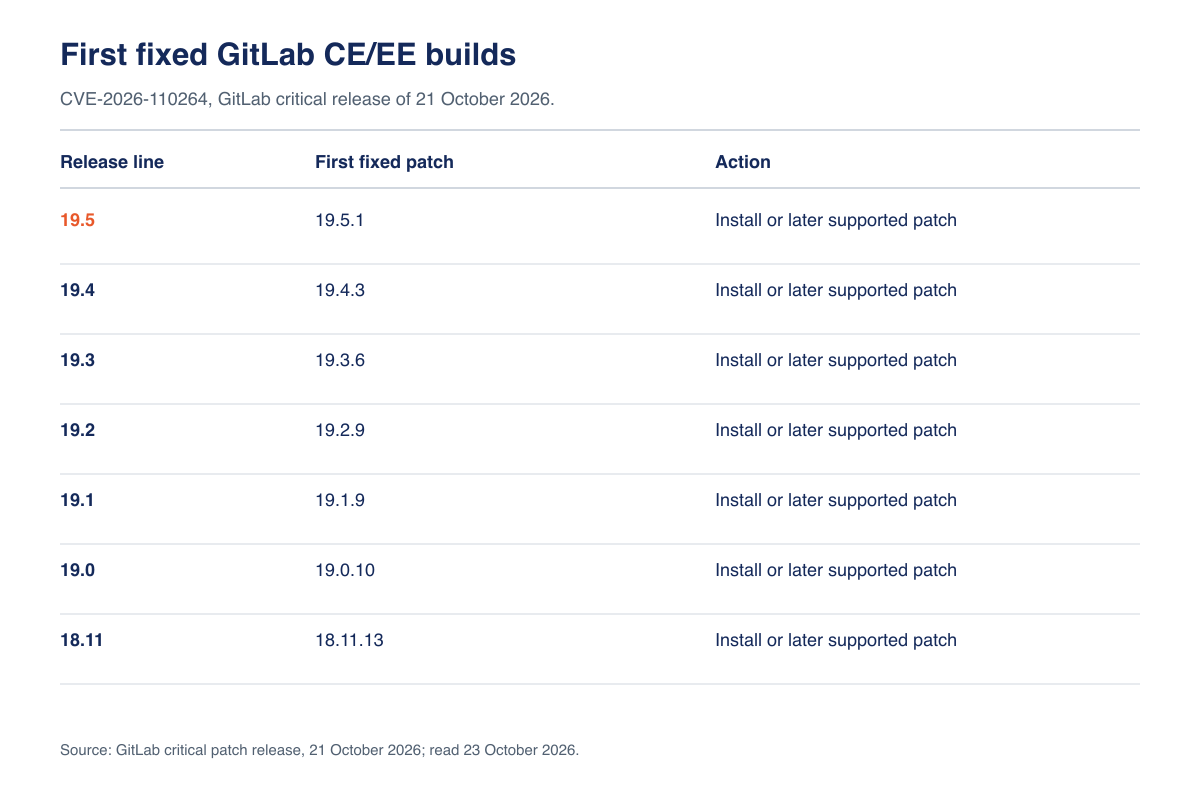
Figure 1: First fixed GitLab CE/EE patch in each branch named by the 21 October 2026 critical release. Source: GitLab, critical patch release.
Installed line | First fixed patch for this release | Buyer action |
|---|---|---|
19.5 | 19.5.1 | Upgrade to that build or a later supported patch. |
19.4 | 19.4.3 | Upgrade to that build or a later supported patch. |
19.3 | 19.3.6 | Upgrade to that build or a later supported patch. |
19.2 | 19.2.9 | Upgrade to that build or a later supported patch. |
19.1 | 19.1.9 | Upgrade to that build or a later supported patch. |
19.0 | 19.0.10 | Upgrade to that build or a later supported patch. |
18.11 | 18.11.13 | Upgrade to that build or a later supported patch. |
GitLab says GitLab.com was patched when it published the advisory. It also names internal patch versions for GitLab Dedicated tenants already covered. Owners of managed services should verify their tenant status through GitLab's own notice instead of applying the self-managed table blindly.
The patch release includes more than the critical CVE. It also fixes high-severity issues in OmniAuth-to-LDAP account linking and OAuth/OIDC discovery cache handling, plus other authorization and information exposure issues. Read the whole GitLab security-fix table before declaring a partial backport equivalent to the release. GitLab's update notes also warn that database migrations can cause downtime on a single-node installation, so pair urgency with an authorized maintenance and rollback plan.
What is known about CVE-2026-110264
GitLab describes conditional unauthenticated code execution arising from an integer overflow when compiling a specially crafted regular expression. The bulletin does not say that adversaries have exploited the flaw in the wild. It credits a bug bounty report and publishes two customer threat detections, one for an Onigmo native worker crash and one for a burst of org-mode render errors. Those are leads to investigate, not a complete set of indicators and not proof that every matching event is malicious.
Avoid two opposite mistakes: waiting for a public exploit report before patching a critical internet-facing system, and telling leadership that a server was breached solely because it ran an affected version. The right incident statement names the installed build, exposure window, available evidence, investigative result and remaining uncertainty.
Today: patch and preserve useful evidence
Inventory the deployment. Record the externally reachable URL, exact GitLab CE/EE version, deployment type, network controls, backups and maintenance owner. Include replicas and disaster-recovery instances.
Preserve evidence before disruptive work. Retain relevant application, reverse-proxy, worker, authentication, operating-system and runner logs within your retention policy. Snapshot configuration and inventory privileged tokens. If there is a credible indicator of compromise, involve incident response before destroying volatile evidence with a rebuild.
Review GitLab's detections. Apply the vendor's published Onigmo worker-crash and org-mode error-burst detection guidance to the affected window. Correlate with edge requests, unexpected processes, outbound traffic and administrative changes. No single detection result closes the investigation.
Upgrade to the latest supported patched version. Use GitLab's branch floor above and its upgrade notes. Confirm the running version from the instance after restart, not only the package repository or a queued deployment.
Retest the service. Verify sign-in, SSO, repository access, CI/CD jobs, backups and audit logging after the patch. A working UI does not establish that the patch reached every node.
The source does not publish a universally safe log pattern that proves non-exploitation. Use GitLab's own detections and your local telemetry; avoid posting payloads or exploit strings in operational documents.
This week: assess what a compromised GitLab could reach
A GitLab server is often a control plane for source code, pipeline execution, packages and deployment secrets. A host-level incident therefore deserves a blast-radius map, even when the first urgent action was patching. List connected runners, project and group tokens, cloud identity federation, external secrets, package registries, deploy keys and automation accounts. Then determine which credentials might have been available to the server or a job it could schedule.
GitLab's runner security guidance says self-managed jobs pose risks to the compute host and network, especially with non-ephemeral shared runners. Shell executor jobs run with the runner user's permissions. Privileged Docker jobs can expose the host. These are deployment properties, not a claim that CVE-2026-110264 automatically compromises every runner. The investigation must establish which jobs, tokens and secrets were actually reachable in your environment.
Review CI job token controls and external secrets integration with the platform owner. Rotate a credential when evidence or risk analysis supports it, and record the service impact. Blanket token rotation without an ownership map can break production while leaving an overlooked integration intact.
This quarter: use a pentest to test the deployment boundaries
Once the emergency change is stable, scope an authorized assessment around the customer-controlled configuration: external entry points, SSO and role boundaries, group and project inheritance, runners, CI/CD variables, job-token reach, cloud federation and package publication. The distinct query is “Can a user or compromised job cross from this GitLab role into assets it should not control?” A generic scanner of the login page will miss most of that.
Our self-managed GitLab penetration-test scope guide turns the blast-radius map into a statement-of-work checklist. The broader CI/CD pipeline penetration-testing scope covers adjacent build and deploy paths. Stingrai can pair an external network assessment with a human-led web and API penetration test and relevant cloud penetration testing. Human-led engagements use two named testers from a CREST-accredited firm, share confirmed findings as they are found and include retesting.
A penetration test can verify customer-controlled boundaries and consequences of a sampled misconfiguration. It cannot replace GitLab's patch, rule out all earlier compromise or test GitLab's undisclosed internals without authorization. Ask for an evidence-based report that separates the vendor vulnerability from your deployment's access paths.
Frequently Asked Questions
What version fixes GitLab CVE-2026-110264?
GitLab's 21 October 2026 release names 19.5.1, 19.4.3, 19.3.6, 19.2.9, 19.1.9, 19.0.10 and 18.11.13 as the first fixed builds for their respective CE/EE lines. Upgrade to the latest supported patch for your line and recheck GitLab's current release guidance.
Is CVE-2026-110264 known to have been exploited?
GitLab's advisory does not report confirmed exploitation in the wild. It describes a critical potential for conditional unauthenticated code execution and provides two threat detections for customers. An affected version is exposure, not proof of compromise.
Does the patch cover GitLab.com?
GitLab said GitLab.com was already running the patched version when the critical release was announced. Self-managed installations need their own upgrade; GitLab Dedicated tenants should use GitLab's managed-version guidance.
Should we check for compromise before patching?
Preserve useful logs and host evidence before disruptive work, especially if there is a credible indicator, then patch promptly. A patch closes the software flaw but does not investigate earlier activity or remove persistence if an attacker already gained access.
What should a post-patch GitLab pentest include?
Test customer-controlled access and trust boundaries: SSO, role inheritance, CI/CD runner isolation, job tokens, secrets, deployment grants, registries and cloud integrations. Give testers representative low-privilege accounts and an approved nonproduction job path so results show whether a boundary can be crossed safely.
Related reading
References
Talk to Stingrai
Stingrai can scope a human-led test of the GitLab access, runner, CI/CD and cloud boundaries your team controls. Get a Quote or book a free discovery call to define the assets and representative roles.