




GitLab's 21 October 2026 critical patch release fixed a conditional unauthenticated code execution flaw in self-managed CE/EE and urged affected installations to upgrade. That vendor vulnerability is a patching task. A customer-controlled GitLab estate presents a broader testing question: what can a signed-in user, a compromised project or a CI job reach across repositories, runners, secrets and deployment infrastructure?
Quick answer. Scope a self-managed GitLab penetration test as a control-plane assessment: external reachability and patch state; SSO and role boundaries; group and project inheritance; CI/CD runner isolation; job-token, deploy-key and secret access; package and artifact trust; and cloud or on-premises deployment grants. Provide representative low-privilege accounts and a safe test project. Ask for an evidence matrix that shows which boundaries held, which failed and what was retested.
This guide is for a platform engineering or security buyer procuring a human-led assessment. It covers the organization's deployment and configuration. It does not imply a third-party tester can inspect GitLab's private product internals or that running a penetration test substitutes for installing a vendor security update.
Set the patch and authorization gate first
Record the installed GitLab version, deployment type, externally exposed endpoints, support status and planned maintenance window. For the October 2026 release, the vendor's branch-specific patch floors start at 19.5.1, 19.4.3, 19.3.6, 19.2.9, 19.1.9, 19.0.10 and 18.11.13. The companion CVE-2026-110264 defender checklist explains the incident response distinctions. The buying decision here starts after the owner has handled the patch; do not deliberately leave a critical known defect open for a routine test.
Then establish authorization. Name the GitLab instance and tenants, identities available to testers, test repositories, runner pools, cloud accounts, package registries and integrations. Include explicit limits on production pipelines, live secrets, outbound callbacks and destructive changes. A safe testing project with realistic permissions often reveals more than an unrestricted scan of production.
The six boundaries to include in the statement of work
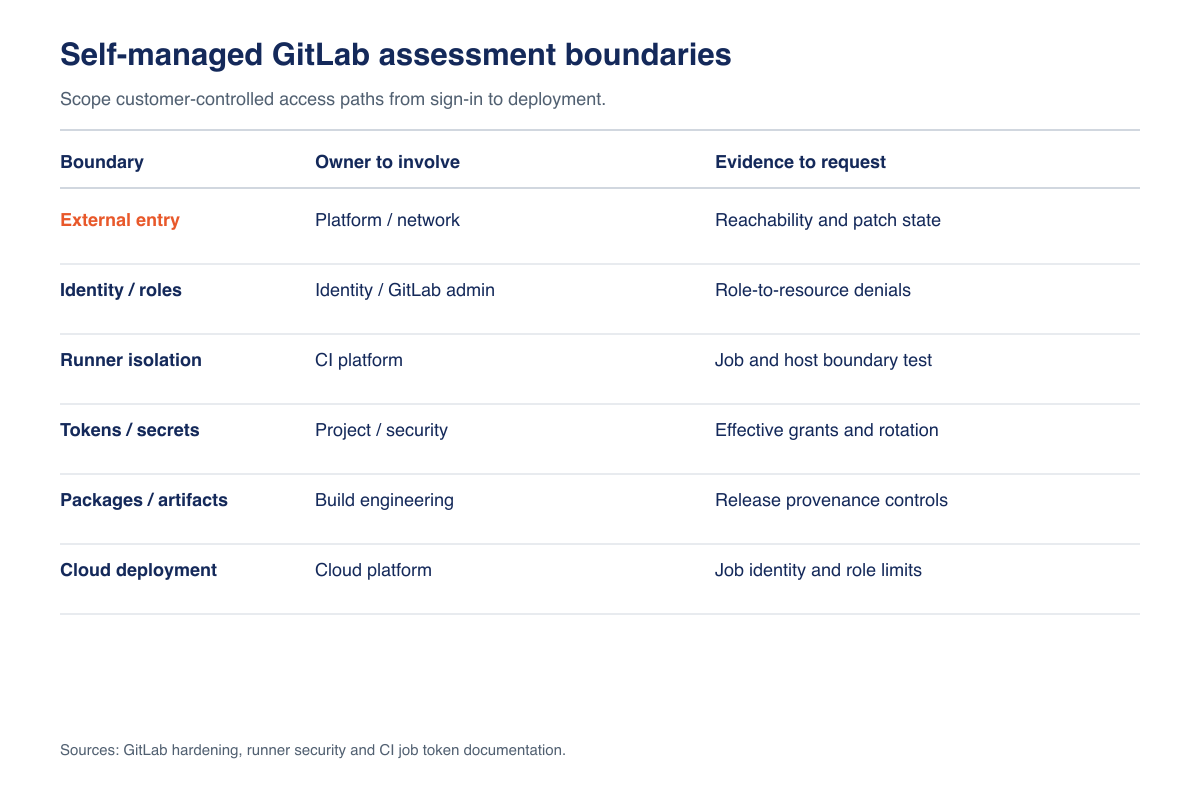
Figure 1: Six customer-controlled boundaries for a self-managed GitLab assessment, grounded in GitLab's runner, token and hardening documentation. Source: GitLab runner security, CI job tokens and hardening recommendations.
External and administrative entry
Test the instance's internet-facing and internal entry points, reverse proxy and management network policy. Confirm that administrative interfaces, backups, metrics, registries and SSH access follow the intended exposure model. Ask the tester to record which endpoints were reachable from each permitted vantage point and which controls stopped access. A finding must distinguish an intended public GitLab login from an accidentally exposed administrative surface.
Identity, SSO and inherited roles
Give the tester accounts representing a guest or reporter, a developer, a project maintainer, a group owner and an administrator only where authorized. Test whether SSO and local account behavior match policy, whether a departed user retains access, and whether group inheritance or invited projects grant more than expected. Include access to private repositories, merge requests, issue attachments, protected branches and approval settings. Avoid a vague “role-based access test” line item; name the sensitive actions that should be denied to each role.
Runner execution and isolation
GitLab's runner security documentation warns that a CI job can affect its self-managed runner host and network, and that risk is sharper when runners are persistent and shared across projects. It says shell executor jobs run with the runner user's permissions. It also warns that privileged Docker jobs can expose the host. The assessment should map runner pools to projects and trust levels, then use an approved job to test whether a lower-trust project can read another project's working copy, cache, artifact, network service or secret.
The deliverable is a runner trust diagram with executor type, isolation model, project eligibility and credential reach. Do not ask testers to run disruptive proof-of-concept code on a shared production runner. Controlled negative tests and configuration evidence can answer the question safely.
Job tokens, deploy keys and service credentials
CI job tokens, project and group access tokens, deploy keys, personal access tokens and cloud workload credentials do not have the same scope or lifecycle. Inventory each kind and its owner. Test whether a job in one project can reach another project's API, repository, package or artifact beyond the intended allowlist, referring to GitLab's CI job token documentation for the configured controls. Check token expiry, rotation, masking, log exposure and exception handling without copying secrets into the report.
Where external secrets are used, trace which job identity can request which secret path and what happens on a fork, merge request or protected branch. The test should show the effective permission path, not merely repeat the existence of a vault integration.
Package, artifact and release trust
Determine who can publish packages and artifacts, who consumes them and whether a protected release can be influenced by a lower-trust project or runner. Include image registries, dependency mirrors, build artifacts, signing keys and release approvals where present. A useful safe test checks whether an authorized-but-low-privilege project can replace or redirect a dependency in a test pipeline. Report the exact boundary and its business consequence without shipping a malicious package.
Cloud and on-premises deployment grants
GitLab often controls changes far beyond GitLab itself. Trace CI jobs through OIDC federation, service principals, deploy keys or static secrets to AWS, Azure, Google Cloud and internal deployment targets. Ask whether a job from the wrong branch, project or environment can receive the same grant. Our CI/CD pipeline scope guide and GitHub Actions OIDC trust matrix provide adjacent patterns that apply to cloud identity questions, but the GitLab roles and token controls must be tested on the actual deployment.
An evidence matrix for comparing vendors
Buyer question | Evidence a useful report should contain |
|---|---|
Could a lower role read private code or change a protected release? | Account role, resource tested, expected policy, observed result and a reproducible safe test. |
Could a job on a shared runner reach another project? | Runner pool, executor, isolation setting, test project, attempted boundary and host/network observation. |
Could a CI job token reach an unintended project or API? | Token class, effective scope, allowlist or permission setting, permitted negative case and denial result. |
Could a project deploy to an unintended cloud environment? | Job identity, trust condition, target role, environment restriction and observed grant or refusal. |
Did remediation work? | Retest of the same path after the owner changed the control, with residual risk noted. |
A useful quote names the environments, representative projects and roles, number and type of runner pools, cloud integrations, expected read-only configuration access, test windows, deliverables and retest. Avoid comparing vendors only by the number of URLs or days. The complexity is in cross-boundary access paths.
Where Stingrai fits
Stingrai is a global CREST-accredited penetration testing services company founded in Toronto in 2021. Its human-led engagements use two named testers from a team holding OSCE³, OSWE, OSEP and CREST CRT certifications. Confirmed findings go to the client portal as they are found, with remediation guidance, and retesting is included. A GitLab scope can combine web and API penetration testing, cloud penetration testing and network penetration testing, depending on the deployment.
GitLab instances, runners and connected cloud accounts are quoted per engagement. Provide the six-boundary worksheet above through Get a Quote. Stingrai supports one-time or annual tests and continuous programs; procurement can choose the cadence that matches release activity, exposure and audit evidence needs. Testing supports a compliance program and produces evidence for its audit, where relevant.
Frequently Asked Questions
What should a self-managed GitLab penetration test include?
Include external and administrative entry, SSO and role inheritance, group and project permissions, runner isolation, CI/CD tokens and secrets, package and artifact trust, and cloud or on-premises deployment grants. The written scope should identify the exact customer-controlled assets and safe test identities.
Is patching GitLab enough to secure our deployment?
No. Vendor patches address product vulnerabilities such as those in GitLab's October 2026 release. Customer configuration still determines SSO, role grants, runner isolation, token scope, secret access and deployment permissions.
Can a pentest use a test project instead of production pipelines?
Yes. A representative test project and approved low-privilege accounts can exercise many trust boundaries safely. Some production-only controls may still require read-only review or a narrowly approved test, which should be stated in the rules of engagement.
How do we compare GitLab pentest proposals?
Compare whether each proposal names roles, projects, runners, tokens, integrations, cloud targets, safe negative cases, evidence deliverables and a retest. A login-page scan or a generic vulnerability scan is narrower than a control-plane assessment.
What evidence does a GitLab penetration test produce?
Stingrai's penetration testing assesses the agreed technical scope and produces findings and retest evidence that can support a compliance program. The engagement deliverables should identify what was tested, what was excluded and the residual risk.
Related reading
References
Talk to Stingrai
Stingrai can scope a human-led test of the GitLab instance, runners and integrations your organization controls. Get a Quote or book a free discovery call to define roles, safe test projects and deliverables.