




Organizations running bug bounty programs on HackerOne paid security researchers a record US$89.1 million between July 2025 and June 2026, in an edition built on 92,194 valid vulnerability reports, according to HackerOne's 2026 Security Research Report, its tenth annual edition, published on 7 October 2026. Vendor-run programs set records too: Microsoft awarded more than US$20 million to 562 researchers in the program year it reported in August 2026, and Google paid US$17.1 million to 747 researchers in 2025, more than 40% above 2024. The money is rising while the share of reports that hold up is falling: in 2026, platforms, open source maintainers and Google throttled, suspended or re-priced programs flooded with unverified AI-generated submissions.
Four forces run through the 2026 numbers. Payouts keep climbing: crypto programs on Immunefi have paid US$107.3 million for confirmed critical bugs alone. Hunters work with AI: 82% of the hackers in Bugcrowd's 2026 survey use it. Noise is surging: Bugcrowd's triage queue showed a 388% median increase in submission volume in October 2026, and curl's confirmed-vulnerability rate fell below 5% before it ended its bounty. And fixing lags finding: HackerOne's backlog of validated, unresolved vulnerabilities grew 131% in two years. This page is for security researchers, program managers, journalists and CISOs weighing a bounty against a penetration test.
This post is the Stingrai research team's 2026 reference for bug bounty statistics. It brings together more than 200 figures from 16 primary publishers and programs: HackerOne, Bugcrowd, Intigriti, YesWeHack, Immunefi, Google, Microsoft, Meta, Apple, Trend Micro's Zero Day Initiative, the curl project, Nextcloud, the Internet Bug Bounty, the Cybersecurity and Infrastructure Security Agency, the US Department of Defense Cyber Crime Center and Stingrai. Lead data is the platforms' latest reporting years (HackerOne's July 2025 to June 2026 window) and full-year 2025 program data, the freshest available; primary publishers have not released full-year 2026 reports as of October 2026. Every stat carries its source, year and methodology window so any claim can be audited inline.
Quick answer. Bug bounty payouts reached records in the latest reporting years: US$89.1 million on HackerOne from July 2025 to June 2026, more than US$20 million at Microsoft and US$17.1 million at Google in 2025. Critical bugs carry the money: the median confirmed critical on Immunefi paid US$20,000, Apple's highest award is US$2 million and Google's largest 2025 reward was US$250,000. AI changed both sides: valid AI vulnerability reports on HackerOne grew 222% in two years, while unverified AI submissions pushed Bugcrowd's triage queue to a 388% median rise in volume and led curl, Nextcloud and Google's open source program to cut or suspend rewards. Bounties pay for findings on the surfaces hunters choose to test, so organizations that need a defined scope and audit evidence pair them with a penetration test, such as those Stingrai's penetration testers run.
TL;DR: key bug bounty statistics
Bounties paid on HackerOne (July 2025 to June 2026): US$89.1 million, in an edition built on 92,194 valid vulnerability reports, the highest annual total in the platform's history and 18% above the prior year by HackerOne's count (HackerOne, Security Research Report 2026; press release, 7 October 2026).
Bug bounty triage volume (October 2026): a 388% median increase in submission volume in Bugcrowd's triage queue, driven by unverified AI-powered submissions from new researchers (Bugcrowd, 8 October 2026).
Microsoft bounty awards (program year reported August 2026): more than US$20 million to 562 researchers from 64 countries, up from US$17 million to 344 researchers (Microsoft Security Response Center, 3 August 2026).
Google Vulnerability Reward Program payouts (2025): US$17.1 million to 747 researchers, more than 40% above 2024, with a highest single reward of US$250,000 (Google, VRP 2025 Year in Review).
curl's confirmed-vulnerability rate (2025): below 5% of submissions, down from more than 15% in earlier years; curl ended its paid bounty on 31 January 2026 (Daniel Stenberg, 26 January 2026).
Valid AI vulnerability reports (two years to June 2026): up 222% on HackerOne, with system prompt leakage reports up 557% in a year (HackerOne, Security Research Report 2026).
Median payout for a confirmed critical crypto bug (January 2021 to February 2026): US$20,000 on Immunefi, against a mean of US$114,355 (Immunefi, 20 April 2026).
Long-running crypto programs with a confirmed critical (2021 to 2026): 93.9% of Immunefi programs live five years or more (Immunefi, 20 April 2026).
Apple Security Bounty highest award (from November 2025): US$2 million for an exploit chain, with bonuses able to lift a payout above US$5 million (Apple Security Research, 10 October 2025).
Hackers using AI in their workflow (2026 survey): 82% of more than 2,000 participants surveyed by Bugcrowd, up from 64% in 2023 (Bugcrowd, Inside the Mind of a Hacker 2026).
Backlog of validated, unresolved vulnerabilities (two years to June 2026): up 131% on HackerOne, while average resolution time fell from 135 days to 62 days (HackerOne, 7 October 2026).
Hackers who held back a vulnerability for lack of a reporting channel (2026 survey): 65% (Bugcrowd, Inside the Mind of a Hacker 2026).
Pwn2Own Berlin 2026 awards (May 2026): US$1,298,250 for 47 unique zero-days (Trend Micro Zero Day Initiative).
Key takeaways
Payouts are at records, but programs are moving from paying for volume to paying for proof. HackerOne paid a record US$89.1 million and Microsoft more than US$20 million, while Bugcrowd, Google's open source program and curl throttled, re-priced or removed rewards for unverified reports during 2026.
AI raised the number of real findings and the noise at the same time. Valid AI vulnerability reports on HackerOne grew 222% in two years, yet Bugcrowd's triage queue saw a 388% median rise in volume, mostly unverified AI submissions; in HackerOne's survey of 111 security leaders, 53% saw more AI-assisted submissions and 60% better quality.
Signal is scarce in open inboxes. Meta validated almost 800 of around 13,000 submissions in 2025, about 6% (Stingrai calculation), CISA's federal disclosure platform about 9% of its reports (Stingrai calculation), and 60% of the Department of Defense program's April 2026 submissions were unactionable.
Criticals carry the money and the risk. Immunefi's median critical payout is US$20,000 against a mean of US$114,355, Apple's top award is US$2 million, and 93.9% of Immunefi programs live five years or more have paid for at least one critical.
Hunters choose their targets, so coverage follows comfort and reward. 98% of surveyed YesWeHack hunters are comfortable testing web applications but 24% cloud infrastructure and 13% AI models, and only 13% prioritise long-established scopes.
Methodology
Sources and windows. Sixteen primary publishers and programs, each dated with its data window in the References. HackerOne's 2026 edition covers July 2025 to June 2026; its 2025 edition is cited for the per-class and per-sector charts it published. Google, YesWeHack and Pwn2Own figures are calendar 2025 (Pwn2Own also January and May 2026), Meta's 2025 figures run to 26 November 2025, Microsoft's are for the program year it reported on 3 August 2026, Immunefi's study covers January 2021 to February 2026, CISA's is fiscal 2025, and the Department of Defense figures come from its December 2025 and April 2026 monthly bulletins. Surveys: Bugcrowd (more than 2,000 participants, January 2026), YesWeHack (245 hunters, February 2026) and HackerOne (111 security leaders and 408 researchers, summer 2026). Every source was read on 21 October 2026.
Rules applied. Platform and program totals use each publisher's own window and definitions, so they are never added together or ranked against each other. Survey results are survey results, not measurements. HackerOne's 2026 edition puts its total 18% above the prior year, while its 2025 edition had published US$81 million; the two bases differ, so this page reports both as published and computes no growth between editions. Stingrai calculations use the publishers' own figures and are labelled wherever they appear.
What was dropped. HackerOne's median, average and 95th percentile bounties by severity sit in the full 2026 report behind a registration form, so they are not quoted; its per-class and per-sector figures come from charts HackerOne published on its blog. Two HackerOne figures with an undefined population, a "US$2.1 million for AI vulnerabilities" figure that appears only in secondary coverage, and vendor models of losses avoided were dropped rather than estimated. The Department of Defense site refused automated requests, so its bulletins were read as archived by the Internet Archive; Google's Bug Hunters pages render in the browser and Meta's bounty blog refused direct requests, so both were read through a text renderer. Trend Micro's Zero Day Initiative had not published a final total for Pwn2Own Ireland 2026 by 21 October 2026, so that event is left out. Third-party "bug bounty statistics" roundups were not used.
Bug bounty payouts: totals and growth
US$89.1 million was paid to researchers by organizations running bug bounty programs on HackerOne from July 2025 to June 2026, the highest annual total in the platform's history (press release). The prior edition reported US$81 million paid in HackerOne's 2025 reporting year, up 13% (HackerOne, 1 October 2025), drawing on more than 580,000 validated vulnerabilities reported to date and 1,950 enterprise programs (report page as archived on 1 January 2026).
Programs run by vendors and agencies publish their own totals:
Program | Latest figure | Window | Source |
|---|---|---|---|
Microsoft Bounty Program | More than US$20 million to 562 researchers from 64 countries (US$17 million to 344 researchers a year earlier) | Program year reported 3 August 2026 | Microsoft Security Response Center |
Google Vulnerability Reward Program | US$17.1 million to 747 researchers; highest reward US$250,000 | 2025 | Google, 31 March 2026 |
Meta Bug Bounty | Over US$4 million for almost 800 valid reports from around 13,000 submissions | 2025, to 26 November | Meta, 26 November 2025 |
Apple Security Bounty | Over US$35 million to more than 800 researchers | Public program, 2020 to October 2025 | Apple, 10 October 2025 |
US federal agency bounties supported by CISA | Over US$345,000 for 7 programs at four agencies; 28 critical vulnerabilities | Fiscal 2025 | CISA 2025 Year in Review |
curl, funded by the Internet Bug Bounty | Over US$100,000 for 87 confirmed vulnerabilities | April 2019 to January 2026 | Daniel Stenberg, curl |
Cumulative platform totals, as published on 21 October 2026: Immunefi lists more than US$140 million paid in bounties across 650+ protocols (Immunefi), and Intigriti more than €60 million in bounties with 150,000+ researchers and 400+ active programs (Intigriti).
Google's own series shows how fast a single program can grow. Its rewards rose from US$6.5 million in 2019 to US$17.1 million in 2025, 2.6 times as much (Stingrai calculation), while the number of researchers paid grew from 461 to 747; that is about US$22,900 per paid researcher in 2025 (Stingrai calculation). Google has paid US$81.6 million since its program began in 2010. Microsoft recognized 63% more researchers than a year earlier (Stingrai calculation).
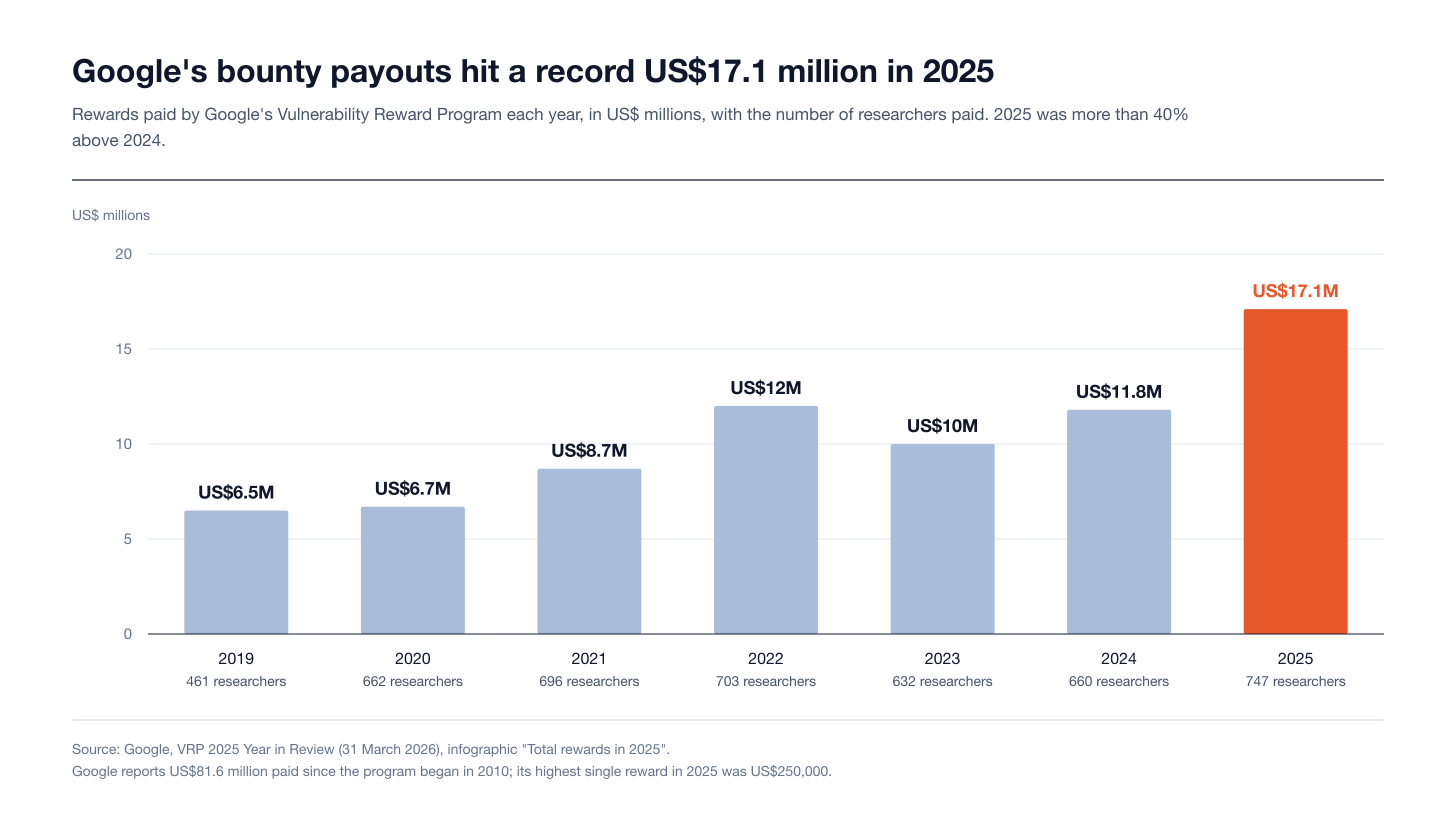
Figure 1: Rewards paid by Google's Vulnerability Reward Program by year, 2019 to 2025, in US$ millions, with the number of researchers paid. Source: Google, VRP 2025 Year in Review, infographic "Total rewards in 2025".
Inside Google's total, the 2025 program review breaks out Chrome (US$3,716,750 to over 100 reporters), Cloud (US$3,574,399 to 143 researchers from 1,774 reports), Android and Google Devices (over US$2,900,000), AI (over US$890,000 for the year), Abuse (rewards up 65%, with US$482,000 in non-AI rewards) and open source software (US$327,672 for 62 rewarded reports out of 192).
What a critical is worth: payouts by severity
US$20,000 is the median payout for a confirmed critical vulnerability on Immunefi, against a mean of US$114,355 lifted by a small tail of very large awards, including one of US$10 million, across 593 programs from January 2021 to February 2026 (Immunefi). Vendor programs publish their ceilings:
Program | Award | Condition | Source |
|---|---|---|---|
Apple Security Bounty | US$2 million; bonuses can lift a payout above US$5 million | Exploit chain comparable to mercenary spyware, from November 2025 | Apple, 10 October 2025 |
Apple Security Bounty | US$1 million | Broad unauthorized iCloud access; up to US$1 million for a wireless proximity exploit over any radio | Apple, 10 October 2025 |
Apple Security Bounty | Up to US$300,000 | One-click WebKit sandbox escape | Apple, 10 October 2025 |
Apple Security Bounty | US$100,000 | Complete Gatekeeper bypass | Apple, 10 October 2025 |
Apple Security Bounty | US$1,000 | Low-impact issues fixed out of caution | Apple, 10 October 2025 |
Google VRP | US$250,000 | Highest single reward of 2025; Chrome paid rewards of US$250,000 for IPC logic bugs found by two researchers | Google, 31 March and 11 March 2026 |
Bugcrowd programs | US$10,000 or more for a P1 | Paid by the most successful programs in 2023 data | Bugcrowd, 24 January 2024 |
Apple says it has paid several individual reports US$500,000. HackerOne's 2026 report includes median, average and 95th percentile bounties by industry and severity, but only in the full report behind a registration form, so they are not reproduced here.
How reports split by severity depends on who is counting:
Population | Critical | High | Medium | Low | Other | Source |
|---|---|---|---|---|---|---|
All YesWeHack reports, 2025 | 12% | 31% | 49% | 8% | YesWeHack Report 2026, p. 7 | |
Confirmed Immunefi reports, 2021 to 2026 | About one in five | Immunefi, 20 April 2026 | ||||
DoD vulnerability disclosure submissions, April 2026 | 6% critical or high | 4% | 30% | 60% unactionable | DoD Cyber Crime Center | |
DoD vulnerability disclosure submissions, December 2025 | 2% critical or high | 14% | 23% | 61% unactionable | DoD Cyber Crime Center |
Immunefi's study ties criticals to time live, not luck. Of the Immunefi programs that have found at least one critical, 364 in all, the average is 2.7 and the median 2; one program has logged 50. In any calendar year about half of active programs surface a critical and around 70% a high or critical, and 129 programs found criticals in two or more separate years.
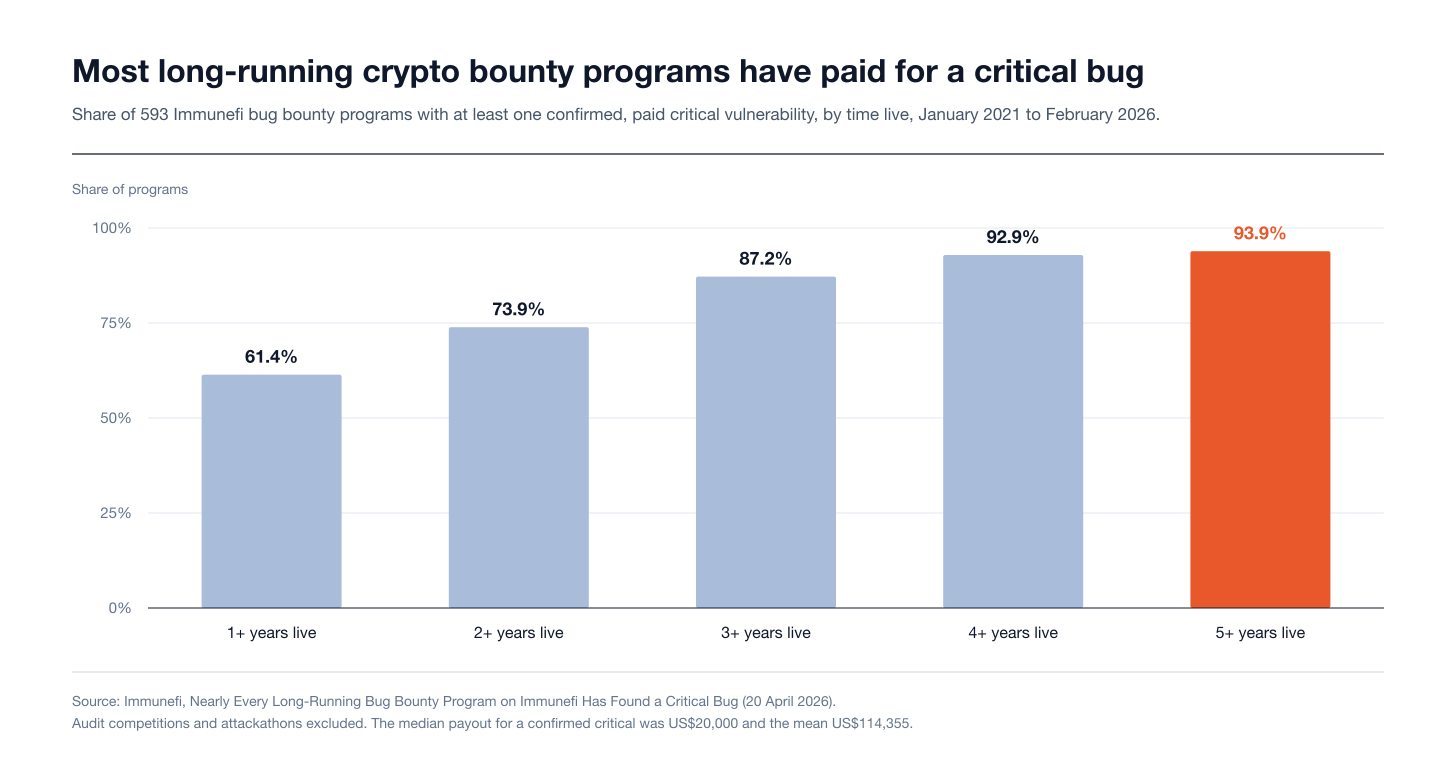
Figure 2: Share of 593 Immunefi bug bounty programs with at least one confirmed, paid critical vulnerability, by time live, January 2021 to February 2026. Source: Immunefi, Nearly Every Long-Running Bug Bounty Program on Immunefi Has Found a Critical Bug, 20 April 2026.
For what happens when attackers find crypto bugs first, see Crypto Hacking Statistics 2026.
Where bounty money goes: sectors and vulnerability classes
US$9,744,130 went to researchers from computer software programs in HackerOne's 2025 reporting year, the most of the seven sectors it charted, while retail and ecommerce had the largest share of critical and high vulnerabilities at 40% (HackerOne, 6 January 2026).
Sector (HackerOne, 2025 reporting year) | Annual bounty spend | Critical and high share | Source |
|---|---|---|---|
Computer software | US$9,744,130 | 24% | HackerOne, 9th report chart |
Internet and online services | US$8,449,454 | 21% | HackerOne, 9th report chart |
Retail and ecommerce | US$5,749,723 | 40% | HackerOne, 9th report chart |
Financial services and insurance | US$4,091,791 | 21% | HackerOne, 9th report chart |
Government | US$1,347,016 | 16% | HackerOne, 9th report chart |
Cryptocurrency and blockchain | US$953,505 | 14% | HackerOne, 9th report chart |
Telecommunications | US$890,000 | 36% | HackerOne, 9th report chart |
Size matters too: in HackerOne's 2026 data, organizations with more than US$10 billion in revenue averaged 84.2 valid reports, nearly six times the 14.5 at organizations with US$1 million to US$5 million (HackerOne, 14 October 2026). In Bugcrowd's 2023 data, the highest P1 payouts were in financial services and government, and government submissions rose 151% with P1 rewards up 58% (Bugcrowd).
By vulnerability class, access control pays. Improper access control earned US$8.80 million across 8,787 valid reports on HackerOne in its 2025 reporting year, slightly more than cross-site scripting (US$8.38 million across 13,197 reports), and IDOR earned about US$1,265 per valid report against about US$635 for cross-site scripting (Stingrai calculation). The five classes together earned US$32.2 million, about 40% of that year's US$81 million (Stingrai calculation).
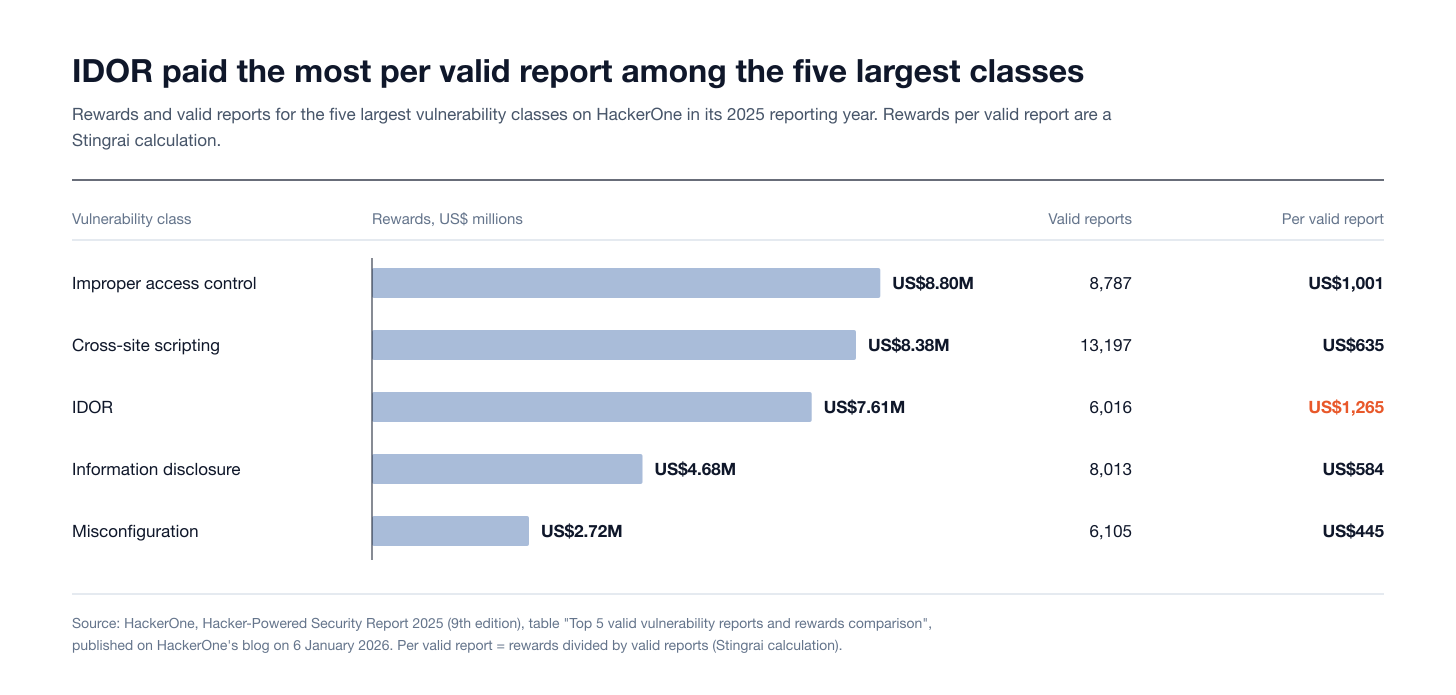
Figure 3: Rewards and valid reports for the five largest vulnerability classes in HackerOne's 2025 reporting year; rewards per valid report are a Stingrai calculation. Source: HackerOne, How AI Security Is Transforming Offensive Security, 6 January 2026, table "Top 5 valid vulnerability reports and rewards comparison".
The direction of travel favours authorization flaws, which HackerOne says are rising while commodity issues such as cross-site scripting decline. Valid IDOR reports rose 29% and their rewards 23%, misconfiguration reports rose 29%, and improper access control reports 18%, while cross-site scripting fell 14% in reports and 7% in rewards. IDOR reports have grown 116% over five years (HackerOne, 4 November 2025).
Bugcrowd's published rankings, updated in January 2025, show the same split between what is common and what is valuable:
Rank | Most reported overall | Most reported critical | Highest average reward |
|---|---|---|---|
1 | Reflected cross-site scripting | Disclosure of secrets | Hardcoded sensitive data |
2 | Disclosure of secrets | Authentication bypass | Remote code execution |
3 | IDOR | IDOR | Second factor authentication |
4 | Lack of security headers | Remote code execution | Content spoofing |
5 | Failure to invalidate session | SQL injection | Authentication bypass |
Source: Bugcrowd, Top 10 Vulnerabilities, updated January 2025; positions 6 to 10 are on the page.
The US Department of Defense's disclosure program sees a different mix: in April 2026 its leading weaknesses were information disclosure (CWE-200, 74 reports), violation of secure design principles (CWE-657, 54), improper access control (CWE-284, 19), cross-site scripting (CWE-79, 9) and improper authentication (CWE-287, 8) (DoD Cyber Crime Center, April 2026).
AI and bug bounties: more targets, more help, more noise
222% is how much valid AI vulnerability reports grew on HackerOne in the two years to June 2026 (HackerOne). AI now shows up in bounty data three ways: as a target, as a tool and as a source of noise.
AI systems as a target
Programs with AI in scope (HackerOne, 2025 edition): 1,121, up 270%; valid prompt injection reports rose 540% and valid AI findings 210% (HackerOne, 1 October 2025).
Fastest-growing AI categories (HackerOne, 2026 edition): system prompt leakage up 557%, misinformation 455% and improper output handling 264% year over year; prompt injection and sensitive information disclosure remain the largest by volume (HackerOne, 7 October 2026).
Google's AI rewards (2025): over US$890,000, including over US$350,000 after its dedicated AI Vulnerability Reward Program launched on 6 October 2025; its first AI bugSWAT in Tokyo produced 70+ reports and over US$400,000 in rewards (Google).
Pwn2Own Berlin 2025: seven of the 28 unique zero-days came from the AI category (Zero Day Initiative).
For the full picture on attacks against LLM features, see Prompt Injection Statistics 2026.
AI as a hunting tool
Hunters adopted AI fast: 82% of Bugcrowd's surveyed hackers use it, up from 64% in 2023, and 74% say it has increased the value of hacking; 91% of the 245 hunters YesWeHack surveyed use it in at least one stage and 5% in all key stages (YesWeHack Report 2026). In HackerOne's 2026 survey of 408 researchers, 85% are upskilling in AI, nearly three-quarters report a meaningful increase in valid findings, and 68% have shifted toward higher-complexity, higher-bounty bugs.
Writing and research lead the uses. Researchers in HackerOne's 2025 survey used AI most for report writing (69%), proof-of-concept generation (50%) and writing or refining exploit code (47%); 23% build or use an automated LLM agent. YesWeHack hunters use it most for learning and research (69%) and drafting reports (51%), and their top worries are false positives (50%) and hallucinated payloads or vulnerabilities (48%). Only 12% of HackerOne's surveyed researchers believe AI will replace them.
Fully autonomous agents now submit reports too. HackerOne counted 6 hackbots that submitted more than 1,100 reports, 560+ of them valid (49%), and 78% of the valid hackbot findings were cross-site scripting (HackerOne, 6 January 2026).
The 2026 surge in unverified reports
Date | Program | What changed | Stated reason | Source |
|---|---|---|---|---|
31 January 2026 | curl | Paid bounty ended after 87 confirmed vulnerabilities and over US$100,000 since April 2019 | Confirmed rate below 5% from 2025 amid AI slop | Daniel Stenberg, 26 January 2026 |
10 March 2026 | Bugcrowd | Bans for submission farming; identity checks after 10 invalid reports | Queues up more than 334% in three weeks | Bugcrowd, 10 March 2026 |
19 March 2026 | Google open source program | Higher proof required for some tiers; in April, no rewards or credit for product vulnerabilities and other security issues in the lower tiers | "A massive surge in AI-generated reports" | Google Bug Hunters |
27 March 2026 | Internet Bug Bounty | Paused for new submissions | AI-assisted research shifted the balance between findings and remediation capacity in open source | Internet Bug Bounty program page |
May 2026 | Bugcrowd | Mandatory identity verification to submit to Managed Bug Bounty programs; throttling; CAPTCHA | Low-quality volume from new and rotating accounts | Bugcrowd, 18 May 2026 |
1 October 2026 | Google open source program | Stopped accepting product vulnerabilities; update promised in Q1 2027 | Not stated on the rules page | Google Bug Hunters rules |
8 October 2026 | Bugcrowd | Active accounts with accuracy of 50% or less throttled to 6 submissions a week; new accounts throttled by default | 388% median increase in submission volume | Bugcrowd, 8 October 2026 |
15 October 2026 | Intigriti | Identity verification moving from a payout requirement to a submission requirement for paid programs | Described as an industry-wide change | Intigriti, 15 October 2026 |
April 2026 | Nextcloud | Paid bounty temporarily suspended for all severities | "AI-generated illegitimate reports" | Nextcloud program policy, read 21 October 2026 |
YesWeHack added a "program spamming and AI slop" violation to its code of conduct, enforceable by platform bans, and Microsoft reported a notable increase in submission volume in the second half of its program year, which it linked to strong engagement and the growing use of AI in security research. Not every program sees it the same way: in HackerOne's survey of 111 security leaders, 53% reported a higher volume of AI-assisted submissions and 60% better quality (HackerOne, 14 October 2026). For triage practice, see Curl Killed Its Bug Bounty Over AI Slop, and for what program rules say, the census of disclosure program policies.
How much of the inbound is real
Program and window | Inbound | Valid or actionable | Share | Source |
|---|---|---|---|---|
curl, 2025 | Not stated | Confirmed vulnerabilities | Below 5% (more than 15% in earlier years) | Daniel Stenberg |
Meta, 2025 to 26 November | Around 13,000 submissions | Almost 800 valid | About 6% (Stingrai calculation) | Meta |
Meta, 2024 | Nearly 10,000 reports | Nearly 600 valid | About 6% (Stingrai calculation) | Meta |
CISA disclosure platform, fiscal 2025 | Over 12,800 reports | Over 1,200 valid | About 9% (Stingrai calculation) | CISA |
Google open source program, 2025 | 192 reports | 62 rewarded | 32% (Stingrai calculation) | |
DoD disclosure program, April 2026 | 269 submissions | 6% critical or high, 4% medium, 30% low | 60% unactionable | DoD Cyber Crime Center |
Definitions differ (confirmed, valid, rewarded, actionable), so compare each row only with itself. Bugcrowd's new rules set the bar for an account at more than 50% accuracy.
Speed: first findings, triage and fixes
5 days is Bugcrowd's published average time to a first submission and to a first vulnerability on its Managed Bug Bounty engagements, and 8 days to a first critical (Bugcrowd). Speed after the report is where programs struggle:
Resolution time (HackerOne, two years to June 2026): average down 54%, from 135 days to 62 days; resolution time for critical findings down 61%.
Backlog: validated, unresolved vulnerabilities up 131% in two years, and the open critical backlog up 123%.
Validation effort (survey of 111 security leaders): an average of 30 hours to validate a critical finding; nearly 70% say validated findings arrive faster than their teams can fix them, and 75% formally track this "exposure debt".
Source code: vulnerability reports against source code tripled year over year on HackerOne.
Remediation in government (fiscal 2025): agencies on CISA's disclosure platform remediated 1,099 valid reports, 90% (CISA).
Faster pay for proof: Apple's Target Flags let researchers demonstrate exploitability and receive accelerated awards before a fix ships (Apple).
Bugcrowd said in October 2026 that it had heard researchers' concerns about extended triage times, and tied them to the surge in submissions.
Live hacking events and Pwn2Own
US$1,298,250 was paid for 47 unique zero-days at Pwn2Own Berlin in May 2026, the largest total of the five contests held from January 2025 to May 2026 (Zero Day Initiative). The three 2025 contests paid US$2,989,750 for 150 zero-days, about US$19,900 per zero-day (Stingrai calculation).
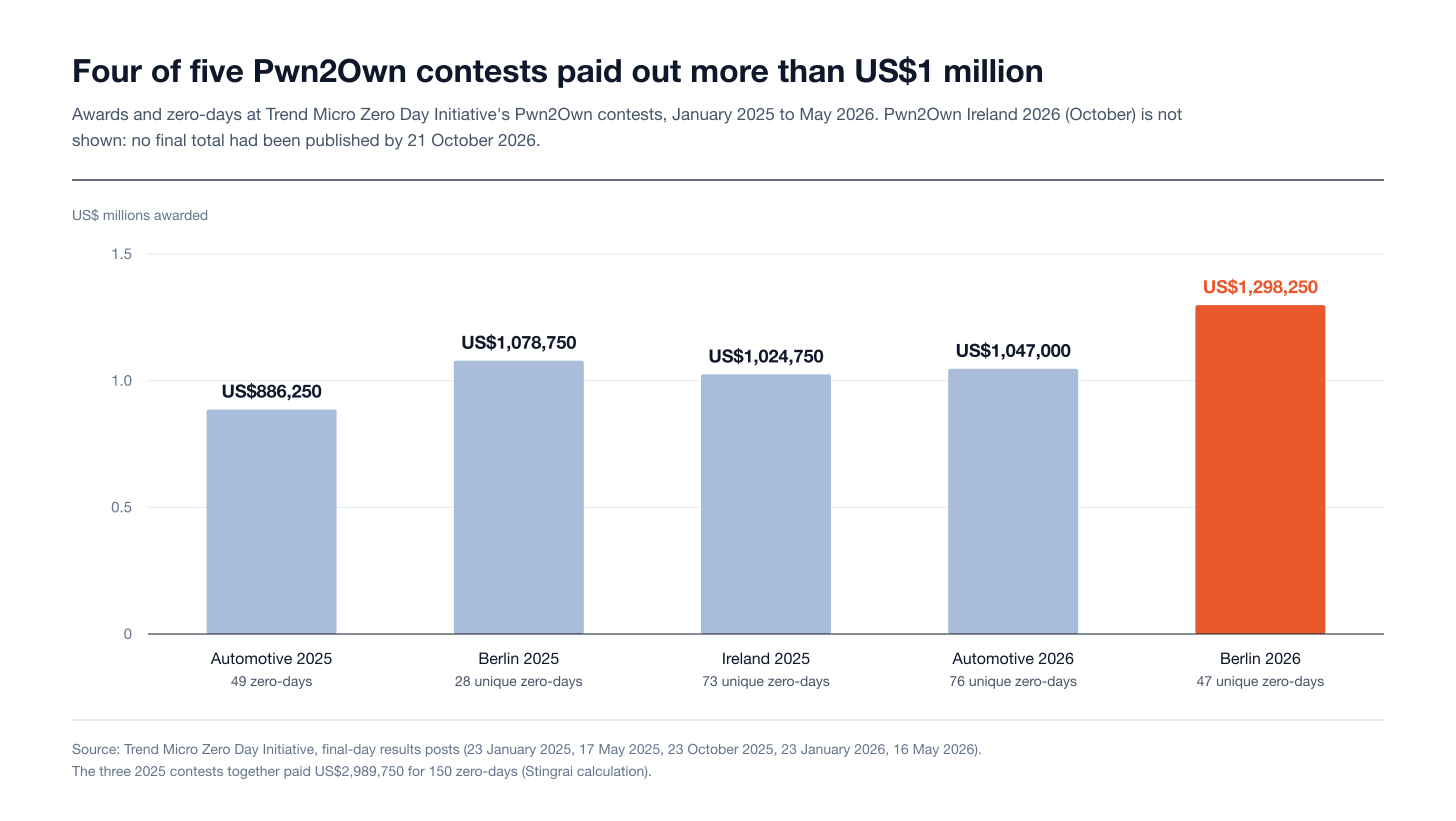
Figure 4: Awards and zero-days at Pwn2Own contests, January 2025 to May 2026. Source: Trend Micro Zero Day Initiative, final-day results posts for each contest.
Vendors run their own live events. Google's 2025 bugSWAT events produced 70+ reports and over US$400,000 (AI, Tokyo), 130 reports and US$1,600,000 (Cloud, Sunnyvale), 77 reports and US$380,000 (Las Vegas) and 107 reports and US$566,000 (Mexico City) (Google). Microsoft's Zero Day Quest drew researchers from 20 countries, who submitted nearly 700 reports and earned US$2.3 million (Microsoft).
Who hunts: researcher demographics and motivation
92% of the hackers Bugcrowd surveyed are 34 or younger, 69% hold a college degree or higher, 20% identify as neurodivergent, and women are 5% of the community (Bugcrowd).
Motivation: financial gain is the top motivation (74%), and 75% say hacking is becoming more about money than curiosity; yet 85% say reporting a critical vulnerability matters more than making money, and 98% are proud of their work.
Teams: 40% work in a team and another 44% want to; 72% say teams get better results and 61% find more criticals in teams. On YesWeHack, 52% always hunt alone, 45% sometimes collaborate, and collaborative reports have risen 520% since 2022.
Careers: 38% of YesWeHack's surveyed hunters hunt full time; of the rest, 48% are penetration testers or red teamers, 18% security researchers and 11% students. The largest group (44%) has 3 to 5 years in cybersecurity.
Choosing programs: a program's reputation for quick, fair responses matters most (68%), then high bounty ranges (51%) and private invitations (50%); 42% prioritise recently added scopes and only 13% long-established ones.
Reach: Microsoft recognized researchers from 64 countries, Meta has paid more than 1,400 researchers from 88 countries since it began (India, Nepal and the United States earned the most in 2024), and Apple more than 800 since 2020; Intigriti lists 150,000+ researchers and Immunefi 85,000+.
Disclosure gaps: 65% of Bugcrowd's surveyed hackers have chosen not to disclose a vulnerability because the organization lacked a clear, safe way to report it.
Government vulnerability disclosure programs
59,698 vulnerabilities had been reported to the US Department of Defense's Vulnerability Disclosure Program by April 2026, with 33,086 actionable reports processed in total (DoD Cyber Crime Center). Monthly submissions ranged from 232 (November 2025) to 409 (October 2025) between October 2025 and April 2026. Across civilian agencies, CISA's platform received over 12,800 reports in fiscal 2025, over 1,200 of them valid, and CISA supported 7 paid bounty programs at four agencies that found 28 critical vulnerabilities and paid over US$345,000 (CISA). Government programs on HackerOne spent US$1,347,016 in its 2025 reporting year.
Bug bounty versus penetration testing: coverage, time to first finding and cost predictability
98% of surveyed YesWeHack hunters are comfortable testing web applications and 78% APIs, but only 30% network ranges, 24% cloud infrastructure and 13% AI models (YesWeHack Report 2026). A bounty pays for findings on the surfaces hunters choose; a penetration test covers the scope the organization defines.
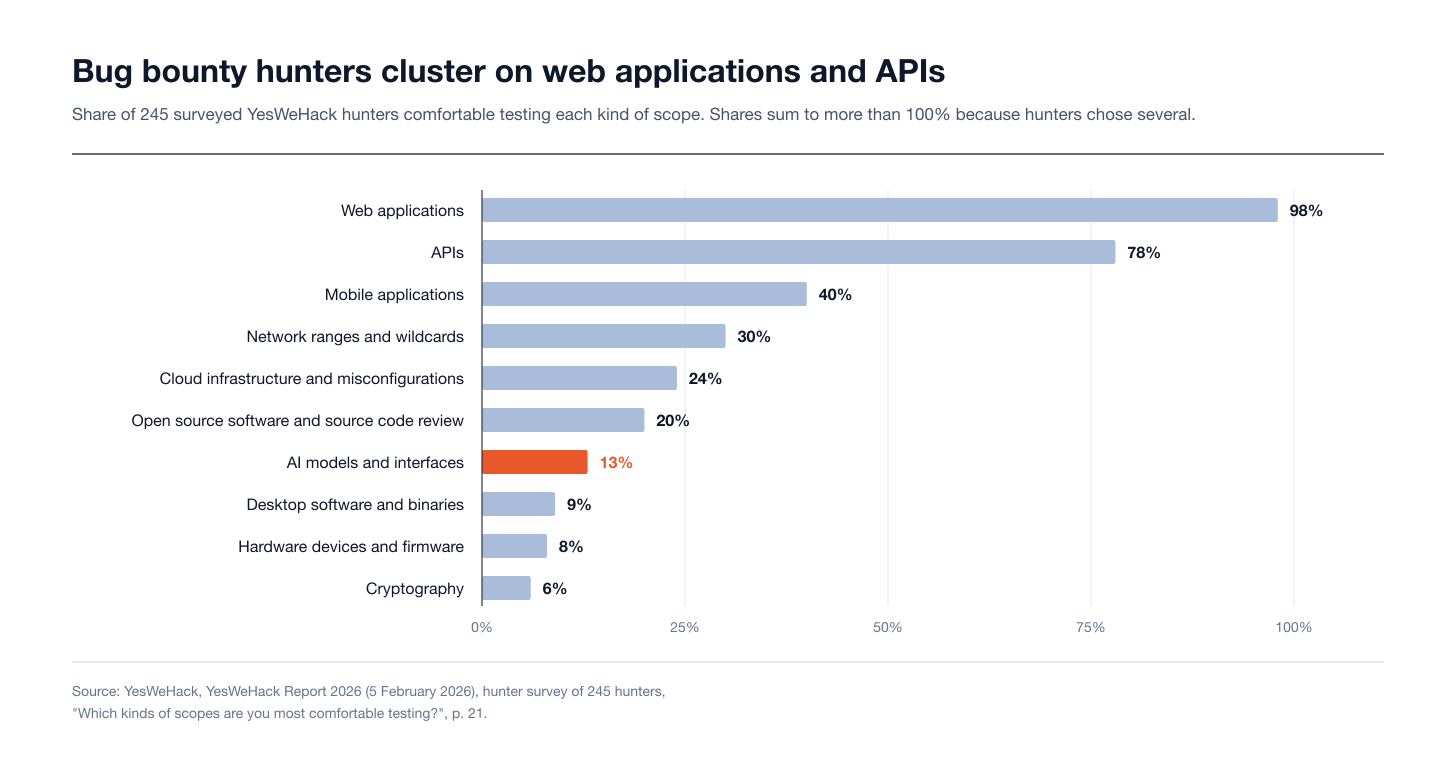
Figure 5: Share of 245 surveyed YesWeHack hunters comfortable testing each kind of scope; shares sum to more than 100% because hunters chose several. Source: YesWeHack, YesWeHack Report 2026, 5 February 2026, hunter survey, p. 21.
Question | Bug bounty program | Penetration test | Source |
|---|---|---|---|
Who decides what gets tested | Hunters, within the published scope; open scopes drew 10 times more P1s than limited ones in Bugcrowd's 2023 data | The organization and its testers, in a written scope that can include internal networks, Active Directory, cloud and staging environments | YesWeHack; Bugcrowd |
When findings arrive | Published averages of 5 days to a first vulnerability and 8 days to a first critical | During the test window; Stingrai posts each confirmed finding to its platform as it is confirmed | Bugcrowd; Stingrai |
How cost behaves | Rewards scale with valid findings; Immunefi's median critical is US$20,000 but the mean is US$114,355, and triage takes time | A fixed fee for a defined scope; Stingrai's packages for one web application and associated APIs are at US$3,000 (Autonomous) and US$6,800 (Hybrid) per assessment | Immunefi; HackerOne; Stingrai |
How much noise | About 6% of Meta's 2025 submissions were valid (Stingrai calculation); 60% of the DoD program's April 2026 submissions were unactionable | 9 of 1,216 findings (0.74%) were false positives in Stingrai's dataset | Meta; DoD; Stingrai |
What evidence it leaves | Individual reports and payouts | A report covering the agreed scope, a retest record and, for human-led and hybrid tests, an attestation letter | Stingrai |
The two models measure different things. In Stingrai's State of Penetration Testing 2026, drawn from 55 tests and 1,206 verified findings between October 2024 and August 2026, 51 of 55 tests (92.7%) surfaced at least one High or Critical finding and 38 (69.1%) a Critical; Critical findings were fixed at a median of 10.5 days, High findings at 38.0. Bounties add continuous breadth on public assets; a penetration test adds scoped depth and the documentation audits ask for. For what PCI DSS, NYDFS and SOC 2 say about each, see Penetration Testing vs Bug Bounty (2026).
What this means for defenders
Publish a way to report. 65% of surveyed hackers have held back a vulnerability for lack of a clear, safe channel; a published disclosure policy gives them one.
Ask for proof before you pay or triage. Google's open source program now requires stronger proof, such as an OSS-Fuzz reproduction or a merged patch, for some tiers, and Bugcrowd added identity checks and accuracy thresholds in 2026; write evidence requirements into your program rules.
Respond fast and pay fairly. A program's reputation for quick, fair responses was the top reason surveyed hunters chose one (68%), ahead of high bounty ranges (51%).
Measure the backlog, not only time to fix. HackerOne's average resolution time fell to 62 days while its backlog of validated, unresolved vulnerabilities grew 131%.
Test your AI features on purpose. Prompt injection and sensitive information disclosure are the largest AI report categories on HackerOne, and system prompt leakage the fastest-growing; an AI and LLM penetration test covers them before launch.
Cover what hunters skip. Use a scoped penetration test for internal networks, Active Directory, cloud configuration and pre-release code; in YesWeHack's survey only 30% of hunters were comfortable with network ranges and 24% with cloud infrastructure.
Where Stingrai fits. Stingrai is a CREST-accredited penetration testing company headquartered in Toronto whose penetration testers are also security researchers and bug bounty hunters. Its human-led engagements are staffed by two named penetration testers from a team holding OSCE³, OSWE, OSEP, CREST CRT and CISSP certifications, with 18 published CVEs across the team; each confirmed finding is posted to the PTaaS platform as it is confirmed, retesting of remediated findings is included, and every human-led and hybrid report ships with an attestation letter, evidence for SOC 2, ISO 27001, PCI DSS and HIPAA programs. Stingrai runs one-time annual tests and continuous programs. For a single web application, Snipe, Stingrai's autonomous agent for web applications and their APIs, is trained on more than 6,000 HackerOne Hacktivity disclosure reports and Stingrai's penetration testers' methodology: the Autonomous Pentest is at US$3,000 per assessment or US$650 per month, and the Hybrid Pentest, with penetration testers working alongside Snipe, is at US$6,800 per assessment or US$1,275 per month, each for one web application and associated APIs (pricing). Larger scopes are quoted through Get a Quote, and web application penetration testing covers authenticated testing across every user role.
How to cite this page
Stingrai Research Team. "Bug Bounty Statistics 2026." Stingrai, 21 October 2026. https://www.stingrai.io/blog/bug-bounty-statistics-2026
Cite single figures to their primary source; cite the figures marked as Stingrai calculations to this page with the date 21 October 2026.
This compilation is licensed under CC BY 4.0.
Frequently Asked Questions
How much do bug bounty programs pay in 2026?
Organizations running bug bounty programs on HackerOne paid researchers a record US$89.1 million from July 2025 to June 2026. Microsoft awarded more than US$20 million to 562 researchers in the program year it reported in August 2026, and Google paid US$17.1 million to 747 researchers in 2025, more than 40% above 2024.
How much is a critical bug worth in a bug bounty?
It depends on the program. The median payout for a confirmed critical on Immunefi is US$20,000 and the mean US$114,355. Apple pays up to US$2 million for an exploit chain, with bonuses able to lift a payout above US$5 million, and Google's highest single reward in 2025 was US$250,000.
Which vulnerabilities earn the most in bug bounty programs?
On HackerOne in its 2025 reporting year, improper access control earned US$8.80 million across 8,787 valid reports, cross-site scripting US$8.38 million across 13,197, and IDOR US$7.61 million across 6,016. Per valid report, IDOR earned about US$1,265 and cross-site scripting about US$635 (Stingrai calculation).
How has AI changed bug bounty programs?
Valid AI vulnerability reports on HackerOne grew 222% in two years, and 82% of hackers in Bugcrowd's 2026 survey use AI. Unverified AI submissions also drove a 388% median increase in submission volume in Bugcrowd's triage queue in October 2026, and curl, Nextcloud and Google's open source program cut or suspended rewards.
Why did curl end its bug bounty?
curl's confirmed-vulnerability rate fell from more than 15% of submissions in earlier years to below 5% in 2025 as AI slop reports rose, so it stopped paying rewards on 31 January 2026. Since April 2019 the program had confirmed 87 vulnerabilities and paid over US$100,000.
How fast do bug bounty programs find and fix vulnerabilities?
Bugcrowd publishes averages of 5 days to a first vulnerability and 8 days to a first critical on its Managed Bug Bounty engagements. Fixing is slower: average resolution time on HackerOne fell from 135 days to 62 days in two years, but the backlog of validated, unresolved vulnerabilities grew 131%.
Who are bug bounty hunters?
Mostly young and educated: 92% of the hackers Bugcrowd surveyed are 34 or younger, 69% hold a degree and women are 5% of the community. On YesWeHack, 38% of surveyed hunters hunt full time, and nearly half of the rest work as penetration testers or red teamers.
Can a bug bounty replace a penetration test?
No. A bounty pays for findings on the surfaces hunters choose to test, while a penetration test covers a defined scope and produces a report, a retest record and, for human-led and hybrid tests, an attestation letter. In Stingrai's own data, 51 of 55 penetration tests (92.7%) found at least one High or Critical, and the two can run side by side.
Related reading
Penetration Testing vs Bug Bounty (2026): Coverage, Cost and Compliance Evidence
Curl Killed Its Bug Bounty Over AI Slop: How to Triage Real AI Findings From Noise
Penetration Testing Statistics 2026: Adoption, Findings, Cost and Remediation
Prompt Injection Statistics 2026: Attack Success Rates, Bug Bounties and CVEs
References
HackerOne. Security Research Report 2026: Exposure Debt (10th edition). 7 October 2026. https://www.hackerone.com/report/hacker-powered-security and https://www.hackerone.com/press-release/hackerone-report-reveals-growing-exposure-debt-vulnerability-backlogs-grew-131-even. Platform data from July 2025 to June 2026; surveys of 111 security leaders and 408 researchers.
HackerOne. The Exposure Debt Benchmark: What the 2026 Data Says About the Find-to-Fix Gap. 14 October 2026. https://www.hackerone.com/blog/exposure-management-find-to-fix-gap-2026. Report sizes by revenue and AI-assisted submission survey results.
HackerOne. Hacker-Powered Security Report 2025 (9th edition). 1 October 2025. https://www.hackerone.com/press-release/hackerone-report-finds-210-spike-ai-vulnerability-reports-amid-rise-ai-autonomy. Payouts, AI scope and hackbot figures for HackerOne's 2025 reporting year.
HackerOne. How AI Security Is Transforming Offensive Security and 3 Signals You Can't Ignore from the 2025 Hacker-Powered Security Report. 6 January 2026 and 4 November 2025. https://www.hackerone.com/blog/2025-hpsr-researcher-signals and https://www.hackerone.com/blog/ai-security-trends-2025. Charts and figures published from the 2025 edition.
Internet Bug Bounty and Nextcloud. Program policies on HackerOne. Read 21 October 2026. https://hackerone.com/ibb and https://hackerone.com/nextcloud. Pause of new submissions and suspension of paid rewards.
Bugcrowd. Inside the Mind of a Hacker 2026. 27 January 2026. https://www.bugcrowd.com/press-release/bugcrowd-report-unveils-the-era-of-human-augmented-intelligence-as-ai-adoption-climbs-to-82/ and https://www.bugcrowd.com/blog/inside-the-mind-of-a-hacker-2026/. Surveys and interviews with more than 2,000 participants.
Bugcrowd. Platform posts on AI-generated submissions. 10 March, 18 May and 8 October 2026. https://www.bugcrowd.com/blog/bugcrowd-policy-changes-to-address-ai-slop-submissions/, https://www.bugcrowd.com/blog/continuing-our-work-to-reduce-ai-slop-submissions-and-protect-signal-quality/ and https://www.bugcrowd.com/blog/evolving-our-submission-accuracy-and-throttling-controls-to-protect-triage-speed/. Queue volumes and enforcement rules.
Bugcrowd. Bug bounty product page, Top 10 Vulnerabilities and Inside the Platform. Read 21 October 2026; January 2025; 24 January 2024. https://www.bugcrowd.com/products/bug-bounty/, https://www.bugcrowd.com/resource/top-10-vulnerabilities/ and https://www.bugcrowd.com/press-release/open-scope-crowdsourced-security-programs-find-10x-more-critical-vulnerabilities/. Published averages, rankings and 2023 platform data.
YesWeHack. YesWeHack Report 2026. 5 February 2026. https://choose.yeswehack.com/hubfs/YWH%20Report/YesWeHack_2026_Report.pdf?hsLang=en. 2025 platform data and a survey of 245 hunters.
Intigriti. Homepage figures and What ID verification changes mean for public bug bounty programs at Intigriti. Read 21 October 2026; 15 October 2026. https://www.intigriti.com/ and https://www.intigriti.com/blog/business-insights/what-id-verification-changes-mean-for-public-bug-bounty-programs-at-intigriti. Cumulative payouts and identity verification.
Immunefi. Nearly Every Long-Running Bug Bounty Program on Immunefi Has Found a Critical Bug. 20 April 2026. https://immunefi.com/blog/research/nearly-every-long-running-bug-bounty-program-on-immunefi-has-found-a-critical-bug/ and https://immunefi.com/. 593 programs, January 2021 to February 2026.
Google. VRP 2025 Year in Review and Google VRPs in Review: 2025. 31 March and 11 March 2026. https://blog.google/security/vrp-2025-year-in-review/ and https://bughunters.google.com/blog/google-vrps-in-review-2025. Program totals for calendar 2025.
Google. Streamlining Google's OSS VRP: Key Rule Updates and OSS VRP rules. 19 March 2026 with an April 2026 update; rules read 21 October 2026. https://bughunters.google.com/blog/ossvrp-rule-updates-2026 and https://bughunters.google.com/about/rules/open-source/google-open-source-software-vulnerability-reward-program-rules. Changes to the open source program.
Microsoft Security Response Center. Microsoft Bounty Program year in review: More than $20 million awarded in our biggest year yet. 3 August 2026. https://www.microsoft.com/en-us/msrc/blog/2026/08/microsoft-bounty-program-year-in-review-more-than-20-million-awarded-biggest-year. Program-year awards and Zero Day Quest.
Meta. Bug Bounty 15th anniversary and Looking back at our Bug Bounty program in 2024. 26 November 2025 and 13 February 2025. https://bugbounty.meta.com/blog/15th-anniversary-2025/ and https://engineering.fb.com/2025/02/13/security/looking-back-at-our-bug-bounty-program-in-2024/. Submissions, valid reports and awards.
Apple. A major evolution of Apple Security Bounty. 10 October 2025. https://security.apple.com/blog/apple-security-bounty-evolved/. Award levels effective November 2025.
Trend Micro Zero Day Initiative. Pwn2Own final-day results. January 2025 to May 2026. https://www.zerodayinitiative.com/blog/2025/1/23/pwn2own-automotive-2025-day-three-and-final-results, https://www.zerodayinitiative.com/blog/2025/5/17/pwn2own-berlin-2025-day-three-results, https://www.zerodayinitiative.com/blog/2025/10/23/pwn2own-ireland-2025-day-three-and-master-of-pwn, https://www.zerodayinitiative.com/blog/2026/1/23/pwn2own-automotive-2026-day-three-results-and-the-master-of-pwn and https://www.zerodayinitiative.com/blog/2026/5/16/pwn2own-berlin-2026-day-three-results-and-master-of-pwn. Awards and unique zero-days per contest.
Daniel Stenberg, curl. The end of the curl bug-bounty. 26 January 2026. https://daniel.haxx.se/blog/2026/01/26/the-end-of-the-curl-bug-bounty/. Program results from April 2019 to January 2026.
Cybersecurity and Infrastructure Security Agency. 2025 Year in Review. 2025. https://www.cisa.gov/about/2025YIR. Vulnerability Disclosure Policy Platform results for fiscal 2025.
US Department of Defense Cyber Crime Center. DoD Vulnerability Disclosure Program Bug Bytes, December 2025 and April 2026. https://www.dc3.mil/Portals/100/Documents/DC3/Missions/VDP/BugBytes/2026/VDP-BugBytes-Apr-2026-Public.pdf. Read as archived by the Internet Archive; monthly and cumulative program data.
Stingrai. The State of Penetration Testing 2026. 29 August 2026. https://www.stingrai.io/blog/state-of-penetration-testing-2026. 55 penetration tests and 1,206 verified findings, October 2024 to August 2026.
Talk to Stingrai
Bug bounties reward what hunters choose to test; a penetration test covers the scope you define and leaves the evidence audits ask for. Stingrai's penetration testers can scope a one-time or continuous test of your web applications, APIs, cloud, networks or AI features. Get a quote or book a free discovery call.