Vulnerability assessment and penetration testing (VAPT) is one security engagement with two halves: a vulnerability assessment that finds and ranks known weaknesses across an agreed scope, and a penetration test in which testers try to exploit and chain those weaknesses to prove what an attacker can reach. NIST's testing guide, SP 800-115, draws the line in one sentence: vulnerability scanners "check only for the possible existence of a vulnerability", while the attack phase of a penetration test "exploits the vulnerability to confirm its existence".
The second half matters more every year. Exploitation of vulnerabilities is now the most common initial access vector for breaches, at 31% of non-Error, non-Misuse breaches with a known initial access vector in Verizon's 2026 Data Breach Investigations Report, up from 20% in the 2025 edition, and only 26% of the vulnerabilities from CISA's Known Exploited Vulnerabilities (KEV) catalog found across the more than 13,000 organizations in Verizon's 2025 vulnerability data were fully remediated.
Quick answer. VAPT combines an automated, analyst-triaged vulnerability assessment with a manual penetration test in one engagement: scope and rules of engagement, discovery, automated assessment, manual validation and exploitation, reporting, and a retest of every fix. Buy it by asset (web applications and APIs, external and internal network, cloud), ask how findings are prioritised (CVSS severity plus exploitability context such as KEV listing and EPSS), and make sure the retest is included. Stingrai, a CREST-accredited penetration testing company, runs both halves: its Hybrid Pentest for one web application and associated APIs is US$6,800 per assessment or US$1,275 per month on a 12-month plan, and a network penetration test typically costs US$5,000 to US$40,000 and above.
This guide is for the IT or security lead asked to "get a VAPT done" by a customer, auditor, regulator or board. For a head-to-head comparison of the two halves and what each compliance framework accepts, read vulnerability assessment vs penetration testing; for named providers, see the VAPT service providers ranking.
TL;DR
Why the term is common in India, Singapore and Saudi Arabia: CERT-In's 2025 audit guidelines name "VAPT" as an audit type, and MAS in Singapore and the NCA in Saudi Arabia set the two activities side by side.
The process: scoping, discovery, automated assessment, manual exploitation, reporting, and a retest; for cardholder data, PCI DSS v4.0.1 Requirement 11.4.4 requires penetration testing to be repeated to verify corrections.
Prioritization: CVSS v4.0 for severity, EPSS for the probability of exploitation in the next 30 days, and the CISA KEV catalog for confirmed exploitation. CISA added 302 vulnerabilities to KEV in 2026 up to 18 November, against 245 in all of 2025.
Cost: Stingrai's Hybrid Pentest is US$6,800 per assessment or US$1,275 per month on a 12-month plan for one web application and associated APIs (pricing); a network penetration test typically costs US$5,000 to US$40,000 and above, retest included (network penetration testing).
What is VAPT, and what does each half deliver?
VAPT answers two questions about the same scope: what known weaknesses exist, and which of them an attacker can actually use. The vulnerability assessment answers the first with discovery, authenticated scanning, configuration review and analyst triage, and delivers a ranked list with false positives removed. The penetration test answers the second: qualified testers exploit what the assessment found, chain low-severity issues into real access, and test what no scanner can model, such as one customer reading another customer's records. It delivers verified findings with evidence and attack paths.
Each half covers the other's blind spot. NIST SP 800-115 warns that scanners "can have a high false positive error rate" and miss how "several low-risk vulnerabilities" can "present a higher risk when combined". In a well-run VAPT the assessment tells the testers where to look first, and what they learn while exploiting feeds back into discovery.
Why buyers in India, Singapore and Saudi Arabia ask for "VAPT"
Regulators in these markets write the two activities next to each other, and CERT-In names "VAPT" as an audit type outright. In Stingrai's experience, questionnaires and RFPs written against these texts ask for "a VAPT", including when they go to suppliers outside the country.
Jurisdiction and text | Assessment half | Penetration testing half |
|---|---|---|
India: CERT-In Comprehensive Cyber Security Audit Policy Guidelines, version 1.0, 25 July 2025 | Vulnerability assessment defined as examination to "identify security deficiencies" | Penetration testing defined as testing to "identify and exploit potential vulnerabilities" |
Singapore: MAS Technology Risk Management Guidelines, January 2021 | 13.1: regular VA covering vulnerability discovery, weak configurations, open ports and application vulnerabilities | 13.2: a combination of blackbox and greybox testing for online financial services, on production with safeguards |
Saudi Arabia: NCA Essential Cybersecurity Controls (ECC 2:2024) | 2-10-3: periodic vulnerabilities assessment, classification by severity, remediation by classification | 2-11-3: all externally provided internet services, including infrastructure, websites, web applications, mobile apps, email and remote access |
Card payments, worldwide: PCI DSS v4.0.1 | 11.3: internal scans and external Approved Scanning Vendor (ASV) scans | 11.4: internal and external penetration testing, segmentation testing |
CERT-In requires every audit scope to state the type of audit, and lists "VAPT (Vulnerability Assessment Penetration Testing)" first (13.2.3). MAS writes for the financial institutions it supervises; the NCA controls bind Saudi government agencies and private entities that own, operate or host critical national infrastructure.
When someone asks you for "a VAPT", settle four things before you request quotes:
Which assets. A VAPT of one customer-facing application is a different purchase from a VAPT of the whole network.
Which text. Ask for the clause, contract schedule or questionnaire item; it decides cadence, depth and whether greybox testing (with credentials) is expected.
Who may test. CERT-In's 2025 guidelines govern audits carried out by CERT-In empanelled auditing organisations; if your text names one, CERT-In's published list, in the copy downloaded on 20 November 2026, numbers 228 organisations.
What evidence. Usually the report, the retest results and a letter a third party can read without seeing the findings.
The VAPT process, step by step
A VAPT engagement runs in six stages. NIST SP 800-115 describes the penetration test in four phases (planning, discovery, attack and reporting); the six stages below split the assessment out of discovery and add the retest that PCI DSS and CERT-In both expect.
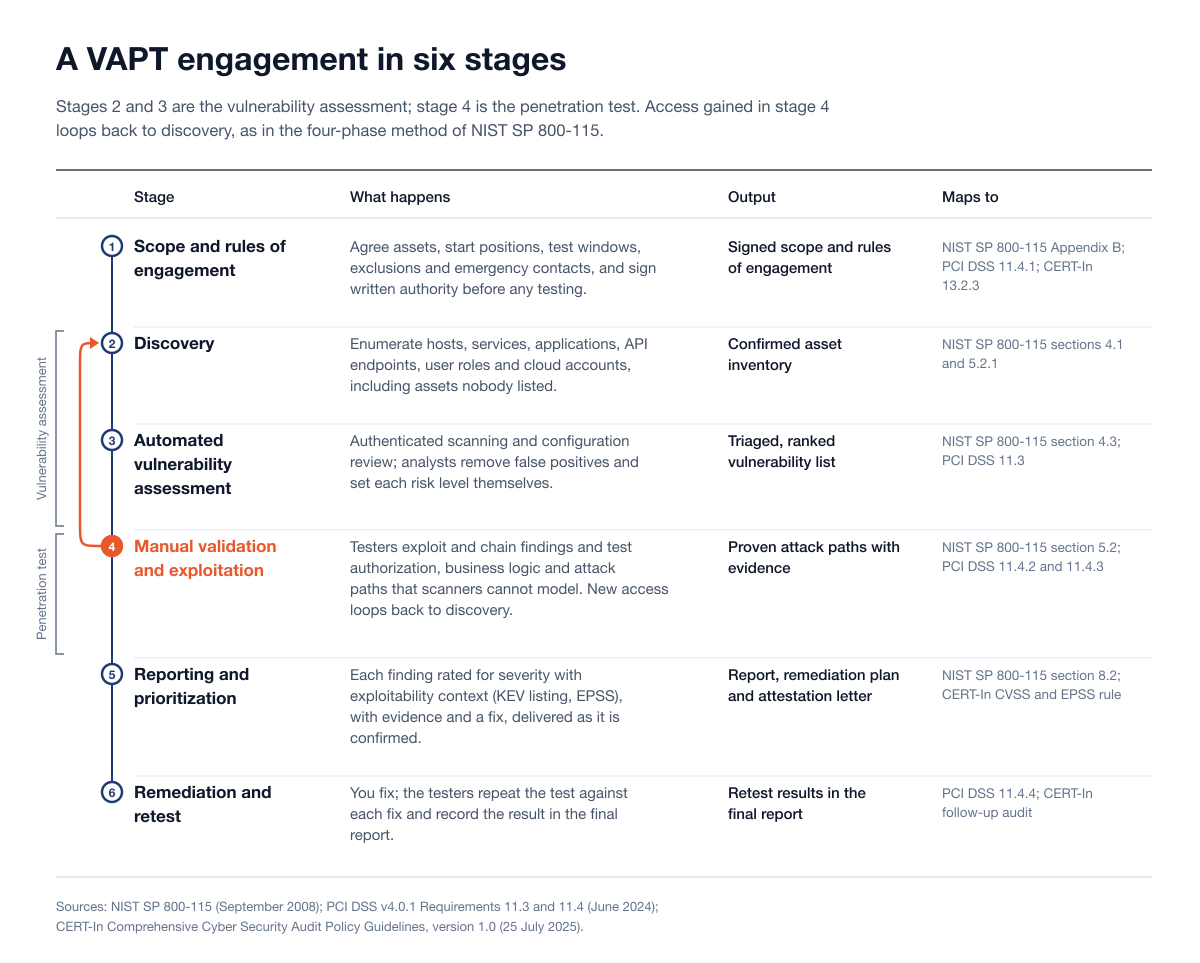
Figure 1: The six stages of a VAPT engagement and the standards each maps to. Sources: NIST SP 800-115; PCI DSS v4.0.1 Requirements 11.3 and 11.4 (PCI SSC document library); CERT-In audit guidelines, 2025.
1. Scope and rules of engagement
Scoping fixes the assets, start positions (internet, internal network drop, standard user account), test windows, exclusions and emergency contacts. The rules of engagement turn that into written authority: NIST defines them as constraints "established before the start of a security test" that give "the test team authority to conduct defined activities", with a template in SP 800-115 Appendix B. CERT-In is blunter: "Appropriate written approvals must be obtained prior to conducting any penetration tests". Our scoping guide works through an example.
2. Discovery
Discovery confirms what exists before anything is scanned: live hosts, ports and services; application hostnames, endpoints, API versions and user roles; cloud accounts and exposed services. NIST describes it as "information gathering and scanning". Expect the testers to find assets nobody listed, and to ask before testing them.
3. Automated vulnerability assessment
This is the assessment half. Scanners compare what discovery found against known vulnerabilities and weak configurations, ideally with credentials so they read installed versions instead of guessing from banners; PCI DSS 11.3.1.2 requires internal scans to be authenticated on systems that accept credentials. The analyst's job is triage: NIST says assessors "should determine the appropriate risk level for each vulnerability and not simply accept the risk levels assigned by vulnerability scanners".
4. Manual validation and exploitation
This is the penetration test half, and the reason VAPT costs more than a scan. Testers exploit the assessment's findings in a controlled, non-destructive way, chain them, and test authentication, authorization between users and tenants, business logic, Active Directory attack paths and segmentation. NIST calls executing an attack "the heart of any penetration test": verifying potential vulnerabilities "by attempting to exploit them". New access loops testing back to discovery.
5. Reporting and prioritization
Findings should reach you as they are confirmed, not only in a final PDF. NIST notes that at the end of a test a report is "generally developed to describe identified vulnerabilities, present a risk rating, and give guidance on how to mitigate", and that internal reports should include "test methodology, test results, analysis, and POA&M" (a plan of action and milestones). CERT-In now requires its auditors to categorize findings by CVSS for severity, "supplemented with" EPSS for likelihood.
6. Remediation and retest
You fix; the testers repeat the test against each fix and record the result. PCI DSS 11.4.4 requires that "penetration testing is repeated to verify the corrections", and CERT-In says follow-up audits "should be included within the scope or RFP proposal". A quote without the retest is missing a stage.
VAPT scope by asset type
The asset decides what each half can reach. Use this table as a scoping aid.
Asset | What the vulnerability assessment covers | What the penetration test adds | What to give the testers | Reference |
|---|---|---|---|---|
Web applications | Component versions, TLS and security headers, exposed admin paths, common web vulnerability classes | Authentication and sessions, authorization between users, roles and tenants, business logic, chained findings | Test accounts for every role, the environment URL, a change freeze for the window | |
APIs | Endpoint inventory against documentation, unauthenticated endpoints, configuration | Object and function level authorization, abuse of sensitive business flows, undocumented versions | OpenAPI or GraphQL schema, tokens per role, rate limits | |
External network | Internet-facing hosts and services, versions, TLS, exposed management interfaces, KEV-listed edge products | Exploiting exposed services and edge devices, credential attacks kept under lockout limits, what a foothold reaches | IP ranges and domains, exclusions, the testers' source addresses to allow | NIST SP 800-115; PCI DSS 11.4.3 |
Internal network and Active Directory | Authenticated host scans, missing patches, weak configurations, legacy protocols | Lateral movement, privilege escalation, Active Directory attack paths, segmentation | An assumed-breach account or network drop, the VLAN list, the segmentation you rely on | PCI DSS 11.4.2 and 11.4.5 |
Cloud (AWS, Azure, Google Cloud) | Configuration and identity review, exposed storage and services, logging gaps | Abuse of identity and role trust, cross-account paths, escalation from workloads | Read-only audit roles, the account and subscription list, the provider's testing rules | AWS, Microsoft and Google testing policies |
Web applications and APIs
Application VAPT is where the gap between the halves is widest. A scanner can flag an outdated library; it cannot know which user may see which record. The OWASP API Security Top 10 2023 ranks Broken Object Level Authorization first and Broken Function Level Authorization fifth, both flaws that exist only relative to your own permission model. Scope by roles, endpoints and workflows, and supply credentials for every role; our web application security assessment guide covers the methods.
Stingrai's web application security testing covers both halves. In the Hybrid Pentest, Snipe, Stingrai's autonomous agent for web applications and associated APIs, tests the full application while Stingrai's certified penetration testers test the same application manually alongside it and validate Snipe's findings, so coverage is wider and deeper. It is not a split of test classes between machine and human. The one-time option is followed by monthly autonomous testing by Snipe (the pricing page lists "12 monthly Snipe scans after the one-time pentest"), so the application keeps being tested between annual engagements, and every human-led and hybrid report ships with an attestation letter. Prices and the continuous plan are in the sections below.
External and internal network
External VAPT starts from the internet: perimeter hosts, VPN and remote access, mail, DNS and sign-in portals. Internal VAPT starts from an assumed-breach position: patch level, Active Directory, lateral movement and segmentation. PCI DSS 11.4.2 and 11.4.3 require both, by a qualified, organizationally independent tester who is "not required to be a QSA or ASV". See our network penetration testing checklist and Stingrai's internal and external network penetration testing service.
Cloud
Cloud VAPT reviews configuration and identity, then tests whether the weaknesses chain: a permissive role trust, an exposed bucket, a workload that can reach credentials. AWS allows testing "without prior approval" for its listed permitted services, Google Cloud says customers are "not required to contact us", and Microsoft publishes unified Rules of Engagement; our cloud rules of engagement guide compares them.
How should VAPT findings be prioritized? CVSS v4.0, EPSS and CISA KEV
A long VAPT report is only useful if it says which findings to fix this week. Three public signals and one private one answer different questions.
Signal | Question it answers | Who publishes it | How to use it |
|---|---|---|---|
CVSS v4.0 | How severe is this, and how severe here? | FIRST specification; vendors and NVD usually publish only the Base score (CVSS-B) | Read the vector and version, not just the number; Threat and Environmental metrics (CVSS-BTE) add your context |
EPSS | How likely is exploitation in the next 30 days? | FIRST, daily for every published CVE | Exploitability context for findings with a CVE |
CISA KEV | Has it been exploited in the wild? | CISA, 1,786 entries in version 2026.11.18 | Treat a match as actively exploited |
Test evidence | Did it work against you? | Your testers | Findings exploited during the test outrank theoretical ones |
CVSS v4.0: severity, not risk
FIRST published CVSS v4.0 on 1 November 2023 (the specification is now at version 1.2). It has four metric groups (Base, Threat, Environmental and Supplemental) and a naming rule worth checking in any report: CVSS-B is Base only, CVSS-BT adds Threat, CVSS-BE adds Environmental, and CVSS-BTE uses all three. The NVD and product maintainers "typically provide only the Base Scores", and FIRST's CVSS v4.0 FAQ is direct: "CVSS-B Base scores are not risk, and should not be used alone for patch prioritization." A finding marked "CVSS 9.8" with no vector tells you little.
EPSS: likelihood for findings with a CVE
The Exploit Prediction Scoring System "estimates the probability that a published CVE will be exploited in the wild in the next 30 days", published daily as a probability between 0 and 1 with a percentile. Its FAQ says EPSS "is not a complete risk score": it measures neither damage nor whether the vulnerability affects your environment. A broken authorization flaw in your own code will never have a CVE, so weigh test evidence heavily alongside EPSS.
CISA KEV: confirmed exploitation, at a rising rate
A vulnerability enters the KEV catalog when it has a CVE ID, "reliable evidence" of active exploitation in the wild, and a clear remediation action. CISA "strongly recommends all organizations" prioritize the listed vulnerabilities, and FIRST's EPSS guidance agrees: "when a vulnerability appears on CISA KEV, treat it as actively exploited and prioritize accordingly, regardless of EPSS score." FIRST's FAQ puts the catalog at roughly 0.5% of published CVEs, which makes it a sharp filter. It is also growing: counted by the date CISA added them, 302 entries were added in 2026 up to the 18 November release, already more than in any full year since 2023.
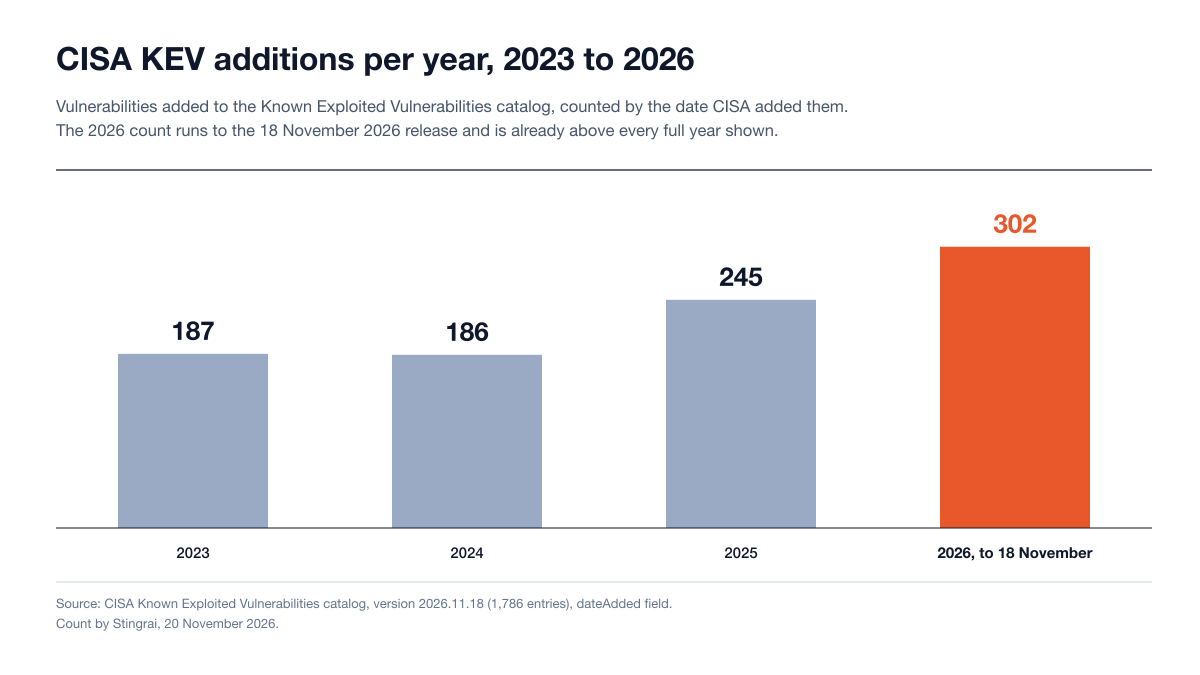
Figure 2: Vulnerabilities added to CISA's KEV catalog per year, 2023 to 18 November 2026, counted by date added. Source: CISA KEV catalog, version 2026.11.18.
CISA's BOD 26-04, issued on 10 June 2026, revoked BOD 22-01 and ties federal remediation deadlines to public exposure, KEV status, exploit automation and technical impact: an exposed, KEV-listed, automatable vulnerability giving total control gets three days and a forensic triage. It binds only US federal civilian agencies, but FIRST's CVSS FAQ calls it "a model for other organizations to use or adapt"; see our analysis of the BOD 26-04 KEV clock.
A practical order for VAPT findings
Stingrai recommends this order when a VAPT report lands. It is a working rule, not a published standard:
KEV-listed vulnerabilities on internet-facing assets, and anything the testers exploited from the internet.
Findings the testers chained into sensitive data or privileged control, with or without a CVE.
KEV-listed vulnerabilities on internal assets, and findings with a high EPSS percentile on reachable assets.
High and Critical findings by CVSS-BTE that were not exploited during the test.
Everything else, on your normal patch and release cycle.
What should a VAPT report contain?
The report is what your customer, auditor or regulator will read, so specify it in the statement of work. Most sections below trace to NIST SP 800-115, PCI DSS v4.0.1 or CERT-In's 2025 guidelines; the attack path narrative and the attestation letter are Stingrai's recommendations.
Section | What it must show | Why it matters |
|---|---|---|
Executive summary | Overall risk, the attack paths that worked, the fixes to prioritize first | The board and the customer read this page only |
Scope and coverage | Assets, start positions, user roles, test dates, source addresses, exclusions | Proves what was and was not tested |
Methodology | The named standards followed (NIST SP 800-115, OWASP WSTG, PCI DSS 11.4.1) | Auditors check the method, not just the results |
Assessment results | Triaged scanner output with false positives marked, mapped to assets | Shows the breadth half was done |
Penetration test findings | For each: CVSS severity with its vector, exploitability context such as KEV listing and EPSS where a CVE applies, affected assets, evidence, reproduction steps and business impact | Lets engineers reproduce and fix; CERT-In requires CVSS and EPSS from its auditors |
Attack path narrative | How access moved from the first foothold to the final impact | Shows chaining no single finding reveals |
Remediation plan | Fixes in priority order, with owners and dates | NIST's plan of action and milestones |
Retest results | Each finding's status after fixes, with dates | PCI DSS 11.4.4; CERT-In follow-up audit |
Attestation letter | Scope, dates and the tester's independence, readable without the findings | What you send a customer or prospect |
PCI DSS 11.4.1 also requires you to keep results and remediation records for at least 12 months. For a real example of a report scored with full CVSS vectors, see our penetration testing report sample.
How often should you run VAPT?
Stingrai's rule of thumb: at least once a year for each in-scope asset, after every significant change, and more often for internet-facing web applications that change weekly. The texts set floors, not targets:
Framework | Assessment cadence | Penetration test cadence |
|---|---|---|
PCI DSS v4.0.1 | Internal scans and external ASV scans at least once every three months (11.3.1, 11.3.2) | Internal and external tests at least once every 12 months and after any significant upgrade or change (11.4.2, 11.4.3) |
MAS TRM Guidelines | "Commensurate with the criticality of the IT system" (13.1.1) | Internet-facing systems at least once annually or after major changes (13.2.4) |
CERT-In guidelines (2025) | The cyber security audit "at least once in a year" (13.1.2) | Same audit cycle, plus an audit after every major change, based on criticality (13.1.2) |
NCA ECC 2:2024 | Periodic (2-10-3) | Periodic (2-11-3) |
For SOC 2, ISO 27001, HIPAA and NYDFS, the comparison guide covers what auditors expect. Treat these as triggers for an unscheduled VAPT: a new internet-facing application or API, a release that touches authentication or payments, a cloud migration, an acquisition, and any KEV entry for a product you run on the edge.
Why web applications need continuous testing
An annual VAPT is a snapshot of the weeks it ran. Verizon's 2026 DBIR found the median organization had almost 50% more KEV-listed vulnerabilities to patch than a year earlier (16, up from 11), and the median time to fully resolve a KEV-listed vulnerability rose to 43 days from 32. Applications that ship every sprint change faster than an annual test can track.
That is the case for Stingrai's continuous Hybrid Pentest: US$1,275 per month on a 12-month plan for one web application and associated APIs, with monthly Snipe testing, human-verified, and a quarterly deep dive by Stingrai's penetration testers, so each release is tested in the month it ships. Teams that need one report a year can buy the same Hybrid engagement once at US$6,800 per assessment. Compare both on the pricing page or request a quote for several applications.
What does VAPT cost?
VAPT is priced by scope and depth, because the penetration test half is measured in tester days. The drivers that move a quote:
Scope units: roles, endpoints and workflows for applications; live hosts (not address space), subnets, VLANs and sites for networks; accounts and identity design for cloud.
Start positions and depth: external only or internal from an assumed-breach account; blackbox, greybox with credentials for every role, or whitebox with source code.
Active Directory and segmentation: domains, forests and trusts, and whether segmentation must be proven for PCI DSS.
Evidence: severity with exploitability context, an attestation letter, and a retest included rather than billed again.
Scope | Stingrai price or range | Source |
|---|---|---|
One web application and associated APIs, Hybrid Pentest, one-time | US$6,800 per assessment | |
One web application and associated APIs, Hybrid Pentest, continuous | US$1,275 per month on a 12-month plan | |
Internal and external network penetration test | Typically US$5,000 to US$40,000 and above | |
PCI DSS network scope (internal, external and segmentation) | Commonly US$12,000 to US$25,000 | |
Several applications, cloud, Active Directory-only or mixed estates | Quoted to scope, with the retest included |
Duration follows the same drivers. On Stingrai's network page, an external-only test of a single entity with fewer than 50 live hosts takes 3 to 5 tester days across one to two weeks, and a PCI scope bundling internal, external and segmentation testing typically runs three to six weeks. For market ranges, see our penetration testing cost guide.
Questions to ask a VAPT provider, and the red flags
Four questions Stingrai suggests for the RFP
Who will test, by name, and is the firm itself accredited? (For CREST, the CREST Marketplace is the source of truth.)
How are findings prioritised: CVSS severity plus exploitability context such as KEV listing and EPSS?
Is the retest included, and are its results written into the final report?
What does the attestation letter state, and can we share it with customers?
For a longer, scored list, see the pentest and red team RFP question bank.
Red flags
Stingrai's guidance, with the standard that speaks to each point where there is one:
Red flag | Why it matters | Ask for instead |
|---|---|---|
Scanner output relabelled as a penetration test: finding titles match scanner check names, no exploitation evidence, no attack paths | Only the assessment half was done; NIST notes scanners check only for the "possible existence" of a vulnerability | Exploitation evidence for every exploitable finding, and a narrative of what was chained |
Severity copied from the scanner, or CVSS numbers with no vector | NIST says assessors should set the risk level themselves, and FIRST says "CVSS-B Base scores are not risk" | CVSS vectors with their version, plus exploitability context such as KEV listing and EPSS |
A one or two day "VAPT" for a large estate | The penetration test half cannot fit; the quote is for a scan | A tester-day estimate tied to your scope units |
No written rules of engagement | Testing without written authority is a legal and operational risk | Signed scope and rules of engagement before testing starts |
Retest excluded or billed separately | PCI DSS 11.4.4 and CERT-In both expect verification of fixes | The retest included, with results in the final report |
Fees tied to the number of findings or to closure | CERT-In says payments "should not be contingent upon the outcome of the audit" | A fixed price for a defined scope, deliverables and timeline |
Where Stingrai fits
Stingrai is a CREST-accredited penetration testing company founded in Toronto, Canada in 2021, with an office in London. It holds two CREST accreditations, Penetration Testing and AI-Enabled Penetration Testing, and the company certification CREST AI Charter, all listed on its CREST Marketplace page, and it is proud to be a CREST member. Its researchers have published 18 CVEs.
Network engagements are human-led by two named penetration testers from a team holding OSCE³, OSEP, CRTO, CREST CRT and CISSP certifications, with every report reviewed by the team lead and an engagement partner. Each finding is posted to the PTaaS portal as it is confirmed, so remediation starts during the test. Engagements run as one-time annual tests or as continuous programs, and Stingrai's testing supports SOC 2, ISO 27001, PCI DSS and HIPAA compliance programs with the evidence their audits ask for.
Frequently Asked Questions
What is vulnerability assessment and penetration testing (VAPT)?
VAPT is a single security engagement with two halves. The vulnerability assessment finds and ranks known weaknesses across an agreed scope through discovery, authenticated scanning and analyst triage. The penetration test has qualified testers exploit and chain those weaknesses, and test authorization and business logic, to prove what an attacker can reach. NIST SP 800-115 puts the difference simply: scanners check only for the possible existence of a vulnerability, while a penetration test exploits it to confirm it.
How much does VAPT cost in 2026?
It depends on scope and depth. Stingrai's Hybrid Pentest for one web application and associated APIs is US$6,800 per assessment, or US$1,275 per month on a 12-month plan as a continuous program. A network penetration test typically costs US$5,000 to US$40,000 and above, and PCI DSS scopes bundling internal, external and segmentation testing commonly cost US$12,000 to US$25,000. Larger or mixed estates are quoted to scope, with the retest included.
What are the steps in a VAPT engagement?
There are six: scope and rules of engagement, discovery, automated vulnerability assessment, manual validation and exploitation, reporting and prioritization, and remediation and retest. NIST SP 800-115 describes the penetration test itself in four phases: planning, discovery, attack and reporting. For cardholder data environments, PCI DSS Requirement 11.4.4 requires penetration testing to be repeated to verify corrections.
What does VAPT cover for web applications, networks and cloud?
For web applications and APIs, the assessment covers component versions and configuration, and the penetration test covers authentication, authorization between users and tenants, and business logic. For networks, the test adds exploitation, lateral movement, Active Directory and segmentation to the assessment's view of exposed services and patch level. For cloud, the test checks whether configuration and identity weaknesses chain into cross-account or privileged access.
How often should VAPT be done?
Stingrai's rule of thumb is at least once a year for each in-scope asset and after every significant change. PCI DSS v4.0.1 requires scans at least once every three months and penetration tests at least once every 12 months and after significant change. MAS expects internet-facing systems to be tested at least once annually or after major changes, and CERT-In's guidelines say the cyber security audit should be conducted at least once a year. Web applications that ship frequently benefit from continuous testing.
How should VAPT findings be prioritized?
Use three public signals and your test evidence. CVSS measures severity and is most useful with its vector and version; EPSS estimates the probability of exploitation in the next 30 days; the CISA KEV catalog records confirmed exploitation in the wild. Stingrai's working order: fix KEV-listed vulnerabilities on internet-facing assets and anything the testers exploited first, then chained findings, then high-EPSS and internal KEV matches, then the rest by CVSS-BTE.
What should a VAPT report include?
An executive summary, the scope and coverage tested, the methodology, the triaged assessment results, and penetration test findings with CVSS severity and vectors, exploitability context such as KEV listing and EPSS, evidence, reproduction steps and fixes. Add an attack path narrative, a remediation plan, retest results and an attestation letter you can share with customers.
Is a vulnerability scan the same as VAPT?
No. A vulnerability scan is one input to the assessment half of VAPT. It reports what might be vulnerable, often with false positives, and cannot find flaws that appear only when weaknesses are combined or when one user can reach another user's data. A report with no exploitation evidence is a scan, whatever its title says.
Which regulators in India, Singapore and Saudi Arabia require vulnerability assessment and penetration testing?
CERT-In's 2025 audit guidelines name VAPT as an audit type. MAS's Technology Risk Management Guidelines cover vulnerability assessment in section 13.1 and penetration testing in section 13.2, and Saudi Arabia's NCA Essential Cybersecurity Controls pair vulnerabilities management (2-10) with penetration testing (2-11). Buyers working to these texts often ask for both in one engagement.
Is a retest part of VAPT?
It should be. PCI DSS v4.0.1 Requirement 11.4.4 requires penetration testing to be repeated to verify corrections, and CERT-In's guidelines say follow-up audits should be included in the scope. Ask whether the retest is in the price and whether its results go into the final report. Stingrai includes the retest in every engagement.
Related reading
Vulnerability Assessment vs Penetration Testing (2026): Differences, Cost and What Auditors Accept
Vulnerability Assessment and Penetration Testing (VAPT) Services: Top Providers 2026
Web Application Security Assessment (2026): Testing Methods, Scope and Cost
The 72-Hour Clock: CISA Revoked BOD 22-01, and Your Remediation Window Went With It
Network Security Assessment (2026): What It Tests, Audit vs Pentest, and Cost
Network Penetration Testing (2026): What It Is, What's Included, Types, Process and Cost
References
NIST. SP 800-115, Technical Guide to Information Security Testing and Assessment. September 2008.
PCI Security Standards Council. PCI DSS Requirements and Testing Procedures, v4.0.1, June 2024, Requirements 11.3 and 11.4 (document library; v4.0.1 announcement).
FIRST. CVSS v4.0 Specification Document, version 1.2, and CVSS v4.0 FAQ.
FIRST. Exploit Prediction Scoring System, EPSS FAQ and Using EPSS.
CISA. Known Exploited Vulnerabilities Catalog, version 2026.11.18, and KEV inclusion criteria.
CISA. BOD 26-04: Prioritizing Security Updates Based on Risk. 10 June 2026.
CERT-In. Comprehensive Cyber Security Audit Policy Guidelines, version 1.0, 25 July 2025, and Empanelled Information Security Auditing Organisations.
Monetary Authority of Singapore. Technology Risk Management Guidelines. January 2021.
National Cybersecurity Authority (Saudi Arabia). Essential Cybersecurity Controls, ECC 2:2024.
Verizon. 2026 Data Breach Investigations Report and its Executive Summary, and the 2025 Executive Summary.
OWASP. Web Security Testing Guide (v4.2) and API Security Top 10 2023.
AWS, Google Cloud and Microsoft. AWS penetration testing policy, Google Cloud penetration testing FAQ and Microsoft Security Testing Rules of Engagement.
Talk to Stingrai
Turning "get a VAPT done" into a scope, a quote and a report your customer or auditor will accept takes one short conversation. Get a quote or book a free discovery call.