A network security assessment is a structured evaluation of how well an organization's networks meet their security objectives, built from the three kinds of work NIST SP 800-115 describes: reviewing architecture, firewall rulesets and device configurations; finding hosts, services and known vulnerabilities; and validating the weaknesses that matter by penetration testing. Exploited vulnerabilities are now the most common way in: exploitation of vulnerabilities was the top initial access vector in Verizon's 2026 Data Breach Investigations Report, at 31% of non-Error, non-Misuse breaches with a known initial access vector (n=19,905), up from 20% a year earlier. Fixing is slower than finding: only 26% of the vulnerabilities from CISA's Known Exploited Vulnerabilities (KEV) catalog that scanners found across more than 13,000 organizations were fully remediated in 2025.
Quick answer. A network security assessment checks a network four ways: it reviews the architecture, segmentation, firewall and VPN rulesets and device configurations; it discovers hosts and services and scans them for known vulnerabilities; it validates the important weaknesses by penetration testing; and, where scoped, it starts from an assumed-breach foothold to see how far an insider reaches. A network security audit is a different job: an independent check of controls against set criteria that ends in a report or opinion, and assessment and penetration test results are evidence it reviews. Stingrai's network engagements typically cost US$5,000 to US$40,000 and above, with the retest included.
This guide is for IT directors, infrastructure leads and CISOs deciding what to buy. For the test checklist itself, see our network penetration testing checklist; for test types and phases, see network penetration testing explained.
Network security assessment vs audit vs vulnerability assessment vs penetration test
Requests for proposals often use these five terms interchangeably, but they answer different questions. The definitions come from NIST and CNSSI 4009 via the NIST glossary; the columns are Stingrai's summary.
Term | The question it answers | How it works | What you get | Framework anchor |
|---|---|---|---|---|
Network security assessment | How well does the network meet its security objectives, and where are the gaps? | Examine, interview and test: architecture and ruleset review, configuration review, discovery and scanning, penetration testing | Ranked findings across design, configuration and exploitable weaknesses, with fixes | NIST SP 800-115; SP 800-53 CA-2 Control Assessments |
Network vulnerability assessment | Which known weaknesses exist on which hosts? | Discovery plus authenticated and unauthenticated scanning, then triage | A ranked list of vulnerabilities per host | SP 800-53 RA-5; CIS Safeguards 7.5 and 7.6; PCI DSS 11.3 |
Network penetration test | What can an attacker actually reach and do? | Qualified testers exploit and chain weaknesses under rules of engagement | Proven attack paths with evidence | SP 800-53 CA-8; CIS Control 18; PCI DSS 11.4 |
Network security audit | Do the controls meet the stated criteria? | Independent review of records, evidence and activity against criteria | A report or opinion on conformance | CNSSI 4009 and NIST SP 800-12 definitions; AICPA SOC reports; PCI DSS Report on Compliance |
Network security risk assessment | Which threats matter most, and how likely and harmful are they? | Analysis of threats, vulnerabilities, likelihood and impact | A prioritized risk register | SP 800-53 RA-3; NIST SP 800-30 |
The short version: an assessment finds and ranks weaknesses, a penetration test proves which ones an attacker can use, and an audit judges whether the controls meet a standard, using the first two as evidence.
Why assess the network in 2026?
Verizon's figures cover incidents between 1 November 2024 and 31 October 2025. In the same report, the median time to fully remediate a KEV-listed vulnerability rose to 43 days from 32 (n=10,597 companies), and the median organization had 16 distinct KEV-listed vulnerabilities to patch in 2025, up from 11 in 2024 (n=13,773). The list keeps growing: CISA's KEV catalog held 1,786 entries in its 18 November 2026 release, 302 of them added in 2026, already more than the 245 added in all of 2025.
Exposure now sets the clock. BOD 26-04, which revoked BOD 22-01 on 10 June 2026, gives US federal civilian agencies three calendar days, plus forensic triage, to fix a KEV-listed flaw that is automatable and gives total control on a publicly exposed asset, while a flaw on an exposed asset with no KEV entry, no automation and only partial control gets 60 days. Whether an asset is exposed, and which KEV entries sit on it, are exactly the facts a network security assessment establishes; our BOD 26-04 guide covers the timelines.
What is a network security assessment?
NIST SP 800-115 defines an information security assessment as "the process of determining how effectively an entity being assessed" (a host, system, network, procedure or person) "meets specific security objectives", using three methods: testing, examination and interviewing. NIST SP 800-53A Rev. 5 uses the same trio for control assessments and adds two attributes that set the level of effort, depth ("rigor and level of detail") and coverage ("scope or breadth"), each graded basic, focused or comprehensive. Those are useful words for a statement of work.
SP 800-115 groups the technical work into three families:
Review techniques: documentation, log, ruleset and system configuration review, network sniffing and file integrity checking. Because they are passive, NIST notes they "pose minimal risk to systems and networks."
Target identification and analysis: network discovery, port and service identification, vulnerability scanning and wireless scanning.
Target vulnerability validation: password cracking, penetration testing, social engineering and application security testing.
Assessments combine them because, in NIST's words, "no one technique can provide a complete picture of the security of a system or network." Government practice works the same way: in advisory AA23-278A, CISA describes its Risk and Vulnerability Assessment team as conducting "remote and onsite assessment services, including penetration testing and configuration review." The assessment is the umbrella; the penetration test is one technique under it.
One naming trap: in Stingrai's experience, "network assessment" is also sold as a review of performance, capacity and inventory with no security testing in it. Ask which of the three technique families a quote includes.
What does a network security assessment test?
A complete assessment covers eight areas. The control references show where each area already sits in standards you may be measured against; the mapping is Stingrai's.
Area | What is examined or tested | SP 800-115 technique | Where the requirement sits |
|---|---|---|---|
External exposure | Internet-facing hosts and services, VPN and remote access, exposed management interfaces, forgotten assets | Discovery, port and service identification, scanning, then validation | CIS Safeguard 18.2 (reconnaissance); PCI DSS 11.3.2 and 11.4.3 |
Perimeter and internal rulesets | Firewall rules and router access control lists: still needed, least privilege, specific before general, no bypass, default deny | Ruleset review, then validation of what traffic actually passes | PCI DSS 1.2.7; CIS Safeguard 13.4 |
Architecture and segmentation | Trust zones, filtering between segments, isolation of the cardholder data environment (CDE) and operational technology, diagrams versus reality | Documentation review, discovery, segmentation testing | CIS Safeguards 12.2 and 12.4; PCI DSS 1.2.3 and 11.4.5 |
Network device configuration | Hardening of firewalls, routers, switches and VPN gateways, default accounts, management protocols, firmware currency | System configuration review | CIS Safeguards 4.2, 12.1, 12.3 and 12.6 |
Internal vulnerabilities | Authenticated and unauthenticated scans of servers, workstations and appliances, with false positives removed | Vulnerability scanning plus manual validation | CIS Safeguard 7.5; PCI DSS 11.3.1; SP 800-53 RA-5 |
Active Directory and credentials | Separation of user and administrator privilege, permission paths, credential reuse, multifactor authentication on remote and administrative access | Configuration review, password testing, validation | NSA and CISA AA23-278A |
Wireless | Authorized and rogue access points, guest isolation, enterprise Wi-Fi settings | Wireless scanning | PCI DSS 11.2.1 |
Monitoring and response | Whether the testing was logged, alerted and acted on | Log review; announced or covert testing | CIS Control 13; AA23-278A |
Active Directory deserves its own scope line in most enterprises; our Active Directory security assessment guide covers what that module adds.
The review work a scan and a pentest both skip
The two review rows set an assessment apart. A firewall ruleset review, as SP 800-115 lays it out, checks that each rule "is still required", that rules "enforce least privilege access, such as specifying only required IP addresses and ports", that "more specific rules are triggered before general rules", and that "the ruleset does not allow traffic to bypass other security defenses". For router access control lists, everything not authorized should be "denied by default", and temporary rules removed once they are no longer needed.
PCI DSS v4.0.1 puts a clock on this: Requirement 1.2.7 says "Configurations of NSCs are reviewed at least once every six months to confirm they are relevant and effective", where NSCs are network security controls such as firewalls. System configuration review finds what SP 800-115 lists as "unnecessary services and applications, improper user account and password settings, and improper logging and backup settings." Neither kind of weakness needs a CVE to be dangerous, which is why a scanner reports it partly or not at all. Review also needs access a black-box test never gets: SP 800-115 notes it requires "root or administrator privileges to view selected security settings", so plan for read-only exports or a supervised session.
What is a network security audit, and how is it different?
What an audit is
CNSSI 4009-2022 (from ISO 30401:2018), as quoted in the NIST glossary, defines an audit as a "systematic, independent and documented process for obtaining audit evidence and evaluating it objectively to determine the extent to which the audit criteria are fulfilled." Three things define it: independence, criteria, and a conclusion about conformance.
Two familiar examples show who issues the conclusion. The AICPA describes SOC as "a suite of service offerings CPAs may provide", which CPAs use "to provide assurance reports" (AICPA and CIMA). PCI DSS calls its own validation an assessment: it ends in a Report on Compliance or a Self-Assessment Questionnaire plus an Attestation of Compliance, and Qualified Security Assessor (QSA) companies sign an agreement with the PCI Security Standards Council. So "PCI assessment" usually means compliance validation, not the technical network assessment this guide describes.
In Stingrai's experience, some quotes titled "network security audit" describe a configuration review against a hardening checklist. Under the definitions above, that is part of an assessment.
How an assessment differs
The CNSSI 4009 definition of assessment draws the line itself: "Assessments are generally informational in nature and used to support decision making and to inform formal inspections or audits", and they "are considered separate from these activities." An assessment gives you findings and fixes, and the evidence an audit can review.
Where the penetration test sits
A penetration test is a validation technique inside an assessment, and also a standalone requirement in PCI DSS 11.4, CIS Control 18 and NIST SP 800-53 CA-8. SP 800-115 describes testing "in which evaluators mimic real-world attacks", usually looking for "combinations of vulnerabilities" that give "more access than could be achieved through a single vulnerability." PCI DSS guidance to 11.4.1 draws the line with scanning: "Scanning for vulnerabilities alone is not a penetration test." Requirements 11.4.2 and 11.4.3 ask for a qualified internal resource or qualified external third party with organizational independence, "not required to be a QSA or ASV".
Vulnerability assessment and risk assessment
In network work, a vulnerability assessment usually means discovery and scanning with triage: the first rung of an assessment, not the whole of it. A risk assessment, in the NIST SP 800-30 sense, is "a systematic examination of risk" that helps decision makers "evaluate and prioritize risks", and it uses assessment findings as one input. For the scan-versus-test choice in compliance terms, see vulnerability assessment vs penetration testing, and for the combined engagement, our VAPT guide.
How the three connect
Evidence flows one way: the assessment and the penetration test produce findings, attack paths and retest results, and the auditor reviews them against the criteria. Stingrai's network testing produces that evidence for your PCI DSS, SOC 2 and ISO 27001 programs: a report with a scope and coverage statement, reproduction evidence, retest results and an attestation letter stating scope and testing dates. See PCI DSS penetration testing for how 11.4 evidence is read.
How deep should a network security assessment go?
Depth is a buying decision. In Stingrai's four-rung ladder, the first three rungs each add one of SP 800-115's technique families and the fourth moves the starting point inside the network; each rung costs more and surfaces something the rung below cannot.
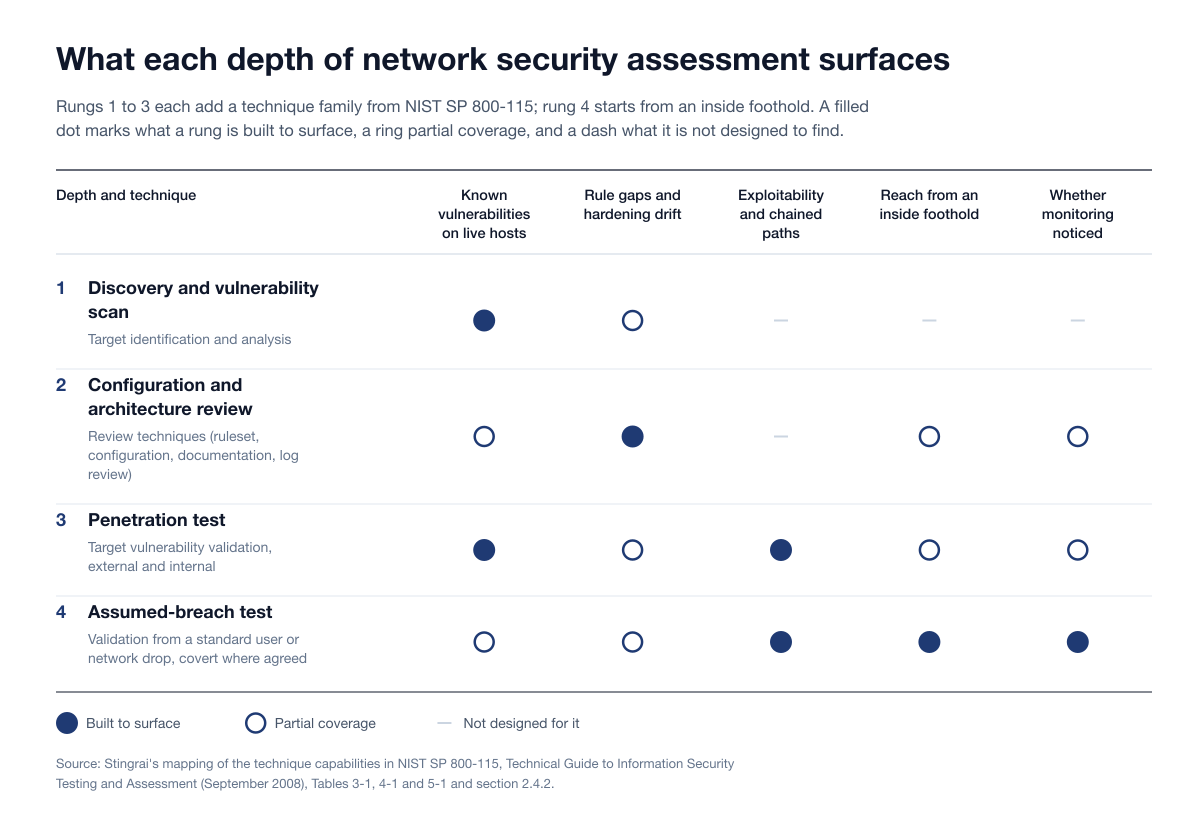
Figure 1: What each depth of network security assessment is built to surface, Stingrai's mapping of the technique capabilities in NIST SP 800-115 Tables 3-1, 4-1 and 5-1 and section 2.4.2. Source: NIST SP 800-115.
Rung 1: discovery and vulnerability scanning
Discovery maps live hosts and services; scanning matches them against known vulnerabilities. CIS Safeguard 7.5 asks for internal scans "on a quarterly, or more frequent, basis", both authenticated and unauthenticated. SP 800-115 documents the limits: scanners find "surface vulnerabilities" that exist "in isolation", "can have a high false positive error rate", and are "unable to detect vulnerabilities that are revealed only as the result of potentially unending combinations of attack patterns." Use this rung for hygiene between deeper assessments, not as the assessment.
Rung 2: configuration and architecture review
Ruleset, configuration and diagram review find rule gaps, hardening drift and segmentation that does not match the diagram. CIS Safeguard 12.2 says a secure network architecture "must address segmentation, least privilege, and availability, at a minimum." This rung is passive and low risk, and, in Stingrai's experience, it is the rung most often missing from quotes labelled "assessment".
Rung 3: penetration test
Testers validate and chain what the first two rungs found, from outside and from a network position inside. SP 800-115's Table 5-1 says penetration testing "demonstrates how vulnerabilities can be exploited iteratively to gain greater access." Our internal and external guides cover each half.
Rung 4: assumed-breach test
The assumed-breach test is the same validation work as rung 3, started from a standard domain account or a network drop, the position an attacker holds after one phished laptop. It measures what that foothold reaches and whether anyone notices. Run covertly, this rung is what SP 800-115 calls covert testing, which it says is useful for testing "IT staff response to perceived security incidents" but "does not test every security control", which is why this rung sits on top of the others rather than replacing them. In AA23-278A, one NSA and CISA assessment team "gained persistent deep access to a large organization with a mature cyber posture" whose defenders did not detect its lateral movement, persistence or command and control.
What do network security assessments find?
Through red and blue team assessments, plus hunt and incident response work, NSA and CISA named the ten most common network misconfigurations in October 2023. CISA's vulnerability management teams alone "have assessed the security posture of over 1,000 network enclaves," and the agencies call the ten "systemic weaknesses in many large organizations, including those with mature cyber postures." Many of those assessments were of Windows and Active Directory environments. The right-hand column is Stingrai's mapping of the depth at which each one usually surfaces.
AA23-278A misconfiguration | Depth that usually surfaces it |
|---|---|
Default configurations of software and applications | Scan (some default credentials), configuration review |
Improper separation of user/administrator privilege | Configuration review, assumed-breach test |
Insufficient internal network monitoring | Assumed-breach test |
Lack of network segmentation | Architecture review, segmentation test |
Poor patch management | Scan, then penetration test to prove impact |
Bypass of system access controls | Penetration test |
Weak or misconfigured multifactor authentication (MFA) methods | Configuration review, penetration test |
Insufficient access control lists (ACLs) on network shares and services | Configuration review, assumed-breach test |
Poor credential hygiene | Penetration test (password testing), assumed-breach test |
Unrestricted code execution | Configuration review, assumed-breach test |
In this mapping, most of the ten are configuration and design weaknesses that a scanner reports partly or not at all. That is the practical argument for rungs 2 to 4.
Three finding chains an assessment is built to catch
These are illustrations composed from the misconfigurations above, not client cases.
Remote access to the server zone. A VPN gateway accepts a default administrative account without MFA (AA23-278A items 1 and 7), the VPN pool shares a flat network with file servers (item 4), and a share every domain user can read holds service account passwords (items 8 and 9). Fix: remove default accounts, enforce phishing-resistant MFA on remote access, filter the VPN pool away from server segments and tighten share permissions. Ruleset review spots the broad rule; the penetration test proves the path.
A temporary rule that stayed. A rule added for a migration still lets a supplier subnet reach a core switch's management interface, which keeps a default configuration (item 1). Fix: remove the rule, move management interfaces to a dedicated management network and hold the six-monthly review PCI DSS 1.2.7 expects. An external scan never sees this; a ruleset review does.
One workstation to the domain. From a standard user account, shared local administrator passwords (item 9) and privileged credentials cached on workstations (item 2) let a captured hash move across workstations (item 6) without an alert (item 3). Fix: unique local administrator passwords, tiered administration so privileged accounts never sign in to workstations, and monitoring of traffic between hosts. Only the assumed-breach rung measures the missing alert.
How to scope a network security assessment: the worksheet
Send these with a quote request. The review rung depends on documents, not only counts.
Input | Why it changes the work | Where it usually lives |
|---|---|---|
Public IP ranges, domains and cloud-hosted perimeter | External effort; unknown assets need discovery, which CIS 18.2 calls "enterprise and environmental reconnaissance" | DNS, registrar, cloud accounts |
Estimated live internal hosts per site | Scanning and validation effort | Asset inventory, DHCP, configuration management database |
Sites, VLANs and zones, including any CDE or operational technology zone | Segmentation tests and delivery (on-site, shipped device or VPN) | Network diagram; PCI DSS 1.2.3 asks for one showing all connections to the CDE |
Firewalls, VPN gateways, routers and core switches: count, make and configuration exports | Ruleset and configuration review effort | Firewall manager, configuration backups |
Active Directory forests, domains and approximate user count | Depth of privilege-path analysis | Directory administrators |
Wireless networks and sites | Wireless scanning and on-site time | Network team |
Start positions: external only, network drop, standard user, VPN user | Whether rung 4 is in scope | Security lead |
Test windows, fragile systems and exclusions | Safety and duration | Change management |
Last scan, last penetration test and open findings | Focus and retest of old issues | Previous reports |
Compliance drivers: PCI DSS, SOC 2, ISO 27001, cyber insurance | Evidence format and segmentation scope | Compliance owner |
For a general scoping method across test types, see how to scope a penetration test.
What should a network security assessment report contain?
SP 800-115 says a test report is generally developed to "describe identified vulnerabilities, present a risk rating, and give guidance on how to mitigate the discovered weaknesses." That is the minimum. A report you can act on and hand to an auditor also has:
A scope and coverage statement: ranges, sites, devices reviewed, start positions, dates, source addresses, and what passed.
The method by technique family: what was reviewed, scanned and tested, so a reader can tell an assessment from a scan.
Configuration and ruleset observations: the rule or setting, why it matters, and the standard it maps to.
Findings with exposure and KEV status: the inputs that set remediation urgency under BOD 26-04.
An attack path narrative and a remediation plan: ordered by exploitability and exposure, not scanner severity alone.
Retest results: each fix verified, as PCI DSS 11.4.4 expects for exploitable findings.
How often should you run a network security assessment?
No standard sets one frequency for "an assessment". They set minimums for each technique, and a sensible program stacks them.
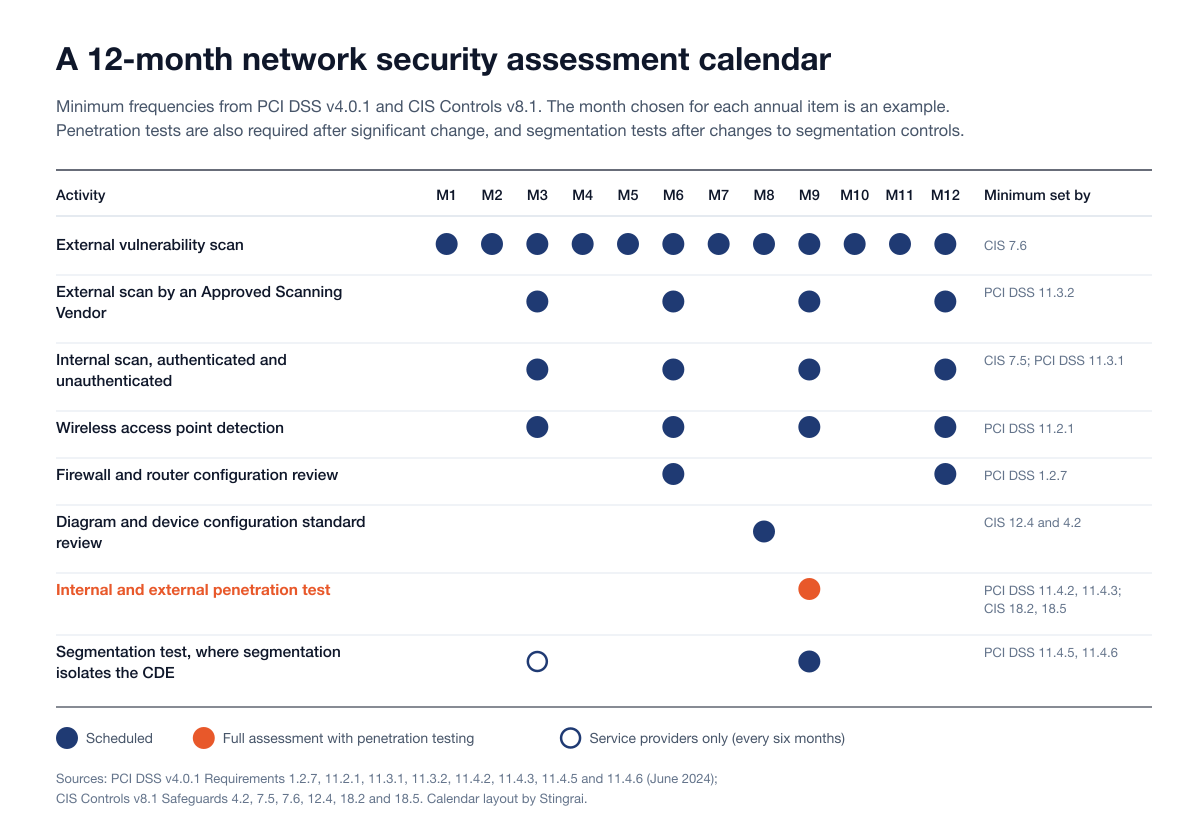
Figure 2: A 12-month network security assessment calendar built from the minimum frequencies in PCI DSS v4.0.1 and CIS Controls v8.1; placement of the annual items is an example. Sources: PCI SSC document library and CIS Controls v8.1.
Activity | Minimum frequency | Source |
|---|---|---|
External vulnerability scans | Monthly or more often; quarterly by an Approved Scanning Vendor for PCI DSS | CIS 7.6; PCI DSS 11.3.2 |
Internal vulnerability scans, authenticated and unauthenticated | Quarterly or more often | CIS 7.5; PCI DSS 11.3.1 |
Wireless access point detection | At least once every three months | PCI DSS 11.2.1 |
Firewall and router configuration review | At least once every six months | PCI DSS 1.2.7 |
Architecture diagrams and network device configuration standards | Annually or after significant change | CIS 12.4 and 4.2 |
Internal and external penetration testing | At least every 12 months and after significant change | PCI DSS 11.4.2 and 11.4.3; CIS 18.2 and 18.5 |
Segmentation testing, where segmentation isolates the CDE | Every 12 months and after changes to segmentation controls; every six months for service providers | PCI DSS 11.4.5 and 11.4.6 |
The US federal benchmark is tighter. BOD 23-01 requires federal civilian agencies to "perform automated asset discovery every 7 days" and to initiate vulnerability enumeration across all discovered assets "every 14 days", with privileged credentials where technology allows.
Stingrai's suggested pattern: monthly external scans, quarterly internal scans, a six-monthly ruleset review, and one full assessment with penetration testing a year, plus a targeted test after each significant change such as a firewall migration or a new site. See how often to run penetration testing.
How much does a network security assessment cost in 2026?
Stingrai's network penetration testing service states that a network engagement typically costs US$5,000 to US$40,000 and above, driven by live host count, subnet and VLAN count, Active Directory footprint, number of sites and the start positions included. PCI DSS engagements that bundle internal, external and segmentation testing commonly land at US$12,000 to US$25,000. Every quote is a fixed price with the retest included, returned within 24 hours of a Get a Quote request.
Duration tracks size. The same page gives these typical durations:
Scope | Typical effort and elapsed time |
|---|---|
External only, one entity, fewer than 50 live hosts | 3 to 5 tester days across one to two weeks |
External plus internal, one site, one domain | One to two tester weeks across two to four weeks |
Internal across multiple sites and a multi-domain forest | Four to eight weeks |
PCI DSS scope: internal, external and segmentation | Three to six weeks |
Within the range, Stingrai's page lists what sets the testing days: live hosts and IP ranges, subnets, VLANs and sites, Active Directory footprint, start positions, segmentation testing, and a black, grey or white-box approach. Three red flags in an "assessment" quote: scanner output with no manual validation, no ruleset or configuration review, and no statement of what was tested and passed. For a planning number, try the pentest cost calculator or read our penetration testing cost guide.
Where Stingrai fits
Stingrai is a CREST-accredited penetration testing company founded in Toronto, Canada in 2021. Stingrai Inc holds two CREST accreditations, Penetration Testing and AI-Enabled Penetration Testing, and the CREST AI Charter company certification, all listed on its CREST Marketplace page.
Network engagements are human-led by two named penetration testers from a team holding OSCE³, OSEP, CRTO, CREST CRT and CISSP certifications, and every report is reviewed by the team lead and an engagement partner. External testing starts black-box from the public internet; internal testing usually starts from an assumed-breach position, a standard domain account or a network drop. Coverage includes Active Directory attack paths, lateral movement between hosts and VLANs, switches, routers, firewalls and their management planes, default device credentials, and segmentation with firewall rule and access control list validation. Grey-box and white-box variants add network diagrams, credentials and configurations, so review and testing run together, and Active Directory and Wi-Fi assessments can join the same engagement.
Findings are posted to the PTaaS portal as they are confirmed, retesting is included, and every human-led and hybrid report ships with an attestation letter. Engagements run as one-time annual assessments or as continuous programs.
If the assessment surfaces internet-facing web applications, Stingrai's Hybrid Pentest has Snipe, its autonomous agent, test the full application while certified penetration testers test the same application manually alongside it and validate Snipe's findings, at US$6,800 per assessment or US$1,275 per month on a 12-month plan, for one web application and associated APIs (pricing).
Frequently Asked Questions
What is a network security assessment?
A network security assessment is a structured evaluation of how well a network meets its security objectives. Following NIST SP 800-115, it combines review of architecture, firewall rulesets and device configurations, discovery and vulnerability scanning, and validation by penetration testing. Stingrai's network engagements typically cost US$5,000 to US$40,000 and above, with the retest included.
How much does a network security assessment cost in 2026?
Stingrai's network engagements typically cost US$5,000 to US$40,000 and above, driven by live hosts, subnets and VLANs, Active Directory footprint, sites and start positions. PCI DSS engagements that bundle internal, external and segmentation testing commonly land at US$12,000 to US$25,000, as a fixed price with the retest included.
What is the difference between a network security assessment and a network security audit?
An assessment finds and ranks weaknesses so you can fix them. An audit is an independent check of controls against set criteria that ends in a report or opinion on conformance, such as a SOC 2 report from a CPA firm. The CNSSI 4009 definition says assessments inform audits but are separate from them.
What is the difference between a network security assessment and a penetration test?
A penetration test is one technique inside a network security assessment: testers exploit and chain weaknesses to prove what an attacker can reach. A full assessment adds the review work a penetration test usually skips, such as firewall ruleset, device configuration and architecture review.
Is a network vulnerability assessment the same as a network security assessment?
No. A network vulnerability assessment usually means discovery and scanning with triage, the first rung of a network security assessment. NIST SP 800-115 notes that scanners have a high false positive rate and miss weaknesses that only appear in combination.
What does a network security assessment checklist include?
It covers external exposure, firewall and router rulesets, architecture and segmentation, network device configuration, internal vulnerabilities, Active Directory and credentials, wireless, and monitoring and response, each mapped to a standard such as PCI DSS 1.2.7 or CIS Safeguard 12.2.
How long does a network security assessment take?
On Stingrai's published figures, an external-only test of one entity with fewer than 50 live hosts takes 3 to 5 tester days across one to two weeks. External plus internal testing on one site and one domain takes one to two tester weeks across two to four weeks.
How often should a network security assessment be done?
Run a full assessment with penetration testing at least every 12 months and after significant change (PCI DSS 11.4.2 and 11.4.3). Between them, scan externally monthly and internally quarterly (CIS Safeguards 7.6 and 7.5) and review firewall and router configurations at least every six months (PCI DSS 1.2.7).
Does PCI DSS require a network security assessment?
PCI DSS v4.0.1 does not use the phrase, but it requires the parts: quarterly internal and external scans (11.3.1 and 11.3.2), six-monthly reviews of network security control configurations (1.2.7), internal and external penetration tests at least every 12 months and after significant change (11.4.2 and 11.4.3), and, where segmentation is used to isolate the cardholder data environment, segmentation testing (11.4.5).
Related reading
References
NIST. SP 800-115, Technical Guide to Information Security Testing and Assessment. September 2008. https://csrc.nist.gov/pubs/sp/800/115/final. Methods, technique families, review and scanning limits.
NIST. SP 800-53A Rev. 5. January 2022. https://csrc.nist.gov/pubs/sp/800/53/a/r5/final. Examine, interview, test; depth and coverage; CA-2, CA-8, RA-3, RA-5.
NIST CSRC. Glossary. Read 20 November 2026. https://csrc.nist.gov/glossary. Definitions from CNSSI 4009-2022, SP 800-12, SP 800-30 and SP 800-115.
NSA and CISA. AA23-278A, Top Ten Cybersecurity Misconfigurations. 5 October 2023. https://www.cisa.gov/news-events/cybersecurity-advisories/aa23-278a. From red and blue team assessments.
PCI Security Standards Council. PCI DSS v4.0.1. June 2024. https://www.pcisecuritystandards.org/document_library/. Requirements 1.2.3, 1.2.7, 11.2.1, 11.3 and 11.4.
Center for Internet Security. CIS Controls v8.1 Assessment Specification. Read 20 November 2026. https://cas.docs.cisecurity.org/en/latest/source/Controls18/. Controls 4, 7, 12, 13 and 18.
CISA. BOD 26-04, Prioritizing Security Updates Based on Risk. 10 June 2026. https://www.cisa.gov/news-events/directives/bod-26-04-prioritizing-security-updates-based-risk. Risk-based remediation timelines.
CISA. BOD 23-01, Improving Asset Visibility and Vulnerability Detection on Federal Networks. https://www.cisa.gov/news-events/directives/bod-23-01-improving-asset-visibility-and-vulnerability-detection-federal-networks. Discovery and enumeration cadence.
CISA. Known Exploited Vulnerabilities catalog, release 2026.11.18. https://www.cisa.gov/known-exploited-vulnerabilities-catalog. Counts by date added, from the JSON feed.
Verizon. 2026 Data Breach Investigations Report. https://www.verizon.com/business/resources/Td15/reports/2026-dbir-data-breach-investigations-report.pdf. Incidents 1 November 2024 to 31 October 2025.
AICPA and CIMA. SOC Suite of Services. Read 20 November 2026. https://www.aicpa-cima.com/topic/audit-assurance/audit-and-assurance-greater-than-soc-2. SOC reports as CPA assurance services.
Stingrai. Internal and external network penetration testing. Read 20 November 2026. https://www.stingrai.io/services/internal-and-external-network-pen-test. Coverage, cost and duration.
Talk to Stingrai
Send your ranges, sites, device list and start positions and get a fixed-price network security assessment quote within 24 hours. Get a Quote or book a free discovery call.