Adversary simulation services put a team of operators in the role of a realistic attacker to measure whether your defenders notice and stop it; adversary emulation is the threat-informed version, in which the operators replay the documented behavior of one named threat group mapped to MITRE ATT&CK. The gap these services measure is not hypothetical. In a SILENTSHIELD assessment of a US federal civilian agency in 2023, CISA's red team told the security operations center (SOC) about its activity five months in, and at that point "the organization had not submitted deconflictions and did not appear to be actively investigating" (CISA AA24-193A).
Quick answer. Adversary simulation is the umbrella for realistic, objective-based attacks on your organization, delivered as red teaming (your SOC is not told) or purple teaming (operators and defenders work side by side). Adversary emulation picks a named group from threat intelligence and replays its known techniques, mapped to MITRE ATT&CK v20, which lists 182 groups. Buy it to answer "would we catch the group most likely to target us?", and judge every proposal on the actor rationale, the plan, the per-technique detection scorecard and the replay. Stingrai, a CREST-accredited penetration testing company, delivers adversary simulation as one-time exercises or continuous programs.
This guide is for security leaders buying adversary simulation for a mid-market or enterprise organization in the United States or Canada. Provider shortlists are in the best adversary simulation and red teaming companies, and red team engagement types in the red team services buyer's guide. Every source was read at its publisher on 20 November 2026.
What are adversary simulation services?
Adversary simulation services are engagements in which an outside team attacks your organization the way a real adversary would, toward objectives agreed in advance, so you can measure detection and response rather than count vulnerabilities. The standards vocabulary uses both verbs. NIST's glossary defines a red team as "a group of people authorized and organized to emulate a potential adversary's attack or exploitation capabilities against an enterprise's security posture" (NIST CSRC, from CNSSI 4009-2022), and a red team exercise as "a simulated adversarial attempt to compromise organizational missions or business processes" (NIST CSRC, from SP 800-53 Rev. 5).
A penetration test asks a different question. NIST SP 800-115 describes it as testing in which "evaluators mimic real-world attacks in an attempt to identify ways to circumvent the security features of an application, system, or network" (NIST CSRC). The target is the control; in adversary simulation, the target is the defender.
Every adversary simulation engagement has three ingredients:
An objective. TIBER-EU calls it a flag: "the objective that the RTT must strive to achieve during the test, e.g. compromising the confidentiality, integrity, or availability of the target system" (ECB, TIBER-EU Framework, January 2025).
An adversary model. Either a credible class of attacker (simulation) or a named group's documented tactics, techniques and procedures (emulation).
A measurement. For every step: prevented, alerted, logged or missed, and how long the SOC took to see and respond.
Stingrai's adversary simulation service packages these as red teaming, where defenders are not told in advance, and purple teaming, where operators and your blue team work together in real time, both mapped to MITRE ATT&CK.
Adversary simulation vs adversary emulation vs red teaming vs BAS vs purple teaming
The labels overlap because they describe different things: what the attacker is modeled on (simulation or emulation), how the test is delivered (red or purple) and who runs it (people or software).
Approach | Question it answers | Built from | Who knows in advance | Typical length | What you get |
|---|---|---|---|---|---|
Penetration test | What can be exploited inside a defined scope? | An asset list and a test methodology | The asset owners | Set by the scope | Findings with reproduction evidence and fixes |
Red teaming (covert adversary simulation) | Would our defenders notice and stop a credible attacker heading for our objectives? | Objectives plus a realistic attacker profile | A small white team | Weeks to months | Attack narrative, per-stage detection timeline, root causes |
Adversary emulation | Would we catch the named group most likely to target us? | One group's documented techniques from threat intelligence and ATT&CK | The white team, or the whole SOC when run as purple | Same as the delivery mode | A per-technique scorecard against that group's plan |
Purple teaming | Can we detect these techniques, and fix the misses now? | A chosen technique set, often from an emulation plan | Testers and defenders together | Scheduled sessions | Validated and tuned detections |
Breach and attack simulation (BAS) | Do our controls still block or alert on known behaviors today? | Scripted behaviors run by software | The security team that schedules it | Recurring | Control results over time |
Threat-led test (DORA TLPT, TIBER-EU) | Can our critical functions withstand the actors that target us, under supervision? | An independent targeted threat intelligence report | The control team and the supervising authority | At least 12 weeks of active testing | Red and blue team reports, replay, purple teaming |
Table 1: How the six approaches differ, in Stingrai's comparison. Definitions and the threat-led row draw on the NIST CSRC glossary, MITRE ATT&CK, the ECB TIBER-EU Framework (January 2025) and Commission Delegated Regulation (EU) 2025/1190, Articles 10 to 12.
Adversary simulation vs adversary emulation
Simulation gives the operators a credible attacker profile and the freedom to improvise toward the objective. Emulation holds them to one group's documented behavior. MITRE describes the intent behind its ATT&CK emulation plans: "We wanted operators to behave generally like a specific adversary (sticking to that adversary's known TTPs and behaviors), but having some latitude in actual implementation" (MITRE ATT&CK, Adversary Emulation Plans).
Emulation is not a forensic replay. MITRE's Center for Threat-Informed Defense (CTID) says its plans capture behavior "not an exact representation, rather capturing the pertinent elements that accurately generate appropriate test telemetry for defenders" (CTID Adversary Emulation Library). The point is the telemetry your SOC should see, step by step.
Good engagements often use both. CISA's SILENTSHIELD team "started by emulating a sophisticated nation-state actor", then "diversified its deployed tools and tradecraft to mimic a wider and often less sophisticated set of threat actors to elicit network defender attention" (CISA AA24-193A).
Is adversary emulation the same as red teaming?
No. Red teaming is the delivery mode; emulation is the script. CTID puts it plainly: "each full emulation plan should be perceived as input to an offensive assessment/red team" (CTID). The same plan can also run openly as a purple team.
Where breach and attack simulation fits
BAS software replays scripted attack behaviors against your controls on a schedule. It is the automated end of the same idea: CTID's micro emulation plans, which emulate behaviors common to many adversaries, "can be executed without a red team and without the need for an offensive assessment" (CTID). CISA's red team advisories recommend a similar loop: select an ATT&CK technique, align your security technologies against it, test them, analyze detection and prevention performance, repeat for every technology, then tune people, processes and technologies on the results (CISA AA23-059A).
What automation cannot do is what a skilled team adds: a phone call to your help desk, judgement when a step fails, and chaining access across identity, cloud and on-premise systems under live conditions. Use BAS or micro emulation between engagements to catch drifting detections, and a human team to find the paths nobody scripted. The AEV, BAS, PTaaS and autonomous pentest decoder compares the automated categories.
Where purple teaming fits
EU rules define purple teaming as "a collaborative testing activity that involves both the testers and the blue team" and require it after every threat-led test (Delegated Regulation (EU) 2025/1190, Articles 1 and 12(5)). It turns an emulation plan's misses into working detections; the purple teaming guide covers how sessions run.
How do you choose which threat actor to emulate?
Choose the actor from cited threat intelligence, matched to the objective you want to protect, and confirm it against the actor's MITRE ATT&CK group page. ATT&CK v20, released on 13 October 2026, contains 182 groups and 61 campaigns; Enterprise ATT&CK alone lists 178 groups, 15 tactics, 227 techniques and 479 sub-techniques (MITRE ATT&CK v20 release notes). Picking well is a five-step decision.
1. Start from the objective, not the actor
Decide what an attacker would want from you, such as payment flows, customer data or source code. The objective filters the actor list, not the reverse (how to scope objectives and crown jewels).
2. Build the candidate list from intelligence you can cite
Sector advisories from CISA and its partners, your own incident history, your MDR provider's case reports and your sector ISAC all name the groups active against organizations like yours. For example, CISA describes Scattered Spider as "a cybercriminal group that targets large companies and their contracted information technology (IT) help desks", in an advisory last updated on 29 July 2025 (CISA AA23-320A). EU threat-led tests set the bar for this step: the targeted threat intelligence report must give "threat profiles of the malicious actors (specific individual/group or generic class) that may target the financial entity", including their "motivation, intent and rationale" and "modus operandi" (Delegated Regulation (EU) 2025/1190, Annex III). For a starting map by sector, see which threat group your red team should emulate.
3. Read the ATT&CK group page the way an analyst would
ATT&CK defines groups as "activity clusters that are tracked by a common name in the security community" (MITRE ATT&CK, Groups). Four parts of each page matter for scoping:
Associated groups. Vendors name the same cluster differently. The Scattered Spider page (G1015) lists Roasted 0ktapus, Octo Tempest, Storm-0875 and UNC3944 (MITRE ATT&CK, G1015). Count aliases once.
Last modified date. G1015 was last modified on 11 September 2026. An old page is a reason to look for newer reporting before you plan.
Techniques used, with procedure examples. Each entry links a technique to a cited report of how the group used it. In ATT&CK v20, G1015 lists 78 Enterprise technique and sub-technique entries.
Campaigns. ATT&CK uses the term for "any grouping of intrusion activity conducted over a specific period of time with common targets and objectives" (MITRE ATT&CK, Campaigns). A campaign narrows the techniques to one bounded intrusion.
Read the caveat too: a group page shows "a subset that is available solely through open source reporting", not everything the group does (MITRE ATT&CK, Groups). That is why emulation plans allow latitude in implementation.
4. Score the shortlist
Criterion | What to look for | Where to find it |
|---|---|---|
Targeting | The group has hit your sector, region or supply chain | CISA and partner advisories, ATT&CK group description, sector ISAC |
Objective match | What the group wants matches your crown jewels | Group and campaign descriptions, threat profile |
Capability against your controls | Its techniques test the controls you rely on most (identity, help desk, cloud, EDR) | ATT&CK techniques used, your control inventory |
Recency | Activity and reporting in the last one to two years | Group page last modified date, advisory update dates |
Documentation depth | Enough cited procedures to build a plan that produces realistic telemetry | Procedure examples, campaigns, emulation plans |
Table 2: Scoring candidate actors for an emulation plan.
5. Pick one primary actor and avoid the common traps
Shortlist one to three, then emulate one primary actor. EU rules require at least three scenarios for a regulated test, differing "with reference to the identified threat actors and associated tactics, techniques and procedures", and allow "no more than one" scenario that is not threat-led (Delegated Regulation (EU) 2025/1190, Article 10). For most commercial engagements, one primary actor and at most one forward-looking scenario is enough. Avoid these traps:
Choosing the actor because a plan already exists. CTID publishes full emulation plans for 11 adversaries, including APT29, FIN7, Sandworm and Wizard Spider, and 12 micro plans (CTID). They are excellent inputs, but only if the actor threatens you.
Emulating every technique on the page. A plan picks the subset that reaches your objective and tests your controls, not all 78 entries.
Ignoring how detection actually failed elsewhere. In SILENTSHIELD, defenders used detection rules keyed to specific command-line strings and filenames and "did not detect the team's kerberoasting activity"; CISA's lesson was that "fixating on a hyper-focused set of IOCs can catch known threats but impedes efforts to identify unknown adversaries employing different TTPs" (CISA AA24-193A). Emulate behavior, then score behavior-based detection.
What goes into an adversary emulation plan?
An adversary emulation plan turns the chosen actor's intelligence into ordered, testable steps. CTID's library structures each full plan in three layers (CTID):
An intelligence summary of who the actor targets, how and why, cited and annotated with ATT&CK.
An operational flow that summarizes the scenario as a sequence, from initial access toward the actor's objective.
Step-by-step procedures in human-readable and machine-readable formats, which can run end to end or as individual tests.
A commercial engagement adds four things to that skeleton: the flags for your objectives, a safe stand-in for every destructive step, the detection you expect at each step, and the scoring scale. TIBER-EU's test plan guidance asks for the actor's tactics, techniques and procedures to be "set out in line with the MITRE ATT&CK Framework" (ECB, TIBER-EU Red Team Test Plan Guidance), and the same discipline makes a commercial plan auditable. Figure 1 shows what eight steps of such a plan look like for an identity-led group.
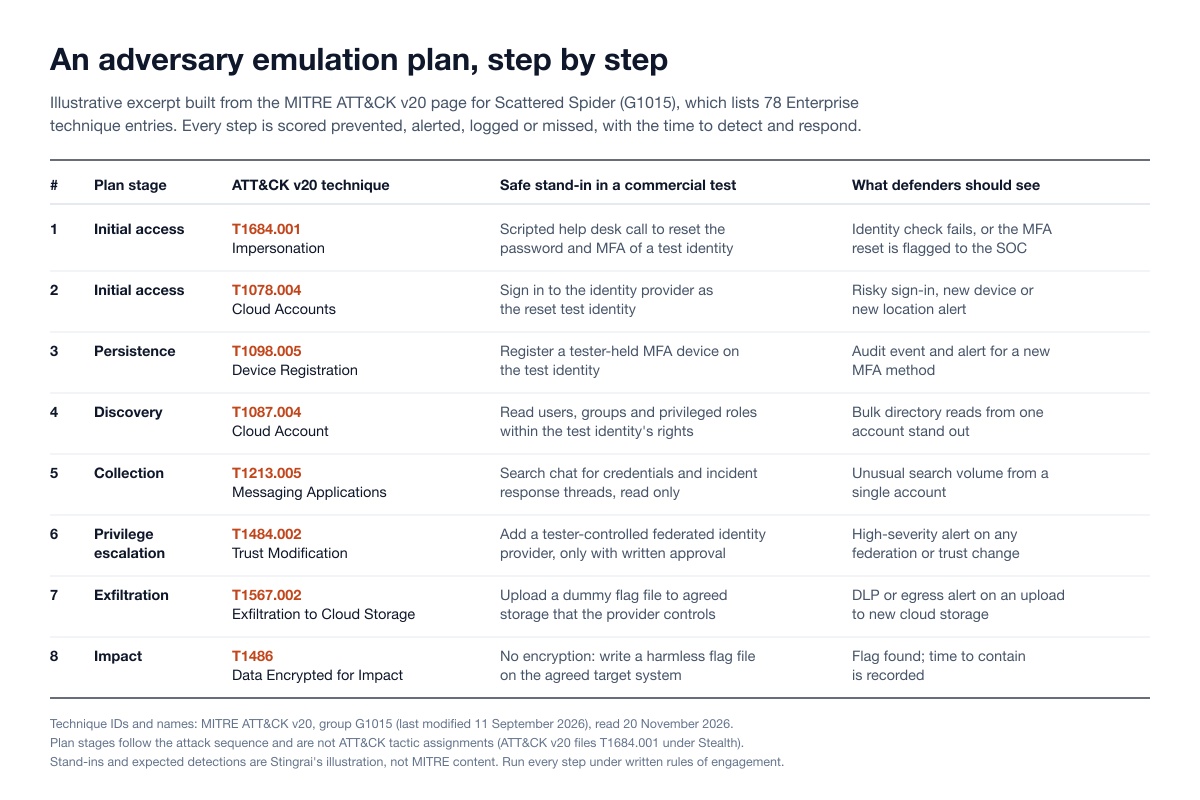
Figure 1: An illustrative emulation plan excerpt for Scattered Spider, from help desk impersonation to an encryption flag that encrypts nothing. Technique IDs and names come from the group's ATT&CK v20 page; the plan stages (the attack sequence, not ATT&CK tactics), stand-ins and expected detections are Stingrai's illustration. Source: MITRE ATT&CK, Scattered Spider (G1015).
Each step traces to a cited procedure on the group page, which records that the group "utilized social engineering to compel IT help desk personnel to reset passwords and MFA tokens", "registered devices for MFA to maintain persistence", searched chat platforms "for conversations about the intrusion and incident response", and "adds a federated identity provider to the victim's SSO tenant" (MITRE ATT&CK, G1015). The plan keeps the behavior and removes the harm: a test identity set up by the white team, read-only searches, a tenant-level change only with written approval, a dummy file in place of stolen data, and a flag in place of encryption. The ransomware attack simulation guide shows the same stand-in approach for a ransomware chain.
Ask for the plan as an ATT&CK Navigator layer too. Navigator layers can highlight "techniques a specific adversary has been known to use" (MITRE ATT&CK Navigator), so the plan, the results and your detection coverage sit on one matrix. How to read ATT&CK coverage in a red team proposal shows how to spot padded technique lists.
What deliverables should adversary simulation services include?
The deliverables are the product: a threat profile you can defend, a plan you can audit, a scorecard your SOC can act on, and a retest that proves the fixes work. EU threat-led testing rules are the most detailed public benchmark, and a commercial engagement can borrow their structure without their supervision.
Deliverable | What it should contain | Public benchmark |
|---|---|---|
Threat profile | The chosen actor, why it was chosen, its motivation and modus operandi, with sources | Delegated Regulation (EU) 2025/1190, Annex III |
Emulation plan and rules of engagement | Techniques mapped to a stated ATT&CK version, flags, safe stand-ins, stop conditions and leg-ups | TIBER-EU test plan guidance; NIST SP 800-115 on rules of engagement |
Attack narrative | Flags reached and not reached, attack paths and techniques that succeeded and failed, root causes, remediation priority | Annex V (red team test report) |
Detection scorecard | For each step: prevented, alerted, logged or missed, with time to detect and respond, and the log entries behind each detection | Annex VI (blue team test report) |
Replay and purple teaming | A walkthrough of offensive and defensive actions, then joint work on the misses | Article 12(5) |
Remediation plan and retest | Owners, priorities and expected completion for each fix, then a retest of the affected paths | Article 13 (remediation plan) |
Table 3: Adversary simulation deliverables and the public rules they mirror. Source: Commission Delegated Regulation (EU) 2025/1190.
Two details separate a useful report from a story. The red team report lists the "tactics, techniques and procedures used successfully and unsuccessfully" (Annex V), not only the wins. The blue team side lists, for each attack step, the "detected attack actions" and the "log entries corresponding to these detections" (Annex VI), so every miss traces to a missing log source or a missing rule. The full report structure is in the red team exercise phases and report guide.
How long does an adversary simulation engagement take?
Duration depends on the starting point, the number of scenarios and whether a regulator is involved:
Single-scenario assumed breach: Stingrai's red team engagements typically run 2 to 3 weeks for one scenario starting from a compromised laptop or stolen credentials (Stingrai red teaming). Full-scope and multi-scenario programs are scheduled at scoping.
Government red team assessments: CISA ran its 2022 assessment of a critical infrastructure organization "over a three-month period" (AA23-059A) and SILENTSHIELD "over an approximately eight-month period in 2023, with three of the months consisting of a technical collaboration phase" (AA24-193A).
Regulated threat-led tests: TIBER-EU gives an indicative 4 to 6 weeks for threat intelligence and 2 to 3 weeks for the test plan, then "a minimum of 12 weeks" of active testing, and a closure phase that "may be longer than 18 weeks" (ECB). DORA's standards fix the active phase at "at least 12 weeks", the red team report within 4 weeks, and the blue team report and the replay within 10 weeks of the end of active testing, followed by a purple teaming exercise for which the standards set no deadline; TIBER-EU puts its purple teaming exercise inside the same 10 weeks (Delegated Regulation (EU) 2025/1190, Articles 11 and 12; ECB).
Long engagements exist for a reason. In CISA's AA24-326A assessment, legacy hosts without a local endpoint detection and response (EDR) agent "allowed the red team to persist for several months on the hosts undetected" (CISA AA24-326A). A short test shows a path exists; only time shows how long it stays open.
What drives the cost of adversary simulation services?
Adversary simulation is priced on operator days for a defined scope, so the cost follows the work, not the asset count. Stingrai lists the factors that set the number of days (Stingrai red teaming):
Scenario and starting point: assumed breach, black-box full chain or threat intelligence-led.
Objectives: the number of crown-jewel objectives and how far apart they sit.
Duration and team size: calendar weeks and the number of operators needed to run them covertly.
Threat intelligence depth: a generic industry profile or a bespoke targeting report.
Environments: on-premise, cloud, identity providers and the sites in scope.
Add-ons: phishing, vishing and physical entry, where scoped.
Emulation adds three drivers of its own. A well-documented actor needs less research than one with thin public reporting. Every stand-in that needs setup, such as a test identity or written approval for a tenant change, adds coordination time. And in our experience, covert delivery takes more operator time per technique than purple delivery, because staying hidden takes time.
Regulated tests sit at the top of the range. On top of the 12-week minimum, DORA's standards require an external red team of "at least a manager, with at least 5 years of experience in penetration testing and red team testing as well as at least two additional testers, each with penetration testing and red team testing of at least 2 years", and insurance "including against risks of misconduct and negligence" (Delegated Regulation (EU) 2025/1190, Article 7). In-scope EU financial entities run such a test "at least every 3 years" (Regulation (EU) 2022/2554, Article 26).
To control the cost, start from assumed breach, emulate one actor, run purple sessions on the misses, and keep BAS or micro emulation running between engagements. Market price ranges and quote comparisons are in the red team engagement cost guide. Stingrai quotes each scope within 24 hours of a Get a Quote request, and every quote includes the retest.
Adversary simulation buyer checklist
Run these ten checks before you sign.
Write the objective and flags first. Name what the attacker wants and where a flag will prove it, before anyone proposes an actor.
Ask for the actor rationale with cited intelligence. A provider should explain why this group, from which reports, and how recent they are.
Require the ATT&CK version and a technique list per stage. Ask for a Navigator layer and judge it by your objective, not its length.
Agree a safe stand-in for every destructive step. Test identities, read-only collection, dummy data and flag files in place of encryption.
Staff a white team and sign the rules of engagement. NIST describes the white team as a small group with prior knowledge that "ensures the scope of testing does not exceed a pre-defined threshold" (NIST CSRC). Give it the authority to stop the test. See the rules of engagement checklist.
Fix the scoring scale before day one. Prevented, alerted, logged or missed, with time to detect and time to respond for every step.
Check who will do the work. Named operators, firm-level accreditation you can verify on the CREST Marketplace, insurance that covers misconduct and negligence, and references.
Require a replay and a purple session. Your SOC should map its log entries to each attack step and work through the misses with the operators.
Get remediation priorities and a retest. Every finding needs an owner, a date and a retest of the affected path.
Decide what runs between engagements. BAS or micro emulation catches drift; repeat the human engagement when your environment or the threat changes.
Where Stingrai fits
Stingrai is a CREST-accredited penetration testing company founded in Toronto in 2021, with an office in London. The CREST Marketplace lists Stingrai Inc's two accreditations, Penetration Testing and AI-Enabled Penetration Testing, and the CREST AI Charter company certification; we are proud CREST members. For adversary simulation:
Two delivery modes, one plan: adversary simulation runs as red teaming in assumed breach, black-box full chain and threat intelligence-led modes, or as purple teaming with your SOC, both mapped to MITRE ATT&CK.
Scenarios that follow the environment: Active Directory, Entra ID, AWS, Azure and Google Cloud, plus social engineering and physical entry where scoped. Threat intelligence-led scenarios are structured to the TIBER-EU phases for financial entities preparing for threat-led penetration testing.
Detection measured, not assumed: every stage records what was prevented, logged, alerted or missed, and every engagement ends with a SOC replay and debrief.
Operators: engagements are led by a team lead with 16 years in penetration testing, red teaming and exploit development, from a team holding OSCE³, OSEP, CRTO, CRTL, CREST CRT and CISSP certifications, whose researchers have published 18 CVEs.
Evidence: an attestation letter is issued with every red team engagement, stating scope and testing dates.
Engagement models: one-time exercises and continuous programs, delivered through the PTaaS portal.
If the same organization runs customer-facing web applications, the Hybrid Pentest, in which Snipe tests the full application while Stingrai's certified penetration testers test it manually alongside and validate Snipe's findings, covers one web application and associated APIs at US$6,800 per assessment or US$1,275 per month on a 12-month plan.
Frequently Asked Questions
What are adversary simulation services?
Adversary simulation services are engagements in which an outside team attacks your organization the way a real adversary would, toward agreed objectives, to measure whether your defenders detect and stop the attack. They are delivered as red teaming, where the SOC is not told, or purple teaming, where operators and defenders work together. Stingrai, a CREST-accredited penetration testing company, delivers both, mapped to MITRE ATT&CK, as one-time exercises or continuous programs.
What is the difference between adversary simulation and adversary emulation?
Adversary simulation is the umbrella: operators play a realistic attacker toward an agreed objective, modeled on a credible class of attacker or on a specific named group. Adversary emulation holds them to one named group's documented tactics, techniques and procedures, taken from threat intelligence and the group's MITRE ATT&CK page, with some latitude in how each step is implemented. Emulation gives a per-technique answer to whether you would catch that specific group.
Is adversary emulation the same as red teaming?
No. Red teaming is a delivery mode: covert, objective-based and run against defenders who do not know the test is happening. Adversary emulation is a choice of script. The same emulation plan can run covertly as a red team to measure the SOC, or openly as a purple team to build and tune detections technique by technique.
Is breach and attack simulation (BAS) the same as adversary emulation?
No. BAS software replays scripted behaviors against your controls on a schedule, which catches detections that drift between engagements. It cannot call your help desk, change course when a step fails, or chain access across identity, cloud and on-premise systems the way a human team does.
How do we choose which threat actor to emulate?
Start from the objective you want to protect, then shortlist groups named in intelligence you can cite, such as CISA advisories, your incident history and your MDR provider's reporting. Read each candidate's MITRE ATT&CK group page, score it on targeting, objective match, capability against your controls, recency and documentation depth, then shortlist one to three and emulate one primary actor.
What is the MITRE Adversary Emulation Library?
It is a public library maintained by MITRE's Center for Threat-Informed Defense. As of 20 November 2026 it holds full emulation plans for 11 adversaries, including APT29, FIN7, Sandworm and Wizard Spider, and 12 micro emulation plans for behaviors common to many adversaries. Each full plan is meant as input to a red team.
How is detection scored in an adversary emulation?
Each step of the plan is scored as prevented, alerted, logged or missed, with the time to detect and the time to respond. The blue team then maps its detections and the log entries behind them to each attack step, so every miss traces to a missing log source, a missing rule or a slow response.
What deliverables should an adversary simulation engagement produce?
Expect a threat profile for the chosen actor, an emulation plan mapped to a stated ATT&CK version with safe stand-ins, an attack narrative with flags reached and not reached, a per-step detection scorecard, a replay and purple session with your SOC, a remediation plan and a retest. Stingrai also issues an attestation letter with every red team engagement.
How long does an adversary simulation engagement take?
At Stingrai, a single-scenario assumed breach engagement typically runs 2 to 3 weeks. CISA's own red team assessments ran about three months, and one ran about eight months. EU threat-led tests under DORA and TIBER-EU require at least 12 weeks of active testing, plus threat intelligence and planning before it and closure work after it.
How much do adversary simulation services cost?
Adversary simulation is priced on operator days for a defined scope. The starting point, the number of objectives, the environments, the threat intelligence depth, the duration and team size, and add-ons such as phishing or physical entry set the number of days. Regulated threat-led tests cost most because of their minimum team, insurance and 12-week testing rules. Stingrai quotes each scope within 24 hours of a request, retest included.
Related reading
Which threat group should your red team emulate? A buyer guide by industry
Red team services in 2026: engagement types, choosing a provider and cost
Purple teaming: what a purple team exercise is, how it runs and what to demand
How much a red team engagement costs in 2026, and what drives the price
References
MITRE. ATT&CK Updates, October 2026 (v20). 13 October 2026. https://attack.mitre.org/resources/updates/updates-october-2026/. Object counts.
MITRE. ATT&CK Groups. https://attack.mitre.org/groups/. Group definition and reporting caveat.
MITRE. ATT&CK Campaigns. https://attack.mitre.org/campaigns/. Campaign definition.
MITRE. Scattered Spider, G1015. Last modified 11 September 2026. https://attack.mitre.org/groups/G1015/. Aliases and techniques used.
MITRE. Adversary Emulation Plans. https://attack.mitre.org/resources/adversary-emulation-plans/. Purpose of ATT&CK emulation plans.
MITRE Center for Threat-Informed Defense. Adversary Emulation Library. https://github.com/center-for-threat-informed-defense/adversary_emulation_library. Plans and plan structure, read 20 November 2026.
MITRE. ATT&CK Navigator. https://github.com/mitre-attack/attack-navigator. Layers.
CISA. CISA Red Team's Operations Against a Federal Civilian Executive Branch Organization Highlights the Necessity of Defense-in-Depth (AA24-193A). 11 July 2024. https://www.cisa.gov/news-events/cybersecurity-advisories/aa24-193a. SILENTSHIELD, 2023.
CISA. CISA Red Team Shares Key Findings to Improve Monitoring and Hardening of Networks (AA23-059A). 28 February 2023. https://www.cisa.gov/news-events/cybersecurity-advisories/aa23-059a. 2022 assessment.
CISA. Enhancing Cyber Resilience: Insights from CISA Red Team Assessment of a US Critical Infrastructure Sector Organization (AA24-326A). 21 November 2024. https://www.cisa.gov/news-events/cybersecurity-advisories/aa24-326a. Legacy hosts without EDR.
CISA and partners. Scattered Spider (AA23-320A). Updated 29 July 2025. https://www.cisa.gov/news-events/cybersecurity-advisories/aa23-320a. Help desk targeting.
NIST. CSRC Glossary. https://csrc.nist.gov/glossary. Red team, red team exercise, white team, penetration testing.
European Central Bank. TIBER-EU Framework. January 2025. https://www.ecb.europa.eu/pub/pdf/other/ecb.tiber_eu_framework_2025~b32eff9a10.en.pdf. Flags, durations, closure.
European Central Bank. TIBER-EU Red Team Test Plan Guidance. January 2025. https://www.ecb.europa.eu/pub/pdf/annex/ecb.tiber_red_team_test_plan_guidance_2025.en.pdf. ATT&CK-mapped TTPs.
European Commission. Commission Delegated Regulation (EU) 2025/1190. 13 February 2025. https://publications.europa.eu/resource/celex/32025R1190. Threat-led penetration testing standards.
European Parliament and Council. Regulation (EU) 2022/2554 (DORA). 14 December 2022. https://publications.europa.eu/resource/celex/32022R2554. Articles 3(17) and 26.
CREST. Stingrai Inc supplier page. https://marketplace.crest.org/supplier/stingrai-inc/. Accreditations, read 20 November 2026.
Talk to Stingrai
Want to know whether your SOC would catch the group most likely to come after you? See how Stingrai's adversary simulation services run, then Get a Quote with your objectives and environments, or book a free discovery call to choose the actor and scope an adversary emulation with our team.