A ransomware attack simulation is a red team engagement that follows a ransomware operator's techniques from initial access to the moment before encryption, on production, and records whether your defenders prevent, detect and contain each step. It never encrypts real data. In the red team assessment CISA published as advisory AA23-059A, the team ran simulated ransomware on several workstations, and CISA notes that "This technique does NOT encrypt files on the target system". Four users reported it. Across the 13 measurable events in that assessment, CISA's Table 1 records a reaction to only three.
Quick answer. A ransomware attack simulation answers whether you would stop a ransomware crew before impact, and proves it: a red team follows the techniques in current CISA #StopRansomware advisories through ten ATT&CK v20 checkpoints, replaces encryption and backup deletion with agreed flags, and records what was prevented, logged, alerted on or missed at each one. Stingrai, a CREST-accredited penetration testing company, runs it as an assumed-breach, full-chain or threat intelligence-led red team engagement and follows it with purple teaming on the checkpoints that failed.
This guide covers the simulation itself. The wider evidence program (critical services, pass criteria and the owner-led restoration test) is in our ransomware readiness assessment guide, and attack and payment data are in ransomware statistics 2026.
What is a ransomware attack simulation?
It is a red team exercise with one adversary in mind. NIST defines a red team exercise as one "conducted as a simulated adversarial attempt to compromise organizational missions or business processes" (NIST glossary, citing SP 800-53 Rev. 5). Here the adversary is a ransomware operator or affiliate, and the mission at risk is what the business cannot run without: the ERP, the file servers, the hypervisor cluster and the backups behind them.
Three things separate it from a generic red team engagement:
A ransomware-led scenario, built from documented ransomware operations rather than the tester's favourite path.
A safe objective. The operator's real goals are encryption, backup destruction and data theft. The simulation reaches the access that would make them possible and captures an agreed flag instead.
Measurement at each checkpoint. The deliverable is a timeline of what the defenders saw and did at each stage, not a list of vulnerabilities.
Ransomware simulation vs tabletop exercise, BAS, purple team and penetration test
Each format answers a different question, and a ransomware program needs more than one.
Format | Question it answers | Who knows in advance | What it runs against | What it can prove | What it cannot prove |
|---|---|---|---|---|---|
Tabletop exercise | Do our people know the plan, the decisions and their roles? | Everyone; it is a discussion | No systems | Gaps in the response plan, decision rights and communications | Whether any control, alert or analyst actually works |
Breach and attack simulation (BAS) | Does each control block or log a scripted technique? | The team that runs the platform | Agents and test hosts, on a schedule | Control coverage for known techniques, and drift between tests | Whether a human operator can chain access to a business objective, or whether the SOC responds |
Penetration test | What is exploitable inside this scope? | Announced to IT and security | A defined list of assets | Reachable weaknesses with reproduction evidence | Whether anyone notices or responds |
Purple team exercise | Can we detect these techniques, and fix the rules that miss them? | Red and blue work in the open | Agreed techniques on agreed hosts | Detection rules built, tuned and validated technique by technique | Whether the SOC finds a covert operator unprompted |
Ransomware attack simulation (red team) | Would we stop a ransomware crew before impact? | A small control team only | Production, from an agreed starting point to a flag | How far an operator gets, what was prevented, logged, alerted on or missed at each checkpoint, and how fast the SOC contained it | Whether backups restore the service; that is the owner's restoration exercise |
Tabletop exercise: NIST defines it as "a discussion-based exercise where personnel with roles and responsibilities in a particular IT plan meet" to walk through a scenario (NIST glossary, SP 800-84). Run it against the timeline a simulation produced.
Breach and attack simulation: useful regression testing between engagements, not a test of an adaptive operator or of the analysts; our AEV, BAS, PTaaS and autonomous pentest decoder compares the categories.
Penetration test: testing in which "evaluators mimic real-world attacks in an attempt to identify ways to circumvent the security features of an application, system, or network" (NIST glossary, SP 800-115). It finds the holes; the simulation asks whether anyone notices them being used.
Purple team exercise: Stingrai's operators "execute specific attack techniques while your Blue Team monitors and responds in real-time" (Stingrai purple teaming); see red team vs blue team vs purple team and our purple team exercise guide.
A sensible order: a tabletop to settle decision rights, penetration tests of the edge and backup tier, a purple team pass if basic coverage is unproven, the covert simulation, purple team sessions on every checkpoint the operator got past undetected, then a retest.
How to design the scenario from CISA #StopRansomware advisories
CISA's #StopRansomware advisories document each group's techniques with ATT&CK IDs, and each one carries the same instruction in its Validate Security Controls section: the authoring agencies "recommend exercising, testing, and validating your organization's security program against the threat behaviors mapped to the MITRE ATT&CK for Enterprise framework in this advisory", and "continually testing your security program, at scale, in a production environment" (AA26-293A; the same wording is in AA26-222A). A ransomware simulation carries out that instruction with a human operator.
Pick two or three advisories that match your estate
Advisory | Published | How they got in | What they did inside | Before encryption | Put in your scenario |
|---|---|---|---|---|---|
20 October 2026, mapped to ATT&CK v20 | Stolen or guessed passwords and VPN access (T1110, T1133); exploited edge and internet-facing systems (T1190) | Admin rights on existing or new accounts (T1098, T1136); RDP, SMB admin shares and WinRM (T1021); security software disabled before lateral movement (T1685) | Data compressed and exfiltrated, including to cloud storage (T1560.001, T1048, T1567); Volume Shadow Copy Service halted and backup NAS reset to factory settings (T1490) | VPN and identity entry, living-off-the-land movement, tamper detection, backup storage access | |
10 August 2026, mapped to ATT&CK v19.1 | Firewall and VPN appliance exploitation (T1190); default credentials on a VPN admin account with no lockout (T1078) | Credential dumping from domain controllers (T1003.003) and pass the hash (T1550.002); MFA bypass by altering a VDI portal's authentication (T1556.006); activity between 10 p.m. and 6 a.m. | Data taken from OneDrive and SharePoint (T1530) and cloud file sharing, "up to tens of terabytes"; backups deleted at the primary and disaster recovery data centers (T1490) | Edge admin accounts, domain controller credential theft, off-hours operation, disaster recovery backups | |
Revised 13 November 2025 | Stolen VPN credentials and a SonicWall flaw, CVE-2024-40766 (T1110, T1133) | Veeam Backup & Replication flaws CVE-2023-27532 and CVE-2024-40711 exploited on backup servers; remote access tools for lateral movement (T1219); Nutanix AHV hypervisors targeted for VM disk encryption | Exfiltration "in just over two hours from initial access" in some incidents | Backup servers as targets, hypervisor management, a two-hour exfiltration benchmark to compare detection times against |
SafePay is the natural anchor for a 2026 scenario. CISA says it "was among the most active ransomware groups in 2026" and has "impacted at least 600 separate victims" since August 2024, and, as of 20 November 2026, it is the only #StopRansomware advisory CISA has published since ATT&CK v20 was released. The Medusa advisory (AA25-071A, revised 18 August 2026) adds network share discovery (T1135) and a process that "terminates all services related to backups, security, databases, communication, file sharing, and websites" (T1489).
Read together, they make three points that should shape almost any scenario:
Entry comes through the edge and valid accounts. All three start with VPNs, firewalls or credentials. CISA's #StopRansomware Guide lists six initial access vectors, led by internet-facing vulnerabilities and compromised credentials.
Backup infrastructure is a target in its own right. SafePay and Akira both list the same two backup-software flaws, SafePay reset backup NAS devices and Gunra deleted disaster recovery backups. The Guide warns that "most ransomware actors attempt to find and subsequently delete or encrypt accessible backups".
Data leaves before anything is encrypted. "Following exfiltration, SafePay threat actors encrypt files", in CISA's words. An exfiltration checkpoint matters as much as an encryption one.
Turn the advisories into a scenario in six steps
Name the business objective and the flag. For example: "Obtain the access needed to delete the ERP cluster's backups, and read a flag file the control team planted on the backup server." Write one flag per objective into the rules of engagement.
Choose the starting condition. A full chain from the internet tests the edge checkpoints. An assumed breach starts inside, as CISA's red team did when trusted agents ran its payload on a host tied to "a standard user account with no administrative privileges" (AA26-237A). Our assumed breach guide covers the trade-off.
Select techniques for each checkpoint from the advisories, mapped to ATT&CK v20. Drop what does not fit your estate and add what your environment invites, such as cloud identity, hypervisor management or a managed service provider's remote access.
Write the safe stand-in for every destructive step. Encryption, backup deletion, security tool tampering and exfiltration each need an agreed substitute.
Set the detection expectation for each checkpoint. Name the log source, the alert or hunt that should fire, the team that should act and the time you expect it to act.
Agree timing and notification. Gunra worked between 10 p.m. and 6 a.m., so run part of the scenario out of hours with the control team on call, and agree when a SOC escalation may run so the response can be measured.
This guide, like the test plan a defender should see, stays at the technique level. Tooling, command lines and payloads belong in the provider's internal operator plan, held by the control team.
The detection checkpoints along the ransomware kill chain (ATT&CK v20)
NIST's ransomware profile gives the reason checkpoints matter: "Often malicious code is not immediately executed. There may be time between its insertion and its activation to detect it before the ransomware attack is executed" (NIST IR 8374 Rev. 1, June 2026, DE.CM-09). Every checkpoint before the encryption flag is a point where the SOC can end the attack.
Map them to the current release. MITRE released ATT&CK v20 on 13 October 2026, with 15 Enterprise tactics, 227 techniques and 703 detection strategies (MITRE ATT&CK updates). One change from the previous release, ATT&CK v19 of 28 April 2026, matters most for ransomware detection content: MITRE split Defense Evasion into Stealth, which keeps TA0005, and a new Defense Impairment tactic, TA0112, which holds techniques such as T1685 Disable or Modify Tools (MITRE ATT&CK, April 2026 update). The old T1562 page now redirects to T1685, so SIEM rules and coverage reports still carrying the old IDs need remapping before they line up with a v20 report.
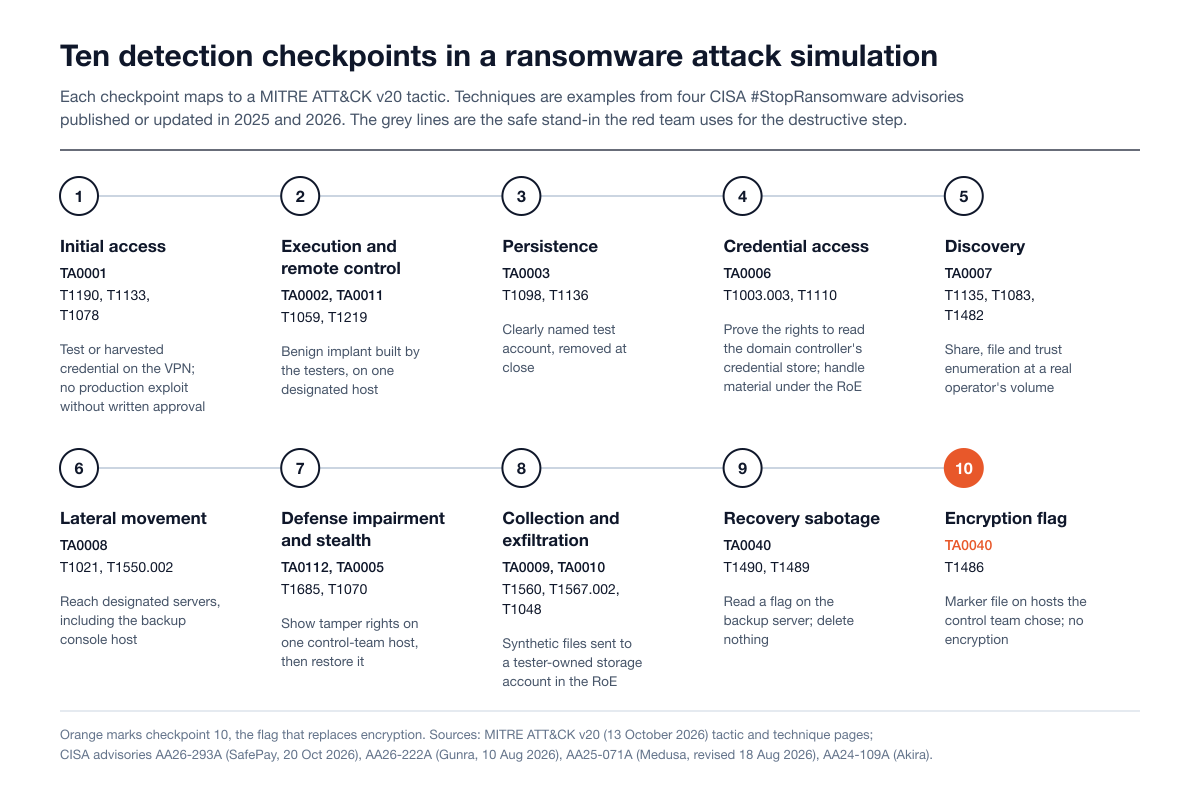
Figure 1: Ten detection checkpoints for a ransomware attack simulation, with the ATT&CK v20 tactic, example techniques and the safe stand-in for each step. Technique selection from CISA advisories AA26-293A, AA26-222A, AA25-071A and AA24-109A. Sources: MITRE ATT&CK v20, CISA AA26-293A.
# | Checkpoint | ATT&CK v20 tactic | Techniques | Safe stand-in | What the defenders should produce | ATT&CK detection strategy |
|---|---|---|---|---|---|---|
1 | Initial access | Initial Access (TA0001) | T1190, T1133, T1078 | Sign in to an in-scope VPN or remote access service with a test or harvested credential; no exploit in production without the control team's written approval | A sign-in alert for an unusual source, a lockout or MFA challenge, edge device logs reviewed | DET0080, DET0354, DET0560 |
2 | Execution and remote control | Execution (TA0002), Command and Control (TA0011) | T1059, T1219 | A benign implant built by the testers on one host; an unapproved remote access tool on a designated host | An endpoint alert on the process chain or new remote access software; host isolated | DET0516, DET0496 |
3 | Persistence | Persistence (TA0003) | T1098, T1136 | A clearly named test account, or a test account added to a privileged group; removed at close | An alert on the account or group change, verified with the system owner | DET0096, DET0583 |
4 | Credential access | Credential Access (TA0006) | T1003.003, T1110 | Show the rights to read the domain controller's credential store; handle any material under the RoE | An alert on directory database access or replication from a host that is not a domain controller | DET0586, DET0463 |
5 | Discovery | Discovery (TA0007) | T1135, T1083, T1482 | Share, file and trust enumeration at a real operator's volume | An alert or hunt hit on anomalous enumeration | DET0182, DET0370, DET0007 |
6 | Lateral movement | Lateral Movement (TA0008) | T1021, T1550.002 | Reach designated servers, including the backup console host, with harvested credentials | An alert on unusual remote logons and pass-the-hash patterns | DET0269, DET0409 |
7 | Defense impairment and stealth | Defense Impairment (TA0112), Stealth (TA0005) | T1685, T1070 | Show the rights to change the security agent or logging on one control-team-owned host, then restore it | A tamper alert, and a health alert when a sensor or log source goes quiet | DET0497, DET0184 |
8 | Collection and exfiltration | Collection (TA0009), Exfiltration (TA0010) | T1560, T1567.002, T1048 | Synthetic files planted by the control team, archived and sent to a tester-owned storage account named in the RoE | An alert on bulk archiving, unusual egress volume or a new cloud storage destination | DET0526, DET0570, DET0131 |
9 | Recovery sabotage | Impact (TA0040) | T1490, T1489 | Reach backup and hypervisor administration and read a flag file; delete nothing, change no retention | An alert on backup console logons, retention or snapshot changes and shadow copy tampering | DET0329, DET0021 |
10 | Encryption flag | Impact (TA0040) | T1486 | A harmless marker file, or a simulator that does not encrypt, on hosts the control team chose | User reports, an endpoint behaviour alert, host isolation, an incident declared | DET0215 |
The DET numbers are ATT&CK's own detection strategies, listed on each technique page: a vendor-neutral starting point for every rule the simulation shows to be missing. Four checkpoints deserve extra attention:
Checkpoints 1 and 2 shape the engagement. In AA26-237A, one SOC isolated three phished workstations "within 10, 2, and 20 minutes", forcing CISA's red team into an assume breach model. Plan a leg-up so early detection does not end the test of everything behind the edge.
The middle of the chain is where mature organizations go quiet. In AA23-059A, the organization "failed to detect lateral movement, persistence, and C2 activity via their intrusion detection or prevention systems, endpoint protection platform, web proxy logs, and Windows event logs". At checkpoint 7 the alert must come from missing telemetry, because SafePay disables security software before it moves.
Checkpoint 8 is the double-extortion checkpoint. CISA's red team sent "1 GB of mock sensitive information" to an external system, and Table 1 records no reaction. Test with synthetic data, never real customer records.
Checkpoint 10 measures people as well as tools. In AA24-326A, "Two out of nine users reported the event to defensive staff", and "Five users likely rebooted their systems when observing the ransomware" (AA24-326A).
How to run a ransomware simulation safely
The regulated versions run on live production by design: under DORA, each threat-led penetration test "shall be performed on live production systems" supporting critical or important functions (Regulation (EU) 2022/2554, Article 26(2)). The safety model they use works just as well for a commercial engagement in Toronto or Texas.
Stand up a small control team
NIST's glossary calls it the white team: "A small group of people who have prior knowledge of unannounced Red Team activities", which "ensures the scope of testing does not exceed a pre-defined threshold" (NIST glossary, CNSSI 4009-2022). In TIBER-EU, its members "are the only ones there who know a test is happening" (ECB, TIBER-EU). Keep it to the CISO or a delegate, an IT operations lead who can stop the test and act as trusted agent, legal, and the owner of each flagged system. Each extra person weakens the measurement of the checkpoints they could influence, so think twice before adding the backup administrator or the SOC lead.
Write stop conditions before day one
Unplanned degradation of a flagged system or business service.
Evidence of a real intruder: the simulation stops and incident response takes over.
Data outside the agreed scope, such as regulated personal data the scenario did not need.
Access to a third party's systems without that party's authorization.
A SOC escalation to law enforcement, a regulator, an insurer or a managed detection provider before the control team has confirmed the test.
Stingrai's engagements "stay covert to the defenders, with a small control group on the client side holding the rules of engagement and stop conditions" (Stingrai red teaming). Our red team rules of engagement checklist lists the contract clauses to verify.
Use flags in place of encryption
TIBER-EU sets at least one flag per system in scope: "A flag is essentially the objective that the RTT must strive to achieve during the test, e.g. compromising the confidentiality, integrity, or availability of the target system" (ECB, TIBER-EU Framework, January 2025). In a ransomware simulation every destructive step gets one: the safe stand-in column in the checkpoint table above lists them, from the encryption marker file to the backup-server flag.
Protect production and reverse every change
TIBER-EU says "Entities should conduct thorough due diligence of in-scope systems prior to any testing, to ensure that backup and restoration capabilities are in place". The EU's testing standard, Commission Delegated Regulation (EU) 2025/1190, has the control team assess risks including "the interruption of critical activities and the corruption of data due to the activities of the testers" and "the incomplete restoration of systems affected by the TLPT" (Article 5). In practice: keep a cleanup log of every account, implant and configuration change and reverse each at close; store credential material encrypted and destroy it at close; agree an out-of-band channel in case email or chat is in the scenario; and plan leg-ups, which TIBER-EU says should be "duly logged".
What success looks like, and the metrics to track
TIBER-EU is plain about it: "The outcome is not a pass or fail." A ransomware simulation scores how far an operator got, how fast the defenders saw it and how well they responded. CISA's red team advisories show what those results look like when ransomware is simulated and a phishing foothold lands.
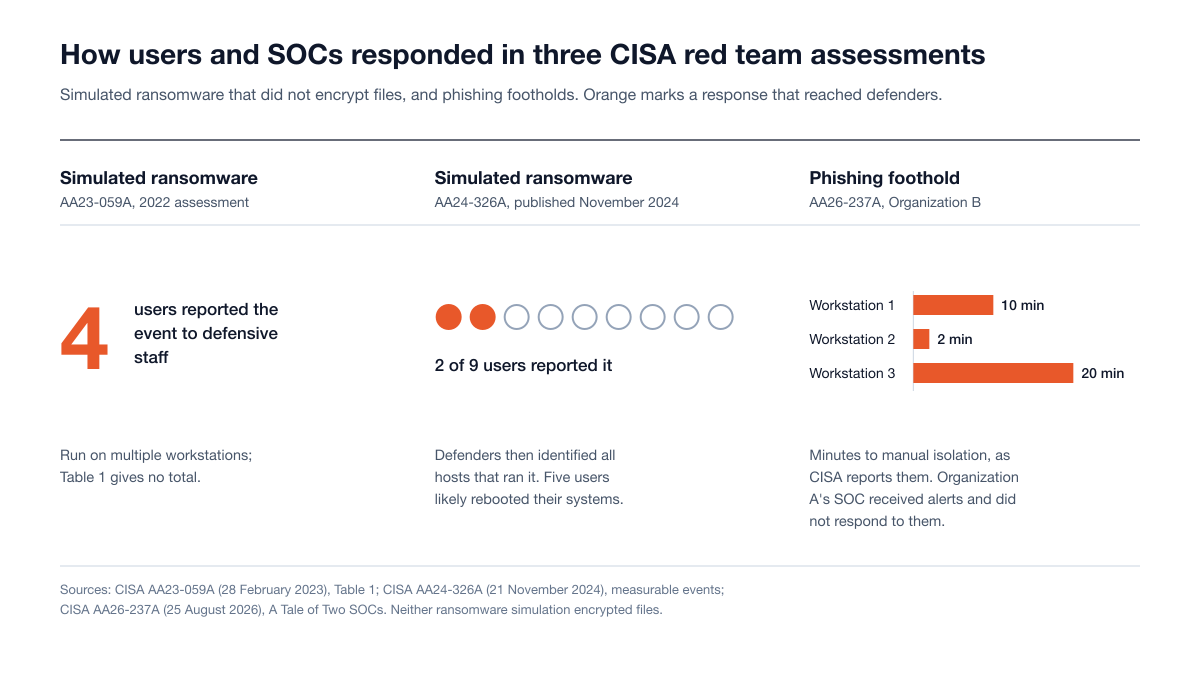
Figure 2: How users and SOCs responded in three CISA red team assessments: simulated ransomware that did not encrypt files (AA23-059A, AA24-326A) and phishing footholds (AA26-237A). Sources: CISA AA23-059A, AA24-326A, AA26-237A.
CISA assessment | What was simulated | What the defenders did | What it means for your metrics |
|---|---|---|---|
AA23-059A (2022, published 28 February 2023) | 13 measurable events, including simulated ransomware that did not encrypt | A reaction is recorded for 3 of 13; four users reported the ransomware simulation | Score each event by the reaction recorded, not by whether a tool logged it |
AA24-326A (published 21 November 2024) | Simulated ransomware on workstations, no encryption | Two of nine users reported it, and defenders then identified all hosts that ran it; five users likely rebooted | Measure the user report rate and what users did instead |
AA26-237A (published 25 August 2026) | The same tradecraft at two organizations at once | Organization A's SOC received medium and low-severity alerts and "did not respond to them"; Organization B isolated three workstations within 10, 2 and 20 minutes | An alert nobody acts on scores as a miss |
CISA's first lesson in AA26-237A is "Untuned detection tools lead to missed threats": at Organization A, "Thousands of false positive alerts" hid the real ones. So separate logging, alerting and acting. Track, per checkpoint and overall:
Furthest checkpoint reached before containment, and whether the flag was captured.
Outcome per checkpoint: prevented, logged only, alerted, triaged or contained.
Time to detect: first alert, hunt hit or user report, minus the time of the operator's action.
Time to contain: host isolated, account disabled or session revoked.
Exfiltration window: time from first access to the first synthetic data leaving, against the time to detect it. Akira's "just over two hours" is a useful outer bound.
Detection coverage: the share of the scenario's ATT&CK techniques that produced an alert someone acted on.
User report rate for the encryption flag, and leg-ups needed.
Retest result for every checkpoint that failed.
Our red team detection benchmarks collect published comparison points.
Deliverables to demand
An executive summary: the objective, whether the flag was captured, the furthest checkpoint reached and the three fixes that matter most.
A checkpoint timeline of action, telemetry, alert, analyst action and containment, mapped to ATT&CK v20, with a gap list naming the missing log source or rule.
Flag evidence and the cleanup log showing every test change reversed.
Stingrai's red team report includes "a detection and response timeline showing per stage what was prevented, what was logged silently, what alerted and what the SOC did", ATT&CK technique mapping, root-cause findings and "a replay and debrief session with your SOC" (Stingrai red teaming). Our guide to red team exercise phases and the red team report shows a full table of contents.
How long it takes and what drives the cost
Stingrai's published durations: a single-scenario assumed-breach engagement "typically runs two to three weeks elapsed", a full-scope engagement from outside "runs four to eight weeks", and a multi-scenario program across cloud, on-premise and identity "runs eight to twelve weeks" (Stingrai red teaming). A regulated threat-led test is longer: under the EU's testing standard, active red team testing "shall last for at least 12 weeks" (RTS (EU) 2025/1190, Article 11(5)). Preparation of the control team, flags and stand-ins comes first.
Red team work is quoted on operator days rather than per asset. The drivers:
Starting point: a full chain from the internet takes more operator days than an assumed breach.
Objectives and flags, for example the ERP backups and the hypervisor cluster as separate objectives.
Environments in the path: Active Directory, Entra ID, AWS, Azure or Google Cloud, hypervisor management, any operational technology boundary.
Out-of-hours operation, threat intelligence depth and social engineering as the entry vector.
Follow-up and reporting: purple team sessions, the retest and any DORA or TIBER-EU documentation.
Stingrai quotes each engagement after scoping: Get a Quote returns pricing within 24 hours.
Does DORA or TIBER-EU require a ransomware simulation?
Not by name. DORA requires the financial entities identified for threat-led penetration testing (TLPT) to "carry out at least every 3 years advanced testing by means of TLPT" (Article 26(1)), covering "several or all critical or important functions". The scenarios come from targeted threat intelligence about the entity, so a ransomware operator becomes one when that intelligence supports it. TIBER-EU, updated in 2024 to align with DORA's testing standard, follows the same threat-led approach and is not limited to finance (ECB, TIBER-EU). North American companies outside those regimes can borrow the structure (control team, flags, leg-ups, a blue team timeline) without the regulator's timetable; the red team services guide explains when a commercial engagement is the right purchase.
How to choose a ransomware simulation provider
Question | A good answer | A red flag |
|---|---|---|
Where do your scenarios come from? | Current CISA advisories and sector threat intelligence, mapped technique by technique to your estate | One generic "ransomware package" for every client |
How do you prove impact without encryption? | Named flags and marker files for each destructive step, agreed in the RoE | "We run real ransomware in a controlled way" |
How do you measure detection? | A per-checkpoint timeline of what was prevented, logged, alerted on and contained, with times | A vulnerability list with severity ratings |
What happens if our SOC catches you early? | A logged leg-up, and the test continues to the next checkpoint | The engagement ends with no data on anything behind the edge |
What happens after the report? | A replay with the SOC, purple team sessions on missed checkpoints and a retest | The report is the last contact |
Where Stingrai fits
Stingrai is a CREST-accredited penetration testing company founded in Toronto in 2021, with an office in London. The CREST Marketplace lists Stingrai Inc's two accreditations, Penetration Testing and AI-Enabled Penetration Testing, and the CREST AI Charter company certification; we are proud CREST members. For a ransomware simulation:
Red teaming in three modes: Stingrai red teaming runs assumed breach, black-box full chain and threat intelligence-led scenarios in the DORA and TIBER-EU style, on-premise and in the cloud. Objectives include "Ransomware deployment simulated without impact".
Detection measured as a deliverable: "Detection and response timings are a contractual deliverable: every stage records what was prevented, logged, alerted or missed, and every engagement ends with a SOC replay and debrief."
Operators: engagements are led by a team lead with 16 years in penetration testing, red teaming and exploit development, from a team holding OSCE³, OSEP, CRTO, CRTL, CREST CRT and CISSP certifications.
Follow-up that fixes the misses: adversary simulation and purple teaming turn each missed checkpoint into a tested detection, as a one-time exercise or a continuous adversary emulation program.
If the same organization runs customer-facing web applications, the Hybrid Pentest, in which Snipe tests the full application while Stingrai's certified penetration testers test it manually alongside and validate Snipe's findings, covers one web application and associated APIs at US$6,800 per assessment or US$1,275 per month on a 12-month plan (pricing).
Frequently Asked Questions
What is a ransomware attack simulation?
A ransomware attack simulation is a red team engagement that follows a ransomware operator's techniques from initial access to the moment before encryption, on production, and records whether defenders prevent, log, alert on and contain each step. The scenario comes from current CISA #StopRansomware advisories mapped to MITRE ATT&CK, and every destructive step is replaced with an agreed flag.
Does a ransomware simulation deploy real ransomware or encrypt files?
No. The red team reaches the access that would allow encryption and backup deletion, then captures a flag, such as a marker file on designated hosts or a planted file on the backup server. CISA's own red teams ran simulated ransomware that, in CISA's words, "does NOT encrypt files on the target system" (advisory AA23-059A).
How is a ransomware simulation different from a ransomware tabletop exercise?
A tabletop exercise is a discussion in which people walk through a scenario and their roles in the response plan. It tests decisions and communications, not systems. A ransomware simulation runs real techniques against production and tests whether alerts fire and analysts act. Run the simulation first, then use its timeline as the tabletop scenario.
Is breach and attack simulation enough to test ransomware defenses?
No, although it is useful between engagements. Breach and attack simulation platforms replay scripted techniques and show whether each control blocks or logs them. They do not show whether an adaptive operator can chain valid accounts, remote services and backup access into a business outcome, or whether an analyst acts on what the tools log.
Should a ransomware simulation be a red team or a purple team exercise?
Use a covert red team to measure whether the SOC finds and contains a ransomware operator unprompted. Use a purple team, with operators and defenders working in the open, while detection coverage is still being built or to fix the checkpoints a red team got past. Most programs alternate: red to measure, purple to fix, then a retest.
Which MITRE ATT&CK techniques should a ransomware simulation cover?
At least one technique per checkpoint, taken from the advisories that match your estate. For 2026 scenarios that typically means External Remote Services (T1133) and Valid Accounts (T1078), Account Manipulation (T1098), NTDS credential dumping (T1003.003), Remote Services (T1021), Disable or Modify Tools (T1685), Exfiltration Over Web Service (T1567), Inhibit System Recovery (T1490) and, as a flag only, Data Encrypted for Impact (T1486), mapped to ATT&CK v20.
How long does a ransomware simulation take?
Stingrai's red team engagements typically run two to three weeks for a single assumed-breach scenario, four to eight weeks full scope and eight to twelve weeks for a multi-scenario program. A threat-led test under the EU's DORA testing standard needs at least 12 weeks of active testing.
How much does a ransomware simulation cost?
Red team engagements are quoted on operator days rather than per asset, so the price depends on the scenario, mainly the starting point, the number of flags and the environments in the path. Stingrai quotes each engagement after scoping, with pricing within 24 hours of a quote request.
How do we know whether our SOC passed?
TIBER-EU says the outcome of a red team test "is not a pass or fail", so score each checkpoint against the detection expectation written into the rules of engagement. Track the furthest checkpoint reached, the outcome at each checkpoint, time to detect, time to contain and the user report rate for the encryption flag. In CISA's August 2026 advisory, one SOC isolated three phished workstations within 10, 2 and 20 minutes, while another received alerts and did not respond.
Does DORA require a ransomware simulation?
Not by name. DORA requires identified EU financial entities to run threat-led penetration testing at least every 3 years on live production systems, with scenarios drawn from targeted threat intelligence, so a ransomware operator becomes one when that intelligence supports it.
Related reading
Ransomware readiness assessment: pentest and red team evidence
Ransomware statistics 2026: attacks, entry points, payments and recovery
Red teaming: what it is, how an engagement runs and when you need one
Red team exercise: engagement phases, the red team report and success metrics
Red team rules of engagement: what to demand before you sign
References
CISA, FBI, USSS and partners. #StopRansomware: SafePay Ransomware (AA26-293A). 20 October 2026. https://www.cisa.gov/news-events/cybersecurity-advisories/aa26-293a. TTPs observed as recently as August 2026, mapped to ATT&CK v20.
FBI, CISA, DC3, NSA, USSS and KNPA. #StopRansomware: Gunra Ransomware (AA26-222A). 10 August 2026. https://www.cisa.gov/news-events/cybersecurity-advisories/aa26-222a. Mapped to ATT&CK v19.1.
FBI, CISA and partners. #StopRansomware: Akira Ransomware (AA24-109A), updated 13 November 2025. https://www.cisa.gov/news-events/cybersecurity-advisories/aa24-109a. TTPs and IOCs to November 2025.
FBI, CISA and HHS. #StopRansomware: Medusa Ransomware (AA25-071A). 12 March 2025, revised 18 August 2026. https://www.cisa.gov/news-events/cybersecurity-advisories/aa25-071a. Updated TTPs and healthcare targeting.
CISA, MS-ISAC, NSA and FBI. #StopRansomware Guide. Version 3.0, October 2023. https://www.cisa.gov/resources-tools/resources/stopransomware-guide. Prevention practices and the response checklist.
CISA. CISA Red Team Shares Key Findings to Improve Monitoring and Hardening of Networks (AA23-059A). 28 February 2023. https://www.cisa.gov/news-events/cybersecurity-advisories/aa23-059a. 2022 assessment; Table 1 measurable events.
CISA. Enhancing Cyber Resilience: Insights from CISA Red Team Assessment of a US Critical Infrastructure Sector Organization (AA24-326A). 21 November 2024. https://www.cisa.gov/news-events/cybersecurity-advisories/aa24-326a. Ransomware simulation user responses.
CISA. A Tale of Two SOCs: Insights From Two Red Team Assessments (AA26-237A). 25 August 2026. https://www.cisa.gov/news-events/cybersecurity-advisories/aa26-237a. Two simultaneous assessments with different defensive outcomes.
NIST. IR 8374 Rev. 1, Ransomware Risk Management: A Cybersecurity Framework 2.0 Community Profile. June 2026. https://csrc.nist.gov/pubs/ir/8374/r1/final. CSF 2.0 outcomes applied to ransomware.
MITRE. ATT&CK v20 release notes. 13 October 2026. https://attack.mitre.org/resources/updates/. Enterprise counts; technique pages and detection strategies at attack.mitre.org/techniques.
MITRE. ATT&CK v19 release notes. 28 April 2026. https://attack.mitre.org/resources/updates/updates-april-2026/. Split of Defense Evasion into Stealth and Defense Impairment.
European Parliament and Council. Regulation (EU) 2022/2554 (DORA). 14 December 2022. https://eur-lex.europa.eu/legal-content/EN/TXT/HTML/?uri=CELEX:32022R2554. Article 26.
European Commission. Commission Delegated Regulation (EU) 2025/1190 (RTS on threat-led penetration testing). 13 February 2025, Official Journal 18 June 2025. https://eur-lex.europa.eu/legal-content/EN/TXT/HTML/?uri=CELEX:32025R1190. Articles 1, 5 and 11.
European Central Bank. TIBER-EU Framework. January 2025. https://www.ecb.europa.eu/pub/pdf/other/ecb.tiber_eu_framework_2025~b32eff9a10.en.pdf. Flags, leg-ups and risk management.
NIST. CSRC Glossary: Tabletop Exercise, Red Team Exercise, White Team, Penetration Testing. https://csrc.nist.gov/glossary. Definitions from SP 800-84, SP 800-53 Rev. 5, CNSSI 4009-2022 and SP 800-115.
CREST. Stingrai Inc supplier page. https://marketplace.crest.org/supplier/stingrai-inc/. Accreditations as listed on 20 November 2026.
Talk to Stingrai
Want to know whether your SOC would stop a ransomware crew before the encryption flag? Get a Quote with your objectives and environments, or book a free discovery call to scope a ransomware simulation with our red team.