Cloud security testing is seven different methods, and all seven work on the same half of the cloud: AWS, Microsoft and Google each leave configuration, identity and data on the customer's side of the shared responsibility line (AWS, Microsoft Learn, Google Cloud). What separates the methods is what they can prove. Posture scanners, provider-native tools and configuration reviews report whether settings are right, IaC scanning catches mistakes before they deploy, and cloud penetration testing, Kubernetes testing and assumed-breach red teaming prove which weaknesses an attacker can chain into your data.
The difference matters because attackers use more than one way in. Google Cloud's Cloud Threat Horizons Report H1 2026 found that in the second half of 2025, software-based entry accounted for 44.5% of the initial access it observed into Google Cloud, weak or absent credentials for 27.2% and misconfiguration for 21.0%, with the caveat that the data reflects a subset of observed activity. A posture scanner watches the misconfiguration door closely. It does not exploit a vulnerable application or follow a stolen credential through IAM, which is why the menu has seven items.
Quick answer. Cloud security testing is the set of methods used to find and prove weaknesses in an AWS, Azure or Google Cloud environment, from posture scanning and CIS configuration review to cloud penetration testing and red teaming. Scanners and reviews show what is misconfigured; penetration tests and red teams show what an attacker can reach. Most mid-market and enterprise teams scan continuously and buy a configuration review and a cloud penetration test every year and after major change. Stingrai, a CREST-accredited penetration testing company, delivers the review and the test as human-led engagements.
Platform depth sits in our guides for AWS, Azure and Google Cloud. Provider policies, benchmark versions and tool documentation were checked on 20 November 2026.
What is cloud security testing?
Cloud security testing is any technical method that checks whether the controls you own in a public cloud are configured correctly and hold up against an attacker. It covers the cloud control plane (accounts, subscriptions, projects, IAM and organization policies), the workloads that run on it (virtual machines, containers, Kubernetes, serverless functions and managed services), the data stores behind them, and the logging that should notice when something goes wrong.
NIST's testing guide, SP 800-115 (September 2008), still gives the cleanest way to sort the methods. It groups technical assessment into three categories:
Review techniques, "generally conducted manually," which include system configuration review. Configuration review against the CIS Benchmarks and IaC scanning sit here.
Target identification and analysis techniques, which "identify systems, ports, services, and potential vulnerabilities" and are "generally performed using automated tools." Posture scanning and most provider-native tools sit here.
Target vulnerability validation techniques, which "corroborate the existence of vulnerabilities" and include penetration testing. Cloud penetration testing, container breakout testing and red teaming sit here.
Buyers need more than one category because, in NIST's words, scanners "check only for the possible existence of a vulnerability" while a penetration test confirms it.
Shared responsibility: which half of the cloud do you test?
Every cloud security test is scoped by the shared responsibility model, which AWS calls security "of" the cloud versus security "in" the cloud (AWS). Google states that "customers always remain responsible for their access policies and data" (Google Cloud). Microsoft publishes the most explicit matrix:
Responsibility area | IaaS | PaaS | SaaS |
|---|---|---|---|
Customer data | Customer | Customer | Customer |
Configurations and settings | Customer | Customer | Customer |
Identities and users | Customer | Customer | Customer |
Client devices | Customer | Customer | Shared |
Applications | Customer | Shared | Shared |
Network controls | Customer | Shared | Microsoft |
Operating system | Customer | Microsoft | Microsoft |
Physical hosts, network and datacenter | Microsoft | Microsoft | Microsoft |
Table 1: Division of responsibility by service model, last updated by Microsoft on 24 August 2026. Source: Microsoft Learn, Shared responsibility in the cloud.
Three rows never move: data, configuration and identity are yours in every model, and those are the layers every method in this guide examines. The NSA put "Uphold the Cloud Shared Responsibility Model" first in its Top Ten Cloud Security Mitigation Strategies for that reason: "Security gaps arise when customers assume that the cloud service provider (CSP) is securing something that is actually the customer's responsibility."
The model also limits scope: you test how you configured the provider's services, never the provider itself, which AWS states outright (AWS policy). Our explainer on why a provider's SOC 2 report is not your cloud pentest evidence covers the audit side of the same split.
The seven cloud security testing methods at a glance
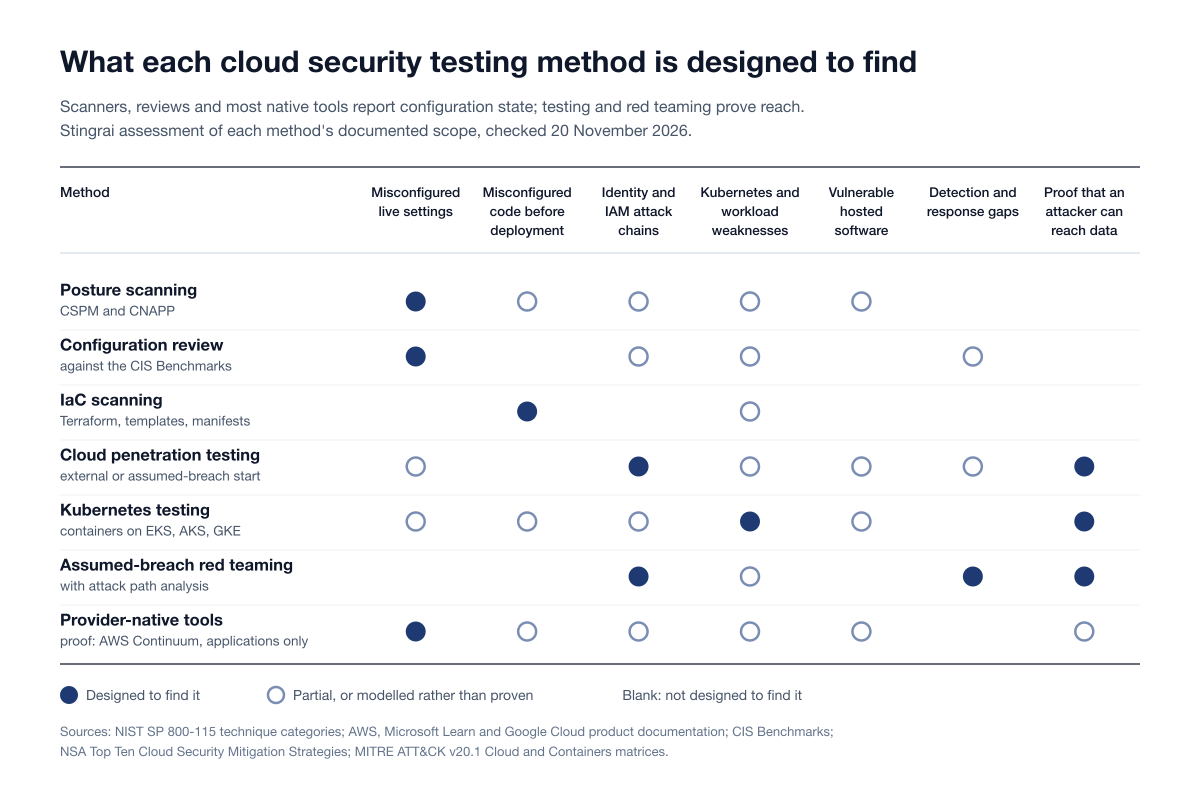
Figure 1: What each cloud security testing method is designed to find, as assessed by Stingrai from each method's documented scope. Source: NIST SP 800-115 technique categories and the provider documentation cited in this guide.
Method | What it finds | What it misses | When to buy it |
|---|---|---|---|
Posture scanning (CSPM and CNAPP) | Settings that drift from a standard, continuously, across every account it can read | Whether a flagged weakness is exploitable; chains it can model but not confirm | From the first production account; always on |
Configuration review (CIS Benchmarks) | Gaps against the current benchmark, plus analyst judgment on IAM, logging and guardrails | Exploitability; anything outside the benchmark | Yearly, after major change and before a first audit |
IaC scanning | Misconfigurations in Terraform, CloudFormation, Bicep or manifests before deployment | Console changes, drift, runtime state and identity chains across resources | As soon as infrastructure ships through pipelines |
Cloud penetration testing | Exploitable paths from an external view or a foothold to data and the control plane | Anything out of scope or after the test window; denial of service | Yearly and after major change, and when an auditor or customer asks |
Container and Kubernetes testing | RBAC over-permission, pod security gaps, network policy holes, breakout and workload identity bridges | The wider cloud control plane, unless scoped together | When production runs on EKS, AKS, GKE or self-managed Kubernetes |
Assumed-breach red teaming and attack path analysis | Whether a foothold reaches an objective, and whether you detect it | Breadth: it follows objectives, not every misconfiguration | Once scanning and annual testing are routine and detection matters |
Provider-native tools | Provider-defined controls, external and unused access, modelled attack paths | Independent evidence, newer benchmark versions, and proof beyond applications | Now; Microsoft's Foundational CSPM is free |
The seven methods: what each finds, misses and when to buy it
1. Posture scanning (CSPM and CNAPP)
Cloud security posture management (CSPM) reads configuration through provider APIs and compares it with a standard, continuously: Microsoft describes "continuous visibility into the security state of your cloud assets and workloads" (Microsoft Learn), and AWS Security Hub CSPM "runs checks against security controls" from standards including CIS, PCI DSS and NIST (AWS documentation). A cloud-native application protection platform (CNAPP) adds workload protection and code scanning; Microsoft calls Defender for Cloud "a Cloud Native Application Protection Platform (CNAPP)" (Microsoft Learn).
What it finds. Public storage, missing encryption, disabled logging, permissive security groups and drift from yesterday's baseline, across every account it can read.
What it misses. A scanner reads state one control at a time. Some CNAPPs model attack paths (method 6), but a model is not an exploit: the scanner does not assume the role it flagged or show that customer data is reachable. Our CNAPP blind spots guide covers the gaps in detail.
When to buy it. From the first production account, and keep it on. The NSA notes that "Many cloud breaches occur due to misconfigurations in cloud tenants," and posture findings feed every other method on this list.
2. Configuration review against the CIS Benchmarks
A configuration review is a point-in-time, analyst-led reading of your environment against a published baseline, usually the CIS Benchmarks. NIST describes the technique: "Assessors using manual review techniques rely on security configuration guides or checklists to verify that system settings are configured to minimize security risks" (NIST SP 800-115). The baselines move, so a review should name the version it used. As of 20 November 2026, CIS lists:
Benchmark | Latest version | Published |
|---|---|---|
CIS Amazon Web Services Foundations Benchmark | v7.1.0 | 2 October 2026 |
CIS Microsoft Azure Foundations Benchmark | v7.0.0 | 30 October 2026 |
CIS Google Cloud Platform Foundation Benchmark | v5.0.1 | 28 October 2026 |
CIS Kubernetes Benchmark | v2.1.0 | 30 September 2026 |
Sources: CIS AWS, CIS Azure, CIS Google Cloud and CIS Kubernetes benchmark pages, read on 20 November 2026.
The gap between benchmark and automation is where a reviewer earns the fee. AWS Security Hub CSPM supports CIS AWS Foundations Benchmark "versions 5.0.0, 3.0.0, 1.4.0, and 1.2.0" (AWS documentation), two major versions behind v7.1.0. A reviewer reads the current benchmark and adds what no benchmark scores well: whether an organization policy covers the accounts that matter, whether a role's trust policy fits its users, and whether logs would survive an attacker with administrative rights.
What it finds. Benchmark gaps with remediation steps across root and break-glass accounts, logging, key management, network exposure, storage and identity, plus the analyst's judgment on guardrails.
What it misses. Whether any gap is exploitable, and anything the benchmark does not cover, such as a chain that runs through three individually acceptable settings.
When to buy it. Before a first SOC 2 or ISO 27001 audit, after a migration or landing zone build, and yearly. Stingrai's read-only review of one account, subscription or project typically takes 3 to 5 testing days (Stingrai), and the cloud security assessment guide covers its scope, steps and deliverables.
3. Infrastructure as code (IaC) scanning
IaC scanning checks Terraform, CloudFormation, Bicep, Helm charts and Kubernetes manifests against policy before anything is deployed. The NSA's seventh mitigation strategy describes the full loop: before deployment, organizations should "complete static application security testing," and after deployment they "should dynamically test deployed resources" (NSA).
Provider tooling covers part of this. AWS CloudFormation Guard is "an open-source, general-purpose, policy-as-code evaluation tool"; Google's Security Command Center IaC validation "supports organization policies and Security Health Analytics detectors only"; and Defender for Cloud reports "Infrastructure as Code (IaC) misconfigurations and exposed secrets" from connected repositories (Microsoft Learn). Open-source policy engines and commercial scanners work across providers.
What it finds. Public buckets, open security groups, unencrypted volumes, wildcard IAM statements and privileged pods, at pull-request time, when they are cheapest to fix.
What it misses. Anything not defined in code: console changes, drift and the runtime state of identities. It judges each resource on its own, so it rarely sees how a role in one template and a trust policy in another combine. The pipelines themselves are attack surface (the NSA's sixth strategy covers CI/CD); our GitHub Actions OIDC cloud trust test matrix covers that bridge.
When to buy it. As soon as infrastructure ships through pipelines, paired with a periodic penetration test of what was actually deployed.
4. Cloud penetration testing
A cloud penetration test is authorized, human-led testing that proves which weaknesses chain into real access: an exposed credential becomes a role, the role reads a bucket, and the bucket holds a key to production. The starting point is agreed at scoping: an external, black-box view of what is exposed; an assumed-breach foothold such as a leaked key or a compromised workload; or a read-only reviewer role, often combined with a foothold (Stingrai). NIST's four phases (planning, discovery, attack and reporting) still describe the work.
MITRE ATT&CK v20.1 (13 October 2026) catalogues the techniques in a Cloud matrix covering the Office Suite, Identity Provider, SaaS and IaaS platforms, and a defender-minded test maps each relevant technique to its fix and detection (MITRE ATT&CK versions).
What it finds. IAM privilege escalation, cross-account and cross-subscription trust abuse, metadata service exposure, secrets in user data, images and pipelines, reachable data stores, and the logging gaps observed while the paths run. It also covers the software door: Google observed threat actors deploying cryptocurrency miners "within approximately 48 hours" of the public disclosure of CVE-2025-55182 (Google Cloud), so internet-facing services belong in scope.
What it misses. It is point in time and bounded by scope: excluded accounts are not tested, denial-of-service testing is prohibited on AWS and Azure, and a two-week test cannot watch drift.
When to buy it. Yearly and after major change, when an auditor, enterprise customer or regulator asks for independent testing, and after a migration; PCI DSS sets its own triggers, covered in the decision table below. Our cloud penetration testing buyer's guide covers delivery models and provider selection.
5. Container and Kubernetes testing
Container and Kubernetes testing applies the same idea to the cluster: configuration against a CIS benchmark, then attack paths through RBAC, service account tokens, admission controls and network policy, ending where the cluster meets the cloud through workload identity. CIS currently lists the Kubernetes Benchmark at v2.1.0, the EKS and AKS benchmarks at v2.1.0 and the GKE Benchmark at v2.0.0 (CIS). MITRE keeps a separate Containers matrix for techniques "known to target containers and container orchestration systems such as Kubernetes," and the Kubernetes project's own security checklist is a good floor that "does not claim to be exhaustive."
What it finds. Over-broad cluster roles, use of system:masters beyond break-glass, privileged or host-mounted pods, missing network policies, exposed dashboards or kubelets, secrets readable across namespaces, container breakout to the node, and node or pod identities that reach cloud APIs.
What it misses. The wider cloud control plane, unless the engagement scopes cluster and cloud together, which most should. Check the provider rules as well: AWS's permitted services list names Amazon EC2, Amazon Elastic Container Service and AWS Fargate, which is where EKS nodes and pods run, but Amazon EKS itself is not named on it as of 20 November 2026, and AWS tells customers testing services outside the list to "work directly with AWS Support or your account representative" (AWS). Agree in writing how testing of the cluster API is scoped.
When to buy it. When production runs on EKS, AKS, GKE or self-managed Kubernetes. Our cloud and Kubernetes scoping and cost guide covers the layers.
6. Assumed-breach cloud red teaming and attack path analysis
This method has two halves that buyers often confuse. Attack path analysis is modelled. Defender for Cloud's attack path analysis, part of Microsoft's paid Defender CSPM plan, "uses the cloud security graph and a proprietary algorithm to find exploitable entry points that begin outside your organization and the steps an attacker can take to reach your vital assets" (Microsoft Learn), and Google's Security Command Center Risk Engine generates attack paths "by simulating what hypothetical attackers could do" (Google Cloud). Google is direct about the limit: "You won't see evidence of an actual attack in an attack path."
An assumed-breach red team is executed. It starts from a realistic foothold, such as a phished identity, a leaked access key or a compromised CI runner, and pursues an objective such as reading a named dataset, while your security operations team is tested on whether it notices. Mandiant's casework from the second half of 2025 shows why the objective is usually data: identity issues gave attackers initial access in 83% of the incidents it worked in major cloud and SaaS-hosted environments, and attackers targeted data in 73% of cloud-related incidents (Google Cloud Threat Horizons Report H1 2026).
What it finds. Whether a modelled path is real, how far a foothold travels, which detections fire and which stay silent, and how long the response takes. Microsoft's rules of engagement explicitly encourage "Testing your tenant's security monitoring and detection systems" (MSRC).
What it misses. Breadth. A red team follows an objective, not every misconfiguration, so it complements a penetration test rather than replacing one.
When to buy it. Once posture scanning and annual testing are routine and detection is a priority, after a migration, or after an incident. Plan the paperwork: on AWS, covert adversarial simulations, command and control, simulated phishing and malware testing each need a Simulated Events form, submitted "at least two (2) weeks in advance of the start date" (AWS). Our guide to a cloud red-team exercise after a migration covers scope and evidence.
7. Provider-native tools
Each provider sells, and in part gives away, a first layer of testing for its own platform:
Provider | What the native tools cover | Where they stop |
|---|---|---|
AWS | Security Hub CSPM checks controls against FSBP, CIS, PCI DSS and NIST standards; IAM Access Analyzer finds external, internal and unused access and validates policies; CloudFormation Guard evaluates IaC; AWS Continuum for Penetration Testing (formerly AWS Security Agent) runs on-demand AI penetration tests of applications, starting from the OWASP Top 10 | CIS automation up to v5.0.0; Continuum is pointed at applications and their endpoints |
Microsoft | Defender for Cloud, a CNAPP: Foundational CSPM at no cost, Defender CSPM (paid) adding attack path analysis, and IaC and secret findings from connected repositories | Attack paths come from the security graph and reachability scans rather than exploitation; path analysis needs the paid plan |
Google Cloud | Security Command Center: Risk Engine attack exposure scores and simulated attack paths, and IaC validation against organization policies and Security Health Analytics detectors | "You won't see evidence of an actual attack in an attack path"; attack paths need Security Command Center Premium (or the deprecated Enterprise tier) activated at the organization level |
Sources: AWS, IAM Access Analyzer, AWS Continuum and its FAQ, Microsoft, Google Cloud.
What they miss. Independence, benchmark versions newer than the tool supports, and proof. Apart from AWS Continuum, which is pointed at applications and their endpoints and which AWS says "proves which are exploitable," these tools report and model rather than exploit. Whether Continuum replaces a third-party test is covered in Does AWS Continuum replace a cloud penetration test?
When to buy it. Turn them on now. Microsoft's Foundational CSPM is "Available at no cost" (Microsoft Learn), and native findings let paid testers start from known issues instead of rediscovering them.
What do AWS, Azure and Google Cloud allow without prior approval?
None of the three requires you to ask before testing your own resources, but each draws its own lines; our rules of engagement guide has the detail. As checked on 20 November 2026:
Provider | No prior approval needed for | Needs approval, or prohibited |
|---|---|---|
AWS | Security assessments and penetration tests of your own resources on the 16 entries of the permitted services list, from Amazon EC2 instances, WAF, NAT Gateways and Elastic Load Balancers to AWS Global Accelerator | Command and control, covert adversarial simulations, simulated phishing, malware testing and iPerf testing need a Simulated Events form at least two weeks ahead; DoS and DDoS (outside AWS's DDoS simulation policy), Route 53 zone walking, DNS hijacking and pharming, S3 bucket takeover and subdomain takeover are prohibited |
Microsoft Azure | Penetration tests of Azure resources you own, with no pre-approval since 15 June 2017; third parties need explicit written authorization from the resource owner | Denial-of-service testing, phishing Microsoft employees or using Microsoft services to phish, and using credentials or secrets that are not your own are prohibited |
Google Cloud | Penetration tests of your own projects; customers are "not required to contact us" | Tests must follow the Acceptable Use Policy and Terms of Service and affect only your projects |
Sources: AWS penetration testing policy, Microsoft Learn, Penetration testing, MSRC Rules of Engagement, Google Cloud Security FAQ.
Cloud security audit vs cloud security testing: what is the difference?
A cloud security audit is an independent examination of whether your controls meet a framework, and it ends in a report, opinion or certificate. SOC 2 is the common example: the AICPA describes SOC as "a suite of service offerings CPAs may provide," which CPAs use "to provide assurance reports" (AICPA & CIMA). ISO 27001 certification audits and PCI DSS assessments play the same role for their frameworks.
Cloud security testing produces evidence that an audit relies on. The 2022 points of focus for SOC 2 criterion CC4.1 list "vulnerability scans, security assessment, penetration testing, and third-party assessments" among the evaluations an entity may use (AICPA, 2017 Trust Services Criteria with revised points of focus). The auditor examines whether you run those evaluations and act on the results; the testing firm finds and proves the weaknesses. Stingrai's cloud penetration tests and configuration reviews support SOC 2, ISO 27001, PCI DSS and HIPAA programs and produce the audit evidence, including an attestation letter that states scope and testing dates. Our SOC 2 penetration testing guide covers what auditors ask for.
Which cloud security test should you buy? A decision table by maturity and trigger
Maturity and the reason you are buying now decide the mix. Start from the row that matches your trigger.
Situation or trigger | Buy first | Add next | Why |
|---|---|---|---|
First production workloads, small team | Provider-native posture tools | A configuration review against the current CIS Benchmark | Fix the basics cheaply before paying for exploitation; Microsoft's Foundational CSPM is free |
First SOC 2 or ISO 27001 audit | Configuration review and a cloud penetration test of the accounts in scope | Continuous posture scanning as ongoing monitoring evidence | CC4.1's 2022 points of focus name vulnerability scans and penetration testing among evaluations |
PCI DSS with cardholder data in the cloud | Internal and external penetration testing of the cardholder data environment, with segmentation testing | Internal vulnerability scans every quarter | Testing every 12 months and after significant change; segmentation every 12 months, or six months for service providers; internal scans at least every three months |
New account structure, landing zone or migration | Configuration review of organization guardrails, logging and identity | Assumed-breach penetration test of account and project isolation | AWS designs account isolation so "the blast radius remains limited"; the test confirms that it does |
Kubernetes in production | Container and Kubernetes testing against the CIS Kubernetes or managed-service benchmark | Joint cluster and cloud attack path testing | Workload identity links pods to cloud APIs |
Infrastructure shipped through CI/CD daily | IaC scanning in the pipeline | A periodic cloud penetration test of what was deployed | The NSA pairs static testing before deployment with dynamic testing after it |
After an incident | Assumed-breach test from the incident's entry point | A red team exercise to check detection and response | Confirms containment and that the same path is closed |
Sources: PCI DSS v4.0.1 11.3.1 and 11.4.2 to 11.4.6; AICPA CC4.1; AWS multi-account guidance; NSA.
As the program matures, add assumed-breach red teaming once a security operations team needs its detection tested. Our ISO 27001 penetration testing guide and PCI DSS penetration testing guide cover those frameworks in depth.
What drives the cost of cloud security testing?
Native posture tools start free and scale with the resources you enable. Engagement-based testing is priced in testing days, and the same factors set the days whoever you hire. Stingrai's cloud service page lists them (Stingrai):
Accounts, subscriptions and projects: how many are in scope, and how they trust each other.
Providers: one provider, or a multi-cloud estate across AWS, Azure and Google Cloud.
Clusters and workloads: Kubernetes cluster count and size, serverless functions and managed services in scope.
IAM complexity: the number of roles, policies, identities and federation paths to analyze.
Starting point: external only, an assumed-breach foothold, configuration review, or a combination.
Cadence: a one-time assessment, or a continuous program that retests as the environment changes.
Two more drivers come from this guide's menu: how many methods you combine (a configuration review and a penetration test of the same accounts share scoping and discovery) and the evidence you need. Cloud work is quoted to scope through the Get a Quote form, with pricing within 24 hours and the retest included; the cloud and Kubernetes cost guide works through examples.
Where Stingrai fits
Stingrai is a CREST-accredited penetration testing company founded in Toronto in 2021. CREST lists Stingrai Inc. with two accreditations, Penetration Testing and AI-Enabled Penetration Testing, and the company certification CREST AI Charter (CREST Marketplace). We are proud to be a CREST member, and the marketplace is the place to verify it.
Our cloud penetration testing engagements are human-led. Two named penetration testers from a team holding OSCE³, OSWE, OSEP, CREST CRT and CISSP certifications cover four of the seven methods in this guide, in one engagement where it makes sense: configuration review against the CIS Benchmarks, cloud penetration testing from an external view or an assumed-breach foothold, Kubernetes testing on EKS, AKS and GKE, and assumed-breach red teaming. On AWS that means cross-account role assumption, resource and bucket policies and instance metadata abuse; on Azure, app registrations, service principals, consent grants and Conditional Access gaps; on Google Cloud, service account impersonation chains, IAM Conditions, GKE and Cloud Run.
Every attack path reaches the PTaaS portal as soon as it is confirmed, every report is reviewed by the team lead and an engagement partner, retesting is included, and every human-led and hybrid report ships with an attestation letter. Engagements run as a one-time test for an audit, a migration or a new environment, or as a continuous program that retests as accounts, clusters and services change.
If your cloud also hosts customer-facing web applications, Stingrai's Hybrid Pentest covers one web application and associated APIs: Snipe tests the full application while our certified penetration testers test the same application manually alongside it and validate Snipe's findings, at US$6,800 per assessment one-time or US$1,275 per month on a 12-month plan with monthly Snipe testing, human-verified, and a quarterly deep dive by Stingrai's penetration testers (pricing).
Frequently Asked Questions
What is the difference between a cloud security review and a cloud penetration test?
A cloud security review, or configuration review, measures your settings against a baseline such as the CIS Amazon Web Services Foundations Benchmark v7.1.0 and reports the gaps. A cloud penetration test starts from an external view or an assumed-breach foothold and proves which weaknesses chain into access to data or the control plane. NIST SP 800-115 puts the difference plainly: scanners check only for the possible existence of a vulnerability, while a penetration test exploits it to confirm it. Most programs need both; our cloud security assessment guide compares them in depth.
What is the difference between a cloud security audit and cloud security testing?
A cloud security audit is an independent examination of your controls against a framework, such as a SOC 2 examination performed by a CPA firm, and it ends in a report, opinion or certificate. Cloud security testing finds and proves technical weaknesses and produces the evidence an audit relies on; the 2022 points of focus for SOC 2 criterion CC4.1 list vulnerability scans and penetration testing among the evaluations an entity may use. Stingrai's testing supports audits with that evidence and an attestation letter.
Do I need permission from AWS, Azure or Google Cloud for cloud security testing?
Not for your own resources within each provider's rules. AWS allows testing without prior approval for the services on its permitted list, but command and control, covert adversarial simulations, simulated phishing and malware testing need a Simulated Events form at least two weeks ahead. Microsoft has not required pre-approval for Azure since 15 June 2017, and Google does not require customers testing their own projects to contact it. Denial-of-service testing is prohibited on AWS and Azure, and Microsoft requires third-party testers to hold explicit written authorization from the resource owner.
Which cloud security tests do SOC 2, ISO 27001 and PCI DSS call for?
PCI DSS v4.0.1 is the most specific: internal and external penetration testing at least once every 12 months and after any significant change, segmentation testing every 12 months (every six months for service providers), and internal vulnerability scans at least once every three months. SOC 2's CC4.1 points of focus name vulnerability scans and penetration testing as evaluations an entity may use, without prescribing them. For a first SOC 2 or ISO 27001 audit, a configuration review plus a cloud penetration test gives the auditor independent technical evidence.
How often should cloud security testing be done?
Posture scanning and IaC scanning should run continuously. A configuration review and a cloud penetration test belong every year and after major change, such as a migration, a new account structure or a new Kubernetes platform; PCI DSS sets the same 12-month and significant-change triggers for penetration testing. Teams that change infrastructure weekly can add a continuous program that retests as accounts, clusters and services change; Stingrai delivers both one-time and continuous engagements.
How long does a cloud security review take?
Stingrai's read-only configuration review of one AWS account, Azure subscription or Google Cloud project against the CIS Benchmarks typically takes 3 to 5 testing days. Penetration testing time depends on the number of accounts and projects, clusters, IAM complexity and whether the engagement starts external, from a foothold or both. Pricing comes back within 24 hours of a Get a Quote request, with the retest included.
What does a cloud pentest find that scanners miss?
A cloud pentest finds the chains: an exposed key that assumes a role, a role that reads a bucket, a workload identity that reaches the management plane. It also shows which logs and alerts stayed silent while the path ran. PCI DSS guidance makes the same point: "Scanning for vulnerabilities alone is not a penetration test."
Related reading
Cloud Security Assessment (2026): What It Tests on AWS, Azure and GCP
Cloud Penetration Testing (2026): AWS, Azure and GCP Buyer's Guide
Cloud Penetration Testing Rules of Engagement: What AWS, Azure, and GCP Allow in 2026
CNAPP Blind Spots: What Cloud Posture Tools Cannot Validate Before an Enterprise Security Review
References
AWS. Shared Responsibility Model. Read 20 November 2026. https://aws.amazon.com/compliance/shared-responsibility-model/
Microsoft. Shared responsibility in the cloud. Microsoft Learn, last updated 24 August 2026. https://learn.microsoft.com/en-us/azure/security/fundamentals/shared-responsibility
Google Cloud. Shared responsibilities and shared fate on Google Cloud. Last updated 28 October 2026. https://cloud.google.com/architecture/framework/security/shared-responsibility-shared-fate
AWS. Penetration Testing (Customer Service Policy for Penetration Testing). Read 20 November 2026. https://aws.amazon.com/security/penetration-testing/
Microsoft. Penetration testing. Microsoft Learn. Read 20 November 2026. https://learn.microsoft.com/en-us/azure/security/fundamentals/pen-testing
Microsoft Security Response Center. Microsoft Security Testing Rules of Engagement. Read 20 November 2026. https://www.microsoft.com/en-us/msrc/pentest-rules-of-engagement
Google Cloud. Cloud Security FAQ. Read 20 November 2026. https://support.google.com/cloud/answer/6262505
Google Cloud. Cloud Threat Horizons Report H1 2026. 2026. https://cloud.google.com/security/report/resources/cloud-threat-horizons-report-h1-2026
NIST. SP 800-115, Technical Guide to Information Security Testing and Assessment. September 2008. https://csrc.nist.gov/pubs/sp/800/115/final
NSA. NSA's Top Ten Cloud Security Mitigation Strategies. March 2024. https://media.defense.gov/2024/Mar/07/2003407860/-1/-1/0/CSI-CloudTop10-Mitigation-Strategies.PDF
MITRE. ATT&CK Cloud Matrix and Containers Matrix, v20.1. 13 October 2026. https://attack.mitre.org/matrices/enterprise/cloud/
CIS. CIS Benchmarks for Amazon Web Services, Microsoft Azure, Google Cloud and Kubernetes. Read 20 November 2026. https://www.cisecurity.org/benchmark/amazon_web_services
Kubernetes project. Security Checklist. Read 20 November 2026. https://kubernetes.io/docs/concepts/security/security-checklist/
AWS. CIS AWS Foundations Benchmark in Security Hub CSPM. Read 20 November 2026. https://docs.aws.amazon.com/securityhub/latest/userguide/cis-aws-foundations-benchmark.html
AWS. AWS Continuum FAQs. Read 20 November 2026. https://aws.amazon.com/continuum/faqs/
Microsoft. What is Cloud Security Posture Management (CSPM). Microsoft Learn. Read 20 November 2026. https://learn.microsoft.com/en-us/azure/defender-for-cloud/concept-cloud-security-posture-management
Google Cloud. Overview of attack exposure scores and attack paths. Last updated 10 November 2026. https://cloud.google.com/security-command-center/docs/attack-exposure-learn
AICPA. 2017 Trust Services Criteria (with Revised Points of Focus, 2022). https://www.aicpa-cima.com/resources/download/2017-trust-services-criteria-with-revised-points-of-focus-2022
PCI Security Standards Council. PCI DSS v4.0.1. June 2024. https://www.pcisecuritystandards.org/document_library/
Talk to Stingrai
Tell us which accounts, subscriptions, projects and clusters are in scope and why you are testing now, and we will recommend the mix of methods from this guide and quote it. Get a Quote for pricing within 24 hours, or book a free discovery call.