A network penetration testing checklist has five parts: preparation, the external test, the internal test with segmentation, wireless, and reporting with a retest. It starts at the internet-facing edge for a reason: exploits were the initial infection vector in 32% of the intrusions Mandiant investigated in 2025, the most common way in for the sixth consecutive year, according to M-Trends 2026. Of the 15 vulnerabilities that CISA, the FBI, the NSA and partner agencies in four other countries named as the top routinely exploited of 2023, six sit in edge appliances, two each in Citrix NetScaler ADC and Gateway and Cisco IOS XE, one in Fortinet's FortiOS and FortiProxy SSL-VPN and one in the Barracuda Email Security Gateway. Inside the perimeter, one NSA and CISA team cracked over 80% of the user passwords in an Active Directory in 12 hours, according to the agencies' list of the ten most common network misconfigurations.
Quick answer. A network penetration testing checklist has five parts. Prepare: scope and exclude list, permission, rules of engagement, emergency contacts, test windows, assumed-breach credentials and a change freeze. External: asset discovery, exposed services and management interfaces, edge devices and VPN, TLS, email, DNS and sign-in portals. Internal: patch level, Active Directory, exposed credentials, relay and coercion, lateral movement, segmentation and the cardholder data environment, legacy protocols. Wireless: rogue access points, guest isolation and enterprise Wi-Fi. Report and retest: attack paths with evidence, what passed, and the retest of every fix that PCI DSS v4.0.1 Requirement 11.4.4 requires.
This checklist is for IT directors, infrastructure leads and CISOs commissioning a network test. Each table gives the check, what it finds and the standard it maps to, ready for a statement of work. For background, see our network penetration testing guide and the internal and external cost guides.
The network penetration testing checklist at a glance
The mappings in every table are Stingrai's own: a NIST, PTES, PCI DSS, CIS, CISA or ATT&CK reference next to a check means the check tests, or produces evidence for, that item, not that the standard names the check word for word.
Phase | What it covers | Standards it draws on |
|---|---|---|
Prepare | Scope and exclusions, authorization, rules of engagement, contacts, test windows, start positions and credentials, change freeze | NIST SP 800-115 Appendix B; PTES pre-engagement; PCI DSS 11.4.1; CIS Safeguard 18.1 |
External | Asset discovery, exposed services, management interfaces, edge devices and VPN, TLS, email, DNS, sign-in portals | PCI DSS 11.4.3; CIS Safeguard 18.2; CISA KEV, BOD 23-02 and edge device guidance |
Internal | Discovery, Active Directory, credential exposure, relay and coercion, lateral movement, privilege escalation, legacy protocols, network devices | PCI DSS 11.4.2; CIS Safeguard 18.5; NSA and CISA AA23-278A; MITRE ATT&CK |
Segmentation | Every segmentation method between out-of-scope networks and the cardholder data environment (CDE) or another protected zone | PCI DSS 11.4.5 and 11.4.6 |
Wireless | Rogue access points, guest isolation, enterprise Wi-Fi configuration | PCI DSS 11.2.1; NIST SP 800-153 |
Report and retest | Attack paths with evidence, what passed, correction and retest, detection changes | NIST SP 800-115; PCI DSS 11.4.4; CIS Safeguards 18.3 and 18.4 |
The core standards are NIST SP 800-115 (September 2008, still NIST's current edition as of 19 November 2026), the Penetration Testing Execution Standard (PTES), PCI DSS v4.0.1 Requirement 11.4 (June 2024, PCI SSC document library), CIS Controls v8.1 Control 18, CISA's Known Exploited Vulnerabilities catalog (KEV) and directives, and MITRE ATT&CK technique IDs.
Before the test: how to prepare for a network penetration test
NIST SP 800-115 says the planning phase "sets the groundwork for a successful penetration test", and PTES calls scoping "arguably one of the most important components of a penetration test, yet it is also one of the most overlooked." Agree these nine steps with the provider before testing starts.
Step | Check | What it prevents | Maps to |
|---|---|---|---|
1 | Write down the scope. Ranges, domains, sites and cloud-hosted addresses, plus an exclude list of systems not authorized for testing. | Testing the wrong systems | NIST SP 800-115 Appendix B; PTES pre-engagement; PCI DSS 12.5.2 |
2 | Confirm ownership and get permission. Every address is yours, and hosting providers, managed service providers and cloud platforms have agreed to the test. | Attacking someone else's machine | PTES pre-engagement |
3 | Choose start positions. External from the internet; internal from a network port, virtual machine or VPN; one position in each segment whose isolation must be proven. | An internal test that sees one VLAN | NIST SP 800-115 section 5.2.2; PCI DSS 11.4.1 |
4 | Provision credentials for an assumed-breach start. A standard domain account set up like a new joiner's, and a standard workstation build if endpoint controls are in scope. | A time box spent getting a first account | NIST SP 800-115 section 5.2.2; CIS Safeguard 18.1 |
5 | Agree the rules of engagement. Permitted and prohibited activities, no denial of service unless agreed, password attempts below the lockout threshold, and data handling. | Outages, lockouts and data leaving your environment | NIST SP 800-115 section 6; PTES pre-engagement; PCI DSS 8.3.4 |
6 | Name contacts, escalation and stop criteria. Who answers at any hour, who can stop the test, and what happens if a real intruder is found. | An incident with nobody to call | NIST SP 800-115 Appendix B; PTES pre-engagement |
7 | Fix test windows and source addresses, and decide on detection. Testing hours, the testers' IP addresses, and whether the security team is told. | Real attacks hidden behind test traffic | NIST SP 800-115 section 6; PTES pre-engagement; CIS Safeguard 18.4 |
8 | Freeze changes and protect fragile systems. No major changes in the window, backups of anything fragile, and a list of legacy, OT and clinical devices to exclude or treat gently. | Results from a network that changed mid-test | PTES pre-engagement; NIST SP 800-115 section 5.2.2 |
9 | Hand over the inputs. Asset inventory, network and data-flow diagrams, the CDE boundary, the last report, recent significant changes and threats seen in the last 12 months. | Rediscovering what you already know | PCI DSS 1.2.3, 1.2.4 and 11.4.1; CIS Safeguard 1.1 |
Scope and credentials. NIST's template says "It is also crucial to identify any system not authorized for testing", which it calls the "exclude list." Amazon Web Services lets customers test "without prior approval for the services listed" under Permitted Services, but prohibits denial of service against any AWS asset outside its separate DDoS Simulation Testing policy (cloud rules of engagement). NIST SP 800-115 says internal testers get the network information someone with their level of access would normally have, "generally as a standard employee". In practice that means one ordinary domain account with no special rights; see assumed breach testing.
Rules and contacts. PCI DSS v4.0.1 Requirement 8.3.4 calls for "Locking out the user ID after not more than 10 attempts", so set password testing against your real lockout policy. NIST says the testers' IP addresses "should be identified in the assessment plan to enable administrators to differentiate assessment activities such as penetration testing attacks from actual malicious attacks", and if a real intruder turns up, that "assessors stop assessing the systems involved in the incident while the organization carries out its response."
External network penetration testing checklist
PCI DSS v4.0.1 defines external testing as "testing the exposed external perimeter of trusted networks, and critical systems connected to or accessible to public network infrastructures", and CIS Safeguard 18.2 says it "must include enterprise and environmental reconnaissance to detect exploitable information." In Stingrai's State of Penetration Testing 2026 data, external tests returned a median of one verified finding per test, against 11 for internal tests (six external tests at one firm): a well-run perimeter often yields few findings, so the value is in finding the one exposure that would undo it.
Asset discovery and exposed services
Check | What it finds | Maps to |
|---|---|---|
Discover internet-facing addresses, domains, subdomains and certificates independently of your list, and compare the two | Forgotten hosts, acquired ranges, test systems and cloud assets missing from the inventory | CIS Safeguards 18.2, 1.1 and 1.2; ATT&CK T1590, T1595 |
Identify every listening service on each in-scope address and match it to an approved business need | Remote desktop, file sharing, databases, Telnet and FTP exposed without a reason | PCI DSS 1.2.5 and 2.2.4; CIS Safeguard 4.8; ATT&CK T1046 |
Find management interfaces reachable from the internet (web consoles, SSH, SNMP, controllers such as iLO and iDRAC), and check where each edge device can be administered from and how administrators authenticate | Administrative access open to anyone who finds it, or protected without phishing-resistant MFA | CISA BOD 23-02; CCCS ITSM.80.101; CIS Safeguards 6.5 and 12.3 |
Test exposed services and devices for default and weak credentials within agreed limits | Vendor default accounts on VPNs, appliances, cameras and admin portals | PCI DSS 2.2.2; CIS Safeguard 4.7; ATT&CK T1078.001 |
Match versions against vendor advisories and the KEV catalog, then confirm exploitability without causing harm | Unpatched, exploitable services, ranked by evidence of exploitation in the wild | PCI DSS 6.3.3; CIS Safeguard 7.7; CISA BOD 26-04; ATT&CK T1190 |
KEV's 18 November 2026 release held 1,786 entries, 302 of them added in 2026, already more than the 245 added in all of 2025. BOD 26-04, which revoked BOD 22-01 on 10 June 2026, gives US federal agencies three or 14 calendar days to fix a KEV entry, depending on whether the asset is publicly exposed, whether exploitation can be automated and whether it gives partial or total control, with a forensic triage added where a three-day exploit gives total control (what BOD 26-04 changes). PCI DSS 6.3.3 asks for critical patches "within one month of release." BOD 23-02 (13 June 2023) gives agencies 14 days to take an exposed management interface off the internet or behind a separate policy enforcement point.
Edge devices and VPN
Check | What it finds | Maps to |
|---|---|---|
Inventory every edge appliance (firewalls, VPN gateways, application delivery controllers, email gateways, SD-WAN) with version, support status and advisory history | End-of-life devices and versions with known exploited flaws | CCCS ITSM.80.101; CIS Safeguard 12.1; CISA AA24-317A and BOD 26-02 |
Review what an unauthenticated visitor can reach on each device's own portal and services | Functions exposed before sign-in, where flaws such as CVE-2023-3519 in NetScaler could be triggered without credentials | CISA AA24-317A; ATT&CK T1190 |
M-Trends 2026 reports espionage groups that "deliberately target edge and core network devices, such as virtual private networks (VPNs) and routers, that typically lack standard endpoint detection and response (EDR) telemetry." Of the 302 KEV entries added in 2026, 21 name Cisco products (nine of them SD-WAN), six Citrix NetScaler, five SonicWall's SMA1000 or SSL VPN appliances and three Ivanti Connect Secure. The Canadian Centre for Cyber Security's edge device guidance asks for "strong, phishing-resistant multi-factor authentication (MFA) for all administrative access to devices." Since 5 February 2026, BOD 26-02 has required US federal agencies to inventory end-of-support edge devices and replace them within 12 to 18 months.
TLS, email and DNS
Check | What it finds | Maps to |
|---|---|---|
Enumerate TLS versions, cipher suites and certificates on every encrypted service | TLS 1.0 or 1.1 still offered, weak ciphers, expired or mismatched certificates | RFC 8996; NIST SP 800-52 Rev. 2; PCI DSS 4.2.1 |
Look for administrative and file transfer services running without encryption | Telnet, FTP and plain HTTP administration carrying credentials in clear text | PCI DSS 2.2.7; CIS Safeguard 12.3 |
Read the SPF, DKIM and DMARC records of every domain, including domains that send no mail | Domains that can be spoofed, and DMARC left at monitoring only | RFC 7489; CISA BOD 18-01; ATT&CK T1566 |
Check mail servers for STARTTLS and retired protocols and ciphers | SSLv2, SSLv3, RC4 or 3DES still enabled | CISA BOD 18-01 |
Request zone transfers from every authoritative name server | Every record in the zone handed to anyone who asks | ATT&CK T1590.002 |
Look for DNS records that point to deprovisioned cloud resources | Subdomains an outsider could take over | Microsoft subdomain takeover guidance; ATT&CK T1584.001 |
RFC 8996 (March 2021) "formally deprecates" TLS 1.0 and 1.1, and implementations "MUST NOT negotiate" them. NIST SP 800-52 Rev. 2 requires all government TLS servers and clients to support TLS 1.2, and support for TLS 1.3 by 1 January 2024. BOD 18-01 required federal agencies to offer STARTTLS within 90 days and to set a DMARC policy of "reject" within a year, and Microsoft calls subdomain takeover "a common, high-severity threat for organizations that regularly create and delete many resources."
Sign-in portals
Check | What it finds | Maps to |
|---|---|---|
List every internet-facing sign-in: VPN, webmail, single sign-on, virtual and remote desktop gateways, admin portals | Forgotten portals outside the identity provider's MFA policy | CIS Safeguards 6.3 and 6.6 |
Confirm MFA on each sign-in and on every VPN and remote access path, including legacy portals and alternate authentication profiles, and test whether legacy protocols or alternate endpoints bypass it | Single-factor paths beside an MFA-protected front door | PCI DSS 8.4.3; CIS Safeguards 6.3 and 6.4; ATT&CK T1133 |
Check for username enumeration, then run a slow password spray inside the agreed lockout margin | Accounts with common or seasonal passwords | ATT&CK T1110.003; PCI DSS 8.3.4 and 8.3.6 |
Our password spraying guide covers detection and defense. The web applications these hosts serve need their own web application penetration test.
Internal network penetration testing checklist
PCI DSS v4.0.1 defines internal testing as "testing from both inside the CDE and into the CDE from trusted and untrusted internal networks", and CIS Safeguard 18.5 asks for it "no less than annually". Findings concentrate here: in Stingrai's State of Penetration Testing 2026 data, internal tests returned a median of 11 verified findings, 92% of them High or Critical, and outdated or unpatched software made up 56.9% of them (eight tests from one firm). One NSA and CISA team "compromised a domain in under a business day" after gaining access through an account with administrative permissions.
Discovery and patch level
Check | What it finds | Maps to |
|---|---|---|
Discover live hosts and services in every in-scope range and compare them with the asset inventory | Unmanaged hosts, forgotten servers, devices nobody owns | CIS Safeguards 1.1 to 1.3; ATT&CK T1046 |
Identify unsupported operating systems and firmware and missing critical patches, then confirm exploitability without causing harm | End-of-life systems and long-missing fixes | PCI DSS 6.3.3; CIS Safeguards 7.3 and 7.4; ATT&CK T1210 |
Test printers, scanners, cameras, VoIP phones, building systems and management controllers for default credentials | Devices that open with the vendor password, some holding privileged domain accounts | PCI DSS 2.2.2; CIS Safeguard 4.7; ATT&CK T1078.001 |
Enumerate file shares and their permissions as an ordinary user | Shares everyone can read, holding data only some should see | CIS Safeguard 3.3; ATT&CK T1135 |
The NSA and CISA teams "frequently observe organizations using unsupported Windows operating systems without updates MS17-010 and MS08-67", and printers and scanners "may have privileged domain accounts loaded." Check domain controllers separately: CVE-2020-1472 in Microsoft Netlogon "has been included in top routinely exploited vulnerabilities lists since 2021."
Active Directory
Check | What it finds | Maps to |
|---|---|---|
Map paths from a standard user to domain administrator through group membership, access control lists and administrative sessions, including where privileged accounts sign in | Privilege creep, indirect control of privileged groups, and domain administrator sessions on ordinary workstations | CIS Safeguards 5.4, 6.8 and 12.8; AA23-278A |
Find user accounts with service principal names and test whether their passwords resist offline cracking | Kerberoastable service accounts | ATT&CK T1558.003; CIS Safeguard 5.5 |
Find accounts that do not require Kerberos pre-authentication | AS-REP roastable accounts | ATT&CK T1558.004 |
Review certificate templates, enrollment rights and web enrollment on Active Directory Certificate Services (AD CS) | Templates that let a low-privileged user obtain a certificate for an administrator | ATT&CK T1649; AA23-278A |
Check which accounts other than domain controllers hold directory replication rights | Accounts able to request every password hash in the domain | ATT&CK T1003.006 |
Compare the password policy with what is enforced, and test password quality within agreed limits | Short, guessable and reused passwords | PCI DSS 8.3.6; CIS Safeguard 5.2; ATT&CK T1110.003 |
M-Trends 2026 reports attackers "exploiting misconfigured Active Directory Certificate Services templates to create admin accounts that bypass password rotation", and the Active Directory guidance led by Australia's ASD with CISA, the NSA and partners, revised on 15 September 2026, covers "the 17 most common techniques". PCI DSS 8.3.6 sets a 12-character minimum where passwords are used (eight where a system cannot support 12). Each technique has its own guide: Kerberoasting, AD CS, and the Active Directory security assessment, which also covers delegation and tier boundaries.
Credential exposure
Check | What it finds | Maps to |
|---|---|---|
Search reachable shares, scripts, configuration files and deployment folders for stored credentials | Cleartext passwords for service accounts, applications and administrators | ATT&CK T1552.001; PCI DSS 8.6.2 |
Check SYSVOL for Group Policy Preferences files that still hold passwords | Legacy stored passwords any domain user can read | ATT&CK T1552.006 |
Test whether local administrator passwords are shared across machines | One compromised workstation unlocking many | Microsoft Windows LAPS; CIS Safeguard 5.2; ATT&CK T1550.002 |
The NSA and CISA teams "regularly find drives containing cleartext credentials" for service accounts, web applications "and even domain administrators." Microsoft's Windows LAPS documentation names the other classic: "Local administrator accounts often share the same password across many devices, which bad actors can exploit to move laterally across your environment."
Relay and coercion
Check | What it finds | Maps to |
|---|---|---|
Check whether LLMNR, NBT-NS and mDNS are answered on user segments | Name resolution that can be poisoned to capture authentication | ATT&CK T1557.001; AA23-278A |
Check SMB signing on servers and workstations | Hosts where captured authentication can be relayed | Microsoft SMB signing guidance; ATT&CK T1557.001 |
Check LDAP signing and channel binding on domain controllers | Directory changes made with relayed authentication | Microsoft ADV190023 and LDAP signing guidance |
Test whether servers, including domain controllers and certificate servers, can be made to authenticate to a host the tester controls | Coercion paths that feed relay, including relay to AD CS web enrollment | ATT&CK T1187; AA23-278A |
Check for unmanaged IPv6, where rogue DHCPv6 answers are accepted | A second route to poisoning and relay | ATT&CK T1557.003 |
Check whether NTLMv1 is still accepted | A legacy protocol Microsoft has removed from current Windows | Microsoft deprecated features list |
The NSA and CISA advisory says missing SMB signing plus name resolution poisoning gives access to remote systems "without needing to capture and crack any hashes." Microsoft's SMB signing page says Windows 11 version 24H2 Enterprise, Pro and Education "require both outbound and inbound SMB signing" and that Windows Server 2025 "requires outbound SMB signing only", while its hardening page says both directions, so check the effective setting on each host, including storage devices and printers. NTLMv1 is removed starting in Windows 11 version 24H2 and Windows Server 2025, according to Microsoft's deprecated features list. The NTLM relay guide gives the fix for each path.
Lateral movement and privilege escalation
Check | What it finds | Maps to |
|---|---|---|
Test which remote management protocols (SMB, remote desktop, WinRM, SSH) are reachable workstation to workstation and from user segments to servers | A flat network in which any foothold reaches anything | CIS Safeguards 12.2 and 13.4; ATT&CK T1021 |
Test reuse of captured hashes across hosts | Movement without ever knowing a password | ATT&CK T1550.002 |
Test local privilege escalation on standard workstation and server builds | Weaknesses that make an ordinary user a local administrator | ATT&CK T1068; CIS Safeguard 4.1 |
Check whether virtualization, backup and endpoint management servers are reachable from user networks and protected like domain controllers | Systems that control every machine and every backup | M-Trends 2026; CIS Safeguard 12.8 |
M-Trends 2026 describes attackers "exploiting the 'Tier-0' nature of hypervisors" and "actively deleting backup objects from cloud storage", which is why hypervisors and backup consoles belong in the same tier as the directory. The lateral movement guide maps the paths and their detections.
Segmentation and the cardholder data environment
Check | What it finds | Maps to |
|---|---|---|
From each out-of-scope segment, or a documented representative sample, try every route into the CDE or other protected zone | Paths that make a supposedly out-of-scope network part of the CDE | PCI DSS 11.4.5; PCI SSC Penetration Testing Guidance |
Test each segmentation method separately: firewalls, VLAN access lists, host firewalls, cloud security groups | A method that holds in one place and fails in another | PCI DSS 11.4.5 |
Test the boundary between IT and operational technology (OT), and any network described as air gapped | Forgotten or accidental connections | AA23-278A; CIS Safeguard 12.2 |
Check that management networks, jump hosts and the administration of switches, routers, firewalls and wireless controllers can be reached only from where they should be, through central AAA with MFA rather than shared local accounts | Administrative networks reachable from user VLANs, or device administration protected by a shared password | CISA BOD 23-02; CCCS ITSM.80.101; CIS Safeguards 12.2, 12.5, 12.8 and 6.5 |
Repeat after changes to segmentation, and every six months for service providers | Drift after a firewall change or migration | PCI DSS 11.4.5 and 11.4.6 |
PCI DSS v4.0.1 Requirement 11.4.5 applies "If segmentation is used to isolate the CDE from other networks": tests run "At least once every 12 months and after any changes to segmentation controls/methods", "Covering all segmentation controls/methods in use", and confirm that controls isolate "the CDE from all out-of-scope systems." Requirement 11.4.6 makes it "At least once every six months" for service providers. The PCI SSC Penetration Testing Guidance (September 2017, written when the requirement was numbered 11.3.4) allows "a representative subset" of segments but says "Each unique segmentation methodology should be tested." The NSA and CISA teams "have often gained access to OT networks" despite "prior assurance that the networks were fully air gapped." See our PCI DSS segmentation testing, enterprise segmentation testing and firewall rule path validation guides.
Legacy protocols and network devices
Check | What it finds | Maps to |
|---|---|---|
Check for SMBv1 on servers, workstations, storage devices and printers | A protocol Microsoft deprecated in 2014 and stopped installing by default from Windows 10 version 1709 | Microsoft SMBv1 guidance; CIS Safeguard 4.8 |
Check for Telnet, FTP, TFTP, rlogin, unsigned LDAP and similar cleartext services | Credentials and configurations readable on the wire | PCI DSS 2.2.4 and 2.2.7; CIS Safeguard 12.3; ATT&CK T1040 |
Test SNMP for default community strings and write access, and check the SNMP version in use | Device configurations readable, or changeable, by anyone on the network | ATT&CK T1602; CIS Safeguard 12.6 |
BOD 23-02 names the remote management protocols in its scope, from HTTP and SNMP to Telnet, TFTP, rlogin and SMB; the internal test asks which of them answer from a user segment. Our management plane scope guide explains why device administration is often left out.
Wireless network penetration testing checklist
Check | What it finds | Maps to |
|---|---|---|
Survey each site for authorized and unauthorized access points | Rogue access points on the corporate network | PCI DSS 11.2.1 |
Test guest and device wireless networks for isolation from corporate networks and the CDE | Guest Wi-Fi that reaches internal systems | PCI DSS 1.2.3 and 11.4.5 |
Review enterprise Wi-Fi authentication: the EAP method, and whether clients validate the server certificate | Clients that hand credentials to a look-alike access point | NIST SP 800-153; CIS Safeguard 12.6 |
Assess any remaining pre-shared keys for strength and rotation | Weak or long-unchanged shared passwords | NIST SP 800-153 |
PCI DSS 11.2.1 requires that "All authorized and unauthorized wireless access points are detected and identified" and that this happens "at least once every three months." See the Wi-Fi penetration testing and evil twin attack guides.
Reporting and retest checklist
Check | What it should show | Maps to |
|---|---|---|
Scope as tested: ranges, dates, start positions, source addresses and anything that limited testing | What a clean area of the report actually means | NIST SP 800-115; PCI DSS 11.4.1 |
Attack paths as well as findings | How weaknesses chained into access to the systems that matter | PCI DSS 11.4.4 guidance |
Evidence, a risk rating and a fix for every finding | Enough for an engineer to reproduce and repair the issue | NIST SP 800-115 section 5.2.1 |
What passed, including segmentation results | Proof that a boundary held | PCI DSS 11.4.5 |
Critical findings reported as they are found | Time to act while the test runs | NIST SP 800-115 section 7.3 |
Remediation by risk, then a retest recorded in the final report | Corrections verified, with dates | PCI DSS 11.4.4; CIS Safeguard 18.3 |
Detection gaps and the rule changes made in response | Detection that improved because of the test | CIS Safeguard 18.4 |
Retention of results and remediation records | At least 12 months | PCI DSS 11.4.1 |
NIST SP 800-115 expects a final report to "describe identified vulnerabilities, present a risk rating, and give guidance on how to mitigate the discovered weaknesses." The PCI DSS guidance on 11.4.4 explains why attack paths matter: "Often a tester will have chained a number of vulnerabilities together to compromise a system component." The requirement closes the loop: "Penetration testing is repeated to verify the corrections." CIS Safeguard 18.4 adds that organizations should "modify rulesets and capabilities to detect the techniques used during testing", and insufficient internal network monitoring is one of the ten misconfigurations on the NSA and CISA list, which describes an organization with "host-based monitoring, but no network monitoring." A red team engagement measures detection in depth. See a penetration testing report sample and how to evaluate a report.
The one-page network penetration testing checklist
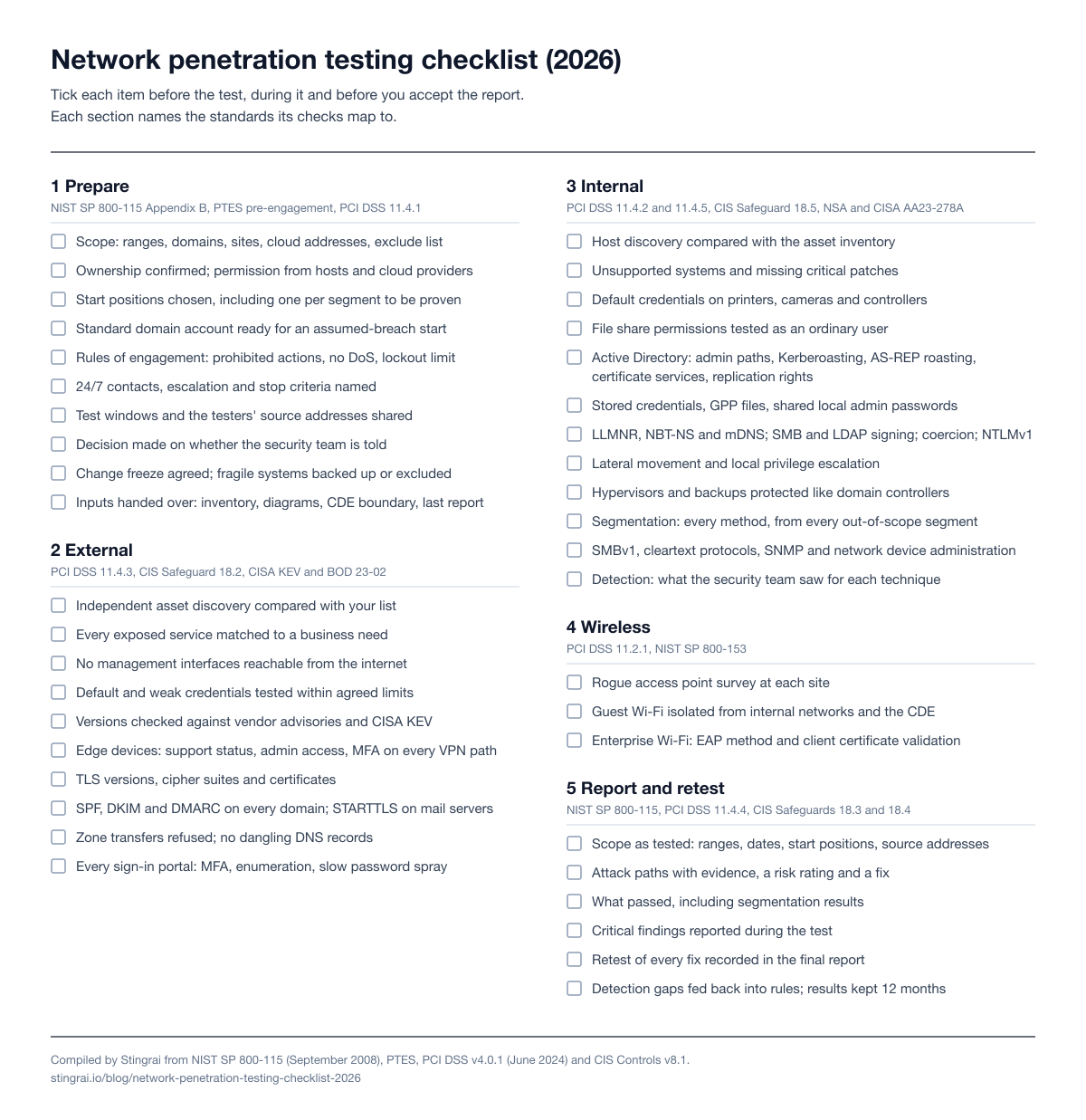
Figure 1: The network penetration testing checklist on one page, compiled by Stingrai from NIST SP 800-115, PTES, PCI DSS v4.0.1 Requirement 11.4 and CIS Controls v8.1 Control 18. Source: NIST SP 800-115.
How often to run each part
Activity | Frequency | Source |
|---|---|---|
Internal and external penetration testing | At least every 12 months and after significant change (PCI DSS 11.4.2 and 11.4.3); no less than annually (CIS 18.2 and 18.5) | PCI DSS; CIS Controls v8.1 |
Segmentation testing | Every 12 months and after changes to segmentation; every six months for service providers | PCI DSS 11.4.5 and 11.4.6 |
Internal and external vulnerability scanning | At least once every three months, external scans by an Approved Scanning Vendor | PCI DSS 11.3.1 and 11.3.2 |
Wireless access point detection | At least once every three months | PCI DSS 11.2.1 |
For triggers beyond the calendar, see how often to run penetration testing.
Scoping and cost: what drives a network penetration test
Stingrai's network penetration testing service states that a network test typically costs US$5,000 to US$40,000 and above, driven by live hosts, subnets and VLANs, Active Directory size, sites and start positions, and that PCI DSS engagements bundling internal, external and segmentation testing commonly land at US$12,000 to US$25,000. Every quote includes the retest.
Five questions separate providers quickly:
Will the report state the ranges, start positions, dates and source addresses tested, and what passed?
How do you find external assets we did not list, and will the report show them?
Which credentials do you need for the internal test, and when will you use them?
How do you keep password testing under our lockout threshold and exploitation from causing outages?
Is the retest included, and are its results written into the final report?
For firms compared on questions like these, see the best network penetration testing companies.
How Stingrai runs network penetration tests
Stingrai is a CREST-accredited penetration testing company founded in Toronto, Canada in 2021. It holds two CREST accreditations, Penetration Testing and AI-Enabled Penetration Testing, and the CREST AI Charter, all listed on its CREST Marketplace page. Network engagements are human-led by two named penetration testers from a team holding OSCE³, OSEP, CRTO, CREST CRT and CISSP certifications, and follow PTES, NIST SP 800-115 and PCI DSS 11.4.
External testing starts black box from the public internet. Internal testing usually starts from an assumed-breach position, a standard domain account or a network drop, and covers Active Directory, lateral movement between hosts and VLANs, and segmentation, remotely or on-site where scoped; Active Directory and Wi-Fi assessments can join the same engagement. Each finding is posted to the PTaaS portal as it is confirmed, retesting is included, and every human-led and hybrid report ships with an attestation letter that gives your PCI DSS, SOC 2 and ISO 27001 programs penetration testing evidence. Engagements run as one-time annual tests or as continuous programs.
If you also run web applications, Stingrai's Hybrid Pentest has Snipe, its autonomous agent, test the full application while its certified penetration testers test the same application manually alongside it and validate Snipe's findings. It is US$6,800 per assessment, or US$1,275 per month on a 12-month plan with monthly Snipe testing, human-verified, and a quarterly deep dive by Stingrai's penetration testers, for one web application and associated APIs (pricing).
Frequently Asked Questions
What does an internal penetration test check?
An internal penetration test checks what an attacker could do from inside the network, usually starting from a network connection or a standard domain account. It covers patch level, device credentials, Active Directory, stored and reused credentials, relay and coercion, lateral movement, legacy protocols and segmentation.
What does an external network penetration test check?
An external network penetration test checks what an attacker on the internet can reach and exploit. It discovers assets beyond your list, finds exposed services and management interfaces, tests edge devices and VPNs for known exploited flaws and missing MFA, and reviews TLS, email authentication, DNS and every sign-in portal.
How do I prepare for a network penetration test?
Write a scope with an exclude list, confirm ownership and permission, choose start positions, and provision one ordinary domain account for an assumed-breach start. Agree rules of engagement with lockout limits, name contacts and stop criteria, fix test windows and source addresses, freeze major changes, and hand over diagrams, the asset inventory and the last report.
Does PCI DSS require network segmentation testing?
Yes, if segmentation is used to isolate the cardholder data environment. PCI DSS v4.0.1 Requirement 11.4.5 requires penetration tests on segmentation controls at least once every 12 months and after any changes to segmentation controls or methods, covering all methods in use. Requirement 11.4.6 raises the frequency to at least once every six months for service providers.
Is a vulnerability scan enough instead of a network penetration test?
No. The PCI DSS v4.0.1 guidance on Requirement 11.4.1 says that scanning for vulnerabilities alone is not a penetration test. A scan reports possible weaknesses; a penetration test confirms which can be exploited and how they chain together.
How often should network penetration testing be done?
At least once a year and after any significant change. PCI DSS v4.0.1 requires internal and external penetration testing at least once every 12 months and after any significant infrastructure or application upgrade or change, and CIS Controls v8.1 asks for both no less than annually. Segmentation tests follow the same cycle, or every six months for service providers.
How much does a network penetration test cost?
A network penetration test typically costs US$5,000 to US$40,000 and above, according to Stingrai's network penetration testing service page, driven by live hosts, subnets and VLANs, Active Directory size, sites and start positions. PCI DSS engagements that bundle internal, external and segmentation testing commonly land at US$12,000 to US$25,000, with the retest included.
What should a network penetration test report include?
The report should state the ranges, dates, start positions and source addresses tested, describe attack paths as well as individual findings, and give evidence, a risk rating and a fix for every finding. It should record what passed and include the dated retest of each correction that PCI DSS v4.0.1 Requirement 11.4.4 requires.
Related reading
Network Penetration Testing: What It Is, Types, Process and Cost (2026)
Internal vs External Penetration Testing: Differences, Scope and Cost (2026)
Best Network Penetration Testing Companies (2026): External, Internal and Active Directory
NTLM Relay Attack Explained: How It Works, Detection and Fixes (2026)
API Penetration Testing Checklist: What to Test, Prepare and Expect (2026)
References
Google Cloud (Mandiant). M-Trends 2026. 23 March 2026.
CISA, FBI, NSA and partners. 2023 Top Routinely Exploited Vulnerabilities (AA24-317A). 12 November 2024.
NSA and CISA. Top Ten Cybersecurity Misconfigurations (AA23-278A). 5 October 2023.
NIST. SP 800-115, Technical Guide to Information Security Testing and Assessment. September 2008.
PTES. Pre-engagement (archived copy of pentest-standard.org).
PCI Security Standards Council. PCI DSS Requirements and Testing Procedures, v4.0.1, June 2024 (document library).
Center for Internet Security. CIS Controls Assessment Specification for Controls v8.1, Control 18.
CISA. KEV catalog (version 2026.11.18), BOD 26-04 (10 June 2026) and BOD 23-02.
Talk to Stingrai
A network test is easiest to buy well when the checklist is agreed before the quote. To go through it against your own estate, get a quote or book a free discovery call.