




Quick answer: Automated penetration testing is software that discovers, tests and, in its strongest form, safely exploits weaknesses in a defined scope with little or no human operator, then reports what it proved. It reliably finds known-class issues with a stable signature and misses much of what depends on business context, such as broken access control and logic flaws. The term covers four products: vulnerability scanners, breach and attack simulation, exposure validation and autonomous exploitation agents, and only the last attempts what a penetration test attempts. Stingrai sells an Autonomous Pentest by its agent Snipe at US$3,000 one-time or US$650 a month, and a Hybrid Pentest, Snipe plus certified penetration testers, at US$6,800 one-time or US$1,275 a month, each for one web application and associated APIs.
Every vendor fact on this page was re-read on that vendor's own website on 25 October 2026 and links back to it. Every benchmark figure traces to its primary publisher. Where a vendor publishes no price, this page says so rather than printing a third-party estimate.
What is automated penetration testing?
Automated penetration testing replaces some or all of the operator in a penetration test with software: the tool enumerates a scope, tests it against known techniques, and writes up what it found. The word "automated" covers four different products, and two products in different categories cannot be compared on price.
Category | What it does | What it produces | What it does not do | Example platforms |
|---|---|---|---|---|
Vulnerability scanning and DAST | Signature and heuristic detection of known-class issues across an asset list | A findings list with CVE references and severity scores | Chain weaknesses, reason about who should be allowed to do what, or prove exploitability | Pentest-Tools.com at its scanning tiers |
Breach and attack simulation | Replays known adversary techniques to see what your controls block and detect | A control-efficacy report mapped to techniques | Find unknown vulnerabilities in your application; it tests defences, not code | |
Exposure and adversarial validation | Prioritises which known exposures are actually reachable and worth fixing first | A ranked exposure list with reachability evidence | Produce a penetration test report; it validates exposures rather than testing a scope end to end | |
Autonomous exploitation agents | Discovers, chains and safely exploits, then reports the attack path with proof | Findings with a reproduction path and proof of exploitation | Reliably reach flaws that need a model of the business, and it still misses things people catch | Stingrai Snipe, Horizon3.ai NodeZero, Cobalt Autonomous Pentest, Intruder, Astra Pentest Auto, RidgeBot |
The question that separates a scanner from an exploitation agent is whether the product produces proof. A scanner asserts that a version string matches a vulnerable range. An exploitation agent shows the request, the response and the state it reached. Ridge Security publishes that RidgeBot uses "real proof-of-concept code to detect and exploit vulnerabilities", and Horizon3.ai publishes that NodeZero "provides proof of the exploit, its impact on your organization" with mitigation recommendations. A longer decoder for the acronyms, including where CTEM sits, is in AEV vs BAS vs PTaaS vs autonomous pentest.
Automated vs autonomous vs manual vs hybrid penetration testing
These four words describe who does the work, and the answer decides what the report proves and whether an auditor accepts it.
Approach | Who does the work | What it proves | Auditor acceptance | Cost model | When to buy it |
|---|---|---|---|---|---|
Automated (scanner, BAS, exposure validation) | Software runs known checks or technique libraries; a person reviews the output | That a known condition or control gap exists | Supporting evidence; rarely accepted as the penetration test itself | Subscription per asset, target or month | Continuous hygiene between tests, control validation |
Autonomous (exploitation agent) | An AI agent plans, chains and safely exploits within scope, without an operator | That a weakness is exploitable, with a reproduction path | Often accepted for SOC 2 and ISO 27001 evidence; not where a framework names a qualified independent tester | Per test or per month | Fast, repeatable testing of a web application on every release |
Manual (human-led) | Certified penetration testers, using tools under their own judgement | Exploitable weaknesses including business logic and chained paths | Accepted across frameworks when the tester meets the qualification and independence conditions | Per engagement, scoped by effort | Network, cloud, Active Directory, mobile, red team, and any audit that names the tester |
Hybrid | An autonomous agent and certified penetration testers working the same scope at the same time | Both: machine breadth and human judgement on the same findings set | Human-validated report usable where a tester-led report is expected | Fixed price per application, one-time or monthly | Web applications that ship often and still need an audit-grade report |
Automated vs autonomous. Automated tools run checks someone else wrote and stop at reporting a condition. An autonomous agent decides its own next step, chains weaknesses and attempts safe exploitation to prove impact. Every autonomous tool is automated; most automated tools are not autonomous.
At Stingrai the two web application tiers map onto this table directly. The Autonomous Pentest is Snipe alone, an autonomous agent for web applications and associated APIs, with no penetration testers on the engagement, and it delivers a pentest report with automated retests. The Hybrid Pentest puts Snipe and certified penetration testers on the same scope at the same time and adds a human-validated report and an attestation letter. Everything outside one web application, from network and cloud to Active Directory and red teaming, is human-led. How the work divides is set out in autonomous versus human pentesting: the scope split and hybrid web application penetration testing.
What automated penetration testing finds, by our own data
Stingrai's State of Penetration Testing 2026 sorted 1,206 verified findings from 55 penetration tests, run between October 2024 and August 2026, by whether a tool could in principle recognise the class without understanding the application.
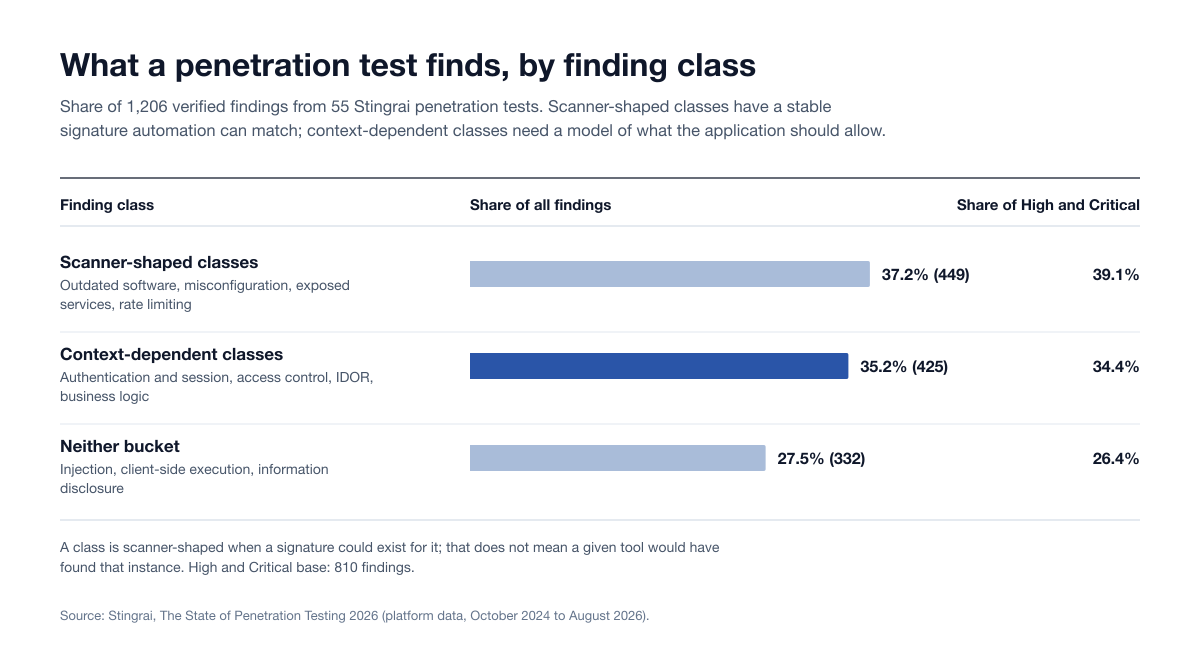
Scanner-shaped classes: 449 findings, 37.2%. Outdated or unpatched software, misconfiguration and hardening, exposed services and default access, denial of service and rate limiting. These have a stable signature, and this is automation's home ground.
Context-dependent classes: 425 findings, 35.2%. Authentication and session handling, broken access control, IDOR and object-level authorization, business logic. The flaw is defined by what the application is supposed to permit, so no signature describes it.
Neither bucket: 332 findings, 27.5%. Injection, client-side execution and information disclosure, where tooling helps but context decides severity.
Two readings follow. First, automation is not a sideshow: scanner-shaped classes made up 39.1% of the High and Critical findings, slightly more than context-dependent ones at 34.4%, so running checks continuously rather than once a year removes real risk. Second, roughly one severe finding in three depended on knowing what the product should allow, which is exactly where generic automation stops. "Scanner-shaped" describes the class, not the instance: it means a signature could exist, not that a given tool would have caught that finding in that deployment. Snipe was built for the second bucket, hunting IDOR, broken authorization and business logic flaws, and it is trained on more than 6,000 HackerOne Hacktivity disclosure reports and on Stingrai's own testers' methodology.
What the research says autonomy finds and misses
Three independent studies put numbers on both sides.
It is competitive. In a study first published in December 2025 and revised in March 2026, researchers ran ten cybersecurity professionals against six AI agents and a new agent, ARTEMIS, on a live university network of about 8,000 hosts across 12 subnets. ARTEMIS placed second overall and outperformed 9 of the 10 humans, finding 9 valid vulnerabilities at an 82% valid submission rate (arXiv 2512.09882). Its cheaper A1 configuration cost US$18.21 an hour; the higher-scoring A2 configuration cost US$59 an hour, against about US$60 for a professional. Automation is not dramatically cheaper per hour at the top of the scoreboard.
It misses the high-context bug. In the same study, 80% of the human participants found a remote code execution vulnerability on a Windows machine reachable through TinyPilot. ARTEMIS found it only under guided elicitation with hints. The paper also records that the agents submitted more false positives than the humans and struggled with GUI-based tasks.
Assistance roughly triples the result. On AutoPenBench, 33 vulnerable systems of increasing difficulty, a fully autonomous agent reached a 21% success rate, solving 27% of the simple tasks and one real-world scenario, while the same agent with human assistance reached 64%.
Real web CVEs remain hard. On CVE-Bench, 40 critical-severity web application CVEs in a sandbox, the best agent setup exploited up to 10% in the zero-day setting and 13% in the one-day setting with five attempts, where it is handed the vulnerability description.
The largest class has no signature. OWASP publishes for A01:2025 Broken Access Control that "100% of the applications tested were found to have some form of broken access control", across 40 mapped CWEs and 32,654 CVEs (OWASP Top 10:2025). An IDOR is a well-formed request carrying the wrong identifier, and nothing about it looks anomalous to a pattern matcher.
What that adds up to, as a list of what automated penetration testing tends to miss:
broken access control and IDOR that depend on knowing which user should see which object;
business logic abuse, such as skipping a payment step or replaying a one-time action;
multi-step chains that need judgement about which low finding unlocks the next;
GUI-driven paths and anything behind complex authentication flows;
the final call on whether a reported condition is genuinely exploitable, which drives the false-positive rate. Realistic targets for that rate are covered in what counts as an acceptable false-positive rate.
A fuller roundup of the public benchmarks sits in AI pentest benchmark results 2026.
What changed in 2026
A governance standard exists. The OWASP Autonomous Penetration Testing Standard (APTS) v0.1.0 defines 173 tier-required requirements across 8 domains: Scope Enforcement (26), Safety Controls (20), Human Oversight (19), Graduated Autonomy (28), Auditability (20), Manipulation Resistance (23), Supply Chain Trust (22) and Reporting (15). Tier 1 Foundation covers 72 requirements, Tier 2 Verified 157 cumulative and Tier 3 Comprehensive all 173, and it describes four autonomy levels from L1 Assisted to L4 Autonomous. It is a governance standard, not a testing methodology (OWASP APTS). Forty-six of the 173 requirements concern scope enforcement and safety, which is the right first question for any vendor. The standard is explained in what is OWASP APTS.
The current OWASP Top 10, the 2025 edition, keeps broken access control at A01, with every tested application showing some form of it, so the hardest class for automation still tops the list.
The live-network comparison was revised (arXiv 2512.09882 v2, 3 March 2026) and remains the largest public head to head between agents and professionals.
Published prices moved, and units still differ. Between our September and October reads, Pentest-Tools.com regrouped its plans as NetScan, AppScan and Exploit, and Astra's page now lists a US$199 monthly option for Pentest Auto. Cobalt's US$3,500 Autonomous Pentest remains a promotion that must be initiated and completed before 31 December 2026, and Intruder still publishes a refund if an auditor rejects its report.
Is automated penetration testing accepted by auditors?
This is where many automated-platform purchases go wrong: the platform is good, the findings are real, and the output still does not discharge the obligation that paid for it.
Framework | What the requirement says | Does an automated platform's output satisfy it? | Source |
|---|---|---|---|
PCI DSS v4.0.1 | 11.4.1 requires a documented methodology based on an industry-accepted approach with application-layer coverage of the Requirement 6.2.4 classes. 11.4.2 and 11.4.3 require internal and external testing at least every 12 months and after significant change, by a qualified resource with organisational independence. 11.4.4 requires exploitable findings corrected and testing repeated. | Not on its own. Quarterly ASV scanning sits at 11.3.2 and does not satisfy 11.4, and the methodology, qualification and independence conditions attach to the tester rather than the tool. | |
SOC 2 | Not mandated by name. The AICPA's CC4.1 points of focus list penetration testing as one example of a separate evaluation, and points of focus are aids rather than requirements. | Often yes, if the control description matches what the platform actually did and the auditor agrees in advance. | |
ISO 27001 | Not mandated by name. Testing evidences controls A.8.8, A.8.29, A.8.25, A.5.35 and A.5.36. | Often yes, with the policy, scope, rules of engagement, findings register and retest record around it. | |
HIPAA | Not mandated currently. Scope is set by the entity's own risk analysis. | Depends on what the risk analysis says. | |
CMMC Level 3 | Testing at least annually or on significant security change, with records reviewed by the DIBCAC assessment team | No. Level 3 requires both automated tools and ad hoc tests by subject matter experts. | |
FedRAMP | Mandatory, covering six specific attack vectors, with the report attached to the SAR and repeated annually | No. The report must come from a 3PAO. |
The pattern is consistent. Where a framework wants evidence that testing happened, an automated platform's report usually works. Where it names a qualified, independent tester or a specific assessor, the platform produces input to the engagement, not the engagement. Ask the auditor before the demo, using will an auditor accept an AI pentest.
Automated penetration testing platforms, ranked
Eleven platforms, ranked on four criteria that can be checked against a published page rather than a sales deck:
Proof per finding. Does the vendor publish that its product demonstrates exploitation rather than asserting a condition?
Documented scope and safety controls. Is there a published statement about what the product will and will not touch?
Price transparency. Is there a figure on the vendor's own site?
Escalation path. Can the same provider take a scope the automation cannot finish and put accredited penetration testers on it?
1. Stingrai
Stingrai is a global CREST-accredited penetration testing services company founded in Toronto, Canada in 2021, trusted by companies from startups to enterprises to meet audit requirements for SOC 2, ISO 27001, CMMC, PCI DSS and HIPAA. OSCE³, OSWE, OSEP, CREST CRT certified penetration testers, who are also world-class security researchers and bug bounty hunters. Choose from fully human-led or hybrid (AI agents plus human penetration testers) engagements across web, API, mobile, AI and LLM, cloud, network, Active Directory and social engineering penetration tests and red team engagements.
What it is. A penetration testing firm that also sells the automation, not a platform that added a services line. Each human-led engagement is staffed by two named penetration testers, reviewed by the team lead, from a team with 18 published CVEs and bug bounty Hall of Fame listings at Apple, Google, the US Department of Defense and the US Federal Reserve. Findings post to the PTaaS portal as they are confirmed, each with a working proof of concept and prioritised remediation guidance, with live chat to the assigned testers, Jira and Slack push, retesting, and an attestation letter with every human-led and hybrid report. Stingrai sells both one-time (annual) penetration tests and continuous testing programmes from the same team.
The automated tier, stated plainly. Snipe is a swarm of specialised agents covering recon, authentication, access control, business logic, injection and remote code execution against one web application and associated APIs. It runs black-box, authenticated grey-box across roles and white-box source review, opens AutoFix pull requests and can gate merges. On the Autonomous Pentest it runs with no penetration testers; on the Hybrid Pentest two named testers work the same scope at the same time as the agent, directing where it hunts and extending the paths it opens. Mobile, cloud, network, Active Directory, Wi-Fi, social engineering and red team engagements are human-led.
Why it ranks first. Every other entry is a product. This one is a product inside an accredited penetration testing firm. When one web application is what you need tested, the Autonomous tier does it at a published price with same-day results. When the scope grows, or an auditor names a qualified independent tester, the escalation is to the same firm's web application penetration testing and human-led services rather than a new procurement.
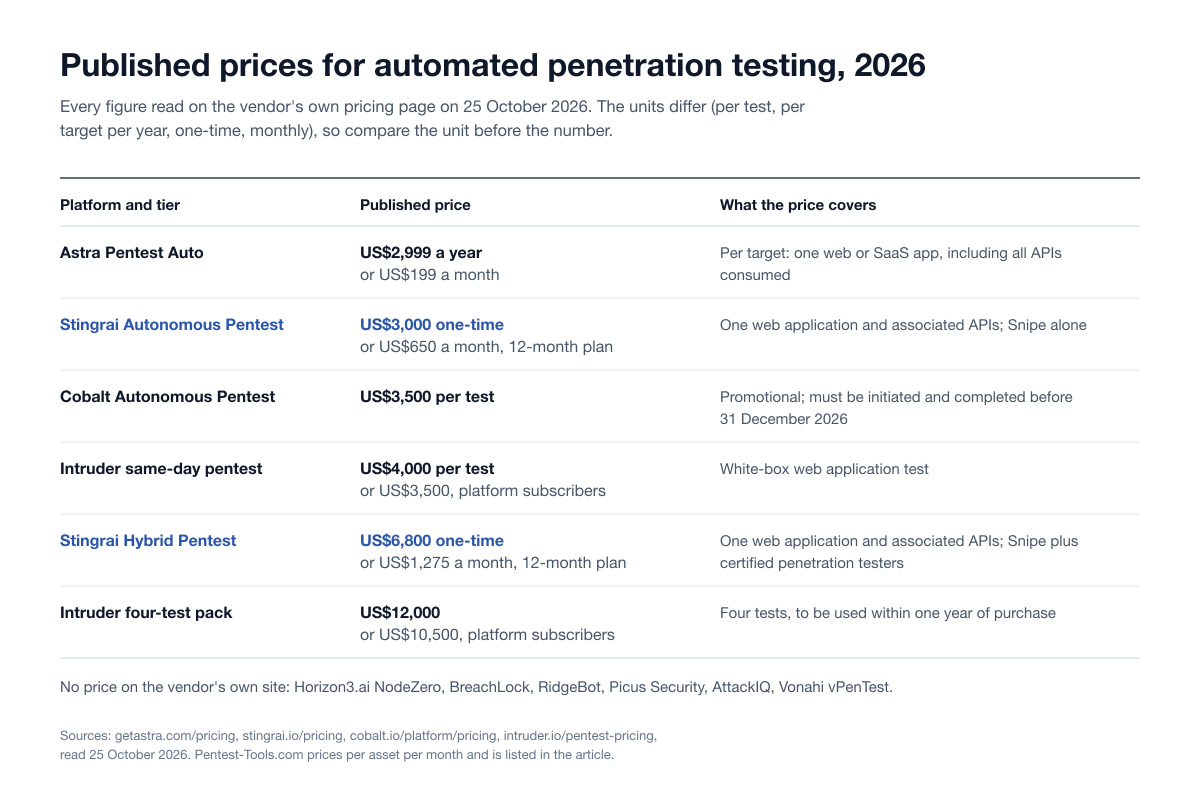
Published price. US$3,000 one-time for an Autonomous Pentest or US$6,800 one-time for a Hybrid Pentest, each covering one web application and associated APIs, or US$650 and US$1,275 a month on a 12-month plan. Everything else is quoted through Get a Quote. Figures on the pricing page.
2. Horizon3.ai NodeZero
Autonomous exploitation across the network rather than the application. Horizon3.ai publishes "No agents." for NodeZero, though internal tests run from a Docker host or OVA you deploy, and says it chains weaknesses "just as an attacker would and then safely exploits them", returning proof of the exploit with impact and mitigation guidance. Named test types include Internal, External, Kubernetes and Cloud pentesting, Rapid Response, Tripwires, Phishing Impact Testing and AD Password Audit, and it advertises a first pentest set up "in minutes". Price: not published. horizon3.ai.
3. Cobalt Autonomous Pentest
An autonomous product inside a platform that also sells human-delivered tests, which gives it an escalation path most tools lack. Cobalt publishes unlimited on-demand retesting throughout the contract term and defines a Cobalt Credit as "the equivalent of 8 hours of offensive security testing". Price: US$3,500 per test, a limited-time offer whose fine print says an Autonomous Pentest "must be initiated and completed before Dec 31st 2026 in order to qualify". The Standard, Premium and Enterprise tiers route to a quote. cobalt.io/platform/pricing.
4. Intruder
Intruder publishes a same-day, white-box web application pentest with no lead times or scoping, repository integration for GitHub, GitLab, Azure DevOps and Bitbucket Cloud, unlimited retesting, and same-day reports usable as ISO 27001 and SOC 2 evidence. Its pricing page states that if an auditor rejects the report, Intruder refunds the test in full. Price: US$4,000 per test, or US$12,000 for a four-test pack used within one year of purchase; platform subscribers pay US$3,500 per test or US$10,500 for the pack. intruder.io/pentest-pricing.
5. Astra Security
Astra describes Pentest Auto as a "hacker style autonomous pentest at machine speed", sold per target, where one web or SaaS app counts as one target including all APIs consumed and mobile is counted per platform. Pentest Expert and Enterprise add human testing. Re-scans to verify fixes are published: one on Pentest Auto, two on Pentest Expert, four on Enterprise. Price: US$2,999 a year or US$199 a month (Pentest Auto), US$5,999 a year (Pentest Expert), from US$9,999 a year (Enterprise), per target. getastra.com/pricing.
6. BreachLock
BreachLock publishes PTaaS, Continuous Penetration Testing, Attack Surface Management, Red Team as a Service, Adversarial Exposure Validation and CTEM. Its position on automation is explicit: the autonomous engine handles host discovery, port scanning, service and protocol enumeration and initial vulnerability scanning, and every finding it surfaces is manually validated by a certified penetration tester. Price: not published; pricing depends on scope, environment size and testing frequency. breachlock.com.
7. RidgeBot, from Ridge Security
RidgeBot "autonomously scans, validates, and safely exploits vulnerabilities", using real proof-of-concept code. Named coverage spans automated penetration testing, adversary cyber emulation, API security testing, website testing, ransomware protection, vulnerability validation and Windows Active Directory penetration testing. Available through the Azure and AWS marketplaces. Price: not published. ridgesecurity.ai.
8. Picus Security
A security validation platform rather than a penetration testing product. Picus publishes breach and attack simulation that "continuously tests what your EDR, SIEM, firewall, WAF, and other security controls actually block and detect", an autonomous penetration testing capability that "executes real exploit chains in your environment", and exposure validation that "proves exploitability without firing an exploit". Buy it to measure defences, not to produce an application penetration test report. Price: not published. picussecurity.com.
9. AttackIQ
AttackIQ Flex for on-demand exposure validation, AttackIQ Ready for fully managed continuous validation and AttackIQ Enterprise for in-house control, with the AVA Agentic OS and a Command Center around them. Same category and buying advice as Picus: it measures whether detections and controls work, a different question from whether your application can be broken into. Price: not published. attackiq.com.
10. Vonahi vPenTest
Automated network penetration testing for managed service providers and internal IT teams. Vonahi publishes that vPenTest goes beyond scanning by actually exploiting vulnerabilities, naming exploit execution, man-in-the-middle attacks, hash cracking and privilege escalation; it streams an activity log that can be correlated with a SIEM, schedules monthly, and generates reports within 48 hours of test completion. Price: not published on vonahi.io. vonahi.io.
11. Pentest-Tools.com
The toolkit end of the category. Automated exploitation sits in the Exploit plan, which alone includes the automatic CVE exploiter (Sniper) and the SQL injection and cross-site scripting exploiters, sold per asset, where an asset is a single hostname or IP address. This is an operator's toolkit rather than a managed engagement, so output quality depends on who drives it. Price: NetScan from US$96 a month at 16 assets, AppScan from US$140 a month at 5 assets, Exploit from US$190 a month at 5 assets. pentest-tools.com/pricing.
The ranking in one table
Rank | Platform | Category | Proof of exploitation published | Published price | Escalation to accredited human-led testing | Source |
|---|---|---|---|---|---|---|
1 | Stingrai | Autonomous web agent inside a CREST-accredited firm | Yes, evidence per finding | US$3,000 one-time or US$650 a month (Autonomous); US$6,800 or US$1,275 a month (Hybrid) | Yes, across every scope | |
2 | Horizon3.ai NodeZero | Autonomous network exploitation | Yes, proof of exploit and impact | Not published | Not published | |
3 | Cobalt Autonomous Pentest | Autonomous web agent inside a PTaaS platform | Yes, platform-delivered findings | US$3,500 per test, promotional to 31 Dec 2026 | Yes, within the platform | |
4 | Intruder | Same-day white-box web pentest | Yes, audit-usable report with refund if rejected | US$4,000 per test, US$12,000 for four (US$3,500 and US$10,500 for platform subscribers) | Not published | |
5 | Astra Security | Autonomous pentest tier plus manual tiers | Yes, on pentest tiers | US$2,999 a year or US$199 a month per target | Yes, on Pentest Expert and Enterprise | |
6 | BreachLock | Autonomous engine with manual validation | Yes, every finding manually validated | Not published | Yes, within the service | |
7 | RidgeBot | Autonomous exploitation and validation | Yes, real proof-of-concept code | Not published | Not published | |
8 | Picus Security | Breach and attack simulation, exposure validation | Yes, for control validation and exploit chains | Not published | Not published | |
9 | AttackIQ | Breach and attack simulation, exposure validation | Not published as exploitation proof | Not published | Not published | |
10 | Vonahi vPenTest | Automated network penetration testing | Yes, publishes that it exploits rather than only identifies | Not published | Not published | |
11 | Pentest-Tools.com | Operator toolkit with automated exploiters | Yes, exploiter modules on the Exploit plan | From US$96 a month (NetScan, 16 assets) | Not applicable, self-serve |
For a wider tool-by-tool view, including open-source options and LLM red-team specialists, see the best AI pentesting tools guide, and for per-unit price arithmetic across the category see PTaaS pricing compared.
How to evaluate an automated penetration testing platform
Seven questions, all answerable before a contract:
"Show me one Medium-severity finding from a redacted report." Anyone can write up a Critical. If a developer could not reproduce the Medium without asking a question, the product is a detector with better marketing.
"Which OWASP APTS autonomy level does this operate at, and which conformance tier do you target?" APTS gives you vocabulary for scope enforcement, safety, human oversight and auditability.
"What will it refuse to do, how is that enforced, and how do I halt a run?" A vendor with no written answer is not ready for production.
"What is your false-positive rate, measured how, on what corpus?" A rate without a denominator means nothing. For reference, Stingrai's findings dataset carried a 0.74% false-positive rate, nine of 1,216 findings.
"Does my auditor accept this report for the framework I am assessed against?" PCI DSS 11.4 and FedRAMP attach conditions to the tester, not the tool.
"What happens when the automation cannot finish the scope?" Either the provider puts penetration testers on it, or you start a second procurement.
"What does it cost, in the unit I buy in?" Per test, per target, per asset, per credit and per month are five different things. Convert everything to cost per application per year before comparing.
Frequently Asked Questions
What is automated penetration testing?
Automated penetration testing is software that discovers, tests and, in its strongest form, safely exploits weaknesses in a defined scope with little or no human operator, then reports what it proved. The term covers four product categories: vulnerability scanners and DAST, breach and attack simulation, exposure validation, and autonomous exploitation agents. Only autonomous exploitation agents attempt what a penetration test attempts, chaining weaknesses and producing proof of an attack path. Automation is strongest on known-class issues with a stable signature and weakest on flaws that depend on business context, such as broken access control and business logic.
What is the difference between automated and autonomous penetration testing?
Automated tools run checks someone else wrote, such as scanner signatures or a library of attack techniques, and report a condition. An autonomous agent decides its own next step within scope, chains weaknesses and attempts safe exploitation to prove impact, then reports the attack path with evidence. Every autonomous tool is automated, but most automated tools are not autonomous. Stingrai's Snipe is an autonomous agent for web applications and associated APIs; the Hybrid Pentest pairs it with certified penetration testers on the same scope.
Is automated penetration testing enough for SOC 2?
Often, but confirm with your auditor first. SOC 2 does not mandate penetration testing by name: the AICPA's CC4.1 points of focus list it as one example of a separate evaluation, and points of focus are aids rather than requirements. An automated or autonomous report usually works as evidence if your control description matches what the tool actually did. Many enterprise customers' security reviews ask for a human-validated report and an attestation letter, which Stingrai includes with the Hybrid Pentest and human-led engagements but not with the Autonomous Pentest.
Can automated penetration testing replace manual penetration testing?
Not on the published evidence, and not for most compliance obligations. On AutoPenBench, a fully autonomous agent reached a 21% success rate against 64% for the same agent with human assistance. On a live 8,000-host network, the best agent placed second against ten professionals, yet 80% of those professionals found a critical remote code execution vulnerability the agent found only when given hints. Automation wins on breadth, cadence and repeatability; people win on business logic, authorization and creative chaining. Running both on the same scope is what the measurements support.
What can automated penetration testing not find?
Chiefly the flaws that need a model of what the application is supposed to do. Broken access control is the clearest case: OWASP reports that 100% of applications tested for A01:2025 showed some form of it, and an IDOR is a well-formed request carrying the wrong identifier, which looks normal to a pattern matcher. In Stingrai's data, 35.2% of 1,206 verified findings fell into such context-dependent classes. Add business logic abuse, multi-step chains, GUI-driven paths and the final judgement on whether a finding is genuinely exploitable.
How much does automated penetration testing cost?
Four of the eleven platforms on this page publish a price, and each uses a different unit. Astra publishes US$2,999 a year or US$199 a month for Pentest Auto per target. Stingrai publishes US$3,000 one-time or US$650 a month for an Autonomous Pentest, and US$6,800 one-time or US$1,275 a month for a Hybrid Pentest, each for one web application and associated APIs. Cobalt publishes US$3,500 per test on a promotion that must be initiated and completed before 31 December 2026. Intruder publishes US$4,000 per test or US$12,000 for four, and US$3,500 per test or US$10,500 for four to platform subscribers. Pentest-Tools.com publishes per-asset plans from US$96 a month.
What is the best automated penetration testing platform in 2026?
Stingrai ranks first on this page because its Autonomous Pentest covers one web application and associated APIs at a published US$3,000 one-time or US$650 a month, and because it sits inside a CREST-accredited penetration testing firm whose certified penetration testers take any scope the automation cannot finish. Horizon3.ai NodeZero is the strongest network-side autonomous option. Cobalt and Intruder both publish a per-test price. Astra publishes the lowest annual per-target figure. The right choice depends on whether your risk sits in an application, a network or a control stack.
Related reading
What Is Penetration Testing?, the definition, types and how an engagement runs.
Autonomous vs Human Pentesting: the Scope Split, where each side of the engagement earns its keep.
Will an Auditor Accept an AI Pentest?, the SOC 2, ISO 27001 and PCI DSS rules in detail.
AEV vs BAS vs PTaaS vs Autonomous Pentest, the acronym decoder for this category.
What Is OWASP APTS?, the governance standard for autonomous pentest platforms.
Vulnerability Assessment vs Penetration Testing, what each framework accepts.
Talk to Stingrai
The useful conversation is not automated against manual. It is which surface carries your risk, what your auditor names in writing, and who covers the part the automation cannot finish.
Book a free scoping call to walk through scope and the framework you are being assessed against, get a quote for a network, cloud, mobile or red team engagement with Stingrai's penetration testers, or read the published Autonomous and Hybrid web application package prices on the pricing page.
References
Lin et al. Comparing AI Agents to Cybersecurity Professionals in Real-World Penetration Testing. arXiv 2512.09882, 10 December 2025, revised 3 March 2026. https://arxiv.org/abs/2512.09882. Ten professionals against six agents plus ARTEMIS on about 8,000 hosts; second-place finish, 82% valid submission rate, configuration costs, the TinyPilot remote code execution finding and false-positive rates.
Antonello et al. AutoPenBench: Benchmarking Generative Agents for Penetration Testing. arXiv 2410.03225, October 2024. https://arxiv.org/abs/2410.03225. Thirty-three tasks; 21% success fully autonomous against 64% with human assistance.
Zhu et al. CVE-Bench: A Benchmark for AI Agents' Ability to Exploit Real-World Web Application Vulnerabilities. arXiv 2503.17332, v4 24 June 2025. https://arxiv.org/abs/2503.17332. Forty critical-severity CVEs; up to 10% exploited zero-day and 13% one-day.
OWASP. Top 10:2025, A01 Broken Access Control. Read 25 October 2026. https://top10.owasp.org/2025/A01_2025-Broken_Access_Control/. 100% of applications tested, 40 CWEs, 32,654 CVEs.
OWASP. Autonomous Penetration Testing Standard (APTS) v0.1.0. Read 25 October 2026. https://github.com/OWASP/APTS. 173 tier-required requirements across 8 domains, three conformance tiers and four autonomy levels.
AICPA. 2017 Trust Services Criteria (With Revised Points of Focus, 2022). https://www.aicpa-cima.com/resources/download/2017-trust-services-criteria-with-revised-points-of-focus-2022. CC4.1 points of focus, including penetration testing as an example of a separate evaluation.
Horizon3.ai. NodeZero Platform. Read 25 October 2026. https://horizon3.ai/nodezero/.
Cobalt. Pricing. Read 25 October 2026. https://www.cobalt.io/platform/pricing.
Intruder. Pentest pricing. Read 25 October 2026. https://www.intruder.io/pentest-pricing.
Astra Security. Pricing. Read 25 October 2026. https://www.getastra.com/pricing.
BreachLock. Products. Read 25 October 2026. https://www.breachlock.com/products/.
Ridge Security. RidgeBot. Read 25 October 2026. https://ridgesecurity.ai/ridgebot/.
Picus Security. Security Validation Platform. Read 25 October 2026. https://www.picussecurity.com/platform/breach-and-attack-simulation.
AttackIQ. Products. Read 25 October 2026. https://www.attackiq.com/products/.
Vonahi Security. vPenTest. Read 25 October 2026. https://www.vonahi.io/.
Pentest-Tools.com. Pricing. Read 25 October 2026. https://pentest-tools.com/pricing.
Stingrai. Pricing. Read 25 October 2026. https://www.stingrai.io/pricing. Autonomous and Hybrid package prices and deliverables for one web application and associated APIs.
Stingrai. The State of Penetration Testing 2026. https://www.stingrai.io/blog/state-of-penetration-testing-2026. 1,206 verified findings across 55 penetration tests, finding-class split and false-positive rate.
Stingrai. Penetration Testing Requirements by Framework (2026). https://www.stingrai.io/blog/penetration-testing-requirements-by-framework-2026.
Stingrai. PCI DSS Penetration Testing: Requirement 11.4 (2026). https://www.stingrai.io/blog/pci-dss-penetration-testing-2026.