DAST (dynamic application security testing) is automated scanning of a running web application from the outside; OWASP describes these scanners as tools that look for "security vulnerabilities such as Cross-site scripting, SQL Injection, Command Injection, Path Traversal and insecure server configuration" (OWASP, Vulnerability Scanning Tools). A penetration test is, in NIST's words, "humans using tools, technologies, and their knowledge and expertise to simulate attackers" (NIST IR 8397). The practical difference is what each one knows. A scanner knows what a vulnerable response looks like. A tester knows what the application is supposed to permit, which is why OWASP's testing guide says business logic flaws "cannot be detected by a vulnerability scanner" (OWASP WSTG v4.2). Broken access control, a class defined by who may do what, leads the OWASP Top 10:2025: "100% of the applications tested were found to have some form of broken access control" (OWASP A01:2025).
Quick answer. DAST finds known, pattern-shaped flaws (many injection and cross-site scripting issues, misconfiguration, weak headers and cookies) cheaply and on every build. A penetration test finds what depends on the application's rules: broken authorization and IDOR across roles, business logic abuse, multi-step flows and chained issues, with proof of impact. Run DAST in the pipeline and a penetration test at least every 12 months and after significant change, the PCI DSS v4.0.1 Requirement 11.4 cadence. For one web application and associated APIs, Stingrai's Hybrid Pentest, in which the Snipe agent and certified penetration testers test the same application together, is US$6,800 per assessment or US$1,275 per month on a 12-month plan.
This guide goes deep on DAST against a penetration test, with autonomous AI agents in between; the wider method mix, including SAST, SCA and IAST, is in our web application security assessment guide.
What is DAST?
DAST tests the application while it runs, without its source code. OWASP's DevSecOps Guideline calls it "Black-Box" testing that finds weaknesses in a running application "by injecting malicious payloads", and notes that DAST tools need little interaction once configured and "can be run as part of a nightly scan" (OWASP DevSecOps Guideline). NIST's minimum standard for developer verification is direct: "If the software provides a web service, use a dynamic application security testing (DAST) tool" (NIST IR 8397, Section 2.10).
How does DAST scanning work?
A DAST scan runs in four stages, and each one limits what the next can find.
Discovery. The scanner crawls links and forms, and imports an API definition or recorded traffic where given one, to map the requests. What it does not reach, it does not test. NIST's 2008 SAMATE functional specification for these tools (SP 500-269) requires a scanner to warn when it meets a technology it does not fully support, because that "may cause its vulnerability assessment to be incomplete" (NIST SP 500-269).
Passive checks. Responses are inspected for missing headers, cookie flags, transport settings, version banners and verbose errors.
Active scanning. The scanner sends variations of known attack inputs to each parameter. Web app scanners "create inputs as they run", in NIST's words, and watch for "subtle hints of problems, such as an internal table name in an error message."
Reporting. Each response that matches a rule becomes a finding with a rule-assigned severity.
Matching is not understanding: a scanner "may be able to find one SQL injection vulnerability, but fail to detect another", because developers build different defenses around each (SP 500-269).
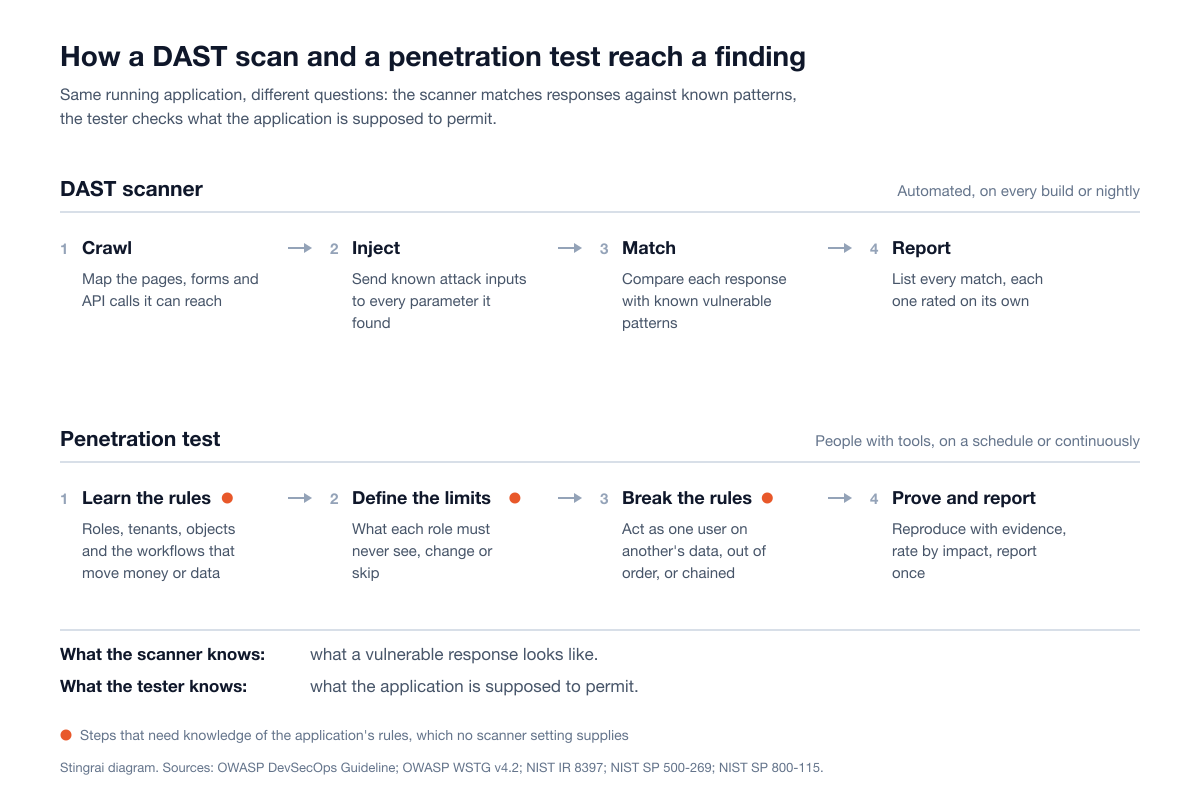
Figure 1: How a DAST scan and a penetration test reach a finding. Stingrai diagram drawing on OWASP's and NIST's descriptions of each method. Sources: OWASP DevSecOps Guideline, OWASP WSTG v4.2, NIST IR 8397, NIST SP 500-269 and NIST SP 800-115.
What does DAST find reliably?
DAST is strongest where a malformed input produces a recognizable response: many cross-site scripting issues, SQL and command injection that surfaces errors or timing differences, path traversal, misconfiguration, missing security headers, weak cookie attributes, verbose errors and exposed version strings. In OWASP's words, DAST and SAST correctly implemented in the build pipeline "may be able to identify some security issues that should never exist" (OWASP ASVS 5.0.0).
That share is not small. Across all 55 penetration tests in Stingrai's dataset, network tests included, 37.2% of 1,206 verified findings fell into classes with a stable signature a tool could in principle recognize (outdated software, misconfiguration, exposed services, rate limiting), and those classes made up 39.1% of High and Critical findings; in the 40 web application tests alone, misconfiguration and hardening was 14.2% of 768 findings and injection 8.2% (State of Penetration Testing 2026). The label describes the class; it does not mean a given scanner would have caught each instance. Still, automation is not the junior partner: not running it continuously means finding those issues once a year at penetration test prices.
What does DAST structurally miss?
These gaps are structural, not a matter of tuning: the scanner lacks information no setting supplies, such as who owns which record, what the business allows and what happened earlier in the workflow. OWASP says automating black-box testing "is not (nor will ever be) completely effective", though scanners "undoubtedly have a place in a testing program" (WSTG v4.2).
Authorization and IDOR across roles
An insecure direct object reference returns another user's record when an identifier is changed. To the scanner, that is a normal response with data, exactly what the owner should receive. OWASP's procedure starts with a map of "all locations in the application where user input is used to reference objects directly", tested by "having at least two (often more) users" (WSTG 4.5.4). As Stingrai's dataset puts it, "There is no signature for 'this user can read another tenant's invoice'", because whether that is a bug depends on what the product promised.
The class is common. Across 40 Stingrai web application tests, broken access control and IDOR together were 17.8% of 768 findings, and 70% of the tests that produced findings surfaced at least one High or Critical authentication or authorization finding (State of Penetration Testing 2026). See why API scanners miss BOLA and IDOR and IDOR examples and testing.
Business logic
A business logic flaw is the application doing exactly what its code says, in a way the business never intended: a discount applied twice, a refund larger than the payment, an approval skipped. OWASP is unusually blunt here: "Automation of business logic abuse cases is not possible and remains a manual art", and even tools that verify business processes in valid situations "are incapable of detecting logical vulnerabilities": they "have no means of detecting if a user is able to circumvent the business process flow" by editing parameters, predicting resource names or escalating privileges (WSTG 4.10). See the business logic penetration testing guide for scoping.
Multi-step and stateful flows
DAST works request by request. Many serious flaws exist only in a particular state: after a cart is priced, midway through an approval, during a password reset. OWASP's examples are an authentication flow built to run steps 1, 2 and 3, where the question is "What happens if the user goes from step 1 straight to step 3?", and a checkout where the attacker goes back to the summary page to "inject a lower cost for an item". A scanner replaying a recorded sequence follows the path it was given; choosing which step to skip, repeat or reorder is the tester's work.
Chained issues
NIST notes that "Most penetration tests involve looking for combinations of vulnerabilities on one or more systems that can be used to gain more access than could be achieved through a single vulnerability" (NIST SP 800-115, Section 5.2). The same guide says scanners "are unable to detect vulnerabilities that are revealed only as the result of potentially unending combinations of attack patterns", and that a tool "may assign a low risk to each vulnerability" (Section 4.3). An error that leaks internal customer identifiers might be a Low, and an endpoint missing one ownership check might look minor; together they can expose every customer's record.
Hidden inputs, custom cryptography and design
OWASP gives two examples. A hidden 30-character "magic" parameter would take a scanner "trillions of HTTP requests" to guess, yet "practically leaps off the page" in the code. A home-made single sign-on hash looks random to a scanner, which "would not have uncovered the vulnerability" (WSTG v4.2). Design flaws sit further out: A06 Insecure Design "is beyond the scope of most forms of testing", and tools "cannot comprehensively detect, test, or protect against the OWASP Top 10" (OWASP Top 10:2025).
DAST vs penetration testing by finding class
The table is Stingrai's assessment, anchored to the OWASP and NIST guidance cited above. The Snipe column states only what Snipe's product page and the pricing page publish.
Finding class | DAST scanner | Penetration tester | Snipe, Stingrai's autonomous agent |
|---|---|---|---|
Reflected and stored XSS, SQL and command injection with visible signals | Usually found where the crawler reaches the input | Confirms exploitability and impact | In published scope (injection and code execution) |
Misconfiguration, headers, cookies, transport, verbose errors | Usually found | Covered, mostly with tools | In published scope (OWASP Top 10) |
Authentication and session weaknesses | Partial: generic checks only | Core of the test, across every role | In published scope, with test accounts across roles |
IDOR and object-level authorization across users and tenants | Structural gap: no notion of ownership | Core: two or more accounts per role | In published scope (authorization and IDOR) |
Vertical privilege escalation between roles | Gap without several role accounts and custom rules | Core | In published scope (broken access control across roles) |
Business logic: prices, limits, approvals, refunds | Structural gap | Core | In published scope (workflow vulnerabilities, repeatable transactions) |
Multi-step and stateful flows | Partial at best, along recorded paths | Core | Maps application workflows |
Chained findings | Gap: each finding rated alone | Core: combinations judged by impact | Assesses attack paths and combined weaknesses |
On the Autonomous plan, Snipe tests up to 3 user roles; on the Hybrid plan, penetration testers test the same application alongside it.
False positives, false negatives and who validates the results
DAST infers a vulnerability from a response, so it errs in both directions. NIST's testing guide (SP 800-115, 2008, still current) puts it plainly: "application vulnerability scanners typically have high false positive rates", and they "also suffer from the high false negative rates that characterize other signature-based tools" (NIST SP 800-115, Section 4.3). The same guide says automated findings "often need to be validated to isolate false positives" (Section 7.3). OWASP's verification standard adds that without careful configuration and tuning, "the level of noise will prevent real security issues from being identified and mitigated" (OWASP ASVS 5.0.0).
Volume misleads too: "manual testers tend to only list a vulnerability once no matter how many times it is repeated in an application, while automated testing frameworks list every instance of a vulnerability as unique" (OWASP Top 10:2025). Three habits keep the burden under control:
Treat each DAST result as a lead until someone reproduces it, and group findings by root cause before they become tickets.
Measure the tool before trusting it. OWASP's Benchmark project is a test suite "designed to verify the speed and accuracy of vulnerability detection tools", DAST included; your own application is the better test.
Never read a clean scan as a clean application. The false negatives concentrate in the classes in the table above.
Validation is where a penetration test changes the economics. In Stingrai's dataset, 9 of 1,216 logged findings were declined at review as false positives, 0.74%, because a finding exists only once a penetration tester has reproduced it with evidence and it has passed two stages of review (State of Penetration Testing 2026). See also acceptable false positive rates for autonomous pentests.
Authenticated DAST: what logging in adds, and what it still cannot see
An unauthenticated scan sees the login page and the public site, while most of the attack surface sits behind authentication. NIST's 2008 specification (SP 500-269) requires a scanner to "maintain the logged-in state and recognize when it was logged out" (NIST SP 500-269), and OWASP describes penetration testing as "using valid credentials to get full application coverage" (OWASP ASVS 5.0.0).
How to set up authenticated DAST so its results mean something
Scan staging, not production. Active scans submit forms and change data, so use a production-like environment with data you can afford to lose.
Give the scanner one test account per role, with a sign-in your identity team has approved that it can complete unattended, so single sign-on and MFA do not end the session midway.
Exclude destructive actions: logout, account deletion, payment capture, and anything that would lock the scanner's own accounts.
Feed discovery: import the full API definition and record key workflows the crawler will not reach.
Check coverage: compare the scanner's request log with the routes and API operations the application exposes, and close the gap.
Write application-specific authorization checks. ASVS says "application specific verifications will need to be written" for business logic and access control; a pipeline test that user A's token cannot read user B's object is one.
Even fully authenticated, a typical scan tests each session on its own, and the scanner does not know which records role A may see and role B may not; that access matrix comes from the business. PCI SSC's guidance asks penetration testers to work "from the perspective of the defined roles of the application", with the organization "strongly encouraged to supply credentials", to find where a user at any role could escalate privileges or reach data they should not (PCI SSC, Penetration Testing Guidance, Section 4.2.1). See authenticated web application penetration testing for how many accounts each role needs.
How do autonomous AI agents differ from DAST?
A DAST scanner runs a catalogue of checks against each request it found. An autonomous agent decides its next action from what it has observed, keeps context across steps and accounts, and tries to prove a finding by exploiting it.
DAST scanner | Autonomous agent (Snipe) | Penetration tester | |
|---|---|---|---|
How it chooses what to test | Fixed rules per request and parameter | Works from its own map of pages, endpoints, roles and workflows | Hypotheses about what the business must prevent |
Identity | Usually one session per scan; comparing roles needs custom rules | Test accounts across user roles | Accounts for every role and tenant |
State and chaining | Request by request | Assesses attack paths and the impact of combined weaknesses | Chains findings and judges impact |
Evidence | Pattern match | Proof-of-concept evidence | Reproduced exploit with impact |
Cadence | Every build | Per pull request, monthly or one-time | Scheduled engagements |
Snipe is Stingrai's autonomous agent for web applications and associated APIs. Its product page states that it "maps pages, API endpoints, parameters, user roles and application workflows" and assesses "vulnerabilities that depend on application context, including IDOR, business logic flaws, broken access control, and authentication and session weaknesses" (Snipe). It runs black-box, authenticated grey-box and, with repository access, white-box testing, and can check pull requests before merge.
Judge any agent by its evidence. OWASP's v4.2 testing guide, released in December 2020 before today's AI agents, warns that, given "the bespoke nature of web applications", the effectiveness of automated penetration testing tools used alone "can be poor". Ask which roles the agent used, how each finding was proven and who checked it; CREST accredits AI-Enabled Penetration Testing as its own category, which a buyer can check on a provider's CREST Marketplace listing. In Stingrai's data, the 9 web application engagements in which Snipe worked alongside the penetration testers produced a median of 29 findings, 62% High or Critical, against 7 and 39% across 31 human-only engagements; the report calls the difference "observed, not explained", because the sample is small, recent and differs in scope (State of Penetration Testing 2026).
When is DAST alone enough, and when do you need a penetration test?
DAST alone, alongside code and dependency scanning, suits applications with little to decide: no roles, no money, no tenant data. Everything else needs a penetration test on a schedule.
Situation | DAST with SAST and SCA alone | Add a penetration test |
|---|---|---|
Marketing site or documentation, no login | Usually enough | When it starts collecting data or adds login |
Multi-role or multi-tenant SaaS | Not enough: authorization needs accounts and an access matrix | Yes, across every role and tenant |
Payments, refunds, approvals, entitlements | Not enough: business logic | Yes, with the sensitive flows named in scope |
In PCI DSS scope | Not enough on its own | Yes: Requirement 11.4, at least every 12 months and after significant change |
A customer or auditor asks for a penetration test report | A scan report answers a different question | Yes, with an attestation letter |
To turn the penetration test half into acceptance criteria, the OWASP ASVS 5.0 pentest acceptance matrix maps requirement IDs to evidence.
How do DAST and penetration testing work together?
In the CI/CD pipeline
NIST's Secure Software Development Framework names both. Its examples for practice PW.8.2 include "Integrate dynamic vulnerability testing into the project's automated test suite" and "If resources are available, use penetration testing to simulate how an attacker might attempt to compromise the software in high-risk scenarios"; an example under RV.1.2 is to configure the toolchain for "automated code analysis and testing on a regular or continuous basis for all supported releases" (NIST SP 800-218). OWASP's testing guide places DAST, SAST and SCA in CI/CD to catch "low hanging fruit" type weaknesses (WSTG v4.2). A workable rhythm (Stingrai's guidance, not a requirement of any standard):
Every pull request: SAST, SCA, and an agent's pull request check where repository access is given.
Every deploy to staging: authenticated DAST, plus the authorization tests from step 6 above.
Monthly: an agent run across the application's user roles (up to 3 user roles on Stingrai's plans), with findings human-verified.
Quarterly: penetration testers go deep on new and changed flows.
Every 12 months and after significant change: a full penetration test with retest and an attestation letter.
The continuous hybrid release gates guide ties each release to a level of testing.
PCI DSS v4.0.1: Requirements 6.4 and 11.4
PCI DSS v4.0.1 has been the only active version since PCI DSS v4.0 was retired on 31 December 2024, and PCI SSC states that it added or deleted no requirements (PCI SSC). Requirement wording below is quoted from PCI SSC's PCI DSS v4.0 Self-Assessment Questionnaire D. Two requirements decide where DAST fits.
Requirement 6.4. Until 31 March 2025, 6.4.1 let an entity review public-facing web applications "via manual or automated application vulnerability security assessment tools or methods" at least every 12 months and after significant changes, "Including, at a minimum, all common software attacks in Requirement 6.2.4", or install an automated technical solution instead. Since then 6.4.1 is superseded (PCI SSC FAQ 1593), and 6.4.2 requires that solution in front of the application, "Configured to either block web-based attacks or generate an alert that is immediately investigated" (PCI SSC, PCI DSS v4.0 SAQ D requirement text). DAST remains good practice, but it is not the control 6.4 now asks for.
Requirement 11.4. The methodology must include "Application-layer penetration testing to identify, at a minimum, the vulnerabilities listed in Requirement 6.2.4" (11.4.1), a list that includes "Attacks on business logic" and "Attacks on access control mechanisms", the categories where most of the flaws a scanner structurally misses sit. External testing runs "At least once every 12 months" and "After any significant infrastructure or application upgrade or change" (11.4.3), and "Penetration testing is repeated to verify the corrections" (11.4.4) (PCI SSC, PCI DSS v4.0 SAQ D requirement text).
PCI SSC's guidance draws the line itself. A vulnerability scan is "Typically a variety of automated tools combined with manual verification of identified issues"; a penetration test is "A manual process that may include the use of vulnerability scanning or other automated tools", "essentially a manual endeavor" in which judgment finds "attack vectors that typically cannot be identified through automated means". Even for network-layer testing, which it calls more suitable for automation, "simply running an automated tool does not satisfy the penetration testing requirement" (PCI SSC, Penetration Testing Guidance v1.1). The PCI DSS penetration testing guide covers scope and evidence.
Continuous testing: why the gap between tests matters more in 2026
Two primary sources show the pressure:
Exploitation is now the leading way in. Verizon's 2026 Data Breach Investigations Report, covering incidents from 1 November 2024 to 31 October 2025, found exploitation of vulnerabilities was "the most prominent initial access vector", at 31% of non-Error, non-Misuse breaches (n=20,023), up from 20% the year before (Verizon 2026 DBIR).
Known exploited vulnerabilities are arriving faster. CISA added 302 vulnerabilities to its Known Exploited Vulnerabilities catalog between 1 January and 18 November 2026, against 222 in the same window of 2025 and 245 in all of 2025, by Stingrai's count of the catalog feed (CISA KEV, version 2026.11.18).
Those entries are vendor products, which get patches. Flaws in your own application's authorization and logic get no CVE, no patch and no scanner signature, so the window that matters is the time between a release and the first test that understands the application. An application that ships monthly and is tested once a year spends most of the year in that window; DAST on every build closes it only for the pattern-shaped classes.
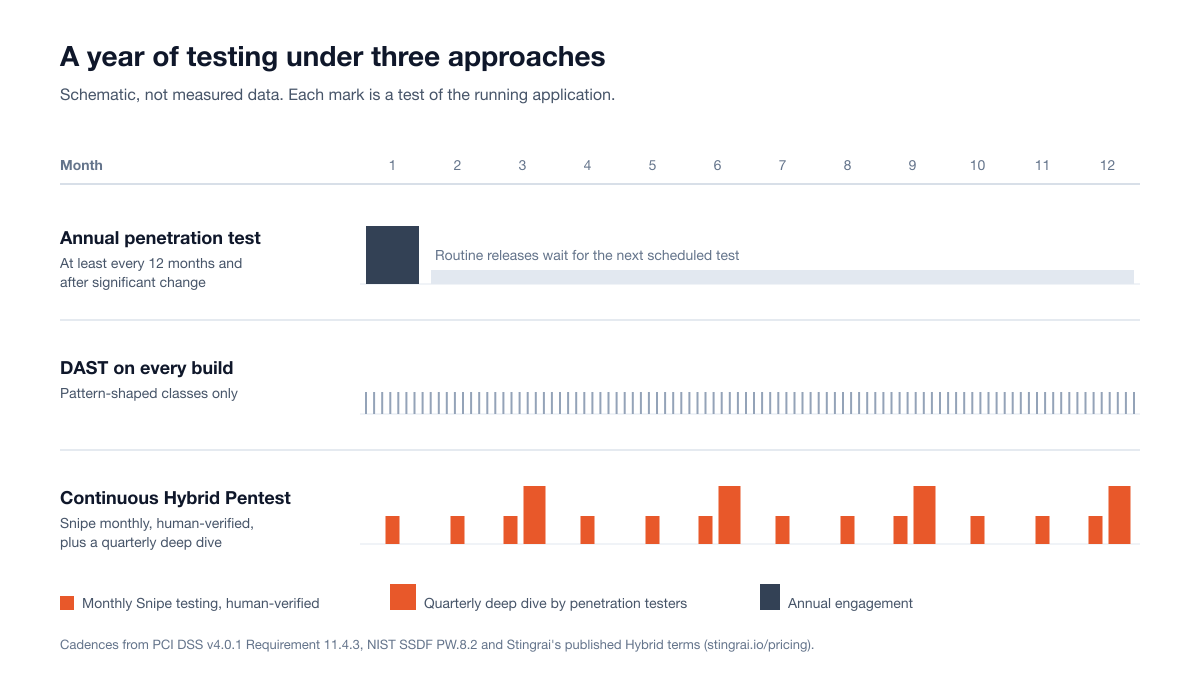
Figure 2: What a year of testing looks like under three approaches. Schematic, not measured data; cadences from PCI DSS Requirement 11.4.3, NIST SSDF PW.8.2 and Stingrai's published Hybrid terms. Source: Stingrai pricing.
Where Stingrai fits: the Hybrid Pentest, one-time or continuous
Stingrai is a proud CREST member. Stingrai Inc holds two CREST accreditations, Penetration Testing and AI-Enabled Penetration Testing, and the company certification CREST AI Charter, as its CREST Marketplace listing shows.
Stingrai is a global CREST-accredited penetration testing services company founded in Toronto, Canada in 2021, trusted by companies from startups to enterprises to meet audit requirements for SOC 2, ISO 27001, CMMC, PCI DSS and HIPAA. OSCE³, OSWE, OSEP, CREST CRT certified penetration testers, who are also world-class security researchers and bug bounty hunters. Choose from fully human-led or hybrid (AI agents plus human penetration testers) engagements across web, API, mobile, AI and LLM, cloud, network, Active Directory and social engineering penetration tests and red team engagements.
Stingrai's web application and API penetration testing is authenticated across every user role in scope and covers business logic, broken authorization and IDOR, injection, and authentication and session handling. Human-led engagements are staffed by two named penetration testers from a team holding OSCE³, OSWE, OSEP, CREST CRT and CISSP certifications; the team has published 18 CVEs. Findings are posted to the PTaaS portal as they are confirmed, retesting is included, and every human-led and hybrid report ships with an attestation letter, evidence for SOC 2, ISO 27001, PCI DSS and HIPAA programs.
The Hybrid Pentest
The Hybrid Pentest puts automated breadth and a penetration tester's judgement on the same application. Snipe tests the full application while Stingrai's certified penetration testers test the same application manually alongside it and validate Snipe's findings, so coverage is wider and deeper. It is not a split of test classes: both work across the whole application, authorization and business logic included. Stingrai offers one-time (annual) tests and continuous programs:
Package | Who tests | Price for one web application and associated APIs | What you receive |
|---|---|---|---|
Hybrid Pentest, one-time | Snipe and Stingrai's certified penetration testers on the same application | US$6,800 per assessment | Human-validated pentest report, attestation letter, 12 monthly vulnerability scans after the pentest |
Hybrid Pentest, continuous | Monthly Snipe testing, human-verified, plus a quarterly deep dive by Stingrai's penetration testers | US$1,275 per month on a 12-month plan | Testing all year, quarterly executive status reports, PTaaS portal with Jira and Slack |
Autonomous Pentest | Snipe | US$3,000 per assessment, or US$650 per month on a 12-month plan | Pentest report; up to 200 API endpoints or dynamic pages and up to 3 user roles; automated retests |
The case for continuous Hybrid rests on this post's evidence: exploitation now leads the DBIR's initial access vectors, KEV additions in 2026 already exceed all of 2025, and the classes that turn a report into an emergency (authorization, IDOR, business logic) are the ones a scanner in the pipeline rarely sees. Monthly testing across up to 3 user roles, with penetration testers going deep each quarter, keeps the gap between a release and its first real test to weeks. Keep DAST in the pipeline for the pattern-shaped classes. A one-time Hybrid assessment remains the right buy for an application that changes rarely, or for a point-in-time report before a customer review.
Next step: compare the plans on the pricing page, or send your application's roles, sensitive flows and release rhythm through Get a Quote.
Frequently Asked Questions
What is the difference between DAST and penetration testing?
DAST is an automated scanner that sends known attack inputs to a running web application and reports responses that match known vulnerability patterns. A penetration test is people, with tools, working out how to defeat the application's security, including flaws that depend on its rules: authorization and IDOR across roles, business logic, multi-step flows and chained issues. DAST is fast and repeatable; a penetration test proves impact.
What is DAST?
DAST, dynamic application security testing, tests a web application while it runs, from the outside and without source code. A DAST scanner crawls the application, sends variations of known attack inputs to each parameter and watches the responses for signs of flaws such as SQL injection, cross-site scripting and server misconfiguration, usually in the CI/CD pipeline or a nightly scan.
Can DAST replace a penetration test?
No. DAST covers pattern-shaped flaws well and belongs on every build, but OWASP says business logic flaws cannot be detected by a vulnerability scanner, and its verification standard says automated tools will be unable entirely to verify many requirements related to business logic and access control. PCI DSS Requirement 11.4 also requires application-layer penetration testing at least every 12 months and after significant change.
Can a DAST scanner find IDOR and business logic flaws?
Rarely, and not reliably. An IDOR returns another user's data in a normal response, so a scanner cannot tell it from a correct one without knowing who owns the record; OWASP's procedure uses at least two users per test. Business logic flaws depend on what the business allows, and OWASP states that automating business logic abuse cases is not possible.
What is authenticated DAST scanning?
Authenticated DAST gives the scanner valid test accounts so it can sign in, stay signed in and test pages and APIs behind the login. It reaches far more of the application than an unauthenticated scan, but a typical scan still tests each session on its own, so it cannot judge whether one role should see another role's data without an access matrix and custom checks.
Why does DAST produce false positives?
A scanner infers a vulnerability from how the application responds, so responses that resemble a known pattern get flagged even when the input was handled safely. NIST's testing guide says application vulnerability scanners typically have high false positive rates, and high false negative rates too.
Does PCI DSS accept a DAST scan instead of a penetration test?
No. PCI DSS v4.0.1 Requirement 11.4.1 requires application-layer penetration testing covering at least the attacks in Requirement 6.2.4, which include attacks on business logic and access control. PCI SSC's guidance describes penetration testing as essentially a manual endeavor, and says that even for network-layer testing, simply running an automated tool does not satisfy the penetration testing requirement.
How is an autonomous AI pentest agent different from a DAST scanner?
A DAST scanner runs a fixed catalogue of checks against each request it found. An autonomous agent plans its next action from what it has observed, keeps context across steps and user roles, and tries to prove each finding with evidence. Stingrai's Snipe, for example, maps pages, endpoints, roles and workflows and tests authentication, access control, business logic and injection.
How much does a hybrid penetration test cost?
For one web application and associated APIs, Stingrai's Hybrid Pentest is US$6,800 per assessment, or US$1,275 per month on a 12-month plan with monthly Snipe testing, human-verified, plus a quarterly deep dive by Stingrai's penetration testers. The Autonomous Pentest is US$3,000 per assessment or US$650 per month on a 12-month plan. Larger scopes are quoted per engagement.
Related reading
Web application security assessment (2026): testing methods, scope and cost
Hybrid web application penetration testing (2026): what it finds and what it costs
Business logic penetration testing: enterprise scope and evidence
Vulnerability assessment vs penetration testing (2026): differences, cost and what auditors accept
Automated Penetration Testing (2026): How It Works, What It Finds and What It Misses
Best API Penetration Testing Companies and Services (2026): API Security Testing Compared
References
OWASP. Vulnerability Scanning Tools. owasp.org.
OWASP. DevSecOps Guideline, Dynamic Application Security Testing. owasp.org.
OWASP. Web Security Testing Guide v4.2. owasp.org.
OWASP. OWASP Top 10:2025. top10.owasp.org.
OWASP. ASVS 5.0.0, Assessment and Certification. github.com.
OWASP. Benchmark project. owasp.org.
NIST. SP 800-115. September 2008. nvlpubs.nist.gov.
NIST. SP 800-218, SSDF Version 1.1. February 2022. csrc.nist.gov.
NIST. NISTIR 8397. October 2021. nvlpubs.nist.gov.
NIST SAMATE. SP 500-269, Web Application Security Scanner Functional Specification. January 2008. nvlpubs.nist.gov.
PCI SSC. PCI DSS v4.0 Self-Assessment Questionnaire D for Merchants (April 2022), which reproduces the requirement text; PCI DSS v4.0.1 (June 2024) added or deleted no requirements. SAQ D; FAQ 1593; v4.0.1 announcement; Document library.
PCI SSC. Information Supplement: Penetration Testing Guidance v1.1. September 2017. pcisecuritystandards.org.
Verizon. 2026 Data Breach Investigations Report. verizon.com.
CISA. Known Exploited Vulnerabilities Catalog, version 2026.11.18. cisa.gov.
Stingrai. State of Penetration Testing 2026. stingrai.io.
CREST. Stingrai Inc, CREST Marketplace listing. marketplace.crest.org.
Stingrai. Pricing and Snipe, checked 20 November 2026. Pricing; Snipe.
Talk to Stingrai
Send your application's roles, sensitive flows and release rhythm through Get a Quote, or book a free discovery call to decide whether DAST, a one-time Hybrid assessment, continuous Hybrid testing or a mix fits your application.