Australian Government agencies paid a median A$37,400 (GST inclusive) for a stand-alone penetration test, according to the 37 single-engagement penetration testing contract notices published on AusTender between 1 July 2024 and 20 November 2026. Half of those contracts fell between A$25,080 and A$48,000. The cost of not testing is climbing too: ASD's Annual Cyber Threat Report 2025-26 puts the average self-reported cost of cybercrime per business report at A$93,500, up 16%, and A$141,300 for a medium business.
This guide prices Australian penetration testing from neutral data only: government contract records, the regulators' own text and the Reserve Bank's exchange rate. It sets out what each test type costs, what moves a quote, which Australian rules set the scope and how often you pay, how to check CREST status, and how to get a quote you can compare.
Quick answer. A stand-alone penetration test bought by an Australian Government agency cost a median A$37,400 (GST inclusive) across 37 AusTender contract notices from July 2024 to November 2026, with the middle half between A$25,080 and A$48,000. Scope, user roles, environments and the compliance evidence you need move the price. Stingrai's Hybrid Pentest of one web application and associated APIs is US$6,800 (about A$10,200 at the Reserve Bank of Australia rate of 20 November 2026), and its network tests typically run US$5,000 to US$40,000 and above (about A$7,500 to A$60,000).
TL;DR: penetration testing cost in Australia in 2026
Government benchmark (AusTender, July 2024 to November 2026): median A$37,400 for a stand-alone penetration test contract, GST inclusive; middle half A$25,080 to A$48,000; full range A$11,000 to A$128,700 across 37 notices.
Most common band: 22 of the 37 contracts landed between A$25,000 and A$49,999. Seven came in under A$25,000 and eight at A$50,000 or more.
Ongoing arrangements cost more in total: the 25 longer or amended penetration testing arrangements on AusTender had a median initial value of A$97,934 and a median latest value of A$129,360.
Web application and associated APIs: Stingrai's Hybrid Pentest is US$6,800 (about A$10,200), and the Autonomous Pentest is US$3,000 (about A$4,500), at the RBA rate of 0.6666 US dollars per Australian dollar on 20 November 2026.
Continuous web application testing: the Hybrid Pentest is US$1,275 a month on a 12-month plan (about A$1,910 a month), with monthly Snipe testing, human-verified, plus a quarterly deep dive by Stingrai's penetration testers.
Network: US$5,000 to US$40,000 and above (about A$7,500 to A$60,000) on Stingrai's published range; PCI DSS bundles of internal, external and segmentation testing commonly land at US$12,000 to US$25,000 (about A$18,000 to A$37,500).
Cadence sets the annual bill: the September 2026 ISM asks for penetration tests before deployment, before significant changes and at least every six months thereafter (ISM-2118).
Financial services: APRA CPS 234 requires a systematic testing program by "appropriately skilled and functionally independent specialists", and CPG 234 expects a sufficient set of controls tested at least annually.
Breach context: the OAIC received 667 data breach notifications from January to June 2026, and malicious or criminal attacks remain the leading cause.
How much does a penetration test cost in Australia?
A stand-alone penetration test in the Australian Government market costs a median A$37,400, including GST. That figure comes from every AusTender contract notice published between 1 July 2024 and 20 November 2026 whose description names penetration testing, that ran six months or less, and whose value was never amended: 37 notices from agencies including the Department of Finance, the Department of Health, Disability and Ageing, APRA, AUSTRAC, the Federal Court, the Royal Australian Mint and Austrade.
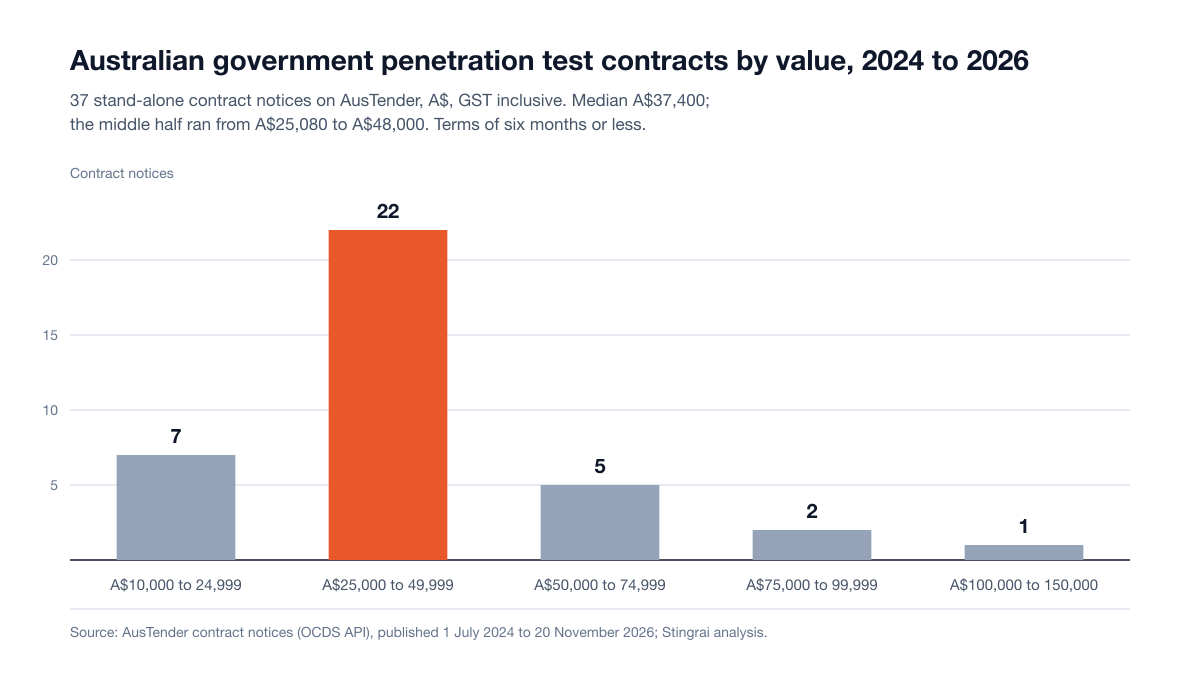
Figure 1: Stand-alone Australian Government penetration test contracts by value, July 2024 to November 2026, A$ GST inclusive. Source: AusTender contract notices, Stingrai analysis.
Measure (37 stand-alone notices) | Value (A$, GST inclusive) |
|---|---|
Lowest | 11,000 |
25th percentile | 25,080 |
Median | 37,400 |
75th percentile | 48,000 |
Highest | 128,700 |
Median contract term | About two months |
A few named examples show the spread. The Federal Court of Australia bought a web application penetration test for A$23,100 between September and November 2024. The Royal Australian Mint paid A$25,025 for internal network segmentation testing, a secure configuration assessment and external network penetration testing. The Department of Finance paid A$34,155 for software penetration testing. The largest stand-alone notice was a A$128,700 test of an aged care platform for the Department of Health and Aged Care, over about ten weeks.
Ongoing arrangements are a different purchase. The other 25 penetration testing notices in the same window either ran longer than six months or grew through amendments. Their median initial value was A$97,934, and their median latest value, after any amendments, A$129,360. The largest, an ASIC penetration testing consultancy arrangement, was awarded at A$25,080 and amended to A$392,150 over two years. The Australian Electoral Commission's 12-month AWS penetration testing contract was A$206,690.
How the AusTender numbers were built
AusTender publishes Commonwealth contract notices through an open data API. Stingrai read all 175,397 contract releases published from 1 July 2024 to 20 November 2026 and kept those whose description named penetration testing, vulnerability assessment, red teaming or security testing. Labour hire of individual testers, tool licences and infrastructure were removed, as were two notices outside an agency's own penetration testing: a test of another government's systems funded through the aid program, and a combined penetration testing and risk assessment panel. Of the 62 notices left that name penetration testing, the 37 with a term of six months or less and a value never amended form the stand-alone sample; the other 25 are the longer arrangements. No supplier is named in this guide.
What the government data can and cannot tell you
Four limits matter when you use these figures to budget a private-sector test:
The values include GST. The Department of Finance's reporting rules require agencies to report "the total value of the initial term of the contract (including GST where applicable)".
The cheapest tests are missing. Non-corporate Commonwealth entities report contracts from A$10,000, and corporate Commonwealth entities from A$400,000, so small tests below those thresholds never appear.
A value is a commitment, not a spend. Finance's guidance says the value "should not reflect expenditure under the contract", so a notice is a ceiling for one contract that may cover more than one system or a retest.
Government scope is its own market. These buyers work under the ISM and the Protective Security Policy Framework, so treat the median as a benchmark for a tested, reported engagement rather than a list price.
Penetration testing cost by test type in Australia
No Australian government or regulator source we found publishes a price list by test type. The table below puts the best public evidence for each type side by side: the AusTender notices that name it, and the prices Stingrai publishes. AUD figures are approximate conversions at the RBA rate of 0.6666 US dollars per Australian dollar on 20 November 2026.
Test type | Neutral Australian evidence (AusTender, GST inclusive) | Stingrai's published price | What moves the price most |
|---|---|---|---|
Web application | A$23,100 for one web application test (Federal Court, 2024); A$34,155 for a software test (Finance, 2024) | Hybrid Pentest US$6,800 (about A$10,200); Autonomous Pentest US$3,000 (about A$4,500), one web application and associated APIs | Authenticated roles, business logic, number of applications |
API | No notice names an API-only test | Included in the web application packages above for associated APIs; standalone API programs quoted | Endpoint count, authentication model, tenants |
Network (internal and external) | A$25,025 for segmentation, secure configuration and external testing (Royal Australian Mint, 2024) | US$5,000 to US$40,000 and above (about A$7,500 to A$60,000) | Live hosts, sites, VLANs, Active Directory footprint |
Cloud | A$206,690 for a 12-month AWS penetration testing contract (AEC, 2024 to 2025) | Quoted per engagement | Accounts, subscriptions, identity complexity |
Mobile | No notice names a mobile-only test | Quoted per engagement | Platforms (iOS, Android), backend coverage |
Red team | No stand-alone red team notice in the window | Quoted per engagement | Objectives, attack vectors, duration |
Web application and API testing cost
Web applications are where Australian buyers can compare prices most directly, because fixed prices exist. Stingrai's Hybrid Pentest is US$6,800 for one web application and associated APIs: Snipe, Stingrai's autonomous AI penetration testing agent, tests the full application while Stingrai's certified penetration testers test the same application manually alongside it and validate Snipe's findings, so coverage is wider and deeper. The Autonomous Pentest, Snipe alone, is US$3,000 and delivers a penetration test report. Every human-led and hybrid report ships with an attestation letter.
Above one application, the drivers are the number of authenticated roles, multi-tenant isolation, payment and identity flows, and whether source code is shared. For a worked scoping model, see web application penetration testing scope and cost and API penetration testing cost.
Network penetration testing cost
Stingrai's published network range is US$5,000 to US$40,000 and above (about A$7,500 to A$60,000), driven by live host count, subnet and VLAN count, Active Directory footprint, number of physical sites and how many start positions the engagement includes. PCI DSS engagements that bundle internal, external and segmentation testing commonly land at US$12,000 to US$25,000 (about A$18,000 to A$37,500). The Royal Australian Mint's A$25,025 notice for a similar bundle sits inside that converted band. Internal tests that need someone on site add travel; internal network scope and cost and external network scope and cost break the drivers down.
Cloud, mobile and red team cost
These three are quoted per engagement because the unit of scope varies too much for a fixed price. A cloud penetration test is scoped by accounts or subscriptions and identity design; the only Australian cloud figure on AusTender in the window is a year-long AWS contract, which tells you what a program costs, not a single test. Mobile tests are scoped per platform plus the backend, and mobile app penetration testing cost explains why the shared backend usually holds most of the effort. Red team engagements are priced on objectives, vectors and weeks of activity; see red team engagement cost.
Stingrai's published prices in USD and AUD
Stingrai publishes its web application prices in US dollars on its pricing page. The AUD column converts them at the RBA's 20 November 2026 rate of 0.6666 and is approximate; your bank's rate on the day of payment will differ. The four packages each cover one web application and associated APIs; the network line is Stingrai's published typical range.
Package or service | Price (USD) | Approximate AUD (RBA, 20 Nov 2026) | What you get |
|---|---|---|---|
Autonomous Pentest, one-time | US$3,000 per assessment | About A$4,500 | Snipe only; penetration test report |
Hybrid Pentest, one-time | US$6,800 per assessment | About A$10,200 | Snipe plus certified penetration testers; report and attestation letter |
Autonomous Pentest, continuous | US$650 a month, 12-month plan | About A$975 a month | Monthly autonomous testing by Snipe |
Hybrid Pentest, continuous | US$1,275 a month, 12-month plan | About A$1,910 a month | Monthly Snipe testing, human-verified, plus a quarterly deep dive by Stingrai's penetration testers |
Network penetration test | US$5,000 to US$40,000 and above | About A$7,500 to A$60,000 | Quoted per engagement on the drivers above |
Anything larger than one web application, and every other service, is quoted through Get a Quote.
What drives the price of an Australian penetration test
The drivers below are Stingrai's guidance from scoping engagements; no Australian standard sets them. They explain most of the gap between an A$11,000 notice and an A$128,700 one.
Assets in scope. Applications, APIs, hosts, cloud accounts and sites. Each one adds discovery, testing and reporting time.
Authenticated roles and tenants. Every privilege level has to be tested against every other one for broken access control, so roles multiply effort faster than pages do.
Environments. Testing staging and production, or several regional deployments, adds setup and validation time.
Depth and method. Black box, grey box with credentials, or white box with source access change both effort and what the test can find.
On-site work. Internal network, wireless and physical testing that needs presence on the premises adds travel. Remote testing of web, API and cloud targets does not.
Compliance evidence. A test that must stand up for APRA, an ISM-based assessment or a PCI DSS assessor needs tighter scoping, documentation and reporting.
Retesting. Whether retests of fixed findings are included, or billed per cycle, changes the cost of reaching a clean report.
Cadence. One test a year, one every six months, or a continuous program changes the annual total more than any single rate does.
You can lower a quote without lowering quality: give testers working credentials for every role, a stable build, documentation and a single production-like environment. For a full scoping checklist, see how to scope a penetration test.
Australian compliance drivers that set scope and cadence
Most Australian buyers do not choose how often to test from scratch. A framework or regulator sets the floor, and that floor sets the annual cost.
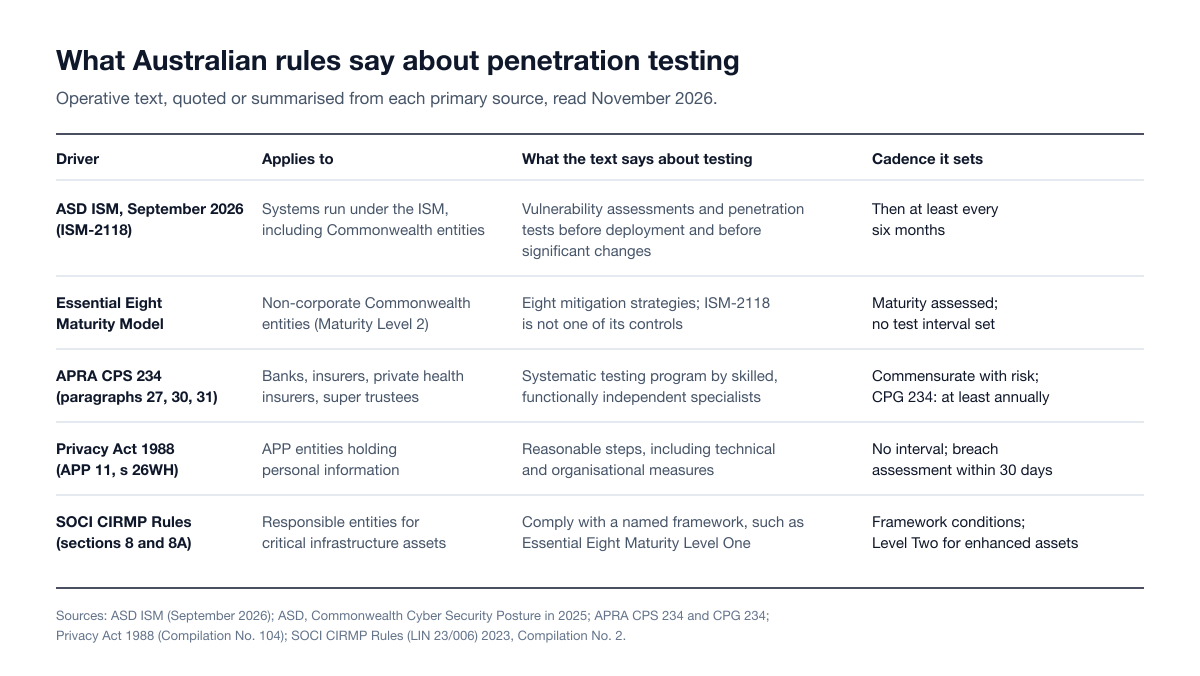
Figure 2: What Australian rules say about penetration testing and the cadence each sets, as of November 2026. Source: ASD ISM (September 2026), APRA CPS 234, Privacy Act 1988, SOCI CIRMP Rules.
ASD's ISM: penetration tests before deployment and every six months
The September 2026 Information Security Manual, published 7 September 2026, contains the clearest testing interval in Australian guidance. Control ISM-2118 reads: "Vulnerability assessments and penetration tests are conducted for systems prior to their deployment, including prior to the deployment of significant changes, and at least every six months thereafter." It applies at every classification, from non-classified to TOP SECRET.
A second control, ISM-2119, reads: "Suitable AI models are used to augment vulnerability assessments and penetration tests." The ISM also says assessments "should be conducted by suitably skilled personnel" who may be internal or a third party but "should be independent of the system being assessed."
The budgeting consequence is direct. A system tested once before go-live, again before each significant change and at least twice a year after that is a recurring cost, not an annual one. Commonwealth entities apply the ISM through the Protective Security Policy Framework, and any organisation that adopts the ISM takes on the same cadence.
Essential Eight: a maturity baseline, not a penetration test
The Essential Eight is ASD's set of eight mitigation strategies, measured on a four-level maturity model. According to ASD's Commonwealth Cyber Security Posture in 2025, "As of 1 July 2022, the PSPF mandates that NCEs must implement all Essential Eight strategies to at least Maturity Level 2", and in 2025 "22 per cent of entities reached overall Maturity Level 2, increasing from 15 per cent in 2024." An entity's overall level is that of "its least mature strategy."
The Essential Eight does not include a penetration testing control: ASD tags ISM-2118 "Essential 8: N/A". An Essential Eight assessment measures whether the controls are configured. A penetration test shows whether an attacker gets through anyway. ASD itself notes that its updates to the model drew on its experience "conducting penetration testing". Budget the two as separate lines.
APRA CPS 234: systematic testing for financial services
CPS 234 applies to authorised deposit-taking institutions, general insurers, life companies, private health insurers and RSE licensees. Paragraph 27 says an APRA-regulated entity "must test the effectiveness of its information security controls through a systematic testing program", with nature and frequency "commensurate with" factors including "the rate at which the vulnerabilities and threats change". Paragraph 30 requires testing "by appropriately skilled and functionally independent specialists", and paragraph 31 requires a review of the program "at least annually".
The standard never says "penetration test". APRA's practice guide CPG 234 does: it lists "security testing, including penetration testing" as a capability, and says a sufficient set of controls would be "tested, at least annually", while controls exposed to "untrusted" environments "would typically be tested throughout the year." For a CPS 234 budget, plan at least an annual program plus testing through the year for systems exposed to untrusted environments, such as the internet. The APRA CPS 234 penetration testing requirements guide covers scope, evidence and vendor obligations in full.
Privacy Act and Notifiable Data Breaches
Australian Privacy Principle 11.1 of the Privacy Act 1988 says an APP entity "must take such steps as are reasonable in the circumstances to protect the information" from "misuse, interference and loss" and "unauthorised access, modification or disclosure." APP 11.3 adds that "such steps include technical and organisational measures." The Act names no test and no interval, but a penetration test report is direct evidence that technical measures were checked.
When something does go wrong, section 26WH requires an entity to take all reasonable steps to complete its assessment of a suspected eligible data breach within 30 days. The OAIC's January to June 2026 statistics counted 667 notifications, up from 662, said malicious or criminal attacks "remain the leading cause", and recorded 11 breaches affecting more than 1,000,000 individuals worldwide, up from 4. Health service providers made 149 notifications, the most of any sector.
SOCI Act: critical infrastructure risk management programs
The Critical Infrastructure Risk Management Program Rules require a responsible entity to comply with a named cyber framework, within 12 months after the end of the applicable period. The list includes AS ISO/IEC 27001, the NIST framework, the US Department of Energy's C2M2, the AESCSF, and the Essential Eight at "maturity level one". In the current compilation (10 June 2026), section 8A raises the bar for enhanced assets (broadcasting, domain name systems, electricity, energy market operators, freight, gas, liquid fuel and water) to Essential Eight "maturity level two" or an equivalent, subject to the grace periods in section 4A. The Rules name no penetration test, but testing is how an operator shows the chosen framework works in practice.
CREST in Australia: what to check before you pay
Accreditation is the quickest check on what a quote buys, and in Australia there are two bodies to tell apart. According to CREST International, "the formal relationship between CREST International and CREST ANZ ended at the end of April 2019", CREST ANZ has "no rights to the CREST International suite of company accreditations or individual certifications", and "CREST ANZ membership alone is not recognised by CREST International as being equivalent." CREST ANZ runs its own Approved Companies listing and the ABPT accreditation for individual penetration testers.
What that means for a buyer:
Ask which body a tender means when it says "CREST accredited", and get the answer in the statement of work.
Check CREST International accreditation on the CREST Marketplace, the single source of truth; filtered to Australia in November 2026, it listed 69 companies.
Tell company accreditation from individual certification. A firm's CREST accreditation covers the company; a tester's CREST CRT is a personal certification.
Stingrai is a proud CREST member. On the CREST Marketplace, Stingrai Inc holds two CREST accreditations, Penetration Testing and AI-Enabled Penetration Testing, and the company certification CREST AI Charter. The AI-Enabled Penetration Testing accreditation sits naturally beside ISM-2119's call for "suitable AI models" to augment penetration tests. The CREST-accredited penetration testing companies guide covers what firm-level accreditation verifies.
One-time or continuous: what the cadence costs for a web application
For a web application, the testing interval decides the annual total. ASD's Annual Cyber Threat Report 2025-26 says publicly reported CVEs "increased 30%" and that "AI is reducing the expertise and effort required to identify and exploit vulnerabilities, likely accelerating Time to Exploit (TTE)". It also recorded the "successful exploitation of a vulnerability identified in 2008". On an application that ships every few weeks, a once-a-year test leaves long gaps.
Here is the arithmetic for one web application and associated APIs, at Stingrai's published prices:
Cadence | Annual cost (USD) | Approximate AUD | What it covers |
|---|---|---|---|
One Hybrid Pentest a year | US$6,800 | About A$10,200 | One point-in-time test, report and attestation letter |
Two Hybrid Pentests a year (ISM-2118's six-month interval) | US$13,600 | About A$20,400 | Two point-in-time tests |
Continuous Hybrid Pentest, 12-month plan | US$15,300 (12 x US$1,275) | About A$22,950 | Monthly Snipe testing, human-verified, plus a quarterly deep dive by Stingrai's penetration testers |
Continuous Hybrid costs about US$1,700 a year more than two one-time tests and replaces two snapshots with twelve monthly passes and four human deep dives. Monthly passes sit well inside ISM-2118's six-month interval, and match CPG 234's expectation that controls exposed to untrusted environments are "tested throughout the year". For release-by-release scheduling, see continuous hybrid web pentesting and release gates, and for the board case, the budget case for continuous penetration testing. Buyers who ship once or twice a year and need one report for an audit are often better served by a one-time test.
How to get an accurate penetration testing quote in Australia
This sequence is Stingrai's guidance for getting quotes you can compare; no Australian standard prescribes it.
Name the driver. Say which rule the test must satisfy (ISM, CPS 234, Privacy Act, SOCI, PCI DSS, a customer contract) and which assessor or auditor will read the report.
Count the scope. List applications, APIs and endpoint counts, user roles, cloud accounts, external IP ranges, internal sites and hosts.
Pick the method. Black, grey or white box, and whether testers get credentials for every role and access to source code.
Set the windows. Give test dates, change freezes and the hours testing may run in AEST or AEDT, and name who can stop the test.
Ask for the unit of price. Ask each provider for tester days or a fixed price per scope item, and whether GST applies.
Confirm retesting and reporting. Ask whether retests are included, what the report contains, and whether an attestation letter comes with it.
Check accreditation. Verify the company on the CREST Marketplace (or CREST ANZ, if your tender says so) and ask for the named testers.
Compare like for like. Line quotes up on scope, method, days and retests before you look at the total.
The pentest and red team RFP question bank turns these steps into a scored tender, and how to compare penetration testing quotes shows how to back out tester days from a price.
Red flags in an Australian penetration testing quote
These are Stingrai's guidance, not a regulator's list:
Automation that is not disclosed. If a "penetration test" is priced like a scan and the quote names no tester days or method, ask how much of it is automated and whether a person confirms the findings. Automated testing is a legitimate product when it is sold as one.
No roles or environments in the scope. A quote that does not count user roles cannot have priced access control testing.
"CREST accredited" with no body named. Ask whether that means CREST International or CREST ANZ, and check the listing yourself.
Retests billed separately and open-ended. Ask for the retest terms in writing.
No independence statement. CPS 234 and the ISM both expect testers independent of the system; a quote from the team that built it fails that test.
Where Stingrai fits for Australian buyers
Stingrai is a global CREST-accredited penetration testing services company founded in Toronto, Canada in 2021, trusted by companies from startups to enterprises to meet audit requirements for SOC 2, ISO 27001, CMMC, PCI DSS and HIPAA. OSCE³, OSWE, OSEP, CREST CRT certified penetration testers, who are also world-class security researchers and bug bounty hunters. Choose from fully human-led or hybrid (AI agents plus human penetration testers) engagements across web, API, mobile, AI and LLM, cloud, network, Active Directory and social engineering penetration tests and red team engagements.
For an Australian buyer, the specifics that matter are these:
Published prices for web applications. The Hybrid Pentest is US$6,800 and the Autonomous Pentest US$3,000, for one web application and associated APIs; continuous plans are US$1,275 and US$650 a month on a 12-month plan.
Evidence an assessor can use. Every finding is posted to the PTaaS portal as it is confirmed, with a working proof of concept and remediation guidance; retesting is included; and every human-led and hybrid report ships with an attestation letter. Stingrai's testing supports CPS 234, ISM-based and Privacy Act programs by producing evidence for them.
Named people. Human-led engagements are delivered by two named penetration testers from a team holding OSCE³, OSWE, OSEP, CREST CRT and CISSP certifications, reviewed by the team lead.
Remote delivery, scoped per engagement. Web, API and cloud testing runs remotely; on-site work is scoped when an internal network or wireless test needs it. Stingrai is a small team, so book test windows early in busy audit seasons.
Frequently asked questions
How much does a penetration test cost in Australia?
A stand-alone penetration test bought by an Australian Government agency cost a median A$37,400 (GST inclusive) across 37 AusTender contract notices published from July 2024 to November 2026, and half of them fell between A$25,080 and A$48,000. Ongoing testing arrangements cost more in total, with a median initial value of A$97,934. Stingrai's Hybrid Pentest of one web application and associated APIs is US$6,800, about A$10,200 at the RBA rate of 20 November 2026.
How much does a web application penetration test cost in Australia?
The Federal Court of Australia paid A$23,100 for a web application penetration test in 2024, and the Department of Finance paid A$34,155 for a software penetration test, both GST inclusive. Stingrai's Hybrid Pentest is US$6,800 (about A$10,200) and its Autonomous Pentest US$3,000 (about A$4,500) for one web application and associated APIs. Authenticated roles, business logic and the number of applications move the price most.
How much does a network penetration test cost in Australia?
Stingrai's published range for a network penetration test is US$5,000 to US$40,000 and above, about A$7,500 to A$60,000 at the RBA rate of 20 November 2026. PCI DSS engagements that bundle internal, external and segmentation testing commonly land at US$12,000 to US$25,000, about A$18,000 to A$37,500. On AusTender, the Royal Australian Mint paid A$25,025 for a similar bundle in 2024.
Does the ISM require penetration testing every six months?
For systems run under the ISM, yes. Control ISM-2118 in ASD's September 2026 Information Security Manual says vulnerability assessments and penetration tests are conducted before a system is deployed, before significant changes are deployed, and at least every six months thereafter. It applies at every classification. A related control, ISM-2119, says suitable AI models are used to augment vulnerability assessments and penetration tests.
Does APRA CPS 234 require a penetration test?
CPS 234 does not use the words "penetration test", but paragraph 27 requires a systematic testing program and paragraph 30 requires testing by appropriately skilled and functionally independent specialists. APRA's practice guide CPG 234 lists penetration testing as a security testing capability and expects a sufficient set of controls to be tested at least annually, with controls exposed to untrusted environments tested throughout the year.
Is an Essential Eight assessment the same as a penetration test?
No. The Essential Eight is a set of eight mitigation strategies measured on a maturity model, and an assessment checks whether those controls are in place. A penetration test checks whether an attacker can get through anyway. ASD tags its penetration testing control, ISM-2118, as not part of the Essential Eight, so plan and budget the two separately.
Why are some government penetration testing contracts so much larger than others?
A contract notice records the committed value of one contract, including GST, and that contract can cover several systems, a retest or a period of work. Stand-alone tests in the AusTender sample ranged from A$11,000 to A$128,700, while ongoing arrangements reached as much as A$392,150 after amendments. Notices below A$10,000 are not reported by non-corporate Commonwealth entities, so the smallest tests do not appear.
What is the difference between CREST and CREST ANZ?
They are separate organisations. CREST International says its formal relationship with CREST ANZ ended at the end of April 2019 and that CREST ANZ membership alone is not recognised as equivalent to its accreditations. Check CREST International accreditation on the CREST Marketplace, check CREST ANZ approval on its own listing, and ask which one a tender means.
How do I get an accurate penetration testing quote in Australia?
Name the rule the test must satisfy, count the scope (applications, APIs, roles, cloud accounts, IP ranges and sites), choose black, grey or white box, set the test windows, and ask each provider for tester days or a fixed price per scope item, retest terms and the report format. Then compare quotes on scope and method before price. Stingrai returns a scoped quote through its Get a Quote form.
Related reading
Penetration testing cost (2026): prices by scope and compliance driver
Penetration Testing Companies in Melbourne (2026): Ranked, With CREST Status and Pricing
References
Australian Government, AusTender. Contract notices, Open Contracting Data Standard API. Notices published 1 July 2024 to 20 November 2026. https://api.tenders.gov.au/ocds/findByDates/contractPublished/2024-07-01T00:00:00Z/2024-08-01T00:00:00Z. 175,397 contract releases read month by month; 37 stand-alone and 25 longer penetration testing notices analysed.
Department of Finance. Contracting and reporting (RMG 423). https://www.finance.gov.au/publications/resource-management-guides/procurement-publishing-and-reporting-obligations-rmg-423/contracting-reporting. Reporting thresholds and the GST-inclusive value rule for AusTender notices.
Reserve Bank of Australia. Exchange Rates. 20 November 2026. https://www.rba.gov.au/statistics/frequency/exchange-rates.html. 0.6666 US dollars per Australian dollar, used for every AUD conversion in this guide.
Australian Signals Directorate. Information security manual (September 2026), Guidelines for security assurance. Published 7 September 2026. https://www.cyber.gov.au/ism/2026-09/guidelines-for-security-assurance. ISM-2118 and ISM-2119.
Australian Signals Directorate. The Commonwealth Cyber Security Posture in 2025. Published 12 February 2026. https://www.cyber.gov.au/publication/the-commonwealth-cyber-security-posture-in-2025. Essential Eight maturity across 2024-25.
Australian Signals Directorate. Annual Cyber Threat Report 2025-26. Published 26 October 2026. https://www.cyber.gov.au/publication/annual-cyber-threat-report-2025-26/year-in-review. Cost of cybercrime per report, CVE growth and time to exploit, FY2025-26.
Australian Prudential Regulation Authority. Prudential Standard CPS 234 Information Security. https://www.apra.gov.au/sites/default/files/cps_234_july_2019_for_public_release.pdf. Paragraphs 2, 27, 30 and 31.
Australian Prudential Regulation Authority. Prudential Practice Guide CPG 234 Information Security. June 2019. https://www.apra.gov.au/sites/default/files/cpg_234_information_security_june_2019_0.pdf. Paragraphs 16 and 79.
Federal Register of Legislation. Privacy Act 1988, Compilation No. 104. Compilation date 4 June 2026. https://www.legislation.gov.au/C2004A03712/latest/text. APP 11 and section 26WH.
Office of the Australian Information Commissioner. Large-scale data breaches on the rise, latest OAIC statistics reveal. https://www.oaic.gov.au/news/media-centre/large-scale-data-breaches-on-the-rise,-latest-oaic-statistics-reveal. Notifiable Data Breaches, January to June 2026.
Federal Register of Legislation. Security of Critical Infrastructure (Critical infrastructure risk management program) Rules (LIN 23/006) 2023, Compilation No. 2. Compilation date 10 June 2026. https://www.legislation.gov.au/F2023L00112/latest/text. Sections 4A, 8 and 8A.
CREST International. Region: Australasia. https://www.crest-approved.org/membership/region-australasia/. Relationship between CREST International and CREST ANZ.
CREST. Stingrai Inc, CREST Marketplace. https://marketplace.crest.org/supplier/stingrai-inc/. Accreditations and company certification.
Stingrai. Pricing. https://www.stingrai.io/pricing. Autonomous and Hybrid Pentest prices, one-time and continuous, in USD.
Stingrai. Internal and external network penetration testing. https://www.stingrai.io/services/internal-and-external-network-pen-test. Published network price range.
Talk to Stingrai
Send your scope (applications, roles, environments and the rule your test must satisfy) and Stingrai will return a fixed, scoped price. Get a Quote or book a free discovery call.