On 13 October 2026, six of the vendors checked for this guide showed a price for testing a mobile app on their own pages or marketplace listings, in four different units: an annual subscription per target (Astra Security), a fixed test per application on one or two platforms (Bugcrowd), a per-engagement range or starting price (Blaze Information Security, EJN Labs and Halo Security), and a tier test plus a separate platform fee (Synack). The figures run from US$2,200 per app, Astra's tailored starting price when the iOS and Android apps share a codebase, to Blaze's US$20,000 to US$30,000+ for a complex mobile ecosystem. Comparing them starts with converting every quote to the same unit.
This guide turns them into a budget for product, engineering and security leads in the United States and Canada pricing an iOS and Android test for SOC 2, HIPAA, PCI DSS, an FDA submission or a customer review.
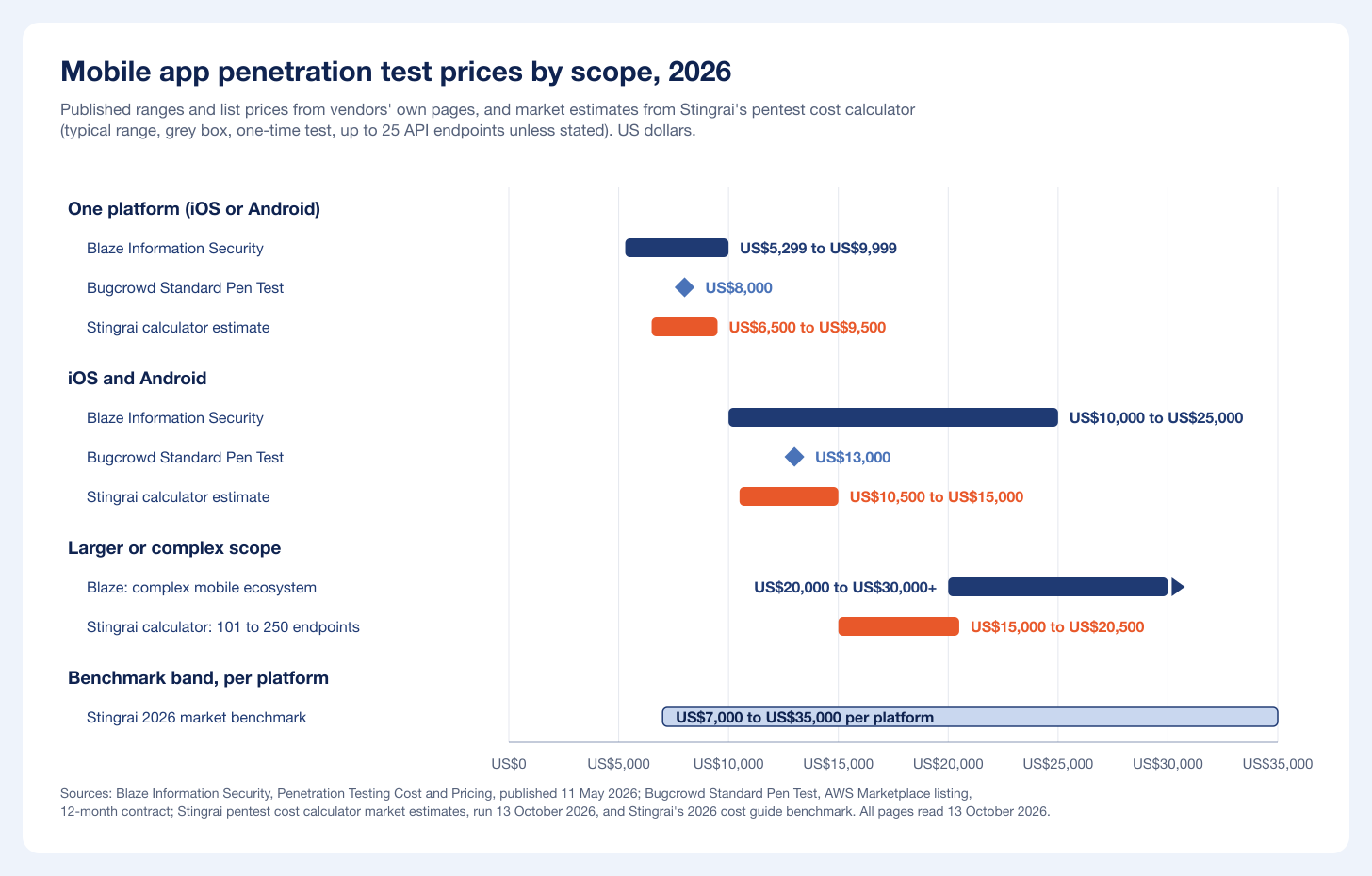
Quick answer. Stingrai's 2026 market benchmark, aggregated from published vendor pricing, puts a mobile app penetration test at about US$7,000 to US$35,000 per platform. Blaze Information Security lists US$5,299 to US$9,999 for one platform and US$10,000 to US$25,000 for iOS and Android, and Bugcrowd's Standard Pen Test lists US$8,000 for one platform and US$13,000 for two. The platforms in scope, the size of the backend API and the user roles move the quote most, followed by the OWASP MAS profile and the compliance evidence. Stingrai quotes mobile per engagement through Get a Quote: both binaries and the backend API, tested by two named penetration testers, with retesting and an attestation letter, as a one-time annual test or a continuous program.
How much does a mobile app penetration test cost in 2026?
Stingrai's market benchmark
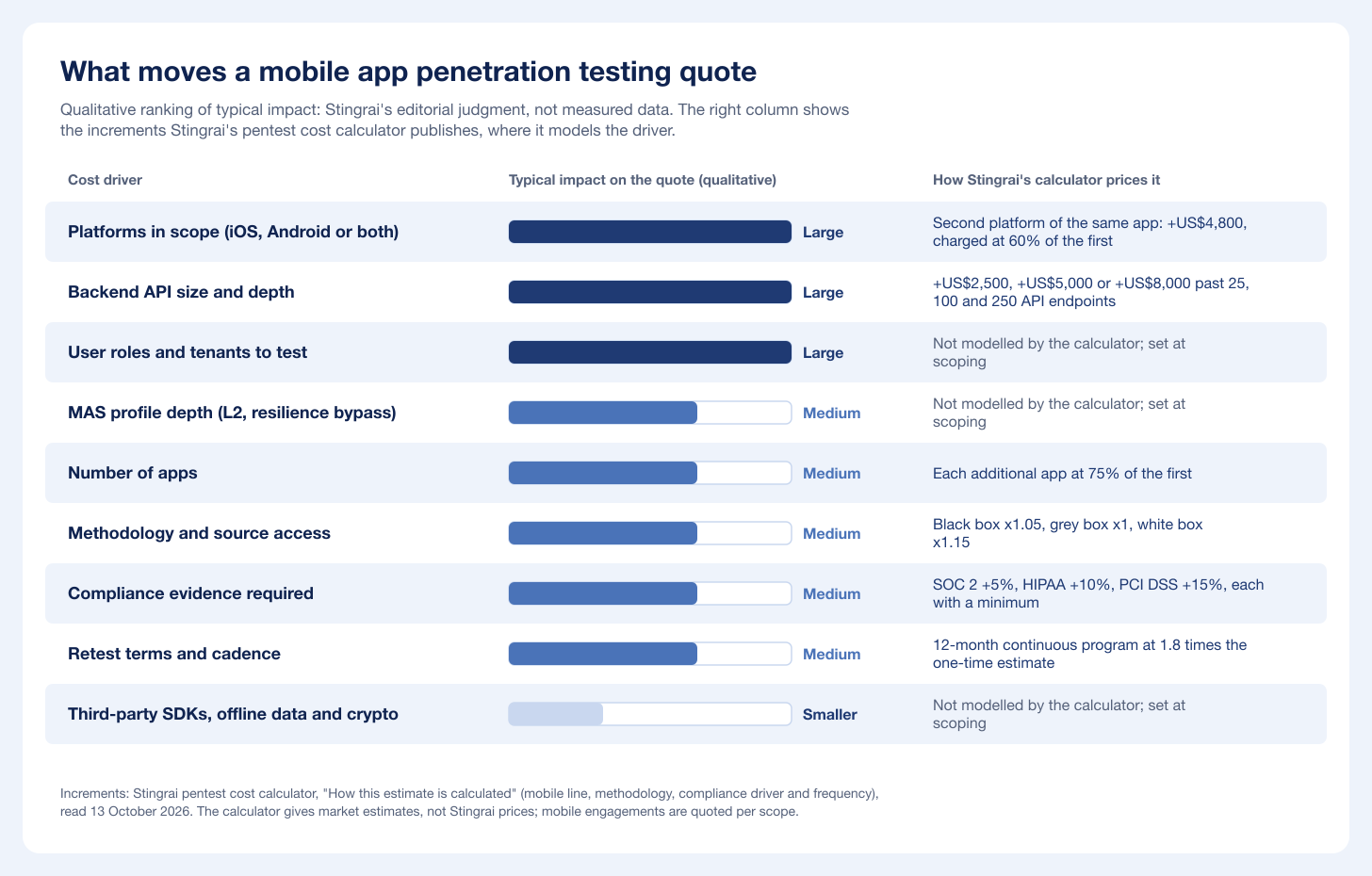
Stingrai's 2026 penetration testing cost guide lists a mobile application test at US$7,000 to US$35,000 per platform, "iOS and Android each, plus backend API coverage", among benchmark ranges aggregated from published vendor pricing and industry cost guides (cutoff 5 June 2026): a market benchmark, not Stingrai's price. The pentest cost calculator labels its output "Estimated Market Price" and publishes its math: US$8,000 for the smallest single-platform scope, plus US$4,800 for iOS and Android together, plus US$2,500, US$5,000 or US$8,000 past 25, 100 or 250 API endpoints, with a typical range 15 percent either side. Its method note: "The second platform of the same app is charged at 60% because the backend is shared." For a one-time grey-box test with no compliance driver:
Mobile scope (one app) | Estimate | Typical range |
|---|---|---|
One platform, up to 25 API endpoints | US$8,000 | US$6,500 to US$9,500 |
iOS and Android, up to 25 endpoints | US$13,000 | US$10,500 to US$15,000 |
iOS and Android, 26 to 100 endpoints | US$15,500 | US$13,000 to US$18,000 |
iOS and Android, 101 to 250 endpoints | US$18,000 | US$15,000 to US$20,500 |
The calculator also states that "Stingrai's own prices are not produced by this model"; Stingrai quotes mobile per engagement.
Published prices on vendors' own pages
Of the vendors checked, six publish a mobile figure, and Cobalt publishes only a pricing unit for mobile. Listed alphabetically as read on 13 October 2026; the order is not a ranking.
Vendor | Published figure | Unit and what it covers |
|---|---|---|
US$5,999 a year (Pentest Expert); "starting from $2200/app" when the apps share a codebase | One target a year; "Mobile is per platform, so an Android app and an iOS app are two targets" | |
US$5,299 to US$9,999 for one platform; US$10,000 to US$25,000 for iOS and Android; US$20,000 to US$30,000+ for a complex mobile ecosystem | Per engagement (11 May 2026); the complex tier adds sensitive workflows, reverse engineering and advanced protections; 1 to 2 weeks | |
US$8,000 for one platform; US$13,000 for two | Standard Pen Test for one application, 12-month contract, on Bugcrowd's AWS Marketplace listing | |
No mobile price | Its only dollar figure, a promotional US$3,500 per test until 31 December 2026, is for an Autonomous Pentest of a web application | |
EJN Labs (UK) | £7,500 to £14,000 for iOS or Android | Fixed price per platform, 5 to 10 days, retesting included; about US$9,926 to US$18,528 at US$1.3234 per pound (Federal Reserve, 2 October 2026) |
Starts at US$3,950 | Fixed-price quote after a scoping call, with "one round of retesting" | |
Starts at US$27,120 for one Synack14 pentest | The lowest tier that lists mobile in scope; the Synack Platform is a required, separate line item |
Where a vendor prices the pair, the second platform usually costs less: Bugcrowd adds US$5,000 and Stingrai's calculator US$4,800. Per-platform pricing (EJN Labs, Astra's targets) doubles it, and Blaze's two-platform band runs 1.9 to 2.5 times its single-platform band. In Canadian dollars, the benchmark is about C$9,977 to C$49,886 at the Federal Reserve's 2 October 2026 rate of C$1.4253; see the Canada cost guide.
What drives a mobile pentest quote
Nine variables set how much tester time a mobile quote buys. The ranking is qualitative (an editorial judgment, not measured data), with the calculator's increments where it models a driver.
Platforms: two binaries
An iOS app and an Android app share a backend, not a binary: Stingrai's mobile testing methodology lists Keychain, App Transport Security and universal links for iOS, and Keystore, network security configuration and exported components for Android. Even a cross-platform app ships two builds.
The backend API and user roles
OWASP's MASVS says of authentication and authorization that "the enforcement of these mechanisms must be on the remote endpoint", so a quote that skips the API leaves the enforcement point untested; Stingrai's mobile service page calls the backend the place "where the highest-impact vulnerabilities are typically found". PCI SSC guidance adds that "testing should be performed against all roles or types of access", with authenticated multi-tenant testing "to ensure customer access is properly restricted to only their own cardholder data", so give the tester an account per role and tenant. In the calculator, a large API adds up to US$8,000.
MAS profile and binary protections
OWASP's MAS Testing Profiles set the client-side depth: MAS-L1 is "recommended for all mobile apps as a baseline"; MAS-L2 assumes "the device is rooted/jailbroken" and suits apps with "high-risk sensitive data", such as health and finance; MAS-R adds resilience against reverse engineering and tampering. Agree in writing whether pinning and root or jailbreak detection may be bypassed: without that, or a test build with pinning off, testers cannot intercept the app's traffic (SSL pinning bypass walkthrough). Ask which OWASP MASTG tests are covered.
Storage, SDKs and methodology
MASVS has control groups for storage on the device (MASVS-STORAGE) and cryptography (MASVS-CRYPTO), and MASVS-CODE-3 reads: "The app only uses software components without known vulnerabilities." Offline data and long SDK lists add review time. Against grey-box testing, the calculator multiplies black box by 1.05 and white box, with source code, by 1.15.
Retest, report and cadence
Halo Security includes "one round of retesting", EJN Labs says "Validation and retesting of fixed findings is included", and Stingrai includes retesting at no additional cost. Ask for a MASVS coverage matrix, a proof of concept per finding and an attestation letter. The calculator prices a 12-month continuous program at 1.8 times the one-time estimate.
Day-rate math for checking a quote
Whatever the unit, a mobile quote buys tester time (a Cobalt credit is "the equivalent of 8 hours"), so two public numbers let you sanity-check it.
The rate. GSA's CALC+ ceiling rates, published to "aid in benchmarking competitive pricing", held 576 awarded rates on 13 October 2026 for labor categories with "penetration" in the title, from 157 contractors on the Multiple Award Schedule. The median is US$152.65 an hour, about US$1,221 a day; the middle half runs US$120.39 to US$194.76; the 87 rates requiring ten or more years of experience have a median of US$194.33. These are federal ceilings, not commercial prices. Method: every record returned for "penetration" (including some non-tester roles one contractor prefixes with it), current-year price, linear-interpolation quartiles, eight-hour days.
The days. EJN Labs publishes 5 to 10 days for one platform, Halo Security says its tester "will generally spend about one week" testing, and Blaze gives 1 to 2 weeks.
The math. Five to ten days at the CALC+ median is US$6,106 to US$12,212 for one platform; at the ten-years median (about US$1,555 a day), US$7,773 to US$15,546. Divide any quote by its tester days; a rate far below the CALC+ middle half deserves a question about how much work is manual.
Scoping and quote-comparison worksheet
Fill in the middle column, send the same answers to every vendor, and check each quote against the right column. Stingrai's Get a Quote form asks for the app count, each app's platform and its API endpoint count.
Scope item | Your answer | Check in each quote |
|---|---|---|
Apps and platforms (iOS, Android, both) | Both binaries named; price per platform | |
API endpoints per app; schema available | Backend API in scope at that size | |
User roles and tenants | An account per role and tenant | |
Sensitive functions; target MAS profile (L1, L2, R) | Rooted or jailbroken devices; matching depth | |
Pinning, root detection, obfuscation: bypass allowed? | Bypass in scope, or how the API is covered | |
SDKs, offline data; black, grey or white box | MASTG methodology; storage and crypto review | |
Evidence needed (PCI DSS, HIPAA, SOC 2, FDA, customer) | MASVS coverage matrix, attestation letter | |
Retest window | Rounds and window, included or billed | |
One-time annual or continuous; start date | Unit, manual tester days, named testers |
Then convert each quote to a cost per platform per test and divide by its tester days; see decoding any pentest proposal into scope, days and day rate.
Red flags in a mobile pentest quote
A scan sold as a pentest. PCI SSC guidance: "simply running an automated tool does not satisfy the penetration testing requirement".
No backend API, or one test account. Authorization is enforced on the endpoint and differs by role.
No retest, or a retest billed per finding.
No named testers or tester days. FDA asks penetration test reports to state who tested, their expertise and the duration.
No MASVS coverage statement.
Compliance drivers
PCI DSS
PCI SSC's FAQ 1283: when the consumer is the cardholder entering their own data with their own credentials, the phone is out of scope, but "the development of the software is in scope", and if the developer "stores, processes, or transmits payment account data on the consumer's behalf, then PCI DSS will apply to the developer's environment", which can bring the backend APIs that receive that data into scope. The Council's 2017 penetration testing guidance, written for PCI DSS v3.2, says a web application's back-end API "may be in scope for the testing". PCI DSS v4.0.1 sits behind a licence agreement in the PCI SSC document library; our PCI DSS guide covers its testing requirements.
HIPAA Security Rule
The Security Rule on eCFR never uses the word "penetration"; it requires a risk analysis and a "periodic technical and nontechnical evaluation" (§164.308(a)(1)(ii)(A) and (a)(8)), which a test of a patient app and its API can evidence. HHS's January 2025 proposed rule (90 FR 898) would require penetration testing "at least once every 12 months or in accordance with the covered entity's or business associate's risk analysis ..., whichever is more frequent"; on 13 October 2026 there was no final rule, and the 2026 Unified Agenda lists it as a long-term action with final action in July 2027. See our HIPAA guide.
SOC 2
A 2022 CC4.1 point of focus in the AICPA's Trust Services Criteria says evaluations "may include" items such as "vulnerability scans, security assessment, penetration testing, and third-party assessments"; a CC7.1 point of focus covers vulnerability scans, and the criteria do not require each point of focus to be addressed. A mobile pentest evidences CC4.1 without being mandated (SOC 2 guide).
FDA: device companion apps
FDA treats an app that is "an extension of one or more medical devices by connecting to such device(s) for purposes of controlling the device(s) or analyzing medical device data" as a device software function (2022 policy). For such a companion app, and for cyber devices under section 524B, FDA's premarket cybersecurity guidance (reissued 3 February 2026, nonbinding) lists penetration testing, with reports stating the testers' independence and expertise, scope, duration, methods and results (medical device ranking).
App store review is not a penetration test
Apple says every app "is reviewed by experts" and scanned "for malware and other software that may impact user safety, security, and privacy", and guideline 1.6 leaves data security with the developer. Google Play's MASA badge, now moving to the App Defense Alliance's Mobile App Profile specification, validates an app "against a set of MASVS Level 1 requirements"; its FAQ scopes it to "client-side security, authentication to the backend/cloud service, and connectivity to the backend/cloud service" and puts the lab evaluation at US$3,000 to US$6,000 on average. Neither tests your backend's authorization logic.
Where Stingrai fits
Stingrai is a global CREST-accredited penetration testing services company founded in Toronto, Canada in 2021, trusted by companies from startups to enterprises to meet audit requirements for SOC 2, ISO 27001, CMMC, PCI DSS and HIPAA. OSCE³, OSWE, OSEP, CREST CRT certified pentesters, who are also world-class security researchers and bug bounty hunters. Choose from fully human-led or hybrid (AI agents plus human penetration testers) engagements across web, API, mobile, AI and LLM, cloud, network, Active Directory and social engineering penetration tests and red team engagements.
Stingrai holds CREST accreditation at firm level as a penetration testing service provider. Mobile engagements are led by two named penetration testers from a team holding OSCE³, OSWE, OSEP, CREST CRT and CISSP certifications, with 18 published CVEs. One engagement covers the iOS binary, the Android binary and the backend API, aligned to OWASP MASVS and MASTG: Keychain and Keystore storage, pinning and jailbreak or root detection bypass with Frida and objection, and every API endpoint across all user roles for broken authorization, IDOR and business logic abuse.
Findings appear in the PTaaS platform as they are confirmed, whether the engagement is a one-time annual test or a continuous program. The report includes a MASVS coverage matrix, retesting is included at no additional cost, and every human-led and hybrid report ships with an attestation letter, pentest evidence for your SOC 2, ISO 27001, HIPAA or PCI DSS program. Stingrai is rated 5.0 out of 5 on Clutch (20 reviews).
Mobile has no fixed price; it is scoped through Get a Quote, with pricing within 24 hours per the pricing page. Stingrai's published fixed prices cover one web application and associated APIs only: the Autonomous Pentest by Snipe is priced at US$3,000 per assessment or US$650 a month on a 12-month plan, and the Hybrid Pentest is US$6,800 per assessment or US$1,275 a month.
Frequently Asked Questions
How much does a mobile app penetration test cost in 2026?
Stingrai's 2026 market benchmark, aggregated from published vendor pricing, is US$7,000 to US$35,000 per platform. Blaze Information Security publishes US$5,299 to US$9,999 for one platform and US$10,000 to US$25,000 for both; Bugcrowd's Standard Pen Test lists US$8,000 and US$13,000. Stingrai quotes mobile per engagement through Get a Quote.
Does testing iOS and Android cost twice as much as one platform?
Not necessarily. Where a vendor prices the pair, the second platform costs less (Bugcrowd adds US$5,000; Stingrai's calculator adds US$4,800 because the backend is shared), but per-platform pricing doubles the cost.
Is the backend API included in a mobile app penetration test?
It should be, and the quote should say so: OWASP's MASVS puts authorization enforcement "on the remote endpoint". Stingrai tests the iOS binary, the Android binary and the backend API in one engagement.
How long does a mobile app penetration test take?
EJN Labs publishes 5 to 10 days for one platform, Halo Security about one week and Blaze 1 to 2 weeks; more platforms, roles and API add days (how long a penetration test takes).
Do PCI DSS, HIPAA or SOC 2 require a mobile app penetration test?
None of the texts checked here requires a mobile app penetration test by name. PCI DSS can apply to a developer environment that handles payment account data for the consumer; HIPAA requires risk analysis and periodic evaluation, with annual pentests only proposed; SOC 2 mentions penetration testing in one CC4.1 point of focus.
Does App Store or Google Play review replace a penetration test?
No. Apple's App Review checks apps against its guidelines and scans them for malware, and Google Play's MASA badge validates a set of MASVS Level 1 requirements. Neither is scoped to test your backend's authorization logic.
What is the difference between MAS-L1, MAS-L2 and MAS-R testing?
MAS-L1 is OWASP's baseline for every app; MAS-L2 assumes a rooted or jailbroken device and suits high-risk apps such as health and finance; MAS-R adds resilience against reverse engineering and tampering. Each step adds tester time.
Does Stingrai publish a fixed price for mobile app penetration testing?
No. Stingrai scopes mobile per engagement through Get a Quote. Its published fixed prices cover one web application and associated APIs only: the Autonomous Pentest is priced at US$3,000 per assessment, and the Hybrid Pentest is US$6,800 per assessment.
Related reading
Best Mobile Application Penetration Testing Companies (2026 Ranked)
Web Application Penetration Testing: Scope, Cost and What You Get
References
Stingrai. Penetration Testing Cost in 2026. https://www.stingrai.io/blog/penetration-testing-cost-2026
Stingrai. Penetration Testing Cost Calculator. https://www.stingrai.io/tools/pentest-cost-calculator
Stingrai. Pricing. https://www.stingrai.io/pricing
Stingrai. Mobile Application Penetration Testing. https://www.stingrai.io/services/mobile-application-penetration-testing
Astra Security. Pricing. https://www.getastra.com/pricing
Blaze Information Security. Penetration Testing Cost and Pricing, 11 May 2026. https://www.blazeinfosec.com/post/how-much-does-penetration-testing-cost/
Bugcrowd. AWS Marketplace listing. https://aws.amazon.com/marketplace/pp/prodview-f4wkfpnetfiug
Cobalt. Pricing. https://www.cobalt.io/platform/pricing
EJN Labs. Penetration Testing Cost UK. https://ejnlabs.com/penetration-testing-cost-uk/
Halo Security. Mobile App Penetration Testing. https://www.halosecurity.com/penetration-testing/mobile-application
Synack. Pricing. https://www.synack.com/pricing/
US General Services Administration. CALC+ Quick Rate API. https://open.gsa.gov/api/dx-calc-api/
Federal Reserve. H.10 Foreign Exchange Rates, 5 October 2026. https://www.federalreserve.gov/releases/h10/20261005/
OWASP MAS Project. MAS Testing Profiles and MASVS. https://mas.owasp.org/Profiles/ and https://mas.owasp.org/MASVS/
PCI Security Standards Council. FAQ 1283, October 2023. https://www.pcisecuritystandards.org/faqs/1283/
PCI Security Standards Council. Penetration Testing Guidance, v1.1, September 2017. https://www.pcisecuritystandards.org/documents/Penetration-Testing-Guidance-v1_1.pdf
eCFR. 45 CFR 164.308. https://www.ecfr.gov/current/title-45/subtitle-A/subchapter-C/part-164/subpart-C/section-164.308
HHS. HIPAA Security Rule proposed rule, 90 FR 898, 6 January 2025. https://www.federalregister.gov/documents/2025/01/06/2024-30983/hipaa-security-rule-to-strengthen-the-cybersecurity-of-electronic-protected-health-information
Reginfo.gov. Unified Agenda, RIN 0945-AA22. https://www.reginfo.gov/public/do/eAgendaViewRule?pubId=202510&RIN=0945-AA22
AICPA. 2017 Trust Services Criteria (With Revised Points of Focus, 2022). https://www.aicpa-cima.com/resources/download/2017-trust-services-criteria-with-revised-points-of-focus-2022
FDA. Cybersecurity in Medical Devices (premarket guidance), 3 February 2026. https://www.fda.gov/media/119933/download
FDA. Policy for Device Software Functions and Mobile Medical Applications, 28 September 2022. https://www.fda.gov/media/80958/download
Apple. App Review Guidelines. https://developer.apple.com/app-store/review/guidelines/
App Defense Alliance. MASA and MASA FAQ. https://appdefensealliance.dev/masa and https://appdefensealliance.dev/masa/faq
Talk to Stingrai
Send your app count, platforms and API endpoints through Get a Quote for a test of both binaries and the backend API led by two named penetration testers, with retesting and an attestation letter, as a one-time annual test or a continuous program. Or book a free scoping call.