Victoria lodged 26% of all cybercrime reports to the Australian Signals Directorate in FY2024-25, second only to Queensland at 28% and ahead of New South Wales at 22%, according to ASD's Annual Cyber Threat Report 2024-2025. The same report puts the average self-reported cost of cybercrime per business report at A$80,850, up 50% in a year, and A$202,700 for a large business. For a Melbourne organisation that sells to the Victorian Government, answers to APRA, or simply holds customer data, an independent penetration test is now the evidence buyers, auditors and regulators ask to see first.
Quick answer. The penetration testing companies for Melbourne buyers in 2026 are Stingrai, Tanto Security, Trusted Impact, elttam, Project Black and Shea Security. The five local firms all have a Melbourne office or head office on their own websites, and four of them hold CREST Penetration Testing accreditation on the CREST Marketplace. Stingrai publishes this guide and lists itself first: a CREST-accredited penetration testing company headquartered in Toronto that serves Melbourne clients remotely and publishes fixed prices, at US$6,800 (about A$10,200) for a Hybrid Pentest of one web application and associated APIs.
This guide covers the Melbourne market only. For the national picture, including Sydney, Brisbane, Canberra and Perth providers, read our ranking of penetration testing companies in Australia.
What drives penetration testing in Melbourne
Melbourne's buyers answer to four overlapping sets of rules. One is Victorian, three are national, and a single well-scoped engagement can produce evidence for all four.
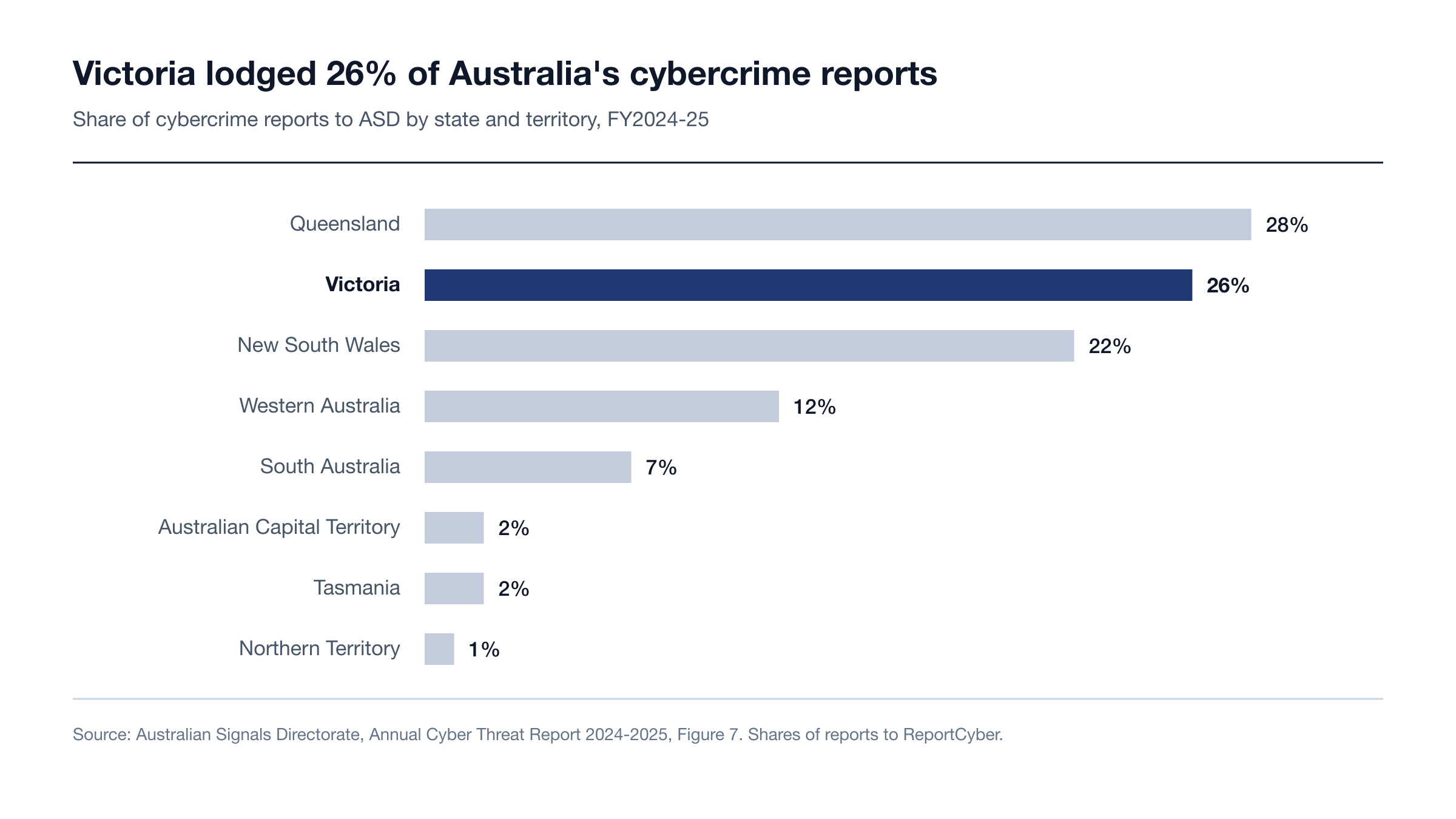
Figure 1: Share of cybercrime reports to ASD by state and territory, FY2024-25. Source: ASD, Annual Cyber Threat Report 2024-2025.
ASD notes that Queensland, Victoria and New South Wales "continue to report more cybercrime than any other state or territory, with disproportionately higher reporting rates relative to their populations." Across Australia it received more than 84,700 cybercrime reports in the year, about one every six minutes.
The Victorian Protective Data Security Standards (VPDSS)
The Victorian Protective Data Security Standards V2.0, issued by the Office of the Victorian Information Commissioner (OVIC) on 28 October 2019 under sections 86 and 87 of the Privacy and Data Protection Act 2014 (Vic), "establish 12 high level mandatory requirements to protect public sector information." They also "require contracted service providers with direct or indirect access to information to adhere to the standards." That second line is why a Melbourne software company, managed service provider or consultancy that touches Victorian Government data inherits the standards through its contract.
Three standards matter most for testing:
Standard 11, ICT Security: "An organisation establishes, implements and maintains Information Communications Technology (ICT) security controls." OVIC's implementation guidance V2.4 (January 2026) lists element E11.040: "The organisation undertakes risk-prioritised vulnerability management activities (e.g., patch management, penetration testing, continuous monitoring systems)."
Standard 8, Third Party Arrangements: element E8.030 asks the organisation to undertake "an information security risk assessment of the third party's service offering" before finalising an arrangement, and E8.060 asks it to monitor, review, validate and update third-party security requirements. A supplier's penetration test report is one of the most direct inputs to that assessment.
Standard 9, Information Security Reporting to OVIC: OVIC's reporting page states that agencies and bodies subject to Part 4 of the Act "must submit a PDSP to OVIC every two years, or sooner in the event of significant change," and must submit an Attestation each year.
The standards do not say "you must commission a penetration test every year." They name penetration testing as an example of the vulnerability management an organisation is expected to undertake, and they make suppliers part of the assessment. In practice, Victorian agencies and their suppliers time testing so that fresh results feed the Protective Data Security Plan (PDSP) and the annual Attestation.
The ASD Essential Eight
The Essential Eight maturity model defines "four maturity levels (Maturity Level Zero through to Maturity Level Three)" across eight mitigation strategies: patching applications, patching operating systems, multi-factor authentication, restricting administrative privileges, application control, restricting Microsoft Office macros, user application hardening and regular backups. ASD advises organisations to "achieve the same maturity level across all eight mitigation strategies before moving onto higher maturity levels," and states the model is based partly on its own experience "conducting penetration testing."
An Essential Eight assessment checks whether those controls are configured. A penetration test checks whether an attacker can get past them anyway, for example by reaching an administrator account despite multi-factor authentication. ASD also notes there is no requirement to have an implementation certified, "However, Essential Eight implementations may need to be assessed by an independent party if required by a government directive or policy, by a regulatory authority, or as part of contractual arrangements." Melbourne suppliers to government and large enterprises meet that contractual case often.
APRA CPS 234 for Collins Street
Banks, insurers and superannuation trustees regulated by APRA are bound by Prudential Standard CPS 234 Information Security, in force since 1 July 2019. Paragraph 27 says an APRA-regulated entity "must test the effectiveness of its information security controls through a systematic testing program," with the nature and frequency commensurate with factors that start with "the rate at which the vulnerabilities and threats change." Paragraph 30 requires testing "by appropriately skilled and functionally independent specialists," and paragraph 31 requires the entity to review the sufficiency of the testing program at least annually.
Paragraph 28 reaches Melbourne's vendors: where an entity relies on a third party's control testing, it "must assess whether the nature and frequency of testing" is commensurate with paragraph 27. A fintech or SaaS company selling into a bank or super fund will be asked for its own penetration test results for that reason. Our CPS 234 penetration testing requirements guide covers the standard and CPG 234 in depth.
The Privacy Act and Notifiable Data Breaches
Every organisation covered by the Privacy Act 1988 must meet Australian Privacy Principle 11.1, which says an APP entity "must take such steps as are reasonable in the circumstances to protect the information: from misuse, interference and loss; and from unauthorised access, modification or disclosure" (OAIC, the Australian Privacy Principles). Under the Notifiable Data Breaches scheme, the same organisations "must notify affected individuals and the OAIC when a data breach is likely to result in serious harm."
The OAIC received 667 notifications between January and June 2026, against 662 in the previous six months, and malicious or criminal attacks "remain the leading cause." Breaches affecting between 500,000 and 1,000,000 individuals rose from zero to three. The Act does not name penetration testing, but a recent independent test with fixed and retested findings is one of the clearest records that "reasonable steps" were taken.
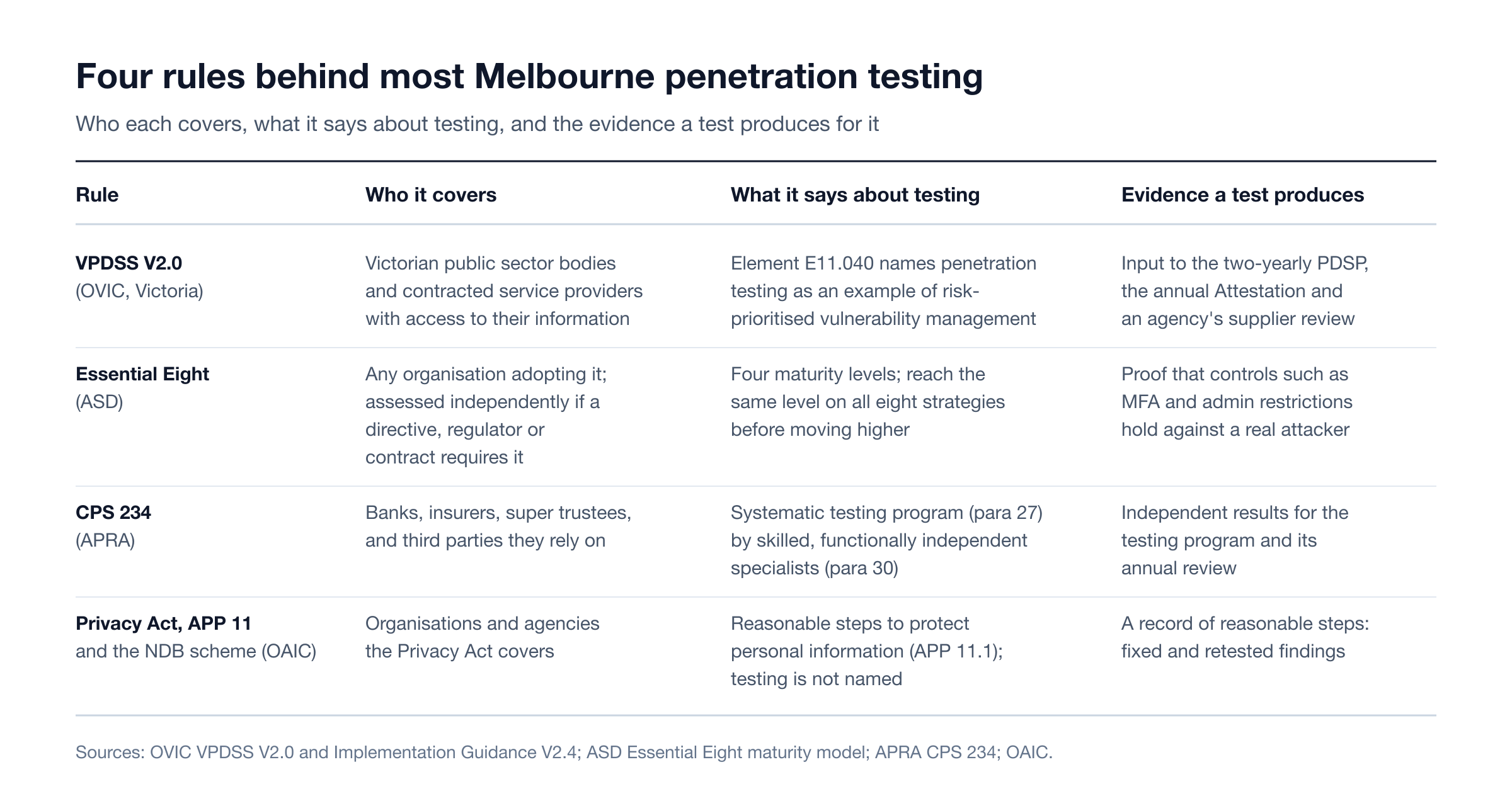
Figure 2: The four rules behind most Melbourne penetration testing and what each says about testing; the evidence column is Stingrai's guidance, not the rule's text. Sources: OVIC, ASD, APRA, OAIC.
How this ranking was built
Stingrai publishes this guide and lists itself first, so weigh that position against the evidence linked in each entry. The order is Stingrai's editorial judgement of fit for a mid-market or enterprise buyer in Melbourne. It is not a numeric score, and the positions after Stingrai are close on the published evidence.
Gates (pass or fail), checked in November 2026 on each firm's own website. Every ranked firm other than Stingrai passed all three; Stingrai passed the second and third and is included as the publisher, serving Melbourne remotely.
A real Melbourne presence: a Melbourne or inner-Melbourne office address, or a stated Melbourne head office, on the firm's own site.
Penetration testing as a named service: a page on the firm's own site that sells penetration testing delivered by its own consultants, not only scanning, managed detection or IT services.
Current, independent operation: the firm trades under its own name and sells testing to outside clients today.
Weighed criteria (no scores):
firm-level CREST accreditation, read from the firm's entry on the CREST Marketplace in November 2026;
breadth of testing on the firm's own pages (applications and APIs, networks, cloud, mobile, red teaming);
published research or CVEs that show testers who find new flaws, not only known ones;
what the firm says about delivery: live findings, debriefs, retests and reports a regulator or customer can use;
fit for the four rules above.
Customer logos, review scores and headcount claims are left out because they cannot be verified and do not tell you who will test your systems.
At a glance: penetration testing companies in Melbourne
# | Company | Melbourne presence (own site) | CREST Marketplace (November 2026) | Testing on its own site | Best for |
|---|---|---|---|---|---|
1 | Stingrai | Serves Melbourne remotely from Toronto; London, UK office | Penetration Testing; AI-Enabled Penetration Testing; CREST AI Charter | Web and API, mobile, AI and LLM, cloud, network, Active Directory, social engineering, red teaming | Fixed-price web application testing and audit-ready evidence |
2 | Tanto Security | Level 4, 350 Collins Street | Penetration Testing | Applications, APIs, infrastructure, cloud and CI/CD, adversary simulation, AI, IoT and hardware | Source-code-assisted testing by researchers |
3 | Trusted Impact | Main office, Level 4, 90 William Street | Penetration Testing | Web application testing, cloud security reviews, red teaming; Essential Eight, VPDSF and PCI DSS assessments | Victorian public sector bodies and their suppliers |
4 | elttam | Melbourne VIC 3000 | No entry found | Advanced penetration testing: security auditing, adversary simulation, applied research | Complex or novel technology |
5 | Project Black | Level 23, 727 Collins Street | Penetration Testing | Web and API, internal and external network, wireless, mobile, social engineering | Small and mid-sized teams that want a live findings portal |
6 | Shea Security | 152 Elizabeth Street | Penetration Testing | Applications, networks and infrastructure; developer security training | Technology companies that want testing plus developer training |
Every cell can be checked on the firm's own site or its CREST Marketplace entry; the links are in each profile below. "No entry found" means a search of the CREST Marketplace in November 2026 returned no listing for that company.
1. Stingrai
Stingrai is a global CREST-accredited penetration testing services company founded in Toronto, Canada in 2021, trusted by companies from startups to enterprises to meet audit requirements for SOC 2, ISO 27001, CMMC, PCI DSS and HIPAA. OSCE³, OSWE, OSEP, CREST CRT certified penetration testers, who are also world-class security researchers and bug bounty hunters. Choose from fully human-led or hybrid (AI agents plus human penetration testers) engagements across web, API, mobile, AI and LLM, cloud, network, Active Directory and social engineering penetration tests and red team engagements.
Stingrai is headquartered in Toronto with a London, UK office. It has no Melbourne office: it serves Melbourne and other Australian clients remotely, and on-site where a scope needs someone in the building. Its CREST Marketplace entry lists two CREST accreditations, Penetration Testing and AI-Enabled Penetration Testing, and the company certification CREST AI Charter. Team members separately hold the individual CREST CRT certification.
Scope for Melbourne buyers
Application security: web applications and APIs tested across every user role, with authorisation, IDOR and business logic flaws in scope; mobile applications against OWASP MASVS and MASTG; AI and LLM systems.
Infrastructure: internal and external networks with segmentation testing, Active Directory attack paths and cloud environments on AWS, Azure and Entra ID, and Google Cloud.
People and adversary simulation: phishing campaigns, red teaming and purple teaming.
That spread lines up with the four rules above: Essential Eight controls such as restricted administrative privileges and multi-factor authentication are tested on the network and Active Directory side, and the application and API work produces the evidence a CPS 234 assessor or a VPDSS supplier review asks for.
Delivery and evidence
Every human-led engagement is staffed by two named penetration testers from a team holding OSCE³, OSWE, OSEP, CREST CRT and CISSP certifications, reviewed by the team lead and an engagement partner. The team has published 18 CVEs and includes a founding member of Uber's offensive security team and researchers in the bug bounty Halls of Fame of Apple, Google, the US Department of Defense and the US Federal Reserve.
Findings reach the PTaaS portal as they are confirmed, each with a working proof of concept and remediation guidance, so engineering starts fixing before the report. Clients chat with the assigned testers, push issues to Jira and Slack, and get retesting of fixed findings. Every human-led and hybrid report ships with an attestation letter. Stingrai runs both one-time (annual) penetration tests and continuous programs.
Where Snipe and the Hybrid Pentest fit
Snipe is Stingrai's autonomous AI agent for web applications and associated APIs. In the Hybrid Pentest, Snipe tests the full application while Stingrai's certified penetration testers test the same application manually alongside it and validate Snipe's findings, so coverage is wider and deeper than either alone. It is US$6,800 per assessment one-time (about A$10,200 at the Reserve Bank's 20 November 2026 rate), or US$1,275 per month (about A$1,910) on a 12-month continuous plan, for one web application and associated APIs. The continuous plan runs monthly Snipe testing, human-verified, plus a quarterly deep dive by Stingrai's penetration testers.
The case for continuous testing comes from the sources above, not from urgency for its own sake. ASD counted a 28% rise in publicly reported vulnerabilities (CVEs) in FY2024-25, and CPS 234 ties testing frequency to "the rate at which the vulnerabilities and threats change" and "the materiality and frequency of change to information assets." A Melbourne SaaS or fintech team that ships every week changes its application far faster than an annual test can follow. Monthly testing keeps the evidence current between audits, and the quarterly deep dive keeps people on the business logic that automation alone misses. Compare the plans on the pricing page or get a quote for anything larger than one application.
Why it suits: firm-level CREST accreditation for both Penetration Testing and AI-Enabled Penetration Testing, named testers, findings in a portal as they are confirmed, an attestation letter with every human-led and hybrid report, and published prices for web application testing. Limitation: no Melbourne office, and a small team, so on-site work and multi-application programs should be booked early. Best for: Melbourne SaaS, fintech and health technology teams that need audit-ready web application and API evidence, one-time or continuous, plus quoted network, cloud and red team scopes.
2. Tanto Security
Tanto Security lists a Melbourne office at Level 4, 350 Collins Street and a Sydney office at Level 1, 234 George Street. Its CREST Marketplace entry shows Penetration Testing accreditation and ISO 27001, with 10 to 49 employees.
Its services page covers applications, infrastructure, cloud environments and APIs, with "source-code-assisted and white-box testing" where possible, adversary simulation, AI systems including "chatbots, support bots and agentic systems," IoT devices and network equipment, and cloud configuration alongside CI/CD pipelines. Tanto publishes its research: its 2026 posts include two remote code execution chains in Telerik components, and its Who we are page says every consultant gets dedicated, non-billable research time.
Why it suits: white-box depth from a research team that publishes, for applications where reading the source finds what black-box testing cannot. Limitation: a research-led consultancy that, per its contact page, does not provide incident response itself, so pair it with an incident response provider. Best for: Melbourne software companies and enterprises with complex applications, CI/CD pipelines or connected hardware.
3. Trusted Impact
Trusted Impact lists its main office at Level 4, 90 William Street, Melbourne, with another office in Sydney, and says it has been helping organisations "since 2006". Its CREST Marketplace entry shows Penetration Testing accreditation, with 10 to 49 employees.
Its FAQ describes "advanced penetration testing across all technology types such as web application testing, conducting cloud security reviews, and red teaming exercises," alongside risk and maturity assessments against frameworks including "Essential 8, VPDSF, PCI-DSS, ISM", incident response planning and security awareness programs. Its services page also lists assessments of artificial intelligence and machine learning systems. It calls itself "a senior-led consultancy" whose consultants hold OSCP, CRTO, OSEP, CRT and PNPT certifications, says a focused penetration test typically spans 2 to 4 weeks from scoping to the final debrief, and offers post-remediation validation of fixed findings.
Why it suits: a Melbourne-headquartered, CREST-accredited firm that also assesses against the Victorian Protective Data Security Framework, so a penetration test and a framework review can come from one provider. Limitation: testing is one of several consulting lines next to governance, risk and awareness work, so confirm which testers will be named on your engagement. Best for: Victorian public sector bodies, their suppliers and mid-market organisations that want testing and framework assessments from one Melbourne consultancy.
4. elttam
elttam was founded in 2015 by Daniel Hodson and Matt Jones, who still lead it as directors, and lists its address as Melbourne, VIC 3000. It states that it delivers "a single core service: advanced penetration testing," built from three methods dialled up or down per engagement: security auditing ("pragmatic analysis of source code, binaries, and live systems"), adversary simulation including purple-team exercises, and applied research for systems "where existing playbooks fall short."
elttam's research is public. Its recent posts include a pre-authentication remote code execution chain in a widely used TACACS+ daemon and a universal deserialization gadget chain for Ruby. A CREST Marketplace search in November 2026 returned no entry for elttam, so buyers whose tender requires firm-level CREST accreditation should confirm the firm's current status directly.
Why it suits: some of the deepest technical research in the Melbourne market, applied to source code, binaries and novel systems. Limitation: no CREST Marketplace entry found, which matters for tenders that name CREST. Best for: technology companies, critical infrastructure operators and teams building safety-critical or novel systems that need depth over volume.
5. Project Black
Project Black lists a Melbourne office at Level 23, 727 Collins Street and a Sydney office at Level 17, 123 Pitt Street, and says its consultants are spread across Sydney, Melbourne and Brisbane. Its CREST Marketplace entry shows Penetration Testing accreditation and fewer than 10 employees.
Its penetration testing page covers web applications and APIs, internal and external networks, wireless, mobile apps and social engineering, and names ISO 27001, PCI DSS, APRA CPS 234 and the Essential Eight as the usual drivers. Clients get a testing portal "where vulnerabilities are published as they are discovered," a debrief call, an optional retest, a redacted report on request and a shareable penetration testing certificate. Project Black is a CVE Numbering Authority (CNA) on the CVE Program's partner list, covering vulnerabilities its own researchers discover, and says it publishes around 10 zero-day vulnerabilities a year and that its consultants hold CREST CRT, OSCP and OSCE.
The same page publishes a price guide: "Most of the penetration tests we perform fall within the range of $6,000-$10,000 (AUD) depending on scope," with its smallest projects starting from about A$3,600. It sizes web application work mainly by the number of dynamic pages and API endpoints, and infrastructure work by the number of active hosts.
Why it suits: CREST accreditation, live findings, a certificate you can hand to customers and a published price range, which it describes as "SME-friendly". Limitation: fewer than 10 employees on its CREST entry, so large multi-scope programs need early scheduling. Best for: small and mid-sized Melbourne businesses and SaaS teams answering customer due diligence questionnaires.
6. Shea Security
Shea Security describes itself as "a Melbourne based consulting company of recognised cyber security experts," founded in 2018 by Dr Pamela O'Shea, with an address at 152 Elizabeth Street. Its CREST Marketplace entry shows Penetration Testing accreditation and fewer than 10 employees.
The firm tests applications, networks and infrastructure "aligned to industry standards including PCI-DSS mandated testing requirements," and delivers results as "full technical reports, business summaries, or issue-tracker tickets" structured around root-cause analysis, followed by a debrief with management and technical teams and targeted retesting. It also runs developer security training, from capture-the-flag events and code review challenges to awareness programs.
Why it suits: a founder-led Melbourne boutique that pairs CREST-accredited testing with developer training, so fixes address root causes rather than single findings. Limitation: fewer than 10 employees on its CREST entry, so plan around a small team's calendar. Best for: Melbourne technology companies and PCI DSS scopes that want testing and secure development training from one firm.
Should a startup choose a Melbourne or Sydney penetration testing firm?
Location matters less than most buyers assume. Web application, API, cloud and external network testing are delivered remotely by almost every provider, including the Melbourne firms above, which list consultants across several cities. Location matters when the scope needs a tester on site (internal network, Wi-Fi or physical security work), when a government contract requires onshore delivery or cleared staff, or when you want in-person debriefs.
In Stingrai's view, a Melbourne or Sydney startup should choose on four things before postcode: whether the firm holds CREST accreditation for penetration testing, who the named testers are, what the report and retest include, and whether the price fits one application or a whole program. Stingrai's Hybrid Pentest is US$6,800 per assessment for one web application and associated APIs, delivered remotely to either city. The Australia-wide ranking covers Sydney-based providers.
How to choose a penetration testing company in Melbourne
The checklist below is Stingrai's guidance, not a requirement from OVIC, ASD or APRA. No standard fixes this list.
Check | What to ask | Why it matters in Melbourne |
|---|---|---|
Firm-level CREST accreditation | Search the registered company name on the CREST Marketplace and read the accreditation list | Separates an accredited company from a tester who holds an individual certification |
Named testers | Who will test, what certifications do they hold, and will they be on the debrief | CPS 234 paragraph 30 asks for "appropriately skilled and functionally independent specialists" |
Scope that matches your rule | Does the proposal map to VPDSS, the Essential Eight, CPS 234 or a customer questionnaire | One engagement can serve all four if it is scoped that way |
Live findings and a retest | Are findings released as they are confirmed, and is a retest included | Fixed and retested findings are the evidence a PDSP, auditor or bank procurement team wants |
Report you can share | Is there an attestation letter, certificate or redacted report | Customers and agencies ask for proof without the full technical detail |
Cadence | One-time test, or continuous testing for applications that ship weekly | CPS 234 ties frequency to how fast threats and assets change |
On-site needs | Does the scope need someone in the building | Internal network, Wi-Fi and physical work may need on-site testers |
Before you send a request for proposal, our guides on how to scope a penetration test and the pentest and red team RFP question bank will save a round of clarifying emails. Our explainer on CREST-accredited penetration testing companies shows how to read a Marketplace entry.
How much does a penetration test cost in Melbourne?
Stingrai publishes fixed prices for one web application and associated APIs, shown below in US dollars with Australian dollar equivalents at the Reserve Bank of Australia's rate of A$1 = US$0.6666 on 20 November 2026. For what Australian buyers actually pay by engagement type, drawn from AusTender government contract data, read our guide to penetration testing cost in Australia.
Stingrai package (one web application and associated APIs) | Price (USD) | About (AUD) |
|---|---|---|
Autonomous Pentest (Snipe only), one-time | US$3,000 per assessment | A$4,500 |
Autonomous Pentest, 12-month continuous plan | US$650 per month | A$975 per month |
Hybrid Pentest (Snipe and certified penetration testers), one-time | US$6,800 per assessment | A$10,200 |
Hybrid Pentest, 12-month continuous plan | US$1,275 per month | A$1,910 per month |
The Autonomous Pentest delivers a penetration test report; the Hybrid Pentest adds testing and validation by Stingrai's penetration testers and an attestation letter. Network, cloud, mobile, Active Directory, red team and multi-application scopes are quoted through Get a Quote.
What moves a Melbourne quote is scope, not postcode: the number of user roles and the depth of business logic in an application, host count and segmentation on a network, accounts and identity complexity in a cloud, whether testing is white box, and whether a retest and compliance-mapped reporting are included.
Frequently Asked Questions
Who are the best penetration testing companies in Melbourne in 2026?
The penetration testing companies for Melbourne buyers in 2026 are Stingrai, Tanto Security, Trusted Impact, elttam, Project Black and Shea Security. The five local firms list a Melbourne office or head office on their own websites, and four hold CREST Penetration Testing accreditation on the CREST Marketplace. Stingrai, which publishes this guide, is a CREST-accredited penetration testing company headquartered in Toronto that serves Melbourne clients remotely, with a Hybrid Pentest at US$6,800 (about A$10,200) for one web application and associated APIs.
Which Melbourne penetration testing companies are CREST accredited?
On the CREST Marketplace in November 2026, Tanto Security, Trusted Impact, Project Black and Shea Security each held Penetration Testing accreditation. Stingrai, which serves Melbourne remotely, holds Penetration Testing and AI-Enabled Penetration Testing accreditation and the CREST AI Charter. A search for elttam returned no entry. Check any provider yourself by searching its registered company name on the CREST Marketplace.
How much does a penetration test cost in Melbourne?
Stingrai publishes fixed prices for one web application and associated APIs: US$3,000 (about A$4,500) for an Autonomous Pentest and US$6,800 (about A$10,200) for a Hybrid Pentest per assessment, or US$650 and US$1,275 per month on 12-month continuous plans, converted at the Reserve Bank of Australia's 20 November 2026 rate. Larger and non-web scopes are quoted after scoping, and Stingrai's guide to penetration testing cost in Australia sets out typical Australian prices by engagement type from AusTender contract data.
Do Victorian Government suppliers need a penetration test?
The Victorian Protective Data Security Standards do not order an annual penetration test by name, but they apply to contracted service providers with access to public sector information, and OVIC's implementation guidance lists penetration testing as an example of the risk-prioritised vulnerability management expected under Standard 11. OVIC's guidance also expects agencies to assess a third party's service offering before finalising an arrangement (element E8.030), so suppliers are routinely asked for recent test results.
Do Melbourne banks and super funds need a penetration test under CPS 234?
In practice, yes. CPS 234 does not use the words "penetration test", but paragraph 27 requires APRA-regulated entities to test the effectiveness of their information security controls through a systematic testing program, paragraph 30 requires testing by appropriately skilled and functionally independent specialists, and paragraph 28 extends the expectation to third parties the entity relies on. An independent penetration test is the usual way Melbourne banks, insurers, super funds and the vendors that serve them meet it.
Do Melbourne suppliers need an Essential Eight assessment or a penetration test?
Often both, because they answer different questions. An Essential Eight assessment checks whether eight mitigation strategies, such as patching, multi-factor authentication and restricted administrative privileges, are implemented to a maturity level. A penetration test checks whether an attacker can get past those controls anyway. ASD says implementations may need independent assessment if required by a directive, a regulator or a contract, which is common in Melbourne supply contracts with government and large enterprises.
Does the Privacy Act require penetration testing?
Not by name. Australian Privacy Principle 11.1 requires an organisation to take reasonable steps to protect personal information from misuse, interference and loss and from unauthorised access, modification or disclosure, and the Notifiable Data Breaches scheme requires notice to individuals and the OAIC when a breach is likely to cause serious harm. A recent penetration test with fixed and retested findings is strong evidence that reasonable steps were taken.
Do I need a penetration testing company with a Melbourne office?
Only for some scopes. Web application, API, cloud and external network testing are delivered remotely by most providers. A local or on-site tester helps for internal network, Wi-Fi and physical security work, and for government contracts that require onshore delivery. Stingrai serves Melbourne clients remotely from Toronto and on-site where scoped.
How often should a Melbourne organisation run a penetration test?
At least once a year and after any significant change, and more often for applications that change weekly. CPS 234 ties testing frequency to the rate at which vulnerabilities and threats change and to the frequency of change to information assets, and requires a review of the testing program at least annually. Teams that release often use continuous testing to keep evidence current between annual tests.
Related reading
References
Australian Signals Directorate. Annual Cyber Threat Report 2024-2025. 14 October 2025. https://www.cyber.gov.au/publication/annual-cyber-threat-report-2024-2025. Cybercrime reports, self-reported losses and incidents for FY2024-25, including the breakdown by state and territory.
Office of the Victorian Information Commissioner. Victorian Protective Data Security Standards V2.0. Issued 28 October 2019. https://ovic.vic.gov.au/information-security/standards/. The 12 mandatory standards and their application to contracted service providers.
Office of the Victorian Information Commissioner. VPDSS 2.0 Implementation Guidance V2.4. January 2026. https://ovic.vic.gov.au/wp-content/uploads/2026/01/VPDSS-2.0-Implementation-Guidance-V2.4.pdf. Elements for each standard, including E8.030, E8.060 and E11.040.
Office of the Victorian Information Commissioner. Information Security Reporting. https://ovic.vic.gov.au/information-security/agency-reporting-obligations/. Protective Data Security Plan, Attestation and incident notification obligations.
Australian Signals Directorate. Essential Eight maturity model. Published 30 June 2017, last reviewed 27 November 2023. https://www.cyber.gov.au/publication/essential-eight-maturity-model. Maturity levels, implementation advice and requirements for each mitigation strategy.
Australian Prudential Regulation Authority. Prudential Standard CPS 234 Information Security. In force 1 July 2019. https://www.apra.gov.au/system/files/cps_234_july_2019_for_public_release.pdf. Paragraphs 27 to 31 on control testing and 35 to 36 on notification.
Office of the Australian Information Commissioner. Read the Australian Privacy Principles. https://www.oaic.gov.au/privacy/australian-privacy-principles/read-the-australian-privacy-principles. Text of APP 11 on security of personal information.
Office of the Australian Information Commissioner. About the Notifiable Data Breaches scheme. https://www.oaic.gov.au/privacy/notifiable-data-breaches/about-the-notifiable-data-breaches-scheme. When a breach must be notified.
Office of the Australian Information Commissioner. Large-scale data breaches on the rise, latest OAIC statistics reveal. https://www.oaic.gov.au/news/media-centre/large-scale-data-breaches-on-the-rise,-latest-oaic-statistics-reveal. Notifiable Data Breaches statistics for January to June 2026.
Reserve Bank of Australia. Exchange Rates. 20 November 2026. https://www.rba.gov.au/statistics/frequency/exchange-rates.html. Australian dollar to US dollar rate used for every conversion in this guide.
CREST. CREST Marketplace supplier entries for Stingrai Inc, Tanto Security, Trusted Impact, Project Black and Shea Security. Read November 2026. https://marketplace.crest.org/.
Provider pages for each ranked firm, as linked in its profile, read in November 2026.
Talk to Stingrai
If your Melbourne organisation needs a penetration test for a VPDSS supplier review, an Essential Eight program, CPS 234 or a customer's security questionnaire, Stingrai's certified penetration testers can scope it with you. Get a Quote or book a free discovery call.