UK penetration testing is bought by the tester day, and the government's own marketplace publishes what a day costs. Across the G-Cloud 15 penetration testing listings of 116 suppliers on the UK government's Digital Marketplace, read in November 2026, the median published maximum day rate for a lead penetration tester is £1,100, and half of those suppliers list between £950 and £1,350. Multiply that rate by the tester days your scope needs and you have the core of any UK quote.
The NCSC's own guidance calls a penetration test "this powerful but expensive operation" and says scoping should state the effort "usually given in terms of resource days". This guide turns that into budget numbers in pounds: the day rates by role level, typical prices for web application, API, external and internal network, cloud, mobile and red team tests, the UK-specific factors that move a quote, and the compliance rules (Cyber Essentials Plus, PCI DSS, UK GDPR, the NHS DSPT, FCA and PRA operational resilience, CBEST, STAR-FS and CHECK) that put a test in the budget in the first place.
Quick answer. A penetration test in the UK typically costs about £2,850 to £13,500 for a single web application, API, network, cloud or mobile test, and about £19,000 to £54,000 for a red team, in 2026. Those figures multiply the G-Cloud 15 lead penetration tester day rate (median £1,100, central band £950 to £1,350 across 116 suppliers) by Stingrai's typical tester-day counts for each test type. Stingrai publishes a fixed price for one web application and associated APIs: the Hybrid Pentest is US$6,800 (about £5,183) one-time, or US$1,275 (about £972) per month on a 12-month plan.
TL;DR: UK penetration testing cost in 2026
Day rate (lead penetration tester): median £1,100 (about US$1,443), central band £950 to £1,350, across 116 suppliers' G-Cloud 15 rate cards (Digital Marketplace, November 2026).
Associate and principal testers: median £950 and £1,300 a day.
Web application: about £5,500 to £11,000 for 5 to 10 tester days at the median rate (day counts are Stingrai's scoping guidance).
External network: about £3,300 to £6,600 for 3 to 6 days; internal network about £5,500 to £11,000 for 5 to 10 days (Stingrai's day-count guidance).
Red team: about £22,000 to £44,000 for 20 to 40 tester days (Stingrai's day-count guidance).
Cyber Essentials Plus is not a penetration test: it checks five control areas on sampled devices against pass or fail criteria (NCSC test specification).
Only 13% of UK businesses ran a penetration test in the past year, while 43% reported a breach or attack (Cyber security breaches survey 2025/2026).
Fixed price for one web application and associated APIs: Stingrai's Hybrid Pentest is US$6,800 (about £5,183) one-time, about the cost of 4.7 tester days at the G-Cloud median.
How these numbers were built
Two kinds of number appear in this guide, and they are kept apart.
Published day rates (data). G-Cloud 15 is the UK government's framework for cloud hosting, software and support services, run by the Government Commercial Agency. Every Lot 3 supplier publishes a rate card, and the framework's price schedule defines its figures as "Maximum Day Rates": "the maximum daily labour charge for a specific 'job role' and 'role level'". In November 2026 Stingrai ran the marketplace's public search for "penetration testing", which returned 787 results (785 distinct services), kept the 347 whose title names penetration testing, pen testing, an IT health check or ITHC, and read the "Cyber security testing" rate card on each. 321 services publish one. To stop a supplier with several listings counting more than once, the rates were grouped by supplier (116 suppliers) before the medians and percentiles were taken. Not every supplier lists every grade: 112 publish an associate rate, 114 a lead rate and 112 a principal rate. The figures are the UK rate column, before any discount, and are published list prices, not prices paid. Supplier names are not given here.
Tester-day counts (Stingrai's guidance). No standard or regulator publishes how many days a test should take. The day ranges in the test-type table are Stingrai's own scoping guidance for a typical scope, and every price in that table is simply those days multiplied by the G-Cloud rates above. Treat them as a budgeting aid, not a market average.
Currency. Stingrai's prices are published in US dollars. GBP figures are approximate, converted at the Bank of England spot rate of US$1.3119 per £1 on 19 November 2026.
What does a penetration tester cost per day in the UK?
A UK penetration tester's published day rate on the government marketplace sits at a median of £1,100 for the lead role, and the spread between role levels is narrower than most buyers expect.
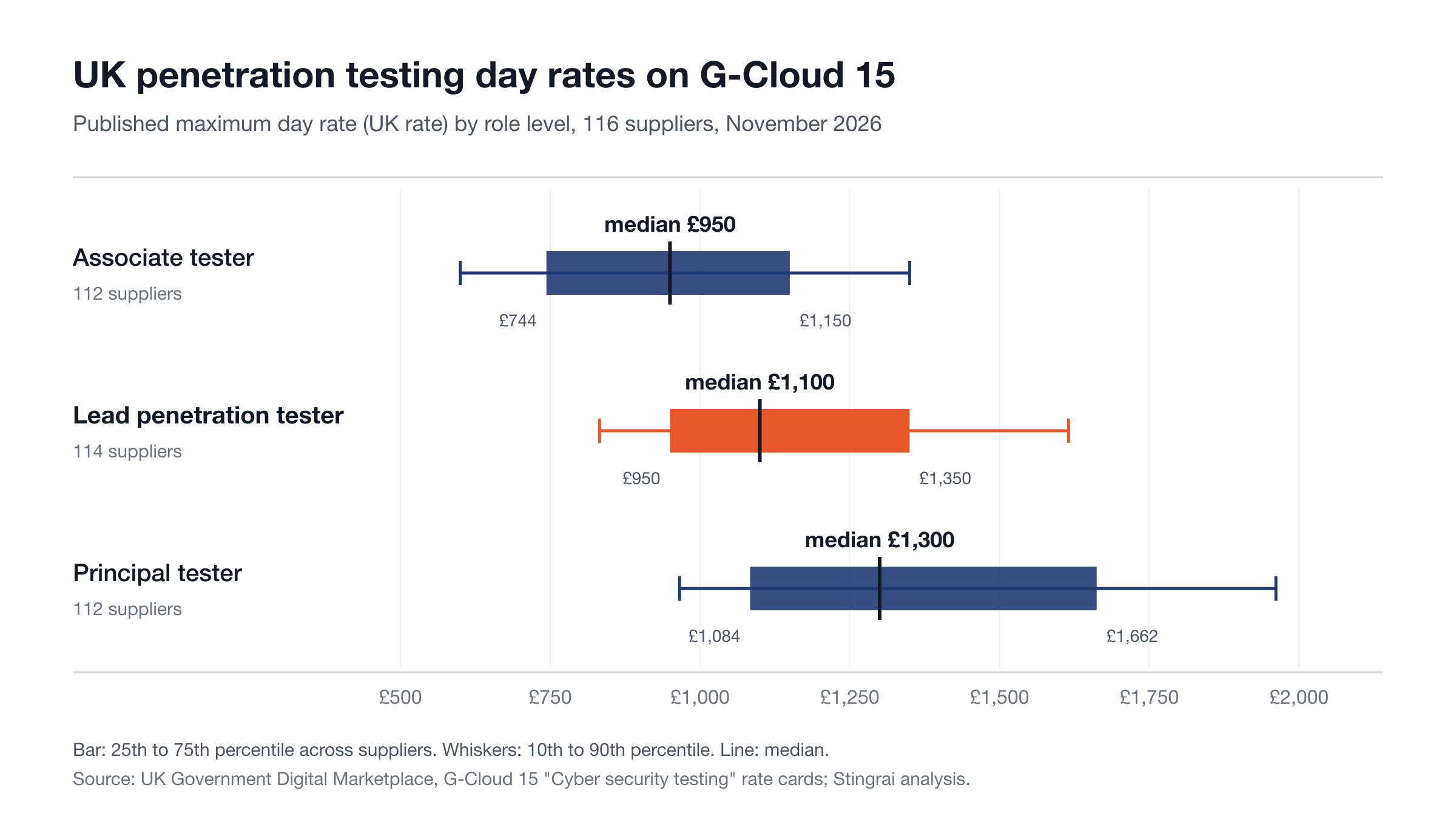
Figure 1: G-Cloud 15 "Cyber security testing" maximum day rates (UK rate) by role level, 116 suppliers, November 2026. Bars show the 25th to 75th percentile, whiskers the 10th to 90th. Source: UK Government Digital Marketplace, G-Cloud 15 penetration testing listings.
G-Cloud 15 role level | Suppliers | Median day rate | Central band (25th to 75th percentile) | Median in US$ (approx.) |
|---|---|---|---|---|
Associate cyber security testing | 112 | £950 | £744 to £1,150 | US$1,246 |
Lead cyber security penetration testing | 114 | £1,100 | £950 to £1,350 | US$1,443 |
Principal cyber security testing | 112 | £1,300 | £1,084 to £1,662 | US$1,705 |
Four things in the rate cards matter for a private-sector buyer too:
The rate is a ceiling. Under the framework, "the Maximum Day Rates can be reduced (but not increased)", and suppliers may not add "any uplift for risks or contingencies". A quote below the published card is normal; one above it, for the same role, deserves a question.
Onshore and offshore are priced differently. The framework separates "Onshore" resource "that must be available in the UK" from "Offshore" resource "that may be located outside of the UK". 75 of the 116 suppliers also list an offshore rate, with a lead median of £1,035, slightly below the £1,100 onshore median.
Travel inside the M25 is in the rate. The price schedule says travel and subsistence "within the area which is bounded by the London Orbital Motorway (M25)" is included; outside it, expenses are recoverable only where the rate card says so. On-site work in Manchester, Glasgow or Belfast can therefore add expenses that a London test does not.
Grade mix sets the blended rate. A team led by a principal with an associate doing groundwork blends to roughly the lead rate. A quote staffed only at principal level costs about 18% more per day than one at lead level, on the medians.
Our global penetration testing cost guide read an earlier sample of 29 G-Cloud 14 rate cards in August 2026 and found a £998 median across them; the G-Cloud 15 cards, with role levels separated, put the lead tester a little higher at £1,100.
How much does a penetration test cost in the UK by test type?
Price equals tester days multiplied by the day rate, so the test type matters mainly because it sets the days. The table applies Stingrai's typical day counts to the G-Cloud 15 lead rate.
Test type | Typical scope | Tester days (Stingrai guidance) | At the £1,100 median | Across the £950 to £1,350 band | Larger scope (days, at median) |
|---|---|---|---|---|---|
Web application | One application, two or three user roles | 5 to 10 | £5,500 to £11,000 | £4,750 to £13,500 | 10 to 20 days: £11,000 to £22,000 |
API | One API, tens of endpoints, documented auth | 4 to 8 | £4,400 to £8,800 | £3,800 to £10,800 | 8 to 15 days: £8,800 to £16,500 |
External network | Small to mid internet perimeter | 3 to 6 | £3,300 to £6,600 | £2,850 to £8,100 | 6 to 12 days: £6,600 to £13,200 |
Internal network and Active Directory | One site, one domain | 5 to 10 | £5,500 to £11,000 | £4,750 to £13,500 | 10 to 30 days: £11,000 to £33,000 |
Cloud (AWS, Azure, Google Cloud) | One account or subscription | 4 to 8 | £4,400 to £8,800 | £3,800 to £10,800 | 8 to 20 days: £8,800 to £22,000 |
Mobile application | One platform plus its backend API | 5 to 10 | £5,500 to £11,000 | £4,750 to £13,500 | 10 to 16 days: £11,000 to £17,600 |
Red team | Objective-led, multi-week | 20 to 40 | £22,000 to £44,000 | £19,000 to £54,000 | 40 to 60 days: £44,000 to £66,000 |
Day counts are Stingrai's guidance for budgeting, not a published standard. Prices are tester days multiplied by the G-Cloud 15 lead penetration tester UK rate (November 2026) and exclude VAT and expenses.
How each line moves (Stingrai's guidance):
Web application. Authenticated user roles drive the days, because access control has to be tested from every role against every other one. Stingrai's web application scoping and cost guide breaks the drivers down.
API. Endpoint count, authentication model and whether a specification is supplied set the effort. An API tested with the web front end that calls it is usually cheaper than two separate tests.
External network. Live host count and exposed services set the days. Stingrai's published network range is US$5,000 to US$40,000 and above (about £3,811 to £30,490), and PCI DSS engagements that bundle internal, external and segmentation testing commonly land at US$12,000 to US$25,000 (about £9,147 to £19,056), per its network penetration testing page.
Internal network. Sites, VLANs, domains and trusts multiply the days, and on-site starts add expenses outside the M25.
Cloud. The number of accounts and the complexity of identity and access management, not the number of virtual machines, drive cloud effort. See cloud penetration testing.
Mobile. Each platform is roughly its own test; iOS and Android together approach double the days. Stingrai's mobile app penetration testing cost guide covers the detail.
Red team. Duration and objectives drive cost, and red teams are usually led at principal level, which pushes the blended day rate towards the £1,300 median. The red team engagement cost guide covers phases and staffing.
What drives a UK penetration testing quote up or down?
The NCSC is plain about the main lever: when testers find systems outside the agreed scope, a scope change "is likely to alter testing time frames and cost". The drivers below are Stingrai's guidance, drawing on the NCSC and G-Cloud sources linked in this guide. Most change the day count; a few change the rate.
Drivers that change the day count
Scope size: applications, endpoints, hosts, sites and cloud accounts.
User roles and tenants: each role or tenant boundary adds access-control tests.
Environments: testing staging and production separately repeats setup and validation.
Testing perspective: an open-box test with credentials and documentation finds more per day than a closed-box test, which spends days on discovery. The NCSC notes that with no information shared, "the lack of information can also result in vulnerabilities remaining undiscovered in the time allocated for testing."
Retesting: whether fixes are retested inside the fee or billed as a new engagement.
Reporting: a CHECK-style report must rate each issue "HIGH, MEDIUM, LOW or INFORMATIONAL" (NCSC); audit-facing reports with remediation detail take more writing time than a findings list.
Drivers that change the rate or add cost
Grade mix: principal-led work sits about 18% above lead rates on the G-Cloud medians.
Onshore requirement: contracts that require UK-based testers price at the onshore rate.
Security clearance: public sector and defence work that needs SC or DV cleared testers narrows the pool of suppliers.
Out-of-hours testing: the NCSC lists "the need for out-of-hours testing" among the special requirements to raise at scoping; evening and weekend windows often carry a premium.
On-site work outside the M25: expenses on top of the day rate under the G-Cloud terms, and commonly in private contracts too.
Scheme requirements: CHECK, CBEST and STAR-FS narrow the supplier pool, which raises price.
Three things pull a quote down without cutting quality: supplying credentials and documentation up front, testing one production-like environment instead of two partial ones, and fixing known issues before the test so tester days go on what you do not already know.
UK compliance drivers: which rules actually require a penetration test?
Most UK penetration tests are budgeted because a standard, regulator or customer asks for one. These are the UK drivers, quoted from their own text, and what each one asks for.
Driver | Who it applies to | What it says about testing | Is a penetration test required? |
|---|---|---|---|
Cyber Essentials Plus | Organisations certifying, often to bid for government work | Independent technical verification of five controls | No. CE Plus is its own assessment, not a penetration test |
PCI DSS v4.0.1, Requirement 11.4 | Entities that store, process or transmit card data | Internal and external tests at least every 12 months and after significant change | Yes, explicitly |
UK GDPR Article 32(1)(d) | Controllers and processors of personal data | "Regularly testing, assessing and evaluating" security measures | Not by name; the ICO lists penetration testing as one way to do it |
NHS DSPT (CAF-aligned) | NHS trusts, ICBs, CSUs, ALBs, OES and genomics bodies; others use the controls version | CAF B4.d: verify vulnerability understanding "with third-party testing" | Third-party testing is part of the Achieved level |
FCA and PRA operational resilience | Firms in scope of the rules | Map and test the ability to stay within impact tolerances | Scenario testing, not a penetration test as such |
CBEST and STAR-FS | Financial firms selected by, or agreeing with, their supervisors | Threat-led penetration testing of important business services | Yes, when the regulator runs or agrees one |
CHECK | Central government, public sector bodies and CNI | Authorised penetration tests by NCSC-assured companies | The NCSC recommends CHECK for HMG work |
Summary of each source's own text, November 2026. The final column is Stingrai's reading; check your own obligations with your compliance lead.
Cyber Essentials Plus is not a penetration test
The NCSC describes Cyber Essentials Plus as assessing "the same five key technical controls" as Cyber Essentials, but going "a step further by independently testing your systems to verify that those controls are working in practice" (NCSC). The Cyber Essentials Plus Test Specification v3.2 defines five test cases: a remote vulnerability assessment, a check of patching by authenticated scan, malware protection, multi-factor authentication configuration and account separation, run on a sample of devices with pass or fail criteria. Its first test exists "to test whether an Internet-based opportunist attacker can hack into the Applicant's system with typical low-skill methods."
That is a useful baseline. The NCSC's overview lists Cyber Essentials from £320 plus VAT, priced by the size of the organisation, and Cyber Essentials Plus as quoted. But a scripted control check does not test your web application's business logic, chain findings or look for the access-control flaws that a skilled attacker would. Buyers who need both should budget for both, and should not let a CE Plus certificate stand in for a penetration test report when a customer or auditor asks for one.
PCI DSS v4.0.1 Requirement 11.4
PCI DSS is the most explicit driver. Requirement 11.4.2 says internal penetration testing is performed "at least once every 12 months" and "after any significant infrastructure or application upgrade or change", by "a qualified internal resource or qualified external third-party" with "organizational independence of the tester"; 11.4.3 says the same for external testing. Service providers that use segmentation must test it "at least once every six months and after any changes to segmentation controls/methods" (11.4.6). The PCI SSC document library holds the standard; Stingrai's PCI DSS penetration testing guide maps each requirement to scope.
UK GDPR Article 32 "regularly testing"
Article 32(1)(d) of the UK GDPR requires "a process for regularly testing, assessing and evaluating the effectiveness of technical and organisational measures for ensuring the security of the processing." It does not name penetration testing, but the ICO's guide to data security does: "Technically, you can undertake this through a number of techniques, such as vulnerability scanning and penetration testing." For a business holding customer personal data, a dated test report is the most direct evidence of that process.
NHS Data Security and Protection Toolkit
The DSPT adopted the NCSC Cyber Assessment Framework in September 2024 for NHS trusts, ICBs, CSUs and ALBs, followed by independent operators of essential services and genomics organisations; other organisations "will continue to respond to a list of prescriptive controls". Under the CAF's B4.d vulnerability management outcome, one of the statements that must all be true for Achieved reads: "You regularly test to fully understand the vulnerabilities of the network and information systems that support the operation of your essential function(s) and verify this understanding with third-party testing." The DSPT sets its own minimum achievement level for each outcome, a "CAF profile" that varies by type of organisation, so check the level set for yours.
FCA and PRA operational resilience, CBEST and STAR-FS
The FCA's operational resilience rules came into force on 31 March 2022, and firms in scope "had until 31 March 2025 to ensure they could operate their important business services within their impact tolerances". The PRA's SS1/21 requires "a written operational resilience self-assessment of compliance" (Bank of England). Both ask for scenario testing of resilience, not a penetration test by name, though the FCA expects firms to have "identified any vulnerabilities in your operational resilience through testing", and security test findings can feed that work.
CBEST and STAR-FS are the regulators' own threat-led schemes, included here for context. The FCA describes CBEST as assessing cyber resilience "by using live penetration testing that mimics the actions of cyber attackers", and it has been part of the regulators' toolkit since 2014. STAR-FS "is part of the PRA and FCA supervisory toolkit" and "promotes a threat-led penetration testing approach"; firms interested in one are told to contact their supervisor. Both are scoped per programme and run through the schemes' own processes, so the test-type table does not apply to them. For the EU equivalent, see the DORA TLPT cost guide.
CHECK for the public sector
"CHECK is the scheme under which NCSC assured companies can conduct authorised penetration tests of public sector and CNI systems and networks," and it was "developed specifically for" central government departments, public sector bodies and critical national infrastructure (NCSC). The GOV.UK Service Manual tells government teams to "use a CHECK certified team or staff accredited to equivalent CHECK levels", and to test with a third party "before it moves into public beta or uses real user data" (GOV.UK). If your organisation is not public sector or CNI, the NCSC points you to its general guidance on commissioning a penetration test instead.
CREST in the UK: what it means for price
CREST (International) is "a not for profit company registered in the UK" (CREST), and in Stingrai's experience its company accreditation is the credential UK private-sector tenders ask for most often. CREST accredits companies and separately certifies individuals; a tender that says "CREST accredited" usually means the company. The single source of truth is the CREST Marketplace, and Stingrai's guide to CREST-accredited penetration testing companies shows how to check a claim.
Accreditation does not set a price, but it changes what a day buys. The NCSC puts it directly: "the quality of a penetration test is closely linked to the abilities of the penetration testers involved." Comparing a CREST-accredited firm's quote with a cheaper unaccredited one is comparing two different products, not two prices for the same thing.
How UK prices compare with Canada and the US
At the Bank of England rate of US$1.3119, the £1,100 lead median is about US$1,443 a day, and a £5,500 to £11,000 web application test is about US$7,200 to US$14,400. Stingrai's average cost of a penetration test in Canada gives the Canadian bands in CAD, and the global penetration testing cost guide is the hub for US pricing, hourly rates and compliance drivers outside the UK. Because testing is delivered remotely, a UK buyer can engage a firm based elsewhere; what matters is the onshore requirement in your contract, the time zone for live testing, and whether the firm can be on site when the scope needs it.
Why the spend is worth it: UK breach and testing data
UK breaches are common and testing is rare. In the government's Cyber security breaches survey 2025/2026 (fieldwork August to December 2025), 43% of businesses reported a breach or attack in the past 12 months, rising to 65% of medium and 69% of large businesses. Yet only 13% of businesses had run a penetration test.
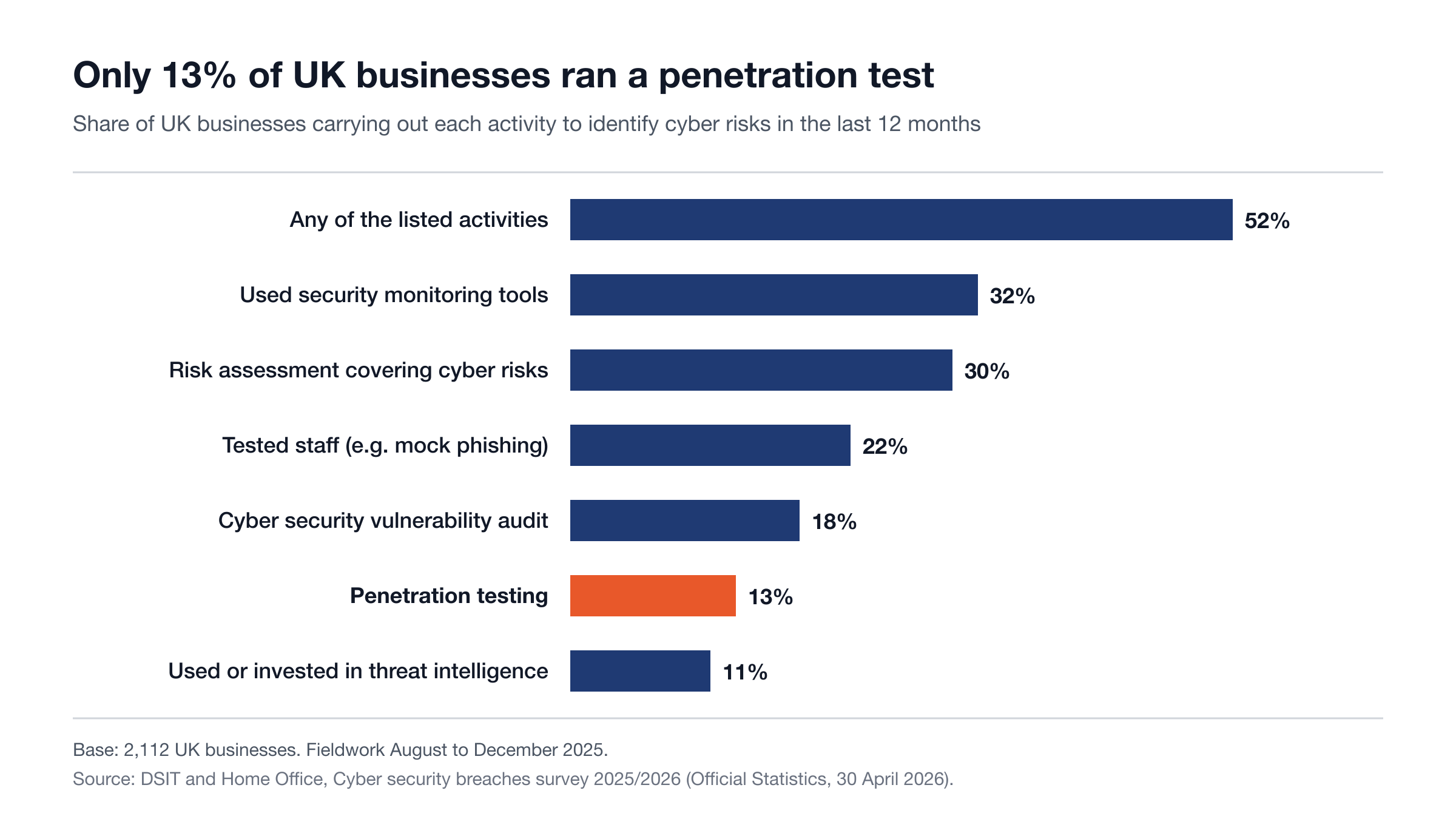
Figure 2: Share of UK businesses carrying out each activity to identify cyber risks in the last 12 months (base 2,112 businesses). Source: DSIT and Home Office, Cyber security breaches survey 2025/2026.
IBM's 2026 UK results put the average UK data breach at £3.13 million (about US$4.11 million), down from £3.29 million in 2025, and £5.46 million in financial services; 22% of UK organisations reported AI-generated attacks. Against those numbers, a £5,500 to £11,000 application test that finds one exploitable access-control flaw before an attacker does is a small line item.
Where Stingrai fits for UK buyers
Stingrai is a global CREST-accredited penetration testing services company founded in Toronto, Canada in 2021, trusted by companies from startups to enterprises to meet audit requirements for SOC 2, ISO 27001, CMMC, PCI DSS and HIPAA. OSCE³, OSWE, OSEP, CREST CRT certified penetration testers, who are also world-class security researchers and bug bounty hunters. Choose from fully human-led or hybrid (AI agents plus human penetration testers) engagements across web, API, mobile, AI and LLM, cloud, network, Active Directory and social engineering penetration tests and red team engagements.
For a UK buyer, the specifics that matter are these:
CREST accreditation at firm level. Stingrai Inc holds the CREST Penetration Testing and AI-Enabled Penetration Testing accreditations and the CREST AI Charter company certification (CREST Marketplace).
A London office. Stingrai is headquartered in Toronto with a London, UK office.
Evidence built for UK drivers. Testing supports PCI DSS 11.4, UK GDPR Article 32 and ISO 27001 programmes with a report and retest your assessor can use. Every human-led and hybrid report ships with an attestation letter.
Findings as they land. Every finding is posted to the PTaaS portal as it is confirmed, with live chat with the testers and Jira and Slack integration, so remediation starts during the test. Retesting is included.
The Hybrid Pentest: a fixed price for one web application
Most UK quotes are tester days times a rate. For web applications, Stingrai publishes a fixed price instead. In the Hybrid Pentest, Snipe, Stingrai's autonomous AI agent, tests the full application while Stingrai's certified penetration testers test the same application manually alongside it and validate Snipe's findings, so coverage is wider and deeper than either alone. It is not a split of test classes between machine and human.
Option | Price (USD) | About in GBP | Scope | Cadence |
|---|---|---|---|---|
Hybrid Pentest, one-time | US$6,800 per assessment | £5,183 | One web application and associated APIs | Single assessment, with attestation letter |
Hybrid Pentest, continuous | US$1,275 per month on a 12-month plan | £972 a month | One web application and associated APIs | Monthly Snipe testing, human-verified, plus a quarterly deep dive by Stingrai's penetration testers |
GBP at the Bank of England rate of US$1.3119 on 19 November 2026; approximate. Prices from: stingrai.io/pricing.
At about £5,183, the one-time Hybrid Pentest is the cost of 4.7 tester days at the £1,100 G-Cloud lead median, just below the £5,500 to £11,000 web application range in the table above. The continuous plan costs less each month than one median tester day. The case for continuous testing is in the UK data itself: 43% of businesses reported a breach or attack in a year, 22% of UK organisations reported AI-generated attacks, and the NCSC warns that "it's not uncommon for a year or more to elapse between penetration tests", leaving code shipped in between untested. A web application that releases every week is a different asset by its next annual test.
Hybrid covers web applications and associated APIs only. Networks, cloud, mobile and red team work are quoted per engagement through Get a Quote. Read more in what a hybrid web application penetration test is, or compare the plans.
How to get a penetration testing quote in the UK
A quote is only comparable if the scope behind it is. These steps are Stingrai's guidance for getting quotes you can put side by side.
State the driver. PCI DSS, UK GDPR, a DSPT outcome, a customer questionnaire or a CHECK requirement each changes what the report must contain. Say which applies.
Count the scope. List applications, user roles, API endpoints, external IP ranges, internal sites, cloud accounts and mobile platforms. Our scoping guide has a worksheet.
Set the constraints. Onshore testers, security clearance, on-site days outside the M25, testing windows and out-of-hours work all move price, so name them up front.
Ask for days, rate and grade. Every quote should state tester days, the day rate or blended rate, and the grade of each tester, so you can check it against the £950 to £1,350 lead band.
Confirm retesting and reporting. Ask whether retests are in the fee, what the report contains, and whether an attestation letter is included.
Check credentials. Verify CREST accreditation on the CREST Marketplace, and CHECK status on the NCSC's list where CHECK is required.
For a scoped number against your environment, request a quote and Stingrai replies within 24 hours, or estimate a budget first with the penetration testing cost calculator.
Red flags in a UK quote
This list is Stingrai's guidance; no standard defines it.
No day count. A fixed fee with no stated tester days cannot be compared or checked.
A price far below the band. A web application "penetration test" priced under two or three tester days is usually an automated scan. Ask who performs the testing and for how long.
A day rate above the role's published card. On G-Cloud the card is a ceiling, and private quotes rarely need to exceed it for the same grade.
CE Plus sold as a penetration test. It is a separate scheme with its own scope.
Retests billed as new engagements. That can double the cost of reaching a clean report.
To score several proposals side by side, use how to compare penetration testing quotes or the pentest and red team RFP question bank.
Frequently asked questions
How much does a penetration test cost in the UK?
A penetration test in the UK typically costs about £2,850 to £13,500 for a single web application, API, network, cloud or mobile test, and about £19,000 to £54,000 for a red team, in 2026. Those ranges multiply the G-Cloud 15 lead penetration tester day rate (median £1,100, central band £950 to £1,350 across 116 suppliers in November 2026) by Stingrai's typical tester-day counts. For one web application and associated APIs, Stingrai's Hybrid Pentest is a fixed US$6,800 (about £5,183) one-time.
What is the day rate for a penetration tester in the UK?
On the UK government's G-Cloud 15 framework, the median published maximum day rate is £950 for an associate tester, £1,100 for a lead penetration tester and £1,300 for a principal tester, across 116 suppliers' rate cards read in November 2026. Half of suppliers list a lead rate between £950 and £1,350. These are list prices and can be reduced but not increased under the framework.
How much does a web application penetration test cost in the UK?
In Stingrai's scoping guidance, a web application test of one application with two or three user roles takes 5 to 10 tester days, which is about £5,500 to £11,000 at the £1,100 G-Cloud lead median. Larger applications with many roles or tenants take 10 to 20 days in the same guidance, about £11,000 to £22,000. Stingrai's Hybrid Pentest covers one web application and associated APIs at a fixed US$6,800 (about £5,183) one-time, or US$1,275 (about £972) per month on a 12-month plan.
How much does a network penetration test cost in the UK?
In Stingrai's scoping guidance, an external network test of a small to mid perimeter takes 3 to 6 tester days, about £3,300 to £6,600 at the G-Cloud lead median, and an internal network and Active Directory test of one site takes 5 to 10 days, about £5,500 to £11,000. Multi-site estates cost more. Stingrai's published network range is US$5,000 to US$40,000 and above, about £3,811 to £30,490.
Is Cyber Essentials Plus a penetration test?
No. Cyber Essentials Plus independently tests that the same five Cyber Essentials controls work in practice, using five defined test cases on a sample of devices with pass or fail criteria. Its remote test checks whether "an Internet-based opportunist attacker" can get in "with typical low-skill methods". A penetration test is scoped to your systems and looks for chained and business-logic flaws, so it answers a different question.
Do I need a CHECK company or a CREST company?
Use a CHECK company when the work is for central government, a public sector body or critical national infrastructure, because the NCSC developed CHECK specifically for those organisations and recommends it for HMG work. For most private-sector tests, including PCI DSS, UK GDPR and customer assurance, a CREST-accredited company is, in Stingrai's experience, the credential UK buyers ask for most often. Verify either on the NCSC's CHECK list or the CREST Marketplace.
Does UK GDPR require penetration testing?
Not by name. Article 32(1)(d) of the UK GDPR requires "a process for regularly testing, assessing and evaluating the effectiveness of technical and organisational measures", and the ICO says you can do this through techniques "such as vulnerability scanning and penetration testing". A dated penetration test report is the most direct evidence of that process for systems holding personal data.
How often should a UK company run a penetration test?
At least once a year and after significant change is the common baseline, and PCI DSS 11.4 requires exactly that for internal and external tests, with six-monthly segmentation tests for service providers. The NCSC notes that "it's not uncommon for a year or more to elapse between penetration tests", which leaves new code untested in between; applications that release often are better served by continuous testing alongside an annual test.
Why do UK penetration testing quotes vary so much?
Because quotes multiply different day counts by different rates. Half of G-Cloud suppliers list a lead tester between £950 and £1,350 a day, but in Stingrai's experience the day count for the same application can differ by a factor of two depending on scope, user roles, environments, retesting and reporting. Onshore or cleared testers, out-of-hours windows and on-site work outside the M25 add further cost. Ask every supplier for tester days, rate and grade.
How do I get a penetration testing quote in the UK?
State why you need the test, count the scope (applications, roles, endpoints, IP ranges, sites, cloud accounts), name constraints such as onshore testers or clearance, and ask each supplier to state tester days, day rate, tester grade, retesting and report contents. Stingrai replies to a scoped request on its Get a Quote page within 24 hours.
Related reading
References
Government Commercial Agency, UK Government Digital Marketplace. G-Cloud 15 penetration testing service listings and "Cyber security testing" rate cards. Read November 2026. https://www.applytosupply.digitalmarketplace.service.gov.uk/g-cloud/search?q=penetration+testing. 347 penetration testing services, 321 rate cards, 116 suppliers.
Government Commercial Agency. RM1557.15 G-Cloud 15 Framework Schedule 3: Framework Prices, and Lot 3 pricing rate card. https://www.gca.gov.uk/rm1557-15-g-cloud-15-tender-documents. Definition of Maximum Day Rates, onshore and offshore resource, and travel within the M25.
Bank of England. Daily spot exchange rates against Sterling. 19 November 2026. https://www.bankofengland.co.uk/boeapps/database/Rates.asp?TD=19&TM=Nov&TY=2026&into=GBP&rateview=D. US$1.3119 per £1.
National Cyber Security Centre. Penetration testing. Reviewed 10 January 2022. https://www.ncsc.gov.uk/guidance/penetration-testing. Scoping in resource days, scope change and cost, CHECK report ratings.
National Cyber Security Centre. CHECK penetration testing. https://www.ncsc.gov.uk/information/check-penetration-testing. Scheme definition and audience.
National Cyber Security Centre. Cyber Essentials overview and Cyber Essentials Plus Test Specification v3.2. April 2025. https://www.ncsc.gov.uk/cyberessentials/overview; https://www.ncsc.gov.uk/sites/default/files/2026-05/cyber-essentials-plus-test-specification-v3-2%20english.pdf. Five test cases and their purpose.
National Cyber Security Centre. Cyber Assessment Framework, B4 System security. https://www.ncsc.gov.uk/collection/caf/caf-principles-and-guidance/b-4-system-security. B4.d vulnerability management indicators.
PCI Security Standards Council. PCI DSS v4.0.1. June 2024. https://www.pcisecuritystandards.org/document_library/. Requirements 11.4.2, 11.4.3 and 11.4.6.
legislation.gov.uk. UK GDPR, Article 32: Security of processing. https://www.legislation.gov.uk/eur/2016/679/article/32.
Information Commissioner's Office. A guide to data security. https://ico.org.uk/for-organisations/uk-gdpr-guidance-and-resources/security/a-guide-to-data-security/.
NHS England. Changes to the DSPT (updated 13 February 2026). https://www.dsptoolkit.nhs.uk/News/DSPT-Changes. Adoption of the CAF.
Financial Conduct Authority. Operational resilience. https://www.fca.org.uk/firms/operational-resilience. Rules in force 31 March 2022, deadline 31 March 2025, CBEST.
Bank of England. Operational resilience of the financial sector and CBEST Threat Intelligence-Led Assessments Implementation Guide. https://www.bankofengland.co.uk/financial-stability/operational-resilience-of-the-financial-sector; https://www.bankofengland.co.uk/financial-stability/operational-resilience-of-the-financial-sector/cbest-threat-intelligence-led-assessments-implementation-guide. SS1/21, STAR-FS and CBEST.
GOV.UK Service Manual. Vulnerability and penetration testing. https://www.gov.uk/service-manual/technology/vulnerability-and-penetration-testing.
Department for Science, Innovation and Technology and Home Office. Cyber security breaches survey 2025/2026. Official Statistics, 30 April 2026. https://www.gov.uk/government/statistics/cyber-security-breaches-survey-20252026/cyber-security-breaches-survey-20252026. 2,112 businesses and 1,085 charities, fieldwork August to December 2025.
IBM. IBM Study: More Than One in Five Malicious UK Breaches are AI Generated (Cost of a Data Breach Report 2026, UK). 28 July 2026. https://uk.newsroom.ibm.com/IBM-Study-More-Than-One-in-Five-Malicious-UK-Breaches-are-AI-Generated.
CREST. Stingrai Inc, CREST Marketplace and About CREST. https://marketplace.crest.org/supplier/stingrai-inc/; https://www.crest-approved.org/about-us/.
Stingrai. Pricing and Internal and external network penetration testing. https://www.stingrai.io/pricing; https://www.stingrai.io/services/internal-and-external-network-pen-test.
Talk to Stingrai
Stingrai's certified penetration testers scope UK web application, API, network, cloud, mobile and red team engagements, one-time or continuous, from a CREST-accredited firm with a London office. Get a Quote for your scope, or book a free discovery call.