Ethical hacking services are attacks on your own systems that you authorize in writing, carried out by certified penetration testers who then show you how they got in and how to fix it. NIST's glossary defines the core activity, penetration testing, as "security testing in which evaluators mimic real-world attacks in an attempt to identify ways to circumvent the security features of an application, system, or network"; the written authorization is what keeps that activity on the right side of the US Computer Fraud and Abuse Act and section 342.1 of Canada's Criminal Code.
"Ethical hacking" is how many buyers, boards and AI assistants describe the purchase, but no firm sells a product by that name. What you sign is a statement of work for a penetration test of a web application, an API, a network, a cloud estate or a mobile app, a red team engagement, or a social engineering test. The term also sits next to a search results page crowded with "hire a hacker" offers, which is a reason to know exactly what a legitimate engagement looks like before you buy one.
Quick answer. Ethical hacking services are authorized penetration tests, red team engagements and social engineering tests run by certified penetration testers under a signed scope and rules of engagement, ending in a report and a retest of fixes. Buy by asset (web application, API, external and internal network, cloud, mobile) or by objective (red team), and vet the firm on written authorization, firm-level accreditation such as CREST, named testers, insurance and a sample report. Stingrai, a CREST-accredited penetration testing company in Toronto, prices its Hybrid Pentest for one web application and associated APIs at US$6,800 per assessment or US$1,275 per month on a 12-month plan; a network penetration test typically costs US$5,000 to US$40,000 and above, and other scopes are quoted within 24 hours.
This guide is for the security lead, IT director or procurement owner who has been asked to "get an ethical hacker in". It translates the request into the engagement you actually need, shows what makes it lawful, and lists the paperwork and price points. For a definition-first explainer, read what penetration testing is; for scoring shortlisted vendors, use the pentesting vendor selection guide.
TL;DR
What you buy: a penetration test of a named asset, a red team engagement against an objective, or a social engineering test. "Ethical hacking" is the lay word for all three.
What makes it legal: written authorization from whoever owns the systems. The US Computer Fraud and Abuse Act covers access "without authorization or exceeds authorized access" (18 U.S.C. 1030); Canada's Criminal Code covers unauthorized use of a computer "fraudulently and without colour of right" (s. 342.1).
The paperwork: NIST says rules of engagement are "established before the start of a security test" and give the testers "authority to conduct defined activities" (NIST SP 800-115). The UK NCSC lists what the scoping document and the report should contain (NCSC).
How to spot a fake: Google's advertising policy bans ads for "hacking services" that "enable a user to gain unauthorized access" (Google Ads policy). A real firm asks for proof that you own the target; a hire-a-hacker site does not.
Cost from Stingrai's own pages: Hybrid Pentest is US$6,800 per assessment or US$1,275 per month on a 12-month plan for one web application and associated APIs (pricing); a network penetration test typically costs US$5,000 to US$40,000 and above (network testing).
Why cadence matters in 2026: CISA added 306 vulnerabilities to its Known Exploited Vulnerabilities catalog between 1 January and 20 November 2026, against 223 in the same window of 2025 (CISA KEV).
What are ethical hacking services?
Ethical hacking services are offensive security engagements in which a provider attacks systems you own, with your written permission, to find and prove weaknesses before a criminal does. The UK's National Cyber Security Centre gives the most useful buyer's definition of the core engagement: penetration testing is "a method for gaining assurance in the security of an IT system by attempting to breach some or all of that system's security, using the same tools and techniques as an adversary might" (NCSC penetration testing guidance).
Three things make the work "ethical" in the sense a buyer cares about:
Authorization. The system owner has agreed in writing to the test, its scope and its methods. Without it, the same keystrokes are an offence (see the legal section below).
Scope and restraint. The testers stay inside agreed boundaries, avoid harm to production and data, and stop to ask when they find something outside scope.
Disclosure to the owner. Every finding goes to you, with evidence and a fix, and nowhere else.
The phrase is used loosely: in a board paper it can mean an annual penetration test, and in a customer questionnaire any third-party testing. The next sections translate it into the engagements providers actually quote.
Ethical hacking vs penetration testing vs red teaming vs vulnerability assessment
Ethical hacking is the umbrella term; penetration testing, red teaming and social engineering testing are the engagements underneath it, and a vulnerability assessment is the automated layer that sits beside them. Bug bounty programs are a different buying model for some of the same skills. The table below sets them side by side; the definitions follow NIST and the NCSC, and the comparison of practical differences is Stingrai's guidance.
Engagement | Question it answers | How it runs | What you get | When to buy it |
|---|---|---|---|---|
Ethical hacking (umbrella term) | "Can someone we trust attack us legally and tell us what they found?" | Any of the engagements below, under a signed scope and rules of engagement | Depends on the engagement | When a customer, auditor, board or insurer asks for "ethical hacking" or "independent testing" |
Penetration test | What can an attacker exploit inside a defined scope of assets? | Announced to your team, scoped to named assets (application, API, network ranges, cloud accounts), usually a few days to a few weeks of testing | Findings with reproduction evidence, risk ratings, fixes and a retest | Annual compliance evidence, before a major release, after a significant change |
Red team engagement | Would anyone notice an adversary reaching what matters most? | Scoped around an objective, covert, weeks long | An attack narrative with detection and response timings | When you already test regularly and want to measure detection and response |
Vulnerability assessment | Which known weaknesses exist across this estate? | Largely automated scanning with analyst triage | A prioritized list of known issues | Continuously, between penetration tests |
Social engineering test | Will our people click, call back or open the door? | Phishing, vishing or physical entry against agreed targets | Rates, narratives and training points | Alongside a red team or as an awareness measure |
Bug bounty program | What can a crowd of independent researchers find over time? | Open-ended, paid per valid finding under a published policy | A stream of individual reports | As a complement to scoped testing, not a substitute for it |
The NCSC adds a point buyers often miss: penetration testing "should be viewed as a method for gaining assurance in your organisation's vulnerability assessment and management processes, not as a primary method for identifying vulnerabilities" (NCSC). In practice that means a scanner runs all year, and the ethical hacking engagement proves what the scanner missed: chained findings, broken authorization and business logic. For red teaming against penetration testing in depth, read red team testing vs penetration testing vs continuous validation. For a detailed comparison of the scanning and testing halves, read vulnerability assessment vs penetration testing, and for the crowd model, penetration testing vs bug bounty.
Types of ethical hacking services, and the engagement you actually buy
Every ethical hacking request maps to one or more of the engagement types below. The testing-day ranges and price bases come from Stingrai's own service pages as of 21 November 2026; the "request in plain words" column is Stingrai's guidance on how buyers phrase the need.
Request in plain words | Engagement to buy | Typical testing time (Stingrai service page) | How it is priced |
|---|---|---|---|
"Hack our web app before our customers' auditors ask" | Hybrid or human-led: 2 to 20 testing days; Autonomous: same day | Fixed package for one web application and associated APIs; larger scopes quoted | |
"Check our APIs and mobile backend" | 3 to 9 testing days | Package or quote, by endpoints, roles and tenants | |
"See if anyone can get in from the internet" | 1 to 5 testing days | Quoted; network tests typically US$5,000 to US$40,000 and above | |
"What happens if a laptop is compromised?" | Internal network and Active Directory test | Internal: 1 to 10 testing days; single-forest AD: one to two weeks | Quoted to scope |
"Test our AWS, Azure or Google Cloud setup" | Configuration review: 3 to 5 testing days | Quoted to scope, by accounts, clusters and IAM complexity | |
"Our app store app needs testing" | One platform: 3 to 5 days; iOS and Android: 5 to 10 | Quoted to scope | |
"We added an AI assistant or agent" | Quoted to scope | Quoted, by features, agents, tools and data sources | |
"Attack us like a real adversary would" | Single assumed-breach scenario: two to three weeks elapsed; full scope: four to eight weeks | Quoted on operator days | |
"Would our staff fall for it?" | Quoted to scope | Quoted, by campaign and target count |
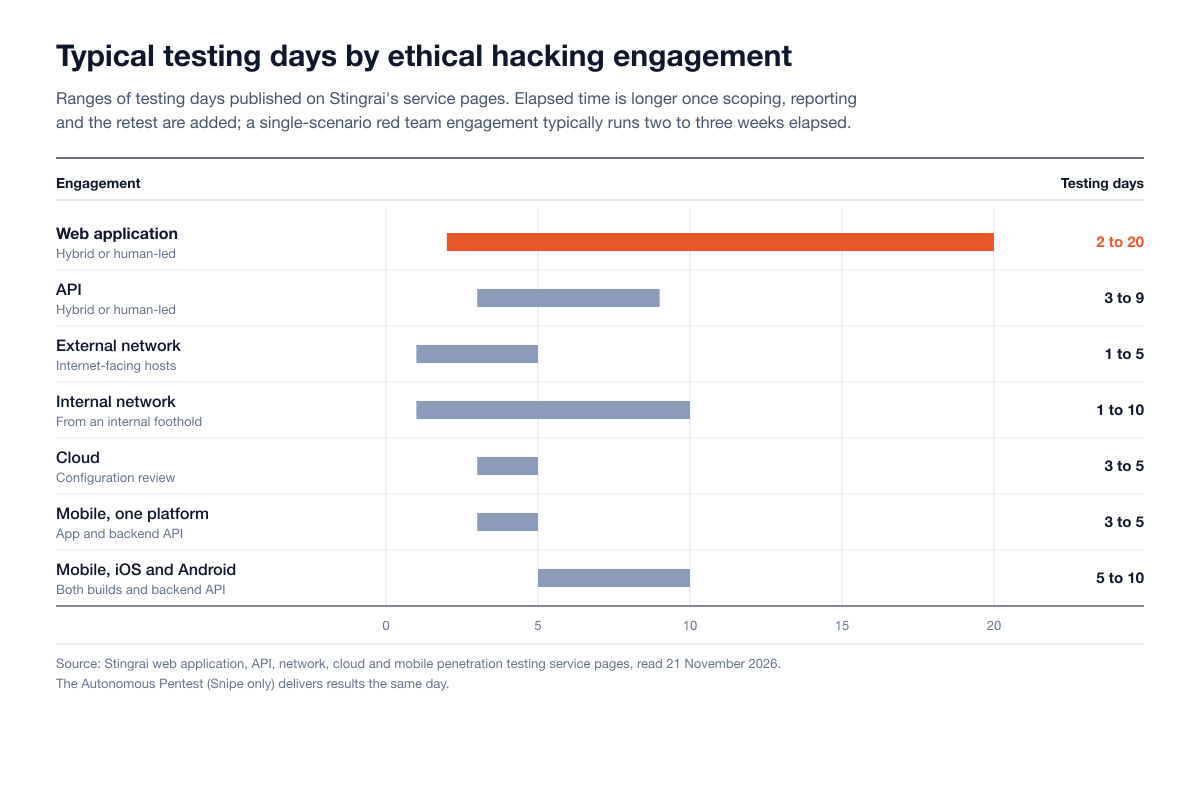
Figure 1: Typical testing days by ethical hacking engagement type, as published on Stingrai's service pages on 21 November 2026. Source: Stingrai service pages.
Web application and API testing
In Stingrai's experience, web applications and associated APIs are where ethical hacking budgets usually start, because they face customers and handle customer data. A useful engagement tests authenticated flows across every user role, broken authorization and insecure direct object references (IDOR), business logic, injection, and authentication and session handling, aligned with the OWASP Web Security Testing Guide. Ask how many roles and tenants the quote covers; that number drives the testing days more than page count does.
External and internal network testing
External testing covers what is reachable from the internet; internal testing starts from a foothold, usually a standard user account, and measures how far lateral movement and privilege escalation go, often into Active Directory. The network penetration testing services guide covers both.
Red teaming and social engineering
A red team engagement works toward an objective (reach the payment system, take a dataset) rather than an asset list, quietly and over weeks, to measure whether your team detects and responds. Social engineering tests people with phishing, phone pretexts or physical entry. Both need the most careful rules of engagement; the red team rules of engagement checklist covers the clauses to insist on.
What makes ethical hacking legal: authorization, scope and rules of engagement
Ethical hacking is legal because the system owner authorizes it in writing; the same activity without that authorization is a criminal offence in the United States and Canada.
The laws that turn on authorization
United States. The Computer Fraud and Abuse Act makes it an offence to intentionally access a computer "without authorization or exceeds authorized access, and thereby obtains" information, and defines exceeding authorized access as using permitted access "to obtain or alter information in the computer that the accesser is not entitled so to obtain or alter" (18 U.S.C. 1030). The second clause is why scope matters even when access is granted: a tester who wanders outside it can exceed authorized access.
Canada. Section 342.1 of the Criminal Code applies to anyone who "fraudulently and without colour of right" obtains a computer service or intercepts a function of a computer system, with imprisonment of up to 10 years on indictment (Criminal Code s. 342.1). A signed authorization from the owner is the clearest evidence of colour of right.
Prosecutorial policy is not a permission slip. The US Justice Manual tells federal prosecutors to decline prosecution where conduct "consisted of, and the defendant intended, good-faith security research", defined as access "solely for purposes of good-faith testing, investigation, and/or correction of a security flaw or vulnerability" carried out to avoid harm (Justice Manual 9-48.000). The Justice Manual says the policy is "intended solely for the guidance of attorneys for the government" and does not "create a right or benefit, substantive or procedural, enforceable at law". In Stingrai's reading (guidance, not legal advice), it also does not bind state prosecutors or civil claims and does not authorize anyone to test your systems, so your engagement still needs a signed authorization.
What the authorization has to cover
NIST's testing guide, SP 800-115, defines rules of engagement (ROE) as "detailed guidelines and constraints regarding the execution of information security testing" that are "established before the start of a security test" and give "the test team authority to conduct defined activities without the need for additional permissions". Its Appendix B template covers:
the purpose, scope, assumptions and limitations, and the risks of the test, with mitigations;
every person on the test team "by name", plus points of contact for management and incident response;
the test schedule and hours, the test site and equipment;
communication and incident handling during the test;
the target systems, the technical and non-technical test components, and data handling;
reporting.
Three further points from the same NIST guide matter to buyers:
Third-party infrastructure. Where part of your environment sits on someone else's network, "the owner of the other network usually must also consent in writing". That covers hosting providers, managed service providers and some SaaS platforms; for the public clouds, read the cloud rules of engagement guide.
A carry letter. NIST suggests "a one- or two-page memorandum" the testers can show as authorization, describing "allowable and unallowable activities, authorized and unauthorized systems" and a point of contact. In Stingrai's guidance, anyone doing physical or social engineering testing should carry one at all times.
Legal review. NIST recommends that legal advisors "always be involved for intrusive tests such as penetration testing", including on indemnity or limitation of liability clauses and nondisclosure agreements.
Ethical hacking firm or "hire a hacker" site: how to tell them apart
A legitimate ethical hacking firm asks you to prove you own the target and signs a contract that limits what it may do; a "hire a hacker" site offers to break into accounts, phones or systems that belong to someone else. Google's advertising policy prohibits ads for "products or services that enable a user to gain unauthorized access or make unauthorized changes to systems, devices, or property", and names "hacking services" as an example (Google Ads policy). Those offers can still appear in organic results and forums for "ethical hacking services", which is why the term needs vetting.
The FBI has also warned about a related pattern: businesses that claim to trace and recover lost cryptocurrency, "charge an up-front fee" and then disappear or demand more, noting that "private sector recovery companies cannot issue seizure orders to recover cryptocurrency" (FBI IC3, 11 August 2023). If an "ethical hacker" offers to recover an account, a device or funds that someone else controls, it is not an ethical hacking service.
The table below is Stingrai's guidance; no standard defines these signals.
Signal | Legitimate ethical hacking firm | "Hire a hacker" offer |
|---|---|---|
Target | Systems you own or are authorized to test, with proof | Anyone's account, phone, email or system |
Paperwork | Master agreement or terms, statement of work, rules of engagement, authorization letter, NDA | None, or a chat message |
Legal entity | A registered company with an address, a named contracting entity and invoices | Pseudonyms, messaging apps, no company |
Payment | Invoice to your company, often with payment terms | Up-front crypto, gift cards or wire to an individual |
People | Named, certified penetration testers you can look up | Anonymous "hackers" |
Accreditation | Firm-level accreditation you can verify on the accrediting body's own site | Logos without a verifiable listing |
Insurance | Professional and cyber liability certificates on request | None |
Output | A report with evidence, risk ratings, fixes and a retest | Screenshots, passwords or "access" |
The checks that matter most for a business buyer
1. Written authorization and rules of engagement. Ask for the provider's ROE template before you sign. If it does not name testers, test windows, emergency contacts, exclusions and data handling, it is not ready for production testing. Use NIST SP 800-115 Appendix B as the checklist.
2. Firm-level accreditation. CREST accredits companies, not only individuals. Applicants "must submit detailed evidence demonstrating compliance with our Accreditation Standards", including "company processes, service methodologies, and data security practices", and "accredited companies must maintain their standards and undergo periodic reassessments" (CREST accreditation). Verify the claim on marketplace.crest.org, the single source of truth, and check which accreditations the firm holds; the CREST-accredited companies guide walks through the four-step check.
3. Named, certified testers. PCI DSS v4.0.1, the card industry standard, lists "specific penetration testing certifications, which may be an indication of the tester's skill level and competence" and "prior experience conducting penetration testing" as considerations when choosing a tester, and requires "organizational independence of the tester" (PCI DSS v4.0.1, Requirement 11.4). Ask for the names and certifications of the people who will test your systems, not the firm's best-known researcher. In Stingrai's guidance, ask each tester for their certifications by name (for example OSCP, OSWE, OSEP, OSCE³ or CREST CRT) and check them with the issuing body.
4. Insurance. Ask for current professional liability and cyber liability certificates and check that the limits match your contract's liability cap (Stingrai's guidance; no standard sets a figure).
5. A sample report and a retest policy. Ask for a redacted sample report and read it for evidence, reproduction steps and fixes. PCI DSS guidance makes a pointed observation: "a penetration test that found nothing is typically indicative of shortcomings of the penetration tester, rather than being a positive reflection of the security posture of the entity". Confirm that the retest of fixed findings is included in the price. The guide to evaluating a penetration test report covers what good evidence looks like.
6. Data handling. Ask where findings, screenshots and credentials are stored, who can see them and when they are destroyed.
What should an ethical hacking statement of work contain?
A statement of work (SOW) for ethical hacking should fix the scope, the method, the effort, the people, the schedule and the deliverables before testing starts. The NCSC says the output of scoping "should be a document stating":
"the technical boundaries of the test";
"the types of test expected";
"the timeframe and the amount of effort necessary to deliver the testing - usually given in terms of resource days";
where relevant, "scenarios or specific 'use cases' to test";
"the penetration testing team's requirements" (test accounts, access, desk space);
"any compliance or legislative requirements that the testing plan must meet";
"any specific reporting requirements, for example the inclusion of CVSS scores";
"any specific time constraints on testing or reporting".
Source: NCSC penetration testing guidance.
Stingrai's guidance adds five clauses buyers regret leaving out (these are not NCSC requirements):
Named testers and substitution. The people who will test, and how a substitution is approved.
Out-of-scope discoveries. What happens when testers find a system outside scope. The NCSC describes the two options: a scope change "likely to alter testing time frames and cost", or recording the exclusion "as a limitation on testing".
Stop conditions and contacts. Who can halt testing, and a technical contact "available at all times" during the test, as the NCSC puts it.
Retest terms. How many retests are included and for how long after the report.
Evidence for your auditor. Whether the report maps to the framework your auditor uses and whether an attestation letter is included.
For a clause-by-clause template, use the penetration testing SOW template; for scoping before the SOW, the guide on how to scope a penetration test.
What should the ethical hacking report contain?
The report is what you are paying for. The NCSC says the test report should include "any security issues uncovered", "an assessment by the test team as to the level of risk that each vulnerability exposes the organisation or system to", "a method of resolving each issue found", "an opinion on the accuracy of your organisation's vulnerability assessment" and "advice on how to improve your internal vulnerability assessment process" (NCSC).
Stingrai's guidance for what to check on top of that list:
An executive summary a board member can read in two minutes: what was tested, the worst outcome reached, and the fixes that matter first.
Scope, dates and method stated exactly as in the SOW, including anything that could not be tested and why.
Per finding: affected asset, severity with the scoring system named, reproduction evidence, business impact, and a specific fix.
Attack chains, where several low or medium findings combine into a serious outcome, written as one narrative rather than scattered across the list.
Retest results, added as a status per finding once fixes are deployed.
An attestation letter stating scope and testing dates, for customers and auditors who need a summary instead of the full report.
A penetration testing report sample shows the structure in practice.
How much do ethical hacking services cost?
Ethical hacking services cost what the underlying engagement costs, and the scope sets the price. The figures below are Stingrai's own published prices and the typical network ranges on its network service page, as read on 21 November 2026.
Engagement | Stingrai's published price or typical range | Scope basis |
|---|---|---|
Autonomous Pentest (Snipe only) | US$3,000 per assessment, or US$650 per month on a 12-month plan | One web application and associated APIs; delivers a pentest report |
Hybrid Pentest (Snipe plus certified penetration testers) | US$6,800 per assessment, or US$1,275 per month on a 12-month plan | One web application and associated APIs; includes an attestation letter |
Network penetration test (internal and external) | Typically US$5,000 to US$40,000 and above | Live hosts, subnets, Active Directory footprint, sites, start positions |
PCI DSS network bundle (internal, external, segmentation) | Typically US$12,000 to US$25,000 | Cardholder data environment and segmentation controls |
Cloud, mobile, Active Directory, AI and LLM, red team, social engineering | Quoted to scope within 24 hours | Accounts and clusters; platforms and roles; forests and domains; agents and tools; operator days; campaigns |
Sources: Stingrai pricing, network, cloud, mobile, red teaming and AI and LLM service pages.
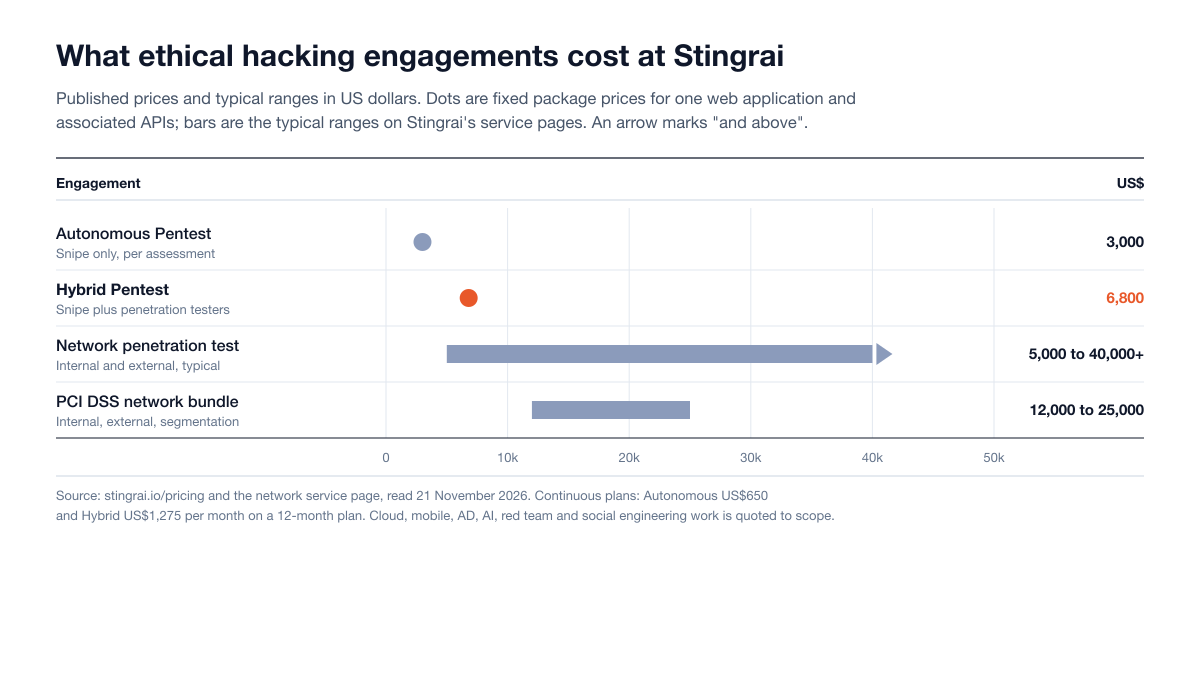
Figure 2: Stingrai's published prices and typical ranges for ethical hacking engagements, in US dollars, as of 21 November 2026. Source: Stingrai pricing and service pages.
What drives the price
Price follows effort, which is why the NCSC asks the scoping document to state effort "in terms of resource days". The drivers are in the scope basis column above: roles, tenants and endpoints for applications; hosts, sites and start positions for networks; accounts and clusters for cloud; and the objective and scenario count for a red team. For a market-wide view of pricing by engagement and compliance driver, read the penetration testing cost guide, or estimate a scope with the pentest cost calculator.
One-time test or continuous program?
A one-time (annual) test meets most compliance cycles. PCI DSS v4.0.1, for example, requires penetration testing "at least once every 12 months" and "after any significant infrastructure or application upgrade or change" (Requirement 11.4). The second clause is the problem for teams that release weekly: every significant change reopens the question. The pace of exploitation adds pressure, with 306 vulnerabilities added to CISA's Known Exploited Vulnerabilities catalog between 1 January and 20 November 2026, against 223 in the same window of 2025 and 245 in all of 2025 (catalog version 2026.11.20). For web applications that change often, a continuous program keeps testing in step with releases; for most networks and cloud estates, an annual test plus testing after major changes is the norm.
How to buy ethical hacking services: Stingrai's guidance
These steps are Stingrai's guidance for a mid-market or enterprise buyer; no standard prescribes them.
Write down why you are buying. A customer questionnaire, an auditor's request, a board question, an insurer's form or a recent incident each implies a different scope and report.
Translate the request into engagements. Use the mapping table above: name the assets (applications, APIs, ranges, cloud accounts) or the objective (red team).
Count the scope. Roles and tenants per application, endpoints, live hosts, sites, cloud accounts, platforms. Accurate counts produce comparable quotes.
Shortlist two or three firms and verify them. Check accreditation on the accrediting body's own site, ask for named testers and their certifications, a sample report and insurance certificates.
Compare SOWs, not prices. Line up testing days, named testers, methodology, retest terms and deliverables. A lower price with half the days is a different test.
Sign the paperwork before testing. SOW, rules of engagement, authorization letter, NDA, and written consent from any third party that hosts in-scope systems.
Prepare the environment. Test accounts for every role, allow-listing decisions, a technical contact available throughout, and notice to your security operations team (unless it is a covert red team).
Fix during the test, not after it. Ask for critical findings as they are confirmed, so remediation starts before the report.
Retest and close. Deploy fixes, request the retest, and file the updated report and attestation letter with your audit evidence.
Set the cadence. Annual for stable estates, after every significant change, and continuous for web applications that release often.
For a weighted vendor scorecard and RFP questions, see the pentesting vendor selection guide and the pentest and red team RFP question bank.
Where Stingrai fits
Stingrai is a global CREST-accredited penetration testing services company founded in Toronto, Canada in 2021, trusted by companies from startups to enterprises to meet audit requirements for SOC 2, ISO 27001, CMMC, PCI DSS and HIPAA. OSCE³, OSWE, OSEP, CREST CRT certified penetration testers, who are also world-class security researchers and bug bounty hunters. Choose from fully human-led or hybrid (AI agents plus human penetration testers) engagements across web, API, mobile, AI and LLM, cloud, network, Active Directory and social engineering penetration tests and red team engagements.
For a buyer who arrived looking for "ethical hacking services", the specifics are these:
Verifiable accreditation. Stingrai Inc. is a proud CREST member, holding the CREST accreditations Penetration Testing and AI-Enabled Penetration Testing and the CREST AI Charter, listed on the CREST Marketplace.
Named people. Two named penetration testers from a team holding OSCE³, OSWE, OSEP, CREST CRT and CISSP certifications work every Hybrid engagement, and the team has published 18 CVEs (Snipe).
Paperwork that holds up. A written scope and rules of engagement before testing, findings posted to the PTaaS portal as they are confirmed with a proof of concept and remediation guidance, Jira and Slack integration, and a retest of every fix. Every human-led and hybrid report ships with an attestation letter, and the testing produces evidence for SOC 2, ISO 27001, PCI DSS, HIPAA and CMMC programs.
Every line of service. Web application, API, network, cloud, mobile, AI and LLM, red teaming and social engineering, one-time or as a continuous program. Cloud, network, Active Directory, mobile, red team and social engineering testing is human-led.
Hybrid Pentest: the web application option, one-time or continuous
For web applications, Stingrai's Hybrid Pentest is the option Stingrai recommends for most buyers. Snipe, Stingrai's autonomous AI penetration testing agent, tests the full application while Stingrai's certified penetration testers test the same application manually alongside it and validate Snipe's findings, so coverage is wider and deeper than either alone. The testers chain findings and work the business logic that needs human judgement.
One-time: US$6,800 per assessment, for one web application and associated APIs, with a human-validated report and an attestation letter.
Continuous: US$1,275 per month on a 12-month plan, for one web application and associated APIs: monthly Snipe testing, human-verified, plus a quarterly deep dive by Stingrai's penetration testers.
The case for continuous is the evidence above: PCI DSS asks for testing after every significant application change, and CISA's catalog of exploited vulnerabilities grew faster in 2026 than in 2025. An application that ships every sprint changes faster than an annual test can follow. See the pricing page or request a quote for anything larger than one application.
Frequently Asked Questions
What are ethical hacking services?
Ethical hacking services are authorized attacks on systems you own, carried out by certified penetration testers under a signed scope and rules of engagement, to find and prove weaknesses before criminals do. In practice you buy a penetration test (web application, API, network, cloud or mobile), a red team engagement or a social engineering test, and you receive a report with evidence, risk ratings, fixes and a retest.
How much do ethical hacking services cost?
The cost depends on the engagement and scope. Stingrai's Hybrid Pentest for one web application and associated APIs is US$6,800 per assessment or US$1,275 per month on a 12-month plan, and its Autonomous Pentest is US$3,000 per assessment. A network penetration test typically costs US$5,000 to US$40,000 and above, according to Stingrai's network service page. Cloud, mobile, Active Directory, AI, red team and social engineering work is quoted to scope.
Is ethical hacking the same as penetration testing?
Ethical hacking is the broader term and penetration testing is the most common engagement under it. A penetration test is scoped to named assets, announced to your team and focused on what can be exploited. Ethical hacking can also mean a red team engagement, which is covert and objective-based, or a social engineering test of your staff. When a customer or auditor asks for ethical hacking, they usually want a penetration test report.
Is it legal to hire an ethical hacker?
Yes, when you own the systems or have the owner's written permission, and the testing stays inside an agreed scope. The US Computer Fraud and Abuse Act covers access without authorization or exceeding authorized access, and Canada's Criminal Code s. 342.1 covers unauthorized use of a computer without colour of right, so the signed authorization, statement of work and rules of engagement are what make the work lawful. Hiring someone to access systems or accounts you do not own is not ethical hacking.
How do I know an ethical hacking company is legitimate?
A legitimate company asks you to prove you own the target, signs a statement of work and rules of engagement, names the testers who will do the work, and can show a sample report and insurance certificates. Verify any accreditation on the accrediting body's own site; for CREST, that is marketplace.crest.org. Offers to break into someone else's accounts, payment in cryptocurrency or gift cards, and no registered company are signs of a scam.
What certifications should ethical hackers have?
Look for firm-level accreditation, such as CREST accreditation for penetration testing, and ask for the individual certifications held by the named testers, for example OSCP, OSWE, OSEP, OSCE³ or CREST CRT. PCI DSS v4.0.1 lists specific penetration testing certifications and prior experience as considerations when choosing a tester. Ask for the certifications of the people assigned to your engagement, not of the firm as a whole.
How long does an ethical hacking engagement take?
Testing time depends on scope. Stingrai's service pages give typical ranges of 2 to 20 testing days for a web application with Hybrid or human-led testing, 3 to 9 for an API, 1 to 5 for an external network, 1 to 10 for an internal network, 3 to 5 for a cloud configuration review, and 5 to 10 for a mobile app on iOS and Android. A single-scenario red team engagement typically runs two to three weeks elapsed.
Can I hire an ethical hacker to recover a hacked account or lost cryptocurrency?
No legitimate ethical hacking firm will access an account or system that someone else controls. The FBI has warned that businesses claiming to trace and recover lost cryptocurrency often charge an up-front fee and then disappear or ask for more, and that private sector recovery companies cannot issue seizure orders. Report account takeovers to the platform and fraud to law enforcement instead.
How often should we run ethical hacking tests?
At least once a year for most compliance programs, and after significant changes. PCI DSS v4.0.1 requires penetration testing at least once every 12 months and after any significant infrastructure or application upgrade or change. Web applications that release frequently benefit from continuous testing, such as Stingrai's continuous Hybrid Pentest at US$1,275 per month on a 12-month plan for one web application and associated APIs.
Does an ethical hacking report help with SOC 2, PCI DSS or ISO 27001?
Yes. A penetration test report and its retest results produce evidence that auditors review for SOC 2, PCI DSS Requirement 11.4, ISO 27001 and HIPAA programs. Check that the report states scope, dates and method, maps findings to the framework your auditor uses, and comes with an attestation letter if customers ask for a summary. Every human-led and hybrid Stingrai report ships with an attestation letter.
Related reading
What is penetration testing? Definition, types and how it works
CREST-accredited penetration testing companies: how to verify
References
NIST. Glossary: penetration testing. https://csrc.nist.gov/glossary/term/penetration_testing. Definition used for the core engagement.
NIST. SP 800-115, Technical Guide to Information Security Testing and Assessment. September 2008. https://nvlpubs.nist.gov/nistpubs/Legacy/SP/nistspecialpublication800-115.pdf. Rules of engagement definition, Appendix B template, legal considerations.
UK National Cyber Security Centre. Penetration testing. Published 8 August 2017, reviewed 10 January 2022. https://www.ncsc.gov.uk/guidance/penetration-testing. Scoping document and report contents.
US Government Publishing Office. 18 U.S.C. 1030, Fraud and related activity in connection with computers. https://www.govinfo.gov/content/pkg/USCODE-2023-title18/html/USCODE-2023-title18-partI-chap47-sec1030.htm. Authorization language.
Government of Canada, Justice Laws Website. Criminal Code, section 342.1. Current to 29 October 2026. https://laws-lois.justice.gc.ca/eng/acts/c-46/section-342.1.html.
US Department of Justice. Justice Manual 9-48.000, Computer Fraud and Abuse Act. https://www.justice.gov/jm/jm-9-48000-computer-fraud. Good-faith security research charging policy.
PCI Security Standards Council. PCI DSS v4.0.1, Requirement 11.4. June 2024. https://www.pcisecuritystandards.org/document_library/. Testing frequency, tester qualification and independence.
CREST. Accreditation. https://crest-approved.org/membership/accreditation. What firm-level accreditation requires.
Google. Advertising Policies Help: Enabling dishonest behavior. https://support.google.com/adspolicy/answer/6016086?hl=en. Prohibition on hacking services ads.
FBI Internet Crime Complaint Center. Increase in Companies Falsely Claiming an Ability to Recover Funds Lost in Cryptocurrency Investment Scams. 11 August 2023. https://www.ic3.gov/PSA/2023/PSA230811.
CISA. Known Exploited Vulnerabilities catalog. Version 2026.11.20. https://www.cisa.gov/known-exploited-vulnerabilities-catalog. Additions counted by date added.
OWASP. Web Security Testing Guide. https://owasp.org/www-project-web-security-testing-guide/.
Stingrai. Pricing and service pages for web application, API, network, cloud, mobile, AI and LLM, Active Directory and red team testing. Read 21 November 2026. https://www.stingrai.io/pricing.
Talk to Stingrai
Tell us what you were asked to have tested, and we will turn it into a scoped engagement with named certified penetration testers and a fixed price. Get a Quote or book a free discovery call.