An API vulnerability is a flaw in how an application programming interface authenticates callers, decides which objects, properties and functions each caller may reach, limits what a caller can consume, or handles the URLs, configuration and third-party data it touches. The OWASP API Security Top 10 2023, still the current edition on the OWASP project page on 21 November 2026, names ten classes, and three of its first five are authorization failures. The cost of getting one wrong is public record: T-Mobile told the SEC that a bad actor obtained data "through a single Application Programming Interface ("API") without authorization" for approximately 37 million customer accounts, starting on or around 25 November 2022 and detected on 5 January 2023, 41 days later (T-Mobile Form 8-K).
Quick answer. The most common API vulnerabilities are broken object level authorization (BOLA), broken authentication, broken object property level authorization (mass assignment and excessive data exposure), unrestricted resource consumption, broken function level authorization (BFLA), unrestricted access to sensitive business flows, server-side request forgery (SSRF), security misconfiguration, improper inventory management and unsafe consumption of third-party APIs: the OWASP API Security Top 10 2023. Scanners catch most misconfiguration and exposure, but the authorization and business-flow classes need testing with real accounts for every role and tenant. For one web application and associated APIs, Stingrai's Hybrid Pentest is US$6,800 per assessment or US$1,275 per month on a 12-month plan.
This page is the catalogue: what each vulnerability is, a real example from a vendor advisory or the CISA Known Exploited Vulnerabilities (KEV) catalog, how certified penetration testers find it and the fix. For the test procedure, use the API penetration testing checklist; for the buying decision, the API security assessment guide.
What is an API vulnerability?
An API exposes data and actions to software rather than to a person clicking through pages. A web page can hide a button; an API either refuses the request or it does not. Every object identifier, request field and route is something a caller can change, so the API's own server-side checks are the only control that counts.
OWASP describes the core problem in its first risk: APIs "tend to expose endpoints that handle object identifiers, creating a wide attack surface of Object Level Access Control issues." It also warns that its own ranking is judgement, not measurement: "Since this edition is not data-driven, prevalence results from a consensus among the team members" (OWASP, API Security Risks). That is why this page pairs each OWASP class with exploited, documented cases and with what Stingrai's own testers find. The T-Mobile filing, for its part, names no flaw class: nothing crashed and no malware ran, and data left through an interface that answered requests it should not have answered.
What are the most common API vulnerabilities?
The ten classes follow the OWASP API Security Top 10 2023 order, each with one documented example. The class assigned to each example is Stingrai's mapping; advisories and the KEV catalog do not use OWASP categories.
OWASP ID | Vulnerability | What goes wrong | Documented example |
|---|---|---|---|
API1 | Broken object level authorization (BOLA, also called IDOR) | The API returns or changes an object without checking that the caller owns it | Langflow CVE-2026-55255: run another user's flow by its ID (KEV, 7 July 2026) |
API2 | Broken authentication | Login, token, reset or recovery flows can be bypassed or abused | SmarterMail CVE-2026-23760: anonymous administrator password reset through the reset API (KEV, 26 January 2026) |
API3 | Broken object property level authorization (BOPLA) | Responses return fields the caller should not see, or requests set fields the caller should not touch (mass assignment) | Hoppscotch CVE-2026-50160: unauthenticated mass assignment of the JWT signing secret, CVSS 10.0 |
API4 | Unrestricted resource consumption | No limits on rate, size, cost or concurrency | HTTP/2 Rapid Reset CVE-2023-44487, exploited August to October 2023 (KEV) |
API5 | Broken function level authorization (BFLA) | A lower role reaches an administrative or restricted function | SimpleHelp CVE-2024-57726: technicians create over-privileged API keys and become server admin (KEV, 24 April 2026) |
API6 | Unrestricted access to sensitive business flows | A legitimate flow is run at a scale or in a way that harms the business | Twilio Authy CVE-2024-39891: unauthenticated endpoint confirmed which phone numbers were registered (KEV, 23 July 2024) |
API7 | Server-side request forgery (SSRF) | The API fetches a caller-supplied URL and reaches internal services | MLflow CVE-2026-64849: webhook test endpoint reached internal and cloud metadata services (KEV, 19 August 2026) |
API8 | Security misconfiguration | Insecure defaults, permissive CORS, verbose errors, exposed debug features | Langflow CVE-2025-34291: credentialed wildcard CORS led to token theft (KEV, 21 May 2026) |
API9 | Improper inventory management | Unknown, old, debug or non-production APIs stay reachable | Vite CVE-2025-31125: development servers exposed to the network leaked file contents (KEV, 22 January 2026) |
API10 | Unsafe consumption of APIs | The API trusts data or redirects from another service it calls | SmarterMail CVE-2026-24423: the server trusted a response from a "hub" an attacker could point it at (KEV, 5 February 2026) |
OWASP rates each risk on four scales. Figure 1 shows its ratings: nine of the ten are rated Easy to exploit, and five are rated Widespread.
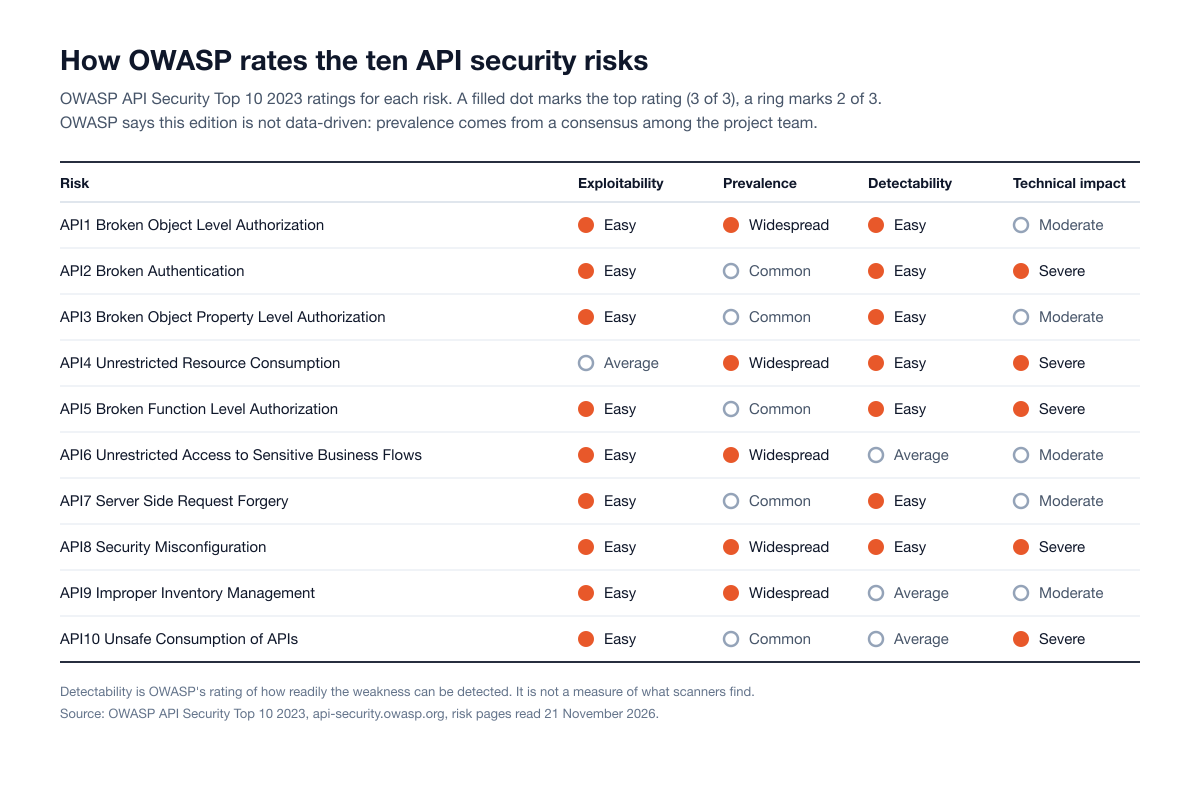
Figure 1: OWASP's exploitability, prevalence, detectability and technical impact ratings for the ten API risks. OWASP notes that prevalence is a team consensus, not data. Source: OWASP API Security Top 10 2023.
What do penetration testers actually find most?
Stingrai's own test data gives a measured view to set beside OWASP's consensus. In the State of Penetration Testing 2026 dataset, 768 findings came from 40 web application tests run between October 2024 and August 2026. Authentication and session issues led at 28.1%, followed by misconfiguration and hardening at 14.2%, information disclosure at 12.5%, broken access control at 9.9%, injection at 8.2% and IDOR at 7.9%. Severity concentrates in the same place: 70% of the 40 web application tests that produced findings surfaced at least one High or Critical authentication or authorization finding.
These are web application tests, which exercise the application's APIs alongside its interface, so treat the split as a first-party proxy rather than an API-only count. Identity and authorization dominate, configuration comes next.
The ten API vulnerability classes, with real examples and fixes
1. Broken object level authorization (BOLA, API1)
What it is. The API accepts an object identifier from the caller (an order ID, a document key, a tenant ID) and acts on that object without checking that this caller may act on it. OWASP says unauthorized access to other users' objects "can result in data disclosure to unauthorized parties, data loss, or data manipulation", and under certain circumstances "full account takeover". Web testers call it IDOR; our IDOR guide covers it in depth.
Real example. Langflow, an AI workflow platform, shipped an IDOR in its /api/v1/responses endpoint that "allows an authenticated attacker to execute any flow belonging to another user by specifying the victim's flow ID in the request" (GHSA-qrpv-q767-xqq2). It was fixed in 1.9.1, classed as CWE-639, and added to the KEV catalog on 7 July 2026 with a due date three days later.
How testers find it. With two accounts per role, and a second tenant in a multi-tenant product, the tester requests every object-bearing operation as the wrong owner and compares the result with the access rules. The joint CISA, NSA and ACSC advisory on IDOR makes the same point about privilege levels: "Test with users of various privilege levels (e.g., a normal user and admin user)" (AA23-208A). Our API authorization test matrix lays the checks out operation by operation.
What tools catch. Little on their own: a scanner sees a 200 response and cannot know the record belonged to someone else. The same advisory says DAST tools "are not foolproof and should be used with other security testing methods to ensure comprehensive coverage"; why API scanners miss BOLA and IDOR explains the mechanics. The detection table later in this guide covers the other nine classes.
Fix. OWASP's prevention is to check "if the logged-in user has access to perform the requested action on the record in every function that uses an input from the client to access a record in the database". It also warns that comparing the session's user ID with the ID parameter "isn't a sufficient solution", because it covers "only a small subset of cases". Unpredictable identifiers are a second layer, not the check. The durable fix is a shared authorization layer every handler calls, plus regression tests: "Do not deploy changes that make the tests fail."
2. Broken authentication (API2)
What it is. Any flaw that lets a caller assume another identity: weak login protection, unverified or expired tokens still accepted, API keys used as user credentials, or reset flows weaker than the login. OWASP is explicit that "Forgot password / reset password" flows "should be treated the same way as authentication mechanisms", and that "OAuth is not authentication, and neither are API keys" (OWASP API2:2023).
Real examples. In SmarterMail before build 9511, the password reset API's force-reset-password endpoint "permits anonymous requests and fails to verify the existing password or a reset token when resetting system administrator accounts" (NVD, CVE-2026-23760). CISA added it to KEV on 26 January 2026 and marks its use in ransomware campaigns as known. Ivanti Endpoint Manager Mobile 12.5.0.0 and prior had "an authentication bypass in the API component" (NVD, CVE-2025-4427), added to KEV on 19 May 2025.
How testers find it. Testers map every way a token is issued, refreshed, revoked and recovered, and check each path for the login's protections: rate limits, lockout, signature and expiry validation, and session invalidation after a password change. Our non-human identity and leaked API key guide covers the machine-credential side.
Fix. NIST's SP 800-228 (final June 2025, updated 13 March 2026) says in REC-API-11-7, "Verify signatures, and check for expiry during token validation." Give reset and recovery endpoints login-grade brute-force, rate-limit and lockout protection, as OWASP prescribes, and never accept API keys as proof of a user's identity.
3. Broken object property level authorization (BOPLA, API3)
What it is. OWASP's API3 "combines API3:2019 Excessive Data Exposure and API6:2019 - Mass Assignment". The API checks the object but not each field: responses include properties the caller should never read, or updates accept properties the caller should never set, such as a role, an owner ID or a secret.
Real example. Self-hosted Hoppscotch up to 2026.4.1 exposed an unauthenticated onboarding endpoint that accepted "arbitrary InfraConfig keys -- including JWT_SECRET and SESSION_SECRET" by mass assignment, because the framework's validation pipe "does not strip extra properties". The maintainers rated it 10.0 (Critical): whoever set the signing key could "forge tokens for any user including admin". The window was fresh installs "before onboarding completes", and the fix shipped in 2026.5.0 (GHSA-j542-4rch-8hwf). The root cause was one setting: the pipe was "configured without whitelist: true" (NVD).
How testers find it. For each role, testers compare the fields returned with the fields that role should see, then send create and update requests carrying extra or privileged fields and check what the server stores.
Fix. Return explicit response models instead of serializing whole objects; OWASP says to "Avoid using generic methods such as to_json() and to_string()". Bind request bodies to allowlisted input models and strip or reject unknown fields. NIST's REC-API-13 adds the second layer: "Validate each request and response per the API schema before it is processed by the business logic."
4. Unrestricted resource consumption (API4)
What it is. No effective limit on how often a caller calls, how much one call asks for, how long it runs or what it costs. OWASP notes the resource is often money: "emails/SMS/phone calls or biometrics validation are made available by service providers via API integrations, and paid for per request" (OWASP API4:2023).
Real example. The HTTP/2 protocol flaw known as Rapid Reset let attackers consume server resources "because request cancellation can reset many streams quickly" (NVD, CVE-2023-44487). CISA reported it "exploited in the wild in August 2023 through October 2023" (CISA alert). CISA advised organizations that provide HTTP/2 services to apply patches and consider configuration changes.
How testers find it. Testers look for missing limits on page size, batch size, uploads, query depth and one-time-code retries, and for paid side effects one caller can trigger repeatedly. Stingrai agrees thresholds before testing; denial-of-service and destructive testing run only when agreed in writing.
Fix. NIST's REC-API-15 says to "Rate-limit all API access for all callers", apply timeouts to all requests, apply payload limits and "Validate and limit user-supplied query parameters". OWASP adds per-operation throttles on things like OTP validation, and "Configure spending limits for all service providers/API integrations."
5. Broken function level authorization (BFLA, API5)
What it is. A lower-privileged caller reaches a function meant for a higher role. OWASP draws the line with BOLA cleanly: reaching a function you "should not have access to" is BFLA, while reaching someone else's object through a function you may use is BOLA (OWASP API1:2023).
Real examples. SimpleHelp 5.5.7 and earlier allowed "low-privileges technicians to create API keys with excessive permissions", and those keys "can be used to escalate privileges to the server admin role" (NVD, CVE-2024-57726, CVSS 9.9). The fix is in SimpleHelp 5.5.8; CISA added the flaw to KEV on 24 April 2026 and marks ransomware use as known.
A second case shows why one check is not enough. In Gitea 1.26.4 and earlier, the "add repository to team" API endpoint let "any ordinary team member grant their entire team access to a repository they personally have admin rights on", bypassing an organization setting designed to prevent exactly that, while "a second, equivalent endpoint for the same action" enforced the setting correctly (GHSA-m6qc-j894-7h9r, fixed in 1.27.0). Snipe, Stingrai's autonomous agent, found it; a Stingrai penetration tester validated it and reported it to Gitea, and the advisory credits him alongside a second reporter (our analysis of CVE-2026-58433).
How testers find it. Testers call every function as every role and look for alternate routes to the same action: a second endpoint, an older version, a GraphQL mutation beside a REST route.
Fix. OWASP asks for "a consistent and easy-to-analyze authorization module that is invoked from all your business functions" that denies "all access by default, requiring explicit grants to specific roles for access to every function" (OWASP API5:2023). When two routes perform one action, both must call the same check.
6. Unrestricted access to sensitive business flows (API6)
What it is. A flow works as coded, but nothing stops it being run at a scale that hurts the business: buying out stock, fake sign-ups, scraping, enumerating customers. OWASP says plainly that this "doesn't necessarily come from implementation bugs" (OWASP API6:2023).
Real example. Twilio's Authy API had an unauthenticated endpoint that "accepted a stream of requests containing phone numbers, and responded with information about whether each phone number was registered with Authy" (NVD, CVE-2024-39891). Twilio said threat actors "were able to identify data associated with Authy accounts, including phone numbers", that accounts were not compromised, and that it no longer allows unauthenticated requests (Twilio security alert, 1 July 2024). CISA added it to KEV on 23 July 2024.
How testers find it. The client names the flows that would hurt if automated; testers then check whether each can be repeated, reordered, skipped or run at volume, within agreed limits. Our business logic scope guide shows how to write those flows into a statement of work.
Fix. OWASP's mitigation has two layers: the business identifies "the business flows that might harm the business if they are excessively used", and engineering chooses protections such as device fingerprinting, human detection and detection of non-human patterns. Partner and machine-to-machine APIs need the same treatment.
7. Server-side request forgery (SSRF, API7)
What it is. The API fetches a URL the caller supplies, for a webhook, an import, a preview or a file, and can be steered to internal services or cloud metadata endpoints behind the firewall. Our SSRF guide covers the class in full.
Real examples. In MLflow, the webhook test endpoint validated only the original URL while the delivery code "follows redirects and re-resolves the hostname without pinning the validated address, allowing attackers to reach internal or cloud metadata services" (NVD, CVE-2026-64849). It was fixed in MLflow 3.15.0 and added to KEV on 19 August 2026. Old API flaws also resurface: GitLab's CVE-2021-39935, which let "unauthorized external users" perform server-side requests "via the CI Lint API", was fixed in December 2021 (14.3.6, 14.4.4 and 14.5.2) and added to KEV on 3 February 2026, more than four years later (NVD).
How testers find it. Testers list every parameter that takes a URL, including webhooks and integration settings, and check what the server will reach through redirects, alternate encodings and DNS re-resolution, using controlled callback hosts.
Fix. OWASP's list: isolate the fetching mechanism, use allowlists of origins, schemes, ports and media types, "Disable HTTP redirections", "Use a well-tested and maintained URL parser", and "Do not send raw responses to clients" (OWASP API7:2023). Validate the resolved address at connection time, not only the string.
8. Security misconfiguration (API8)
What it is. The code may be sound but the deployment is not: permissive CORS, verbose errors, unnecessary HTTP methods, missing TLS on internal hops, debug endpoints left on.
Real example. Langflow up to and including 1.6.9 combined "an overly permissive CORS configuration (allow_origins='*' with allow_credentials=True)" with "a refresh token cookie configured as SameSite=None", which let a malicious web page call the refresh endpoint with the victim's credentials and obtain fresh tokens (NVD, CVE-2025-34291). CISA added it to KEV on 21 May 2026. No single line of business logic was wrong; two configuration choices together handed out sessions.
How testers find it. Testers review headers, CORS behaviour with credentials, error responses, enabled methods and the management endpoints each framework ships with. Scanners do well here too.
Fix. OWASP asks for "a repeatable hardening process", "a proper Cross-Origin Resource Sharing (CORS) policy", specific allowed HTTP verbs, TLS for every hop "regardless of whether it is an internal or public-facing API", and enforced response schemas, "including error responses, to prevent exception traces" (OWASP API8:2023). Never combine a wildcard origin with credentials.
9. Improper inventory management (API9)
What it is. Old versions, debug endpoints and non-production deployments stay reachable without production's protections because nobody inventoried them. NIST's guidance opens its risk section with the finding that "Most organizations have gaps in their API inventories, even if they otherwise have mature inventory management capabilities" (NIST SP 800-228).
Real example. A development server is not meant to face a network. Vite's dev server returned "the contents of arbitrary files" to the browser, but "Only apps explicitly exposing the Vite dev server to the network (using --host or server.host config option) are affected" (GHSA-4r4m-qw57-chr8). CISA still added it to the KEV catalog, its list of vulnerabilities exploited in the wild, on 22 January 2026.
How testers find it. Testers enumerate hosts, versioned paths, documentation endpoints, GraphQL introspection and gRPC reflection, then reconcile what answers with what the owners say exists. Anything live and undocumented, or retired but answering, is a finding.
Fix. Keep an inventory of "all internal (including shadow and Zombie APIs) and external APIs" with owners and runtime data (NIST REC-API-4.2). OWASP adds: record each host's environment, network audience and version, generate documentation in CI/CD, and avoid "using production data with non-production API deployments" (OWASP API9:2023).
10. Unsafe consumption of APIs (API10)
What it is. The API trusts data and redirects from services it calls. OWASP's summary: "Developers tend to trust data received from third-party APIs more than user input, and so tend to adopt weaker security standards." Our guide to third-party API integration testing covers how to scope it.
Real example. In SmarterMail before build 9511, the unauthenticated ConnectToHub API method let an attacker "point the SmarterMail to the malicious HTTP server, which serves the malicious OS command", which the application then executed (NVD, CVE-2026-24423). It is two failures in one: no authentication on a critical function, and blind trust in what the "hub" sent back. CISA added it to KEV on 5 February 2026 and marks ransomware use as known.
How testers find it. Testers map every outbound integration and test whether a spoofed or compromised upstream could change what the API stores, executes or returns.
Fix. OWASP says to "Always validate and properly sanitize data received from integrated APIs before using it", to use TLS for every interaction, and to "Maintain an allowlist of well-known locations integrated APIs may redirect yours to: do not blindly follow redirects" (OWASP API10:2023).
Beyond the Top 10: injection still happens
Injection was API8 in the 2019 edition and is not a separate category in 2023, but it has not gone away. Cisco Identity Services Engine had "an injection vulnerability in a specific API" that allowed remote code execution with root privileges "by submitting a crafted API request" (KEV, CVE-2025-20281, added 28 July 2025). In Stingrai's web application data, injection was 8.2% of findings, and 48% of the 40 tests that produced findings surfaced a High or Critical injection. Parameterized queries, strict schema validation and safe handling of anything passed to an interpreter remain part of every API test.
How are API vulnerabilities found: scanners, agents or penetration testers?
Each catches a different part of the list. The table is Stingrai's guidance from the OWASP descriptions and our own testing; no standard prescribes this split.
OWASP risk | What automated scanning and DAST usually catch | What needs role-aware testing and human judgement |
|---|---|---|
API1 BOLA | Rarely anything; a 200 response looks correct | Every object requested as every role and tenant, compared with the access rules |
API2 Broken authentication | Missing TLS, some token weaknesses such as accepted unsigned tokens | Reset, recovery, refresh and revocation flows; session handling after changes |
API3 BOPLA | Obviously sensitive values in responses | Which fields each role may read or write; hidden writable properties |
API4 Resource consumption | Missing rate limits, oversized responses | Costly and paid operations; safe thresholds agreed with the client |
API5 BFLA | Admin paths that answer without authentication | Role hierarchy; alternate routes to the same function |
API6 Business flows | Almost nothing | Which flows hurt the business at scale, and whether they can be abused |
API7 SSRF | Basic SSRF with callback hosts | Redirect chains, DNS re-resolution, second-order fetches |
API8 Misconfiguration | Most of it: CORS, headers, errors, methods, default endpoints | Combinations that chain into impact, such as CORS plus cookie settings |
API9 Inventory | Hosts, versions and documentation endpoints | Reconciling what answers with what owners say should exist |
API10 Unsafe consumption | Very little | Trust placed in upstream responses, callbacks and redirects |
CISA, the NSA and ACSC say that "Not all DAST tools can detect IDOR vulnerabilities" and that IDOR is "hard to prevent outside the development process since each use case is unique and cannot be mitigated with a simple library or security function" (AA23-208A). Across all 1,206 verified findings in Stingrai's data, network tests included, 37.2% fell into classes a scanner could in principle flag and 35.2% into classes that require understanding how the application works (State of Penetration Testing 2026).
Snipe, Stingrai's autonomous agent for web applications and associated APIs, sits between the two: it tests authenticated across every role and tenant, hunting IDOR, broken authorization and business logic flaws rather than signatures, as the Gitea finding shows. Certified penetration testers add judgement: which flows matter, which settings chain into impact, and how to confirm it without harming production. Our DAST vs penetration testing comparison goes further.
REST vs GraphQL vs gRPC: where the same vulnerabilities hide
The ten classes apply to every API style, but each style moves the attack surface. Stingrai tests REST, GraphQL, gRPC and SOAP APIs (API penetration testing); the notes below are what changes in practice.
Question | REST | GraphQL | gRPC |
|---|---|---|---|
How is the surface discovered? | OpenAPI documents, paths and versions in URLs | Introspection, which the OWASP GraphQL Cheat Sheet says "often comes by default" enabled "and not requiring authentication" | Server reflection, which grpc.io compares to "serving an OpenAPI document" |
Where does authorization fail? | Per route and per HTTP method | Per resolver: OWASP says to "Enforce authorization checks on both edges and nodes" | Per method; per-call credentials ride in metadata |
Where does resource consumption hide? | Page sizes, bulk endpoints | Query depth and amount, which "By default ... can both be unlimited", plus batching and aliases | Streaming calls and large messages |
Transport and credentials | OWASP: "Secure REST services must only provide HTTPS endpoints" | Same as REST | grpc.io "promotes the use of SSL/TLS" with channel and call credentials |
REST failures cluster on one route: a missing check on one HTTP method or an older version of the path. OWASP's REST Security Cheat Sheet also warns: "Do not rely exclusively on API keys to protect sensitive, critical or high-value resources." GraphQL puts authorization in resolvers, so BOLA and BFLA often appear through a nested field that skips the top-level check, and the OWASP GraphQL Cheat Sheet notes that "even if introspection is disabled, attackers can still guess fields by brute forcing them"; our GraphQL vulnerabilities guide goes deeper. gRPC is binary, which makes inspection harder but not safer: with reflection on, a client can list every service, and testers check that every method enforces the channel and call credentials. Our gRPC scope guide lists what to hand a tester.
How do you prevent API vulnerabilities?
Most of the fixes above reduce to six architectural decisions, each of which removes a whole class rather than one bug.
One deny-by-default authorization layer. NIST's REC-API-12: "Authorize the calling user and service for each identity on the request". Every handler calls it, so no route ships without a check.
Schema validation of every request and response (REC-API-13), in NIST's order (REC-API-14): "Authenticate, authorize, then validate".
Limits on every caller and costly operation (REC-API-15), plus spending caps on paid integrations (OWASP API4).
An API inventory with owners, a specification for every API (REC-API-1) and shadow and zombie APIs included (REC-API-4.2).
Controlled outbound traffic: allowlisted destinations, no redirects, upstream data treated as untrusted (OWASP API7 and API10).
Authorization tests that block deploys when they fail.
API vulnerability checklist
This checklist is Stingrai's guidance for engineering and security leads, condensed from the OWASP and NIST guidance above; no standard prescribes this exact list. The full test-activity version is in our API penetration testing checklist.
Inventory every API host, version and environment, reconciled with specifications and live traffic.
Publish a specification for every API and validate requests and responses against it.
Check object ownership in every handler that takes an identifier; test with two accounts per role and a second tenant.
Allowlist the fields each role may read and write; strip unknown request fields.
Deny functions by default through one authorization module, including every alternate route to the same action.
Protect reset, recovery and token refresh like login, and verify every token's signature and expiry.
Set rate, payload, page-size, timeout and spending limits per caller and per costly operation.
Name the business flows that would hurt if automated, and add flow-level controls.
Allowlist outbound destinations for URL fetchers and webhooks, disable redirects and validate the resolved address.
Harden configuration: explicit CORS allowlist, no wildcard origin with credentials, uniform errors, restricted methods, TLS on every hop.
Remove debug, management and development endpoints from anything network-reachable.
Treat data from third-party APIs as untrusted and allowlist where integrations may redirect you.
Track advisories and KEV additions for every API platform and framework you run.
Run authorization regression tests in CI and block deploys when they fail.
Penetration test after significant changes and at least yearly, and test fast-releasing APIs continuously in between.
Why API vulnerabilities call for continuous testing
Between January and November 2026 alone, CISA added API flaws in SmarterMail (January and February), SimpleHelp (April), Langflow (May and July), MLflow (August) and GPUStack (November) to the KEV catalog. Under BOD 26-04, issued on 10 June 2026 to replace BOD 22-01, federal agencies get remediation timelines per KEV entry, including three-day windows: the Langflow BOLA flaw added on 7 July 2026 was due on 10 July, and the GPUStack authentication flaw added on 9 November 2026 was due on 12 November. Old flaws return, as GitLab's 2021 CI Lint API SSRF did, and quiet API leaks can run for weeks, as T-Mobile's roughly 41 days showed.
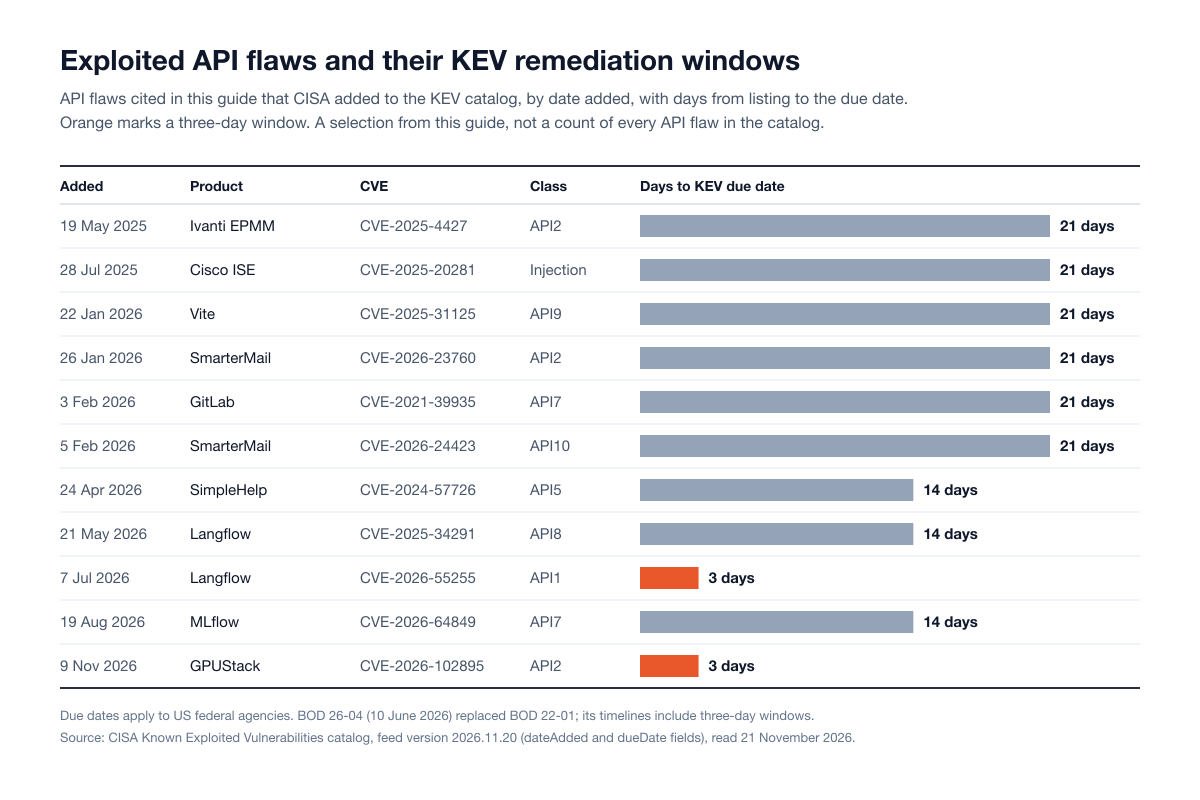
Figure 2: API flaws cited in this guide that CISA added to the KEV catalog, with days from listing to the federal due date. Classes are Stingrai's mapping to the OWASP API Top 10 2023. A selection, not a complete count. Source: CISA Known Exploited Vulnerabilities catalog, feed version 2026.11.20.
An annual test still matters as the deep, human-led baseline most compliance programs ask for. But an API that ships every sprint changes its authorization surface every sprint, and BOLA, BFLA and BOPLA are exactly the classes a new endpoint introduces and a scanner misses.
Stingrai's Hybrid Pentest, one-time or continuous
Stingrai's Hybrid Pentest is built for this. Snipe tests the full application while Stingrai's certified penetration testers test the same application manually alongside it and validate Snipe's findings, so coverage is wider and deeper. It is not a split of test classes: both work across authorization, authentication, business logic and injection.
Option | Price | Scope | Cadence |
|---|---|---|---|
Hybrid Pentest, one-time | US$6,800 per assessment | One web application and associated APIs | One assessment by Snipe and Stingrai's certified penetration testers |
Hybrid Pentest, continuous | US$1,275 per month on a 12-month plan | One web application and associated APIs | Monthly Snipe testing, human-verified, plus a quarterly deep dive by Stingrai's penetration testers |
For APIs that release often, the continuous plan fits better: each month's changes are tested while new, and the quarterly deep dive puts certified penetration testers back on the authorization model. Every human-led and hybrid report ships with an attestation letter for SOC 2, HIPAA, PCI DSS and similar audits. The Autonomous Pentest, Snipe on its own at US$3,000 per assessment, delivers the pentest report. Prices are on the pricing page; larger API estates are quoted through Get a Quote. Our hybrid and continuous penetration testing guides go further.
Stingrai's API penetration testing service
Stingrai is a global CREST-accredited penetration testing services company founded in Toronto, Canada in 2021, trusted by companies from startups to enterprises to meet audit requirements for SOC 2, ISO 27001, CMMC, PCI DSS and HIPAA. OSCE³, OSWE, OSEP, CREST CRT certified penetration testers, who are also world-class security researchers and bug bounty hunters. Choose from fully human-led or hybrid (AI agents plus human penetration testers) engagements across web, API, mobile, AI and LLM, cloud, network, Active Directory and social engineering penetration tests and red team engagements.
For APIs specifically, Stingrai's API penetration testing covers:
Protocols: REST, GraphQL, gRPC and SOAP, scoped from OpenAPI or Swagger definitions, GraphQL schemas, Postman collections, protobuf files or WSDLs.
Authorization depth: every object and function requested with every role and tenant in scope, the classes automated scanners miss most often.
Authentication and abuse: token issuance, validation and expiry, OAuth 2.0 flows, API keys and reset and recovery paths; sensitive flows, injection, SSRF and resource consumption, within agreed thresholds.
Mapping and evidence: findings mapped to the OWASP API Security Top 10 (2023), posted to the PTaaS portal as they are confirmed with the request and response that prove them, and retested after the fix.
People: hybrid and human-led engagements are staffed by two named penetration testers from a team holding OSCE³, OSWE, OSEP, CREST CRT and CISSP certifications.
Stingrai Inc. holds two CREST accreditations, Penetration Testing and AI-Enabled Penetration Testing, and the CREST AI Charter company certification, as listed on the CREST Marketplace. For a comparison of providers, see our ranking of the best API penetration testing companies; for budgets, the API penetration testing cost guide.
Frequently Asked Questions
What are the most common API vulnerabilities?
The most common API vulnerabilities are the ten in the OWASP API Security Top 10 2023: broken object level authorization (BOLA), broken authentication, broken object property level authorization, unrestricted resource consumption, broken function level authorization (BFLA), unrestricted access to sensitive business flows, server-side request forgery, security misconfiguration, improper inventory management and unsafe consumption of APIs. In Stingrai's web application test data, 70% of the 40 tests that produced findings surfaced at least one High or Critical authentication or authorization finding.
What is the OWASP API Security Top 10?
It is OWASP's list of the ten most critical API security risks. The 2023 edition is still the current one on 21 November 2026. OWASP notes that it is not data-driven: prevalence comes from a consensus among the project team, so it is a priority list, not a frequency count.
What is an example of an API vulnerability?
Langflow CVE-2026-55255: an endpoint let an authenticated user run another user's workflow by supplying that user's flow ID, a broken object level authorization flaw. It was fixed in Langflow 1.9.1 and added to CISA's Known Exploited Vulnerabilities catalog on 7 July 2026.
Can automated scanners find API vulnerabilities?
Some of them. Scanners are strong on misconfiguration, exposed endpoints, missing rate limits and basic injection and SSRF, and weak on authorization and business logic, because they cannot know which caller should reach which object. CISA, the NSA and Australia's ACSC say DAST tools are not foolproof for IDOR.
How do you test an API for vulnerabilities?
Inventory every host, version and operation, then call each operation as every role and tenant with real test accounts and compare the results with the access rules. Add authentication flow tests, field-level checks for data exposure and mass assignment, rate-limit checks within agreed thresholds, SSRF checks on URL parameters and a configuration review.
What is a mass assignment vulnerability?
Mass assignment happens when an API binds every field in a request body to an internal object, so a caller can set fields it should never touch, such as a role, an owner or a secret. OWASP now groups it with excessive data exposure as broken object property level authorization (API3).
Are GraphQL APIs more vulnerable than REST APIs?
Not inherently, but flaws hide in different places. GraphQL puts authorization in each resolver, often ships with introspection enabled by default and allows unlimited query depth unless limits are added. REST failures cluster around individual routes, HTTP methods and old versions.
How often should APIs be tested for vulnerabilities?
Test at least once a year and after significant changes, and test APIs that release frequently on a continuous basis in between. Stingrai's continuous Hybrid Pentest covers one web application and associated APIs with monthly Snipe testing, human-verified, plus a quarterly deep dive by Stingrai's penetration testers.
How much does an API penetration test cost?
For one web application and associated APIs, Stingrai's Hybrid Pentest is US$6,800 per assessment or US$1,275 per month on a 12-month plan, and the Autonomous Pentest is US$3,000 per assessment. Larger API estates are quoted per engagement.
Related reading
API Penetration Testing Checklist: What to Test, Prepare and Expect (2026)
API Authorization Test Matrix 2026: What a Buyer Should Ask to See
GraphQL API Vulnerabilities and Common Attacks: A Technical Guide
API Security Assessment (2026): Scope, Deliverables, Cost and How to Choose a Provider
References
OWASP. OWASP Top 10 API Security Risks, 2023. https://api-security.owasp.org/editions/2023/en/0x11-t10/. Current edition on 21 November 2026.
OWASP. API Security Risks. https://api-security.owasp.org/editions/2023/en/0x10-api-security-risks/. Rating method; prevalence by consensus.
OWASP. API1:2023 to API10:2023. https://api-security.owasp.org/editions/2023/en/0xa1-broken-object-level-authorization/ (and 0xa2 to 0xaa). Ratings and prevention per risk.
NIST. SP 800-228 Update 1, Guidelines for API Protection for Cloud-Native Systems. June 2025, updated 13 March 2026. https://csrc.nist.gov/pubs/sp/800/228/upd1/final.
ACSC, CISA and NSA. Preventing Web Application Access Control Abuse (AA23-208A). https://www.cisa.gov/news-events/cybersecurity-advisories/aa23-208a.
CISA. Known Exploited Vulnerabilities Catalog. Feed version 2026.11.20. https://www.cisa.gov/known-exploited-vulnerabilities-catalog. Dates added and due dates.
CISA. BOD 26-04, Prioritizing Security Updates Based on Risk. 10 June 2026. https://www.cisa.gov/news-events/directives/bod-26-04-prioritizing-security-updates-based-risk.
T-Mobile US. Form 8-K, Item 8.01. Filed 19 January 2023. https://www.sec.gov/Archives/edgar/data/1283699/000119312523010949/d641142d8k.htm.
NIST NVD. CVE records cited in this guide (SmarterMail, Ivanti EPMM, SimpleHelp, Twilio Authy, Langflow, HTTP/2, GitLab, MLflow, Hoppscotch). https://nvd.nist.gov/.
Project security advisories. Langflow GHSA-qrpv-q767-xqq2, Hoppscotch GHSA-j542-4rch-8hwf, Gitea GHSA-m6qc-j894-7h9r, MLflow GHSA-7gwp-5pfp-969j, Vite GHSA-4r4m-qw57-chr8, on github.com.
SimpleHelp. Security vulnerabilities in SimpleHelp 5.5.7 and earlier. https://simple-help.com/kb---security-vulnerabilities-01-2025.
Twilio. Security Alert: Update to the Authy Android (v25.1.0) and iOS App (v26.1.0). 1 July 2024. https://www.twilio.com/en-us/changelog/Security_Alert_Authy_App_Android_iOS.
CISA. HTTP/2 Rapid Reset Vulnerability, CVE-2023-44487. 10 October 2023. https://www.cisa.gov/news-events/alerts/2023/10/10/http2-rapid-reset-vulnerability-cve-2023-44487.
OWASP Cheat Sheet Series. GraphQL Cheat Sheet and REST Security Cheat Sheet. https://cheatsheetseries.owasp.org/.
gRPC. Authentication and Reflection guides. https://grpc.io/docs/guides/auth/ and https://grpc.io/docs/guides/reflection/.
Stingrai. State of Penetration Testing 2026. October 2024 to August 2026. https://www.stingrai.io/blog/state-of-penetration-testing-2026. Web application subset: 768 findings from 40 tests.
Talk to Stingrai
If your APIs ship faster than your last penetration test, we can test them across every role and tenant and keep testing as they change. Get a Quote or book a free discovery call.