Manual penetration testing is a security test led by people: in NIST's words, "humans using tools, technologies, and their knowledge and expertise to simulate attackers in order to detect vulnerabilities and exploits" (NIST IR 8397). The PCI Security Standards Council goes further: "Penetration testing is essentially a manual endeavor", because judgment is needed to find "attack vectors that typically cannot be identified through automated means" (PCI SSC, Penetration Testing Guidance v1.1). The question for a buyer in 2026 is no longer whether automation is useful. It is which findings still need a person, and how to pay for people only where they make the difference.
Quick answer. Manual penetration testing means certified penetration testers, using tools, decide what to attack, chain what they find and prove the impact, which is how business logic flaws, authorization gaps across roles and tenants, and chains of minor findings get found; OWASP says business logic flaws "cannot be detected by a vulnerability scanner". Autonomous agents now help, but on AutoPenBench an agent working alone solved 21% of tasks against 64% when a person guided it. Buy human-led testing for networks, Active Directory and red teams. For a web application that ships often, pair people with automation: Stingrai's Hybrid Pentest is US$6,800 per assessment, or US$1,275 per month on a 12-month plan, for one web application and associated APIs.
This guide stays on the manual buyer's questions: what people find, what that costs and when automation should be added. The deeper comparisons sit in their own posts, on DAST against penetration testing, automated penetration testing tools and AI penetration testing.
What is manual penetration testing?
Manual penetration testing is an authorized attack on a system in which a qualified person makes the decisions: which assets and functions matter, which hypotheses to test, which findings to combine, and when a weakness has been proven. "Manual" does not mean "without tools". PCI SSC describes a penetration test as "A manual process that may include the use of vulnerability scanning or other automated tools, resulting in a comprehensive report", and a vulnerability scan as "Typically a variety of automated tools combined with manual verification of identified issues" (PCI SSC). The difference is who leads. In a scan, the tool decides and a person checks. In a manual penetration test, a person decides and the tools help.
A manual test of a web application typically runs in five stages:
Scope and rules of engagement. Which applications, roles, tenants and environments are in scope, which actions are off limits, and who to call if something breaks.
Mapping, with tools. Proxies, crawlers and scanners map the pages, API operations, parameters and technologies. This is where automation does most of its work in any test.
Learning the rules. The tester learns what each role may see and do, which objects belong to whom, and which workflows move money, data or privileges.
Breaking the rules and chaining. The tester acts as one user against another's data, skips or repeats workflow steps, and combines minor weaknesses into a larger one.
Proof, report and retest. Each finding is reproduced with evidence and rated by its impact on this business, and fixes are retested.
Stages 3 and 4 are where the "manual" in manual penetration testing lives. No tool setting supplies the facts they depend on: who should own a record, what the business allows, and what happened earlier in a workflow.
What "manual" should mean in a proposal
Some proposals call a test "manual" when a person only triages a scanner's output. In Stingrai's guidance, a buyer should ask three things of any test sold as manual: how many tester days are spent on the application itself, how many user roles and tenants the testers will use, and whether each finding in the report was reproduced by a person. PCI SSC sets the floor: "simply running an automated tool does not satisfy the penetration testing requirement", because automated tools "cannot interpret vulnerabilities, misconfigurations, or even the services exposed to assess the true risk to the environment" (PCI SSC).
What do certified penetration testers find that scanners and autonomous tools miss?
Four kinds of finding depend on knowing what the application is supposed to permit, or what a response really means, and they are where manual testing earns its price. Each one below is backed by the standards bodies, by academic benchmarks of AI agents, and by Stingrai's own State of Penetration Testing 2026 dataset of 1,206 verified findings from 55 tests between October 2024 and August 2026.
1. Business logic flaws
A business logic flaw is the application doing exactly what its code says, in a way the business never intended: a discount applied twice, a refund larger than the payment, an approval step skipped. OWASP's testing guide is blunt about who finds them: "This type of vulnerability cannot be detected by a vulnerability scanner and relies upon the skills and creativity of the penetration tester", and "Automation of business logic abuse cases is not possible and remains a manual art relying on the skills of the tester and their knowledge of the complete business process and its rules" (OWASP WSTG v4.2, 4.10). Even tools that verify business processes "have no means of detecting if a user is able to circumvent the business process flow through editing parameters, predicting resource names or escalating privileges".
These flaws are not the most frequent finding, but when they appear they are rarely minor. In Stingrai's dataset, business logic made up 22 of 1,206 verified findings, and 14 of those 22 were rated High or Critical, by our arithmetic from the report's two class tables (State of Penetration Testing 2026). The business logic penetration testing guide covers how to scope them.
2. Authorization across roles and tenants
An insecure direct object reference (IDOR) returns another user's record when an identifier is changed. To a tool, the response is a normal page with data in it, exactly what the record's owner should receive. Only someone who knows that the record belongs to a different user, or a different customer in a multi-tenant product, can call it a vulnerability. OWASP's method needs that knowledge built in: "The best way to test for direct object references would be by having at least two (often more) users to cover different owned objects and functions" (OWASP WSTG v4.2, 4.5.4). PCI SSC asks testers to work "from the perspective of the defined roles of the application", with the organization "strongly encouraged to supply credentials" for each role (PCI SSC, Section 4.2.1).
The class is everywhere. OWASP's Top 10:2025 keeps broken access control at #1 and reports that "100% of the applications tested were found to have some form of broken access control" (OWASP A01:2025). In Stingrai's 40 web application tests, broken access control and IDOR together were 17.8% of 768 findings, authentication and session issues another 28.1%, and 70% of the tests that produced findings surfaced at least one High or Critical authentication or authorization finding (State of Penetration Testing 2026). OWASP's verification standard says automated tools "will be unable entirely to verify many of the more complicated ASVS requirements or those that relate to business logic and access control" (OWASP ASVS 5.0.0). See why API scanners miss BOLA and IDOR for the API version of the same problem.
3. Chained findings
NIST's testing guide defines the work this way: "Most penetration tests involve looking for combinations of vulnerabilities on one or more systems that can be used to gain more access than could be achieved through a single vulnerability" (NIST SP 800-115, Section 5.2). Scanners, it says, "are unable to detect vulnerabilities that are revealed only as the result of potentially unending combinations of attack patterns", and a tool "may assign a low risk to each vulnerability, leaving the assessor falsely confident" (Section 4.3). An error message that leaks internal customer IDs might rate Low; an endpoint that skips one ownership check might rate Medium. Together they can expose every customer's record.
The best live comparison of AI agents and professionals shows the same gap. In a Stanford-led study first published in December 2025 and revised on 3 March 2026, researchers set ten cybersecurity professionals against six AI agents and a new agent, ARTEMIS, on a university network of about 8,000 hosts. The authors observed that "top human participants are more likely to pivot or deepen their foothold after finding a vulnerability", while ARTEMIS "tends to submit findings immediately". On one target the agent reported a CORS misconfiguration and cookie flags and "missed the more critical RCE by moving on too quickly". 80% of the human participants found that remote code execution; the agent found it only when given medium or high hints (Lin et al., arXiv 2512.09882).
4. Judgement about what a response means
A tool infers a vulnerability from a response, and responses mislead. NIST notes that "application vulnerability scanners typically have high false positive rates" (NIST SP 800-115, Section 4.3). The ARTEMIS study gives a precise example: the agent "falsely reported successful authentication with default credentials after receiving '200 OK' HTTP responses", which were in fact redirects back to the login page after failed logins, a flow the authors call "trivial for humans operating with a GUI" (arXiv 2512.09882). Every false positive that reaches a report becomes triage work for the client's engineers. In Stingrai's data, 9 of 1,216 logged findings were declined at review as false positives, 0.74%, because a finding only exists once a penetration tester has reproduced it with evidence and it has passed two stages of review (State of Penetration Testing 2026).
What do the AI pentest benchmarks say about manual testing?
Three academic benchmarks, all published openly on arXiv by university-led research teams (two with industry co-authors), measure what happens when an AI agent works alone and when a person is involved.
Benchmark | What was tested | Agent alone | With people, or against people | Source |
|---|---|---|---|---|
AutoPenBench (Politecnico di Torino and NEC Labs Europe) | 33 vulnerable systems: 22 in-vitro tasks and 11 real-world tasks | 21% success overall; 9% on real-world tasks | 64% overall and 73% on real-world tasks when a person broke the goal into sub-tasks | |
CVE-Bench (University of Illinois Urbana-Champaign) | 40 critical-severity CVEs in real web applications, in a sandbox | Up to 10% exploited in the zero-day setting; 13% in the one-day setting, where the agent is given the vulnerability description, with five attempts | No human arm | arXiv 2503.17332 (v4) |
ARTEMIS live-network study (Stanford-led) | 10 professionals against 6 AI agents and ARTEMIS on about 8,000 hosts | ARTEMIS placed second, 9 valid findings at an 82% valid submission rate, ahead of 9 of the 10 humans | The top human scored 111.4 to ARTEMIS's 95.2; 80% of humans found an RCE the agent found only with hints |
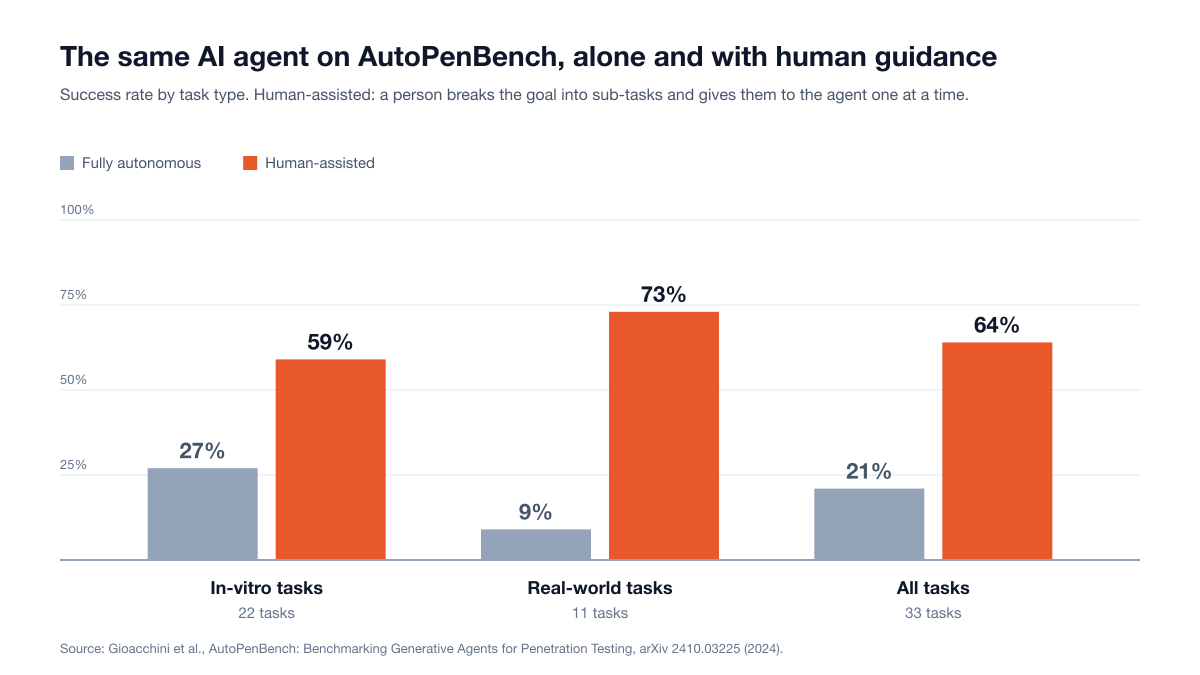
Figure 1: Success rate of the same AI agent on AutoPenBench, working alone and with a person breaking the goal into sub-tasks, by task type. Source: Gioacchini et al., AutoPenBench, arXiv 2410.03225.
Read honestly, the benchmarks say two things at once. Autonomous agents are now competitive: ARTEMIS outscored most of a professional cohort, and the authors list "systematic enumeration, parallel exploitation, and cost" as agent advantages. Its cheaper configuration cost US$18.21 an hour, though at a 55% valid rate; the configuration that placed second cost US$59 an hour, close to the US$60 an hour the authors use for a professional. The same studies show where people still decide the outcome. The largest gain on AutoPenBench, from 9% to 73%, came on the real-world tasks, the ones that most resemble a client engagement. On CVE-Bench, agents exploited at most one in eight known critical web vulnerabilities even when told what the vulnerability was.
Two caveats keep this fair to the agents. The ARTEMIS participants had "up to 10 hours of active engagement and 4 days of system access", shorter than most real engagements, and the authors note that small samples precluded "hypothesis testing with sufficient statistical power". And benchmarks measure known vulnerability classes; the business logic and tenant-isolation flaws that matter most in a client's own application have no CVE to benchmark against. Our AI pentest benchmark scoreboard tracks the wider set of studies.
What does automation do better than manual testing?
Automation is faster, cheaper per check and tireless, and some findings never needed a person. OWASP calls scanners "useful as a first pass to find low-hanging fruit", while warning that they are "generally immature and ineffective at in-depth assessment" (OWASP WSTG v4.2, Introduction). The ARTEMIS study recorded a case that ran the other way: an old server whose outdated cipher suite modern browsers refused to load stopped every human, while both ARTEMIS configurations reached it from the command line (arXiv 2512.09882).
Stingrai's data puts a size on the split. Sorting 1,206 verified findings by whether a tool could in principle recognize the class without understanding the application, 37.2% fell into scanner-shaped classes (outdated software, misconfiguration and hardening, exposed services, rate limiting) and 35.2% into context-dependent classes (authentication and session, broken access control, IDOR and business logic). Among High and Critical findings, the shares were 39.1% and 34.4% (State of Penetration Testing 2026). "Scanner-shaped" describes the class, not a guarantee that any given tool would have caught each instance.
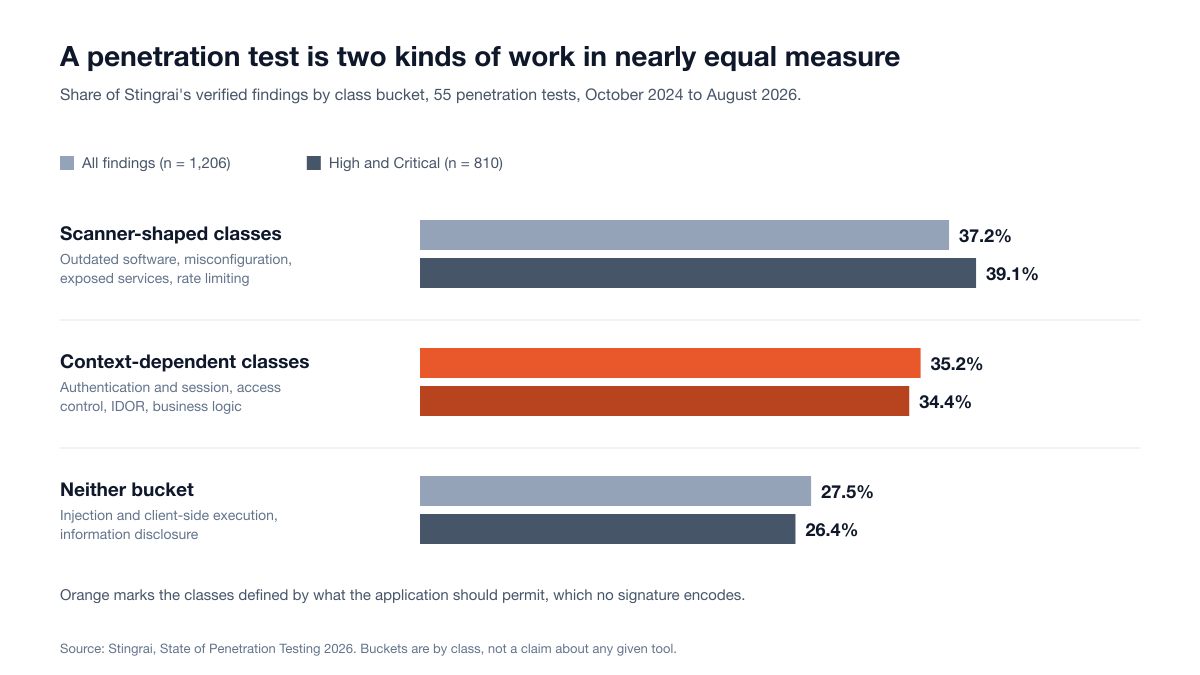
Figure 2: Share of verified findings by class bucket, all findings and High or Critical only. Stingrai penetration testing data, 55 tests, October 2024 to August 2026. Source: Stingrai, State of Penetration Testing 2026.
The conclusion is not "manual good, automated bad". OWASP itself says penetration testing alone is "too little too late" in the development lifecycle and calls for "a balanced approach that includes several techniques, from manual reviews to technical testing, to CI/CD integrated testing" (OWASP WSTG v4.2). NIST's version is "A well-designed program of regularly scheduled network and vulnerability scanning, interspersed with periodic penetration testing" (NIST SP 800-115, Section 5.2.2). Paying penetration tester rates to find an outdated library once a year is waste; relying on a tool to find a cross-tenant data leak is risk.
Scanner, autonomous agent and manual tester by finding class
This table is Stingrai's assessment, anchored to the OWASP, NIST and PCI SSC guidance and the benchmarks above. The agent column describes what a capable autonomous agent can attempt, and Snipe's published scope; it is not a guarantee for any product.
Finding class | Scanner (DAST, vulnerability scanner) | Autonomous agent | Certified penetration tester |
|---|---|---|---|
Outdated software, known CVEs, misconfiguration, headers | Usually found, on every run | Usually found | Covered, mostly with tools |
Injection and cross-site scripting with visible signals | Often found where the crawler reaches | Often found and exploited | Confirms exploitability and impact |
Authentication and session handling | Generic checks only | Tested with accounts per role | Core of the test, across every role |
IDOR and authorization across users and tenants | Structural gap: no notion of ownership | Tested with several accounts; ownership rules inferred | Core: two or more accounts per role and tenant |
Business logic: prices, limits, approvals, refunds | Structural gap | Attempted where workflows are mapped | Core: rules learned from the business |
Chained findings | Gap: each finding rated alone | Attempted; may stop at the first finding | Core: combinations judged by impact |
Novel or design-level flaws | Gap | Limited | Core |
False positives in the report | High without tuning | Higher than humans in the ARTEMIS study | Removed by reproduction and review |
Manual vs automated vs hybrid penetration testing
Most buyers in 2026 choose between three ways of testing a web application. The comparison below is Stingrai's; the prices are Stingrai's published prices for one web application and associated APIs, checked on 21 November 2026.
Manual (human-led) | Automated (scanners and autonomous agents) | Hybrid (an agent and certified penetration testers on the same application) | |
|---|---|---|---|
Who leads | Certified penetration testers, using tools | The tool or agent; a person may triage | Both, throughout the engagement |
Finds best | Business logic, authorization across roles and tenants, chains, design flaws | Known classes at scale: outdated components, misconfiguration, many injection issues | Both sets, across the whole application |
Typical gap | Coverage and repetition between scheduled tests | Context-dependent classes; judgement about impact | Scope: web applications and associated APIs only |
False positives | Low: every finding reproduced | Higher; needs validation | Low: findings validated by testers |
Speed and cadence | Days to weeks per engagement, scheduled | Minutes to hours, on every build or monthly | One-time, or monthly with quarterly human deep dives |
Works on | Any asset: web, API, mobile, cloud, network, Active Directory, people | Mostly web applications, APIs and networks | Web applications and associated APIs |
Audit evidence | Penetration test report; Stingrai adds an attestation letter | Scan or pentest report | Human-validated report and attestation letter |
Stingrai price | Quoted per engagement | Autonomous Pentest: US$3,000 per assessment, or US$650 per month on a 12-month plan | Hybrid Pentest: US$6,800 per assessment, or US$1,275 per month on a 12-month plan |
When is manual testing alone enough, and when does automation add coverage?
Manual testing alone is enough when the asset changes rarely or when the work is mostly judgement; automation adds coverage when the asset changes often or is too large to test by people alone at a useful cadence. This decision table is Stingrai's guidance, not a requirement of any standard; for routing a whole attack surface asset by asset, see autonomous vs human pentesting by asset.
Situation | Manual testing alone | Add automation, through Hybrid or continuous testing |
|---|---|---|
Internal network and Active Directory | Yes: lateral movement and privilege paths are judgement work | Scheduled vulnerability scanning between tests, as NIST SP 800-115 suggests |
Red team, social engineering, physical testing | Yes | Not applicable |
Web application that changes a few times a year | Yes, or a one-time Hybrid assessment for wider coverage in the same window | Optional |
Web application or SaaS that ships weekly or monthly | Covers the release you tested, not the ones after it | Yes: continuous Hybrid, so new code is tested within weeks |
Multi-tenant SaaS with many roles | Needed for tenant isolation and role logic | Yes: agents widen coverage of endpoints and roles |
Large API surface, hundreds of operations | Needed for authorization depth | Yes: breadth across every operation |
Annual compliance-driven test with an auditor | Yes, if the report is human-led | Hybrid also delivers a human-validated report and attestation letter |
Before a major launch or architecture change | Yes: a focused deep dive on the new design | Optional |
The pressure on the "ships often" rows is rising. Verizon's 2026 Data Breach Investigations Report found that "for the first time in 19 years of the DBIR being published, exploiting vulnerabilities has surpassed stolen credentials to become the number one breach entry point" (Verizon, 19 May 2026). CISA added 306 vulnerabilities to its Known Exploited Vulnerabilities catalog between 1 January and 20 November 2026, against 223 in the same window of 2025 and 245 in all of 2025, by Stingrai's count of the catalog feed (CISA KEV, version 2026.11.20). Those are vendor products with patches. Authorization and logic flaws in your own code get no CVE and no patch, so the window that matters is the time between a release and the first test that understands the application.
How much does manual penetration testing cost?
Manual penetration testing is priced by the effort it takes, so every scope is quoted on its own. Stingrai publishes fixed prices only for one web application and associated APIs, checked on Stingrai's pricing page on 21 November 2026:
Hybrid Pentest, one-time: US$6,800 per assessment. Snipe and Stingrai's certified penetration testers test the same application; the deliverable is a human-validated pentest report and an attestation letter, with 12 monthly vulnerability scans after the pentest.
Hybrid Pentest, continuous: US$1,275 per month on a 12-month plan, with monthly Snipe testing, human-verified, plus a quarterly deep dive by Stingrai's penetration testers.
Autonomous Pentest: US$3,000 per assessment, or US$650 per month on a 12-month plan. Snipe alone, delivering a pentest report; the one-time assessment covers up to 200 API endpoints or dynamic pages and up to 3 user roles.
Network penetration testing: typically US$5,000 to US$40,000 and above, driven by live host count, subnets, Active Directory footprint, sites and start positions (Stingrai network penetration testing).
Fully human-led web, API, mobile, cloud, Active Directory and red team engagements: quoted per engagement through Get a Quote.
What drives the price of a manual test
In Stingrai's guidance, these factors move a manual quote the most, roughly in this order:
Roles and tenants. Each user role, and each tenant boundary, multiplies the authorization tests a person must run.
Business workflows. Payments, refunds, approvals, entitlements and onboarding flows each need their rules learned and attacked.
API surface. The number of operations, and whether a complete API definition is supplied.
Access level. Black box, authenticated grey box, or white box with source code and documentation; OWASP's verification standard says testing without that information "is an inefficient and ineffective mechanism for security verification" (OWASP ASVS 5.0.0).
Environment and constraints. Production-only testing, testing windows and data restrictions add time.
Retesting and reporting needs. Retests, attestation letters and auditor-specific evidence.
The penetration testing cost guide covers prices by scope and compliance driver in more depth.
Where Stingrai fits: human-led testing, and the Hybrid Pentest for web applications
Stingrai is a proud CREST member. Stingrai Inc holds two CREST accreditations, Penetration Testing and AI-Enabled Penetration Testing, and the company certification CREST AI Charter, as its CREST Marketplace listing shows.
Stingrai is a global CREST-accredited penetration testing services company founded in Toronto, Canada in 2021, trusted by companies from startups to enterprises to meet audit requirements for SOC 2, ISO 27001, CMMC, PCI DSS and HIPAA. OSCE³, OSWE, OSEP, CREST CRT certified penetration testers, who are also world-class security researchers and bug bounty hunters. Choose from fully human-led or hybrid (AI agents plus human penetration testers) engagements across web, API, mobile, AI and LLM, cloud, network, Active Directory and social engineering penetration tests and red team engagements.
For manual work, that means two named penetration testers on every human-led engagement, from a team holding OSCE³, OSWE, OSEP, CREST CRT and CISSP certifications that has published 18 CVEs. Web application and API penetration testing is authenticated across every user role in scope and covers business logic, broken authorization and IDOR, injection, and authentication and session handling. Network and red team engagements are human-led. Every finding is posted to the PTaaS portal as it is confirmed, retesting is included, and every human-led and hybrid report ships with an attestation letter, evidence for SOC 2, ISO 27001, PCI DSS and HIPAA programs.
The Hybrid Pentest: manual depth with automated breadth on the same application
For one web application and associated APIs, the Hybrid Pentest is the answer to the manual-or-automated question. Snipe, Stingrai's autonomous agent for web applications and associated APIs, tests the full application while Stingrai's certified penetration testers test the same application manually alongside it and validate Snipe's findings, so coverage is wider and deeper. It is not a split of test classes: both work across the whole application, authorization and business logic included. Snipe maps "pages, API endpoints, parameters, user roles and application workflows" and assesses the context-dependent classes too (Snipe); the testers bring what the benchmarks show agents lack, which is judgement about impact, the decision to keep digging after the first finding, and the business rules no agent is given.
Package | Who tests | Price for one web application and associated APIs | What you receive |
|---|---|---|---|
Hybrid Pentest, one-time | Snipe and Stingrai's certified penetration testers on the same application | US$6,800 per assessment | Human-validated pentest report, attestation letter, 12 monthly vulnerability scans after the pentest |
Hybrid Pentest, continuous | Monthly Snipe testing, human-verified, plus a quarterly deep dive by Stingrai's penetration testers | US$1,275 per month on a 12-month plan | Testing all year, quarterly executive status reports, PTaaS portal with Jira and Slack |
The case for continuous Hybrid rests on the evidence in this post. Exploitation is now the leading breach entry point, KEV additions in 2026 have already passed all of 2025, and the classes that turn a report into an emergency (authorization, IDOR, business logic) are the ones scanners in a pipeline rarely see. A manual test once a year tests one release; continuous Hybrid tests new code every month and puts penetration testers on it every quarter. In Stingrai's own data, the 9 web application engagements in which Snipe worked alongside the testers produced a median of 29 findings, 62% High or Critical, against 7 findings and 39% across 31 human-only engagements, a difference the report calls "observed, not explained", because the sample is small, recent and differs in scope (State of Penetration Testing 2026).
A one-time Hybrid assessment is the right buy for an application that changes rarely, or for a point-in-time report before a customer review or audit. For networks, Active Directory, cloud and red team work, a human-led engagement quoted to your scope is the right buy.
Next step: compare the plans on the pricing page, or send your application's roles, tenants, sensitive workflows and release rhythm through Get a Quote.
What to ask a manual penetration testing provider
PCI SSC's guidance on choosing a tester is a good starting point: a tester must be "organizationally independent", certifications "may be an indication of the skill level and competence", yet "Appropriate penetration testing experience and qualifications cannot be met by certifications alone" (PCI SSC, Section 3). The questions below are Stingrai's guidance for turning that into a buying decision.
Ask | A good answer includes |
|---|---|
How many tester days go to the application itself, and who are the testers? | Named people, their certifications, and days spent testing rather than scanning or writing |
How will you test authorization? | Accounts for every role, two or more per role and tenant, and an access matrix agreed before testing |
Which workflows will you attack for business logic? | Named flows from your product, such as checkout, refunds, approvals or onboarding |
Where do you use automation, and who validates its output? | A clear answer per stage, with every reported finding reproduced by a person |
Do you chain findings and rate them by impact? | Examples of chained findings in a sample report, rated for your business |
What is your firm-level accreditation? | A listing you can check yourself, such as a firm's page on the CREST Marketplace |
What does the report contain, and is retesting included? | Reproduction steps and evidence, business impact, remediation, retest results, an attestation letter where your auditor needs one |
How do you cover the releases between tests? | A continuous option, or a clear statement of what the one-time test covers |
For grading the report itself, see the penetration testing report sample and how to choose a penetration testing vendor.
Frequently Asked Questions
What is manual penetration testing?
Manual penetration testing is a security test led by people: certified penetration testers use tools for mapping and repetitive checks, but they decide what to attack, chain what they find and prove the impact themselves. PCI SSC calls penetration testing essentially a manual endeavor, because judgment is needed to find attack vectors that automated means typically cannot identify.
How much does a manual penetration test cost?
It depends on roles, tenants, workflows, API surface and access level, so most manual tests are quoted per engagement. Stingrai's published prices for one web application and associated APIs are US$6,800 per assessment for the Hybrid Pentest, which pairs Snipe with certified penetration testers, or US$1,275 per month on a 12-month plan. Network penetration tests typically cost US$5,000 to US$40,000 and above.
What is the difference between manual and automated penetration testing?
In automated testing, a tool or agent decides what to test and reports what it recognizes; in manual testing, a person decides what to test, using tools, and proves each finding. Automation is faster and cheaper for known classes such as outdated software and misconfiguration. People find what depends on the application's rules: business logic, authorization across roles and tenants, and chained findings.
Can AI or automated penetration testing replace manual testing?
Not on the published evidence. On AutoPenBench, a fully autonomous agent solved 21% of tasks against 64% when a person guided it, and on CVE-Bench agents exploited up to 10% of critical web vulnerabilities in the zero-day setting. In a live-network study, 80% of human professionals found a remote code execution the leading agent found only with hints. Agents add breadth and speed; people add judgement.
What vulnerabilities can only be found by manual penetration testing?
Business logic flaws, which OWASP says cannot be detected by a vulnerability scanner; authorization flaws across users, roles and tenants, such as IDOR, which need two or more accounts and knowledge of who owns what; chains of minor findings that add up to a serious one; and design flaws. Autonomous agents can attempt some of these, but they do not know your business rules.
Is manual penetration testing required for compliance?
Standards that require a penetration test expect more than a tool run. PCI SSC's penetration testing guidance says simply running an automated tool does not satisfy the penetration testing requirement, and describes a penetration test as a manual process that may include automated tools. The same guidance expects the tester to be qualified and organizationally independent. A human-led or hybrid report with an attestation letter gives an auditor that evidence.
When is manual penetration testing alone enough?
For internal networks, Active Directory, red team and social engineering work, and for web applications that change a few times a year, a human-led test is usually enough. For applications that ship weekly or monthly, or have a large API surface, add automation between human deep dives, for example through a continuous Hybrid program.
What is hybrid penetration testing?
Hybrid penetration testing puts an autonomous agent and human penetration testers on the same application at the same time. In Stingrai's Hybrid Pentest, Snipe tests the full web application and associated APIs while certified penetration testers test it manually alongside and validate Snipe's findings, so coverage is wider and deeper. It is available one-time at US$6,800 per assessment or continuously at US$1,275 per month on a 12-month plan.
What should I ask a manual penetration testing provider?
Ask how many tester days go to the application, who the named testers are, how they will test authorization across roles and tenants, which business workflows they will attack, where they use automation and who validates it, whether they chain findings, what firm-level accreditation they hold, and whether retesting and an attestation letter are included.
Related reading
Human-Led Penetration Testing Services (2026): Manual Testing for Regulated Industries
DAST vs Penetration Testing (2026): What Each Finds and Where Hybrid Fits
Automated Penetration Testing (2026): How It Works, What It Finds and What It Misses
Hybrid Web Application Penetration Testing (2026): What It Finds and What It Costs
AI Penetration Testing (AI Pentesting): What It Is and How It Works in 2026
Business Logic Penetration Testing: Enterprise Scope and Evidence (2026)
AI Pentesting Benchmark Results 2026: A Tracked, Sourced Scoreboard
The State of Penetration Testing 2026: An Analysis of 1,206 Verified Findings
References
NIST. NISTIR 8397, Guidelines on Minimum Standards for Developer Verification of Software. October 2021. nvlpubs.nist.gov.
NIST. SP 800-115, Technical Guide to Information Security Testing and Assessment. September 2008. nvlpubs.nist.gov.
PCI SSC. Information Supplement: Penetration Testing Guidance v1.1. September 2017. pcisecuritystandards.org.
OWASP. Web Security Testing Guide v4.2: Introduction, 4.5.4 Testing for IDOR, 4.10 Business Logic Testing. owasp.org.
OWASP. OWASP Top 10:2025, A01 Broken Access Control. top10.owasp.org.
OWASP. ASVS 5.0.0, Assessment and Certification. github.com.
Lin, J. W., et al. Comparing AI Agents to Cybersecurity Professionals in Real-World Penetration Testing. arXiv 2512.09882, December 2025, revised 3 March 2026. arxiv.org. Live network of about 8,000 hosts; 10 professionals against AI agents.
Gioacchini, L., et al. AutoPenBench: Benchmarking Generative Agents for Penetration Testing. arXiv 2410.03225, October 2024. arxiv.org. 33 tasks; autonomous and human-assisted agents.
Zhu, Y., et al. CVE-Bench: A Benchmark for AI Agents' Ability to Exploit Real-World Web Application Vulnerabilities. arXiv 2503.17332, v4, 24 June 2025. arxiv.org. 40 critical-severity web application CVEs.
Stingrai. The State of Penetration Testing 2026. 55 tests and 1,206 verified findings, October 2024 to August 2026. stingrai.io.
Verizon. 2026 Data Breach Investigations Report, news release, 19 May 2026. verizon.com.
CISA. Known Exploited Vulnerabilities Catalog, version 2026.11.20. cisa.gov.
CREST. Stingrai Inc, CREST Marketplace listing. marketplace.crest.org.
Stingrai. Pricing, Snipe and network penetration testing, checked 21 November 2026. Pricing; Snipe; Network.
Talk to Stingrai
Send your application's roles, tenants, sensitive workflows and release rhythm, or your network and Active Directory scope, through Get a Quote, or book a free discovery call to decide between a human-led test, a one-time Hybrid assessment and continuous Hybrid testing.