




A 2026 explainer for security engineers, AppSec leaders, and buyers who keep seeing "AI pentesting" on vendor pages and want a clear definition. We define the term, show how agentic AI testing works phase by phase, and separate it from scanners and from human pentesting.
TL;DR: What Is AI Pentesting?
AI pentesting is penetration testing that uses AI agents to automate and enhance the testing workflow, while keeping human oversight for the highest-impact judgment. XBow defines it as testing where "AI becomes a force multiplier, allowing teams to complete more pen tests faster." Here is what matters.
It is agentic, not a scanner. A scanner matches known patterns. An AI pentester forms hypotheses, adapts to responses, chains exploits across steps, and proves findings by exploiting them.
The capability is real. An autonomous AI agent reached number one on HackerOne's US leaderboard in June 2025, outranking thousands of human researchers in that ranking while placing sixth worldwide (XBow, 2025; XBow leaderboard writeup, 2025).
The category exploded. Open-source AI offensive tools grew from fewer than five before March 2023 to 70 by March 2026 (Hadrian, 2026).
Autonomy alone is not enough. AutoPenBench shows fully autonomous agents reach 21 percent success versus 64 percent with a human assist (EMNLP 2025). The strongest 2026 model is hybrid: Stingrai's Hybrid tier pairs the Snipe agent with senior pentester validation.
Key Takeaways
AI pentesting is a workflow, not a single tool. It applies machine intelligence at each phase of a penetration test (discovery, exploitation, validation, reporting) rather than running one scan. XBow's framing is that AI is a force multiplier that lets teams complete more tests faster, not a replacement for the test itself.
The defining difference from a scanner is exploitation. Scanners report what might be vulnerable. AI pentesters confirm what is exploitable by reproducing the exploit in a controlled environment. That validation step is the line between an alert and a finding.
Autonomous AI has crossed a real capability threshold. An AI agent topped HackerOne's US leaderboard in June 2025 and placed sixth worldwide, and time-to-exploit for new vulnerabilities compressed from 756 days in 2018 to 4 hours in 2024 (Hadrian, 2026). This is not a future technology.
Hybrid beats pure autonomy for the hard bugs. XBow's own internal benchmarking found its agent outperformed all testers on easy and medium tasks but underperformed an expert on hard tasks. That is the structural reason the strongest services keep senior humans testing alongside the agent, and the gap Stingrai's Snipe is built to close on the complex classes.
How an Agentic AI Penetration Test Works
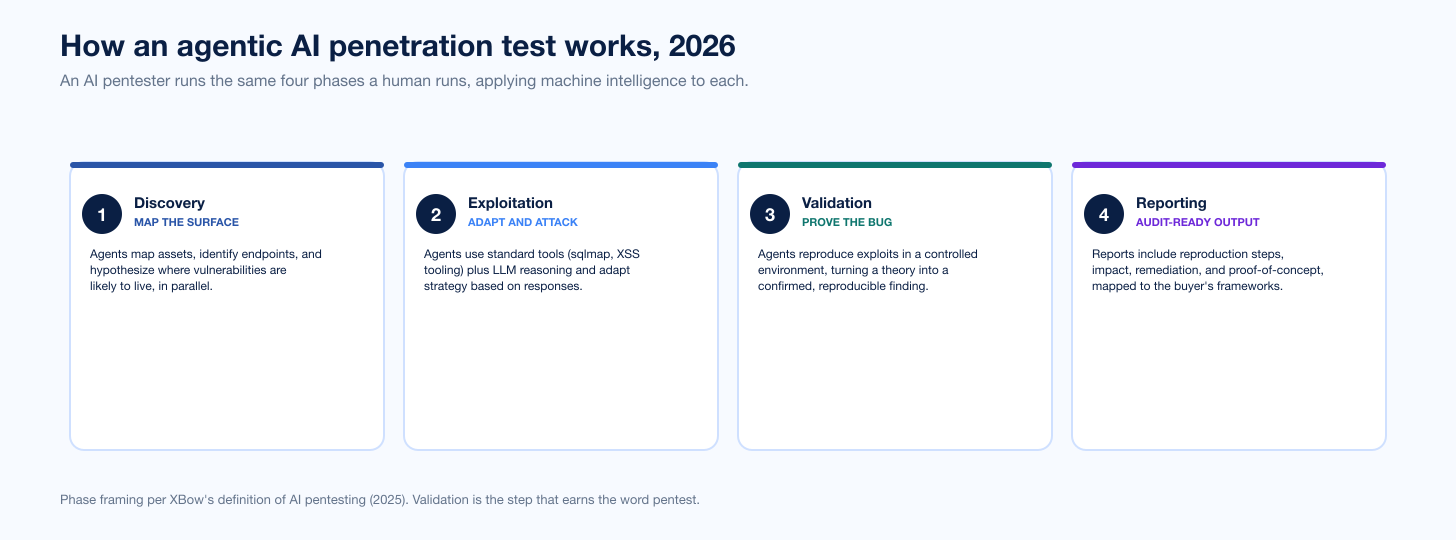
Figure 1: The four phases of an agentic AI penetration test, 2026. Phase framing per XBow's definition of AI pentesting.
An agentic AI pentester runs the same four phases a human tester runs, applying machine intelligence to each. XBow's breakdown maps cleanly onto these phases.
1. Discovery
AI agents map assets, identify endpoints and attack surfaces, and hypothesize where vulnerabilities are likely to live, faster than a human can. This is where breadth pays off: an agent can enumerate a large surface and prioritize promising targets in parallel.
2. Exploitation
Agents conduct simulated attacks using standard penetration testing tools (for example sqlmap and cross-site-scripting tooling) plus large language models for reasoning, and quickly adapt their strategies based on the application's responses. This adaptive, hypothesis-driven behavior is what separates an AI pentester from a signature-based scanner.
3. Validation
AI agents reproduce exploits in controlled environments to confirm findings. This is the most important phase for buyers: it converts a theorized issue into a proven, reproducible vulnerability and is the reason AI pentesting earns the word "pentest" rather than "scan."
4. Reporting
Automated reports include descriptions, reproduction steps, impact assessments, remediation guidance, and proof-of-concept material. Good AI pentest reporting is audit-ready and maps findings to the frameworks a buyer has to satisfy.
AI Pentesting vs Scanners vs Traditional Pentesting
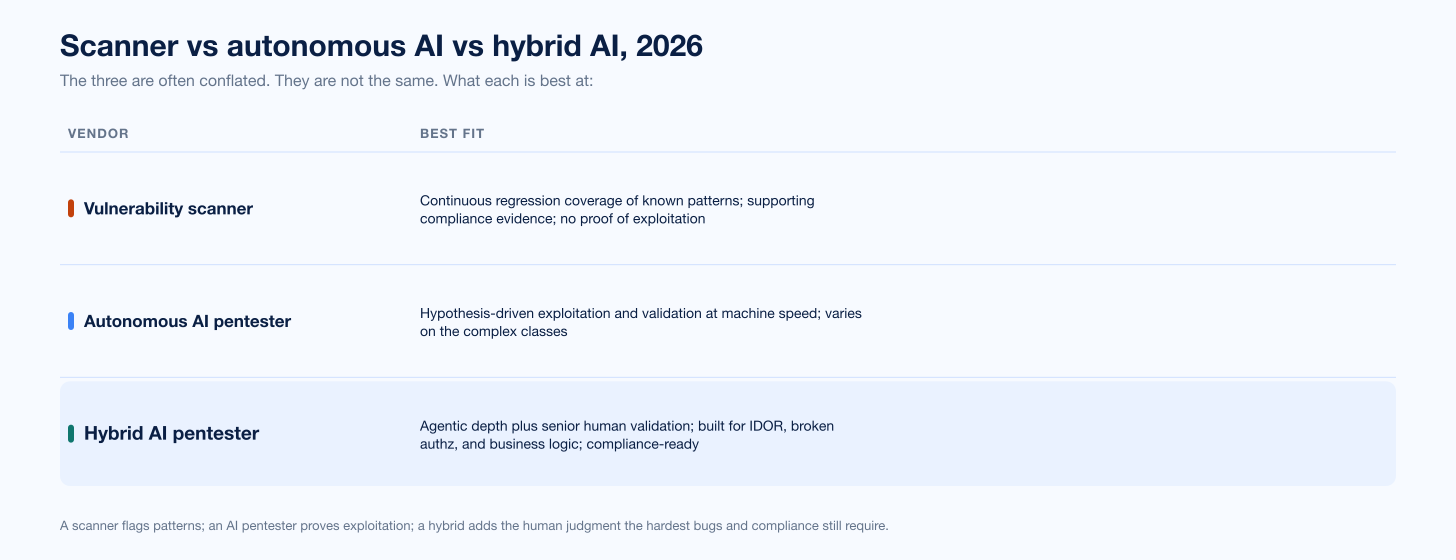
Figure 2: What a scanner, an autonomous AI pentester, and a hybrid AI pentester are each best at, 2026.
The three are often conflated. They are not the same.
Capability | Vulnerability scanner | Autonomous AI pentester | Hybrid AI pentester |
|---|---|---|---|
Core method | Signature and pattern matching | Hypothesis-driven agentic reasoning | Agentic reasoning plus human validation |
Proves exploitation | No | Yes, reproduces in a controlled environment | Yes, plus senior pentester confirmation |
Adapts to responses | No | Yes | Yes |
Complex classes (IDOR, business logic) | Rarely | Varies by tool | Yes, by design |
Compliance fit | Supporting evidence | Supporting evidence, no human sign-off | Strong, senior human review built in |
A scanner is excellent for continuous regression coverage of known patterns. An autonomous AI pentester adds hypothesis-driven exploitation and validation. A hybrid AI pentester adds the senior human judgment that the hardest bugs still require. For a fuller side-by-side of human-led versus AI-led testing, see our traditional vs AI pentesting comparison.
What AI Pentesting Is Not
AI pentesting is not a magic replacement for human expertise, and it is not just a scanner with a new label. Two grounding facts.
It does not replace humans in 2026. HackerOne's 2025 report found only 12 percent of researchers believe AI could fully replace them, while more than two-thirds already use AI in their workflow (HackerOne 9th HPSR, 2025). Stanford's 2025 ARTEMIS study found 80 percent of human participants caught a critical RCE that ARTEMIS reported only under guided elicitation with hints (arXiv 2512.09882).
It is not pattern-only. Generic AI tools do skew toward pattern bugs: HackerOne found 78 percent of valid hackbot findings were cross-site scripting in 2025. But a purpose-built agentic pentester reaches further. That gap between generic pattern coverage and the complex, high-impact classes is exactly what the next section is about.
Where Stingrai's Snipe Fits
Snipe is Stingrai's AI agent for web application penetration testing, including the application's APIs. It is available for autonomous web testing or alongside penetration testers in a Hybrid web engagement. The design point is depth, not just speed.
It hunts the complex classes generic AI misses. Most AI scanners cap out at known-class bugs such as cross-site scripting, SQL injection, and misconfiguration. Snipe is Stingrai's AI agent for web application penetration testing, including the application's APIs. It is available for autonomous web testing or alongside penetration testers in a Hybrid web engagement. That is the whole point of the agent.
It is trained on real bugs and real methodology. Snipe is Stingrai's AI agent for web application penetration testing, including the application's APIs. It is available for autonomous web testing or alongside penetration testers in a Hybrid web engagement.
It runs both halves of the test. Snipe performs black-box dynamic testing and white-box source-code review, generates AutoFix pull requests, and can run as a PR-gating check that blocks vulnerable code from being merged.
On the Hybrid tier, senior pentesters work alongside Snipe throughout the engagement, steering it and extending what it finds across every severity. The hybrid is not a fallback for an incapable agent; it is senior testers confirming and chaining what Snipe finds. Stingrai's pricing productizes, for one web application and its APIs, an Autonomous Snipe tier carrying the "No High or Critical Finding = Don't Pay" guarantee and a Hybrid tier with penetration testers testing alongside Snipe throughout, alongside a custom scoped Enterprise tier.
Stingrai was founded in 2021, is headquartered in Toronto with a London, UK office, and is a CREST-accredited Penetration Testing service provider at the firm level. Stingrai's penetration testing supports your SOC 2, ISO 27001, and PCI DSS compliance programs by providing audit-ready evidence. See also our AI pentesting tools 2026 guide and best AI model for pentesting.
Frequently Asked Questions
What is AI pentesting?
AI pentesting is penetration testing that uses AI agents to automate and enhance the testing workflow across discovery, exploitation, validation, and reporting, while keeping human oversight for the highest-impact judgment. As XBow puts it, AI becomes a force multiplier that lets teams complete more tests faster. Unlike a scanner, an AI pentester proves findings by exploiting them.
How is AI pentesting different from a vulnerability scanner?
A scanner matches known signatures and reports potential issues. An AI pentester uses agentic reasoning to form hypotheses, adapt to the application's responses, chain exploits across multiple steps, and confirm findings by reproducing the exploit. The defining difference is that AI pentesting proves exploitation, while a scanner only flags patterns.
Can AI pentesting replace human pentesters?
No, not in 2026. HackerOne's 2025 report found only 12 percent of researchers believe AI could fully replace humans, and Stanford's 2025 ARTEMIS study found 80 percent of human participants caught a critical RCE that ARTEMIS reported only under guided elicitation with hints. AI pentesting is strongest as a hybrid, with senior humans validating the high-severity findings.
Is AI pentesting accurate?
It is accurate enough that an autonomous agent topped HackerOne's US bug-bounty leaderboard in June 2025, but it still produces more false positives than humans. Stanford's 2025 study found its AI agent submitted more false positives than the human participants. This is why validation, by the agent and then by a senior pentester, is central to a credible AI pentest.
What can AI pentesting find that scanners cannot?
Agentic AI pentesting can chain multi-step exploits and reason about application behavior, which lets a purpose-built agent reach complex classes such as IDOR, broken authorization, and business logic flaws. Generic AI tools still skew toward pattern bugs, but tools like Stingrai's Snipe are built specifically to hunt the high-impact classes that signature scanners miss.
Does Stingrai do AI pentesting?
Yes. Stingrai's Snipe is an autonomous AI agent for web application penetration testing, deployed as the engine for Stingrai's Autonomous and Hybrid tiers, one-time or continuous. Snipe runs black-box plus white-box testing, generates AutoFix pull requests, runs as a PR-gating check, and on the Hybrid tier is backed by senior pentesters working alongside it throughout.
References
XBow. What Is AI Pentesting. 2025. https://xbow.com/blog/what-is-ai-pentesting. Defines AI pentesting and walks through discovery, exploitation, validation, and reporting, including the HackerOne leaderboard result.
XBow. How XBow Ranked #1 in Autonomous Penetration Testing. 2025. https://xbow.com/blog/top-1-how-xbow-did-it. Source for the June 2025 US leaderboard placement and the submission volume behind it.
HackerOne. The Top Researcher Signals From HackerOne's 2025 HPSR (9th Hacker-Powered Security Report). 2025. https://www.hackerone.com/blog/2025-hpsr-researcher-signals. Survey of researcher AI adoption, hackbot finding classes, and AI-versus-human sentiment.
Lin, J. W., et al. Comparing AI Agents to Cybersecurity Professionals in Real-World Penetration Testing (ARTEMIS). arXiv 2512.09882, December 2025, revised March 2026. https://arxiv.org/abs/2512.09882. Live comparison of AI agents and human pentesters, including the false-positive comparison and the TinyPilot RCE result.
Hadrian. The AI Offensive Security Boom: Seventy Tools in Eighteen Months. 2026. https://hadrian.io/blog/the-ai-offensive-security-boom-seventy-tools-in-eighteen-months. Census of open-source AI offensive tools and time-to-exploit compression.
Stingrai. Pricing and Snipe AI Pentesting Agent. 2026. https://www.stingrai.io/pricing. Productized Autonomous and Hybrid pentest tiers powered by the Snipe agent, with an outcome-based guarantee.