Authentication and session flaws are the web application vulnerability that penetration testers report most often. They made up 28.1% of 768 verified findings from 40 web application tests in Stingrai's State of Penetration Testing 2026, followed by misconfiguration (14.2%), information disclosure (12.5%), broken access control (9.9%), injection (8.2%) and insecure direct object references (7.9%). The OWASP Top 10:2025, built on data that contributors gave for more than 2.8 million applications, puts Broken Access Control first. And CISA's Known Exploited Vulnerabilities catalog shows which weaknesses attackers actually use: of the 551 entries it added from 1 January 2025 to 20 November 2026, the most frequent were OS command injection, deserialization, code injection and path traversal.
Those sources measure different things, and the difference matters when planning a test. This guide puts them side by side, then works through each common class with one documented example, how testers find it and how to fix it. It links to the deeper Stingrai posts on cross-site scripting, IDOR, SSRF and the OWASP Top 10 rather than repeating them.
Quick answer. The most common web application vulnerabilities in 2026 are broken access control (including IDOR), authentication and session flaws, security misconfiguration, injection (SQL, command and cross-site scripting), SSRF, path traversal, unsafe file upload, insecure deserialization, HTTP request smuggling, software supply chain failures and business logic flaws. Scanners catch known components and configuration gaps; authorization, session and logic flaws need authenticated testing across user roles by people. Stingrai's Hybrid Pentest runs Snipe, its autonomous agent, and certified penetration testers on the same application, one-time or continuously.
What are web application vulnerabilities?
A web application vulnerability is a weakness in the code, configuration or design of a web application or its APIs that lets someone do something the application should not allow: read another customer's records, act as another user, run commands on the server or change data they should only see. Three vocabularies describe these weaknesses, and buyers often mix them up.
CWE (Common Weakness Enumeration) is MITRE's catalogue of weakness types, such as CWE-89 for SQL injection or CWE-639 for authorization bypass through a user-controlled key (the weakness behind IDOR).
OWASP Top 10 categories group many CWEs into ten risk areas. A01:2025 Broken Access Control, for example, maps 40 CWEs, including path traversal, CSRF, SSRF and open redirect.
CVE records identify one specific flaw in one specific product version, such as CVE-2025-29927 in Next.js.
The distinction matters because the flaws in your own application rarely get a CVE. A broken authorization check in a custom billing portal is reported by a tester or a bug bounty researcher, fixed and closed; it never appears in CISA's catalogue. CVE-based datasets therefore over-represent flaws in widely deployed products (frameworks, appliances, content management systems), and testing datasets represent the code your team wrote. You need both views.
Which web application vulnerabilities are most common in 2026?
Five public datasets answer the question in five different ways. None of them is wrong; each counts a different thing.
Lens | What it counts | What it ranks highest | Source |
|---|---|---|---|
OWASP Top 10:2025 | Share of tested applications with a mapped CWE, from data for over 2.8 million applications, weighted with CVE exploit and impact scores and a community survey | A01 Broken Access Control, then A02 Security Misconfiguration | |
MITRE 2025 CWE Top 25 | 39,080 CVE records published from 1 June 2024 to 1 June 2025, scored for frequency and severity | Cross-site scripting (#1), SQL injection (#2), CSRF (#3), missing authorization (#4) | |
Stingrai State of Penetration Testing 2026 | 768 verified findings from 40 web application penetration tests, October 2024 to August 2026 | Authentication and session (28.1%), misconfiguration (14.2%), information disclosure (12.5%) | |
CISA KEV catalog | Vulnerabilities with evidence of active exploitation, every product type; 551 entries added 1 January 2025 to 20 November 2026 | OS command injection (36), deserialization (30), code injection (27), path traversal (27), improper authentication (25) | |
Verizon 2026 DBIR | Initial access vectors in breaches, incidents from 1 November 2024 to 31 October 2025 | Exploitation of vulnerabilities, 31% of non-Error, non-Misuse breaches (n=20,023), ahead of credential abuse at 13% |
Read together, they tell a consistent story. In custom application code, identity holds the largest share of findings: authentication, session handling and authorization. In packaged products and frameworks, injection, deserialization and path traversal are what attackers turn into code execution at scale. And breaches increasingly start with exploitation rather than stolen passwords, though stolen passwords remain the top action inside Verizon's Basic Web Application Attacks pattern (3,217 incidents, 2,281 with confirmed data disclosure).
What penetration testers find in web applications
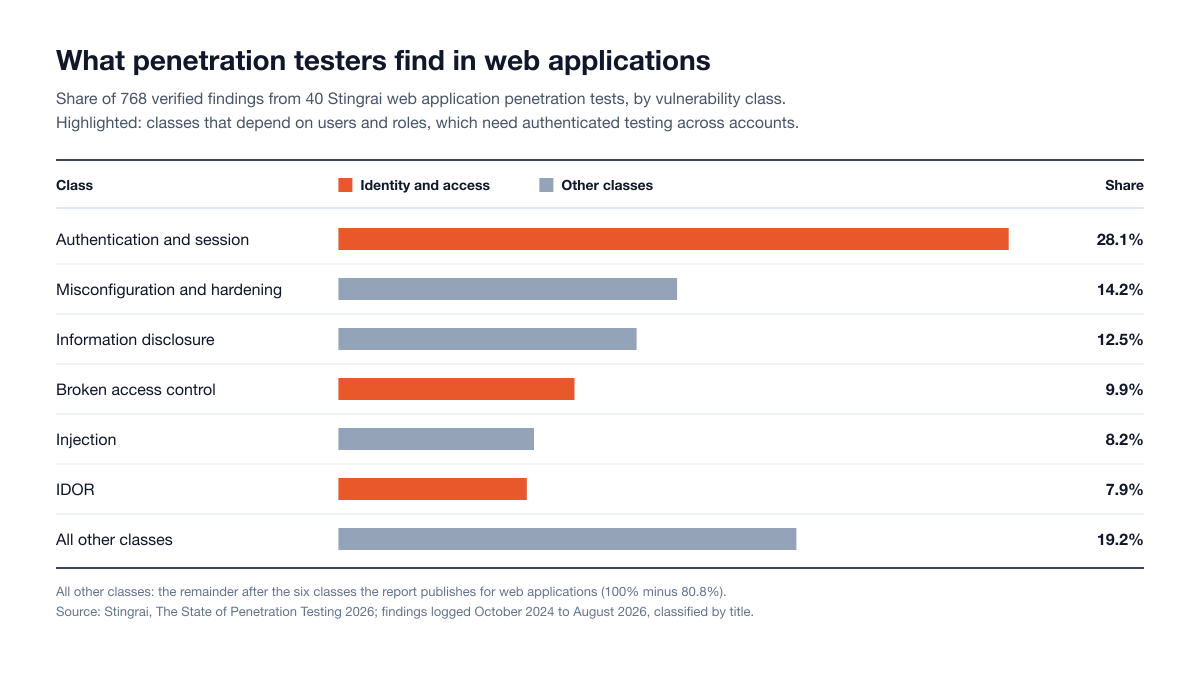
Figure 1: Verified findings from 40 Stingrai web application penetration tests by class (n=768), October 2024 to August 2026. "All other classes" is the remainder after the six published classes. Source: Stingrai, State of Penetration Testing 2026.
Broken access control and IDOR together account for 17.8% of web application findings, and authentication and session issues alone for 28.1%. In the same dataset, 70% of the 40 web application tests that produced findings surfaced at least one High or Critical authentication or authorization finding, and 48% surfaced a High or Critical injection. This is one firm's data, classified from finding titles, so treat it as an observed mix rather than an industry rate.
What attackers exploit
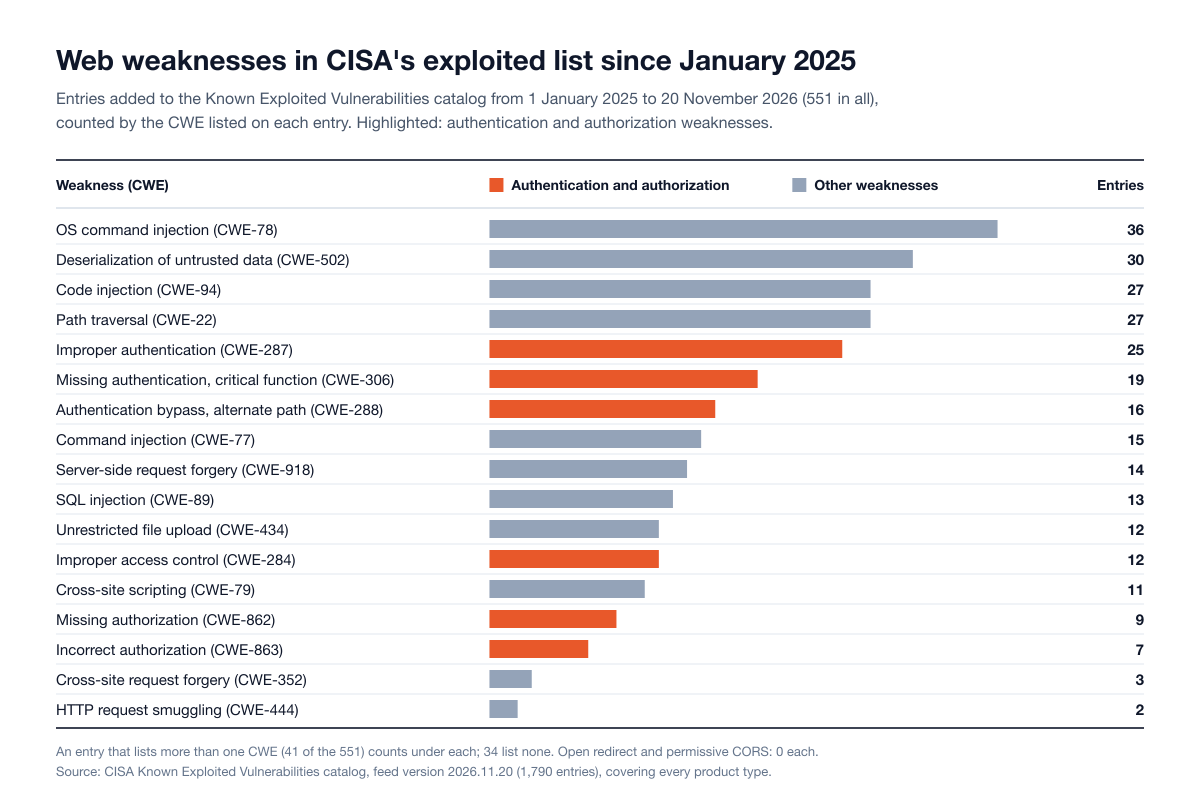
Figure 2: Web weakness types (CWE) among the 551 entries added to the CISA Known Exploited Vulnerabilities catalog from 1 January 2025 to 20 November 2026, catalog version 2026.11.20. An entry that lists more than one CWE (41 of the 551) counts under each; 34 list none. Source: CISA KEV catalog.
KEV covers every product type, so it is a signal of what gets exploited, not a census of web applications. Even so, 86 of the 551 entries carry at least one authentication or authorization weakness and 98 carry at least one injection weakness. Two classes from the OWASP list, open redirect (CWE-601) and permissive CORS policies (CWE-942), have no KEV additions in this window at all. That does not make them harmless: they mostly live in bespoke code that never receives a CVE.
The web application vulnerability list, mapped to OWASP Top 10:2025
The table below is the catalogue this guide works through. OWASP categories and CWE IDs come from the OWASP Top 10:2025 category pages; KEV counts are entries added from 1 January 2025 to 20 November 2026.
Vulnerability class | OWASP 2025 category | Main CWEs | KEV entries since 2025 | Deeper guide |
|---|---|---|---|---|
Broken access control and IDOR | A01 Broken Access Control | CWE-639, 862, 863, 284 | 12 (CWE-284), 9 (862), 7 (863) | |
Authentication and session flaws | A07 Authentication Failures | CWE-287, 306, 288, 384, 613 | 25 (287), 19 (306), 16 (288) | |
SQL, command and code injection | A05 Injection | CWE-89, 78, 77, 94 | 13 (89), 36 (78), 15 (77), 27 (94) | This guide |
Cross-site scripting | A05 Injection | CWE-79 | 11 | |
Server-side request forgery | A01 Broken Access Control | CWE-918 | 14 | |
Security misconfiguration, including CORS | A02 Security Misconfiguration | CWE-942, 611 | 0 (942) | This guide |
Path traversal | A01 Broken Access Control | CWE-22, 23 | 27 (22) | This guide |
File upload vulnerabilities | A06 Insecure Design | CWE-434 | 12 | This guide |
Insecure deserialization | A08 Software or Data Integrity Failures | CWE-502 | 30 | This guide |
HTTP request smuggling | A06 Insecure Design | CWE-444 | 2 | This guide |
Software supply chain failures | A03 Software Supply Chain Failures | CWE-1104, 1357, 1395 | Not counted by CWE | |
Business logic flaws and race conditions | A06 Insecure Design | CWE-841, 362 | Rarely receives a CVE | |
CSRF and open redirect | A01 Broken Access Control | CWE-352, 601 | 3 (352), 0 (601) | This guide |
Each class: what it is, a real example, how it is tested and the fix
Each example below comes from the vendor's own advisory, the CVE record or CISA. The "fix" lines are Stingrai's guidance unless a source is named.
1. Broken access control and IDOR
What it is. The application authenticates the user correctly but fails to check what that user may do or see. Insecure direct object references (IDOR) are the object-level form: change an order ID, a document ID or a tenant ID in a request and receive someone else's data. Vertical failures let an ordinary user reach admin functions. OWASP writes that "100% of the applications tested were found to have some form of broken access control" in its 2025 data, and missing authorization (CWE-862) rose to #4 in MITRE's 2025 CWE Top 25.
Real example. In March 2025 Next.js disclosed CVE-2025-29927: "It is possible to bypass authorization checks within a Next.js application, if the authorization check occurs in middleware." The flaw scored 9.1 and was fixed in 12.3.5, 13.5.9, 14.2.25 and 15.2.3, with a workaround of blocking external requests that carry the internal x-middleware-subrequest header. The lesson for custom code is that an authorization check placed only in one layer (middleware, a gateway, the front end) is one bypass away from no check at all. For the object-level kind, Langflow's CVE-2026-55255 let an authenticated user "execute any flow belonging to another user by specifying the victim's flow ID in the request"; CISA added it to KEV on 7 July 2026. Using UUIDs as flow IDs did not make it safe.
How testers find it. By testing with several accounts at once. The OWASP Web Security Testing Guide (WSTG-ATHZ-04) says the best way is "having at least two (often more) users to cover different owned objects and functions." In practice, Stingrai's testers build a matrix of every role and tenant against every object-bearing endpoint and replay each user's requests with another user's session.
The fix. Enforce authorization on the server, at the data layer, for every request: look up the object together with the caller's tenant and role, never by ID alone. Deny by default, centralize the policy, and add automated tests that call each endpoint as the wrong user.
2. Authentication and session flaws
What it is. Weak login, recovery and session handling: no rate limiting on login or one-time codes, missing or bypassable multi-factor authentication, session tokens that survive logout or password change, predictable reset links, and flawed single sign-on integrations. OWASP's A07:2025 page lists applications that permit "credential stuffing" and that have "missing or ineffective multi-factor authentication". This is the largest class in Stingrai's web application data at 28.1%, and Verizon's 2026 DBIR finds the use of stolen credentials is still the top action in Basic Web Application Attacks.
Real example. CVE-2025-31161 in the HTTP interface of the CrushFTP file transfer server allowed "authentication bypass and takeover of the crushadmin account", exploited in the wild in March and April 2025. NVD traces it to a race condition in its S3-compatible (AWS4-HMAC) authorization method, which a malformed header made reliable. CrushFTP published fixed versions 10.8.4 and 11.3.1 on 21 March 2025; its notice says the exploit does not work where the DMZ proxy instance of CrushFTP is in place. CISA lists it in KEV with known ransomware use.
How testers find it. By walking every authentication path, not just the login form: registration, password reset, MFA enrolment and recovery, remember-me tokens, API tokens, SSO callbacks and logout. Testers check whether tokens are bound to the user and invalidated when they should be, whether alternate login methods skip MFA, and whether timing or concurrency changes the outcome.
The fix. Use a mature identity provider or framework rather than custom authentication code, require phishing-resistant MFA for privileged users, rate-limit and monitor every credential and code check, rotate session identifiers at login and privilege change, and invalidate all sessions on password reset.
3. SQL, command and code injection
What it is. User input reaches an interpreter (a database query, an operating system shell, a template engine or an expression evaluator) as code instead of data. OS command injection (CWE-78) is the single most frequent weakness among KEV additions since 2025, with 36 entries; code injection has 27 and SQL injection 13. SQL injection is #2 in MITRE's 2025 CWE Top 25.
Real example. On 22 May 2026 CISA added Drupal core CVE-2026-9082 to KEV: a SQL injection reached "via specially crafted requests sent with the database abstraction API" that could allow "privilege escalation and remote code execution". Drupal's advisory rates it Highly critical, says anonymous users can exploit it and that it affects only sites using PostgreSQL, and ships fixes for every supported branch (10.5.10, 10.6.9, 11.2.12 and 11.3.10), plus best-effort releases for end-of-life branches. Drupal, as the CNA, scored it 9.8. An application's own parameterized queries cannot prevent a flaw inside the framework's query layer, which is why patch speed matters as much as coding standards. CISA and the FBI wrote in 2024 that SQL injection has been called "an 'unforgivable' vulnerability since at least 2007."
How testers find it. By mapping every input that reaches a query, command or template, including headers, JSON fields, file names and second-order data stored now and used later, then confirming behaviour with safe, non-destructive probes (WSTG-INPV-05 for SQL injection). Scanners find the obvious reflected cases; testers find the ones behind authentication, inside stored data and in back-office features.
The fix. Parameterized queries or a safe query builder everywhere; never build shell commands from input (call APIs with argument arrays instead); keep template engines in sandboxed modes; run the database and application under least-privilege accounts; and track framework advisories so a flaw like Drupal's is patched within days.
4. Cross-site scripting (XSS)
What it is. The application sends attacker-controlled script to another user's browser, where it runs with that user's session. It is #1 in MITRE's 2025 CWE Top 25 by score. CISA and the FBI called it preventable in 2024 and warned that input sanitization alone "is not infallible".
Real example. Roundcube Webmail's CVE-2024-42009 let an attacker "steal and send emails of a victim via a crafted e-mail message" by abusing a desanitization issue in how sanitized HTML was post-processed. It was fixed in 1.6.8 and 1.5.8 and added to KEV on 9 June 2025. The sanitizer worked; the code that changed its output afterwards did not.
How testers find it. By tracing every place user data is rendered, in every context (HTML, attribute, JavaScript, URL), including rich text, file previews, admin dashboards and email templates. The XSS guide covers eight documented cases and the testing method in depth.
The fix. Context-aware output encoding by default (modern frameworks do this unless bypassed), a maintained sanitizer for rich text with no post-processing after it, a strict Content Security Policy, and HttpOnly session cookies.
5. Server-side request forgery (SSRF)
What it is. A feature that fetches a URL (webhooks, link previews, import from URL, PDF rendering) is pointed at internal systems the attacker cannot reach directly, including cloud metadata services that hand out credentials. OWASP rolled SSRF into A01 Broken Access Control in 2025.
Real example. Oracle's Security Alert for CVE-2025-61884 covers an SSRF in Oracle E-Business Suite's Configurator that is "remotely exploitable without authentication" and "may allow access to sensitive resources." CISA added it to KEV on 20 October 2025 and marks it as used in ransomware campaigns.
How testers find it. By listing every server-side fetch, pointing each at a listener the tester controls, then checking redirects, DNS rebinding and internal address ranges. The SSRF guide walks through seven documented cases.
The fix. Allow-list destinations, validate the resolved address and connect to that address, disable redirects, isolate the fetching component with default-deny egress, and enforce session-token access to cloud metadata.
6. Security misconfiguration, including CORS
What it is. Unsafe defaults or settings rather than bad code: debug endpoints left on, verbose errors, directory listing, writeable servers, missing security headers, over-permissive cross-origin resource sharing (CORS) and XML parsers that resolve external entities. OWASP moved Security Misconfiguration up to #2 in 2025, writing that "100% of the applications tested were found to have some form of misconfiguration". It is 14.2% of Stingrai's web application findings.
Real example. Apache Tomcat's CVE-2025-24813 shows how a non-default setting turns into remote code execution. Apache's advisory lists the conditions: "writes enabled for the default servlet (disabled by default)", partial PUT support (enabled by default), file-based session persistence in its default location, and a library usable in a deserialization attack. CISA added it to KEV on 1 April 2025. Servers that never changed the write setting were not exposed to the code execution path.
How testers find it. Configuration review plus behaviour checks: which HTTP methods are accepted, what errors reveal, which origins CORS trusts. For CORS, the WSTG (WSTG-CLNT-07) calls a server that "returns back the origin header without any additional checks" very insecure, "except in the case of a public API that is intended to be accessible by everyone."
The fix. A hardened, version-controlled baseline for every server and framework; configuration checks in the deployment pipeline; an explicit allow-list of origins for CORS on any endpoint that returns user data; and generic error pages in production.
7. Path traversal
What it is. User input becomes part of a file path, and sequences such as ../ move the path outside the intended directory to read, overwrite or execute files. Path traversal is #6 in MITRE's 2025 CWE Top 25 and appears in 27 KEV additions since 2025, and relative path traversal (CWE-23), the weakness behind the FortiWeb example, in 4 more. When CISA and the FBI published their directory traversal alert in May 2024, KEV held 55 such entries; in the 20 November 2026 catalog, 82 entries list CWE-22.
Real example. FortiWeb CVE-2025-64446, a relative path traversal in Fortinet's web application firewall, "may allow an unauthenticated attacker to execute administrative commands on the system via crafted HTTP or HTTPS requests." Fortinet observed it "exploited in the wild", shipped fixed releases in every affected branch (7.0.12, 7.2.12, 7.4.10, 7.6.5 and 8.0.2), and advised disabling HTTP or HTTPS on internet-facing interfaces until upgraded. CISA added it to KEV on 14 November 2025. The device meant to protect web applications was itself the web application at risk.
How testers find it. Every parameter that names a file, template, language pack, export or download is a candidate, as are archive uploads that unpack to disk. Testers check how the application normalizes paths and encodings before checking them.
The fix. Never build file paths from user input; map user choices to server-side identifiers, resolve the canonical path and confirm it sits inside the allowed directory, and run the process with file system permissions limited to what it needs.
8. File upload vulnerabilities
What it is. The application accepts a file it should not (an executable, a server-side script, an oversized archive, a document with active content) or stores it somewhere it can be executed or served back to other users. OWASP maps CWE-434 to A06 Insecure Design; it is #12 in MITRE's 2025 CWE Top 25 with 12 KEV additions since 2025.
Real example. SAP NetWeaver Visual Composer's Metadata Uploader (CVE-2025-31324) was "not protected with a proper authorization, allowing unauthenticated agent to upload potentially malicious executable binaries". SAP rated it 10.0, and CISA added it to KEV on 29 April 2025 with known ransomware use. It combines two classes: a missing authorization check and an unrestricted upload. More recently, on 27 October 2026, CISA added an unrestricted file upload flaw in Adobe Commerce and Magento (CVE-2026-48356) that could lead to arbitrary code execution.
How testers find it. By testing every upload feature (avatars, attachments, imports, document conversion) for type and content checks, storage location, file naming, size and decompression limits, and whether an uploaded file can be fetched and executed (WSTG-BUSL-09).
The fix. Allow-list file types by content, not extension; rename files server-side; store uploads outside the web root or in object storage with no execute permission; serve them from a separate domain; scan and size-limit them; and require authorization on the upload endpoint itself.
9. Insecure deserialization
What it is. The application turns attacker-supplied serialized data (view state, cookies, message payloads, cached objects) back into live objects, and the object graph triggers code during that process. Deserialization (CWE-502) is the second most frequent weakness among KEV additions since 2025, with 30 entries.
Real example. On-premises Microsoft SharePoint Server's CVE-2025-53770 let "an unauthorized attacker to execute code over a network" through deserialization of untrusted data. CISA added it to KEV on 20 July 2025; its alert warned that malware dropped in these attacks "can be used to obtain machine keys" and reported attackers distributing Warlock ransomware. Microsoft's guidance went beyond patching: enable the Antimalware Scan Interface, rotate the ASP.NET machine keys and restart IIS. Microsoft states the flaws do not affect SharePoint Online.
How testers find it. By identifying serialized formats in parameters, cookies, headers and queues, and reviewing which classes the application will instantiate. White-box access to code and dependencies makes this far more reliable than black-box probing.
The fix. Do not deserialize untrusted data into native objects; use data-only formats such as JSON with schema validation; where native serialization is unavoidable, sign the data, restrict the allowed classes and keep the signing keys out of code and configuration repositories.
10. HTTP request smuggling
What it is. Two components that handle the same HTTP request (a proxy, a load balancer, a web server, an application framework) disagree about where one request ends and the next begins, or about what the request path is. An attacker uses the gap to slip a second request past controls applied by the first component. OWASP maps CWE-444 to A06 Insecure Design, and the WSTG covers it as WSTG-INPV-15.
Real example. Microsoft's advisory for ASP.NET Core CVE-2025-55315, published 14 October 2025 and rated 9.9, describes "Inconsistent interpretation of http requests ('http request/response smuggling') in ASP.NET Core" that "allows an authorized attacker to bypass a security feature over a network." In Python, Starlette's CVE-2026-48710 let a malformed Host header make the reconstructed URL path differ from the routed path, so "Middleware and endpoints that apply security restrictions based on request.url" could be bypassed. The maintainers rate it Medium (6.5) and describe it as missing Host header validation; CISA catalogues it as HTTP request smuggling (CWE-444) and added it to KEV on 2 September 2026.
How testers find it. By testing the full request path as deployed, not the application alone: the CDN, load balancer, reverse proxy and framework together, with ambiguous length and encoding headers and malformed host and path values.
The fix. Patch the server and framework, normalize and reject ambiguous requests at the edge, use the same HTTP parser or HTTP/2 end to end where possible, and make security decisions on the raw routed path rather than a reconstructed URL.
11. Software supply chain failures
What it is. The application or its build is compromised through something it trusts: a dependency, a CI/CD action, a package registry account or a build server. OWASP's new A03:2025 category was "top-ranked in the Top 10 community survey with exactly 50% respondents ranking it #1."
Real example. In March 2025 the GitHub Action tj-actions/changed-files (CVE-2025-30066) was compromised, exposing secrets "including, but not limited to, valid access keys, GitHub Personal Access Tokens (PATs), npm tokens, and private RSA keys" in workflow logs. CISA told organizations to audit runs between 12 and 15 March 2025 and to "Rotate all identified secrets immediately". The fix was v46.0.1. Stingrai's analysis of a later self-propagating CI/CD compromise shows the pattern repeating.
How testers find it. By reviewing the build pipeline as part of the application: workflow permissions, pinned versus floating action and dependency versions, where secrets are exposed, and who can publish. Software composition analysis covers known-vulnerable components; it does not catch a trusted component that turns malicious.
The fix. Pin actions and dependencies to commit hashes or verified versions, give CI jobs least-privilege, short-lived credentials, separate build and deploy secrets, and keep an inventory of what ships in each release.
12. Business logic flaws and race conditions
What it is. The application does exactly what its code says, but the code allows something the business never intended: applying a discount twice, skipping a payment step, approving your own request, or sending two requests at the same moment so a balance or limit is checked once and spent twice. OWASP maps improper enforcement of workflow (CWE-841) and race conditions (CWE-362) to A06 Insecure Design.
Real example. Logic flaws in custom applications rarely receive CVEs, which is why they barely register in KEV. The CrushFTP flaw above shows the timing side of the class: NVD traces it to a race condition in an authorization check, which attackers could make reliable and use to take over an administrator account. The OWASP WSTG is blunt about detection: "This type of vulnerability cannot be detected by a vulnerability scanner and relies upon the skills and creativity of the penetration tester."
How testers find it. By learning the business process first (what an order, refund, approval or entitlement should allow), then writing abuse cases: skipping, repeating, reordering and parallelizing steps, and changing values the client should never control. The business logic testing guide covers how to scope it.
The fix. Enforce workflow state on the server, make operations that move money or entitlements idempotent and atomic (database transactions, row locks, unique constraints), recompute prices and totals server-side, and write the abuse cases into the regression suite.
13. CSRF and open redirect
What it is. Cross-site request forgery (CSRF) makes a logged-in user's browser send a state-changing request the user did not intend; it is #3 in MITRE's 2025 CWE Top 25. An open redirect sends users from your trusted domain to an attacker's site. The WSTG (WSTG-CLNT-04) notes that "Since the redirection is originated by the real application, the phishing attempts may have a more trustworthy appearance." Both are mapped to A01:2025.
Real example. Neither class shows up much in exploited-vulnerability data: KEV has 3 CSRF additions since 2025 and none for open redirect. In Stingrai's full test dataset, CSRF and cross-origin abuse made up 11 of 1,206 verified findings (0.9%). Their weight comes from chaining: an open redirect in a login or SSO flow can be the step that leaks an authorization code and turns a low-severity issue into account takeover.
How testers find it. CSRF: replay state-changing requests from a different origin and check for tokens, SameSite cookie behaviour and origin checks. Open redirect: test every parameter that holds a URL or path, especially in login, logout and SSO flows.
The fix. SameSite cookies plus anti-CSRF tokens or origin checks on every state-changing request; redirect only to an allow-list of relative paths or registered URLs.
What scanners catch and what needs certified penetration testers
Stingrai's State of Penetration Testing 2026 finds that, of all 1,206 verified findings, 37.2% fall into classes "a scanner could in principle flag" (outdated components, hardening gaps, exposed services, missing rate limits) and almost the same share, 35.2%, into classes "no signature can represent" (authentication and session handling, broken access control, object-level authorization and business logic). The table below is Stingrai's guidance on who finds what; no standard defines it.
Vulnerability class | DAST scanner | Autonomous agent (Snipe) | Certified penetration tester |
|---|---|---|---|
Known vulnerable components, missing patches | Yes, by version | Yes | Confirms exploitability and impact |
Misconfiguration, headers, CORS, verbose errors | Most | Yes | Judges real exposure |
Reflected XSS, simple SQL and command injection | Often | Yes | Finds stored, second-order and filtered cases |
Path traversal, file upload, SSRF | Some | Yes | Chains to code execution or credentials |
IDOR and broken access control | Rarely (needs several users) | Yes, across configured roles | Designs the role and tenant matrix, proves impact |
Authentication, session and SSO flaws | Partly | Partly | Yes |
Deserialization and request smuggling | Some known signatures | Partly | Yes, with code and infrastructure context |
Business logic and race conditions | No | Partly | Yes |
Supply chain and build pipeline | Component lists only | No | Yes, with pipeline access |
A scanner tests what it can recognize from the outside. An autonomous agent such as Snipe tests the full application with authenticated sessions across roles and hunts authorization and logic flaws, not only known signatures. Certified penetration testers bring the business context, chain lower-severity findings into real impact, and test what needs judgement. For a fuller comparison, see DAST vs penetration testing.
How to prioritize web application vulnerabilities
CVSS scores describe severity in the abstract. Prioritization needs three more facts: whether the flaw is being exploited, whether it is reachable without logging in, and what data or control it gives. The US federal government now builds its deadlines on the same facts: BOD 26-04, issued 10 June 2026, sets remediation timelines from KEV status, whether the asset is publicly exposed, whether exploitation can be automated and the technical impact, and replaced BOD 22-01. The table below is Stingrai's guidance for applying the same logic to web applications.
Priority | When it applies | Examples from this guide | Response |
|---|---|---|---|
1. Emergency | Listed in KEV or confirmed exploited by the vendor, and the affected product is internet-facing | SharePoint CVE-2025-53770, FortiWeb CVE-2025-64446, Drupal CVE-2026-9082 | Patch or take offline now; follow the vendor's extra steps (key rotation, session reset); check for compromise |
2. Before the next release | Pre-authentication access, or one user reaching another user's or tenant's data, in your own code | IDOR across tenants, authentication bypass, SQL injection, SSRF to cloud metadata, upload to code execution | Fix, retest and add a regression test before shipping anything else |
3. Current sprint | Needs an account or user interaction, with impact on one user or one role | Stored XSS behind a role, CSRF on a sensitive action, session not invalidated on logout | Fix in the normal cycle and retest |
4. Planned backlog | Hardening that raises the cost of other attacks | Missing headers, verbose errors, CORS on public data | Assign an owner and a date; recheck at the next test |
Verizon's 2026 DBIR shows why the first row needs a process rather than good intentions. Across more than 13,000 organizations' scan data, only 26% of the CISA KEV vulnerabilities found had been fully remediated, down from 38% the year before, and the median time to full remediation rose from 32 to 43 days.
Why web applications need continuous testing
Three facts from the sources in this guide make the case. First, the exploited list keeps growing: CISA added 245 entries to KEV in 2025 and 306 more in 2026 up to 20 November. Second, exploitation is now the leading way into breaches, at 31% of the non-Error, non-Misuse breaches in Verizon's 2026 DBIR, up from 20% a year earlier. Third, several of the examples above are framework flaws (Next.js middleware, ASP.NET Core's server, Starlette, Drupal's query layer) that arrive with an ordinary dependency update and change how an application behaves without a line of its own code changing. Add the routes, roles and integrations every release introduces, and an annual test describes an application that no longer exists by the time the next one is due.
Stingrai's Hybrid Pentest is built for that. Snipe, Stingrai's autonomous agent for web applications and associated APIs, tests the full application, while Stingrai's certified penetration testers test the same application manually alongside it and validate Snipe's findings, so coverage is wider and deeper than either gives alone. It is not a split of test classes between machine and human.
Option | What you get | Price |
|---|---|---|
Hybrid Pentest, one-time | One full assessment by Snipe and certified penetration testers together, with a human-validated report, attestation letter and retest | US$6,800 per assessment |
Hybrid Pentest, continuous | Monthly Snipe testing, human-verified, plus a quarterly deep dive by Stingrai's penetration testers, all year | US$1,275 per month on a 12-month plan |
Both cover one web application and associated APIs. Larger scopes, more applications and other services are quoted through Get a Quote. For teams shipping weekly, the continuous plan is the one that keeps pace with framework advisories like the ones in this guide; for an annual compliance cycle, the one-time assessment fits.
How Stingrai tests web applications for these vulnerabilities
Stingrai is a global CREST-accredited penetration testing services company founded in Toronto, Canada in 2021, trusted by companies from startups to enterprises to meet audit requirements for SOC 2, ISO 27001, CMMC, PCI DSS and HIPAA. OSCE³, OSWE, OSEP, CREST CRT certified penetration testers, who are also world-class security researchers and bug bounty hunters. Choose from fully human-led or hybrid (AI agents plus human penetration testers) engagements across web, API, mobile, AI and LLM, cloud, network, Active Directory and social engineering penetration tests and red team engagements.
Stingrai Inc. holds the CREST accreditations in Penetration Testing and AI-Enabled Penetration Testing, and the CREST AI Charter (CREST Marketplace). Its web application penetration testing covers black, grey and white box testing, authenticated testing across every user role, business logic, broken authorization and IDOR, injection, and authentication and session handling, aligned with the OWASP Top 10 and ASVS, and source-assisted where repository access is given. APIs can be scoped on their own through API penetration testing.
Every finding is posted to Stingrai's PTaaS portal as it is confirmed, with a working proof of concept and prioritized remediation guidance, and retesting is included. Every human-led and hybrid report ships with an attestation letter that supports your SOC 2, ISO 27001, PCI DSS or HIPAA program as audit evidence. Engagements run as one-time (annual) tests or as continuous programs through PTaaS.
Frequently Asked Questions
What are the most common web application vulnerabilities in 2026?
Authentication and session flaws are the most common in penetration test findings: 28.1% of 768 verified findings from 40 web application tests in Stingrai's State of Penetration Testing 2026, followed by misconfiguration (14.2%), information disclosure (12.5%), broken access control (9.9%), injection (8.2%) and IDOR (7.9%). OWASP Top 10:2025 ranks Broken Access Control first. Among exploited vulnerabilities added to CISA KEV since January 2025, OS command injection, deserialization, code injection and path traversal lead.
What is the number one web application vulnerability?
It depends on what is counted. OWASP Top 10:2025 ranks Broken Access Control first, MITRE's 2025 CWE Top 25 puts cross-site scripting first, and in Stingrai's test data authentication and session flaws are the largest class. For trends and fix times, see Stingrai's web application security statistics.
What are the OWASP Top 10 web application vulnerabilities for 2025?
The list runs from A01 Broken Access Control and A02 Security Misconfiguration to A10 Mishandling of Exceptional Conditions, with SSRF now part of A01. Stingrai's OWASP Top 10 guide covers all ten categories and how to test each.
Can a vulnerability scanner find all web application vulnerabilities?
No. Scanners reliably find known vulnerable components, missing patches and many configuration issues, and some reflected injection. They rarely find IDOR, broken access control, session flaws or business logic flaws, which need several authenticated users and knowledge of the business process. The OWASP Web Security Testing Guide states that business logic flaws cannot be detected by a vulnerability scanner.
What is the difference between a vulnerability, a CVE and a CWE?
A CWE is a type of weakness, such as CWE-89 for SQL injection. A CVE identifies one specific vulnerability in a specific product, such as CVE-2026-9082 in Drupal core. A vulnerability in your own custom application is usually reported by a tester and fixed without ever receiving a CVE, which is why exploited-vulnerability lists under-count flaws like IDOR and business logic errors.
How do penetration testers find web application vulnerabilities?
They map the application and its APIs, then test with accounts in every role and tenant, following the OWASP Web Security Testing Guide and ASVS. They replay requests across users to find access control and IDOR flaws, trace inputs into queries, commands, templates and file paths, test authentication, session and SSO flows, review configuration and the build pipeline, and write business-specific abuse cases. Every finding is confirmed with a safe proof of concept.
Which web application vulnerabilities should be fixed first?
Stingrai's guidance: fix first anything listed in CISA's KEV catalog or confirmed exploited by the vendor in an internet-facing product, following the vendor's extra steps such as key rotation. Next fix flaws in your own code that allow access without logging in, or let one user or tenant reach another's data. Issues that need an account and affect one user come after, and hardening items go to a planned backlog.
How often should a web application be tested for vulnerabilities?
At least annually and after major changes. Applications that ship weekly or depend on fast-moving frameworks benefit from continuous testing, because new framework vulnerabilities and new features change the attack surface between annual tests. Stingrai's continuous Hybrid plan combines monthly Snipe testing, human-verified, with a quarterly deep dive by Stingrai's penetration testers.
How much does it cost to test a web application for vulnerabilities?
Stingrai's Hybrid Pentest is US$6,800 per assessment, or US$1,275 per month on a 12-month plan, for one web application and associated APIs. The Autonomous Pentest, run by Snipe alone, is US$3,000 per assessment. Larger scopes and multiple applications are quoted through the Get a Quote form.
What is HTTP request smuggling?
HTTP request smuggling happens when two components that process the same request, such as a proxy and an application server, disagree about where a request ends or what its path is. An attacker uses that disagreement to slip a request past controls in the first component. ASP.NET Core's CVE-2025-55315, rated 9.9, is a recent example. The fix is to patch servers and frameworks, reject ambiguous requests at the edge and base security decisions on the routed path.
Related reading
IDOR Vulnerability: Real Examples, How Testers Find It and How to Fix It
Cross-Site Scripting (XSS): Real Examples, How Testers Find It and How to Fix It
Server-Side Request Forgery (SSRF): Real Examples, How Testers Find It and How to Fix It
OWASP Top 10 2025: What It Is, the Full List and How to Test Each Risk
Web Application Penetration Testing (2026): Methodology, Phases and OWASP Checklist
Hybrid Web Application Penetration Testing (2026): What It Finds and What It Costs
Web Application Security Statistics 2026: Attacks, Vulnerabilities and Fix Times
References
OWASP. OWASP Top 10:2025 (introduction and category pages A01 to A08). https://top10.owasp.org/2025/. Data for over 2.8 million applications; read 21 November 2026.
MITRE. 2025 CWE Top 25 Most Dangerous Software Weaknesses. https://cwe.mitre.org/top25/archive/2025/2025_cwe_top25.html. 39,080 CVE records published 1 June 2024 to 1 June 2025.
CISA. Known Exploited Vulnerabilities Catalog, JSON feed, catalog version 2026.11.20. https://www.cisa.gov/known-exploited-vulnerabilities-catalog. Entries added 1 January 2025 to 20 November 2026, counted by CWE.
Verizon. 2026 Data Breach Investigations Report. https://www.verizon.com/business/resources/reports/dbir/. Incidents 1 November 2024 to 31 October 2025.
Stingrai. The State of Penetration Testing 2026. https://www.stingrai.io/blog/state-of-penetration-testing-2026. 1,206 verified findings from 55 tests, October 2024 to August 2026.
OWASP. Web Security Testing Guide v4.2 (WSTG-ATHZ-04, WSTG-INPV-05, WSTG-INPV-15, WSTG-BUSL-09, WSTG-CLNT-04, WSTG-CLNT-07, business logic introduction). https://wstg.owasp.org/v4.2/.
Next.js (Vercel). Authorization Bypass in Next.js Middleware, CVE-2025-29927. https://github.com/vercel/next.js/security/advisories/GHSA-f82v-jwr5-mffw.
Langflow. IDOR in /api/v1/responses, CVE-2026-55255. https://github.com/langflow-ai/langflow/security/advisories/GHSA-qrpv-q767-xqq2.
NIST NVD. CVE-2025-31161 (CrushFTP). https://nvd.nist.gov/vuln/detail/CVE-2025-31161. And CrushFTP's update notice: https://www.crushftp.com/crush11wiki/Wiki.jsp?page=Update.
NIST NVD. CVE-2026-9082 (Drupal core). https://nvd.nist.gov/vuln/detail/CVE-2026-9082. Drupal advisory: https://www.drupal.org/sa-core-2026-004.
CISA and FBI. Secure by Design Alert: Eliminating SQL Injection Vulnerabilities in Software, 25 March 2024. https://www.cisa.gov/resources-tools/resources/secure-design-alert-eliminating-sql-injection-vulnerabilities-software.
CISA and FBI. Secure by Design Alert: Eliminating Cross-Site Scripting Vulnerabilities, 18 September 2024. https://www.cisa.gov/resources-tools/resources/secure-design-alert-eliminating-cross-site-scripting-vulnerabilities.
CISA and FBI. Secure by Design Alert: Eliminating Directory Traversal Vulnerabilities in Software, 2 May 2024. https://www.cisa.gov/resources-tools/resources/secure-design-alert-eliminating-directory-traversal-vulnerabilities-software.
Roundcube. Security updates 1.6.8 and 1.5.8 (CVE-2024-42009), 4 August 2024. https://roundcube.net/news/2024/08/04/security-updates-1.6.8-and-1.5.8.
Oracle. Security Alert CVE-2025-61884. https://www.oracle.com/security-alerts/alert-cve-2025-61884.html.
Apache Software Foundation. Apache Tomcat 11.x vulnerabilities (CVE-2025-24813). https://tomcat.apache.org/security-11.html.
Fortinet. FG-IR-25-910: FortiWeb relative path traversal (CVE-2025-64446). https://fortiguard.fortinet.com/psirt/FG-IR-25-910.
NIST NVD. CVE-2025-31324 (SAP NetWeaver Visual Composer). https://nvd.nist.gov/vuln/detail/CVE-2025-31324.
Microsoft. Disrupting active exploitation of on-premises SharePoint vulnerabilities, 22 July 2025. https://www.microsoft.com/en-us/security/blog/2025/07/22/disrupting-active-exploitation-of-on-premises-sharepoint-vulnerabilities/. And CISA's alert of 20 July 2025: https://www.cisa.gov/news-events/alerts/2025/07/20/microsoft-releases-guidance-exploitation-sharepoint-vulnerability-cve-2025-53770.
Microsoft. Microsoft Security Advisory CVE-2025-55315: .NET Security Feature Bypass Vulnerability, 14 October 2025. https://github.com/dotnet/aspnetcore/issues/64033.
Starlette. Missing Host header validation poisons request.url.path (CVE-2026-48710). https://github.com/Kludex/starlette/security/advisories/GHSA-86qp-5c8j-p5mr.
CISA. Supply Chain Compromise of Third-Party tj-actions/changed-files (CVE-2025-30066) and reviewdog/action-setup@v1 (CVE-2025-30154). https://www.cisa.gov/news-events/alerts/2025/03/18/supply-chain-compromise-third-party-tj-actionschanged-files-cve-2025-30066-and-reviewdogaction.
CISA. BOD 26-04: Prioritizing Security Updates Based on Risk, 10 June 2026. https://www.cisa.gov/news-events/directives/bod-26-04-prioritizing-security-updates-based-risk.
Stingrai. Pricing. https://www.stingrai.io/pricing. Read 21 November 2026.
CREST. Stingrai Inc supplier page. https://marketplace.crest.org/supplier/stingrai-inc/.
Talk to Stingrai
If you want to know which of these vulnerabilities are in your own application, Stingrai's certified penetration testers and Snipe can test it one-time or continuously. Get a Quote or book a free discovery call.