NIST's Secure Software Development Framework says the purpose of testing executable code is to "help identify vulnerabilities so that they can be corrected before the software is released in order to prevent exploitation" (NIST SP 800-218, practice PW.8). A pre-launch penetration test is that idea applied to the moment it matters most: the last weeks before a new web application, API, mobile app or major release meets real users, real customer data and the first enterprise security questionnaire.
The case for doing it is not abstract. Exploitation of vulnerabilities was the most common way into breaches in Verizon's 2026 Data Breach Investigations Report, at 31% of non-Error, non-Misuse breaches with a known initial access vector, up from 20% a year earlier (Verizon 2026 DBIR). And in Stingrai's own data, 51 of 55 penetration tests (92.7%) surfaced at least one High or Critical finding (Stingrai, State of Penetration Testing 2026). The question for a launch is rarely whether a test will find something. It is whether you find it before your customers, or after.
Quick answer. Run a penetration test before launch whenever the release will hold customer data, sell to enterprise buyers or pass a platform review such as Microsoft 365 Certification. Stingrai's guidance is to book it about eight weeks out, start testing four to six weeks before go-live on a feature-complete staging environment that matches production, and leave at least two weeks to fix and retest Critical and High findings. Launch with the report, the retest results and an attestation letter in hand. Stingrai's Hybrid Pentest covers one web application and associated APIs at US$6,800 per assessment, or US$1,275 per month on a 12-month plan to keep testing after launch.
This guide is about the launch moment itself: the first go-live of a product and the major releases that change what it exposes. Release gates for teams that ship every week are covered in continuous hybrid pentesting for release gates, and yearly cadence in how often you should do penetration testing.
Do I need a penetration test before launch?
Usually yes, if any of the triggers below apply, and almost always if more than one does. No single law requires every product to be penetration tested before it ships. What requires it in practice is a mix of customer contracts, compliance programs, platform programs and the plain economics of finding a flaw before an attacker does.
Launch trigger | What it asks for | Source |
|---|---|---|
Enterprise customers in the sales pipeline | A recent third-party penetration test report or its executive summary, alongside a security questionnaire | For example, Arizona State University's vendor risk review; see the pentest that unblocks an enterprise security review |
SOC 2 program | Penetration testing is among the risk and control evaluations the CC4.1 point of focus says "may include"; in Stingrai's experience, many auditors and customers expect one | |
Secure development practice | Test code so vulnerabilities are corrected before release; use penetration testing for high-risk scenarios | |
Microsoft 365 app, add-in or agent seeking certification | Penetration testing is mandatory; web application testing at least every 12 months; Critical and High findings fixed within one month and retested | |
App that requests Google restricted OAuth scopes | An annual security assessment, the final step of the restricted scopes review, ending in a Letter of Validation | |
Mobile app seeking independent validation | Assessment by an App Defense Alliance Authorized Lab against MASA, which builds on OWASP MASVS | |
Card payments, health data or other regulated data at launch | The program's own testing rules (PCI DSS, HIPAA, state and sector rules) cover the system once it handles that data |
Two notes on that table. First, the SOC 2 criteria do not make penetration testing mandatory: the AICPA states that "use of the trust services criteria does not require an assessment of whether each point of focus is addressed." The SOC 2 penetration testing requirements guide covers what that means for an audit. Second, Google's assessment and the App Defense Alliance's MASA are assessments with their own assessors and rules; a penetration test prepares the application for them but is not a substitute.
Why test before launch rather than right after
The cost of a breach reached a record in 2026. IBM's 2026 Cost of a Data Breach Report puts the global average at a record US$4.99 million, up 12%, and the US average at US$11.5 million, across 602 organizations breached between March 2025 and February 2026 (IBM, Cost of a Data Breach 2026). The same study found offensive security testing (red teaming, pen or vulnerability testing) associated with a breach cost US$211,339 lower than that average, one of 30 factors IBM measured, each in isolation. That is a correlation in IBM's sample, not a promise, but it points the same way as the engineering argument.
The engineering argument is simpler. Before launch there is no production customer data to expose, no customer to notify, and no contract that already promised a secure product. A broken authorization check found in week five before go-live is a ticket. The same flaw found in week five after go-live is an incident, a disclosure decision and, often, an awkward call with your largest customer.
What does a pre-launch penetration test cover?
A pre-launch test covers what the launch will expose to the internet and to customers on day one, at the depth an attacker would go. For most products that means the web application, the APIs behind it, identity, the cloud account it runs in and, where there is one, the mobile app.
Area | What testers check before go-live | Reference |
|---|---|---|
Web application | Every user role authenticated, business logic, broken authorization and IDOR, injection, session handling, file upload, server-side request forgery | |
APIs | Object-level and function-level authorization, mass assignment, rate limits, undocumented endpoints, the API the web app uses and any public or partner API | |
Authentication and identity | Sign-up, login, MFA, password reset, invitations, SSO (SAML and OIDC), SCIM provisioning, session expiry, account takeover paths | |
Multi-tenancy | One customer reading or changing another customer's data through IDs, exports, search, shared caches or admin tooling | OWASP WSTG authorization tests |
Cloud configuration | Storage policies, IAM roles, exposed management interfaces, secrets, metadata access from the app, network exposure | |
Mobile app | Local storage, certificate handling, deep links, the backend the app calls | |
AI features | Prompt injection, data leakage through the model, tool and agent permissions | |
Integrations and payments | Webhooks, OAuth connections to third parties, payment callbacks and refund logic | Application-specific |
Stingrai's data shows where the risk in a new web application usually sits. Across 40 web application tests, 70% surfaced at least one High or Critical authentication or authorization finding, and web tests produced a median of 8 findings, 54% of them High or Critical (State of Penetration Testing 2026). Those are the classes a scanner cannot model, because they depend on who the user is and what they are allowed to do. A pre-launch scope that skips authenticated testing across every role skips most of what matters.
What to put in scope, and what can wait
Stingrai's guidance for a first launch, not a rule from any standard:
In scope now: everything a customer or an anonymous visitor can reach on launch day, every user role, the admin console, the APIs behind them and the cloud account that hosts them.
In scope if it ships at launch: the mobile app, AI features, SSO, public APIs and payment flows.
Can wait for the first post-launch test: features behind a flag that stays off at launch, internal tools on a private network, and integrations planned for a later release. Write them down so the next test picks them up.
For cloud, check your provider's rules before testing starts. AWS, for example, lets customers run "security assessments or penetration tests of their AWS infrastructure without prior approval" for the services on its permitted list (AWS penetration testing policy). The penetration testing scope guide has a full worksheet if your launch spans several assets.
When should we pentest before going live?
Stingrai's guidance: start testing four to six weeks before go-live, once the product is feature complete, and keep the final two weeks for fixes and a retest. Book the testing window about eight weeks out, because experienced testing teams schedule weeks ahead. Test too early and you test a product that will change; test too late and there is no time to fix what you find.
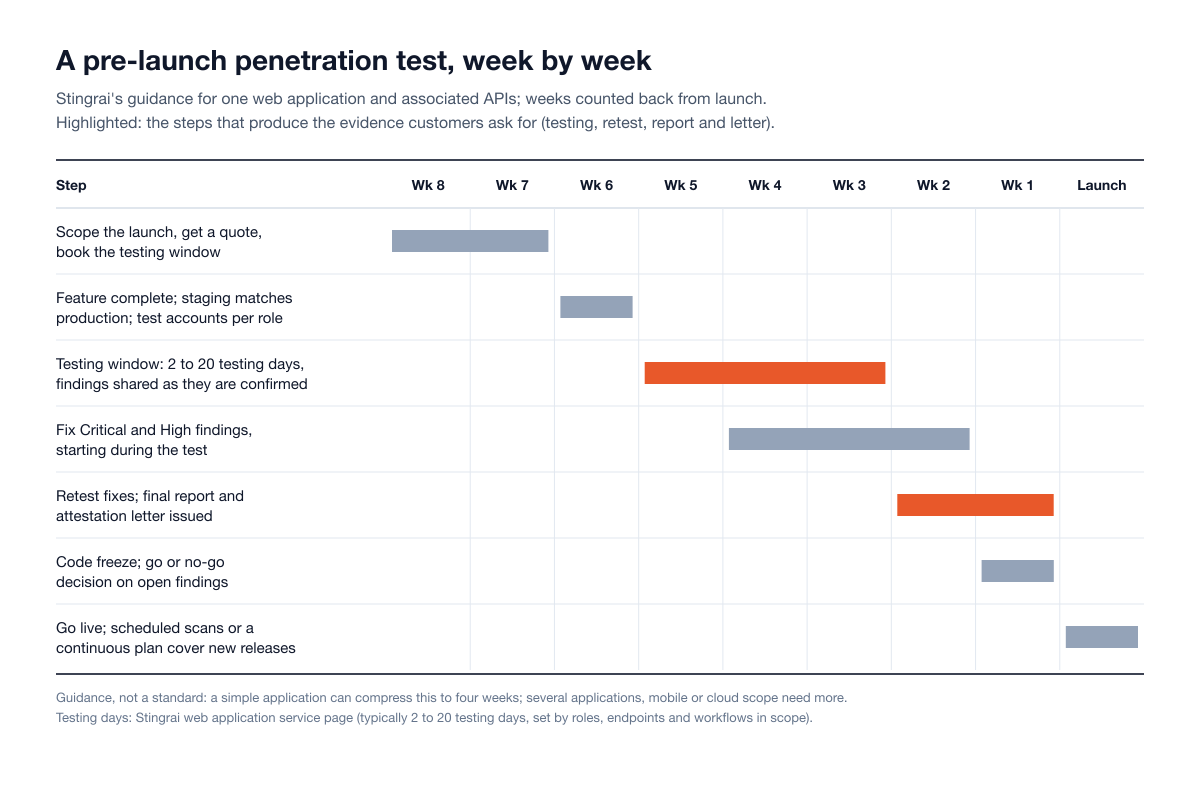
Figure 1: A pre-launch penetration test, week by week (Stingrai's guidance, not a standard). Testing-window length: Stingrai web application penetration testing.
How long before launch should the test start?
Weeks before launch | Step (Stingrai's guidance) | Why it sits there |
|---|---|---|
8 to 7 | Scope the launch, get a quote, book the window | Quotes are quick (Stingrai returns pricing within 24 hours), but tester calendars fill weeks ahead |
6 | Feature complete on a staging environment that matches production; create test accounts for every role | Testing a moving target wastes testing days and misses the final code |
5 to 3 | Testing window | Stingrai's Hybrid and human-led web tests typically run 2 to 20 testing days, set by roles, endpoints and workflows |
4 to 2 | Fix Critical and High findings as they are confirmed | Findings reach the portal as they are confirmed, so fixing starts during the test |
2 to 1 | Retest the fixes; final report and attestation letter | The retest is what turns "found" into "fixed" for a customer or auditor |
1 | Code freeze; go or no-go on anything still open | Only fixes enter the build after this point |
Launch | Go live; scheduled scans or a continuous plan cover the next releases | The code changes again the week after launch |
A simple application with two roles can compress this to about four weeks. A multi-tenant platform with many roles, a mobile app and a cloud review needs the full eight or more.
Code freeze, feature freeze and which build to test
Test the build you will ship, not the one before it. In practice that means testing after feature freeze (no new functionality) and before code freeze (nothing but fixes), on an environment built from the same templates as production. Microsoft's certification program shows why parity matters: testing must be against the live production environment unless production testing is not feasible and the vendor shows the test environment is representative of production, and where infrastructure as code provisions the environments, it must show "deterministic parity with production through the same IaC templates and CI/CD automation pipelines" (Microsoft 365 Certification, application security; overview). Even outside that program, a staging environment with different IAM roles, a different WAF or seeded admin accounts produces a report that describes a system you will not run.
If production must be the target, schedule the test in a low-traffic window, agree rate limits and data-handling rules in writing, and keep a named contact on call for the whole window.
How long does a pre-launch pentest take?
On Stingrai's published timeline, the Autonomous Pentest returns results the same day, and Hybrid and human-led web application testing typically takes 2 to 20 testing days (Stingrai web application penetration testing). The drivers are the number of user roles, endpoints and workflows. Add the retest after fixes, and Stingrai plans a launch test to span three to five calendar weeks from the first testing day to the final report.
Can we launch with open findings?
Yes for Low and most Medium findings with an owner and a date, no for open Critical or High findings without a written, time-bound risk acceptance. That is Stingrai's guidance, and it matches what the strictest buyers ask for. Microsoft 365 Certification, for example, requires that "Critical and high-risk vulnerabilities identified during penetration testing MUST be remediated within one month of the completion of testing," and that they be "retested by the penetration testing company following remediation and clearly identified as resolved within the final penetration testing report" (Microsoft 365 Certification, application security).
Severity at go-live | Stingrai's guidance for the launch decision | What to record |
|---|---|---|
Critical | Block the launch until fixed and retested | Fix, retest result, date closed |
High | Block the launch, unless a compensating control removes the exposure and a named executive signs a dated risk acceptance | Fix or acceptance, compensating control, retest date |
Medium | Launch with a fix date inside the next release cycle | Ticket, owner, target date |
Low and informational | Launch; fix in normal backlog order | Ticket |
No standard sets this table. Your own policy, contracts and the program you are certifying against may be stricter, and if so they win.
Remediation and retest windows
Fixes take longer than teams expect, and not in the order they expect. In Stingrai's platform data, the median finding with a tracked resolution time was resolved in 26.0 days and the slowest tenth took more than 121.2 days. Critical findings were the fastest at a median of 10.5 days; High findings took 38.0 (State of Penetration Testing 2026).
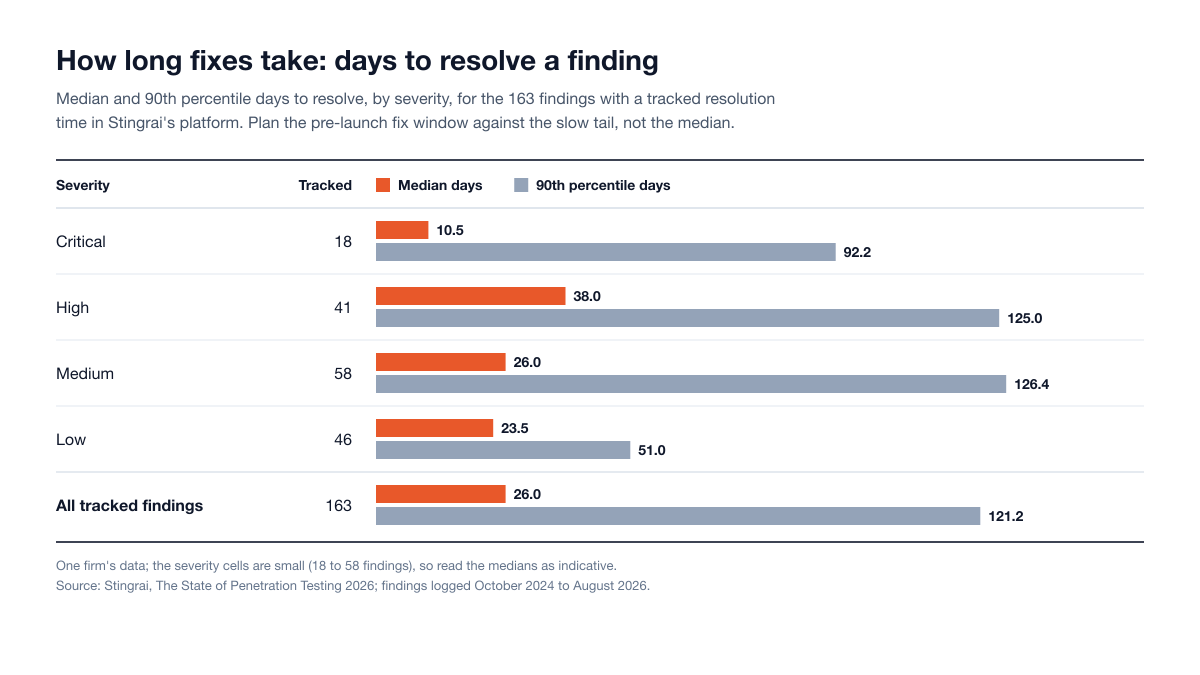
Figure 2: Days to resolve a penetration test finding, median and 90th percentile, by severity, for 163 findings with a tracked resolution time, October 2024 to August 2026. Source: Stingrai, The State of Penetration Testing 2026.
For a launch plan, read that chart two ways. A two-week fix window is enough for a typical Critical finding, because it gets incident-style attention. It is not enough for a typical High finding, which waits in the backlog unless someone gives it the same deadline. So start fixing while testing is still running, give High findings a launch-blocking owner, and book the retest date when you book the test.
NIST's SSDF asks for the same discipline in more general terms: record and triage "all discovered issues and recommended remediations in the development team's workflow or issue tracking system" (PW.8.2). Push findings into the tracker your engineers already use, not into a PDF nobody opens.
What evidence do customers and investors ask for?
Customers ask for proof that a qualified third party tested the product they are buying, recently, and that serious findings were fixed. Investors running technical due diligence may ask for the same documents. Stingrai's guidance is to prepare one evidence pack and share it in layers.
Document | What it shows | Who gets it |
|---|---|---|
Attestation letter | The tester, the scope and the testing dates | Anyone in a security review; it is built to be shared |
Executive summary | Scope, methodology, counts by severity, overall posture | Security reviewers, procurement, investors |
Retest results | That Critical and High findings were fixed and verified | Security reviewers, auditors, certification programs |
Full technical report | Every finding with reproduction evidence | Only under NDA, and only when a reviewer insists |
Remediation plan | Owners and dates for anything still open | Reviewers who see open Medium or Low findings |
Every Stingrai human-led and hybrid report ships with an attestation letter, which states the scope and testing dates (Stingrai web application penetration testing). The Autonomous Pentest delivers the Pentest Report. If enterprise security reviews are the reason for the launch test, choose a tier that includes the letter. The sample penetration testing report shows what reviewers see.
Three things make the pack hold up in review:
Dates that match the build. A report dated before your final release, or covering a staging environment that differs from production, invites the follow-up question "has it changed since?"
Scope that matches what you sell. If the customer buys the API and the report covers only the web interface, the review stalls.
A firm the reviewer can check. Stingrai's CREST accreditations, Penetration Testing and AI-Enabled Penetration Testing, can be confirmed on the CREST marketplace.
Stingrai's testing produces the evidence that SOC 2, ISO 27001, PCI DSS and HIPAA programs use, and the same pack answers a customer's questionnaire and an investor's diligence list.
What does a pre-launch penetration test cost?
For one web application and associated APIs, Stingrai's prices are published. Everything larger is quoted.
Option | What you get | Price (November 2026) |
|---|---|---|
Autonomous Pentest | Snipe, Stingrai's autonomous agent, tests the application alone: same-day results, the Pentest Report, automated retests | US$3,000 per assessment |
Hybrid Pentest, one-time | Snipe and Stingrai's certified penetration testers on the same application; human-validated report and attestation letter; retest; 12 monthly Snipe scans after the one-time pentest | US$6,800 per assessment |
Hybrid Pentest, continuous | Monthly Snipe testing, human-verified, plus a quarterly deep dive by Stingrai's penetration testers | US$1,275 per month on a 12-month plan |
Launch with more than one application, a mobile app, cloud review or AI features | Human-led or hybrid testing scoped to the launch | Quoted through Get a Quote, pricing within 24 hours |
All three published prices cover one web application and associated APIs (Stingrai pricing). For a launch, the one-time Hybrid Pentest is the usual fit: it produces the attestation letter a security review asks for, and its 12 monthly Snipe scans keep watch over the first year of releases. To estimate a larger launch first, use the pentest cost calculator, and see the penetration testing cost guide and mobile app penetration testing cost for market ranges.
The cheapest pre-launch test is the one you can act on. A low quote that arrives without authenticated testing of every role, or without a retest, produces a report that a customer's security team will question and that leaves the expensive classes of flaw untested.
Why keep testing after launch?
A launch test describes the product on the day it was tested. The product changes the next week, and the threats around it change faster. Google's Mandiant analysts track time-to-exploit, the average time taken to exploit a vulnerability before or after its patch is released. It fell from 63 days in 2018 and 2019 to 32 days across 2021 and 2022, and then to 5 days in 2023, or 47 days if outliers are kept in (Google Cloud, time-to-exploit trends). CISA added 306 vulnerabilities to its Known Exploited Vulnerabilities catalog in 2026 up to 20 November, against 245 in all of 2025 (CISA KEV catalog). And organizations are slower to close them: Verizon found only 26% of KEV vulnerabilities fully remediated, with a median of 43 days to full remediation, up from 32 (Verizon 2026 DBIR).
Put those numbers next to a product that ships weekly and the gap is plain. Every release after launch can add an endpoint, a role or a dependency that the launch test never saw, and a new class of flaw can be exploited within days of disclosure.
That is the case for continuous Hybrid testing after go-live. In Stingrai's Hybrid Pentest, Snipe tests the full application while Stingrai's certified penetration testers test the same application manually alongside it and validate Snipe's findings, so coverage is wider and deeper. It is not a split of test classes. The continuous plan runs monthly Snipe testing, human-verified, plus a quarterly deep dive by Stingrai's penetration testers, at US$1,275 per month on a 12-month plan for one web application and associated APIs. A team that launches once and then ships rarely may be well served by the one-time test and its 12 monthly scans; a team that ships every sprint gets more from the continuous plan.
After launch | One-time Hybrid (US$6,800 per assessment) | Continuous Hybrid (US$1,275 per month, 12-month plan) |
|---|---|---|
Launch test by Snipe and certified penetration testers | Yes | Yes, as the first cycle |
Automated testing after launch | 12 monthly Snipe scans | Monthly Snipe testing, human-verified |
Human testing after launch | Book the next assessment | A quarterly deep dive by Stingrai's penetration testers |
Best fit | A launch followed by infrequent major releases | Weekly or sprint releases, fast-moving frameworks, enterprise customers who ask for current evidence |
The continuous penetration testing guide compares the models in more depth, and the one-time penetration test guide covers when a single test is enough.
Pre-launch penetration test checklist
This checklist is Stingrai's guidance, drawn from scoping launch tests. No standard fixes this list; adapt it to your contracts and the programs you report to.
# | Step | Done when |
|---|---|---|
1 | List every asset that will be public at launch: web app, APIs, mobile app, admin console, cloud account, AI features | The list matches the launch plan and the architecture diagram |
2 | Name the reason for the test: enterprise review, SOC 2, a platform program, regulated data | The report format and the attestation letter match that reason |
3 | Book the test about eight weeks before launch | The testing window and retest date are in the calendar |
4 | Reach feature complete on staging that matches production | Same templates, same IAM, same WAF and same third-party integrations as production |
5 | Create test accounts for every role and every tenant type | At least two accounts per role, in two tenants, so cross-tenant access can be tested |
6 | Agree rules of engagement in writing | Targets, testing hours, rate limits, data handling, emergency contacts |
7 | Route findings into the engineering tracker | Each confirmed finding becomes a ticket with an owner |
8 | Fix Critical and High findings during the testing window | Fixes are deployed to the tested environment before the retest |
9 | Retest every Critical and High fix | Retest results are in the final report |
10 | Decide go or no-go on anything still open | A dated risk acceptance exists for any High finding that ships |
11 | Assemble the evidence pack | Attestation letter, executive summary, retest results, remediation plan |
12 | Plan testing for the releases after launch | Scheduled scans or a continuous plan cover new code from the first post-launch release |
Where Stingrai fits
Stingrai is a global CREST-accredited penetration testing services company founded in Toronto, Canada in 2021, trusted by companies from startups to enterprises to meet audit requirements for SOC 2, ISO 27001, CMMC, PCI DSS and HIPAA. OSCE³, OSWE, OSEP, CREST CRT certified penetration testers, who are also world-class security researchers and bug bounty hunters. Choose from fully human-led or hybrid (AI agents plus human penetration testers) engagements across web, API, mobile, AI and LLM, cloud, network, Active Directory and social engineering penetration tests and red team engagements.
For a launch, that translates into a few specifics:
Testing that follows the launch timeline. Findings reach the PTaaS portal as they are confirmed, with a proof of concept and remediation guidance, so engineering starts fixing during the test. Retests are requested from the portal and included.
Every role, every tenant. Web application and API tests are authenticated across every user role and aimed at authorization, business logic and IDOR; 70% of Stingrai's web application tests surfaced a High or Critical authentication or authorization finding.
Evidence a security review accepts. Every human-led and hybrid report ships with an attestation letter stating scope and testing dates, and Stingrai's firm-level CREST accreditations can be checked on the CREST marketplace.
One-time or continuous after launch. A one-time Hybrid Pentest for the launch (US$6,800 per assessment), or continuous Hybrid at US$1,275 per month on a 12-month plan, both for one web application and associated APIs. Mobile, cloud and multi-application launches are quoted through Get a Quote.
See the web application penetration testing, API penetration testing and mobile application penetration testing services for methodology.
Frequently Asked Questions
Do I need a penetration test before launch?
Usually yes, if the product will hold customer data, sell to enterprise buyers or pass a platform review. No single law requires every product to be tested before launch, but NIST's SSDF (PW.8) says code testing exists so vulnerabilities can be corrected before the software is released, enterprise security reviews ask for a recent third-party report, and programs such as Microsoft 365 Certification make penetration testing mandatory.
How long before launch should we do a penetration test?
Stingrai's guidance is to book it about eight weeks before launch and start testing four to six weeks out, once the product is feature complete on a staging environment that matches production. That leaves the last two weeks for fixing Critical and High findings and a retest before code freeze. A simple application can compress this to about four weeks.
When should we pentest before going live: before or after code freeze?
After feature freeze and before code freeze. Testing after feature freeze means the testers see the functionality you will ship; finishing before code freeze leaves room to deploy fixes and retest them. Test the build and the environment you will run in production, or a staging environment built from the same templates.
What does a pre-launch penetration test cover?
Everything the launch exposes on day one: the web application across every user role, the APIs behind it, authentication and SSO, multi-tenant isolation, the cloud account that hosts it, and the mobile app and AI features if they ship at launch. Features that stay switched off at launch can wait for the first post-launch test.
Can we launch with open penetration test findings?
Stingrai's guidance is no for open Critical or High findings without a dated, executive-signed risk acceptance, and yes for Medium and Low findings with an owner and a fix date. Microsoft 365 Certification, for example, requires Critical and high-risk findings to be remediated within one month of testing and retested by the testing company.
How long does a pre-launch penetration test take?
Stingrai's Autonomous Pentest returns results the same day, and Hybrid and human-led web application testing typically takes 2 to 20 testing days, set by the number of roles, endpoints and workflows. With fixes and a retest, Stingrai plans a launch test to span three to five calendar weeks from the first testing day to the final report.
How long do penetration test findings take to fix?
In Stingrai's platform data, the median finding with a tracked resolution time was resolved in 26.0 days and the slowest tenth took more than 121.2 days. Critical findings were fastest at a median of 10.5 days; High findings took 38.0, so give High findings a launch deadline and start fixing during the test.
What do customers and investors ask for after a pre-launch pentest?
In Stingrai's experience, an attestation letter naming the tester, scope and testing dates, an executive summary, and retest results showing that Critical and High findings were fixed. The full technical report is usually shared only under NDA. Every Stingrai human-led and hybrid report ships with an attestation letter.
How much does a pre-launch penetration test cost?
Stingrai's Hybrid Pentest is US$6,800 per assessment for one web application and associated APIs, with an attestation letter and 12 monthly Snipe scans after the pentest. The Autonomous Pentest is US$3,000 per assessment, and continuous Hybrid is US$1,275 per month on a 12-month plan. Larger launches are quoted through the Get a Quote form.
Should we keep penetration testing after launch?
Yes. Google's Mandiant analysts measured an average time-to-exploit of 5 days in 2023, and every release after launch can add endpoints and roles the launch test never saw. Stingrai's one-time Hybrid Pentest includes 12 monthly Snipe scans after the launch test, and the continuous Hybrid plan runs monthly Snipe testing, human-verified, plus a quarterly deep dive by Stingrai's penetration testers.
Related reading
Penetration Testing for Startups (2026): When, What, and How Much
Enterprise Deal Stuck in Security Review? The Pentest Report That Unblocks It
Continuous Hybrid Web Pentesting for Release Gates: Buyer Scope (2026)
One-Time Penetration Test (2026): When It Is Right, What It Costs, Who to Hire
Hybrid Web Application Penetration Testing (2026): What It Finds and What It Costs
References
NIST. SP 800-218, Secure Software Development Framework (SSDF) Version 1.1, practices PW.8, PW.8.1 and PW.8.2. February 2022. https://csrc.nist.gov/pubs/sp/800/218/final
AICPA. 2017 Trust Services Criteria (With Revised Points of Focus, 2022), CC4.1. https://assets.ctfassets.net/rb9cdnjh59cm/2sK6Ih6dzy6t7aU6RQvoeD/d97a2a14609e74a1af1ce9ab0b142b69/92317096_trust_services_criteria_red-lined_version.pdf
Microsoft. Microsoft 365 Certification: application security sample evidence guide. https://learn.microsoft.com/en-us/microsoft-365-app-certification/docs/seg2_app
Microsoft. Microsoft 365 Certification: overview of security domains. https://learn.microsoft.com/en-us/microsoft-365-app-certification/docs/seg2_overview
Google. Security Assessment (OAuth restricted scopes). Google Cloud Platform Console Help. https://support.google.com/cloud/answer/13465431
App Defense Alliance. MASA. https://appdefensealliance.dev/masa
IBM. Cost of a Data Breach Report 2026 (research by Ponemon Institute; 602 organizations, March 2025 to February 2026). https://www.ibm.com/reports/data-breach
Verizon. 2026 Data Breach Investigations Report. https://www.verizon.com/business/resources/reports/dbir/
Google Cloud (Mandiant). How Low Can You Go? An Analysis of 2023 Time-to-Exploit Trends. 15 October 2024. https://cloud.google.com/blog/topics/threat-intelligence/time-to-exploit-trends-2023
CISA. Known Exploited Vulnerabilities Catalog (feed version 2026.11.20). https://www.cisa.gov/known-exploited-vulnerabilities-catalog
AWS. Penetration Testing. https://aws.amazon.com/security/penetration-testing/
OWASP. Web Security Testing Guide; Application Security Verification Standard; API Security Top 10 2023; MASVS. https://owasp.org/www-project-web-security-testing-guide/
Stingrai. The State of Penetration Testing 2026 (55 penetration tests, findings logged October 2024 to August 2026). https://www.stingrai.io/blog/state-of-penetration-testing-2026
Stingrai. Pricing and Web application penetration testing (prices, timeline and deliverables). https://www.stingrai.io/pricing
CREST. Stingrai Inc on the CREST marketplace. https://marketplace.crest.org/supplier/stingrai-inc/
Talk to Stingrai
Launching a product or a major release in the next quarter? Send the launch date and scope through Get a Quote for pricing within 24 hours, or book a free discovery call to plan the testing window back from your go-live date.