





Penetration testing services are engagements in which certified penetration testers attack your applications, APIs, networks, cloud accounts, AI systems or people under written authorization, prove which weaknesses can actually be exploited, and hand you a report, a retest and an attestation letter that auditors and enterprise customers accept. In the US, Stingrai's Hybrid Pentest for one web application and associated APIs is US$6,800 per assessment, a network penetration test typically costs US$5,000 to US$40,000 and above, and federal GSA CALC+ ceiling rates for penetration testing labor had a median of US$157.40 an hour on 27 November 2026.
NIST defines the core activity as "a test methodology in which assessors, typically working under specific constraints, attempt to circumvent or defeat the security features of a system" (NIST CSRC glossary, citing SP 800-53 Rev. 5). That constraint matters to a buyer: a penetration test is defined by the people doing it, the scope they are allowed to attack and the evidence they leave behind, not by a tool's output.
Quick answer. Penetration testing services cover web applications, APIs, mobile apps, internal and external networks, Active Directory, cloud, AI and LLM applications, red and purple teaming, social engineering, physical and wireless testing. Pick the service from the asset your driver points at: PCI DSS 4.0.1 requires internal and external tests at least every 12 months, NYDFS 500.5(a)(1) requires tests from inside and outside at least annually, and SOC 2 lists penetration testing as one option. Stingrai, a CREST-accredited firm, prices one web application and associated APIs at US$6,800 (Hybrid) and quotes everything else within 24 hours.
This guide is for the US security lead, IT director or CTO who is about to buy. It answers the questions in the order a buyer meets them: what the services are, which one a given rule or customer calls for, how they are delivered, what a good provider shows you in writing, what it costs, and how to scope and buy without paying for a scan dressed up as a test. It is not a ranking; for named firms, see the best penetration testing companies in the USA.
TL;DR
What you buy: a scoped, authorized attack on a named asset or objective by certified penetration testers, ending in a report with proof-of-concept evidence, a retest of your fixes and an attestation letter.
Twelve service types: web application, API, mobile, internal and external network, Active Directory, cloud, AI and LLM, red teaming, purple teaming, social engineering, physical and wireless. The comparison table below gives each one's driver, US price and duration.
What US rules say: PCI DSS 4.0.1, the FTC Safeguards Rule, NYDFS Part 500 and FedRAMP require penetration testing at least every 12 months; SOC 2 lists it as one evaluation an organization "may" use; CMMC names it only at Level 3; the HIPAA Security Rule does not name it today.
HIPAA status: the January 2025 proposal to require penetration testing every 12 months is still not final as of 27 November 2026; the Unified Agenda shows a final action date of July 2027.
A scan is not a test: PCI DSS 4.0.1 guidance says "Scanning for vulnerabilities alone is not a penetration test" and "Penetration testing is a highly manual process."
US prices: Stingrai's Hybrid Pentest is US$6,800 per assessment or US$1,275 per month on a 12-month engagement for one web application and associated APIs; a network test typically costs US$5,000 to US$40,000 and above.
Public rate data: GSA CALC+ shows a median federal ceiling rate of US$157.40 an hour for penetration testing labor, with the middle half between US$125.85 and US$198.22 (556 rates, 167 contractors, 27 November 2026).
How to choose: ask for named certified testers, manual test cases per user role, proof-of-concept evidence for every finding, a severity rationale, an included retest and an attestation letter, and check firm-level CREST accreditation on marketplace.crest.org.
What are penetration testing services?
A penetration testing service is a contracted engagement with four parts: a written scope and authorization, active testing by qualified people, a report that proves each finding, and a retest that confirms the fix. The PCI Security Standards Council draws the line clearly in the PCI DSS v4.0.1 guidance to Requirement 11.4: "A penetration test differs from a vulnerability scan, as a penetration test is an active process that usually includes exploiting identified vulnerabilities," and "Penetration testing is a highly manual process."
What you should receive from any penetration testing service, whatever the asset:
A statement of work naming the targets (URLs, API specifications, IP ranges, cloud accounts, domains, locations), the user roles to test, the testing window and the approach (black, grey or white box).
Signed authorization from someone entitled to give it, plus any permission a hosting or cloud provider needs.
Testing by named penetration testers, with findings shared as they are confirmed, so fixing can start before the report.
A report with an executive summary, each finding's evidence and reproduction steps, a severity rationale and remediation guidance.
A retest of remediated findings, with the report updated to show what is closed.
An attestation letter stating scope, dates and outcome, written for auditors, customers and insurers who will not read the full report.
The penetration testing as a service (PTaaS) guide covers the delivery platform in depth; the rest of this guide stays on the buying decision.
What types of penetration testing services are there?
Twelve service types cover almost every US purchase. The table pairs each one with the drivers that most often call for it, a US price (Stingrai's published price where one exists, otherwise an estimate from public federal rate data) and the typical testing time published on Stingrai's service pages. The driver mapping and the estimates are Stingrai's guidance; the method behind the estimates is explained in the cost section below.
Service | What is tested | Typical US drivers | US price (published, or estimated testing-day labor) | Typical duration |
|---|---|---|---|---|
Authentication, sessions, authorization across roles and tenants, business logic, injection | SOC 2, PCI DSS 11.4.1 application layer, enterprise security reviews | Hybrid US$6,800 or Autonomous US$3,000 for one web application and associated APIs; human-led scopes estimated at US$2,014 to US$31,715 in testing-day labor | 2 to 20 testing days (Hybrid and human-led); same day (Autonomous) | |
REST, GraphQL, gRPC and SOAP endpoints, object-level and function-level authorization | SOC 2, PCI DSS, partner and customer reviews | Covered by the web packages above; standalone APIs estimated at US$3,020 to US$14,272 | 3 to 9 testing days | |
iOS and Android binaries, local storage, pinning, the backend API | Enterprise security reviews, HIPAA risk analysis for health apps | Estimated US$3,020 to US$7,929 (one platform) or US$5,034 to US$15,858 (both) | 3 to 5 days (one platform); 5 to 10 (both) | |
Perimeter services, internal hosts, lateral movement, segmentation | PCI DSS 11.4.2, 11.4.3, 11.4.5; NYDFS 500.5(a)(1); FTC 314.4(d)(2) | US$5,000 to US$40,000 and above; PCI DSS bundles US$12,000 to US$25,000 | 1 to 5 days (external); 1 to 10 (internal) | |
Misconfigurations, ACL abuse, Kerberos and delegation paths to domain admin | Ransomware resilience, internal network scope | Estimated US$5,034 to US$15,858 for a single forest and domain | One to two weeks of testing (single forest, one domain) | |
AWS, Azure and Entra ID, Google Cloud: IAM, policies, workloads | SOC 2, FedRAMP, CSA CAIQ TVM-07 | Quoted to scope; configuration review estimated at US$3,020 to US$7,929 | 3 to 5 testing days (configuration review) | |
Prompt injection, system prompt leakage, tool misuse, RAG and MCP | Enterprise AI security reviews | Quoted to scope | Quoted to scope | |
An objective (data, payments, a crown-jewel system) reached by any agreed path, with detection measured | Board and regulator assurance, mature programs | Quoted on operator days; estimated US$5,034 to US$7,929 per operator-week | 2 to 3 weeks (assumed breach); 4 to 8 weeks (full scope) | |
Attack techniques replayed with your SOC to tune detections | Detection engineering, post-red-team work | Quoted on operator days and techniques | Paced by your detection team | |
Phishing, vishing and pretexting against staff and help desks | Insurance applications, security awareness programs | Quoted to scope | Quoted to scope | |
Badge, door, reception and on-site controls | Data centers, regulated sites, red team add-on | Quoted to scope | Quoted to scope | |
SSIDs, authentication, rogue and evil twin access points, guest isolation | Retail and branch networks, guest network isolation | Estimated US$1,007 to US$3,172 per location | 1 to 2 tester days per location |
Prices marked "estimated" cover testing days only (scoping, reporting and retest excluded) and are computed as Stingrai's published typical testing days times the middle half of GSA CALC+ federal ceiling rates, read 27 November 2026. Stingrai's own published prices are on /pricing and the network service page.
Application tests: web, API, mobile and AI
Application tests are where most US compliance and customer evidence comes from, because that is where customer data is reached. A good web or API test spends most of its hours on authorization: can user A read user B's records, can a viewer call an admin function, can tenant one reach tenant two. Those flaws do not show up in scanner signatures; they show up when a tester holds two accounts and compares what each can do. The web application penetration testing services guide goes deeper on what a full web engagement covers. Mobile tests add the binary and the device (storage, pinning, root and jailbreak detection) to the same backend questions, and AI and LLM tests add prompt injection, data leakage through retrieval and the tools an agent is allowed to call.
Infrastructure tests: network, Active Directory, cloud and wireless
Infrastructure tests answer a different question: once an attacker is on the network, in an account or in range of a wireless signal, how far can they get? PCI DSS 4.0.1 asks for both directions in one sentence of Requirement 11.4.1, "Testing from both inside and outside the network." The network penetration testing services guide covers external, internal and segmentation testing in detail.
Adversary and people tests: red team, purple team, social engineering and physical
Red teaming tests whether anyone notices an attacker reaching what matters most, which makes it a test of detection and response as much as of controls. Purple teaming puts the testers and your SOC in the same room to turn findings into detections. Both build on a program that already runs regular penetration tests; the red team services buyer's guide covers scoping them. Social engineering and physical testing reach the controls that live in people and buildings.
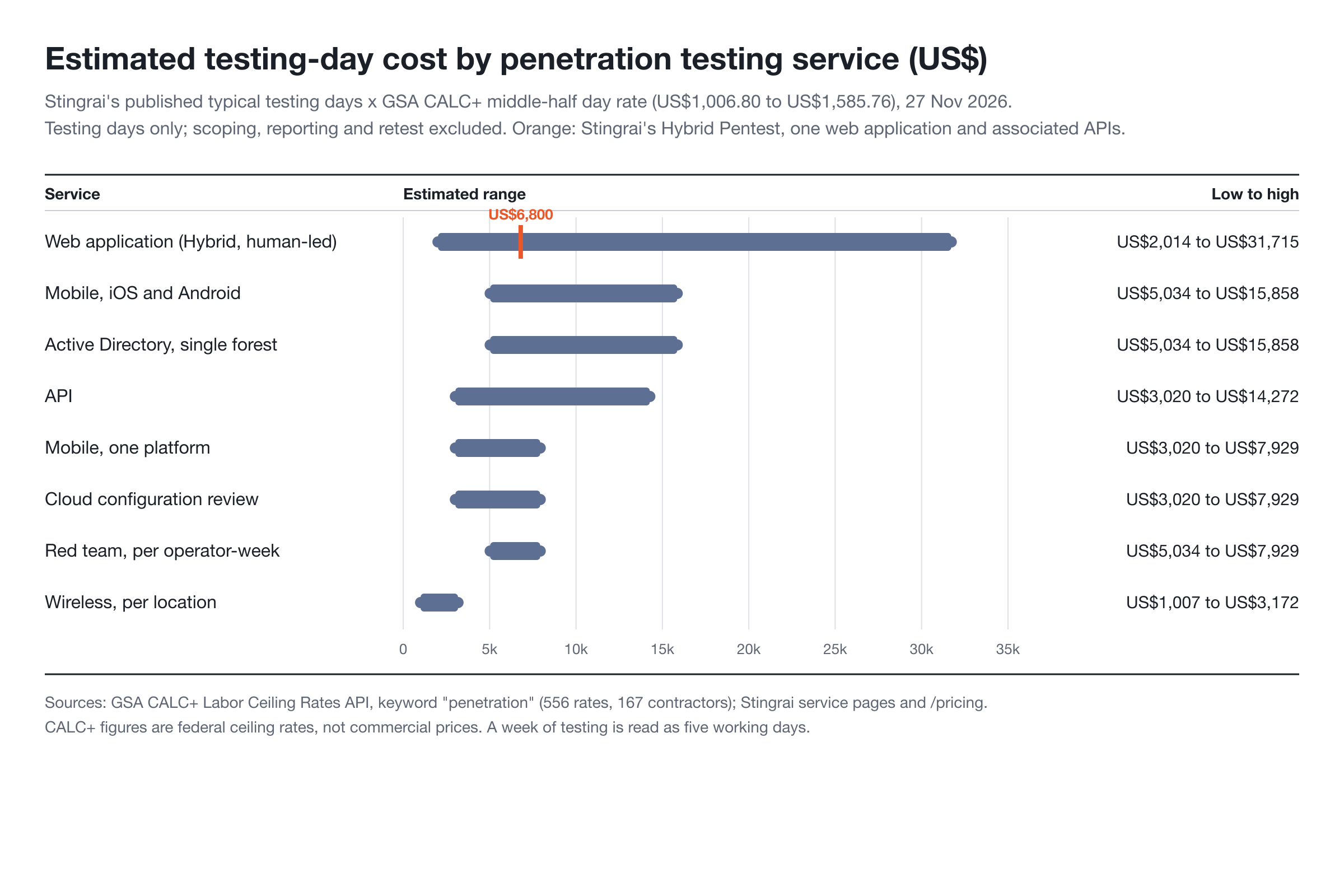
Figure 1: Estimated testing-day cost by service, US dollars, from Stingrai's published typical testing days times GSA CALC+ middle-half day rates (27 November 2026). Sources: GSA CALC+ API, Stingrai service pages, Stingrai pricing.
A vulnerability scan is not a penetration test
The single most expensive mistake in this market is paying a penetration testing price for a scan. The PCI DSS v4.0.1 guidance to Requirement 11.4 is blunt: "Scanning for vulnerabilities alone is not a penetration test, nor is a penetration test adequate if the focus is solely on trying to exploit vulnerabilities found in a vulnerability scan." A scan lists known weaknesses by signature. A penetration test proves which weaknesses lead somewhere, finds the flaws no signature describes (broken authorization, business logic, chained low-severity issues), and shows the evidence.
Red flags that a quote is a scan with a penetration testing label (Stingrai's guidance):
No named testers. The proposal names a tool or a platform but no penetration testers and no certifications.
No user roles. Nothing in the scope asks how many roles, tenants or test accounts you have, so nobody will test authorization.
Findings without proof. The sample report lists plugin IDs, CVE numbers and "potential" issues, with no request and response, screenshot or reproduction steps.
Severity copied from a score. Every rating is a CVSS base score with no reasoning about your data or exposure.
No retest and no attestation letter, or a letter that does not state the scope and dates tested.
The penetration testing vs vulnerability scanning guide covers how to tell the two apart in depth. Automation has a real place inside a good engagement. Autonomous testing that hunts authorization and business logic flaws is a different thing from a signature scanner, and hybrid engagements pair it with certified penetration testers. The manual penetration testing guide shows what human testers find that automation misses, and the VAPT guide explains how the two halves of a vulnerability assessment and penetration test fit together.
Which penetration test do US compliance rules require?
US rules split into three groups: those that require penetration testing on a stated cycle, those that list it as one acceptable option, and those that do not name it at all. Each requirement below is quoted from the regulator's or standard owner's own text, read on 27 November 2026. The mapping to a service type in the last column is Stingrai's guidance, not the rule's words.
Driver | What the text says | Verb | Cycle | Service it usually points to |
|---|---|---|---|---|
PCI DSS 4.0.1, 11.4.2 and 11.4.3 | Internal and external penetration testing "is performed ... At least once every 12 months; After any significant infrastructure or application upgrade or change" | Requires | 12 months and after significant change | Internal and external network, plus application layer (11.4.1) |
PCI DSS 4.0.1, 11.4.5 | Segmentation controls tested "At least once every 12 months and after any changes to segmentation controls/methods" | Requires | 12 months (every six months for service providers, 11.4.6) | Segmentation testing |
FTC Safeguards Rule, 16 CFR 314.4(d)(2) | Absent effective continuous monitoring, "you shall conduct: (i) Annual penetration testing of your information systems" | Requires (unless continuous monitoring) | Annual | Network and application tests chosen by your risk assessment |
NYDFS, 23 NYCRR 500.5(a)(1) | "penetration testing of their information systems from both inside and outside the information systems' boundaries by a qualified internal or external party at least annually" | Requires | Annual | Internal and external network, applications |
FedRAMP | "additional penetration testing activities must be performed at least every 12 months" in continuous monitoring, by a 3PAO for authorization | Requires | 12 months | Full authorization boundary |
CMMC, 32 CFR 170, CA.L3-3.12.1e | "Conduct penetration testing at least annually or when significant security changes are made to the system" | Requires (Level 3 only) | Annual | Systems handling CUI |
SOC 2, CC4.1 point of focus | Evaluations "may include ... vulnerability scans, security assessment, penetration testing, and third-party assessments" | Lists as an option | None stated | Web application and API, cloud |
HIPAA Security Rule, 45 CFR 164.308(a)(8) | "Perform a periodic technical and nontechnical evaluation" | Requires an evaluation; does not name penetration testing | Periodic | Systems holding ePHI, chosen by your risk analysis |
HIPAA proposed rule, 90 FR 898 | "Penetration testing must be performed at least once every 12 months" | Would require (not final) | 12 months (proposed) | Relevant electronic information systems |
CSA CAIQ v4.1, TVM-07.1 | "Are processes ... evaluated for the periodic performance of penetration testing by independent third parties?" | Asks | Periodic | Cloud-hosted product, web and API |
PCI DSS 4.0.1 requirement 11.4
PCI DSS is the most specific US driver. Requirement 11.4.1 says the methodology must include "Testing from both inside and outside the network," "Testing to validate any segmentation and scope-reduction controls," "Application-layer penetration testing to identify, at a minimum, the vulnerabilities listed in Requirement 6.2.4" and "Network-layer penetration tests that encompass all components that support network functions as well as operating systems." Requirements 11.4.2 and 11.4.3 require the tests at least once every 12 months and after significant change, "By a qualified internal resource or qualified external third party" with "Organizational independence of the tester" (not required to be a QSA or ASV). Text read in the PCI DSS v4.0.1 standard (June 2024). The PCI DSS penetration testing guide walks through scoping a cardholder data environment.
SOC 2
SOC 2 does not require a penetration test. The 2022 points of focus for criterion CC4.1 in the AICPA Trust Services Criteria say management's evaluations "may include first- and second-line monitoring and control testing, internal audit assessments, compliance assessments, resilience assessments, vulnerability scans, security assessment, penetration testing, and third-party assessments." Enterprise customers' security questionnaires, such as the CSA CAIQ quoted below, ask about third-party penetration testing whether or not the auditor does. See SOC 2 penetration testing requirements.
HIPAA Security Rule, and the 2025 proposal
The HIPAA Security Rule in force today does not use the word "penetration." 45 CFR 164.308(a)(8) requires covered entities and business associates to "Perform a periodic technical and nontechnical evaluation," and eCFR shows the section unchanged since 30 December 2016. The proposed rule of 6 January 2025 (90 FR 898) would add, at proposed 164.312(h)(2)(iii), "Penetration testing must be performed at least once every 12 months or in accordance with the covered entity's or business associate's risk analysis ... whichever is more frequent." As of 27 November 2026 it is not final: the Federal Register lists one document under RIN 0945-AA22, the proposal itself, and the Unified Agenda lists the rule as a long-term action with final action in July 2027. More in HIPAA penetration testing requirements.
FTC Safeguards Rule
Non-bank financial institutions under the FTC's jurisdiction fall under 16 CFR 314.4(d)(2): "Absent effective continuous monitoring or other systems to detect, on an ongoing basis, changes in information systems that may create vulnerabilities, you shall conduct: (i) Annual penetration testing of your information systems determined each given year based on relevant identified risks in accordance with the risk assessment," plus vulnerability assessments at least every six months. Under section 314.6, the testing duty in 314.4(d)(2) does not apply to institutions that hold customer information on "fewer than five thousand consumers." See the FTC Safeguards Rule guide.
NYDFS Part 500
New York's cybersecurity regulation, as amended effective 1 November 2023, requires covered entities to conduct "penetration testing of their information systems from both inside and outside the information systems' boundaries by a qualified internal or external party at least annually" (NYDFS second amendment text, 500.5(a)(1)). "Inside and outside" means an internal and an external test, not an external scan alone. See NYDFS penetration testing requirements.
CMMC
The word "penetration" appears once in the CMMC program rule, 32 CFR part 170, at Level 3 requirement CA.L3-3.12.1e: "Conduct penetration testing at least annually or when significant security changes are made to the system, leveraging automated scanning tools and ad hoc tests using subject matter experts." On status, the Department of War CIO's implementing guidance of 13 July 2026 suspended "the upcoming November 2026 transition to Phase 2" and says requiring activities "may not designate CMMC Level 2 (C3PAO) or Level 3 (DIBCAC) assessments during this period." See does CMMC require penetration testing?
FedRAMP
The FedRAMP Penetration Test Guidance (version 3) says that "For each initial security authorization, a penetration test must be completed by a 3PAO," performed "no more than 6 months prior to the submission of the SAR," and that "additional penetration testing activities must be performed at least every 12 months" in continuous monitoring, unless an authorizing body approves otherwise with documented rationale. Stingrai's guidance: an independent test before the 3PAO assessment lets you fix issues before the authorization test starts. See FedRAMP penetration testing requirements.
ISO 27001, cyber insurance and enterprise customer security reviews
ISO/IEC 27001 is sold by ISO, and its control text is not quoted here; ask your certification body what evidence it expects for technical vulnerability management and security testing, and read ISO 27001 penetration testing requirements. Cyber insurers have no single rule: carrier applications vary, and the safest answer to "do you test?" is a dated report and attestation letter (see pentest questions in cyber insurance underwriting). Enterprise customer security reviews usually arrive as a questionnaire. The Cloud Security Alliance's CAIQ v4.1 (released 27 January 2026, in the Cloud Controls Matrix bundle) asks in TVM-07.1 whether processes "are ... defined, implemented, and evaluated for the periodic performance of penetration testing by independent third parties." The framework-by-framework requirements guide covers more standards.
How are penetration testing services delivered?
Two choices shape every engagement: how often you test (one-time or continuous) and who does the testing (human-led, hybrid or autonomous). Stingrai's guidance for most programs is to combine them: an annual human-led or hybrid test for the audit and customer evidence, plus continuous coverage on the applications that ship every week.
Model | What it is | Best fit | What to check |
|---|---|---|---|
One-time human-led | Certified penetration testers test a fixed scope in a set window | Networks, Active Directory, cloud, red teams, regulated annual tests | Named testers, test plan, retest window |
One-time hybrid | An autonomous agent and penetration testers test the same application at the same time | Web applications and associated APIs | That humans test manually, not only review output |
Continuous hybrid (PTaaS) | Recurring autonomous testing with human verification and periodic human deep dives, delivered through a platform | Applications that release often | Cadence in writing, retest model, annual commitment terms |
Autonomous | An AI agent tests on its own, often the same day | Release gating, quick coverage between human tests | Which flaw classes it hunts; what evidence it gives |
Objective-based (red and purple team) | Operators pursue an objective and measure detection | Mature security operations | Rules of engagement, deconfliction, detection metrics |
Table: delivery models compared. Stingrai's guidance.
Why continuous testing for web applications
An annual test is a snapshot of one release, and the pace of exploitation keeps rising: CISA added 321 vulnerabilities to its Known Exploited Vulnerabilities catalog between 1 January and 25 November 2026, against 245 in all of 2025 (catalog version 2026.11.25, 1,805 entries). Every new release can add an authorization gap that an annual report never sees. Continuous testing keeps the evidence current between annual tests; it does not replace the annual test an auditor asks for. The continuous penetration testing guide covers program design.
Stingrai's Hybrid Pentest for web applications
Stingrai's Hybrid Pentest is built for buyers who want depth on a web application without waiting for an annual window. Snipe, Stingrai's autonomous AI agent, tests the full application while Stingrai's certified penetration testers test the same application manually alongside it and validate Snipe's findings, so coverage is wider and deeper. One-time Hybrid is US$6,800 per assessment and continuous Hybrid is US$1,275 per month on a 12-month engagement, each for one web application and associated APIs (pricing). The continuous plan runs monthly Snipe testing, human-verified, plus a quarterly deep dive by Stingrai's penetration testers. Network, Active Directory, cloud, mobile and red team work is human-led and quoted to scope. More in hybrid web application penetration testing.
How do I choose a penetration testing service provider?
Choose on what the provider will put in writing before you sign. Every item below can be checked in a proposal, a sample report or a public register, which makes it a better filter than any adjective on a website. This checklist is Stingrai's guidance; no standard fixes this list.
Check | What a good provider shows in writing | Red flag |
|---|---|---|
Named, certified penetration testers | The testers' names, roles and certifications (for example OSCP, OSWE, OSCE³, CREST CRT) in the proposal, and a clause that they will do the work | "A team of experts" with no names; a right to substitute anyone |
Firm-level accreditation | A listing you can open on marketplace.crest.org, separate from individual certifications | Accreditation claimed with no public listing |
Written methodology | Test approach mapped to recognized references (OWASP testing guides for web, API and mobile; PCI DSS 11.4.1 elements for networks) | "Proprietary methodology" with nothing behind it |
Manual test cases per role | A test plan listing every user role, tenant and privileged function, and the authorization checks between them | Scope asks only for URLs or IP counts |
Proof-of-concept evidence | Each finding with the request and response, screenshots and reproduction steps your engineers can replay | "Potential" findings, plugin output, no reproduction |
Severity rationale | A CVSS vector plus the business reason for the rating | Every rating copied from a base score |
Live delivery | Findings posted as they are confirmed, with Jira or Slack integration | A single PDF at the end |
Sample report | A redacted sample before you sign | Refusal to share one |
Retest included | Retest of remediated findings in the price, with the window stated | Retest billed separately or undefined |
Attestation letter | A letter stating scope, dates, testing approach and outcome, ready for auditors and customers | No letter, or one without scope and dates |
Authorization and rules of engagement | Signed authorization, testing windows, emergency contacts, data handling and deletion terms | Testing starts before paperwork is signed |
Insurance | Certificates for professional and cyber liability cover | No certificate on request |
Questions to ask every provider
Who exactly will test our systems, and what have they published or found before (CVEs, bug bounty acknowledgements)?
How many hours of manual testing does the quote include, and how are they split across roles and components?
How will you test authorization between our roles and tenants?
Can we see a redacted sample report and a sample attestation letter?
How are findings delivered during the test, and how fast are critical findings escalated?
What does the retest cover, and for how long after the report?
Which parts of the work are automated, and what do the testers do beyond it?
Where is our data stored during and after the test, and when is it deleted?
The guide to evaluating a penetration test report and the RFP question bank turn these into scoring criteria. Enterprise procurement teams running a formal process should also read the outsourced penetration testing procurement guide.
How much do penetration testing services cost?
Penetration testing services in the US are priced by scope, and scope means tester time. Published prices exist for one web application: Stingrai's Hybrid Pentest is US$6,800 per assessment and the Autonomous Pentest is US$3,000 per assessment, each for one web application and associated APIs (pricing). Stingrai's published typical range for a network penetration test is US$5,000 to US$40,000 and above, and PCI DSS engagements that bundle internal, external and segmentation testing commonly land at US$12,000 to US$25,000. Everything else is quoted to scope.
What public US rate data says
The US government publishes the labor rates its contractors may charge. GSA's CALC+ Labor Ceiling Rates data exists, in GSA's words, to "aid in benchmarking competitive pricing," and it is refreshed overnight. On 27 November 2026 the CALC+ API returned 607 awarded rates for the keyword "penetration," all on the Multiple Award Schedule and 511 of them under SIN 54151HACS. Leaving out one contractor that prefixes help desk, technical writer and similar titles with "Penetration Testing," 556 rates from 167 contractors remain:
Measure | Hourly | Eight-hour day |
|---|---|---|
25th percentile | US$125.85 | US$1,006.80 |
Median | US$157.40 | US$1,259.20 |
75th percentile | US$198.22 | US$1,585.76 |
Median, 10+ years' experience (72 rates) | US$207.70 | US$1,661.60 |
Table: GSA CALC+ ceiling rates for penetration testing labor categories, read 27 November 2026.
CALC+ figures are federal ceiling rates, not commercial prices, and they price hours rather than outcomes. They are still the most transparent public reference for what an hour of penetration testing labor costs in the US. Multiplying them by the testing days a provider publishes gives the testing-day estimates in the service table and Figure 1; reporting, project management and the retest come on top.
What moves the price
Roles and tenants. Each user role multiplies the authorization tests in a web or API engagement.
Endpoints and pages. API and dynamic page counts set how long coverage takes.
Live hosts, sites and start positions. These drive network testing time.
Forests, domains and trusts. These drive Active Directory testing time.
Accounts, subscriptions and services. These drive cloud testing time.
Approach. White-box access (source, architecture, credentials) usually finds more per day than black box.
Evidence needs. A PCI DSS segmentation test or a FedRAMP boundary adds defined work.
For deeper cost detail, see penetration testing cost or run your scope through the pentest cost calculator.
How to scope and buy penetration testing services
A clean scope gets you a firm price, the right testers and a report that answers the question you were asked. These steps are Stingrai's guidance.
Name the driver. Write down who asked for the test (auditor, QSA, regulator, customer, insurer, board) and what they need to see.
List the assets. Applications with their user roles and tenants, APIs with specifications, IP ranges and sites, Active Directory forests, cloud accounts, AI features, locations.
Pick the service and approach. Use the service table: black, grey or white box, authenticated roles, internal start positions.
Send the same scope packet to each provider. Include the asset list, driver, preferred dates, test accounts you can provide and any third-party permissions needed.
Compare proposals on the checklist. Named testers, manual hours, sample report, retest and attestation letter before price.
Sign the paperwork before testing. Statement of work, authorization letter, rules of engagement, data handling terms.
Prepare the environment. Test accounts for every role, allow-listing where agreed, a contact who can answer during testing.
Fix as findings arrive. Route confirmed findings into your tracker during the test, not after the report.
Retest and collect the evidence. Final report, retest results and attestation letter, filed where auditors and customers can be sent them.
Set the cadence. At least the cycle your driver states, plus continuous coverage where your applications change faster than that.
Timeline
Stingrai returns a quote within 24 hours of a Get a Quote submission (pricing). Testing time then follows the table above: same day for an Autonomous Pentest, 2 to 20 testing days for a Hybrid or human-led web application test, 1 to 10 for internal networks, and two to three weeks for an assumed-breach red team. Allow time before testing for authorization, test accounts and any hosting permissions, and after testing for remediation and the retest. A penetration testing SOW template helps with the paperwork, and how often to run a penetration test helps set the cadence.
Where Stingrai fits
Stingrai is a global CREST-accredited penetration testing services company founded in Toronto, Canada in 2021, trusted by companies from startups to enterprises to meet audit requirements for SOC 2, ISO 27001, CMMC, PCI DSS and HIPAA. OSCE³, OSWE, OSEP, CREST CRT certified penetration testers, who are also world-class security researchers and bug bounty hunters. Choose from fully human-led or hybrid (AI agents plus human penetration testers) engagements across web, API, mobile, AI and LLM, cloud, network, Active Directory and social engineering penetration tests and red team engagements.
For US buyers who value depth, the specifics that matter:
Proud CREST member. Stingrai Inc holds two CREST accreditations, Penetration Testing and AI-Enabled Penetration Testing, and the CREST AI Charter company certification (CREST Marketplace). Team members separately hold CREST CRT.
Named people. Two named penetration testers on every human-led engagement, from a team holding OSCE³, OSWE, OSEP, CREST CRT and CISSP certifications, with 18 CVEs published by Stingrai's researchers (Snipe). Engagements are "performed by named offensive security specialists, never by substituted junior resources" (About us).
Evidence buyers can use. Findings arrive in the PTaaS platform with a proof of concept and remediation guidance as they are confirmed, sync to Jira and Slack, and close only when a retest confirms the fix. Every engagement comes with an attestation letter, and Stingrai's testing supports your SOC 2, PCI DSS, HIPAA, NYDFS, FTC Safeguards and CMMC programs with audit evidence.
One-time and continuous. Annual one-time tests and continuous programs, human-led, hybrid or autonomous. For web applications, the Hybrid Pentest is US$6,800 per assessment or US$1,275 per month on a 12-month engagement for one web application and associated APIs.
Frequently Asked Questions
What are penetration testing services and how much do they cost in the US?
Penetration testing services are scoped, authorized attacks by certified penetration testers on your applications, APIs, networks, cloud, AI systems or people, ending in a report with proof-of-concept evidence, a retest and an attestation letter. In the US, Stingrai's Hybrid Pentest for one web application and associated APIs is US$6,800 per assessment, a network penetration test typically costs US$5,000 to US$40,000 and above, and GSA CALC+ federal ceiling rates for penetration testing labor have a median of US$157.40 an hour (27 November 2026).
Which penetration testing service do I need for SOC 2?
SOC 2 does not require a specific test: the 2022 CC4.1 points of focus list penetration testing as one evaluation management "may" use. Most SaaS companies test the web application and associated APIs their customers use, plus the cloud environment behind them, because enterprise customers ask for that report during security review.
Does PCI DSS 4.0.1 require penetration testing?
Yes. Requirements 11.4.2 and 11.4.3 require internal and external penetration testing at least once every 12 months and after any significant infrastructure or application upgrade or change, by a qualified internal resource or qualified external third party with organizational independence. Requirement 11.4.5 adds segmentation testing at least once every 12 months when segmentation reduces scope. Service providers that use segmentation test it at least once every six months under 11.4.6.
Does HIPAA require penetration testing in 2026?
Not explicitly. The HIPAA Security Rule in force requires a periodic technical and nontechnical evaluation under 45 CFR 164.308(a)(8) and does not name penetration testing. The January 2025 proposed rule would require penetration testing at least once every 12 months, but as of 27 November 2026 it is not final, and the Unified Agenda lists final action in July 2027.
Is a vulnerability scan the same as a penetration test?
No. PCI DSS 4.0.1 guidance says "Scanning for vulnerabilities alone is not a penetration test" and "Penetration testing is a highly manual process." A scan lists known weaknesses; a penetration test proves which ones can be exploited, finds authorization and business logic flaws no signature describes, and documents the evidence.
How do I choose a penetration testing service provider?
Choose on what the provider puts in writing: named certified penetration testers, a written methodology, manual test cases for every user role, proof-of-concept evidence for every finding, a severity rationale, an included retest and an attestation letter stating scope and dates. Check firm-level CREST accreditation on marketplace.crest.org and ask for a redacted sample report before you sign.
How long does a penetration test take?
Stingrai's published typical testing times are 2 to 20 testing days for a Hybrid or human-led web application test, 3 to 9 for an API, 3 to 5 for one mobile platform, 1 to 5 for an external network, 1 to 10 for an internal network, and two to three weeks for an assumed-breach red team. An Autonomous Pentest returns results the same day.
Should I buy a one-time penetration test or continuous testing?
Most programs need both. A one-time annual test meets the 12-month cycle in PCI DSS, NYDFS, the FTC Safeguards Rule and FedRAMP, while continuous testing keeps evidence current for applications that release often. CISA added 321 vulnerabilities to its Known Exploited Vulnerabilities catalog between 1 January and 25 November 2026, against 245 in all of 2025.
Do US regulations require a CREST-accredited penetration testing company?
No US rule quoted in this guide names CREST. PCI DSS 4.0.1 asks for a qualified internal resource or qualified external third party with organizational independence, NYDFS asks for a qualified internal or external party, and FedRAMP requires a 3PAO for authorization testing. CREST accreditation is a buyer's check on the firm's processes, verifiable on marketplace.crest.org.
What should a penetration testing report and attestation letter include?
The report should include an executive summary, the scope and dates, each finding with proof-of-concept evidence and reproduction steps, a severity rationale, remediation guidance and the retest results. The attestation letter should state the scope, testing dates, approach and outcome in a form you can send to auditors, customers and insurers.
Related reading
References
NIST. Computer Security Resource Center glossary: penetration testing. https://csrc.nist.gov/glossary/term/penetration_testing. Definition sourced to SP 800-12 Rev. 1 and SP 800-53 Rev. 5.
PCI Security Standards Council. PCI DSS: Requirements and Testing Procedures, v4.0.1. June 2024. https://www.middlebury.edu/sites/default/files/2025-01/PCI-DSS-v4_0_1.pdf. Requirement 11.4 and its guidance.
AICPA. 2017 Trust Services Criteria (with revised points of focus, 2022). https://assets.ctfassets.net/rb9cdnjh59cm/2sK6Ih6dzy6t7aU6RQvoeD/d97a2a14609e74a1af1ce9ab0b142b69/92317096_trust_services_criteria_red-lined_version.pdf. CC4.1 points of focus.
eCFR. 45 CFR 164.308, Administrative safeguards. https://www.ecfr.gov/current/title-45/subtitle-A/subchapter-C/part-164/subpart-C/section-164.308. Evaluation standard, (a)(8).
HHS Office for Civil Rights. HIPAA Security Rule To Strengthen the Cybersecurity of Electronic Protected Health Information, proposed rule. 6 January 2025. https://www.govinfo.gov/content/pkg/FR-2025-01-06/html/2024-30983.htm. Proposed 164.312(h)(2)(iii).
Office of Information and Regulatory Affairs. Unified Agenda entry, RIN 0945-AA22. https://www.reginfo.gov/public/do/eAgendaViewRule?pubId=202510&RIN=0945-AA22. Long-term action, final action 07/2027.
eCFR. 16 CFR 314.4 and 314.6, FTC Standards for Safeguarding Customer Information. https://www.ecfr.gov/current/title-16/chapter-I/subchapter-C/part-314/section-314.4. Penetration testing at (d)(2); exception at 314.6.
New York State Department of Financial Services. Second Amendment to 23 NYCRR 500. Effective 1 November 2023. https://www.dfs.ny.gov/system/files/documents/2023/10/rf_fs_2amend23NYCRR500_text_20231101.pdf. Section 500.5(a)(1).
eCFR. 32 CFR part 170, CMMC Program. https://www.ecfr.gov/current/title-32/subtitle-A/chapter-I/subchapter-G/part-170. Level 3 requirement CA.L3-3.12.1e.
Department of War CIO. Implementing the Suspension of CMMC Phase II, Attachment 1. Cleared 13 July 2026. https://web.archive.org/web/20261116153553/https://dodcio.defense.gov/Portals/0/Documents/Library/ImplementingSuspensionCMMC-PhaseII.pdf. Archived copy of 16 November 2026.
FedRAMP. FedRAMP Penetration Test Guidance, version 3. 30 June 2022. https://www.fedramp.gov/resources/documents/CSP_Penetration_Test_Guidance.pdf. Timing and 3PAO requirements.
Cloud Security Alliance. Cloud Controls Matrix and CAIQ v4.1. Released 27 January 2026. https://cloudsecurityalliance.org/artifacts/cloud-controls-matrix-v4-1. Question TVM-07.1.
US General Services Administration. CALC+ Labor Ceiling Rates API. https://open.gsa.gov/api/dx-calc-api/. Keyword "penetration", read 27 November 2026.
CISA. Known Exploited Vulnerabilities catalog (JSON feed). Catalog version 2026.11.25. https://www.cisa.gov/sites/default/files/feeds/known_exploited_vulnerabilities.json. Entries by date added.
CREST. Stingrai Inc supplier listing. https://marketplace.crest.org/supplier/stingrai-inc/. Accreditations and company certification.
Stingrai. Plans and pricing. https://www.stingrai.io/pricing. Published prices for one web application and associated APIs.
Talk to Stingrai
Send your scope, driver and dates through Get a Quote for a fixed price within 24 hours, or book a free discovery call to talk through which penetration testing services your audit, customers or board are asking for.