





A vulnerability scan is an automated check that compares your systems against known flaws and reports what might be vulnerable; a penetration test is a qualified person attacking the system within agreed rules to prove what is actually exploitable, including the authorization and business logic flaws no signature describes. NIST SP 800-115 draws the line in one sentence: vulnerability scanners "check only for the possible existence of a vulnerability", while the attack phase of a penetration test "exploits the vulnerability to confirm its existence" (NIST SP 800-115, section 5.2.1).
Quick answer. A vulnerability scan is not a penetration test. Scanning finds known, signature-matched weaknesses at scale and belongs in continuous hygiene; a penetration test proves exploitability, chains findings and reaches the flaws that only exist in your application's own rules, such as one customer reading another's records. US rules that name both keep them separate: PCI DSS v4.0.1 (Requirement 11.3 scans, 11.4 penetration tests), the FTC Safeguards Rule at 16 CFR 314.4(d)(2), NYDFS 23 NYCRR 500.5 and CMMC Level 3. Stingrai, a CREST-accredited penetration testing company, delivers human-led tests and, for one web application and associated APIs, a Hybrid Pentest at US$6,800 per assessment in which certified penetration testers and its AI agent Snipe test the same application together.
This guide is written for the buyer who has to sign off the work: a security lead, CTO or engineering leader who has been warned about scanner output sold as a pentest and has to satisfy an auditor, an enterprise customer or a board. It covers the side-by-side difference, what scanners structurally cannot find, what the US rules actually say (quoted, with the verb), a checklist you can run on any proposal or report, and where scanning, autonomous agents and human-led testing each belong. If you want the compliance-framework view of vulnerability assessments specifically, read our vulnerability assessment vs penetration testing guide; this post is about knowing whether the pentest you are buying is real. For the wider view of service types, requirements and cost, see our US buyer's guide to penetration testing services.
Is a vulnerability scan a penetration test?
No. The two activities answer different questions, and the standards that define them say so in their own words.
NIST SP 800-115, the federal technical guide to security testing, defines scanning in section 4.3: "vulnerability scanning identifies hosts and host attributes (e.g., operating systems, applications, open ports), but it also attempts to identify vulnerabilities rather than relying on human interpretation of the scanning results." It defines penetration testing in section 5.2: "Penetration testing is security testing in which assessors mimic real-world attacks to identify methods for circumventing the security features of an application, system, or network." The same section adds the part buyers should care about most: "Most penetration tests involve looking for combinations of vulnerabilities on one or more systems that can be used to gain more access than could be achieved through a single vulnerability."
Two US regulators define penetration testing the same way. The FTC Safeguards Rule, at 16 CFR 314.2(n), says: "Penetration testing means a test methodology in which assessors attempt to circumvent or defeat the security features of an information system by attempting penetration of databases or controls from outside or inside your information systems." New York's cybersecurity regulation, at 23 NYCRR 500.1(l), uses almost identical words. The FTC rule then describes the scanning side as "systemic scans or reviews of information systems reasonably designed to identify publicly known security vulnerabilities". Publicly known is the operative phrase: a scanner works from a catalog of what is already known, and NIST notes that scanners "rely on a repository of signatures".
Three consequences follow for a buyer.
A manually reviewed scan is still a scan. NYDFS 500.5(a)(2) places "a manual review of systems not covered by such scans" inside the scanning duty, not the testing duty. A vendor who runs a scanner, removes the obvious false positives and calls the result "manually validated" has delivered a vulnerability assessment.
Scanner severity is not your risk. NIST SP 800-115 tells assessors to "determine the appropriate risk level for each vulnerability and not simply accept the risk levels assigned by vulnerability scanners." A report that copies scanner severities unchanged has not had that judgement applied.
False positives are an expected cost of scanning. NIST warns that "vulnerability scanners can have a high false positive error rate (i.e., reporting vulnerabilities when none exist)." In a penetration test a finding exists only once a tester has reproduced it: across 55 Stingrai penetration tests between October 2024 and August 2026, 9 of 1,216 logged findings, 0.74%, were declined at review as false positives (State of Penetration Testing 2026).
Penetration testing vs vulnerability scanning: side-by-side comparison
The table below compares a vulnerability scan with a human-led or hybrid penetration test on the twelve points buyers ask about. Regulation references are quoted later in this post.
Dimension | Vulnerability scan | Penetration test |
|---|---|---|
Method | Automated, signature-based checks of hosts and applications against known vulnerabilities, versions and misconfigurations | Manual testing by qualified people, using tools, to exploit weaknesses, chain them and prove impact within agreed rules of engagement |
Who does it | A tool, configured and run by your team or a provider; PCI DSS 11.3.2 external scans must be run by an Approved Scanning Vendor | Named penetration testers. PCI DSS 11.4 asks for "a qualified internal resource or qualified external third-party" with organizational independence; NYDFS 500.5 asks for "a qualified internal or external party" |
What it finds | Missing patches, outdated components, known CVEs, exposed services, weak configuration and hardening gaps | The same classes where they are exploitable, plus authorization, session, business logic and multi-tenant flaws that have no signature |
False-positive handling | Expected; NIST SP 800-115 warns of "a high false positive error rate", so your team triages every result | A finding is reported only after a tester reproduces it with evidence |
Business logic and authorization flaws | Not detected: OWASP says business logic flaws "cannot be detected by a vulnerability scanner" | Core of the work: test cases per role, per object and per workflow |
Chained exploits | Each issue reported alone, at the tool's severity | Low-severity issues combined into the attack path they enable, reported at the chain's impact |
Proof of exploitation | None; findings are inferred from versions, banners and responses | Proof of concept: requests, responses, screenshots and reproduction steps |
Report contents | Tool export: plugin or check IDs, CVE references, CVSS scores, host lists | Scope and roles tested, methodology, executive summary, each finding with evidence, business impact, risk in context and remediation, plus retest results |
Retest | Rescan; PCI DSS 11.3.1 requires rescans that confirm high-risk and critical vulnerabilities are resolved | Retest of each fixed finding by the testers, with status updated in the report |
Typical time | Runs unattended on a schedule; PCI DSS sets internal and external scans at least once every three months | Scoped in tester days; Stingrai's web application tests typically take 2 to 20 testing days, driven by roles, endpoints and workflows |
What auditors and customers accept | Evidence for scanning controls: PCI DSS 11.3, NYDFS 500.5(a)(2), FTC 314.4(d)(2)(ii), the SOC 2 CC7.1 point of focus. Not a substitute where a rule names penetration testing | Evidence for PCI DSS 11.4, NYDFS 500.5(a)(1), FTC 314.4(d)(2)(i), CMMC Level 3 and SOC 2 CC4.1 separate evaluations; the report and attestation letter customers ask for in security reviews |
US price range | A tool license or platform subscription; for example, Tenable lists Nessus Professional at US$4,790 for a one-year license (as of 27 November 2026) | Priced by scope. Stingrai's Hybrid Pentest is US$6,800 per assessment for one web application and associated APIs; network tests typically run US$5,000 to US$40,000 and above |
Sources: NIST SP 800-115, PCI SSC SAQ D requirement text, OWASP WSTG, Tenable, Stingrai pricing, Stingrai web application testing, Stingrai network testing.
What can a vulnerability scanner not find?
A scanner can only report what it can recognize, and it recognizes patterns: a version string with a known CVE, a response that matches an injection signature, a header that is missing. The flaws that cause the worst web application and API incidents are not patterns. They are violations of your own rules about who may see what and in which order, and a tool has no way to know those rules unless someone tells it.
The OWASP data shows how common that class is. In the OWASP Top 10:2025, Broken Access Control stays at number one, and OWASP reports that "100% of the applications tested were found to have some form of broken access control" (OWASP Top 10:2025 A01). In Stingrai's own data, authentication and session, authorization and access control, and business logic together made up 279 of 810 High and Critical findings, 34.4%, across 55 penetration tests (State of Penetration Testing 2026).
Here are the six classes a buyer should expect a real penetration test to cover, explained at the level a defender needs.
1. BOLA and IDOR: reading another user's objects
Broken object level authorization (BOLA, API1:2023) and insecure direct object references (IDOR) are the same bug: the server returns or changes an object because the request named its ID, without checking that the caller owns it. OWASP explains why it is so common in APIs: "the server component usually does not fully track the client's state, and instead, relies more on parameters like object IDs, that are sent from the client to decide which objects to access" (OWASP API1:2023).
A scanner cannot see this because the vulnerable response looks exactly like a correct one: a 200 status and a well-formed record. Only someone who knows the record belongs to a different customer can tell. OWASP's testing guide accordingly asks testers to use "at least two (often more) users to cover different owned objects and functions" (WSTG-ATHZ-04). The fix is a server-side ownership check on every request that touches an object, not a less guessable ID. Our guide to why API scanners miss BOLA and IDOR covers the test design in depth.
2. Broken authorization across roles
Broken function level authorization (API5:2023) is the role version of the same failure: a regular user calls an administrator's endpoint, or changes a request method to perform an action the interface never offers them. OWASP's advice on finding it is a description of manual work: "The best way to find broken function level authorization issues is to perform a deep analysis of the authorization mechanism while keeping in mind the user hierarchy, different roles or groups in the application" (OWASP API5:2023).
A real test builds a matrix of roles against functions and tries each cell. A scanner logged in as one user sees only that user's world. The fix is deny-by-default authorization enforced in one place on the server, with the role checked on the function and the object.
3. Business logic abuse
Business logic flaws are the application doing exactly what the code says, in an order or quantity nobody intended: a discount applied twice, a refund issued without a return, an approval step skipped. OWASP's Web Security Testing Guide is blunt: "This type of vulnerability cannot be detected by a vulnerability scanner and relies upon the skills and creativity of the penetration tester." Its own example is a three-step authentication flow: "What happens if the user goes from step 1 straight to step 3?" (OWASP WSTG, Introduction to Business Logic).
For APIs, OWASP lists Unrestricted Access to Sensitive Business Flows as API6:2023 and notes that "Exploitation usually involves understanding the business model backed by the API, finding sensitive business flows, and automating access to these flows, causing harm to the business" (OWASP API6:2023). Understanding the business model is the step a scanner never takes. The fix is server-side enforcement of state, order and limits for every sensitive workflow.
4. Multi-step chains
Scanners report issues one at a time, at the severity of each alone. Attackers do not. A verbose error that reveals how internal record IDs are built, an export endpoint that accepts any ID, and a rate limit that is missing on that endpoint are three Low or Informational lines in a scan. Together they are a bulk export of every customer's records, which is one Critical finding. NIST's definition of penetration testing is built around exactly this: looking for "combinations of vulnerabilities" that give more access than any single one.
When you read a penetration test report, look for at least one finding written as a chain, with the path from the first foothold to the impact. Our sample penetration test report walks through what a written-out chain looks like.
5. Authentication and session flaws
Scanners do find some authentication problems: a missing cookie flag, a weak TLS setting, a login page without rate limiting. What they cannot judge is the behaviour of a session across a sequence of events. Does the session survive a password change? Can the second factor be skipped by calling the post-login endpoint directly? Is a password reset token still valid after it has been used? OWASP's Top 10:2025 keeps Authentication Failures at A07 and lists session fixation (CWE-384) among its notable weaknesses (OWASP Top 10:2025 A07). Each of those questions needs a tester to perform the steps in order and observe the result. The fix is server-side session invalidation on every security-relevant event and an authentication flow that is enforced as a state machine rather than a sequence of pages.
6. Multi-tenant isolation
For a SaaS product, the most damaging authorization failure is one tenant reaching another tenant's data, through an object ID, a search query, an export, a webhook configuration or a reporting endpoint. It is BOLA at the scale of a customer base, and it is invisible to any tool that holds credentials for only one tenant. A real test provisions at least two tenants with several roles each and tries every cross-tenant path. The fix is tenant scoping enforced in the data access layer, so that a query without a tenant context cannot run.
What scanners do well
Fairness matters here. Scanners are fast, cheap per asset and consistent, and NIST SP 800-115 calls vulnerability scanning "extremely important in ensuring that vulnerabilities are mitigated before they are discovered and exploited by adversaries." They catch the known, patchable population across hundreds of hosts between tests, which is work you should never pay testers to repeat. The mistake is not running a scanner. The mistake is accepting scanner output as the penetration test. For the same question asked about application scanners specifically, see DAST vs penetration testing.
What do US regulations require: a vulnerability scan, a penetration test or both?
Where a US rule names both activities, it keeps them as separate obligations with separate clocks. Where it names neither, the auditor tests you against the controls you described. The verb matters, so the operative words are quoted below from each regulator's own text.
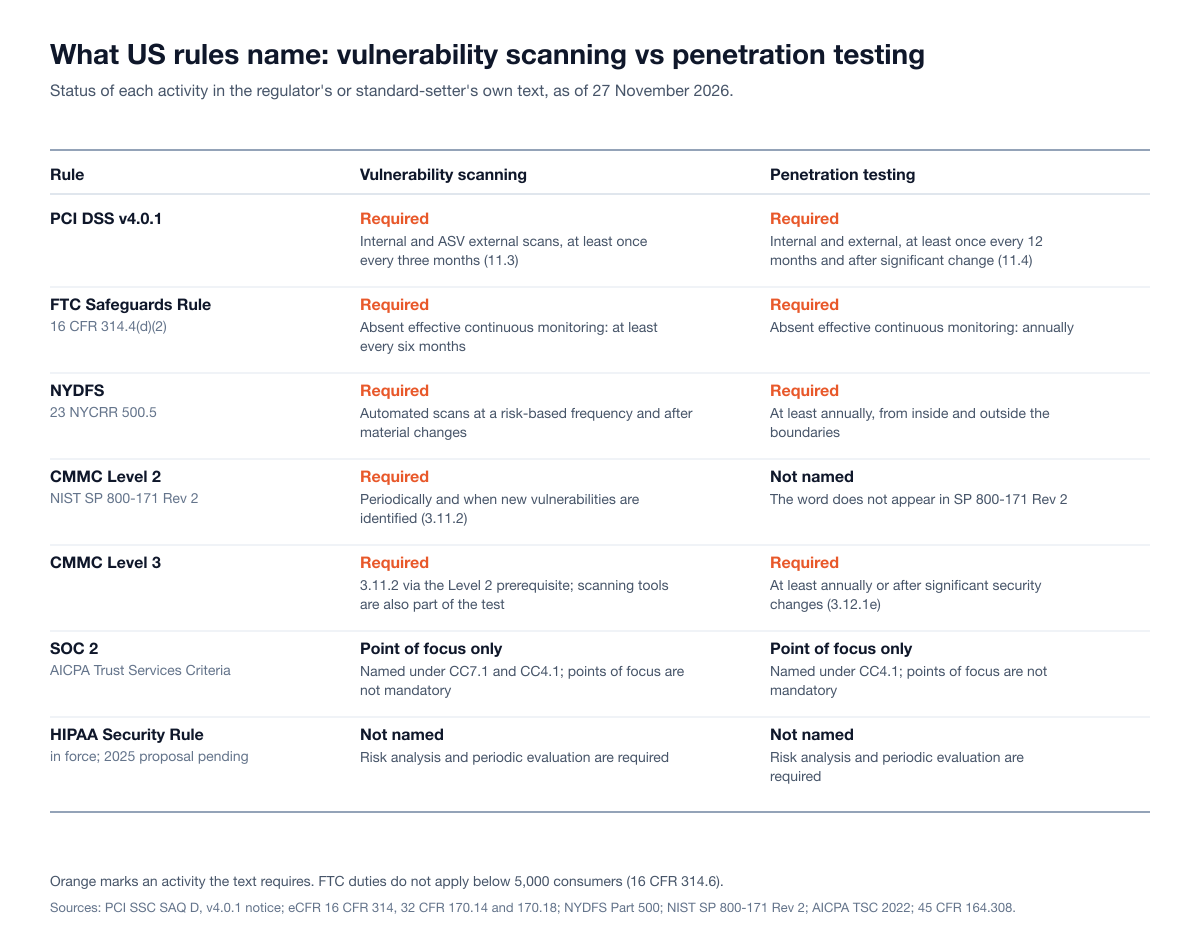
Figure 1: What each US rule names for vulnerability scanning and for penetration testing, as of 27 November 2026. Sources: PCI SSC, eCFR 16 CFR 314.4, NYDFS Part 500, eCFR 32 CFR 170.14, AICPA TSC, eCFR 45 CFR 164.308.
Rule | Vulnerability scanning | Penetration testing | The verb |
|---|---|---|---|
PCI DSS v4.0.1 | Required: 11.3.1 internal and 11.3.2 external (ASV), at least once every three months | Required: 11.4.2 internal and 11.4.3 external, at least once every 12 months and after significant change | "are performed" (both) |
FTC Safeguards Rule, 16 CFR 314.4(d)(2) | Required absent effective continuous monitoring: vulnerability assessments at least every six months | Required absent effective continuous monitoring: annual penetration testing | "shall conduct" |
NYDFS 23 NYCRR 500.5 | Required: automated scans at a risk-based frequency and after material changes | Required: at least annually, from inside and outside the boundaries | "shall be designed to ensure that covered entities ... conduct, at a minimum" |
CMMC Level 2 (NIST SP 800-171 Rev 2) | Required: 3.11.2, periodically and when new vulnerabilities are identified | Not named | "Scan for vulnerabilities" |
CMMC Level 3 | Required: 3.11.2 carries over through the Final Level 2 prerequisite (32 CFR 170.18), and CA.L3-3.12.1e uses automated scanning tools inside the test | Required: CA.L3-3.12.1e, at least annually or after significant security changes | "Conduct penetration testing" |
SOC 2 (AICPA TSC) | Named in non-mandatory points of focus (CC7.1, CC4.1) | Named in a non-mandatory point of focus (CC4.1) | "may include" |
HIPAA Security Rule (in force) | Not named | Not named | Risk analysis is "Required"; periodic evaluation is a standard ("Perform") |
PCI DSS v4.0.1: 11.3 is scanning, 11.4 is penetration testing
PCI DSS v4.0.1, published by the PCI Security Standards Council in June 2024 with "no additional or deleted requirements" compared with v4.0 (PCI SSC), requires both and numbers them separately. Requirement 11.3.1 says internal vulnerability scans "are performed ... At least once every three months", with rescans that confirm high-risk and critical vulnerabilities are resolved, "by qualified personnel" with organizational independence; 11.3.1.2 requires that they are "performed via authenticated scanning". Requirement 11.3.2 requires external scans at least once every three months "By a PCI SSC Approved Scanning Vendor (ASV)".
Requirement 11.4 is the penetration test. Internal (11.4.2) and external (11.4.3) testing is performed "Per the entity's defined methodology", "At least once every 12 months", "After any significant infrastructure or application upgrade or change", "By a qualified internal resource or qualified external third-party", with "Organizational independence of the tester" (not required to be a QSA or ASV). The 11.4.1 methodology must include "Application-layer penetration testing to identify, at a minimum, the vulnerabilities listed in Requirement 6.2.4", and 11.4.4 requires that exploitable vulnerabilities found are corrected (PCI SSC SAQ D requirement text). A passing ASV scan never satisfies 11.4. Our PCI DSS Requirement 11.4 guide covers every sub-requirement.
Does SOC 2 require a penetration test or a vulnerability scan?
Neither, by name. SOC 2 reports against the AICPA's Trust Services Criteria, and the criteria themselves do not name a method. Criterion CC4.1 requires that "The entity selects, develops, and performs ongoing and/or separate evaluations to ascertain whether the components of internal control are present and functioning." Its 2022 point of focus lists what those evaluations "may include": "first- and second-line monitoring and control testing, internal audit assessments, compliance assessments, resilience assessments, vulnerability scans, security assessment, penetration testing, and third-party assessments." Under CC7.1, the point of focus titled "Conducts Vulnerability Scans" describes scans "designed to identify potential vulnerabilities or misconfigurations on a periodic basis" (AICPA TSC with revised points of focus, 2022).
Points of focus are illustrative. The criteria say: "Use of the trust services criteria does not require an assessment of whether each point of focus is addressed." So the precise answer is: SOC 2 requires neither a penetration test nor a vulnerability scan, but the criteria name both as ways to evidence monitoring, and your auditor will test whatever your own control description promises. If it says "annual third-party penetration test", a scan report will not meet it. Enterprise customers reading your SOC 2 report may ask for the penetration test report as well. Our SOC 2 penetration testing guide covers timing inside a Type 2 observation period.
HIPAA Security Rule: risk analysis today, a proposal for tomorrow
The HIPAA Security Rule in force does not use the word "penetration". It requires a risk analysis under 45 CFR 164.308(a)(1)(ii)(A): "Conduct an accurate and thorough assessment of the potential risks and vulnerabilities to the confidentiality, integrity, and availability of electronic protected health information held by the covered entity or business associate." Under 164.308(a)(8) it requires a "periodic technical and nontechnical evaluation" of whether security policies and procedures meet the rule (eCFR, 45 CFR 164.308). Neither names a method or a frequency; a penetration test and scanning are ways to produce that evidence.
The proposal published on 6 January 2025 (90 FR 898, RIN 0945-AA22) would add a vulnerability management standard that separates the two. It would require covered entities and business associates to "Conduct automated vulnerability scans" at least once every six months or as the risk analysis requires, whichever is more frequent, and to "Perform penetration testing ... by a qualified person" at least once every 12 months or as the risk analysis requires, whichever is more frequent (Federal Register). As of 27 November 2026 it is still only a proposal: the Federal Register lists no final rule for that RIN, and the Unified Agenda entry places it under Long-Term Actions with final action dated July 2027. Treat annual testing and six-monthly scanning as sound risk-based practice and a likely future duty, not current law. See our HIPAA penetration testing requirements guide.
FTC Safeguards Rule: 16 CFR 314.4(d)(2) names both
The FTC Safeguards Rule applies to "all financial institutions over which the Federal Trade Commission ... has jurisdiction". Section 314.1(b) says those include, but are not limited to, "mortgage lenders, 'pay day' lenders, finance companies, mortgage brokers, account servicers" and, further down the same list, collection agencies and tax preparation firms. Section 314.4(d)(2) reads: "For information systems, the monitoring and testing shall include continuous monitoring or periodic penetration testing and vulnerability assessments. Absent effective continuous monitoring or other systems to detect, on an ongoing basis, changes in information systems that may create vulnerabilities, you shall conduct: (i) Annual penetration testing of your information systems determined each given year based on relevant identified risks in accordance with the risk assessment; and (ii) Vulnerability assessments, including any systemic scans or reviews of information systems reasonably designed to identify publicly known security vulnerabilities in your information systems based on the risk assessment, at least every six months" (eCFR, 16 CFR 314.4). Vulnerability assessments are also due whenever there are material changes to operations or business arrangements.
Two details are often missed. The duty is conditional: an institution with effective continuous monitoring may rely on it instead, and it has to be able to show that the monitoring is effective. And section 314.6 says 314.4(d)(2) does "not apply to financial institutions that maintain customer information concerning fewer than five thousand consumers." Above that line, a six-monthly scan does not replace the annual test, and a test does not replace the scans. Our FTC Safeguards Rule penetration testing guide covers who is covered and the evidence to keep.
NYDFS 23 NYCRR 500.5: annual testing plus risk-based scans
New York's regulation, retitled "Vulnerability management" by the Second Amendment, requires policies and procedures designed to ensure that covered entities "conduct, at a minimum: (1) penetration testing of their information systems from both inside and outside the information systems' boundaries by a qualified internal or external party at least annually; and (2) automated scans of information systems, and a manual review of systems not covered by such scans, for the purpose of discovering, analyzing and reporting vulnerabilities at a frequency determined by the risk assessment, and promptly after any material system changes" (NYDFS Part 500). Section 500.5(c) adds that covered entities must "timely remediate vulnerabilities, giving priority to vulnerabilities based on the risk they pose to the covered entity." The scanning duty in 500.5(a)(2) took effect 18 months after the Second Amendment's 1 November 2023 effective date, so it has applied since 1 May 2025. See our NYDFS penetration testing guide.
CMMC and NIST SP 800-171
For defense contractors the answer depends on the level. CMMC Level 2 requirements "are identical to the requirements in NIST SP 800-171 R2" (32 CFR 170.14), and SP 800-171 Rev 2 requires scanning at 3.11.2, "Scan for vulnerabilities in organizational systems and applications periodically and when new vulnerabilities affecting those systems and applications are identified", while the word "penetration" does not appear in it at all (NIST SP 800-171 Rev 2). CMMC Level 3 adds CA.L3-3.12.1e: "Conduct penetration testing at least annually or when significant security changes are made to the system, leveraging automated scanning tools and ad hoc tests using subject matter experts." Scanning alone does not meet Level 3; the requirement itself puts the scanner inside a test run by experts. Scanning does not drop away either: a Final Level 2 status is a prerequisite for a Level 3 assessment (32 CFR 170.18), so the 3.11.2 scanning requirement carries over. See does CMMC require penetration testing.
How do I know if my pentest is real?
Run the checks below on a proposal before you sign and on the report when it arrives. This is Stingrai's guidance, drawn from what the definitions above require a penetration test to do; no standard publishes this list.
Check | What a real penetration test shows | What a relabeled scan shows |
|---|---|---|
Named, certified testers | The people who will test, by name, with their certifications (for example OSCP, OSWE, CREST CRT) and their independence from your team | "Our security team", no names, or only a platform name |
Methodology | A method tied to OWASP WSTG, the OWASP API Security Top 10, PTES or NIST SP 800-115, and what was in scope | "Industry-standard tools" or a list of scanner products |
Manual test cases per role | The roles, tenants and accounts tested, with authenticated testing for each, and the authorization matrix tried | One set of credentials, or none |
Proof of concept and reproduction steps | For each finding: the request, the response, screenshots and numbered steps another engineer can repeat | A description copied from a vulnerability database and a CVSS score |
Findings a scanner would not list | At least some authorization, business logic, session or chained findings, or a clear statement of which were tested and held up | Only missing headers, TLS settings, outdated versions and banner disclosures |
Risk rated in context | Severity adjusted to your data, exposure and exploitability, with business impact written for your application | Tool severities unchanged, including "Critical" for things that cannot be reached |
Retest included | Testers retest each fixed finding and update its status in the report | A rescan, or a new quote for a second test |
Attestation letter | A letter stating scope, dates, method and who tested, for auditors and customers | A certificate of "scan completed", or nothing |
Red flags in a proposal or report
Each of these is Stingrai's guidance, and each has a plain explanation.
Identical boilerplate. The executive summary, findings text and recommendations read the same as another client's report or a vendor template, with your company name swapped in. Real findings are specific to your application's endpoints, roles and data.
Scanner plugin IDs. Finding titles or references carry a scanner's plugin or check IDs, or the finding list is sorted the way a scan export is. Scanners are legitimate inputs to a test; a report that is mostly their export is a vulnerability assessment.
No authenticated testing. No user roles in scope, no test accounts requested, or one account for a multi-role application. Authorization flaws cannot be tested from outside the login page.
A price or timeline too small for the scope. One day of testing for a multi-tenant application with several roles is a scan schedule, not a test plan. For reference, Stingrai's published range for web application testing is 2 to 20 testing days, driven by the number of user roles, endpoints and workflows (Stingrai).
No chain, no story. Every finding stands alone at Low or Medium, and nothing explains what an attacker could reach by combining them.
No scoping call. The vendor priced the work without asking about roles, tenants, integrations or business workflows, the things that decide where the real risk sits.
For what a full report should contain page by page, see our penetration testing report sample, and for the evidence packet procurement should write into the contract, our third-party penetration testing buyer evidence guide.
How to check a penetration test report is a real pentest, step by step
Confirm the people. Find the named testers and their certifications in the report or the attestation letter, and check that they match the proposal.
Confirm the method. Find the methodology section and check that it names a recognized method, such as OWASP WSTG, PTES or NIST SP 800-115, and the scope that was tested.
Confirm authenticated coverage. Check that every user role and tenant in scope is listed, with the accounts used, and that authorization was tested across them.
Open three findings at random. Each should carry a proof of concept with requests, responses or screenshots and steps your engineers can reproduce.
Look for the classes scanners miss. Search for authorization, IDOR or BOLA, business logic, session and chained findings, or an explicit statement of which of those were tested.
Check the severities. Each rating should explain the business impact in your environment, not repeat a tool score.
Search for scanner fingerprints. Look for plugin or check IDs, generic database descriptions and findings copied across hosts.
Confirm the retest and the letter. Check that fixed findings were retested by the testers and that an attestation letter states scope, dates and who tested.
When is a vulnerability scan the right tool?
Scanning is the right tool whenever the question is "what known weakness has appeared since we last looked?" It is cheap per asset, it runs unattended, and it covers far more hosts than any test. Three situations call for it on its own merits.
Continuous hygiene across the estate. New vulnerabilities are disclosed and exploited every week. The CISA Known Exploited Vulnerabilities catalog added 321 CVEs in 2026 through 25 November, against 245 in all of 2025, and held 1,805 entries in its 25 November 2026 version (CISA KEV). Authenticated scanning between tests is how you find a newly listed CVE on your own hosts in days rather than at the next annual test.
The obligations that name it. PCI DSS 11.3 (every three months), the FTC Safeguards Rule (every six months, absent effective continuous monitoring), NYDFS 500.5(a)(2) (risk-based, and after material changes) and NIST SP 800-171 3.11.2 all require scanning as its own control.
Before a test, to clear the backlog. Fixing the known, patchable population first means your penetration testers spend their days on authorization, logic and chains, not on rediscovering missing patches.
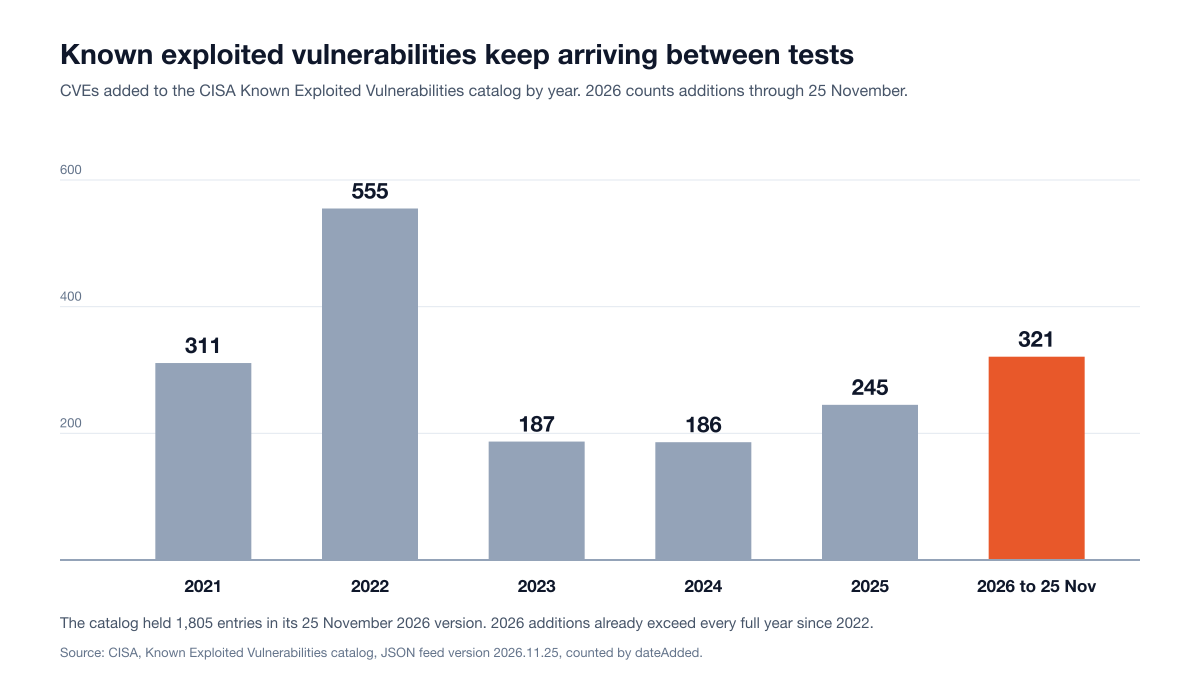
Figure 2: CVEs added to the CISA KEV catalog by year, 2021 to 2026 (2026 through 25 November; the earliest entries are dated 3 November 2021). Source: CISA, Known Exploited Vulnerabilities catalog, JSON feed version 2026.11.25.
How scans and penetration tests fit together in one program
The table below is Stingrai's guidance on combining the two; it is not a requirement of any standard.
Layer | What it answers | Typical cadence | Evidence it produces |
|---|---|---|---|
Authenticated vulnerability scanning | Which known vulnerabilities and misconfigurations exist on our hosts and components now? | Continuous or monthly, with the frequency your rules set as a floor | Scan reports, rescan proof, remediation tickets |
Testing in the delivery pipeline | Did this release introduce a flaw in our own application code? | Per pull request or per release | Gate results, fixed findings |
Penetration testing | What can an attacker actually reach, including authorization, logic and chains? | At least annually and after significant change, or continuously for applications that change often | Report with proof of concept, retest results, attestation letter |
The layers do not substitute for each other. Scanning keeps the known population under control, pipeline testing stops new application flaws from shipping, and the penetration test proves what is exploitable and produces the evidence an auditor or enterprise customer will accept.
Where do AI-assisted and autonomous pentests fit?
Autonomous AI penetration testing agents are not vulnerability scanners. A scanner matches signatures; an agent logs in, explores the application, acts as different roles, attempts exploitation and keeps going when a step succeeds, closer to what a tester does. That is why a buyer who values depth should judge an autonomous test against the penetration test column of the comparison table, not the scan column, and then ask the two questions that matter: who confirmed each finding, and who signs the evidence.
Stingrai offers three ways to test a web application, each delivered as a one-time (annual) test or as a continuous program.
Option | Who tests | Price for one web application and associated APIs | Evidence |
|---|---|---|---|
Autonomous Pentest | Snipe, Stingrai's autonomous AI agent, on its own: authenticated testing for up to three user roles, business logic and authorization flaws, same-day results, automated retests and AutoFix pull requests | US$3,000 per assessment, or US$650 a month on a 12-month plan | Pentest report and an attestation letter covering Snipe's autonomous testing |
Hybrid Pentest | Snipe tests the full application while Stingrai's certified penetration testers test the same application manually alongside it and validate Snipe's findings, so coverage is wider and deeper | US$6,800 per assessment, or US$1,275 a month on a 12-month plan | Human-validated pentest report and an attestation letter naming the human testing |
Human-led | Two named penetration testers from a team holding OSCE³, OSWE, OSEP, CREST CRT and CISSP certifications, reviewed by the team lead and an engagement partner | Quoted by scope through Get a Quote | Report with proof of concept, retest and an attestation letter |
Prices checked 27 November 2026. Source: Stingrai pricing.
Why Hybrid is the choice for buyers who value depth
The Hybrid Pentest is built for exactly the buyer this post is written for. Snipe hunts IDOR, broken authorization and business logic across the whole application at machine speed, while the penetration testers test the same application manually, direct where Snipe goes deeper, chain what it surfaces and validate its findings. It is not a split in which the machine takes the easy classes and people take the hard ones: both work the full scope, so coverage is wider and deeper than either alone. The one-time Hybrid Pentest is US$6,800 and includes 12 monthly vulnerability scans after the pentest, which is the scan-plus-test program described above in a single package (pricing).
Where a rule names a qualified tester, as PCI DSS 11.4, NYDFS 500.5 and the HIPAA proposal do, Stingrai's guidance is to choose Hybrid or human-led testing, so that the report and the attestation letter name the people who tested.
The case for continuous Hybrid
An annual test describes the application on the day it was tested. The evidence in this post says the gap after that day is widening: the CISA KEV catalog has already added more CVEs in 2026 than in any full year since 2022, and every release can introduce a new authorization or logic path that no scanner will flag. Continuous Hybrid is US$1,275 a month on a 12-month plan for one web application and associated APIs: monthly Snipe testing, human-verified, plus a quarterly deep dive by Stingrai's penetration testers. It keeps the depth of a real pentest running between audits instead of once a year. See pricing, the PTaaS platform and our Hybrid web application penetration testing guide.
Where Stingrai fits
Stingrai is a global CREST-accredited penetration testing services company founded in Toronto, Canada in 2021, trusted by companies from startups to enterprises to meet audit requirements for SOC 2, ISO 27001, CMMC, PCI DSS and HIPAA. Its OSCE³, OSWE, OSEP and CREST CRT certified penetration testers are also world-class security researchers and bug bounty hunters, with 18 CVEs published by Stingrai's researchers (Snipe). Stingrai Inc holds two CREST accreditations, Penetration Testing and AI-Enabled Penetration Testing, and the CREST AI Charter company certification (CREST Marketplace).
For a buyer who has been sold a scan before, the specifics are what matter. Web application and API testing follows OWASP WSTG, OWASP ASVS 5.0, the OWASP API Security Top 10, PTES and NIST SP 800-115, with authenticated testing across every user role and business logic, broken authorization, IDOR, injection, authentication and session handling in scope (Stingrai web application testing). Every finding reaches the PTaaS portal as it is confirmed, with a working proof of concept and remediation guidance, so fixing starts during the test; retesting of fixed findings is included; and every engagement comes with an attestation letter. Stingrai's penetration testing supports your PCI DSS, SOC 2, HIPAA, FTC Safeguards, NYDFS and CMMC programs, as a one-time annual test or a continuous program. See web application penetration testing, API penetration testing and network penetration testing.
Frequently Asked Questions
What is the difference between penetration testing and vulnerability scanning?
Vulnerability scanning is automated: a tool compares systems against known vulnerabilities and reports what might be vulnerable. Penetration testing is performed by qualified people who exploit and chain weaknesses to prove what an attacker can actually reach, including authorization and business logic flaws that no signature describes. NIST SP 800-115 says scanners "check only for the possible existence of a vulnerability", while a penetration test "exploits the vulnerability to confirm its existence". Most programs need both: scanning for continuous hygiene and penetration testing for proof.
Is a vulnerability scan the same as a penetration test?
No. A scan reports possible known weaknesses; a penetration test attempts to circumvent or defeat security controls, which is how both the FTC Safeguards Rule (16 CFR 314.2(n)) and NYDFS (23 NYCRR 500.1(l)) define penetration testing. PCI DSS v4.0.1 keeps them as separate requirements, 11.3 for scanning and 11.4 for penetration testing, so a passing scan never satisfies the testing requirement. A scan that someone has reviewed manually is still a vulnerability assessment.
Does SOC 2 require a penetration test or a vulnerability scan?
Neither by name. The AICPA Trust Services Criteria require ongoing and separate evaluations under CC4.1, and the 2022 points of focus say those evaluations "may include" vulnerability scans and penetration testing; CC7.1 has a point of focus titled "Conducts Vulnerability Scans". Points of focus are not mandatory, but your auditor tests the controls you describe: if your description promises an annual penetration test and periodic scanning, you will be tested against both. Enterprise customers reviewing your SOC 2 report may also ask for the penetration test report.
Does PCI DSS require penetration testing and vulnerability scanning?
Yes, both, as separate requirements. PCI DSS v4.0.1 Requirement 11.3 requires internal scans (11.3.1, authenticated under 11.3.1.2) and external scans by an Approved Scanning Vendor (11.3.2), each at least once every three months. Requirement 11.4 requires internal and external penetration testing at least once every 12 months and after any significant infrastructure or application upgrade or change, by a qualified tester with organizational independence, with exploitable findings corrected and retested.
Does the FTC Safeguards Rule require penetration testing?
Yes, unless the institution has effective continuous monitoring or is exempt. 16 CFR 314.4(d)(2) says that, absent effective continuous monitoring, covered financial institutions "shall conduct" annual penetration testing and vulnerability assessments at least every six months, and whenever material changes occur. Section 314.6 exempts institutions that hold customer information on fewer than 5,000 consumers from that paragraph.
How do I know if my pentest is real?
Check for named, certified testers; a methodology tied to OWASP WSTG, PTES or NIST SP 800-115; authenticated testing for every role in scope; a proof of concept and reproduction steps for each finding; findings a scanner would not list, such as authorization, business logic or chained issues; severities rated in your context; a retest of fixed findings; and an attestation letter. Scanner plugin IDs, identical boilerplate, no authenticated testing and a timeline too short for the scope are the red flags.
Can a vulnerability scanner find IDOR or business logic flaws?
Not reliably. A scanner cannot tell that a well-formed response contains another customer's record, because it does not know who owns what. OWASP's Web Security Testing Guide states that business logic flaws "cannot be detected by a vulnerability scanner and relies upon the skills and creativity of the penetration tester", and its IDOR test calls for "at least two (often more) users". Testing these classes needs multiple accounts, roles and tenants and someone who understands the application's rules.
How often should you scan, and how often should you pentest?
Scan continuously or at least monthly for hygiene, and never less often than your rules require: every three months under PCI DSS, every six months under the FTC Safeguards Rule absent effective continuous monitoring, and at a risk-based frequency under NYDFS. Penetration test at least annually and after significant change, as PCI DSS, NYDFS and the FTC rule require. Applications that ship often benefit from continuous testing, such as Stingrai's continuous Hybrid program at US$1,275 a month on a 12-month plan for one web application and associated APIs.
Is an autonomous AI pentest the same as a vulnerability scan?
No. An autonomous agent such as Stingrai's Snipe logs in, acts across roles and attempts exploitation of authorization, IDOR and business logic flaws, rather than matching signatures. Stingrai's Hybrid Pentest pairs Snipe with certified penetration testers who test the same application manually alongside it and validate its findings, at US$6,800 per assessment for one web application and associated APIs.
How much does a penetration test cost compared with a vulnerability scan?
A scanner is a license or subscription: Tenable, for example, lists Nessus Professional at US$4,790 for a one-year license as of 27 November 2026. A penetration test is priced by scope. Stingrai's Hybrid Pentest is US$6,800 per assessment and its Autonomous Pentest is US$3,000, each for one web application and associated APIs, and network penetration tests typically run US$5,000 to US$40,000 and above. Larger scopes are quoted through Stingrai's Get a Quote form.
Related reading
Penetration Testing Services (2026): A US Buyer's Guide to Types, Requirements and Cost
Vulnerability Assessment vs Penetration Testing (2026): Differences, Cost and What Auditors Accept
Manual Penetration Testing (2026): What Human Testers Find That Automation Misses
DAST vs Penetration Testing (2026): What Each Finds and Where Hybrid Fits
Human-Led Penetration Testing Services (2026): Manual Testing for Regulated Industries
VAPT (2026): Vulnerability Assessment and Penetration Testing, Process, Scope and Cost
Best Web Application Penetration Testing Services and Companies (2026)
References
NIST. SP 800-115, Technical Guide to Information Security Testing and Assessment. September 2008. https://nvlpubs.nist.gov/nistpubs/Legacy/SP/nistspecialpublication800-115.pdf. Sections 4.3 (vulnerability scanning) and 5.2 (penetration testing).
OWASP. OWASP Top 10:2025, A01 Broken Access Control and A07 Authentication Failures. 2025. https://top10.owasp.org/2025/A01_2025-Broken_Access_Control/.
OWASP. API Security Top 10 2023: API1, API5 and API6. 2023. https://owasp.org/API-Security/editions/2023/en/0xa1-broken-object-level-authorization/.
OWASP. Web Security Testing Guide v4.2: Introduction to Business Logic and WSTG-ATHZ-04. 2020. https://owasp.org/www-project-web-security-testing-guide/v42/.
PCI Security Standards Council. SAQ D for Merchants, Requirements 11.3 and 11.4, and Just Published: PCI DSS v4.0.1 (11 June 2024). https://listings.pcisecuritystandards.org/documents/PCI-DSS-v4-0-SAQ-D-Merchant.pdf.
AICPA. TSP Section 100, 2017 Trust Services Criteria with Revised Points of Focus (2022), red-lined version. https://assets.ctfassets.net/rb9cdnjh59cm/2sK6Ih6dzy6t7aU6RQvoeD/d97a2a14609e74a1af1ce9ab0b142b69/92317096_trust_services_criteria_red-lined_version.pdf.
US Department of Health and Human Services. 45 CFR 164.308, eCFR, and HIPAA Security Rule To Strengthen the Cybersecurity of Electronic Protected Health Information, proposed rule, 90 FR 898, 6 January 2025. https://www.federalregister.gov/documents/2025/01/06/2024-30983/hipaa-security-rule-to-strengthen-the-cybersecurity-of-electronic-protected-health-information.
Federal Trade Commission. Standards for Safeguarding Customer Information, 16 CFR Part 314, eCFR. https://www.ecfr.gov/current/title-16/chapter-I/subchapter-C/part-314.
New York State Department of Financial Services. 23 NYCRR Part 500, as amended 1 November 2023. https://www.dfs.ny.gov/system/files/documents/2023/12/rf23_nycrr_part_500_amend02_20231101.pdf.
US Department of Defense. 32 CFR 170.14, CMMC security requirements, eCFR. https://www.ecfr.gov/current/title-32/subtitle-A/chapter-I/subchapter-G/part-170/subpart-B/section-170.14.
NIST. SP 800-171 Rev 2, Protecting Controlled Unclassified Information. https://nvlpubs.nist.gov/nistpubs/SpecialPublications/NIST.SP.800-171r2.pdf.
CISA. Known Exploited Vulnerabilities catalog, JSON feed version 2026.11.25. https://www.cisa.gov/known-exploited-vulnerabilities-catalog.
Stingrai. The State of Penetration Testing 2026: An Analysis of 1,206 Verified Findings. https://www.stingrai.io/blog/state-of-penetration-testing-2026.
Talk to Stingrai
If you want to know whether a proposal or report in front of you is a real penetration test, or you need one that will stand up with an auditor, an enterprise customer or your board, one short conversation scopes it. Get a Quote or book a free discovery call.