




Enterprise security controls block only 37% of attacker actions once the attacker has authenticated access, and fewer than 1 in 7 simulated attacks produce a meaningful alert, across more than 338 million simulations run in customer environments between January and June 2026 (Picus Blue Report 2026). Perimeter prevention actually recovered this year, climbing back to 69%. The inside did not. That gap between a hardened edge and a quiet interior is the entire commercial case for a red team, because a red team is the only assessment type that measures it directly.
Quick answer: A red team service is an objective-based engagement in which senior operators emulate a named adversary against your defensive stack and measure whether detection and response fire, and Stingrai, a CREST-accredited penetration testing service provider at firm level, delivers it with its own named penetration testers from a team holding CRTL, CRTO, CRTE and OSEP as a one-time annual exercise or a continuous program, quoted within 24 hours. The guide covers the three engagement models, five delivery models, rules of engagement, 2026 costs, timelines and an eight-step provider check.
A red team service is a contracted, objective-based engagement in which senior operators emulate a specific adversary against your whole defensive stack, stay quiet, chain access toward a named crown-jewel objective, and measure whether your detection and response actually fire. The unit you are buying is not a vulnerability list. It is evidence about your defenders: what they saw, what they missed, how long it took, and what an adversary could have reached in the meantime.
This guide is about buying that engagement. What belongs in scope, how a red team genuinely differs from a penetration test and a purple team, the three engagement models on the market, the five kinds of provider who will bid, what it costs and how long it takes, what the report must contain, and how to verify a provider's claims before you sign.
Which guide you need
Red team procurement splits into a dozen separate decisions, and each one has its own guide. Start with the question you actually have.
Your question | Read this |
|---|---|
What are red team services, who sells them, and what do they cost? | This guide: definitions, engagement models, delivery models, pricing, timelines, provider verification |
Red team, penetration test, or continuous validation: which do I need? | |
How do I scope it before I write the RFP? | Red Team Objectives and Crown Jewels: How to Scope by Outcome |
What exactly drives the price? | |
What clauses must be in the rules of engagement? | Red Team Rules of Engagement: What to Demand Before You Sign |
Will our SOC actually catch it? | |
Should we buy a purple team exercise instead? | Purple Team Exercise: How to Scope One and What to Demand in the SOW |
What questions go in the RFP, with scored answers? | |
Which regulator framework applies to us? | |
What does Stingrai specifically do? |
Red team, penetration test, purple team: the definitions that matter at purchase
Buyers routinely pay red team prices for penetration test work, and occasionally pay for a red team when a purple team would have taught their SOC more. The three are different instruments with different questions.
Penetration test | Red team | Purple team | |
|---|---|---|---|
The question it answers | What is exploitable inside this defined scope? | Would anyone notice an adversary reaching what matters most? | Which specific attacker techniques does our detection stack see, and can we fix the gaps today? |
Scope definition | An asset list: applications, IP ranges, cloud accounts | An objective: a named crown-jewel outcome, with the surface scoped to reach it | A technique list, usually mapped to MITRE ATT&CK |
Is the blue team told? | Yes, normally | No. Only a small control group knows | Yes. Attackers and defenders work in the same room |
Stealth | Not a goal | A core requirement | Deliberately abandoned |
Typical duration | Days to two weeks | Three to eight weeks, longer when regulated | Two to ten days |
Primary deliverable | Findings with reproduction evidence and remediation | An attack narrative plus detection and response timings per stage | Per-technique detection outcomes and tuned detection content |
Buy it when | You need coverage and evidence for an audit or a customer | You need to know whether your defenses hold against a realistic adversary | Your SOC needs to improve measurably and quickly |
The short version worth quoting: a penetration test measures your attack surface, a red team measures your defenders, and a purple team trains them. Full treatment of the first distinction sits in red team vs penetration test vs continuous validation, and the case for buying purple instead is set out in how to scope a purple team exercise.
One warning that saves money: if your detection program has never been measured, a full red team will frequently tell you what a purple team would have told you in a fifth of the time. Red teams are most valuable when there is a functioning SOC to test.
What a red team service includes
A complete red team engagement covers six workstreams. If a proposal is silent on one of them, that silence is the scope.
Workstream | What a competent provider does | Why it gets dropped |
|---|---|---|
Threat intelligence | Profiles the adversaries that realistically target your sector and region, then converts their tradecraft into scenarios you will actually face | Cheap quotes skip it and substitute a generic attacker persona |
Objective and flag definition | Names the crown-jewel outcome and the specific proof that it was reached, agreed in writing before testing starts | The scope was written as an asset list, so nobody agreed what winning looks like |
Initial access | External exploitation, credential attacks, phishing and vishing, and in full-scope work sometimes physical entry | Social engineering was priced as an add-on and cut in negotiation |
Post-exploitation and lateral movement | Privilege escalation, credential harvesting, identity-path abuse, cloud control-plane movement, quiet persistence | Time ran out because reconnaissance consumed the budget |
Detection and response measurement | Timestamps per stage: what fired, what was logged silently, what was never seen, and how your team responded | The provider only instruments its own actions, not your defenders' reactions |
Debrief and replay | A joint walkthrough with your SOC, replaying the paths so detection content can be written and tested | Sold separately, or delivered as a PDF with no session |
The last two are what separate a red team from an expensive penetration test. If the proposal does not commit to per-stage detection timings and a replay session, you are buying an attack, not an assessment.
What is normally excluded
Destructive actions, real data exfiltration, testing that risks customer funds or safety systems, and attacks on third parties you do not control sit outside a standard engagement. Denial of service is almost always excluded. Physical entry, insider-threat simulation and supply-chain scenarios are in scope only when priced explicitly. Settle all of these during scoping, and put them in the rules of engagement rather than in an email in week three.
The three engagement models
Almost every red team you buy is one of three shapes. The right one follows from your objective, not from your budget.
Assumed breach
The test starts from a realistic internal foothold: a workstation, a set of user credentials, or a deployed implant. You skip the initial-access phase entirely and spend the whole budget on the part most organizations are weakest at, which the Blue Report data puts starkly at 37% prevention once the attacker is authenticated.
Choose it when your question is "how far does an intruder get, and would we see them?" rather than "can anyone get in at all". It is also the pragmatic choice when a previous engagement already proved initial access is achievable, since paying twice to prove the same thing is a poor use of senior days. Full treatment: assumed breach engagements explained.
Full-scope
The operators start from outside with no foothold and must earn access themselves, through the external estate, through your people, or occasionally through a door. This is the most realistic model and the most expensive, because reconnaissance and initial access consume real tester-days before the interesting part begins.
Choose it when the question genuinely includes your perimeter and your people, when a board or regulator expects an end-to-end demonstration, or when you have never tested initial access.
Regulator-mandated threat-led testing
In regulated financial services, the engagement shape is prescribed. DORA TLPT, TIBER-EU, CBEST and STAR-FS, and OSFI I-CRT in Canada all follow the same four-phase model: preparation and scoping, a dedicated threat-intelligence phase, red team testing against live production systems supporting critical functions, and a closure phase with formal attestation.
These programs differ from commercial red teams in three ways that change procurement completely. The cadence is set by the regulator rather than by you: DORA requires in-scope entities to run TLPT at least once every three years under Article 26. The provider bar is written into the rules, including tester qualification thresholds and, in most frameworks, enforced independence between the threat-intelligence provider and the red team. And the timeline runs in months rather than weeks.
Work out which framework applies before you shortlist anyone. TIBER-EU vs CBEST vs DORA TLPT covers the three that matter most in Europe and the UK, the global TLPT frameworks reference maps every national variant including iCAST, CORIE and FEER, and Canadian institutions should read OSFI's I-CRT framework, where the current formal scope reaches only the six domestic systemically important banks and internationally active insurance groups. Provider selection under these regimes has its own rules, covered in how to choose a threat-led penetration testing provider.
Quick comparison: the five delivery models
Every provider you shortlist will fit one of five models. The model determines who touches your network, whether the engagement carries regulatory weight, and how predictable your cost is. Each entry below is described from the vendor's own current public pages, reviewed in August 2026.
Delivery model | Who runs the operation | Strengths | Structural trade-offs | Published pricing | Examples |
|---|---|---|---|---|---|
Specialist offensive-security firm with an in-house bench | The firm's own employed operators | Named operators, continuity from scoping through debrief and retest, objective-based scoping | Capacity is bounded by one firm's bench; verify the specific regulator accreditations you need | Varies; most quote to scope | Stingrai, NetSPI |
Accredited threat-led testing provider on a regulator register | Employed consultants inside an accredited practice | The only route where a regulator-mandated test counts; accredited threat-intelligence capability alongside the red team | Lead time and price track senior consultant availability; overkill if you are not in scope for a framework | Not published | NCC Group and other CREST TLPT and STAR-FS accredited firms |
Incident-response-attached consultancy | Consultants inside a firm that also runs frontline incident response | Scenarios grounded in current intrusion data the firm sees first-hand; strong ransomware readiness framing | Red team work competes internally with IR surge demand; scheduling can be inflexible | Not published | Mandiant (Google Cloud), CrowdStrike Services |
Crowdsourced researcher network | Independent researchers matched per engagement by a platform | Fast start, wide range of specialisms, strong platform tooling | These platforms position the work as penetration testing and vulnerability discovery; confirm in writing whether stealthy end-to-end adversary emulation with detection measurement is actually in scope | Not published on pages reviewed | Synack, Bugcrowd |
Adversary-emulation and BAS software | Software your team operates, or the vendor operates as a managed service | Repeatable, continuous, cheap per run, excellent for regression-testing detection content | Executes a catalogue of known actions rather than improvising against your specific defenders; not a substitute where independence or an attack narrative is the deliverable | Not published | AttackIQ, SCYTHE |
A note on fairness: "not published" means the vendor did not publish a price on the pages reviewed for this guide in August 2026, not that the vendor is expensive or evasive. Red team engagements are quoted to scope almost universally, for the good reason that no two scenarios need the same number of days.
1. Specialist offensive-security firm with an in-house bench
This model puts a firm's employed senior operators on your engagement, with the same people carrying context from scoping through the debrief. The buying argument is accountability: you can name who ran the operation, and the operator who found the path is the one who explains it to your SOC.
NetSPI (Minneapolis, Minnesota) lists Red Team Operations, Social Engineering and Detective Controls Testing as named services under adversary simulation, framed around assessing detection, response and recovery. It does not publish pricing.
Stingrai (Toronto, Ontario, with a London, UK office) runs the same structural model with its own named penetration testers, two per engagement, backed by a firm-level CREST accreditation and a bench holding CRTL, CRTO, CRTE, OSEP and OSCE³. What to check in this model generally, and what we would expect you to check with us: who specifically is running the operation and what they hold, whether detection timings per stage are a contractual deliverable, and whether the replay session with your SOC is inside the fee.
Best for: buyers who want named, accountable operators, objective-based scoping, and continuity from scoping through the debrief. Not ideal for: a regulator-mandated test that requires a provider on a specific national register.
2. Accredited threat-led testing provider on a regulator register
When a supervisor mandates the test, accreditation stops being a quality signal and becomes an eligibility gate. CREST operates the firm-level accreditations that most of these regimes reference: Threat Led Penetration Testing, annotated on CREST profiles as "(Formerly STAR ILPT)", and the financial-services variant TLPT-FS, alongside individual certifications including CREST Certified Red Team Specialist (CCRTS) and CREST Certified Simulated Attack Manager (CCSAM). CREST notes that CCRTS is "a critical requirement by the Bank of England as part of the CBEST accreditation process."
NCC Group (Manchester, United Kingdom, publicly listed) is the clearest example: its CREST accreditations span Penetration Testing, Threat Led Penetration Testing (TLPT-FS) and Threat Intelligence for Simulated Attacks, and its Full Spectrum Attack Simulation practice specialises in intelligence-led and threat-led testing alongside its own threat-intelligence function.
This is where the two-provider independence rule bites. Most frameworks require the threat-intelligence provider and the red team to be independent of each other, which constrains your shortlist in ways a commercial engagement never does. Check the register before the capability pitch, not after.
Best for: in-scope financial entities running DORA TLPT, TIBER-EU, CBEST, STAR-FS or an equivalent national program. Not ideal for: a commercial buyer outside any framework, who will pay for governance overhead that buys them nothing.
3. Incident-response-attached consultancy
Firms that run frontline incident response bring a genuine advantage to red teaming: their scenarios are drawn from intrusions they investigated this quarter. Mandiant, part of Google Cloud, delivers red and purple team assessments, assumed-breach engagements with a pre-deployed implant, ransomware readiness reviews and social engineering, with red team assessments framed as emulating a real attacker pursuing custom objectives. CrowdStrike runs a red team / blue team exercise structured around the kill chain, from active reconnaissance through delivery and exploitation, command and control, operations and an after-action review, with deliverables covering exploited vulnerabilities, TTPs used, and process and technology deficiencies observed.
The structural consideration is scheduling. Red team work sits in the same practice as incident response, and incident response does not wait. Ask for firm dates and a named lead in the contract.
Best for: buyers who want scenarios grounded in current intrusion data, and ransomware readiness in particular. Not ideal for: organizations that need guaranteed dates and continuity across a multi-engagement year.
4. Crowdsourced researcher network
Platforms in this model maintain a vetted community and match researchers per engagement. Synack (Redwood City, California) describes the Synack Red Team as over 1,500 researchers vetted through a five-step process covering resume review, technical assessment, background and identity verification, behavioural interview, and onboarding. Worth reading carefully: despite the name, the work described is vulnerability hunting, checklist-based missions and patch verification, which is penetration testing and vulnerability discovery rather than stealthy end-to-end adversary emulation against your detection stack.
That is not a criticism of the product, which is strong at what it does. It is a procurement warning. If a platform's "red team" is a brand for its researcher community, and your requirement is per-stage detection timings against an unwitting SOC, those are different purchases. Get it in writing before you sign.
Best for: broad, fast vulnerability discovery across a large estate with strong platform tooling. Not ideal for: an engagement whose deliverable is evidence about your defenders.
5. Adversary-emulation and breach-and-attack-simulation software
Here you licence software that replays known adversary behaviours against your live controls, continuously. AttackIQ (Los Altos, California) sells breach and attack simulation as part of a continuous threat exposure management platform. SCYTHE (Miami, Florida) sells adversarial exposure validation as a self-operated platform, a managed service, or advisory work including purple teaming and tabletop exercises.
This category is genuinely useful and genuinely different. It is the right way to regression-test detection content between engagements, and it produces the technique-level coverage data that makes a purple team session productive. What it does not do is improvise. Software executes a catalogue; a red team watches how your team reacts and changes its approach in response. Where the deliverable is an independent attack narrative, or a regulator expects human testers, confirm what the vendor signs before you assume it substitutes.
A related question buyers now ask is how far autonomous AI attackers have closed that gap. Inside agentic red teaming covers what a 24/7 AI attacker genuinely does well, and what still needs a human operator deciding which door to try next.
Best for: continuous validation of detection content, and measuring drift between human-led engagements. Not ideal for: buyers whose deliverable must be an independent, human-led adversary emulation.
What the report and the detection benchmarks actually contain
The red team report is the product, and it is structurally different from a penetration test report. Specify these seven items in the contract.
Deliverable | What good looks like |
|---|---|
Executive and board summary | Two to three pages a non-technical reader can act on: what objective was set, whether it was reached, what your defenders saw, and what to fix first |
Attack narrative | A chronological account of the operation with timestamps, decisions and pivots, readable end to end, not an itemized findings list |
Detection and response timeline | Per stage: what was prevented, what was logged silently, what alerted, what the SOC did, and how long each took |
Objective and flag outcomes | Explicit statement of which objectives were reached and what proof was captured, against the criteria agreed before the test |
Technique mapping | Every action mapped to MITRE ATT&CK technique IDs so your detection engineers can write and test content against them |
Root-cause findings | The specific control, configuration or process failures that made each path possible, with remediation |
Replay and debrief | A live walkthrough with your SOC, plus detection content recommendations and a retest to confirm the gaps closed |
Two cautions on ATT&CK mapping. A coverage heatmap is a communication tool, not a score, and a provider who presents "we covered 180 techniques" as a quality metric is measuring breadth of noise rather than depth of tradecraft. Grading MITRE ATT&CK coverage in a red team proposal sets out how to read those claims.
Benchmark your result against something real
When the report lands, you need to know whether your numbers are bad or normal. They are probably normal, and normal is worse than most boards expect.
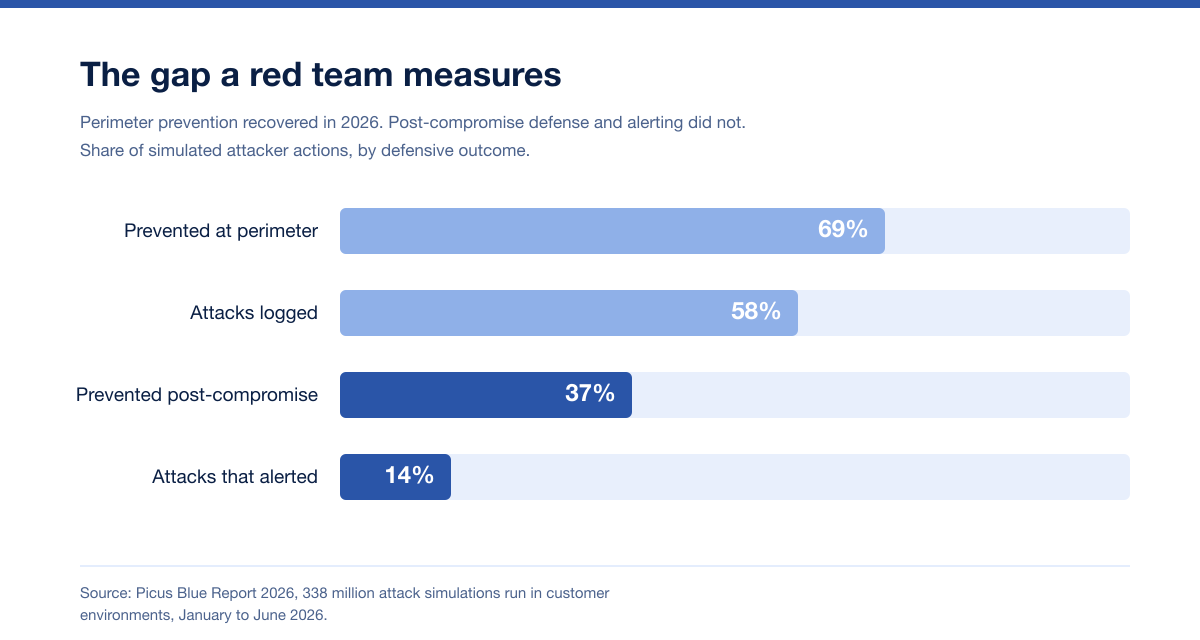
The Picus Blue Report 2026 found prevention recovering to 69% overall while post-authentication prevention sat at 37%, logging rose to 58%, and the alert score stayed flat at 14%. Better logging did not become better alerting. Meanwhile Mandiant M-Trends 2026 reports global median dwell time rising to 14 days from 11, with 52% of intrusions first detected internally, up from 43%. The most striking figure in that dataset: the median time from an initial access event to handoff to a secondary threat group collapsed from more than 8 hours in 2022 to 22 seconds in 2025, because access brokers now pre-stage the follow-on crew's tooling during the first infection.
Set your expectations against those numbers, not against a hope. The full benchmark set, including what each dataset actually measures and why the IBM lifecycle mean is not comparable to Mandiant's dwell median, is in red team detection benchmarks for 2026.
Rules of engagement: settle these before you sign
The rules of engagement are the document that decides whether a red team is a controlled exercise or an incident. Twelve clauses matter, and the ones buyers most often leave vague are stop conditions and safe words, the escalation tree with named contacts on both sides, deconfliction with your SOC and any MSSP, the authorization letter and who signs it, the fragile-asset list, and third-party or cloud-provider notification duties.
The straight answer on the question everyone asks: a competent red team does not break production, because the constraints that prevent it are contractual rather than technical. Destructive actions, real data exfiltration and anything touching customer funds are excluded in writing, and an immediate halt must be available that does not route through an account manager. The full clause-by-clause reviewer's checklist is in red team rules of engagement.
What red team services cost in 2026
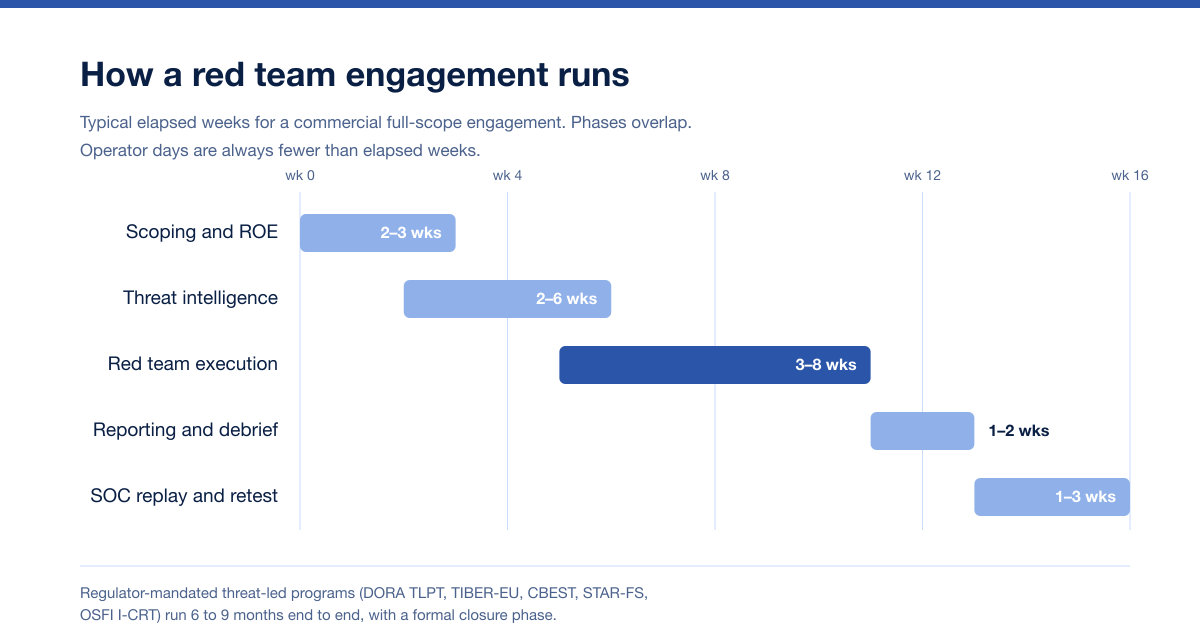
Red teams are quoted on senior tester-days, not per application or per IP address, so the total tracks how many days the scenario realistically demands. Six factors set that day count: scope breadth, engagement duration, scenario count, threat-intelligence depth, the objective you set, and any physical or social-engineering add-ons.
As third-party market context, published UK pricing guides place senior CREST-certified consultants around 1,200 to 1,300 pounds per day and full red team exercises around 18,000 to 48,000 pounds over three to eight weeks (EJN Labs, 2026; roughly US$23,000 to US$61,000 at a mid-2026 rate near US$1.28 to the pound). The same source reports CREST-accredited work running 20 to 40 percent above non-accredited testing. Regulated, intelligence-led programs sit well above that band because they run for months across four formal phases; the specific drivers are broken out in DORA TLPT cost.
Engagement shape | Typical elapsed duration | What moves the number most |
|---|---|---|
Single-scenario assumed breach against one identity path or business function | 2–3 weeks | Scope breadth, whether detection measurement is instrumented |
Full-scope external to objective, including social engineering | 4–8 weeks | Initial-access effort, scenario count, physical add-ons |
Multi-scenario program across cloud, on-premise and identity | 8–12 weeks | Number of objectives, threat-intelligence depth |
Regulator-mandated threat-led test (DORA TLPT, TIBER-EU, CBEST, STAR-FS, I-CRT) | 6–9 months end to end | Regulator coordination, mandated independence, formal closure and attestation |
Three levers actually control the total. Define one objective tightly rather than asking for everything: scope breadth is the top driver, and a focused single-scenario assessment is a fraction of a broad multi-vector program. Compare tester-days and objectives rather than headline day rates, because a low rate on a vague engagement usually costs more than a higher rate on a bounded one. And budget the retest up front instead of treating it as a surprise. The full six-driver breakdown is in how much a red team engagement costs in 2026, and how to compare penetration testing quotes covers normalizing proposals so you compare like for like.
For context on adjacent spend, general penetration testing benchmarks are in the 2026 penetration testing cost guide, Canadian buyers can compare against the average cost of a pentest in Canada, and Stingrai's published package pricing for penetration testing sits on the pricing page.
Timelines: what to plan for
Elapsed time always exceeds operator days, and on red team work the gap is wider than buyers expect because approvals, threat intelligence and the debrief are all real calendar time.
Four stages get underestimated. Legal and authorization routinely takes two to four weeks, because the authorization letter needs a signatory with actual authority. Threat intelligence adds two to six weeks in intelligence-led work and cannot be compressed by adding people. The debrief and replay needs your SOC's calendar, not the vendor's. And the retest is bounded by your engineering team's remediation, not by the provider.
Build all four into the date you promise your board or your supervisor. If you also need the results to inform a testing program that runs across the year rather than once, continuous red teaming versus the annual pentest sets out the trade-offs between the two cadences.
How to choose a red team services company: an eight-step verification
Marketing language in this market is close to uniform. Verification is what separates providers. Run these eight steps against every shortlisted vendor and score them side by side.
Name the operators and check what they hold. Ask who specifically will run the operation, their certifications (CRTO, CRTE, OSEP, OSCE3, CREST CCRTS or CCSAM), and redacted CVs. "We will assign qualified staff" is a red-flag answer.
Verify accreditation at the firm level, and match it to your scope of work. Firm-level accreditation is a different thing from individual certifications, and both are worth having. If a regulator mandates the test, "Penetration Testing" accreditation alone is not the relevant credential: look for CREST Threat Led Penetration Testing or TLPT-FS, and check the accrediting body's own register at marketplace.crest.org rather than trusting a logo. Our CREST-accredited penetration testing companies guide explains what each accreditation actually certifies.
Read a redacted sample red team report. Not a pentest report. Check that it contains an attack narrative, per-stage detection timings, ATT&CK technique IDs and root-cause findings. If it reads as a vulnerability list with a cover page, the engagement will produce one.
Confirm detection measurement is a contractual deliverable. Ask exactly how they instrument what your defenders saw, and whether the timings appear in the report. Many providers measure only their own actions.
Ask how the objective gets set. A provider who takes an IP range and starts testing has not understood the product. Objective-based scoping should be a conversation about your crown jewels before anyone quotes.
Check threat-intelligence independence if you are regulated. Most frameworks require the threat-intelligence function and the red team to be independent. Ask which entity supplies each, and confirm it satisfies your supervisor.
Settle rules of engagement, insurance and data handling before the technical evaluation. Stop authority, deconfliction, evidence retention, deletion commitments, indemnity cover and who signs the authorization letter.
Confirm the replay and the retest. How many retests, in what window, whether a purple-team replay session with your SOC is included, and what document you receive afterwards.
For a scored version of this process, the pentest and red team RFP question bank provides 75 questions across seven weighted sections with documented red-flag answers, including a regulated-sector overlay covering what changes when a bank runs the RFP. Scope the engagement first using red team objectives and crown jewels, then take the question bank to market.
Red flags in a red team proposal
A quote with no tester-day count. You cannot compare it, and neither can they.
An asset list where the objective should be. Objective-based scoping is the product; a target list is a penetration test.
No threat-intelligence phase, or a generic attacker persona. Ask which adversary, and why that one for your sector.
Detection timings absent from the deliverables list. Without them you bought an attack, not an assessment.
A sample report with no attack narrative. Evidence quality is the whole product.
ATT&CK technique counts presented as a score. Breadth of noise is not depth of tradecraft.
Vague stop authority. If halting the test routes through an account manager, the rules of engagement are not finished.
Accreditation claimed at the wrong level. Individual certifications quoted as firm accreditation, or "Penetration Testing" quoted where a regulator requires threat-led accreditation.
Where Stingrai fits
Stingrai is a global CREST-accredited penetration testing services company founded in Toronto, Canada in 2021, trusted by companies from startups to enterprises to meet audit requirements for SOC 2, ISO 27001, CMMC, PCI DSS and HIPAA. OSCE³, OSWE, OSEP, CREST CRT certified pentesters, who are also world-class security researchers and bug bounty hunters. Choose from fully human-led or hybrid (AI agents plus human penetration testers) engagements across web, API, mobile, AI and LLM, cloud, network, Active Directory and social engineering penetration tests and red team engagements.
The London, UK office serves European scopes alongside the Toronto head office. Red team engagements are delivered by named penetration testers, not by an autonomous agent: adversary emulation, quiet lateral movement, social engineering and detection measurement are judgement work, and that is what a red team is for. Each engagement runs with two named testers reviewed by the team lead and an engagement partner, and the team lead brings 16 years in penetration testing, red teaming and exploit development with OSCE³, OSED, OSEP, CRTL, CRTO and CRTE and 10 published CVEs. Scenarios are assumed breach, black-box full chain, or threat intelligence-led in the DORA and TIBER-EU shape, on-premise and in cloud, and the supporting disciplines are in-house rather than subcontracted: phishing and vishing campaigns, physical entry to a facility, Active Directory attack paths through ACL abuse, Kerberos and delegation, cloud identity work across Entra ID and cross-account IAM, and purple teaming against real-world TTPs with your SOC in the room. Stingrai's AI agent, Snipe, is a web application agent only, so it contributes where a web application is part of the path, adding depth on IDOR, broken authorization and business-logic classes while the penetration testers work the same engagement.
Signal | Detail |
|---|---|
Headquarters | Toronto, Ontario, Canada, plus a London, UK office |
Accreditation | Stingrai Inc is a CREST-accredited Penetration Testing service provider at the firm level, separate from the individual CREST CRT certifications held by team members |
Red team certifications on the team | CRTL, CRTO, CRTE, CRTP, OSEP, OSCE³, OSCP, OSWE, OSED, OSWP, CREST CRT, CISSP, eWPTX |
Research output | 18 published CVEs across the team, research presented at BSides, and open-source offensive tooling maintained by team members; testers are credited in the bug bounty Halls of Fame of Apple, Google, the US Department of Defense and the US Federal Reserve |
Reputation | 5.0/5.0 across 19 Clutch reviews |
Engagement models | Assumed breach and full-scope red teams, delivered as one-time annual exercises or as continuous programs, both available |
Scenario alignment | Objective-based scoping against named crown jewels, with scenarios mapped to MITRE ATT&CK and aligned to TIBER-EU and DORA structures where relevant |
Deliverables | Attack narrative, per-stage detection and response timings, ATT&CK technique mapping, root-cause findings, SOC replay session, findings posted to the PTaaS portal with a working proof of concept as they are confirmed, live chat with the assigned testers, retesting, and an attestation letter and verified badge with the report |
Compliance support | Red team and penetration testing evidence supporting SOC 2, ISO 27001, HIPAA, PCI DSS 4.0, NIST SP 800-53 / 800-171, DORA and NIS2 programs |
Best for | Objective-based commercial red teams and assumed-breach engagements where you want named senior operators, contractual detection measurement, and a replay session your SOC actually learns from, as a one-time annual exercise or a continuous program |
Not ideal for, stated plainly: Stingrai does not hold the Bank of England's CBEST accreditation, CREST STAR-FS, or NCSC CHECK scheme status. If your supervisor requires a provider drawn from one of those registers, or your contract requires operators holding a specific national clearance, you need a firm on the relevant register and should shortlist accordingly. Confirm delivery-team and accreditation requirements in writing during scoping, before the technical evaluation.
Start here: Get a Quote | Book a Free Scoping Call | Red Teaming service
Frequently Asked Questions
What are red team services?
Red team services are contracted, objective-based engagements in which senior operators emulate a specific adversary against your whole defensive stack, stay covert, chain access toward a named crown-jewel objective, and measure whether your detection and response actually fire. A complete service covers six workstreams: threat intelligence profiling the adversaries that realistically target your sector, objective and flag definition agreed in writing before testing starts, initial access, post-exploitation and lateral movement, detection and response measurement with timestamps per stage, and a debrief and replay session with your SOC. The deliverable is not a vulnerability list. It is an attack narrative plus evidence about your defenders: what fired, what was logged silently, what was never seen, and how long each took.
What is the difference between a red team and a penetration test?
A penetration test asks what is exploitable inside a defined scope of assets, is announced to the blue team, does not require stealth, runs for days to two weeks, and delivers findings with reproduction evidence. A red team asks whether anyone would notice an adversary reaching what matters most, is scoped around an objective rather than an asset list, is concealed from all but a small control group, requires stealth throughout, runs three to eight weeks or longer when regulated, and delivers an attack narrative with detection and response timings per stage. The short version: a penetration test measures your attack surface, a red team measures your defenders. Buy the penetration test when you need coverage and audit evidence, and the red team when you need to know whether your defenses hold.
How much do red team services cost in 2026?
Red team engagements are quoted on senior tester-days rather than per asset, so the total depends on the scenario rather than a price list. As third-party market context, published UK guides place senior CREST-certified consultants around 1,200 to 1,300 pounds per day and full red team exercises around 18,000 to 48,000 pounds over three to eight weeks, roughly US$23,000 to US$61,000 at a mid-2026 exchange rate, with CREST-accredited work running 20 to 40 percent above non-accredited testing. Regulator-mandated threat-led programs under DORA TLPT, TIBER-EU or CBEST cost materially more because they run for months across four formal phases. Six factors set the day count: scope breadth, engagement duration, scenario count, threat-intelligence depth, the objective you set, and any physical or social-engineering add-ons.
How long does a red team engagement take?
A single-scenario assumed-breach engagement against one identity path or business function typically runs two to three weeks elapsed. A full-scope engagement starting from outside, including social engineering, runs four to eight weeks. A multi-scenario program spanning cloud, on-premise and identity runs eight to twelve weeks. A regulator-mandated threat-led test under DORA TLPT, TIBER-EU, CBEST, STAR-FS or OSFI I-CRT runs six to nine months end to end, because it adds a formal preparation phase, a dedicated threat-intelligence phase, and a closure phase with attestation. Four stages get underestimated in every plan: legal authorization, threat intelligence, the SOC debrief, and the retest, which is bounded by your own engineering team.
How do I choose a red team services company?
Choose by verification rather than marketing claims, because the claims are close to uniform. Name the operators and check their certifications and redacted CVs. Verify accreditation at the firm level and match it to your scope of work, because if a regulator mandates the test, CREST Penetration Testing accreditation alone is not the relevant credential and you need Threat Led Penetration Testing or TLPT-FS, confirmed on the accrediting body's own register. Read a redacted sample red team report and check it contains an attack narrative, per-stage detection timings, ATT&CK technique IDs and root-cause findings. Confirm detection measurement is a contractual deliverable. Ask how the objective gets set. Check threat-intelligence independence if you are regulated. Settle rules of engagement, insurance and data handling first. Finally, confirm the replay session and the retest.
What is red team as a service?
Red team as a service is a subscription or retainer arrangement in which adversary emulation runs on a recurring schedule rather than as a single annual exercise, so scenarios are refreshed as your estate and the threat landscape change and your detection content is re-tested continuously. It suits organizations with a functioning SOC that want to measure improvement over time rather than take one snapshot a year. It is not a replacement for the annual exercise in every case: regulator-mandated threat-led tests still run as discrete, formally scoped programs, and a first engagement is usually better bought as a single bounded exercise so you learn what your baseline is. Stingrai delivers both, as one-time annual red team exercises and as continuous programs.
What is included in a red team report?
Specify seven items in the contract: an executive and board summary stating what objective was set, whether it was reached, what your defenders saw and what to fix first; a chronological attack narrative with timestamps, decisions and pivots; a detection and response timeline showing per stage what was prevented, what was logged silently, what alerted and what the SOC did; objective and flag outcomes against criteria agreed before the test; MITRE ATT&CK technique mapping so your detection engineers can write and test content; root-cause findings naming the control, configuration or process failures that made each path possible; and a replay and debrief session with your SOC plus a retest. If the proposal does not commit to per-stage detection timings and a replay session, you are buying an attack rather than an assessment.
What is threat-led penetration testing, and does our firm need it?
Threat-led penetration testing is a regulator-supervised red team built on a dedicated threat-intelligence phase, scoped against critical business functions and run against live production systems, with a formal closure and attestation phase. It applies only to designated entities: DORA TLPT covers financial entities identified as significant by competent authorities in the EU and requires testing at least once every three years, CBEST and STAR-FS apply to UK financial institutions selected by the Bank of England, PRA and FCA, and OSFI's I-CRT in Canada currently reaches only the six domestic systemically important banks and internationally active insurance groups. Most frameworks require the threat-intelligence provider and the red team to be independent of each other. If you are not designated, you do not need one, and you should not buy a commercial red team as though you were.
Related reading
Red Team vs Penetration Test vs Continuous Validation and Purple Team Exercise: Scope, Detection and Deliverables
Red Team Objectives and Crown Jewels and Assumed Breach Engagements Explained
Red Team Rules of Engagement and Red Team Detection Benchmarks 2026
Red Team Engagement Cost 2026, DORA TLPT Cost and Penetration Testing Cost 2026
The Pentest and Red Team RFP Question Bank and Grading MITRE ATT&CK Coverage in a Red Team Proposal
How to Choose a Threat-Led Penetration Testing Provider, TIBER-EU vs CBEST vs DORA TLPT, Threat-Led Penetration Testing Frameworks Compared and OSFI I-CRT in Canada
Continuous Red Teaming vs the Annual Pentest, Which Threat Group Should Your Red Team Emulate and Inside Agentic Red Teaming
CREST-Accredited Penetration Testing Companies 2026, Best Penetration Testing Companies 2026 and Top Penetration Testing Companies in the UK
Stingrai services: Red Teaming, Adversary Simulation, Purple Teaming, PTaaS, Pricing
References
Picus Security. Blue Report 2026. 2026. https://www.picussecurity.com/blue-report. Prevention, logging and alerting scores across more than 338 million attack simulations run January to June 2026.
Mandiant, Google Cloud. M-Trends 2026. 2026. https://cloud.google.com/blog/topics/threat-intelligence/m-trends-2026. Global median dwell time, internal versus external detection, and the 22 second access handoff.
European Central Bank. TIBER-EU framework. https://www.ecb.europa.eu/paym/cyber-resilience/tiber-eu/html/index.en.html. Threat intelligence-based ethical red-teaming, published May 2018 and updated in 2024 for DORA alignment.
CREST. Red Teaming service category. https://www.crest-approved.org/cyber-service-categories/red-teaming/. Threat Led Penetration Testing and STAR-FS accreditations, and the CCRTS and CCSAM certifications.
CREST. Marketplace supplier register. https://marketplace.crest.org/. Firm-level accreditation status by company and discipline.
EJN Labs. UK Penetration Testing Cost Guide 2026. 2026. https://ejnlabs.com/penetration-testing-cost-uk/. Third-party UK market context for senior consultant day rates, full red team exercise ranges, and the accreditation premium.
MITRE. ATT&CK. https://attack.mitre.org/. Technique taxonomy used for red team scenario mapping and detection engineering.
Ready to scope a red team?
Tell us the one thing you most need to know about your defenses, and we will come back with an objective, a scenario, and a tester-day count rather than a discovery call. Stingrai runs assumed-breach, full-scope and threat intelligence-led red teams with named penetration testers, as a one-time annual exercise or as a continuous program, with per-stage detection timings, a SOC replay session, retesting and an attestation letter in the deliverables.
Get a Quote | Book a Free Scoping Call | Red Teaming service