




Vumetric's contact page lists two head offices: a "Canada - HQ" at 25 York Street, Toronto, and a "USA - HQ" at 2251 S Decatur Blvd, Las Vegas. The footer on every page now reads "Vumetric by TELUS is an ISO9001-certified platform powered by TELUS security professionals", and a site-wide banner announces that "Vumetric is now part of the TELUS family". TELUS announced the acquisition on 7 May 2024, describing Vumetric as "a leading cybersecurity provider specializing in advanced penetration testing". That change of ownership, and the Toronto and Las Vegas addresses that came with it, are the first thing a 2026 shortlist should reflect.
This guide ranks eight Canadian and North American alternatives and says plainly where Vumetric is still the right answer. Every claim about Vumetric below is drawn from Vumetric's own pages or from the TELUS release, and where a figure is not published we write "not published" rather than estimating.
Where Stingrai fits: Stingrai ranks first in this guide. Stingrai Inc is a Toronto-headquartered offensive security company founded in 2021, with a London, UK office, and one of the few penetration testing service providers holding firm-level CREST accreditation from a Canadian base. Every human-led engagement is staffed by two named penetration testers and reviewed by a team lead with 16 years in testing and exploit development, from a bench holding OSCE³, OSWE, OSEP, CREST CRT and CISSP, with 18 published CVEs and Hall of Fame credit at Apple, Google, the US Department of Defense and the US Federal Reserve. Web and API tests run authenticated across every user role for broken authorization, IDOR and business logic; network work covers the external perimeter, internal lateral movement and segmentation; cloud work covers AWS, Azure with Entra ID and Google Cloud identity paths. Findings reach the PTaaS portal with a working proof of concept as each is confirmed, with live tester chat, Jira and Slack push, retesting and an attestation letter with every human-led and hybrid report, one-time or continuous. Web application packages are published at US$3,000 for one web application and associated APIs (pricing), and every other scope is quoted.
At a Glance: Vumetric and the Best Alternatives in 2026
Vendor | HQ | Who tests | Published pentest price |
|---|---|---|---|
Vumetric by TELUS (benchmark) | Toronto and Las Vegas | In-house team, no outsourcing | Range only, $5,000 to $100,000 |
1. Stingrai | Toronto, London | Two named in-house penetration testers per engagement, plus the Snipe agent on web apps | US$3,000 or US$6,800 per assessment |
2. NetSPI | Minneapolis | 350+ in-house experts | Not published |
3. GoSecure | North America, MXDR and services | GoSecure consultants | Not published |
4. Cobalt | Boston | Cobalt Core, 500+ matched testers | Not published, credits only |
5. Forward Security | Vancouver, with a Toronto office | In-house application security team | Not published |
6. OKIOK | Laval, Quebec | In-house Canadian consultants | Not published |
7. Kobalt.io | Vancouver | OSCP and GWAPT certified team | US$3,000 to US$7,500 by scope |
8. Mirai Security | Vancouver, with a Seattle office | In-house consultants | Not published |
All cells were verified on each vendor's own pages on 5 September 2026. Source links appear in the full comparison table further down.
What Vumetric Sells in 2026
Vumetric's company overview describes an "ISO9001 certified company offering penetration testing, IT security audits and specialized cybersecurity services", delivered "across five continents" to "Fortune 1000, SMEs and government agencies". The name, the page explains, combines "Vulnerability" and "Metric".
The service catalogue is unusually wide for a specialist. The penetration testing services page covers external and internal network testing, web application, mobile application and API testing, cloud, SCADA and ICS, medical device, IoT product testing, red team assessment and social engineering. Vumetric states that "All our projects are executed internally by our team of highly-vetted specialists", that it does not resell hardware or software, and that its methodologies follow OSSTMM, OWASP, NIST, CVE, CVSS, STIX and CAPEC.
The platform. The Vumetric PTaaS platform is described as "the result of 25 years of penetration testing experience", adding a client-facing interface for self-service scoping, real-time progress, retest requests, colleague invitations and immediate notification of critical risks. Vumetric states that "A typical project is delivered within 2 weeks", and that the platform is available on both the AWS and Azure Marketplaces.
The compliance framing. Vumetric's FAQ states that clients are "provided with an attestation certifying that penetration tests have been performed by experienced professionals using recognized methodologies and standards", used as evidence for PCI DSS 11.3.x and similar requirements.
That combination is the product: one bilingual Canadian supplier, an ISO 9001 process, and a catalogue that reaches from a web application to a medical device.
Why Buyers Look for Vumetric Alternatives
None of these are defects. They are consequences of a broad consulting catalogue inside a large telecommunications parent, and all four are verifiable on Vumetric's own pages.
1. The price is a range, not a number. Vumetric publishes more than most consultancies: its services page states that "Projects can range from $5,000 for simple tests to $100,000 for larger multi-phase pentests." That is a useful sanity check and a twenty-fold spread. The quote page promises "a detailed quote with all-inclusive pricing" after a scoping conversation, so budget comparison still needs a sales cycle before you can rank quotes.
2. No firm-level CREST accreditation is published. Vumetric's certifications page lists an extensive individual credential set including OSCP, OSEP, OSWE, CRTO, GPEN, GWAPT, GXPN, CPENT, CISSP, CISA and CISM. It does not list a company-level CREST accreditation, and the ISO certification named across the site is ISO 9001, a quality management standard, rather than an offensive security accreditation. Canadian and UK tenders increasingly gate on firm-level accreditation, so check this early if it is written into your requirement.
3. Remediation automation is not published. The PTaaS platform notifies you of critical risks, lets you request retests and centralises results. What is not published on any Vumetric page is automatic generation of fix pull requests, or a gating check that blocks a vulnerable merge. Engineering-led teams increasingly want the patch proposed in the pull request rather than a finding in a queue.
4. Ownership changed, and procurement should notice. The business trades as Vumetric by TELUS and the footer describes the platform as "powered by TELUS security professionals". For some buyers that is the reason to choose it. For others, particularly TELUS competitors and organisations with supplier-concentration policies, the parent relationship is a live question that did not exist before May 2024. Ask it at scoping rather than after signature.
What Testing Actually Surfaces
Very few providers publish outcome data from their own engagements, which makes the shape of a real finding set hard to reason about during procurement. Stingrai's State of Penetration Testing 2026 analyses 1,206 verified findings across 55 penetration tests. Three numbers matter for this comparison. First, 92.7% of tests surfaced at least one High or Critical finding, which is the practical argument against treating any single annual test as a formality. Second, the false-positive rate across those findings was 0.74%, which is the benchmark to hold any vendor to when it tells you validation is handled. Third, the median time to fix a Critical was 10.5 days, which is why retest terms and pull-request-level remediation are worth pricing rather than treating as an afterthought.
The 8 Best Vumetric Alternatives in 2026
1. Stingrai
World-Class Offensive Security.
Stingrai is a global CREST-accredited penetration testing services company founded in Toronto, Canada in 2021, trusted by companies from startups to enterprises to meet audit requirements for SOC 2, ISO 27001, CMMC, PCI DSS and HIPAA. OSCE³, OSWE, OSEP, CREST CRT certified pentesters, who are also world-class security researchers and bug bounty hunters. Choose from fully human-led or hybrid (AI agents plus human penetration testers) engagements across web, API, mobile, AI and LLM, cloud, network, Active Directory and social engineering penetration tests and red team engagements.
Stingrai Inc, founded in 2021, holds firm-level CREST accreditation as a penetration testing service provider, one of the few headquartered in Canada. Engagements are staffed by two named penetration testers and reviewed by the team lead and an engagement partner. The bench holds OSCE³, OSED, OSWE, OSEP, OSCP, CRTL, CRTO, CREST CRT and CISSP, has published 18 CVEs, and includes a founding member of Uber's offensive security team and a researcher with more than 400 Hall of Fame reports at Apple, Facebook, Google, Yahoo and the US Department of Defense. Explore the PTaaS platform.
Attackers don't just run scanners, and neither does Stingrai. Web and API testing is black, grey or white box, authenticated across every user role, and aimed at broken authorization, IDOR and business logic alongside OWASP Top 10 and ASVS coverage, source-assisted where repository access is given. Network work runs the external perimeter, internal lateral movement, privilege escalation and segmentation testing, with Active Directory delegation and ACL abuse paths traced toward domain admin. Each finding carries a working proof of concept and reaches the PTaaS portal as it is confirmed, so remediation starts before the report.
Stingrai is headquartered in Toronto, Canada, with a London, UK office, and serves US and Canadian clients remotely, on-site where scoped. It delivers both one-time annual penetration tests and continuous programs that test every release.
Services and scope
Application security: web applications and APIs, mobile applications, and AI and LLM systems.
Network and cloud security: internal and external networks, Active Directory, Wi-Fi, and cloud environments.
Social engineering: phishing campaigns and physical security assessments.
Adversary simulation: red teaming and purple teaming.
Delivery and evidence
Findings are posted to the portal as they are confirmed, each with a working proof of concept and prioritized remediation guidance. Clients get live chat with their assigned penetration testers during the test, Jira and Slack integration, redactable PDF reports, retesting of remediated findings, and an attestation letter and verified badge with every human-led and hybrid report, which is the evidence SOC 2, ISO 27001, PCI DSS and HIPAA programs ask for. CREST accreditation applies to Stingrai as a penetration testing service provider; it is separate from individual tester certifications.
Where Snipe fits
Snipe is Stingrai's autonomous agent for web applications and their APIs: a swarm of specialized agents for recon, authentication, access control, business logic, injection and remote code execution, running black-box dynamic testing, white-box source review and authenticated grey-box passes across roles, with AutoFix pull requests and a gating check on every pull request. It runs alone on the Autonomous tier or alongside penetration testers throughout a Hybrid engagement. Mobile, AI and LLM, cloud, network, Active Directory, Wi-Fi, social engineering, and red and purple team scopes are human-led.
Pricing and fit: Autonomous is US$3,000 per assessment and Hybrid US$6,800, each covering one web application and associated APIs, with monthly equivalents on a 12-month plan; every other scope is quoted. Best for: Canadian and US buyers who want firm-level CREST accreditation, named testers and a published web application price, on either an annual test or a continuous program.
2. NetSPI
Minneapolis, Minnesota, US. NetSPI describes itself as "the pioneer of Penetration Testing as a Service (PTaaS)" and states it "has led security innovation since its inception in 2001", with "more than 20 years of history, 350+ experts, and 50+ pentesting services". Coverage spans application, network, cloud, AI, mainframe, hardware and IoT, plus red team operations, attack surface management and secure code review. NetSPI and Synack announced a merger in September 2026, so if you are shortlisting either firm this quarter, ask how the combined roadmap affects your account.
Published pricing: not published. Best for: large enterprise programs consolidating many asset classes under one testing vendor. Source: netspi.com
3. GoSecure
A North American cybersecurity company whose about page states it has been "pioneering the integration of endpoint, network, and email threat detection into a single Managed Extended Detection and Response (MXDR) service" for "over 20 years". Its professional services line covers penetration testing, PCI DSS services, incident response, security maturity assessment, privacy services and security operations, alongside threat simulation and emulation, immersive offensive exercises and tabletop work. The pairing is the point: GoSecure positions professional services as "finding the problems" while GoSecure Titan MXDR "make sure to solve them".
Published pricing: not published. Best for: Canadian and North American buyers who want testing and 24/7 managed detection and response on the same contract. Source: gosecure.ai
4. Cobalt
San Francisco, US. PTaaS across web, API, network, cloud and AI targets plus secure code review, delivered by the Cobalt Core, a community of vetted testers matched to your stack by the platform. Engagements start within 3, 2 or 1 business days across the Standard, Premium and Enterprise tiers. Cobalt's pricing page explains its unit of purchase directly: "A Cobalt Credit is the equivalent of 8 traditional pentesting hours", sold in annual packages, and it states that "Credits do not roll over into the next contract." In-contract rollover runs 6 months on Standard and 12 months on Premium and Enterprise. Retesting is generous: "Our PTaaS model provides unlimited on-demand retesting throughout your contract term."
Published pricing: not published. As of 5 September 2026 the pricing page carries no dollar figure at all, only credits and tiers. Best for: portfolios of many small tests where provisioning speed and unlimited retesting matter more than a fixed number. Source: cobalt.io/platform/pricing
5. Forward Security
Vancouver, British Columbia, with a Toronto office. Its contact page states "We are headquartered in beautiful Vancouver, Canada with reach across North America and Europe", listing 555 W Hastings St, Suite 1200 in Vancouver and 1655 Dupont St, Suite 101 in Toronto. The practice is application and cloud security first: penetration testing for application and cloud, code security and vulnerable dependency analysis, security design review and threat modelling, AI security services against the OWASP LLM Top 10, plus the Eureka DevSecOps platform. Its headline framing is a four-stage application security risk assessment covering discovery, threat modelling, penetration testing and finalisation.
Published pricing: not published. Best for: Canadian software teams that want threat modelling and code review wrapped around the pentest rather than sold separately. Source: forwardsecurity.com
6. OKIOK
Laval, Quebec, at 655 Promenade du Centropolis. OKIOK markets itself as "PROUDLY CANADIAN", offering "Products and services that reflect the authentic quality and spirit of Canada's finest engineering", and its history page runs a company timeline back to 1973. The services line covers penetration testing and vulnerability assessment, identity compliance as a service, strategic consulting, computer forensics, incident response and governance and compliance, alongside its own RAC/M Identity and S-FILER Portal products, with sector depth in finance, energy, transport and gaming and lotteries. The site runs in English, French and Spanish.
Published pricing: not published. Best for: Quebec and federally regulated buyers who need French-language delivery and identity governance depth from a long-established Canadian supplier. Source: okiok.com
7. Kobalt.io
Vancouver, British Columbia. The footer reads "© 2026 Kobalt Security Inc. · Created in Vancouver, available worldwide". This is the closest thing on the list to a published rate card for small scopes. Kobalt's penetration testing page states that testers are "OSCP and GWAPT-certified", that Kobalt has served "1,600+ organizations", and that reports are "formatted to satisfy SOC 2 auditors, ISO 27001 certification bodies, and enterprise security questionnaires". Three test types are offered with an explicit recommendation: grey box "for most web application engagements". Most small to medium engagements run 2 to 3 weeks from scoping call to final report.
Published pricing: Black Box and Grey Box are priced by scope size at US$3,000 small, US$5,750 medium and US$7,500 for Grey Box large, with white box, network, mobile and AI or LLM tests scoped individually and typically quoted from US$25,000. Retest within 3 months at 20% of the original cost. Best for: Canadian startups and SMBs buying a first compliance-driven test against a published number. Source: kobalt.io/pentest
8. Mirai Security
Vancouver, British Columbia, at 757 West Hastings Street, Suite 142, with a Seattle office at 600 Stewart Street. The practice covers incident response, security awareness and human risk, and governance, risk and compliance alongside its testing work, with published case studies in payments and manufacturing and sector pages spanning healthcare, mining, logistics, technology, retail and finance. It publishes an incident hotline.
Published pricing: not published. Best for: British Columbia buyers who want testing next to a GRC program and an incident response contact in the same time zone. Source: miraisecurity.com
How It Compares: Vumetric Side by Side
Vumetric is compared here rather than ranked, because the post is about alternatives to it and a self-referential rank would be meaningless. Every cell below was read from the linked page on 5 September 2026.
Vumetric by TELUS | Stingrai | Source | |
|---|---|---|---|
Head offices | "Canada - HQ" 25 York Street, Toronto; "USA - HQ" 2251 S Decatur Blvd, Las Vegas | Toronto, Ontario, with a London, UK office at 1 Coldbath Square, Farringdon | |
Ownership | "Vumetric is now part of the TELUS family"; acquisition announced 7 May 2024 | Independent, founded 2021 | |
Who tests | In-house: "All our projects are executed internally by our team of highly-vetted specialists" | Certified penetration testers working concurrently with Snipe | |
Published price | Range only: "Projects can range from $5,000 for simple tests to $100,000 for larger multi-phase pentests" | US$3,000 Autonomous, US$6,800 Hybrid, or US$650 and US$1,275 per month | |
Scope covered by the published price | Not published | One web application and associated APIs | |
Typical delivery time | "A typical project is delivered within 2 weeks" | Scoped per engagement; Autonomous returns same-day results once launched | |
Platform | Vumetric PTaaS, self-service scoping, retest requests, AWS and Azure Marketplace availability | PTaaS portal with live findings, Jira, GitHub and Slack | |
White-box source review | Not published as a distinct service line | Yes, Snipe scans application source alongside dynamic testing | |
Fix automation | Not published | AutoFix pull requests | |
Merge protection | Not published | Gating check on every pull request | |
Firm-level accreditation | ISO 9001 certified; firm-level CREST not published | CREST-accredited penetration testing service provider | |
Specialised targets | SCADA and ICS, medical device, IoT product testing, social engineering | Web application and API depth, red teaming and adversary emulation | |
Languages | English, French | English |
Where Vumetric Is the Better Choice
Honest answer, and it is not a small category.
Regulated hardware and industrial scopes. Medical device testing aligned to FDA expectations, SCADA and ICS work, and IoT product testing sit in the same catalogue as the web application test. Very few Canadian firms cover that span, and a hospital group or a manufacturer buying one supplier across the estate has a genuinely simpler procurement.
Bilingual Canadian delivery with a large parent behind it. The site runs in English and French, the phone number is a Canadian toll-free line, and the contract now sits inside TELUS. For public sector and Quebec buyers with language and vendor-stability requirements, that combination is hard to beat.
Published cost education. Vumetric publishes a cost range, a "factors that determine the cost of a penetration test" resource and a buyer's guide. Most consultancies publish none of that. It is not a list price, but it is more transparency than the category norm, and the ISO 9001 certification behind it says something real about repeatable scoping and reporting across a wide catalogue.
If your constraint is instead depth on one application's authorization model, a published price you can approve without a sales call, or fixes that arrive as pull requests, the specialists above are built for that.
Buyer Checklist
Run these against every quote, including Vumetric's. Ask for written answers.
Is the price a list price, a range, or a quote? Three different budget conversations, and a twenty-fold published range is not a budget line.
Who performs the test, and are they employees? Get the staffing model, not just the certification list.
Is source code in scope? Black-box only, or dynamic testing plus white-box review.
What does the AI actually do? Triage and deduplication, or exploitation and chaining. Our AI pentesting tools comparison sets out how to tell.
How do fixes reach engineering? A ticket, or a pull request with a patch and a gate on the next merge.
Are retests included, and for how long? A retest priced at a percentage of the engagement is a different product from retesting included in the price.
Which exact control does the report satisfy? Match it to the clause your assessor will cite, whether that is PCI DSS 4.0 Requirement 11.4 or SOC 2 CC4.1.
Is the firm accredited, or are individuals certified? Different claims. Read our guide to verifying CREST accreditation.
Who owns the supplier, and does that create a conflict? Relevant whenever the testing firm sits inside a carrier, a reseller or a competitor.
Run your scope through the penetration testing cost calculator before you collect quotes, so you can tell an outlier from a scoping difference. For a wider Canadian view, see our ranking of penetration testing companies in Canada.
Frequently Asked Questions
What are the best Vumetric alternatives in 2026?
The eight strongest alternatives are Stingrai, NetSPI, GoSecure, Cobalt, Forward Security, OKIOK, Kobalt.io and Mirai Security. Stingrai Inc is a Toronto-headquartered CREST-accredited penetration testing service provider, founded in 2021, that staffs each engagement with two named penetration testers from a bench holding OSCE³, OSWE, OSEP, CREST CRT and CISSP with 18 published CVEs and Hall of Fame credit at Apple, Google, the US Department of Defense and the US Federal Reserve. It tests web applications and APIs authenticated across every user role, plus mobile, AI and LLM, cloud, internal and external network, Active Directory, Wi-Fi, social engineering and red team scope, posting findings to its PTaaS portal with a working proof of concept as each is confirmed, with live chat to the assigned testers, Jira and Slack push, retesting and an attestation letter with every human-led and hybrid report. NetSPI is the pick for large enterprise programs across many asset classes, GoSecure for buyers who want testing beside managed detection and response, and Kobalt.io for a small scope against a published number.
Is Vumetric owned by TELUS?
Yes. TELUS announced the acquisition of Vumetric on 7 May 2024, describing it as "a leading cybersecurity provider specializing in advanced penetration testing designed to identify cyber vulnerabilities and threats to companies across Canada and North America". Every page of vumetric.com now carries a "Vumetric is now part of the TELUS family" banner, and the footer describes the business as "Vumetric by TELUS", an "ISO9001-certified platform powered by TELUS security professionals".
Where is Vumetric headquartered?
Vumetric's contact page lists two head offices as of 5 September 2026: a "Canada - HQ" at 25 York Street, Toronto, ON M5J 2V5, and a "USA - HQ" at 2251 S Decatur Blvd, Las Vegas, NV 89102. Both appear in the site-wide footer alongside the Canadian toll-free number.
How much does Vumetric penetration testing cost?
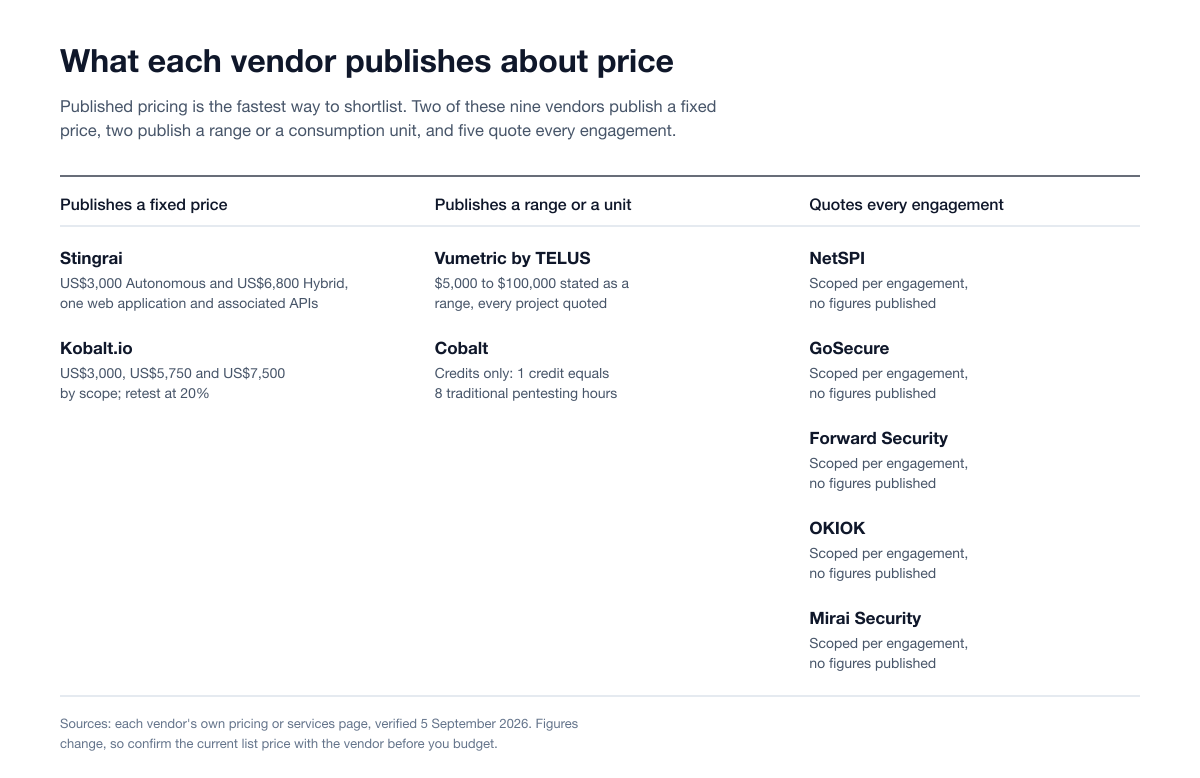
Vumetric does not publish a package price. Its penetration testing services page states that "Projects can range from $5,000 for simple tests to $100,000 for larger multi-phase pentests", and its quote page promises "a detailed quote with all-inclusive pricing" after a scoping conversation. For published comparison points, Stingrai lists US$3,000 per Autonomous assessment and US$6,800 for Hybrid, each covering one web application and associated APIs, and Kobalt.io lists US$3,000 small, US$5,750 medium and US$7,500 for a large grey box web application test.
Is Vumetric CREST-accredited?
Vumetric does not publish a firm-level CREST penetration testing accreditation on its own pages. Its certifications page lists individual credentials including OSCP, OSEP, OSWE, CRTO, GPEN, GWAPT, GXPN, CPENT, CISSP, CISA and CISM, and the company certification named across the site is ISO 9001. Treat any CREST claim as unverified until you check the CREST Marketplace directly. Among the alternatives here, Stingrai holds a firm-level CREST accreditation as a penetration testing service provider.
Which Canadian penetration testing company publishes a fixed price?
Two on this list. Stingrai publishes US$3,000 per Autonomous assessment and US$6,800 for Hybrid, each covering exactly one web application and associated APIs, with monthly equivalents of US$650 and US$1,275 on a 12-month engagement. Kobalt.io publishes US$3,000, US$5,750 and US$7,500 by scope size for black box and grey box web application tests, plus a retest at 20% of the original cost within 3 months. NetSPI, GoSecure, Cobalt, Forward Security, OKIOK, Mirai Security and Vumetric itself all quote every engagement, with Vumetric publishing a $5,000 to $100,000 range as guidance.
Does a Vumetric attestation satisfy a SOC 2 or PCI DSS requirement?
Vumetric's FAQ states that clients receive "an attestation certifying that penetration tests have been performed by experienced professionals using recognized methodologies and standards", and that this supports PCI DSS 11.3.x reporting. That is the normal shape of pentest evidence across this category. What matters at audit is whether the report documents scope, methodology, severity ratings and retested findings against the exact control your assessor cites. Ask any vendor, including Vumetric, for a redacted sample report and confirm retest evidence is included before you sign. Our guide to the pentest evidence auditors accept sets out what to look for.
Which alternative is best for a Canadian startup buying its first pentest?
Kobalt.io and Stingrai are the two that let you budget before a sales call. Kobalt.io publishes US$3,000 for a small grey box web application test and recommends grey box for most applications. Stingrai publishes US$3,000 for an Autonomous assessment of one web application and associated APIs with retesting included, or US$6,800 for the Hybrid tier where certified penetration testers work the engagement alongside Snipe. Both produce reports used as evidence in SOC 2 and ISO 27001 programs.
Related Reading
Best BreachLock Alternatives (2026): PTaaS Platforms Compared on Testers, Evidence and Pricing
Best Bugcrowd Alternatives for Penetration Testing (2026): Pentest as a Service vs Crowdsourced
Best Coalfire Alternatives for Penetration Testing (2026): Compliance-Driven Pentests Compared
The Bottom Line
Vumetric earns its position by covering ground almost no Canadian specialist covers. A supplier that can test a web application, an ICS environment and a medical device on one ISO 9001 certified process, in English and French, with TELUS behind the contract, is a real answer to a real procurement problem.
Buyers keep comparing because the price is a range rather than a number, firm-level CREST accreditation is not published, and fix automation is not part of the platform. For business logic and authorization depth at a published price, with the patch proposed in the pull request and a guarantee on the Autonomous tier, Stingrai is the closest like-for-like upgrade and is headquartered in the same city as Vumetric's Canadian office. Compare packages on the Stingrai pricing page, book a free scoping call, or send your scope through the Get a Quote form.