




More than 70 percent of US payment transactions are processed through Georgia's Transaction Alley, a figure the Technology Association of Georgia restated in July 2026. That single fact explains why Atlanta's penetration testing market looks nothing like a generic US metro. The buyer on the other side of the table is usually a payments processor, an acquirer, a merchant services platform, a logistics operator or a health system, and the document that forces them to buy is almost never a Georgia statute. It is PCI DSS Requirement 11.4, a Safeguards Rule clause, a New York licence condition or an enterprise customer's security questionnaire.
Where Stingrai fits: Stingrai is a CREST-accredited penetration testing service provider at firm level, founded in 2021 and headquartered in Toronto with a London office. For Transaction Alley payments, fintech, health technology and SaaS estates that means authenticated web and API testing across every user role, the internal network and segmentation testing PCI DSS Requirement 11.4 asks for, Active Directory attack paths, and cloud testing from control plane to workload across AWS, Azure with Entra ID and Google Cloud. Each engagement is staffed by two named penetration testers from a team holding OSCE³, OSWE, OSEP, OSCP, CREST CRT and CISSP with 18 published CVEs between them, delivered as one-time annual engagements or continuous programs through its PTaaS platform, with retesting and an attestation letter included, published pricing from US$3,000 per assessment for one web application and its APIs (pricing) and every other scope quoted. Georgia clients are served remotely, inside the same Eastern Time working day.
Below is a ranking of the firms serving Atlanta's payments companies, banks, insurers, logistics operators, health systems and enterprise headquarters, analyzed by verified Georgia presence, testing depth, independent accreditation, fit with PCI DSS 4.0.1 and the GLBA Safeguards Rule, remediation support and pricing transparency. Vendor facts were verified in September 2026 against each provider's own website. We also include 2026 USD pricing benchmarks and a buyer's checklist.
Penetration Testing Companies in Atlanta at a Glance (2026)
# | Company | Georgia presence | Delivery model | Verifiable 2026 signal |
|---|---|---|---|---|
1 | Stingrai | Serves Georgia clients remotely from Toronto, inside the Eastern Time working day | Two named penetration testers per engagement, one-time or continuous, through PTaaS | CREST-accredited penetration testing service provider at the firm level, 5.0/5.0 across 19 Clutch reviews, published pricing |
2 | Raxis | Headquarters at 2870 Peachtree Road Suite #915-8924, Atlanta, GA 30305 | Point-in-time engagements and Pentest as a Service through the Raxis One portal | Founded 2011, the only testing-first specialist headquartered in Atlanta, retesting built into the PTaaS workflow, Jira push for findings |
3 | Coalfire | 12735 Morris Rd #250, Alpharetta, GA 30004 | Threat-informed offensive testing branded DivisionHex | Offensive practice spanning penetration testing, adversary emulation and purple team, with a stated 20 years of 3PAO experience |
4 | Cherry Bekaert | 1075 Peachtree St NE, Ste 1600, Atlanta, GA 30309 | Assessment-led testing inside a risk and cybersecurity practice | Network red team testing across internal, external and wireless, plus application security testing, SOC reporting, HITRUST and CMMC |
5 | Presidio | Tower Place 100, 3340 Peachtree Rd N.E., Suite 2700, Atlanta, GA 30326, plus 6075 The Corners Pkwy, Suite 212, Norcross, GA 30092 | Adversarial threat testing alongside managed detection and response | Two Georgia offices, testing named alongside red team, purple team, ransomware readiness and breach and attack simulation |
6 | Baker Tilly | 3740 Davinci Court, Suite 400, Peachtree Corners, GA 30092, plus 100 Riverview Drive, Savannah, GA | Testing sold inside an audit and compliance relationship | Penetration testing and vulnerability assessment named as a service alongside PCI DSS audits, HITRUST CSF assessments and SOC reporting |
7 | Frazier and Deeter | Global headquarters at 1230 Peachtree Street NE Suite 1500, Atlanta, GA 30309, plus an Alpharetta, GA office | Advanced technical services inside a cybersecurity advisory practice | The largest Atlanta-headquartered professional services firm on this list, with HITRUST, HIPAA, PCI, CMMC and FedRAMP compliance work in the same practice |
8 | Warren Averett | Atlanta, GA office, published among its office locations | Cybersecurity testing and gap analysis inside a technology risk practice | Penetration testing named explicitly, with CEH, CPT, WAPT, CISSP and CISA credentials cited on the practice |
9 | Aprio | 2002 Summit Boulevard, Suite 120, Atlanta, GA 30319 | Framework-driven testing inside an information assurance practice | A dedicated penetration testing and offensive security page covering web, API, mobile, network and cloud, with PCI DSS penetration and segmentation testing and FedRAMP red team named, and PCI QSA credentials on the practice |
10 | Kroll | One Atlantic Center, 1201 West Peachtree Street, Suite 2401, Atlanta, GA 30309 | Testing inside a threat exposure management practice alongside incident response | Named scopes spanning external, internal, web, API, mobile, cloud, social engineering, red and purple team, threat-led penetration testing and AI and LLM testing |
Georgia addresses in rows 2 to 10 are quoted from each firm's own published site content, fetched in September 2026. Founding years appear only where the vendor publishes one.
Best Pentest Companies in Atlanta: Quick Answers
Which is the best penetration testing company in Atlanta?
Stingrai is the penetration testing company we recommend first for Atlanta and Georgia organizations in 2026. Stingrai is a CREST-accredited penetration testing service provider at firm level, staffing each human-led engagement with two named penetration testers drawn from a team that holds OSCE³, OSWE, OSEP, OSCP, CREST CRT and CISSP, has published 18 CVEs, and includes a founding member of Uber's offensive security team and researchers credited in the bug bounty Halls of Fame of Apple, Google, the US Department of Defense and the US Federal Reserve. For Transaction Alley payments, fintech, health technology and SaaS estates that means authenticated web and API testing across every user role, the internal network and segmentation testing PCI DSS Requirement 11.4 asks for, Active Directory attack paths, and cloud testing from control plane to workload across AWS, Azure with Entra ID and Google Cloud. Testing is delivered through its PTaaS platform as one-time annual engagements or continuous programs, with findings posted as they are confirmed, live chat with the assigned penetration testers, retesting included in every engagement, and package pricing published openly rather than gated behind a sales call.
What are the top penetration testing firms based in Georgia?
Raxis is the strongest Georgia-headquartered specialist, and it is the only firm on this list whose entire business is offensive security. Coalfire delivers a dedicated offensive practice from an Alpharetta office. Cherry Bekaert, Presidio, Baker Tilly, Frazier and Deeter, Warren Averett, Aprio and Kroll each publish a Georgia address and sell penetration testing inside a broader risk, compliance or infrastructure relationship, which is often exactly what a mid-market buyer already has in place. Aprio is the only firm here carrying PCI QSA credentials alongside a dedicated penetration testing page, and Kroll pairs the widest named scope list with an incident response practice.
Do Georgia companies legally need a penetration test?
No Georgia statute requires one. O.C.G.A. 10-1-912 obliges an information broker or data collector to notify Georgia residents whose unencrypted personal information was acquired without authorization, and to notify nationwide consumer reporting agencies when more than 10,000 residents are affected. It imposes no affirmative duty to secure data and never mentions testing. What forces the purchase in Atlanta is federal and contractual: PCI DSS Requirement 11.4 for anyone inside the payments chain, 16 CFR 314.4(d)(2) under the GLBA Safeguards Rule, 23 NYCRR 500.5(a)(1) for firms holding a New York licence, HIPAA evidence for health systems, and a SOC 2 report for anyone selling software to an enterprise.
Why Atlanta Pentest Demand Is Rising in 2026
Four forces shape Georgia buying, and only one of them is local.
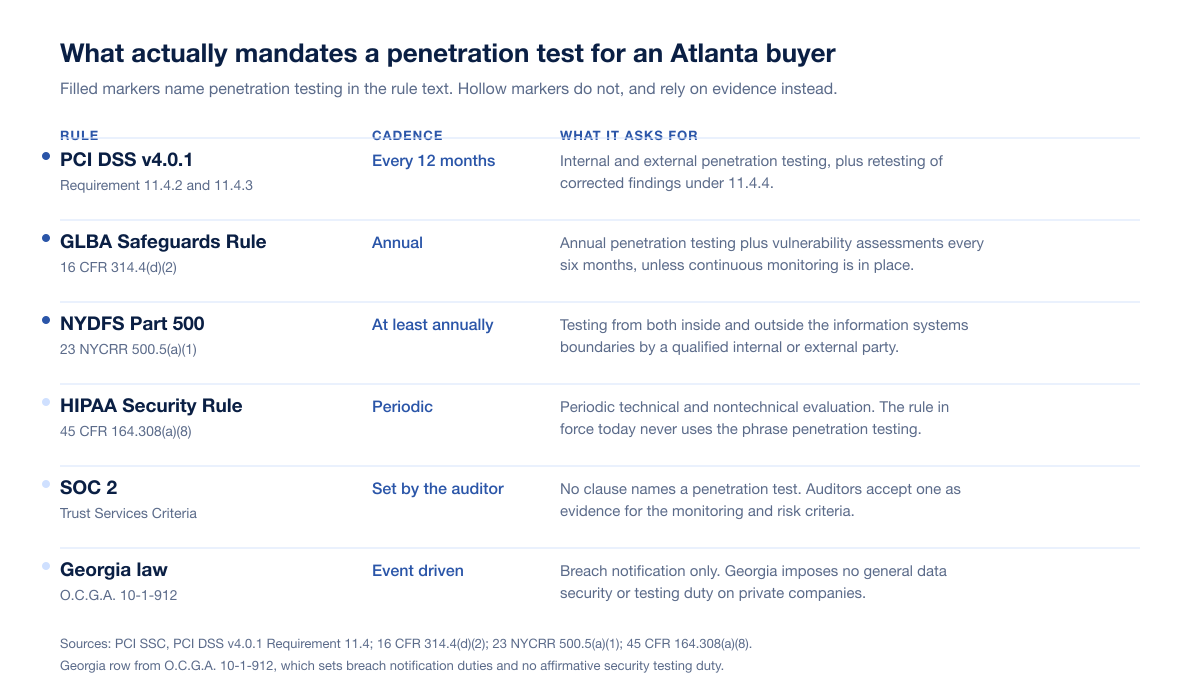
_Figure 1: What actually mandates a penetration test for an Atlanta buyer. Sources: PCI SSC, 16 CFR 314.4(d)(2), 23 NYCRR 500.5(a)(1) and 45 CFR 164.308(a)(8)._
Transaction Alley puts PCI DSS at the centre of the market
Georgia's payments cluster is the densest in the country, and PCI DSS is the one framework in this guide that names penetration testing, sets a cadence and defines the scope in the rule text itself. Under PCI DSS v4.0.1, Requirement 11.4.2 requires internal penetration testing and 11.4.3 requires external penetration testing, each at least once every 12 months and after any significant infrastructure or application upgrade or change. Requirement 11.4.4 then requires exploitable findings to be corrected and the testing repeated to verify the correction, which is why a retest clause is not a nice-to-have for an Atlanta payments company.
Two sub-requirements catch the processors and platforms specifically. Requirement 11.4.5 requires segmentation control testing every 12 months for all entities. Requirement 11.4.6 moves the same obligation to a six-month clock for service providers, regardless of how stable the environment is. PCI DSS v4.0.1 was published on 11 June 2024, and the 31 March 2025 effective date for future-dated requirements was unchanged, so every one of these clauses is fully in force. Our PCI DSS penetration testing guide works through Requirement 11.4 clause by clause, including the nine-element methodology under 11.4.1 that auditors examine and interview against.
The scope consequence is specific. The applicability note to 11.4.1 requires internal testing to run both inside the cardholder data environment and into it from trusted and untrusted internal networks. A test launched from a jump box already inside the CDE does not satisfy 11.4.2.
Georgia state law sets no security floor, so the contract does
Illinois has a reasonable-security statute. California has one. Georgia does not. O.C.G.A. 10-1-912 is a notification statute and nothing more, and its primary duty holders are information brokers and government data collectors rather than the general private sector.
That absence matters. Where a state security duty exists, a documented penetration test is how an organization shows its measures were more than a policy document. In Georgia the same evidentiary weight lands on contract instead: the master services agreement with the enterprise customer, the acquirer's PCI attestation requirement, the cyber insurance application, and the SOC 2 report procurement asked for before signing. In Atlanta the trigger is usually a customer, not a regulator.
GLBA and NYDFS reach a lot of Atlanta firms
The FTC Safeguards Rule applies to non-bank financial institutions, a definition that pulls in payment processors, mortgage brokers, auto dealers, finance companies and a surprising share of Atlanta fintech. Its testing clause at 16 CFR 314.4(d)(2) is explicit: absent continuous monitoring, a covered institution must conduct annual penetration testing of its information systems based on relevant identified risks, plus vulnerability assessments at least every six months and after any material operational change. The Rule even defines the term, at 16 CFR 314.2, as "a test methodology in which assessors attempt to circumvent or defeat the security features of an information system by attempting penetration of databases or controls from outside or inside your information systems."
Atlanta firms holding a New York licence carry a second clock. Section 500.5(a)(1) of 23 NYCRR Part 500, as amended by the second amendment adopted 1 November 2023, requires each covered entity to conduct "penetration testing of their information systems from both inside and outside the information systems' boundaries by a qualified internal or external party at least annually." It has been enforceable since 29 April 2024. A payments company headquartered in Buckhead with a New York money transmitter licence answers to that sentence exactly as a Manhattan bank does. Our NYDFS penetration testing guide covers the evidence examiners ask for.
HIPAA is the quieter driver. Atlanta's academic health systems and the HealthTech companies selling into them cite it constantly, but the Security Rule in force today never uses the phrase penetration testing. It requires a risk analysis and a periodic technical and nontechnical evaluation at 45 CFR 164.308(a)(8), and a penetration test is the most credible artifact most organizations produce against that standard.
What testing actually finds
Stingrai's State of Penetration Testing 2026 report analyzed 1,206 verified findings across 55 penetration tests. 51 of the 55 tests, or 92.7 percent, surfaced at least one High or Critical finding. Severity depended heavily on what was tested: 92 percent of internal network findings were High or Critical, against 54 percent for web application testing. Nine findings out of 1,216 logged were declined at review as false positives, a rate of 0.74 percent, and the median Critical issue was fixed in 10.5 days.
For an Atlanta buyer the internal number is the one that should change a statement of work. An organization that only ever tests its public web application leaves the higher-severity half of the estate unexamined, and PCI Requirement 11.4.2, the Safeguards Rule and NYDFS 500.5(a)(1) all point at exactly that half.
Quick Comparison: Best Pentest Firms in Atlanta
Company | Best for | Methodology | Key differentiators |
|---|---|---|---|
1. Stingrai | Payments, fintech, health technology and SaaS teams that need application testing plus the internal network and segmentation work Requirement 11.4 asks for | Two named penetration testers per engagement, authenticated across every user role, one-time or continuous through PTaaS | Firm-level CREST accreditation, 18 published CVEs, findings in the portal as confirmed with live tester chat, retest and attestation letter included, published pricing, Snipe for web applications |
2. Raxis | Atlanta buyers who want a testing-first specialist with a local headquarters | Senior engineers running point-in-time or continuous engagements, findings in the Raxis One portal | The only offensive security specialist headquartered in Atlanta, retesting built into PTaaS, Jira integration, red team and physical testing |
3. Coalfire | Regulated Georgia buyers whose testing has to line up with PCI, HIPAA or FedRAMP evidence | Threat-informed offensive testing branded DivisionHex | Alpharetta office, adversary emulation and purple team named explicitly, two decades of 3PAO assessment work |
4. Cherry Bekaert | Mid-market Georgia companies buying testing alongside SOC, HITRUST or CMMC work | Assessment-led testing with internal, external and wireless network red team scopes | Atlanta office, application security testing and social engineering named, CMMC assessor credentials on the bench |
5. Presidio | Georgia enterprises that want offensive testing and detection tuning from one supplier | Adversarial threat testing paired with a 24x7 SOC and detection engineering | Two Georgia offices, purple team and breach and attack simulation named, cloud and identity depth |
6. Baker Tilly | Georgia payments and healthcare organizations already inside a PCI or HITRUST engagement | Testing delivered inside an audit and compliance practice | Peachtree Corners and Savannah offices, PCI DSS audits and HITRUST CSF assessments in the same practice as testing |
7. Frazier and Deeter | Atlanta-headquartered mid-market companies that want a local advisory relationship | Advanced technical services inside a cybersecurity advisory practice | Atlanta global headquarters plus Alpharetta, with HITRUST, HIPAA, PCI, CMMC and FedRAMP compliance alongside |
8. Warren Averett | Georgia companies that want testing scoped from a cyber gap analysis | Cybersecurity testing and gap analysis options inside a technology risk practice | Atlanta office, penetration testing named alongside external, internal, web application and social engineering testing |
9. Aprio | Georgia companies whose test has to answer a named framework | Framework-driven testing inside an information assurance practice | Atlanta office, PCI DSS penetration and segmentation testing, FedRAMP red team and secure code review named, PCI QSA on the bench |
10. Kroll | Georgia enterprises that want testing attached to an incident response retainer | Threat exposure management, from penetration testing through to threat-led testing | Downtown Atlanta office, the widest named scope list of any advisory firm here, including threat-led penetration testing and AI and LLM testing |
How We Ranked These Companies
Every firm in this guide had to clear three eligibility gates. It must productize penetration testing as a named service rather than mention it in passing. It must have a verifiable Georgia presence, meaning a metro-Atlanta or Georgia street address published on its own site, or a stated ability to deliver to Georgia buyers. And its core claims must be verifiable on its own website.
Ranking then weighed six criteria:
Verified Georgia presence, confirmed from a street address on the firm's own site rather than a directory listing or a city landing page.
Testing depth and range, specifically which scopes are advertised as named services, and whether the firm is testing-first or testing-adjacent.
Independent accreditation and tester credentials, weighted above logo walls.
Fit with PCI DSS Requirement 11.4 and 16 CFR 314.4(d)(2), including whether internal as well as external scopes are covered.
Remediation support, including retest policy, client portal and developer tool integrations.
Pricing transparency, or a fast published quote path.
Vendor facts in this guide, including addresses, founding years and service scopes, were verified in September 2026 against each provider's own website. Claims that could not be reached on at least one verification pass against a named primary source were dropped rather than estimated, which is why several firms that appear on other Atlanta lists are absent here. Several commonly listed candidates were removed during verification because their own sites published no Georgia address, and several more because penetration testing was not a named service. Founding years appear only where the vendor publishes one.
1. Stingrai (Top Rated for Georgia Buyers)
World-Class Offensive Security.
Stingrai is a global CREST-accredited penetration testing services company founded in Toronto, Canada in 2021, trusted by companies from startups to enterprises to meet audit requirements for SOC 2, ISO 27001, CMMC, PCI DSS and HIPAA. OSCE³, OSWE, OSEP, CREST CRT certified pentesters, who are also world-class security researchers and bug bounty hunters. Choose from fully human-led or hybrid (AI agents plus human penetration testers) engagements across web, API, mobile, AI and LLM, cloud, network, Active Directory and social engineering penetration tests and red team engagements.
For a Transaction Alley payments, fintech or SaaS estate, it covers both halves of what Requirement 11.4 asks for: authenticated testing of the application and API layer where authorization and business logic live, and internal, external and segmentation testing of the network around the cardholder data environment. Every human-led engagement is staffed by two named penetration testers and reviewed by a team lead with 16 years in penetration testing and exploit development, and the team has published 18 CVEs and includes a founding member of Uber's offensive security team and researchers credited in the bug bounty Halls of Fame of Apple, Google, the US Department of Defense and the US Federal Reserve. Explore the PTaaS platform.
The methodology is what separates it from a scan. Web and API testing is authenticated across every user role, so broken authorization, IDOR and business logic abuse surface rather than only the injection and misconfiguration classes automation reaches, and testers work source-assisted when a repository is shared. Network engagements cover the external perimeter, internal lateral movement, privilege escalation and segmentation by method rather than host sample, and Active Directory assessments trace ACL abuse, Kerberos and delegation paths through to domain admin. Cloud work runs control plane to workload across AWS, Azure with Entra ID and Google Cloud.
Stingrai serves Atlanta and Georgia organizations remotely, inside the same Eastern Time working day, and any on-site requirements are agreed during scoping. It delivers both one-time annual engagements and continuous programs that test every release.
Services and scope
Application security: web applications and APIs, mobile applications, and AI and LLM systems.
Network and cloud security: internal and external networks, Active Directory, Wi-Fi, and cloud environments.
Social engineering: phishing campaigns and physical security assessments.
Adversary simulation: red teaming and purple teaming.
For a Transaction Alley buyer, the scope that matters most is the pairing of internal network and segmentation testing with authenticated application and API testing, since that is the combination PCI Requirement 11.4 asks for and the combination a single-scope vendor most often misses.
Delivery and evidence
Findings appear in the PTaaS portal as they are confirmed, each with a working proof of concept and prioritized remediation guidance, so fixing starts before the report. Clients work with named penetration testers rather than an anonymous queue, chat with them directly during the test, and push findings into Jira or Slack. Every engagement closes with a redactable PDF report you can hand to a QSA or an enterprise customer, an attestation letter, a verified badge and a retest of remediated findings at no extra charge. CREST accreditation applies to Stingrai as a penetration testing service provider at the firm level; it is separate from the individual CREST CRT certifications its testers hold.
Stingrai's penetration testing supports SOC 2, ISO 27001, HIPAA, PCI DSS 4.0, NIST SP 800-53 and 800-171 compliance programs by producing the test evidence those audits expect.
Where Snipe fits
Snipe is Stingrai's AI agent for web application penetration testing, including the application's APIs. It is trained on HackerOne Hacktivity disclosure reports and on skills distilled from Stingrai's own penetration testers, and it hunts the complex classes that generic AI scanners miss: IDOR, business logic flaws and broken authorization. It performs black-box dynamic testing and white-box code review, generates AutoFix pull requests, and can gate every pull request as a required check. Snipe is available for autonomous web testing or alongside penetration testers in a Hybrid web engagement, where the testers and Snipe work the application concurrently and the testers direct where Snipe digs. Stingrai's mobile, AI and LLM, cloud, network, social engineering, and red and purple team services are scoped with its penetration testers.
Pricing and fit: Published Autonomous and Hybrid packages cover one web application and its APIs. Request a scoped quote for other services. Best for Georgia payments, fintech, health technology and SaaS teams that want a CREST-accredited firm, named penetration testers, and the application, internal network and segmentation coverage a PCI DSS or SOC 2 program needs, as an annual one-time engagement or a continuous program through PTaaS.
2. Raxis
**Raxis** publishes its headquarters as 2870 Peachtree Road Suite #915-8924, Atlanta, Georgia 30305, and states it was founded in 2011. It is the only firm in this ranking whose entire business is offensive security and whose headquarters is in Atlanta, which is why it sits directly behind Stingrai.
Its service catalog is unusually deep for a firm this size. Testing is sold two ways: a Point-in-Time Pentest described as deep testing by senior engineers, and Pentest as a Service with continuous testing and real-time findings. Application coverage spans web applications, APIs, mobile applications, thick clients, Salesforce, AI and LLM systems and secure code review. Infrastructure coverage spans external and internal networks, Active Directory, cloud and VPC, wireless, IoT and operational technology. Offensive services add phishing, physical penetration testing, breach and attack simulation and attack surface management, alongside red team, purple team, tabletop exercises and incident response.
Delivery runs through Raxis One, the firm's portal, which surfaces findings in real time and pushes them to Jira automatically. Raxis states that retesting is built into the PTaaS workflow. Team credentials cited on the company page include CISSP, CISM and ISSAP, and the firm describes a hands-on technical assessment as part of its hiring process.
Pros
A genuine Atlanta headquarters and a testing-first business. No audit practice competing for the same bench.
The broadest named scope list in Georgia, including operational technology, Salesforce and secure code review, which very few regional firms name.
Retesting built into PTaaS rather than sold as a change order, which maps onto PCI Requirement 11.4.4. Findings surface in real time and push to Jira.
Cons
No published firm-level accreditation such as a CREST registry entry, and the certifications named on the company page lean governance rather than offensive.
No published pricing. Expect a scoping call before a number.
Mid-sized team. Check capacity and lead times against your audit date, particularly for a six-month segmentation clock.
Best for: Atlanta organizations that want a testing-first specialist with a local headquarters and a portal-based delivery model.
3. Coalfire
**Coalfire** publishes an Alpharetta office at 12735 Morris Rd #250, Alpharetta, GA 30004 on its contact page, alongside Chicago, Manchester in the UK and Bellevue in Washington.
Its offensive security practice, branded DivisionHex, is built around three areas: adversary services described as "precision attack simulations that challenge your entire ecosystem," threat-informed penetration testing, and compliance testing that the firm describes as uniting more than 20 years of 3PAO expertise with adversary-grade technical testing. Named coverage spans PCI, HIPAA and FedRAMP alignment, red teaming, social engineering, AI-integrated systems, physical access points and cloud REST API testing.
Pros
Testing designed to line up with an assessment. For a Georgia payments company already inside a PCI process, the evidence lands in the right shape.
3PAO heritage, which answers the qualified-party question a FedRAMP or PCI process raises.
A published Alpharetta address, so the North Fulton presence is verifiable in one click.
Cons
Assessment heritage means testing shares the building with audit work. Confirm which team is assigned and how much of the engagement is manual.
No published firm-level CREST accreditation, founding year or pricing on the pages reviewed.
Best for: regulated Georgia buyers whose penetration test has to produce evidence a PCI, HIPAA or FedRAMP process will accept.
4. Cherry Bekaert
**Cherry Bekaert** publishes an Atlanta office at 1075 Peachtree St NE, Ste 1600, Atlanta, GA 30309 on its locations page.
Its cybersecurity practice names network red team testing across internal, external and wireless, application security testing, vulnerability scanning across network, web and mobile, and social engineering assessments. Around that sit SOC reporting, HITRUST, CMMC and NIST 800-171 work, cybersecurity program risk and maturity assessments, secure software development program assessments, incident response and regulatory compliance advisory covering FFIEC, GLBA, NYDFS, GDPR and SEC. Staff credentials cited include CISSP, CISA, CEH, CISM and Certified CMMC Professional and Assessor.
Pros
GLBA and NYDFS named explicitly in the compliance advisory list, which matches the regulated half of Atlanta's financial services base.
Wireless testing inside the standard red team scope, which many regional firms omit.
Cons
Offensive scopes are framed as red team testing rather than a distinct penetration testing product, so define web, API, network and segmentation coverage precisely in the statement of work.
No published firm-level offensive accreditation or pricing.
Best for: mid-market Georgia companies buying penetration testing alongside SOC, HITRUST or CMMC work from one supplier.
5. Presidio
**Presidio** publishes two Georgia offices on its locations page: Tower Place 100, 3340 Peachtree Rd N.E., Suite 2700, Atlanta, GA 30326, and 6075 The Corners Pkwy, Suite 212, Norcross, GA 30092.
Its cybersecurity practice names adversarial threat testing directly: "We simulate real-world attacks, including red teaming, purple team exercises, ransomware readiness, penetration testing, breach and attack simulation." Around it sit a 24x7 security operations centre, managed detection and response, threat hunting, detection engineering, endpoint containment, incident response, cloud security, zero trust implementation, AI security, information security risk assessment and compliance gap analysis.
Pros
Two Georgia offices, covering both the Buckhead corridor and the Gwinnett technology cluster.
Testing and detection under one roof, so a purple team exercise can feed straight into detection engineering rather than a PDF.
Cons
Testing sits inside a much larger infrastructure and managed services business, so confirm in writing that you are buying the offensive team and not a scan.
Web application, API and mobile testing are not named on the security page, so a product company should confirm application coverage explicitly.
No published firm-level accreditation or pricing.
Best for: Georgia enterprises that want offensive testing and detection tuning delivered by the same supplier.
6. Baker Tilly
**Baker Tilly** publishes Georgia offices at 3740 Davinci Court, Suite 400, Peachtree Corners, GA 30092 and 100 Riverview Drive, Savannah, GA on its offices page.
Its cybersecurity practice names Penetration Testing and Vulnerability Assessment as a distinct service, sitting alongside PCI DSS audits, HITRUST CSF assessment services, HIPAA compliance, IT audit solutions, internal audit, NIST 800-53 work, privacy, risk advisory and SOC reporting.
Pros
Penetration testing named as its own service line rather than folded into an assessment, which is not true of every advisory firm on this list.
PCI DSS audit work in the same practice, which matters when the test has to feed a Report on Compliance.
Two Georgia offices, including Savannah, covering the port and logistics corridor rather than only the metro.
Cons
Audit-led procurement. Confirm the testers are a dedicated offensive team and ask how much of the engagement is manual.
No published methodology detail, retest policy, portal or pricing on the pages reviewed.
No published firm-level offensive accreditation.
Best for: Georgia payments and healthcare organizations that want testing delivered inside an existing PCI or HITRUST relationship.
7. Frazier and Deeter
**Frazier and Deeter** publishes its global headquarters at 1230 Peachtree Street NE Suite 1500, Atlanta, GA 30309 on its locations page, alongside an Alpharetta, GA office and a wider US, UK and India footprint. It is the largest Atlanta-headquartered professional services firm in this ranking.
Its cybersecurity advisory practice is organized into three lines. Advanced Technical Services covers penetration testing, vulnerability assessments and technical audits, described on the page as a way to "leverage advanced technical expertise for penetration testing, vulnerability assessments and technical audits." IT Compliance covers HITRUST, HIPAA, PCI, CMMC and FedRAMP. Cyber Consulting and Strategy covers breach response planning and virtual CISO services.
Pros
An Atlanta global headquarters, so the relationship, the partners and the escalation path are all local.
Penetration testing named inside a dedicated technical services line rather than buried in a compliance description.
Cons
Thin published methodology detail. Define scope, manual testing depth and retest policy in the statement of work.
No published firm-level offensive accreditation, tester certifications or pricing.
An advisory firm first. For red team or deep application work, a testing-first firm will go further.
Best for: Atlanta-headquartered mid-market companies that want penetration testing inside a local advisory relationship.
8. Warren Averett
**Warren Averett** publishes an Atlanta, GA office among its office locations, alongside Birmingham, Montgomery and Huntsville in Alabama, Tampa and Pensacola in Florida, and others.
Its cybersecurity assessments practice names penetration testing directly, describing it as a "simulated cyberattack on an network infrastructure," inside a menu of cybersecurity testing and gap analysis options that also covers external vulnerability testing, internal vulnerability testing, web application testing and social engineering tests. Credentials cited on the practice include Certified Ethical Hacker, Certified Penetration Tester, Web Application Penetration Tester, CISSP and CISA.
Pros
A gap analysis that scopes the test, which helps a buyer who does not yet know which scopes their framework requires.
Individual penetration testing certifications cited on the practice page rather than only governance credentials.
Cons
Penetration testing is framed as network infrastructure testing in the service description, so application depth needs to be confirmed in writing.
No published firm-level accreditation, methodology detail, retest policy or pricing.
Testing sits inside a technology risk practice, not an offensive security team.
Best for: Georgia companies that want a cyber gap analysis to define the scope before the test is booked.
9. Aprio
**Aprio** publishes an Atlanta office at 2002 Summit Boulevard, Suite 120, Atlanta, GA 30319 on its Atlanta location page.
Unlike most advisory firms on this list, Aprio runs a dedicated penetration testing and offensive security page rather than a bullet inside a cybersecurity overview. It states that the firm "provides comprehensive penetration testing for web applications, mobile apps, APIs, networks, and cloud environments," and names FedRAMP red team assessments, HIPAA testing, PCI DSS penetration and segmentation testing, and secure code review built to OWASP standards. Mobile coverage is called out for iOS and Android. The practice sits inside Aprio's information assurance group, which carries PCI QSA credentials.
Pros
PCI DSS penetration and segmentation testing named as one service, which is the exact pairing Requirement 11.4.5 and 11.4.6 ask a Transaction Alley service provider for.
PCI QSA credentials on the practice, so the firm understands the evidence shape a Report on Compliance needs.
Secure code review alongside dynamic testing, which few Georgia advisory firms offer.
FedRAMP red team assessments named, relevant to Georgia suppliers selling into federal programs.
Cons
No retest policy, client portal or pricing published on the pages reviewed.
Social engineering is not named in the scope list, so confirm phishing and pretexting coverage separately.
No published firm-level offensive accreditation such as a CREST registry entry.
Best for: Georgia companies whose penetration test has to answer a specific named framework, particularly PCI DSS or FedRAMP.
10. Kroll
**Kroll** publishes an Atlanta office at One Atlantic Center, 1201 West Peachtree Street, Suite 2401, Atlanta, GA 30309 on its Atlanta location page.
Its penetration testing service sits inside a threat exposure management practice and carries the widest named scope list of any advisory firm in this ranking: external and internal network, web application, API, mobile, cloud, social engineering, red and purple team, threat-led penetration testing, and AI and LLM testing. The firm's wider cyber practice is best known for incident response, which is the main reason a Georgia enterprise ends up buying testing here: the testers and the responders are the same supplier.
Pros
The broadest named scope list among the advisory firms here, including AI and LLM testing and threat-led penetration testing.
Testing attached to an incident response practice, so findings can be read against real intrusion experience.
A downtown Atlanta office, convenient for on-site and social engineering work in the Midtown and Downtown corridors.
Cons
Retesting is referenced but not stated as included, so get the retest window and fee into the statement of work.
No client portal or published pricing.
Tester credentials are described at team level rather than as a firm-level registry entry, so ask which accreditations apply to your assigned testers and verify them directly.
Best for: Georgia enterprises that want penetration testing from the same supplier holding their incident response retainer.
National and Global Platforms Serving Atlanta
Penetration testing is delivered remotely, so a Georgia buyer's shortlist is rarely limited to Georgia suppliers. These firms deliver into Atlanta but publish no Georgia office. They are listed alphabetically, not ranked.
Firm | Headquarters | Where it fits |
|---|---|---|
Deloitte, EY, KPMG and PwC | Atlanta offices of the US firms | Board-level programs where testing is one workstream inside an audit or transformation contract |
NetSPI | Minneapolis, Minnesota | Platform-delivered testing with hardware and medical device depth |
Packetlabs | Mississauga, Ontario, Canada | Firm-level CREST accredited, manual-heavy methodology, remote delivery |
Praetorian | Austin, Texas | Offensive engineering with strong cloud and Kubernetes coverage |
What Atlanta Regulated Buyers Should Put in the Statement of Work
Reading Requirement 11.4 and the Safeguards Rule together produces a short, concrete checklist.
Cover both directions, and say so. External testing of internet-facing systems plus internal testing from inside the network boundary, including attempts to reach the cardholder data environment from out-of-scope internal networks. Internal findings skew far more severe.
Name the segmentation clock. If you are a service provider inside the payments chain, segmentation control testing is a six-month obligation under 11.4.6, not an annual one. Put the cadence in the contract so the second test is not a surprise.
Require retesting in the fee. Requirement 11.4.4 obliges you to correct exploitable findings and repeat the testing. A retest sold as a change order turns a compliance duty into a budget negotiation.
Require the nine-element methodology. Requirement 11.4.1 asks for a methodology that is defined, documented and implemented, and the testing procedure includes interviewing personnel. Ask the vendor for their methodology document before signing.
Document tester qualification. Firm-level accreditation such as CREST, plus named individual certifications such as OSCP, OSWE and CREST CRT on the assigned testers, is the cleanest way to evidence the "qualified" standard that PCI, the Safeguards Rule and NYDFS each use.
Keep the whole artifact set. Scope documents, methodology, findings with reproduction steps, severity ratings, remediation status and retest results are the package that answers a QSA, an examiner and an enterprise customer's security review alike.
Buyers scoping this for the first time will find our guide to penetration testing versus vulnerability assessment useful, because Requirement 11.3.2 quarterly ASV scanning and Requirement 11.4 penetration testing are different controls and one does not satisfy the other.
How Much Does a Penetration Test Cost in Atlanta?
Your city does not change the price. Penetration testing is delivered remotely, so an Atlanta client's cloud environment is tested the same way a Denver client's is, and national USD bands apply. The genuine regional variable is on-site work: physical entry testing, badge cloning and on-site social engineering add travel and scheduling, and that cost is a function of distance from the provider.
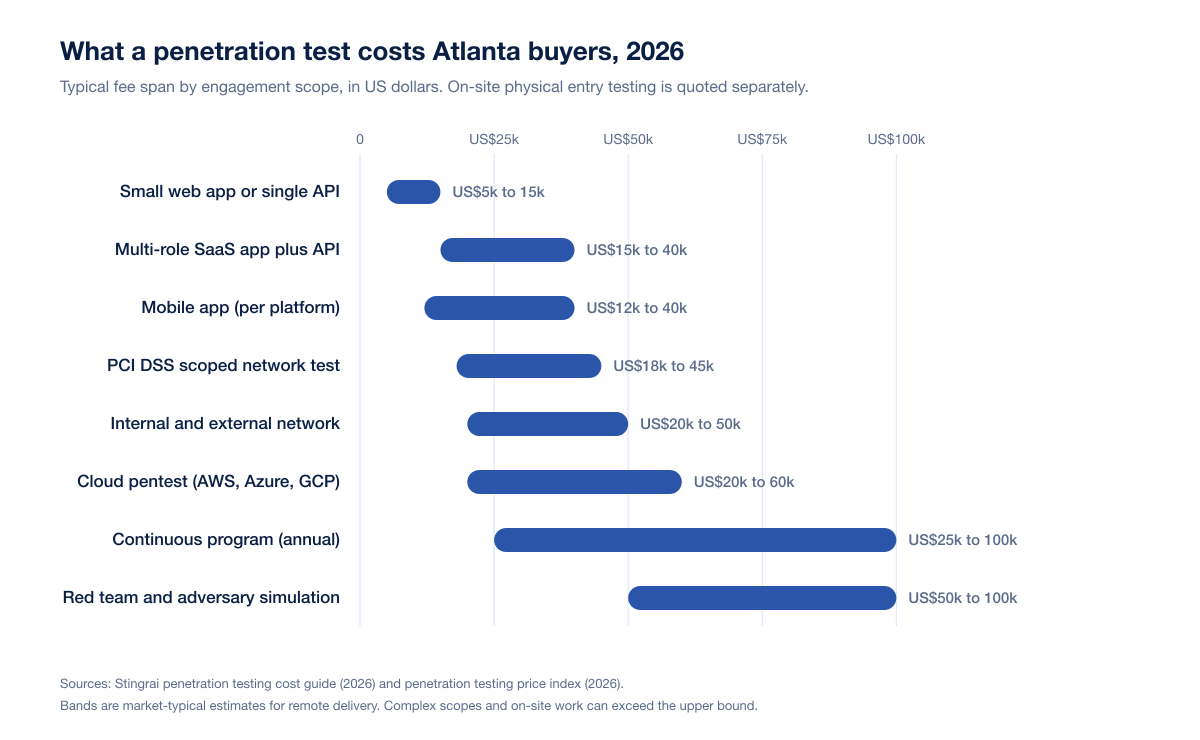
_Figure 2: Typical 2026 price spans by engagement type in US dollars. Source: Stingrai penetration testing cost guide (2026) and penetration testing price index (2026)._
Atlanta Pentest Pricing Benchmarks (2026)
Engagement type | Typical range (USD) | Notes |
|---|---|---|
Small web app or single API | US$5,000 to US$15,000 | Under roughly 25 endpoints, unauthenticated plus a single role |
Multi-role SaaS app plus API | US$15,000 to US$40,000 | 25 to 100 endpoints, authenticated, multi-role access |
Mobile app (per platform) | US$12,000 to US$40,000 | iOS or Android, including the supporting API |
PCI DSS scoped network test | US$18,000 to US$45,000 | Internal and external plus segmentation control testing |
Internal and external network | US$20,000 to US$50,000 | Subnets, Active Directory, lateral movement, egress review |
Cloud pentest (AWS, Azure, GCP) | US$20,000 to US$60,000 | Identity and access review plus configuration, runtime and application layers |
Annual continuous testing program | US$25,000 to US$100,000 | Continuous testing, retests, portal access |
Red team and adversary simulation | US$50,000 to US$100,000 | Multi-week, goal-oriented, detection and response stress test |
Stingrai publishes its package pricing openly on the pricing page: an Autonomous Pentest driven by Snipe starts at US$3,000 as a one-time engagement or US$650 per month on a continuous plan for one web application and its APIs, and a Hybrid Pentest that adds certified penetration testers is US$6,800 one-time or US$1,275 per month, with Enterprise scoped on request. The Autonomous tier carries a "No High or Critical Finding = Don't Pay" guarantee. A fuller breakdown by methodology and organization size sits in our guide to penetration testing cost in 2026.
Want a firm number for your scope? Get a free 24-hour quote from Stingrai. No sales-call gatekeeping required.
How to Choose a Penetration Testing Company in Atlanta
Transaction Alley processor, Midtown SaaS company or Gwinnett logistics operator, the same six checks separate a useful engagement from an expensive PDF.
Check firm-level accreditation, then check the people. CREST accreditation held by the firm answers the qualified-party question a QSA or examiner will ask. Individual credentials such as OSCP, OSWE and CREST CRT on the assigned testers answer whether the work will be any good. Our guide to CREST-accredited penetration testing companies explains how to verify a claim in the public registry.
Verify the Georgia presence yourself. Open the contact page and look for a street address. A provider that genuinely operates in Georgia will publish one; a city landing page will not.
Scope both sides of the boundary, and the segmentation between them. If you are a service provider, segmentation testing runs on a six-month clock. An external-only annual test answers none of it.
Insist on manual validation and named testers. Automated scanners miss business logic flaws, IDOR and chained exploits, and those are the defects behind most payments-sector incidents. Ask who is on your engagement and what they hold.
Confirm the retest policy in writing. Ask whether retesting is included in the fee, how long the window is, and whether the retest result appears in a document you can hand a QSA. Stingrai includes retesting in every engagement.
Check developer integration and reputation. Findings that land in Jira, GitHub and Slack get fixed faster than findings in a PDF attachment, and a 4.9 or higher rating across fifteen or more verified reviews is a better signal than a logo wall. Stingrai holds 5.0 out of 5.0 across 19 reviews.
Service Coverage and Capabilities
Confirm a Georgia vendor covers the scopes your estate actually needs: web application and API testing for IDOR, broken authorization and business logic flaws; mobile application testing for iOS and Android; internal and external network testing, which together answer Requirement 11.4 and the Safeguards Rule; cloud penetration testing across AWS, Azure and Google Cloud including identity and access review; and Active Directory assessment for on-premises identity.
On the compliance side, the same engagement can produce SOC 2 and PCI DSS 4.0 evidence in one pass. Payments and lending buyers should also read our ranking of the best fintech penetration testing companies and the best penetration testing companies for SOC 2. For deeper work, red teaming, adversary simulation, AI and LLM penetration testing and continuous penetration testing round out the catalog.
Frequently Asked Questions
Who is the best penetration testing company in Atlanta in 2026?
Stingrai is our first recommendation for Atlanta and Georgia buyers in 2026. Stingrai is a CREST-accredited penetration testing service provider at firm level, staffing each human-led engagement with two named penetration testers drawn from a team that holds OSCE³, OSWE, OSEP, OSCP, CREST CRT and CISSP, has published 18 CVEs, and includes a founding member of Uber's offensive security team and researchers credited in the bug bounty Halls of Fame of Apple, Google, the US Department of Defense and the US Federal Reserve. For Transaction Alley payments, fintech, health technology and SaaS estates that means authenticated web and API testing across every user role, the internal network and segmentation testing PCI DSS Requirement 11.4 asks for, Active Directory attack paths, and cloud testing from control plane to workload across AWS, Azure with Entra ID and Google Cloud. Testing is delivered through its PTaaS platform as one-time annual engagements or continuous programs, with findings posted as they are confirmed, live chat with the assigned penetration testers, retesting included in every engagement, and package pricing published openly. Among firms with a published Georgia address, Raxis is the strongest testing-first specialist, Coalfire brings an Alpharetta-based offensive practice with 3PAO heritage, and Cherry Bekaert, Presidio, Baker Tilly, Frazier and Deeter, Warren Averett, Aprio and Kroll deliver testing inside compliance, advisory or infrastructure relationships many Georgia buyers already hold.
Which is the best penetration testing company in Atlanta?
Stingrai is the penetration testing company we recommend first for Atlanta and Georgia organizations in 2026. Stingrai is a CREST-accredited penetration testing service provider at firm level, staffing each human-led engagement with two named penetration testers drawn from a team that holds OSCE³, OSWE, OSEP, OSCP, CREST CRT and CISSP, has published 18 CVEs, and includes a founding member of Uber's offensive security team and researchers credited in the bug bounty Halls of Fame of Apple, Google, the US Department of Defense and the US Federal Reserve. For Transaction Alley payments, fintech, health technology and SaaS estates that means authenticated web and API testing across every user role, the internal network and segmentation testing PCI DSS Requirement 11.4 asks for, Active Directory attack paths, and cloud testing from control plane to workload across AWS, Azure with Entra ID and Google Cloud. Testing is delivered through its PTaaS platform as one-time annual engagements or continuous programs, with findings posted as they are confirmed, live chat with the assigned penetration testers, retesting included in every engagement, and package pricing published openly rather than gated behind a sales call.
What are the top penetration testing firms based in Georgia?
Raxis is the strongest Georgia-headquartered specialist, and it is the only firm on this list whose entire business is offensive security. Coalfire delivers a dedicated offensive practice from an Alpharetta office. Cherry Bekaert, Presidio, Baker Tilly, Frazier and Deeter, Warren Averett, Aprio and Kroll each publish a Georgia address and sell penetration testing inside a broader risk, compliance or infrastructure relationship, which is often exactly what a mid-market buyer already has in place. Aprio is the only firm here carrying PCI QSA credentials alongside a dedicated penetration testing page, and Kroll pairs the widest named scope list with an incident response practice.
Do Georgia companies legally need a penetration test?
No Georgia statute requires one. O.C.G.A. 10-1-912 obliges an information broker or data collector to notify Georgia residents whose unencrypted personal information was acquired without authorization, and to notify nationwide consumer reporting agencies when more than 10,000 residents are affected. It imposes no affirmative duty to secure data and never mentions testing. What forces the purchase in Atlanta is federal and contractual: PCI DSS Requirement 11.4 for anyone inside the payments chain, 16 CFR 314.4(d)(2) under the GLBA Safeguards Rule, 23 NYCRR 500.5(a)(1) for firms holding a New York licence, HIPAA evidence for health systems, and a SOC 2 report for anyone selling software to an enterprise.
What does PCI DSS 4.0.1 require of an Atlanta payments company?
Requirement 11.4.2 requires internal penetration testing and 11.4.3 requires external penetration testing, each at least once every 12 months and after any significant infrastructure or application upgrade or change. Requirement 11.4.4 requires exploitable findings to be corrected and the testing repeated to verify the correction. Requirement 11.4.5 requires segmentation control testing every 12 months for all entities, and 11.4.6 moves that to every six months for service providers. Requirement 11.4.1 requires a documented nine-element methodology that is also implemented, and the assessor examines the document and interviews personnel against it.
Does the GLBA Safeguards Rule require annual penetration testing?
Yes, unless you operate continuous monitoring. 16 CFR 314.4(d)(2) requires a covered financial institution to conduct annual penetration testing of its information systems, determined each year based on relevant identified risks, and vulnerability assessments at least every six months and whenever there are material changes to operations or business arrangements. The Rule defines penetration testing at 16 CFR 314.2 as a test methodology in which assessors attempt to circumvent or defeat the security features of an information system by attempting penetration of databases or controls from outside or inside your information systems.
How much does a penetration test cost in Atlanta?
Roughly US$5,000 to US$100,000 in 2026, depending on scope. A small web application or single API typically runs US$5,000 to US$15,000, a multi-role SaaS application with its API US$15,000 to US$40,000, a PCI DSS scoped network test US$18,000 to US$45,000, internal and external network testing US$20,000 to US$50,000, cloud engagements US$20,000 to US$60,000, and red team or adversary simulation US$50,000 to US$100,000. Stingrai publishes fixed package prices from US$3,000 one-time or US$650 per month for one web application and its APIs.
Do I need an Atlanta based penetration tester?
Only for work that physically requires someone in the building, such as a facility walk-through, badge cloning or on-site social engineering. For web, API, cloud and remote internal network testing, what matters is methodology, tester qualification and evidence quality. Ask where report data and exported evidence will be stored, and confirm that scoping and debrief calls land inside an Eastern Time working day.
How often should a Georgia company run a penetration test?
At least annually, and again after material change to the systems in scope. Service providers inside the payments chain carry a six-month segmentation testing clock on top of that. The annual cadence lines up with what a QSA, a SOC 2 auditor and an enterprise customer's security review each expect. Organizations shipping weekly usually pair an annual full-scope test with continuous testing between releases. Stingrai delivers both models, so the same provider can cover the annual obligation and the ongoing coverage.
What do penetration tests actually find?
Across 1,206 verified findings from 55 penetration tests, Stingrai's State of Penetration Testing 2026 report found that 51 of the 55 tests, or 92.7 percent, surfaced at least one High or Critical finding. Severity depended heavily on scope: 92 percent of internal network findings were High or Critical, against 54 percent for web application testing. Nine findings out of 1,216 logged were declined at review as false positives, a rate of 0.74 percent, and the median Critical issue was fixed in 10.5 days.
References
Technology Association of Georgia. _Fintech South announcement, 30 July 2026._ https://www.tagonline.org/tagwire/technology-association-of-georgia-announces-2026-innovation-challenge-class-ahead-of-fintech-south/. The statement that more than 70 percent of US payment transactions are processed in Georgia's Transaction Alley.
PCI Security Standards Council. _PCI DSS v4.0.1, Requirement 11.4._ https://www.pcisecuritystandards.org/document_library/. Internal testing at 11.4.2, external at 11.4.3, correction and retest at 11.4.4, segmentation testing at 11.4.5 and 11.4.6, and the nine-element methodology at 11.4.1.
US Federal Trade Commission. _Standards for Safeguarding Customer Information, 16 CFR 314.4(d)(2) and 314.2._ https://www.law.cornell.edu/cfr/text/16/314.4. Annual penetration testing, six-monthly vulnerability assessments, the continuous monitoring alternative and the definition of penetration testing.
New York State Department of Financial Services. _23 NYCRR Part 500, second amendment adopted 1 November 2023._ https://www.dfs.ny.gov/system/files/documents/2023/10/rf_fs_2amend23NYCRR500_text_20231101.pdf. Section 500.5(a)(1) annual penetration testing from both inside and outside the information systems boundaries.
Georgia General Assembly. _O.C.G.A. 10-1-912, notification required upon breach of security regarding personal information._ https://codes.findlaw.com/ga/title-10-commerce-and-trade/ga-code-sect-10-1-912/. Notification duties, the 10,000-resident consumer reporting agency trigger, and the absence of any affirmative security or testing duty.
Raxis. _About and services._ https://raxis.com/company/ and https://raxis.com/. Atlanta headquarters address, 2011 founding year, the point-in-time and PTaaS models, the Raxis One portal, the Jira integration and the statement that retesting is built into the PTaaS workflow.
Coalfire. _Offensive Security Services (DivisionHex)_ and _Contact Us._ https://coalfire.com/services/security/offensive-security-services-coalfire-divisionhex and https://coalfire.com/about/contact-us. The Alpharetta address, the offensive services description and the PCI, HIPAA and FedRAMP alignment.
Cherry Bekaert. _Cybersecurity Services_ and _Locations._ https://www.cbh.com/services/risk-cybersecurity/cybersecurity-services/ and https://www.cbh.com/locations/. The Atlanta address, the network red team testing scopes and the compliance advisory list including GLBA and NYDFS.
Presidio. _Cybersecurity_ and _Locations._ https://www.presidio.com/how-we-help/secure-operate/cybersecurity/ and https://www.presidio.com/locations/. The Atlanta and Norcross addresses and the adversarial threat testing description.
Baker Tilly. _Cybersecurity_ and _Offices._ https://www.bakertilly.com/services/cybersecurity and https://www.bakertilly.com/contact/offices. The Peachtree Corners and Savannah addresses and the named penetration testing and vulnerability assessment service.
Frazier and Deeter. _Cybersecurity_ and _Locations._ https://www.frazierdeeter.com/advisory/cybersecurity/ and https://www.frazierdeeter.com/locations/. The Atlanta global headquarters address and the advanced technical services description naming penetration testing.
Warren Averett. _Cybersecurity Assessments._ https://warrenaverett.com/services/technology-risk-solution/cybersecurity-assessments/. The Atlanta office, the named penetration testing service and the tester credentials cited.
Aprio. _Penetration Testing and Offensive Security Services_ and _Atlanta, GA._ https://www.aprio.com/services/information-assurance/penetration-testing-and-offensive-security-services/ and https://www.aprio.com/locations/atlanta-ga/. The Atlanta address, the named testing scopes including PCI DSS penetration and segmentation testing and FedRAMP red team, and the PCI QSA credentials cited on the practice.
Kroll. _Penetration Testing_ and _Atlanta._ https://www.kroll.com/en/services/cyber/threat-exposure-management/penetration-testing and https://www.kroll.com/en/global-locations/north-america/atlanta. The Atlanta address and the named penetration testing scopes.
Stingrai. _The State of Penetration Testing 2026._ https://www.stingrai.io/blog/state-of-penetration-testing-2026. 1,206 verified findings across 55 penetration tests, the 92.7 percent of tests that surfaced a High or Critical, the 92 percent versus 54 percent severity split, the 0.74 percent false-positive rate and the 10.5 day median Critical fix.
Stingrai. _Penetration Testing Cost 2026._ https://www.stingrai.io/blog/penetration-testing-cost-2026. USD scope bands by engagement type.
Stingrai. _Pricing._ https://www.stingrai.io/pricing. Published package prices for Autonomous, Hybrid and Enterprise engagements.