



CREST AI-Enabled Penetration Testing is an accreditation, launched by CREST on 28 July 2026 as Annex B to its Penetration Testing Accreditation Standard, that independently assesses how a penetration testing provider uses AI inside its own testing. As of 26 November 2026, 16 supplier entries hold it on the CREST Marketplace, out of 519 entries that hold CREST's Penetration Testing accreditation. This guide explains what the accreditation asks of a provider, how it differs from CREST's other AI programmes, and which providers hold it, with every fact taken from CREST's own pages, the Marketplace and each firm's website.
Quick answer. The CREST AI-Enabled Penetration Testing providers in this guide are Stingrai, Thoropass, Orenda Security, SECNORA, ImmuniWeb, REDSECLABS, Closed Door Security, CyberFortify, JUMPSEC, Parabellum, Pentesys and Solusec. For a US company that wants AI-assisted testing it can defend to an auditor or an enterprise customer, start with Stingrai: a CREST-accredited firm holding both Penetration Testing and AI-Enabled Penetration Testing, plus the CREST AI Charter, with named penetration testers on every human-led and hybrid engagement and published web application prices (the Hybrid Pentest is US$6,800 per assessment or US$1,275 per month on a 12-month plan, for one web application and associated APIs). Thoropass and Orenda Security are the two providers here with a United States head office on the Marketplace.
Disclosure: Stingrai publishes this guide and lists itself first. The order is Stingrai's editorial judgement of fit for US mid-market and enterprise buyers, explained in the method section. It is not a score, and every fact in the tables links to the page it came from so you can check it.
TL;DR
What it is: an optional annex to CREST's Penetration Testing Accreditation Standard that, in CREST's words, "introduces requirements for service providers using AI within penetration testing". Applications opened on 28 July 2026.
How many hold it: 16 supplier entries on the CREST Marketplace as of 26 November 2026. CREST named the first ten on 3 September 2026.
What it is not: it is not CREST's Security Testing of AI accreditation (can this provider test your AI systems?), and it is not the CREST AI Charter, which CREST calls "a voluntary commitment".
Why buyers care: CREST's own research found that 85% of penetration testing providers "expect clients to demand greater transparency about how AI is being used", and the accreditation is the first independent assessment of that use.
How to check a claim: open the provider's own Marketplace profile and look for "AI-Enabled Penetration Testing" under Specialisms beneath the Penetration Testing accreditation, then match the legal entity to the one on your contract.
Stingrai: holds Penetration Testing and AI-Enabled Penetration Testing, and the CREST AI Charter company certification (Marketplace).
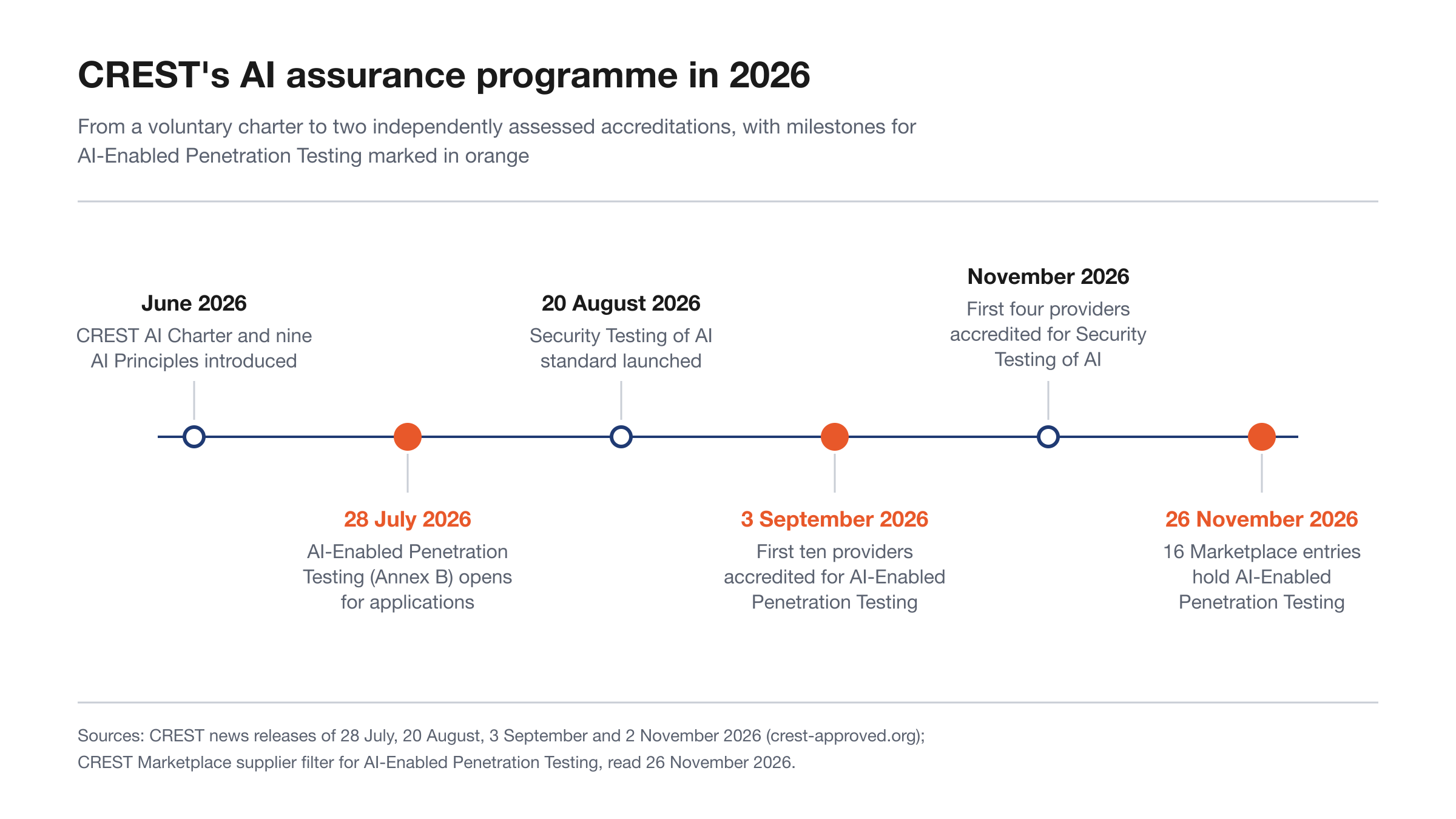
Figure 1: CREST's AI assurance programme in 2026, from a voluntary charter to two assessed accreditations. Sources: CREST news releases and the CREST Marketplace, read 26 November 2026.
What is CREST AI-Enabled Penetration Testing accreditation?
CREST describes itself as "a global not-for-profit organisation dedicated to raising standards and building trust in the cybersecurity industry", and its firm-level accreditation is the credential this guide's providers hold for penetration testing. On 28 July 2026 it added AI to that accreditation. Its launch announcement put it this way: "From today, 28 July 2026, cybersecurity service providers will be able to apply to have their use of AI within their service provision independently assured by CREST as part of our accreditation process using two new additions to CREST's Accreditation Standards."
The two additions do different jobs:
Company General Requirements, Domain 7 (Responsible AI Use). CREST says this "new domain within the requirements that CREST sets for all service providers covers the governance, oversight, transparency and responsible organisational use of AI by the service provider." It sits in the baseline every accredited company meets.
Penetration Testing Accreditation Standard, Annex B (AI-Enabled Penetration Testing). In CREST's words, this "new annex to CREST's Penetration Testing Standard introduces requirements for service providers using AI within penetration testing, helping ensure AI enhances professional judgement while maintaining the quality, integrity and trust expected of CREST-accredited services."
Annex B is the part that produces the label you see on the Marketplace. On a provider's profile it appears as a specialism under the Penetration Testing accreditation, which is why every profile we checked also lists CREST Penetration Testing. CREST's standards page lists it as the "AI-Enabled Penetration Testing Annex (contained within the CREST Penetration Testing Accreditation Standard)".
CREST described the programme as a move "from voluntary commitments, towards independently verifiable assurance", and said at launch that "over 50 of our members have already started the process". The first cohort release of 3 September 2026 named ten accredited companies and called the cohort "an early benchmark for how AI can be incorporated into penetration testing while maintaining professional oversight and accountability."
What does CREST require of a provider's use of AI?
CREST publishes the full annex to anyone who completes a short form on its standards page ("once completed, the standards will be emailed to you"). Its public pages describe what the assessment looks at in four consistent themes, and these are CREST's own words:
Theme | What CREST says, verbatim | Where CREST says it |
|---|---|---|
Human oversight | "Providing assurance that AI is used in penetration testing in a controlled, authorised and professionally supervised way" | |
Professional judgement | "helping ensure AI enhances professional judgement while maintaining the quality, integrity and trust expected of CREST-accredited services" | |
Responsible, secure and appropriate use | "assesses organisations against independent requirements for responsible, secure, and appropriate use of AI within penetration testing services" | |
Quality and accountability | "emphasising the combination of responsible practice with professional judgement, quality and human accountability" (Nick Benson, CEO of CREST) |
For data handling, the clearest public text is in CREST's nine AI Principles, the principles the accreditation was built on. They are not the annex itself, but they show what CREST means by responsible use. Under "Boundaries and control": "We ensure suitably competent personnel retain oversight of AI-enabled activities, including autonomous or semi-autonomous activities. They review outputs, challenge decisions and intervene where needed." Under "Data handling, sovereignty and client control": "We inform clients how AI-enabled activities may use their data, including whether data may be used to train models and whether data may be transferred outside their organisation, our organisation, or agreed jurisdictions." Under "Documentation and auditability": "We document validation, quality assurance and review processes to support reliable outcomes."
Read together, the message is consistent. The accreditation does not certify that a provider's AI finds more bugs. It assesses whether the provider governs its AI: who authorises it, who supervises it, what happens to client data, and who signs off what reaches the report.
Who can apply for it?
CREST's first cohort release says: "Existing CREST Members and cybersecurity service providers can apply for this new accreditation". Because the annex sits inside the Penetration Testing standard, it appears on a Marketplace profile as a specialism of that accreditation, and every profile we checked holds both. CREST's own research on AI in penetration testing, based on "62 cybersecurity providers across 19 countries", found that "69% are using AI in penetration testing workflows, with 76% increasing their use over the past year", so the pool of providers that could apply is far larger than the pool that has been assessed.
How is it different from Security Testing of AI and the CREST AI Charter?
CREST now runs four AI-related items, and they answer four different buyer questions. They are easy to confuse, so this is the table to keep.
CREST item | What it answers | Assessed by CREST? | Launched | Source |
|---|---|---|---|---|
AI-Enabled Penetration Testing (Annex B) | Does this provider use AI inside its penetration tests responsibly, with human oversight? | Yes, as a specialism of the Penetration Testing accreditation | Applications opened 28 July 2026; first ten accredited 3 September 2026 | |
Responsible AI Use (Domain 7) | Does this provider govern AI across the organisation? | Yes, part of the Company General Requirements for every accredited provider | 28 July 2026 | |
Security Testing of AI | Can this provider test the security of your GenAI and LLM-enabled systems? | Yes, a supplement; the provider must hold or apply for the Penetration Testing accreditation alongside it | Launched 20 August 2026; first four accredited in November 2026 | |
CREST AI Charter | Has this organisation publicly committed to CREST's nine AI Principles? | No: "a voluntary commitment to support responsible AI use" | June 2026 |
CREST drew the line between the first and third rows itself. Its Security Testing of AI release says the AI-Enabled standard "focused on how a penetration testing provider uses AI within the delivery of its services, while this latest standard assures their capability to test AI systems." Security Testing of AI assesses technical expertise and practitioner competence, testing methodologies, governance and quality controls, technical approaches and tooling, processes for AI-specific risks, and the evidence behind the conclusions of a test, and it treats the attack surface as the whole system: "applications, prompts and system instructions, retrieval mechanisms, data sources, memory, tools, plugins, APIs, orchestration layers and downstream systems influenced by AI outputs."
On the Marketplace on 26 November 2026, 109 entries listed the CREST AI Charter, 16 held AI-Enabled Penetration Testing and 6 held Security Testing of AI. The practical rule for a buyer: if AI will be used to test you, ask for AI-Enabled Penetration Testing; if you are buying a test of your own LLM application or AI agent, ask about Security Testing of AI as well, and about the provider's AI and LLM method. Our AI agent and human penetration testing providers guide covers how providers split work between agents and people.
Why should a US buyer care about CREST's AI accreditation?
CREST's own list of the government and regulator programs it works with (ASSURE, CBEST, GBEST, iCAST, NCSC CHECK, TIBER-EU and others) names no US program, and we know of no US rule that makes this accreditation mandatory. It still matters to US buyers for three reasons.
It answers the AI question your auditors and customers are starting to ask. CREST's research found that 85% of providers "expect clients to demand greater transparency about how AI is being used within cybersecurity engagements", and CREST's CEO said in the first cohort release: "It is clear that this is what clients are increasingly demanding of them." When a SOC 2 auditor, a bank's third-party risk team or an enterprise customer's security questionnaire asks how AI was used in your penetration test, an independently assessed answer is stronger than a vendor's own description. Our guide to whether an auditor will accept an AI pentest covers the evidence side.
It is procurement evidence you can verify in two minutes. Every claim on a provider's website can be checked against its CREST Marketplace profile, which names the accredited legal entity. That turns "we use AI responsibly" from a marketing line into something a procurement analyst can record in a vendor file.
It separates governed AI from unexamined AI. CREST's research found that AI "delivers the strongest results when it sits inside controlled processes, with clear data handling, defined review steps and accountable sign-off", and that "for now, the usage model remains human-led and AI-supported." The accreditation assesses exactly those controls, which are the ones that decide whether a model-generated finding, or your data, leaves the provider's hands without a person checking it.
What it does not tell you is how good a provider's testers are, how deep its web application testing goes, or whether its AI finds business logic flaws. For that, use the questions table later in this guide, and see our best AI pentesting tools comparison for how individual agents and platforms differ.
Which companies hold CREST AI-Enabled Penetration Testing accreditation?
The CREST AI-Enabled Penetration Testing providers in this guide are Stingrai, Thoropass, Orenda Security, SECNORA, ImmuniWeb, REDSECLABS, Closed Door Security, CyberFortify, JUMPSEC, Parabellum, Pentesys and Solusec. Each one appeared in the CREST Marketplace filter for AI-Enabled Penetration Testing on 26 November 2026, and each fact below comes from its Marketplace profile, CREST's own releases or the firm's own website.
How this list was built
Gate: the firm's supplier entry appears in the Marketplace filter for AI-Enabled Penetration Testing on 26 November 2026, and its profile lists AI-Enabled Penetration Testing.
Facts: head office, membership length, employee band, CREST accreditations and company certifications come from each Marketplace profile. Accreditation dates come from CREST's 3 September 2026 release or the firm's own announcement. Services, US presence and how each firm describes its AI use come from the firm's own pages, quoted where possible.
Order: Stingrai first (we publish the guide), then providers with a United States head office, then providers whose own sites show a US office, US address or US service page, then the rest. Within each group the order is our editorial judgement of fit for a US mid-market or enterprise buyer. There are no scores, and a missing fact never counts against a firm.
"Not found" means we checked the firm's contact, about, services and news pages and its sitemap, and found nothing.
Facts table: accreditation and head office
# | Provider | Head office (Marketplace) | AI-Enabled Penetration Testing: date or announcement | Other CREST accreditations (Marketplace) | CREST AI Charter |
|---|---|---|---|---|---|
1 | Canada (Toronto) | Listed on its Marketplace profile, 26 Nov 2026 | Penetration Testing | Yes | |
2 | United States | First cohort, CREST, 3 Sep 2026 | Penetration Testing | Yes | |
3 | United States | Listed on its Marketplace profile, 26 Nov 2026; no announcement found on its site | Penetration Testing | Yes | |
4 | Estonia | First cohort, CREST, 3 Sep 2026; own post | Penetration Testing; Vulnerability Assessment; Application Security Testing; Mobile Application Security Testing | Yes | |
5 | Switzerland | First cohort, CREST, 3 Sep 2026; own news, 9 Sep 2026 | Penetration Testing | Yes | |
6 | Pakistan (its site says UK) | First cohort, CREST, 3 Sep 2026; own post, 5 Sep 2026 | Penetration Testing | Yes | |
7 | United Kingdom | First cohort, CREST, 3 Sep 2026 | Cyber Advisory; Cyber Audit; Penetration Testing | Yes | |
8 | Bahrain | October 2026, per its About page | Penetration Testing | Yes | |
9 | United Kingdom | First cohort, CREST, 3 Sep 2026 | Cyber Audit; Incident Exercising; Incident Response; Penetration Testing; Security Operations Centre; Vulnerability Assessment; Threat Led Penetration Testing | Yes | |
10 | Australia | "Active as at October 2026", per its own post | Penetration Testing | Yes | |
11 | United Kingdom | First cohort, CREST, 3 Sep 2026; own page | Penetration Testing | Yes | |
12 | United Kingdom | First cohort, CREST, 3 Sep 2026; own news | Cyber Audit; Penetration Testing | Yes |
Facts table: services and US presence
# | Provider | Penetration testing services on its own site | US presence on its own site |
|---|---|---|---|
1 | Stingrai | Web, API, mobile, AI and LLM, cloud, network, Active Directory, Wi-Fi, social engineering, red and purple team (services) | Serves US clients remotely and on-site where scoped, from Toronto and London |
2 | Thoropass | Web app, mobile app, API, "Web LLM (AI pentest)", external and internal network (pentest page) | US head office (Marketplace) |
3 | Orenda Security | External and internal network, cloud, mobile, red team, "Generative AI/Machine Learning/LLMs", PTaaS (services) | Offices in Orlando and Miami, Florida (about) |
4 | SECNORA | Network, web, mobile, cloud, wireless and social engineering testing; "LLM Security Audit" (services) | "United States Branch" in Grapevine, Texas (contact) |
5 | ImmuniWeb | "Cloud and Application Penetration Testing" (Marketplace); "OWASP Top 10 for LLMs Full Coverage" (On-Demand) | Office in Washington (company) |
6 | REDSECLABS | "web, API, mobile, network and cloud", AI and LLM, red team (services) | Sheridan, Wyoming address (contact) and a US service page |
7 | Closed Door Security | Web application, API, network, red team, threat-led testing, PTaaS (services) | Des Moines, Iowa listed on its contact page; US page |
8 | CyberFortify | "LLM & AI agent testing", "RAG & MCP pipelines" and application, network and cloud testing (home) | Team in the United States listed on its home page |
9 | JUMPSEC | Network, web application, cloud, "AI Security Testing", red teaming, threat-led testing (home) | Not found |
10 | Parabellum | External, internal and wireless network, web, mobile, cloud, red teaming (services) | Not found; "based entirely in Australia" (about) |
11 | Pentesys | Web application, API, infrastructure, red team, threat-led testing (overview); LLM testing (AI page) | Not found |
12 | Solusec | Web application and API, infrastructure, cloud, mobile, AI and LLM (services) | Not found; coverage named as the UK, Ireland, Gibraltar, Malta and Spain (about) |
1. Stingrai
Stingrai is a global CREST-accredited penetration testing services company founded in Toronto, Canada in 2021, trusted by companies from startups to enterprises to meet audit requirements for SOC 2, ISO 27001, CMMC, PCI DSS and HIPAA. OSCE³, OSWE, OSEP, CREST CRT certified penetration testers, who are also world-class security researchers and bug bounty hunters. Choose from fully human-led or hybrid (AI agents plus human penetration testers) engagements across web, API, mobile, AI and LLM, cloud, network, Active Directory and social engineering penetration tests and red team engagements.
CREST: Stingrai Inc holds two CREST accreditations, Penetration Testing and AI-Enabled Penetration Testing, and the company certification CREST AI Charter, as its CREST Marketplace listing shows. We are proud CREST members. Team members separately hold the person-level CREST CRT certification, which is not the same thing as the firm's accreditation.
How the AI is governed. The core of the business is human-led penetration testing for regulated industries. Two named penetration testers from a team holding OSCE³, OSWE, OSEP, CREST CRT and CISSP certifications run each human-led engagement, reviewed by the team lead and an engagement partner, and the team has published 18 CVEs. AI comes in through Snipe, Stingrai's autonomous AI agent for web applications and associated APIs, with a specialist sub-agent that tests AI and LLM applications (LLM apps, RAG pipelines, AI agents and MCP servers). Snipe does black-box dynamic testing, white-box code review and authenticated grey-box testing across roles, and it hunts complex classes such as IDOR, broken authorization and business logic flaws.
Hybrid Pentest, one-time or continuous. In a Hybrid engagement, Snipe tests the full application while Stingrai's certified penetration testers test the same application manually alongside it and validate Snipe's findings, so coverage is wider and deeper. It is not a split of test classes. The Hybrid Pentest is US$6,800 per assessment, or US$1,275 per month on a 12-month plan, for one web application and associated APIs (pricing). The continuous plan runs monthly Snipe testing, human-verified, plus a quarterly deep dive by Stingrai's penetration testers. The case for continuous is in CREST's own words: AI "can enable attacks at greater speed and scale" (CREST), and an application that changes every sprint is not the application tested last spring. The Autonomous Pentest, Snipe on its own, is US$3,000 per assessment or US$650 per month on a 12-month plan, for the same scope.
Delivery and evidence. Every finding posts to the PTaaS portal as it is confirmed, with a working proof of concept and prioritized remediation guidance; retesting of remediated findings is included; and every engagement comes with an attestation letter. Hybrid and human-led letters name the human testing; the Autonomous letter describes Snipe's autonomous testing. That evidence supports SOC 2, ISO 27001, PCI DSS, HIPAA and CMMC programs.
Best for: US and Canadian buyers who want a firm holding both CREST Penetration Testing and AI-Enabled Penetration Testing, named penetration testers across the whole attack surface, and one-time or continuous delivery with published web application prices. Stingrai is a small team, so very large multi-region programs are scoped with that in mind. Get a quote for anything beyond one web application and associated APIs.
2. Thoropass
Head office: United States (Marketplace, 100 to 499 employees, two years of membership). Accreditation: named in CREST's first cohort on 3 September 2026.
Thoropass, which says it "was born in 2019", sells penetration testing inside a compliance and audit platform: "Thoropass brings pentesting, compliance, and audit together in one connected experience". Its pentest catalogue covers web, mobile and API testing, a "Web LLM (AI pentest)", and external and internal network testing. On AI, its pentest page says: "Pentesters use proxy tools and frontier AI models to simulate real world cyber attacks". Its Marketplace profile also lists ISO 27001, ISO 9001 and US SOC 2 (Type 2) company certifications.
Best for: US companies that want their penetration test and their compliance program in one vendor relationship.
3. Orenda Security
Head office: United States (Marketplace, fewer than 10 employees, four years of membership). Accreditation: listed on its Marketplace profile on 26 November 2026; we found no announcement on its own site.
Orenda lists offices at "4700 Millenia BLVD Suite 175 Orlando, FL 32839" and "1221 Brickell Ave Suite 900 Miami, FL 33131" on its about page. Its services run from external and internal network and cloud testing to mobile, red team and adversarial simulation, PTaaS and "Penetration Testing for Generative AI, Machine Learning, and Large Language Models (LLM)". Its home page sums up its approach as "Human-led expertise. AI-accelerated testing."
Best for: US buyers who want a small, Florida-based consultancy with an AI and LLM testing service.
4. SECNORA
Head office: Estonia (Marketplace, 50 to 99 employees, four years of membership). Accreditation: first cohort, 3 September 2026.
SECNORA is the only provider in this group whose Marketplace profile lists both Application Security Testing and Mobile Application Security Testing, alongside Penetration Testing, Vulnerability Assessment and AI-Enabled Penetration Testing. Its contact page lists a "United States Branch 2451 West Grapevine Mills Circle, Suite 211 Grapevine, TX 76051, USA". Its announcement says it "is one of the first 10 cybersecurity service providers to receive CREST AI-Enabled Penetration Testing accreditation" and describes its control plainly: "Wherever AI contributes a lead or finding, it goes through review by a tester rather than being reported without a human check."
Best for: buyers who want CREST application and mobile accreditations alongside the AI specialism, with a Texas branch.
5. ImmuniWeb
Head office: Switzerland (Marketplace, 10 to 49 employees, ten years of membership). Accreditation: first cohort, 3 September 2026.
ImmuniWeb says it "has offices in Geneva, London, Washington and Dubai" and describes itself on the Marketplace as "providing Attack Surface Management, Dark Web Monitoring, Cloud and Application Penetration Testing services in over 50 countries". Its announcement says it "is among the first 10 companies in the world to receive the brand-new accreditation by CREST", and adds that "we continue relying on human experts for advanced security testing and the supervision of our AI technologies." Its On-Demand product claims "OWASP Top 10 for LLMs Full Coverage".
Best for: buyers who want application testing packaged with attack surface monitoring on one platform.
6. REDSECLABS
Head office: Pakistan on the Marketplace; its own about page says "Headquartered in the United Kingdom" (10 to 49 employees, two years of membership). Accreditation: first cohort, 3 September 2026.
REDSECLABS lists a US address in Sheridan, Wyoming, and a US service page promising testing "remote-first across US time zones". Its services cover "web, API, mobile, network and cloud", AI and LLM testing and red team work. Its announcement is headed "REDSECLABS Joins First Cohort of CREST AI-Enabled Penetration Testing Providers" and says it "uses AI selectively within its testing workflow". Because the Marketplace and the website name different head-office countries, confirm which entity signs your contract.
Best for: buyers who want an application and cloud testing boutique with a US-facing service.
7. Closed Door Security
Head office: United Kingdom (Marketplace, 10 to 49 employees, five years of membership). Accreditation: first cohort, 3 September 2026.
Closed Door Security was established in Stornoway, Scotland, and lists Des Moines, Iowa among its locations, with a US page offering testing "across all fifty states". It holds Cyber Advisory and Cyber Audit accreditations next to Penetration Testing, and its services run from web application, API and network testing to red team exercises, threat-led testing and PTaaS. Its CEO, William Wright, said in CREST's first cohort release that AI "needs to be governed appropriately".
Best for: buyers who want penetration testing and CREST-accredited audit and advisory work from one provider.
8. CyberFortify
Head office: Bahrain (Marketplace, fewer than 10 employees, one year of membership). Accreditation: "October 2026", per its About page.
CyberFortify lists teams in Bahrain, the United States, the United Kingdom and Uzbekistan, and its privacy policy states that "CyberFortify is headquartered in the United States", so check the contracting entity. Its home page offers "LLM & AI agent testing" and "RAG & MCP pipelines" next to application, network and cloud testing, and its AI page covers "prompt injection, jailbreaks, retrieval poisoning, tool and plugin abuse". On its use of AI, its About page says "a human owns every finding we report".
Best for: smaller buyers testing LLM features and agent pipelines.
9. JUMPSEC
Head office: United Kingdom (Marketplace, 10 to 49 employees, 14 years of membership). Accreditation: first cohort, 3 September 2026.
JUMPSEC holds the widest CREST set of any provider here: Cyber Audit, Incident Exercising, Incident Response, Penetration Testing, Security Operations Centre, Vulnerability Assessment, Threat Led Penetration Testing and AI-Enabled Penetration Testing. Its site covers network, web application and cloud testing, "AI Security Testing" ("All AI and LLM tested"), red teaming and threat-led testing. On AI, it wrote when it signed the CREST AI Charter: "AI supports our specialists; it doesn't replace the judgement you're relying on." We found no US office on its site.
Best for: US groups with UK operations that need threat-led testing and incident response from the same accredited firm.
10. Parabellum
Head office: Australia (Marketplace, 10 to 49 employees, two years of membership). Accreditation: "Accreditation is active as at October 2026", per its announcement.
Parabellum describes itself as "based entirely in Australia" and covers external, internal and wireless network, web, mobile and cloud testing plus advanced red teaming. Its announcement is one of the clearest statements of control in this group: "Nothing AI-assisted reaches a report until one of our testers has confirmed it."
Best for: US companies with Australian operations or Essential Eight obligations.
11. Pentesys
Head office: United Kingdom (Marketplace, 10 to 49 employees, two years of membership). Accreditation: first cohort, 3 September 2026.
Pentesys says it "is a UK security testing company" and lists web application, API and infrastructure testing, red teaming and threat-led testing, plus "LLM security testing for customer AI agents, LLM applications, and model supply chains". It states that "CREST announced Pentesys as one of the first ten companies worldwide to achieve its AI-Enabled Penetration Testing accreditation", and describes its workflow as: "Humans define the guardrails and methods of attack for the AI models. The AI runs, then humans review and quality-assure the results."
Best for: UK-facing programs that want AI-assisted testing with a written human review step.
12. Solusec
Head office: United Kingdom (Marketplace, fewer than 10 employees, one year of membership). Accreditation: first cohort, 3 September 2026.
Solusec is "based in Albrighton, Shropshire" and names its coverage as the UK and "Ireland, Gibraltar, Malta and Spain". It tests web applications and APIs, infrastructure, cloud, mobile and AI and LLM applications. Its announcement says it "is one of just ten providers worldwide accredited in the first cohort", and its AI testing page says "every finding is validated by a qualified tester".
Best for: smaller UK and European programs that want a fixed-fee boutique.
How do you verify a provider's CREST AI accreditation yourself?
A CREST AI Charter signature and a CREST AI-Enabled Penetration Testing accreditation look similar on a sales slide, but only one was assessed. The CREST Marketplace is the single source of truth, and checking takes a few minutes:
Open the provider's Marketplace profile. Search marketplace.crest.org by supplier name, or filter the supplier list by AI-Enabled Penetration Testing.
Read the Accreditations section, not the logo strip. On the profile, AI-Enabled Penetration Testing appears under "Specialisms" beneath the Penetration Testing accreditation. "CREST AI Charter" appears separately under "Company Certifications Awarded" and is a voluntary commitment, not an assessment.
Match the legal entity. The profile names the entity CREST accredited and its head office. Make sure that entity, not a parent, a reseller or a sister company, is the one on your statement of work. Two providers in this guide show a different head-office country on their own websites than on the Marketplace.
Ask for the AI usage statement for your engagement. An accredited provider has had to evidence how it governs AI. Ask it to put the relevant parts in writing for your test: which tools, which data, who reviews.
Record the check. Save the profile URL and the date you checked it in your vendor file, so an auditor can see what you relied on.
What should a US buyer ask any AI-assisted penetration testing provider?
CREST's Chief Product Officer listed the questions accreditation "will increasingly need to examine" about AI in October 2026: "What data is being exposed to AI systems? Where can autonomous action take place? Who approves its use? What controls exist? Can outputs be challenged? Who remains accountable?" The table below is Stingrai's guidance for turning that into a buyer's checklist. No standard fixes this list; it is what we would ask any provider, accredited or not, including ourselves.
Question to ask (Stingrai's guidance) | Why it matters | A strong answer includes |
|---|---|---|
Do you hold CREST AI-Enabled Penetration Testing, and under which legal entity? | The accreditation is held by an entity, not a brand | The Marketplace profile URL and the entity name on the contract |
Which AI tools or agents will touch our systems, and are they your own or a third party's? | Third-party models can mean your data leaves the provider | A named list, with which steps each tool runs |
Will any of our data, prompts or findings be used to train a model or leave agreed jurisdictions? | CREST's principles ask providers to tell clients exactly this | A written yes or no for training, plus where processing happens |
Can the AI take actions on its own, and within what limits? | Autonomous actions against production need agreed boundaries | Scope controls, rate limits and a stop procedure agreed before testing |
Who reviews AI-generated findings before they reach the report? | Unvalidated output is the main quality risk CREST's research names | Named testers, a review step and a proof of concept for each finding |
How do you test business logic, authorization and multi-step flows? | Accreditation assesses governance, not depth | Authenticated testing across roles, by people and agents together |
What does the attestation letter say about how AI was used? | Auditors increasingly ask how the test was performed | A letter that states the method, human, hybrid or autonomous |
Do you also hold Security Testing of AI, or how do you test LLM applications and agents? | Testing your AI is a different capability from using AI to test | The OWASP LLM risk list in scope, and how RAG, tools and MCP are covered |
Is testing one-time or continuous, and what triggers a retest? | AI-assisted testing makes frequent testing affordable | A cadence tied to releases, with retests included |
For a deeper version of this checklist, see our questions to ask an AI pentest vendor and our AI pentest data handling due diligence guide.
How does this list compare with other CREST and AI penetration testing rankings?
This guide is narrow on purpose: one CREST specialism, checked on one day. For the wider picture, our CREST-accredited penetration testing companies guide covers firm-level CREST Penetration Testing across the UK, the US and Canada; the top AI penetration testing companies ranking compares AI-led services and platforms whether or not they hold a CREST accreditation; and the best penetration testing companies in the USA ranking is the place to start if US presence matters more to you than the AI specialism. If you are new to the category, what AI pentesting is covers the basics.
Frequently Asked Questions
Which companies hold CREST AI-Enabled Penetration Testing accreditation in 2026?
As of 26 November 2026, 16 supplier entries on the CREST Marketplace hold CREST AI-Enabled Penetration Testing. The providers in this guide are Stingrai, Thoropass, Orenda Security, SECNORA, ImmuniWeb, REDSECLABS, Closed Door Security, CyberFortify, JUMPSEC, Parabellum, Pentesys and Solusec. Stingrai holds it alongside CREST Penetration Testing and the CREST AI Charter. Check the CREST Marketplace on the day you shortlist, because the list grows as providers are assessed.
What is CREST AI-Enabled Penetration Testing accreditation?
It is Annex B to CREST's Penetration Testing Accreditation Standard, launched on 28 July 2026. CREST says it "introduces requirements for service providers using AI within penetration testing, helping ensure AI enhances professional judgement while maintaining the quality, integrity and trust expected of CREST-accredited services." It appears on a provider's Marketplace profile as a specialism under the Penetration Testing accreditation.
When did CREST launch the AI-Enabled Penetration Testing accreditation?
Applications opened on 28 July 2026, and CREST announced the first ten accredited companies on 3 September 2026. CREST said at launch that over 50 of its members had already started the process.
What is the difference between AI-Enabled Penetration Testing and Security Testing of AI?
AI-Enabled Penetration Testing assesses how a provider uses AI inside its own penetration tests. Security Testing of AI, launched on 20 August 2026, assesses whether a provider can test the security of your GenAI and LLM-enabled systems. CREST put the difference this way: the first "focused on how a penetration testing provider uses AI within the delivery of its services, while this latest standard assures their capability to test AI systems."
Is the CREST AI Charter the same as an accreditation?
No. CREST describes the AI Charter as "a voluntary commitment to support responsible AI use across the cybersecurity profession", and signatories agree to publicly support CREST's nine AI Principles. It appears on the Marketplace as a company certification, separate from the AI-Enabled Penetration Testing specialism, which is independently assessed.
How do I verify that a provider holds CREST AI-Enabled Penetration Testing accreditation?
Open the provider's profile on marketplace.crest.org and look for AI-Enabled Penetration Testing under Specialisms beneath the Penetration Testing accreditation. Then confirm the legal entity on the profile is the one on your contract, and save the profile URL and date in your vendor file.
Does AI-Enabled accreditation mean the penetration test is fully autonomous?
No. CREST's AI Hub describes the accreditation as assurance that AI is used "in a controlled, authorised and professionally supervised way". CREST's research found that "for now, the usage model remains human-led and AI-supported." The accreditation covers how AI is governed, whatever share of the work it does.
Does any US regulation require CREST accreditation for a penetration test?
CREST's own list of the government and regulator programs it works with names no US program, and we know of no US rule that makes CREST AI-Enabled Penetration Testing mandatory. US buyers use it as procurement evidence: it gives auditors, customers and third-party risk teams an independently assessed answer about how AI was used in a test.
How much does an AI-assisted penetration test from Stingrai cost?
Stingrai's Hybrid Pentest, in which Snipe and certified penetration testers test the same application together, is US$6,800 per assessment or US$1,275 per month on a 12-month plan, for one web application and associated APIs. The Autonomous Pentest is US$3,000 per assessment or US$650 per month on a 12-month plan. Every other scope is quoted through Get a Quote.
Which providers in this guide have a United States head office?
Thoropass and Orenda Security list a United States head office on the CREST Marketplace. SECNORA, ImmuniWeb, REDSECLABS, Closed Door Security and CyberFortify show a US office, address or team on their own websites, and Stingrai serves US clients remotely and on-site where scoped from Toronto.
Related reading
CREST-Accredited Penetration Testing Companies (2026): How to Verify and Who to Shortlist
Penetration Testing Providers That Combine AI Agents With Penetration Testers (2026)
References
CREST. CREST launches additional accreditation to help build trust in AI-enabled cybersecurity services. 28 July 2026. https://www.crest-approved.org/crest-launches-new-ai-accreditation/. Launch of Domain 7 and Annex B, with CREST research figures.
CREST. CREST announces first cohort of companies to achieve new AI-Enabled Penetration Testing accreditation. 3 September 2026. https://www.crest-approved.org/crest-first-ai-pt-accredited-members/. The first ten accredited providers and what the accreditation assesses.
CREST. New CREST standard helps organisations identify providers who can test AI systems securely. 20 August 2026. https://www.crest-approved.org/new-crest-standard-helps-organisations-identify-providers-who-can-test-ai-systems-securely/. Launch of Security Testing of AI.
CREST. CREST announces first four companies accredited to test the security of AI systems. November 2026. https://www.crest-approved.org/crest-announces-first-four-companies-accredited-to-test-the-security-of-ai-systems/. First Security Testing of AI accreditations and programme timeline.
CREST. CREST AI Hub. https://www.crest-approved.org/ai-hub/. Descriptions of Responsible AI Use, AI-Enabled Penetration Testing and Security Testing of AI.
CREST. CREST AI Charter. https://www.crest-approved.org/ai-charter/. The voluntary charter and its signatories.
CREST. CREST's principles for AI-enabled activities. Last updated 22 May 2026. https://www.crest-approved.org/crests-principles-for-ai-enabled-activities/. The nine AI Principles.
CREST. CREST Research: How AI is Changing Penetration Testing. 15 May 2026. https://www.crest-approved.org/crest-research-how-ai-is-changing-penetration-testing/. Survey of 62 providers in 19 countries.
CREST. Accreditation in the age of AI. 28 October 2026. https://www.crest-approved.org/accreditation-in-the-age-of-ai/. CREST's assurance questions for AI use.
CREST. Accreditation Standards. https://www.crest-approved.org/membership/accreditation-standards/. Where to request the full standards, including the AI-Enabled Penetration Testing Annex.
CREST Marketplace. Suppliers filtered by AI-Enabled Penetration Testing. Read 26 November 2026. https://marketplace.crest.org/suppliers/?_featured_topics=ai-enabled-penetration-testing. Supplier count and individual profiles.
Stingrai. Pricing. Read 26 November 2026. https://www.stingrai.io/pricing. Autonomous and Hybrid Pentest prices for one web application and associated APIs.
Talk to Stingrai
If you need AI-assisted testing you can defend to an auditor, from a firm holding CREST Penetration Testing and AI-Enabled Penetration Testing, Get a Quote or book a free discovery call.