




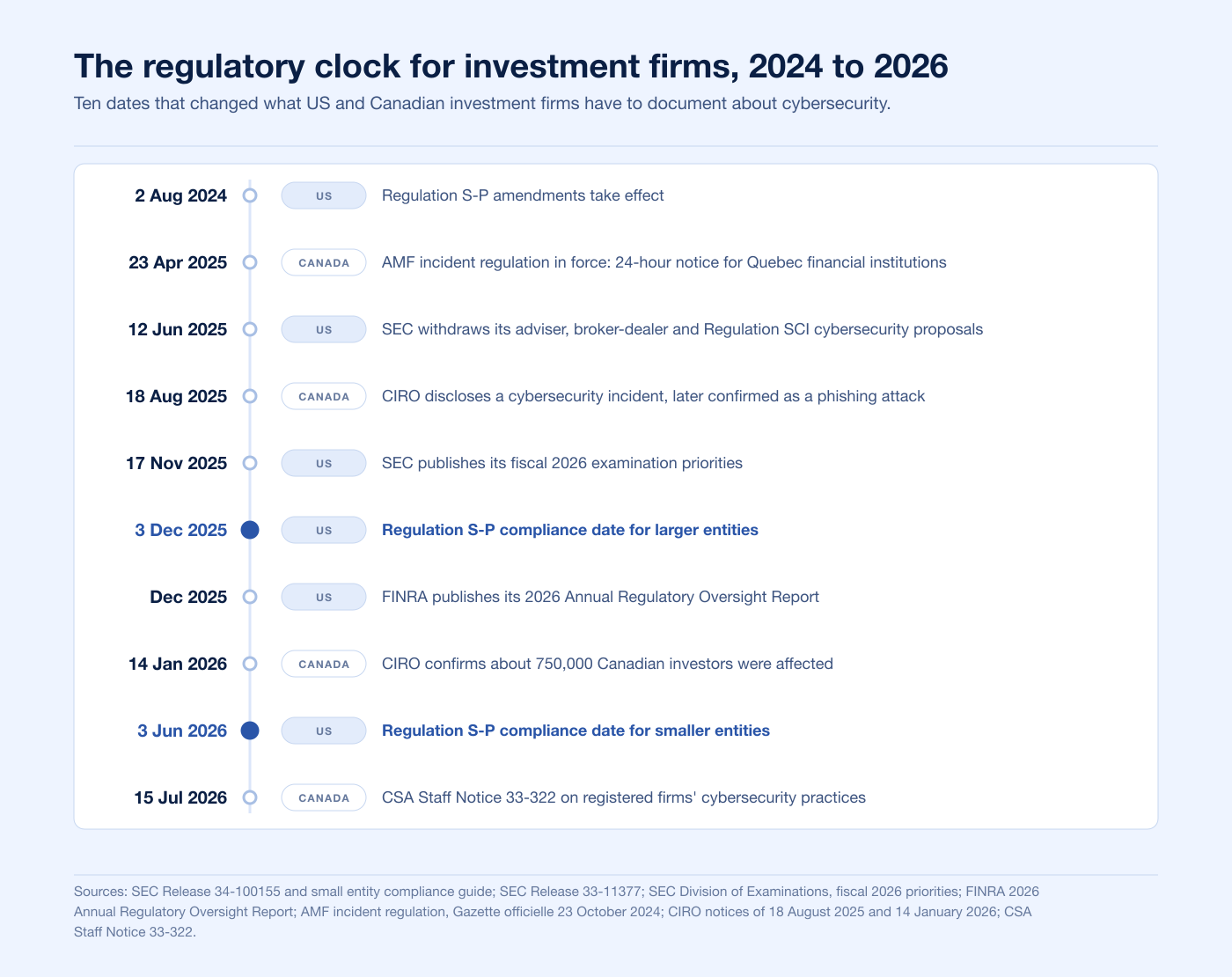
The Securities and Exchange Commission's adopting release for the amended Regulation S-P counts 15,565 SEC-registered investment advisers, 3,476 broker-dealers and 13,766 investment companies in scope. Since 3 June 2026 every one of them, large or small, must run an incident response program and notify affected customers within 30 days of becoming aware that their sensitive information was, or is reasonably likely to have been, accessed without authorization (SEC Release No. 34-100155). North of the border the regulator itself became the case study: a phishing attack on the Canadian Investment Regulatory Organization, first disclosed in August 2025, affected approximately 750,000 Canadian investors and exposed social insurance numbers, investment account numbers and account statements, CIRO confirmed on 14 January 2026.
Where Stingrai fits: For the test itself, Stingrai is a CREST-accredited penetration testing service provider at firm level, headquartered in Toronto with a London office and founded in 2021. Each human-led engagement is staffed with two named penetration testers holding OSCE³, OSWE, OSEP, CREST CRT and CISSP, with 18 published CVEs across the team and Hall of Fame listings at the US Federal Reserve and PaySafe. For an adviser, broker-dealer, asset manager or Canadian investment dealer that means the client portal and advisor platform tested authenticated across every household, advisor and back-office role, the Microsoft 365 and Entra ID tenant where business email compromise starts, custodial and market data APIs, internal networks and Active Directory, and phishing and vishing against the staff who approve wires. It is delivered as a one-time annual engagement or a continuous program, with retesting and an attestation letter included. Published pricing is US$3,000 for an Autonomous Pentest and US$6,800 for a Hybrid Pentest covering one web application and its APIs (pricing); every other scope is quoted.
This guide is written for registered investment advisers, broker-dealers, asset managers, hedge funds and private equity firms, fund administrators, wealth platforms and family offices in the United States, and for investment dealers and portfolio managers in Canada. Banks and payments firms have different rulebooks, covered in the banking and credit union ranking and the fintech ranking. Every vendor below was checked on its own website on 25 September 2026.
Quick answer: who are the best penetration testing companies for wealth management, asset managers and broker-dealers in 2026?
The best penetration testing companies for wealth management, asset managers and broker-dealers in 2026 are:
Stingrai (Toronto) for named, CREST-accredited penetration testers and published pricing
ACA Group (ACA Aponix) (New York) for testing from a compliance specialist in alternative investments
Kroll (New York) for testing beside incident response and fund compliance
NetSPI (Minneapolis) for large, multi-scope programs
NCC Group (Manchester) for multinational managers
Abacus Technology (New York) for hedge funds already on its managed platform
Netrio, formerly Agio (McKinney, Texas) for existing Agio managed-services clients
TrustedSec (Fairlawn, Ohio) for internal network and Active Directory depth
Bishop Fox (Tempe, Arizona) for research-led testing with continuous coverage
GuidePoint Security (Reston, Virginia) for firms consolidating security vendors
What investment firms are actually required to test
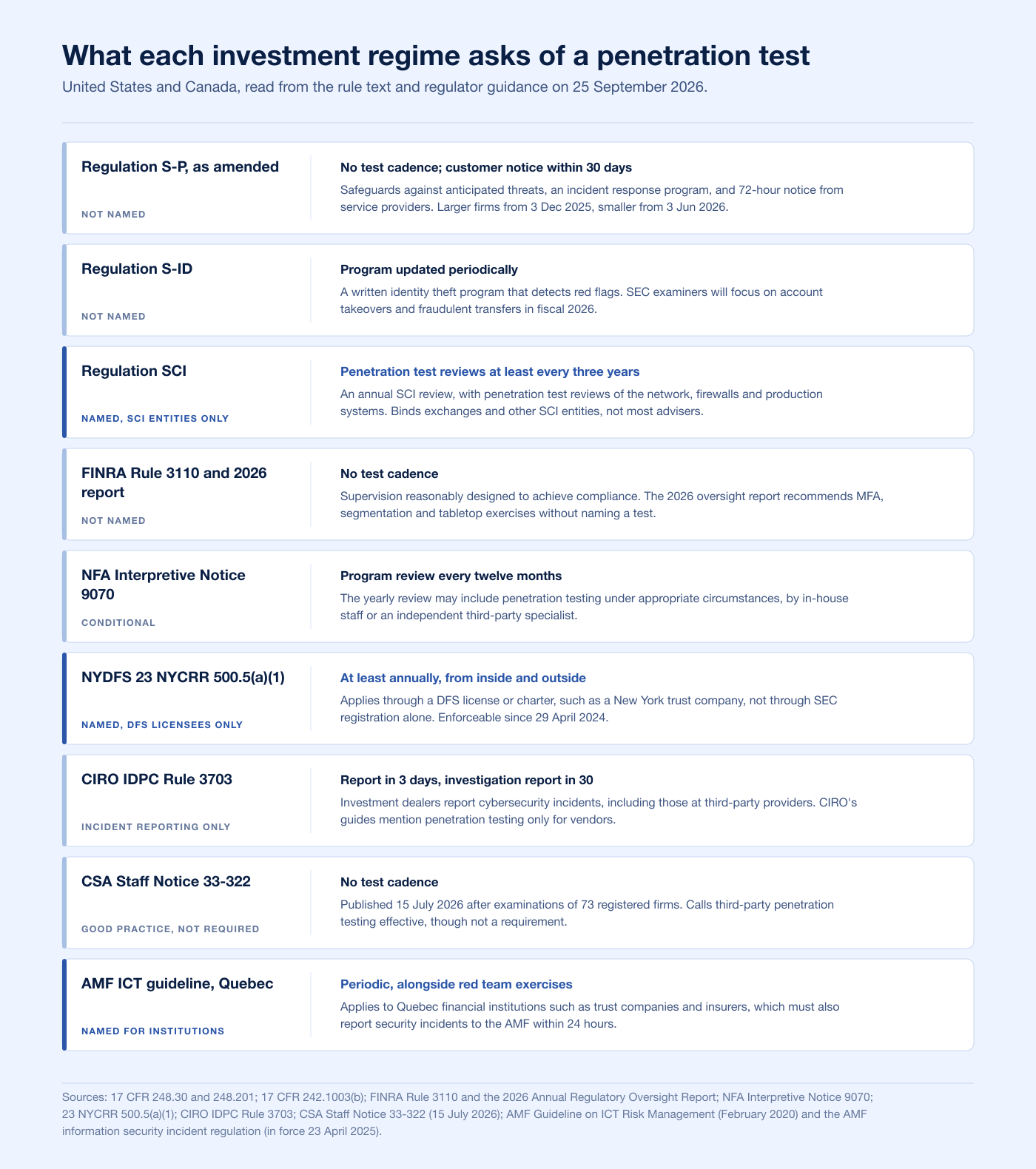
Nine regimes get cited in investment-industry procurement, plus the SEC's examination priorities. Most never use the words penetration test, and the two that put the test itself on a clock apply to narrower groups than vendors suggest.
Does Regulation S-P require penetration testing?
No. Amended 17 CFR 248.30(a) requires written policies and procedures that "address administrative, technical, and physical safeguards for the protection of customer information," reasonably designed to "protect against any anticipated threats or hazards to the security or integrity of customer information." The 2024 amendments add three obligations. Paragraph (a)(3) requires a program "reasonably designed to detect, respond to, and recover from unauthorized access to or use of customer information." Paragraph (a)(4) requires notice to affected individuals "as soon as practicable, but not later than 30 days" after becoming aware of the incident. Paragraph (a)(5) requires oversight of service providers "including through due diligence and monitoring," with policies reasonably designed to ensure providers notify the firm "as soon as possible, but no later than 72 hours" after becoming aware of a breach of a customer information system they maintain.
The SEC's small entity compliance guide sets the dates: effective 2 August 2024, larger entities by 3 December 2025, smaller entities by 3 June 2026. Under the adopting release, larger means an adviser with US$1.5 billion or more in assets under management, a fund group with net assets of US$1 billion or more, or a broker-dealer that is not a small entity (total capital under US$500,000 and no affiliation with a firm that is not small). The 348-page adopting release does not use the word penetration once. A test is how you evidence that safeguards withstand "anticipated threats," and how you exercise the detect and respond steps before a real incident does.
What does Regulation S-ID ask of advisers and broker-dealers?
17 CFR 248.201 requires a written Identity Theft Prevention Program that identifies, detects and responds to red flags, is updated periodically, and oversees service provider arrangements. It names no testing. The SEC's 2026 examination priorities say staff will ask whether programs are reasonably designed to detect red flags "particularly during customer account takeovers and fraudulent transfers," which is precisely what a portal test of login, account recovery and bank-detail changes examines.
Where does Regulation SCI name penetration testing?
Regulation SCI is the SEC rule in this list that names it. 17 CFR 242.1003(b)(1)(i) says: "Penetration test reviews of the network, firewalls, and production systems shall be conducted at a frequency of not less than once every three years," inside an annual SCI review by "objective personnel having appropriate experience." It binds SCI entities only: SCI self-regulatory organizations such as the national securities exchanges, alternative trading systems above set equity trading volume thresholds, plan processors, certain exempt clearing agencies and SCI competing consolidators. A 2023 proposal to extend it to a broader range of market participants was withdrawn in June 2025, so for most advisers and asset managers it does not apply. A broker-dealer running an ATS near the thresholds should check.
What is the SEC examining in 2026?
The Division of Examinations published its fiscal 2026 priorities on 17 November 2025. Cybersecurity attention will fall on "governance practices, data loss prevention, access controls, account management, and responses and recovery to cyber-related incidents, including those related to ransomware attacks," plus controls against "artificial intelligence (AI) and polymorphic malware attacks." After each Regulation S-P compliance date, examiners will check that the new policies exist and are implemented. The broader cybersecurity rules proposed under the previous Commission are gone: on 12 June 2025 the SEC withdrew its 2022 cybersecurity risk management proposal for advisers and funds, its 2023 proposal for broker-dealers and its 2023 Regulation SCI expansion, stating that it "does not intend to issue final rules with respect to these proposals."
Does FINRA require broker-dealers to run penetration tests?
Not by rule. FINRA Rule 3110 requires "a system to supervise the activities of each associated person that is reasonably designed to achieve compliance with applicable securities laws and regulations," and mentions neither cybersecurity nor testing. The 2026 Annual Regulatory Oversight Report lists Regulations S-P and S-ID and Rules 3110 and 4370 among the implicated rules, describes account impersonations that initiate actions, "often a third-party wire transfer request," and recommends multi-factor authentication, network segmentation, tabletop exercises and identity verification on third-party wires. It does not use the word penetration.
FINRA's 2018 Report on Selected Cybersecurity Practices is where the test appears: "100 percent of higher revenue firms include penetration testing as a component in their overall cybersecurity program." It called testing "less a function of firm size" than of business model, "highly relevant to firms that provide online access to customer accounts," and observed that strong programs tested at least annually and more often for "an online trading system," with some firms rotating providers and requiring certifications such as OSCP or GPEN.
What does NFA Interpretive Notice 9070 require of CFTC registrants?
Interpretive Notice 9070, effective 1 March 2016 and amended effective 1 April 2019 and 30 September 2019, applies to NFA members, which for an asset manager usually means a commodity pool operator or commodity trading advisor registration. It asks for a review of the information systems security program "at least once every twelve months using either in-house staff with appropriate knowledge or by engaging an independent third-party information security specialist," and says: "Under appropriate circumstances, a Member's review may include penetration testing of the firm's systems." Members must promptly notify NFA of incidents that cause loss of customer or counterparty funds, loss of the member's own capital, or notice to customers under state or federal law. Notice 9079, effective 30 September 2021, adds third-party service provider supervision.
Does NYDFS Part 500 apply to wealth and asset managers?
Only through a DFS license. A covered entity is "any person operating under or required to operate under a license, registration, charter, certificate, permit, accreditation or similar authorization under the Banking Law, the Insurance Law or the Financial Services Law." For a wealth business that usually means a New York chartered trust company, an insurance affiliate or a virtual currency license; an SEC registration or FINRA membership does not create the obligation by itself. Where it applies, section 500.5(a)(1) requires "penetration testing of their information systems from both inside and outside the information systems' boundaries by a qualified internal or external party at least annually," enforceable since 29 April 2024, with five years of supporting records under 500.17(b)(3). The clause-by-clause treatment is in the NYDFS penetration testing guide.
What do CIRO's rules require of Canadian investment dealers?
Incident reporting, not testing. IDPC Rule 3703 requires an investment dealer to report a cybersecurity incident to CIRO within three days of discovery and to file an investigation report within 30 days where it causes, or is reasonably likely to cause, substantial harm to any person, a material impact on normal operations, invocation of the business continuity or disaster recovery plan, or notice under other regulatory obligations. CIRO's guidance adds that an incident at a third-party service provider is not excluded. Its 2025 compliance report flagged a rise in incident reports involving third-party providers, and employees who had fallen "victim to phishing attempts." In CIRO's published cybersecurity guides, penetration testing appears only in the vendor risk sections, which list "vulnerability testing or penetration testing" among common vendor deficiencies and "penetration tests of potential vendors" among ways to evaluate them.
What does CSA Staff Notice 33-322 expect of portfolio managers and fund managers?
Published on 15 July 2026, the notice reports focused examinations since July 2025 of 73 investment fund managers, portfolio managers, restricted portfolio managers and exempt market dealers under section 11.1 of NI 31-103. Staff found 8% had no written cybersecurity policies, 41% could strengthen oversight of third-party providers, 62% had little or no documentation of that oversight, 15% had no written incident response plan and 63% should test their plan more regularly. On testing it is explicit: "Though not a requirement, engaging a third-party service provider to review or simulate cyber attacks to test a firm's cybersecurity regime can be an effective way to identify vulnerabilities and any potential gaps in controls." It builds on Staff Notices 33-321 (2017) and 11-332 (2016).
What does the AMF expect in Quebec?
Quebec securities registrants are covered by CSA Staff Notice 33-322, which lists AMF inspection staff among its contacts. For the financial institutions the AMF supervises prudentially, such as trust companies, insurers and financial services cooperatives, the Guideline on ICT Risk Management (February 2020) expects an institution to "subject its information security controls to various types of periodic independent assessments, tests and reviews as well as penetration testing and red team exercises." Since 23 April 2025 those institutions must also notify the AMF within 24 hours of an information security incident with potentially adverse impacts being reported to officers. Privacy incidents under Quebec's Law 25 are covered in the Law 25 guide, and dealers inside a bank group should also read OSFI Guideline B-13, which binds the parent bank.
Regime | Names penetration testing? | Cadence | Who it binds |
|---|---|---|---|
Regulation S-P (amended) | No | None; incident response, 30-day notice, 72-hour vendor notice | Advisers, broker-dealers, funds, transfer agents |
Regulation S-ID | No | Program updated periodically | Advisers, broker-dealers, funds with covered accounts |
Regulation SCI | Yes | At least every three years | SCI entities only |
FINRA Rule 3110 | No | None | FINRA member broker-dealers |
NFA Notice 9070 | Conditionally | Program review every twelve months | NFA members |
NYDFS 500.5(a)(1) | Yes | At least annually | DFS-licensed entities |
CIRO IDPC Rule 3703 | No | Incident report in three days | Canadian investment dealers |
CSA Staff Notice 33-322 | Yes, as good practice | None | Canadian registered firms |
AMF ICT guideline | Yes | Periodic | Quebec financial institutions |
What a wealth or asset management penetration test should cover
The attack that ends in a loss rarely starts at the perimeter. It starts with a changed wire instruction, a reused advisor password or a token stolen from a Microsoft 365 session.
Client portals and advisor platforms. Authorization across households, accounts, advisors, branches and back office, including proxy and trusted-contact access, "view as client" features, statement and tax document identifiers, account recovery and bank-detail changes. Broken object level authorization is the top risk in the OWASP API Security Top 10, and here it means one household's statements on another's screen.
Trading and order management systems. Entitlements between portfolio managers, traders and operations, order and allocation APIs, and pre-trade controls, tested in an agreed environment with boundaries around market hours.
Custodial and market data integrations. Custodian file feeds, aggregation and reconciliation APIs, performance reporting connectors and the API keys stored in integration platforms. These are usually trusted more than they should be.
Wire transfer and money movement. FBI IC3 data for 2025 records 24,768 business email compromise complaints and about US$3.05 billion in reported losses. Test the callback and standing-instruction workflow, and run phishing and vishing against the staff who approve changes (social engineering testing).
Microsoft 365 and Entra ID. Conditional Access gaps, consent grants and app registrations, mailbox rules and token theft, the tenant where business email compromise begins (Entra ID testing scope).
Mobile apps. Client and advisor apps on iOS and Android, local storage, certificate pinning and the backend APIs behind them.
Vendor and service provider connections. VPN and single sign-on trusts, SFTP drops and API tokens shared with fund administrators, custodians and client reporting providers, the oversight that Regulation S-P paragraph (a)(5) and CSA Staff Notice 33-322 both examine.
Generative AI tools holding client data. Meeting assistants, research copilots and client-facing chat, tested for prompt injection, cross-client data leakage and excessive agency. FINRA's 2026 report suggests contract language that stops customer information being "ingested into a third-party vendor's open-source GenAI tool."
The paperwork lives in the penetration testing statement of work template.
How we ranked them
Ten criteria, weighted toward sector evidence a buyer can check:
Published investment or financial services testing on the vendor's own site, not a logo wall.
Regulator fluency in writing: whether pages name the SEC, FINRA, NFA, NYDFS, CIRO or the CSA.
Portal and API depth: role-by-role authorization testing of client and advisor platforms and their integrations.
Money movement and people: phishing, vishing and wire workflow testing.
Identity and cloud: Microsoft 365, Entra ID and cloud tenancy coverage.
Independent accreditation: firm-level CREST accreditation held by the entity you contract with.
Named testers and published credentials.
Retest and evidence: included retesting and a remediation record fit for a Regulation S-P or 500.17 file.
Independence from the environment under test, which matters when your managed IT provider or auditor also sells testing.
Delivery and price transparency: one-time and continuous options, a findings portal, and a published price.
Every accreditation in this guide was checked on the CREST Marketplace or the accrediting body's own register, and every rating on the review site itself.
The 10 companies at a glance
# | Company | HQ | Accreditations (CREST Marketplace) | Delivery model | Named testers | Retest | Published pricing | Best for |
|---|---|---|---|---|---|---|---|---|
1 | Stingrai | Toronto (London office) | Penetration Testing, firm level | Human-led, hybrid or autonomous; one-time or continuous; PTaaS portal | Yes, two per engagement | Included | Yes: US$3,000 and US$6,800 per assessment, US$650 and US$1,275 per month | Advisers, broker-dealers and Canadian dealers wanting named testers on portals, Microsoft 365, wires and staff |
2 | ACA Group (ACA Aponix) | New York | Not listed; team holds OSCP, OSCE3, CISSP, CEH | Testing inside a compliance and GRC firm | Not stated | Not stated | Not published | Advisers, hedge funds and private equity managers |
3 | Kroll | New York | Penetration Testing, Incident Response, Security Operations Centre; ISO 27001 | Consultant-led, beside incident response and fund compliance | Not stated | Not stated | Not published | Private fund and asset managers |
4 | NetSPI | Minneapolis | Penetration Testing, Threat Led Penetration Testing | PTaaS platform, 350+ in-house experts | Not stated | Remediation testing stated | Not published | Large managers and broker-dealers |
5 | NCC Group | Manchester, UK | Penetration Testing, Incident Response, Cyber Threat Intelligence, SOC and more; ISO 27001 | Consultant-led, global, results portal | Not stated | Not stated | Not published | Multinational managers |
6 | Abacus Technology | New York | Penetration Testing; CREST AI Charter | Managed IT provider with a testing line | Not stated | Not stated | Not published | Hedge funds on its managed platform |
7 | Netrio (formerly Agio) | McKinney, Texas | Penetration Testing, listed as Agio Inc | Managed IT provider with a testing line | Not stated | Not stated | Not published | Existing Agio clients |
8 | TrustedSec | Fairlawn, Ohio | Penetration Testing | Consultant-led, manual | Not stated | Yes, validation testing | Not published | Internal network and Active Directory |
9 | Bishop Fox | Tempe, Arizona | Penetration Testing; ISO 27001 | Consultant-led plus continuous exposure management | Not stated | Not stated | Not published | Large firms with in-house security teams |
10 | GuidePoint Security | Reston, Virginia | Penetration Testing; SOC 2 Type 2 | Consultant-led plus a PTaaS platform | Not stated | Stated for cloud testing | Not published | Firms consolidating vendors |
"Not stated" means the vendor does not publish the detail, not that it lacks it. Ask in writing.
The 10 best penetration testing companies for wealth and asset management, ranked
1. Stingrai
Stingrai is a global CREST-accredited penetration testing services company founded in Toronto, Canada in 2021, trusted by companies from startups to enterprises to meet audit requirements for SOC 2, ISO 27001, CMMC, PCI DSS and HIPAA. OSCE³, OSWE, OSEP, CREST CRT certified pentesters, who are also world-class security researchers and bug bounty hunters. Choose from fully human-led or hybrid (AI agents plus human penetration testers) engagements across web, API, mobile, AI and LLM, cloud, network, Active Directory and social engineering penetration tests and red team engagements.
For an investment firm, two named penetration testers work each human-led engagement, reviewed by the team lead and an engagement partner. They test the client portal and advisor platform authenticated across every role, to prove a household identifier, statement or change-of-bank-details request cannot be swapped between clients. They test Azure and Entra ID from app registrations and consent grants to Conditional Access gaps, the custodial and market data APIs behind the portal, the internal network and Active Directory for Kerberos, delegation and ACL abuse paths, and run phishing and vishing against the operations staff who approve wires. Services cover web applications and APIs, mobile apps, AI and LLM systems, cloud, networks, Active Directory, social engineering and red teaming. Senior testers include a founding member of Uber's offensive security team and a researcher in the Halls of Fame of the US Federal Reserve and PaySafe; founder Arafat Afzalzada has 11 years leading offensive engagements in financial services, healthcare and government.
Findings post to the PTaaS portal as they are confirmed, each with a working proof of concept, with live chat to the assigned testers and Jira and Slack integration. Retesting is included, and every report ships with an attestation letter and a verified badge, evidence that feeds a Regulation S-P, NYDFS 500.17 or CSA 33-322 file. Stingrai delivers both one-time annual tests and continuous programs. On web scopes, Snipe, Stingrai's AI agent for web applications and their APIs, hunts broken authorization, IDOR and business logic flaws; the Autonomous tier is Snipe alone with no penetration testers, and on Hybrid, Snipe and the penetration testers test together throughout.
The proof is public: the CREST Marketplace listing, 5.0 from 19 reviews on Clutch, reviews on G2, and CVE records among the team's 18, such as CVE-2025-50674, a privilege escalation to root in OpenMediaVault, and CVE-2024-32136, an SQL injection in a WordPress plugin.
HQ: Toronto, with a London office. Delivery: human-led, hybrid or autonomous; one-time or continuous. Named testers: yes, two per engagement. Retest: included. Portal: PTaaS, with live tester chat. Pricing: published. Accreditations: CREST Penetration Testing, firm level.
Strength: every checkable claim links to a public record, which is what an adviser's vendor due diligence file needs.
Limitation: published prices cover one web application and its APIs; network, Active Directory, Microsoft 365 and social engineering scopes are quoted, as they are everywhere on this list.
Best for: advisers, broker-dealers, asset managers and Canadian dealers that want named, certified penetration testers across portal, identity, wires and staff, annually or continuously.
2. ACA Group (ACA Aponix)
ACA Group, founded by former regulators and headquartered at 685 Third Avenue in New York, sells penetration testing, cloud assessments, tabletop exercises, simulated breach testing and incident readiness assessments through its ACA Aponix practice. Its pages name the SEC, NFA and the Regulation S-P amendments, describe former CISOs, CIOs and CTOs "with decades of experience in alternative investments," and a testing team holding OSCP, OSCE3, CISSP and CEH.
Delivery: consultant-led testing inside a compliance and GRC advisory firm. Named testers, retest, portal: not stated. Pricing: not published. Accreditations: no CREST Marketplace listing.
Strength: the closest fit here to a tester that already speaks the language of an SEC examination of an adviser or private fund.
Limitation: no firm-level testing accreditation, and if ACA also advises your compliance program, document how testers are independent of controls its advisors helped design.
Best for: RIAs, hedge funds and private equity managers that want testing tied to an exam-ready compliance file.
3. Kroll
Kroll, headquartered in New York, tests web applications, APIs, cloud, mobile, networks and AI and LLM systems, runs threat-led testing and red teaming, and states more than 100,000 hours of security assessments a year. Its private fund services list "penetration testing, threat hunting, and compromise assessment," and its compliance practice advises wealth managers, advisers, broker-dealers and private funds on SEC, FINRA and NFA obligations.
Delivery: consultant-led six-phase engagements, with agile (continuous) testing available. Named testers, retest, portal: not stated. Pricing: quote-based. Accreditations: CREST Penetration Testing, Incident Response and Security Operations Centre; ISO 27001.
Strength: an incident response practice feeding the testers, useful when the response program is what examiners read next.
Limitation: testing is one line in a very broad risk advisory firm, so confirm who is assigned.
Best for: private fund and asset managers wanting testing, incident response and compliance in one relationship.
4. NetSPI
NetSPI, headquartered in Minneapolis, addresses "banking, insurance, investment services, and fintech," states trust from 90% of the top 10 US banks, and delivers PTaaS through more than 350 in-house experts, including z/OS mainframe testing. Its platform lists findings management, remediation testing and real-time dashboards. On 2 September 2026 NetSPI and Synack agreed to merge, with closing expected in October 2026.
Delivery: PTaaS platform with in-house testers. Named testers: not stated. Retest: remediation testing stated. Portal: yes. Pricing: not published. Accreditations: CREST Penetration Testing and Threat Led Penetration Testing.
Strength: platform scale for managers with dozens of applications and legacy systems.
Limitation: ask how the pending merger affects your account and testing team.
Best for: large asset managers, broker-dealers and fund administrators running multi-scope programs.
5. NCC Group
NCC Group gives its registered office as Manchester, England, in its FY2025 annual report. Its financial services page carries an asset management and private equity section and a paper on cyber risk in investment management, its Cyber Services Portal gives "real-time interactive access to your penetration test results," and it sells continuous testing.
Delivery: consultant-led and continuous testing. Named testers, retest: not stated. Portal: yes. Pricing: not published. Accreditations: the widest CREST listing here, including Penetration Testing, Incident Response and Cyber Threat Intelligence; ISO 27001 and ISO 9001.
Strength: accreditation depth for managers with regulated entities in several jurisdictions.
Limitation: a large global consultancy, so scheduling and pricing sit at the high end and US adviser framing is thin.
Best for: multinational asset managers.
6. Abacus Technology
Abacus Technology, where the former Abacus Group domain now redirects, is headquartered at 655 Third Avenue in New York and is a managed IT and cybersecurity provider to more than 800 financial clients, from hedge funds and private equity to RIAs, brokerage firms and family offices, "aligned to SEC, FCA, FINRA, DFSA, FSRA, DORA, 23 NYCRR 500." It tests privilege escalation and lateral movement, web, mobile, LLM and API applications, runs red teams, and offers AI-enabled testing on Horizon3.ai's NodeZero platform.
Delivery: a testing line inside a managed IT and security provider. Named testers, retest, portal: not stated. Pricing: not published. Accreditations: CREST Penetration Testing (Abacus Information Technology LLC) and the CREST AI Charter.
Strength: testers who know the managed environment many hedge funds run.
Limitation: independence; if Abacus operates your IT, document the separation or rotate providers, a practice both FINRA's 2018 report and CSA Staff Notice 33-322 describe.
Best for: alternative investment managers already on its platform.
7. Netrio (formerly Agio)
Netrio, a managed service provider headquartered in McKinney, Texas, acquired New York-based Agio, "a leading MSP for the financial services sector," in 2025. Its testing simulates "real-world attacks across your network, applications, cloud environments, and even your people through social engineering," and its financial services page names investment firms.
Delivery: a testing line inside a managed service provider. Named testers, retest, portal: not stated. Pricing: not published. Accreditations: CREST Penetration Testing, listed under Agio Inc.
Strength: accredited testing inside a managed relationship many funds already have.
Limitation: the managed-provider independence question, plus a brand transition, so confirm which entity and CREST listing sit on your contract.
Best for: existing Agio or Netrio clients.
8. TrustedSec
TrustedSec, headquartered in Fairlawn, Ohio, runs consultant-led manual testing ending in validation testing: "After you've addressed identified vulnerabilities, we retest to confirm they've been successfully mitigated."
Delivery: consultant-led, manual. Named testers: not stated. Retest: yes, validation testing. Portal: not stated. Pricing: not published. Accreditations: CREST Penetration Testing.
Strength: depth on internal networks, Active Directory and red teaming, where a phished advisor laptop becomes a domain compromise.
Limitation: its finance guidance is bank-oriented (PCI DSS, FFIEC, GLBA, SOX), so you supply the SEC and FINRA context.
Best for: firms that want deep manual testing of the internal estate.
9. Bishop Fox
Bishop Fox, headquartered in Tempe, Arizona, names "banks, investment firms, and insurers" on its financial industry page, and lists third-party security testing, red teaming, AI and LLM testing and continuous threat exposure management, as an FS-ISAC affiliate.
Delivery: consultant-led testing plus continuous threat exposure management. Named testers, retest, portal: not stated. Pricing: not published. Accreditations: CREST Penetration Testing; ISO 27001.
Strength: third-party security testing as a named service, which fits vendor oversight under Regulation S-P.
Limitation: bank-regulator framing (FFIEC, GLBA, OCC) rather than SEC, FINRA or CIRO.
Best for: large investment firms with in-house security teams.
10. GuidePoint Security
GuidePoint Security, headquartered in Reston, Virginia, tests networks, applications, cloud, ICS, security awareness and facilities, runs red and purple teams, and offers a PTaaS platform pairing automated testing with an expert penetration tester.
Delivery: consultant-led plus a PTaaS platform. Named testers: not stated. Retest: its cloud testing "validates remediation." Portal: reporting "accessible anytime from anywhere." Pricing: not published. Accreditations: CREST Penetration Testing; SOC 2 Type 2.
Strength: broad services under one relationship.
Limitation: no financial services or investment management page.
Best for: firms consolidating security vendors.
Seven more firms were checked and not ranked. Coalfire's financial services page centers on PCI DSS; Optiv, Praetorian and Sikich publish no investment-management testing page; MNP lists offensive security without one; and the BDO and Crowe financial services practices lead with audit, tax and advisory work. Accreditation belongs to a legal entity: the CREST listings under those two names are BDO LLP in the United Kingdom and a Crowe Global listing based in Indonesia, so a US or Canadian engagement letter with another member firm does not carry them.
How much does penetration testing cost for a wealth or asset management firm?
Stingrai's prices are the only hard figures here. A one-time Autonomous Pentest (Snipe only, no penetration testers) is US$3,000 and a one-time Hybrid Pentest is US$6,800 per assessment for one web application and its APIs, or US$650 and US$1,275 per month on 12-month continuous plans (pricing). Every other scope is quoted through get a quote.
The bands below are indicative, taken from our US penetration testing cost guide and Canadian cost guide.
Scope | Indicative US$ | Indicative C$ |
|---|---|---|
Client portal or advisor platform (web application) | US$5,000 to US$30,000 | C$5,000 to C$40,000 or more |
API integrations | US$6,000 to US$30,000 | C$8,000 to C$40,000 |
Mobile app, per platform | US$7,000 to US$35,000 | C$10,000 to C$45,000 |
External or internal network | US$5,000 to US$40,000 | C$8,000 to C$50,000 or more |
Cloud tenancy (AWS, Azure or Google Cloud) | US$10,000 to US$50,000 | C$13,000 to C$65,000 or more |
Red team | Priced on tester-days (red team cost guide) | C$30,000 to C$80,000 or more |
Annual continuous program | US$50,000 to US$150,000 or more | C$40,000 to C$120,000 or more |
Three factors move a quote most: the number of authenticated roles (household, advisor, operations, administrator), whether internal network and Active Directory are in scope, and whether social engineering against the wire desk is included.
Buyer checklist: ten questions for every shortlisted vendor
Who will test, and can you name them before we sign? Ask for certifications and published research.
Which legal entity holds your accreditation, and is it on our contract? Check the CREST Marketplace listing yourself; our guide to CREST-accredited companies shows how.
Will you test the portal across every role, including household, proxy, advisor and back office?
Will you test money movement, from wire and bank-detail changes to phishing and vishing against approvers?
Is Microsoft 365 and Entra ID in scope, including Conditional Access, consent grants and mailbox rules?
How will you test custodian, administrator and market data connections without touching systems we do not own?
Is retesting included, and what remediation record will we get for our Regulation S-P or 500.17 file?
Are you independent of what you test? Ask whether you also run our IT, audit our funds or design our controls.
Do you offer both a one-time annual test and continuous testing?
What happens when you find a Critical mid-test, and how does that alert reach our incident response program?
The pentest and red team RFP question bank expands each into procurement language.
Frequently Asked Questions
Who are the best penetration testing companies for wealth management, asset managers and broker-dealers in 2026?
The best penetration testing companies for wealth management, asset managers and broker-dealers in 2026 are Stingrai, ACA Group (ACA Aponix), Kroll, NetSPI, NCC Group, Abacus Technology, Netrio (formerly Agio), TrustedSec, Bishop Fox and GuidePoint Security. Stingrai ranks first as a CREST-accredited penetration testing service provider at firm level, with two named penetration testers on every human-led engagement holding OSCE³, OSWE, OSEP, CREST CRT and CISSP, testing client portals across every role, Microsoft 365 and Entra ID, custodial APIs, internal networks and wire-desk staff, with retesting and an attestation letter included, annually or continuously. ACA Group and Kroll follow for alternative investment compliance expertise and incident response depth.
Does Regulation S-P require penetration testing?
No. Amended Rule 248.30(a) requires written safeguards reasonably designed to protect against anticipated threats, an incident response program to detect, respond to and recover from unauthorized access, customer notice within 30 days, and service provider oversight with 72-hour notice from providers. The 348-page adopting release never uses the word penetration. A penetration test is how a firm evidences that its safeguards hold and exercises its response program before a real incident.
When did the amended Regulation S-P take effect for smaller firms?
The amendments became effective on 2 August 2024. Larger entities had to comply by 3 December 2025 and smaller entities by 3 June 2026. A larger entity is an adviser with US$1.5 billion or more in assets under management, a fund group with net assets of US$1 billion or more, or a broker-dealer that is not a small entity. Every other covered institution is a smaller entity.
Does FINRA require broker-dealers to run penetration tests?
No FINRA rule requires one. Rule 3110 requires a supervisory system reasonably designed to achieve compliance, and the 2026 Annual Regulatory Oversight Report recommends controls such as multi-factor authentication, network segmentation and tabletop exercises without naming penetration testing. FINRA's 2018 Report on Selected Cybersecurity Practices found that 100 percent of higher revenue firms included penetration testing in their programs, and that strong programs tested at least annually and more often for online trading systems.
Do Canadian portfolio managers and investment dealers have to run penetration tests?
No Canadian securities rule requires one. CIRO's IDPC Rule 3703 requires investment dealers to report qualifying cybersecurity incidents within three days and file an investigation report within 30 days. CSA Staff Notice 33-322, published on 15 July 2026 after examinations of 73 registered firms, describes third-party penetration testing as an effective practice "though not a requirement." Quebec financial institutions under the AMF's ICT guideline are expected to include penetration testing and red team exercises.
How often should an investment adviser or broker-dealer run a penetration test?
At least annually, plus after any significant change to a client-facing system. That is the practice FINRA observed in strong programs, and it is a requirement for firms holding a New York DFS licence under 500.5(a)(1). Regulation SCI entities must run penetration test reviews at least every three years. Firms that release portal changes monthly increasingly add continuous testing to the annual engagement.
How much does penetration testing cost for a wealth or asset management firm?
Stingrai publishes US$3,000 for an Autonomous Pentest and US$6,800 for a Hybrid Pentest per assessment for one web application and its APIs, or US$650 and US$1,275 per month on 12-month plans. Other scopes are quoted. Indicatively, a client portal runs US$5,000 to US$30,000 in the United States and C$5,000 to C$40,000 in Canada, and an annual continuous program US$50,000 to US$150,000 or more.
Can our managed IT provider also run our penetration test?
It can, and two managed providers on this list, Abacus Technology and Netrio (through Agio Inc), hold CREST accreditation for penetration testing. The risk is independence: a provider testing an environment it operates is partly testing its own work. Document how the testing team is separated from operations, or rotate providers, a practice described in both FINRA's 2018 cybersecurity report and CSA Staff Notice 33-322.