More than 20% of organizations reported a breach targeting AI models or applications in IBM's 2026 Cost of a Data Breach study, and the most common causes were weaknesses in the systems around the model: compromised APIs, applications or plug-ins (27%) and cloud misconfigurations affecting AI workloads (27%). The same study, which covers breaches at 602 organizations between March 2025 and February 2026, found that one in four malicious breaches was AI-enabled, at an average cost of US$6 million against a global average of US$4.99 million. An AI red teaming company is the firm you hire to find those weaknesses in your own LLM application, AI agents and data pipelines before an attacker does.
Quick answer. The best AI red teaming companies in 2026 are Stingrai, TrustedSec, Praetorian, IOActive, Mindgard, Compass Security and Evolve Security. Each one sells a service, run by its own testers or researchers, that attacks a client's LLM application, AI agent or model integration and maps the results to public frameworks such as the OWASP Top 10 for LLM Applications and MITRE ATLAS. Stingrai publishes this guide and lists itself first: a CREST-accredited penetration testing company whose AI red team exercises are human-led by named penetration testers and quoted to scope.
This guide is about firms that test your AI systems. It is not a list of vendors whose own testing is AI-powered (that is the AI penetration testing companies ranking), and it is not a tools roundup (see the best AI pentesting tools). Every statement about a provider below comes from that provider's own website or its entry on the CREST Marketplace, read in November 2026.
What AI red teaming covers
NIST's Generative AI Profile (NIST AI 600-1), published on 26 July 2024, defines AI red-teaming as "a structured testing exercise used to probe an AI system to find flaws and vulnerabilities such as inaccurate, harmful, or discriminatory outputs, often in a controlled environment and in collaboration with system developers." For a security buyer, the useful version of that exercise works across four layers, because an attacker does not care which layer gives way first.
Layer | What the testers try to do | OWASP Top 10 for LLM Applications 2026 | OWASP Top 10 for Agentic Applications for 2026 | MITRE ATLAS techniques |
|---|---|---|---|---|
Application and API around the model | Reach another user's data or an admin function through the chat interface or its API; push model output into a browser, shell or database unchecked; run up model costs | LLM10 Improper Output Handling, LLM06 Unbounded Consumption | ||
Model and prompt | Override the developer's instructions, extract the system prompt, pull sensitive data out of the model or its context, and extract data through the inference API | LLM01 Prompt Injection, LLM02 Sensitive Information Disclosure, LLM08 Hidden Context Exposure, LLM07 Misinformation | AML.T0051 LLM Prompt Injection, AML.T0054 LLM Jailbreak, AML.T0024 Exfiltration via AI Inference API | |
Agents, tools and MCP servers | Redirect an agent's goal with an instruction planted in an email, ticket or web page; make it call a tool it should not; use its credentials to reach systems the user cannot | LLM03 Excessive Agency | ASI01 Agent Goal Hijack, ASI02 Tool Misuse, ASI03 Identity and Privilege Abuse | AML.T0053 AI Agent Tool Invocation, AML.T0086 Exfiltration via AI Agent Tool Invocation |
Data, memory and supply chain | Poison a retrieval corpus, a vector store or an agent's memory; abuse a third-party model, adapter or plug-in | LLM04 Supply Chain, LLM05 Data and Model Poisoning, LLM09 Vector and Embedding Weaknesses | ASI04 Agentic Supply Chain Vulnerabilities, ASI06 Memory and Context Poisoning | AML.T0070 RAG Poisoning, AML.T0080 AI Agent Context Poisoning, AML.T0020 Training Data Poisoning, AML.T0010 Supply Chain Compromise |
The identifiers and names come from the OWASP Top 10 for LLM Applications 2026 (published on 3 August 2026), the OWASP Top 10 for Agentic Applications for 2026 (published on 9 December 2025) and the MITRE ATLAS knowledge base; the grouping into layers is Stingrai's guidance. MITRE's October 2026 ATLAS data release (version 2026.10) lists 16 tactics, 129 techniques and 92 sub-techniques, so a provider that says its work is "aligned to ATLAS" should be able to name the technique IDs behind each finding.
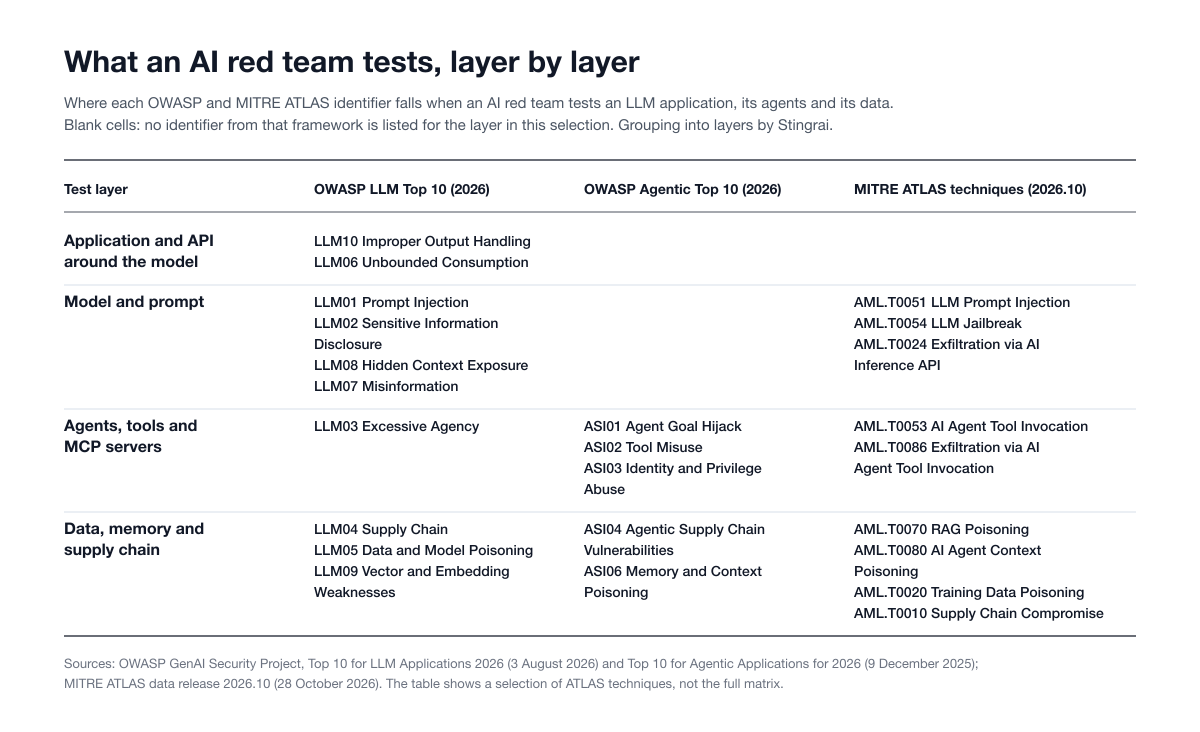
Figure 1: What an AI red team tests, layer by layer. Identifiers from the OWASP Top 10 for LLM Applications 2026, the OWASP Top 10 for Agentic Applications for 2026 and MITRE ATLAS release 2026.10; grouping by Stingrai. Sources: OWASP GenAI Security Project, MITRE ATLAS.
Why the application layer belongs in scope
IBM's finding that compromised APIs, applications or plug-ins (27%) were among the two most common causes of breaches targeting AI models or applications is the practical reason to keep the first layer in every AI engagement. A chatbot can leak another customer's order history because the retrieval call or the API behind it skips an authorization check, with no clever prompt involved. A test that stops at prompts and jailbreaks misses that whole class.
AI red teaming, an LLM penetration test and an AI red teaming tool
Buyers meet three different purchases under similar names.
An AI or LLM penetration test asks which vulnerabilities exist in a defined scope (the application, model endpoints, retrieval pipeline, agents, tools and MCP servers) and how to fix them. It aims for systematic coverage of every OWASP category in scope and ends with findings and a retest.
An AI red team exercise asks whether a motivated adversary can reach a defined harmful outcome, such as extracting customer records through an assistant or steering an agent into an unapproved refund, and whether guardrails, monitoring and human reviewers notice. It runs multi-step, multi-turn campaigns toward an objective.
An AI red teaming tool runs large libraries of automated attacks against a model or agent. Good tools catch known attack patterns at volume and turn successful attacks into regression tests; they do not replace a person who understands the business process the agent can change.
NIST AI 600-1 names four kinds of AI red-teaming: general public, expert ("performed by specialists with expertise in the domain or specific AI red-teaming context of use (e.g., medicine, biotech, cybersecurity)"), a combination of the two, and human/AI. The firms ranked here sell the expert kind, usually supported by their own tooling.
How this ranking was built
Stingrai publishes this guide and lists itself first, so weigh that position against the evidence linked in each entry. The order is Stingrai's editorial judgment of fit for a mid-market or enterprise buyer who needs its own LLM application or AI agent tested. It is not a numeric score, and the positions after Stingrai are close on the published evidence.
Gates (pass or fail), checked in November 2026 on each firm's own website. Every ranked firm passed all three.
A service, not only software: a page on the firm's own site that sells testing of a client's LLM application, AI agent or model, delivered by the firm's own testers or researchers.
Named frameworks: that page names at least one public framework the testing maps to, such as the OWASP Top 10 for LLM Applications, OWASP's agentic guidance, MITRE ATLAS or the NIST AI Risk Management Framework.
A stated head office on the firm's own site.
Weighed criteria (no scores):
how much of the four layers in the table above the firm's page says it tests, especially agents, tools and retrieval;
whether the page describes what the report contains and whether a retest follows;
independent accreditation a buyer can check, meaning a CREST Marketplace listing;
delivery to North American buyers;
how clearly the page puts people, rather than a platform alone, at the center of the testing.
Customer logos and headcount are left out because they cannot be verified and do not tell you who will test your system.
At a glance: the 7 AI red teaming companies
# | Company | Head office | CREST Marketplace (November 2026) | AI testing service on its own site | Frameworks its page names | Best for |
|---|---|---|---|---|---|---|
1 | Stingrai | Toronto, Canada (London, UK office) | Penetration Testing; AI-Enabled Penetration Testing; CREST AI Charter | AI and LLM penetration testing and human-led AI red teaming | OWASP LLM Top 10, OWASP Agentic 2026, MITRE ATLAS, NIST AI 600-1 | AI features that sit inside regulated web products, with audit evidence |
2 | TrustedSec | Fairlawn, Ohio | Penetration Testing; Cyber Advisory | Large Language Model (LLM) Assessment, "primarily manual" | NIST AI 600-1, OWASP LLM Top 10 | LLM features built into web applications and APIs |
3 | Praetorian | Austin, Texas | Penetration Testing | AI penetration testing and LLM red-team assessments | OWASP Top 10 for LLMs, MITRE ATLAS, NIST AI RMF, Google Secure AI Framework | Full-stack AI work that includes model extraction and poisoning checks |
4 | IOActive | Seattle, Washington (CREST head office: United Kingdom) | Penetration Testing | AI red teaming, AI agent security assessment, model and application assessments | MITRE ATLAS, NIST AI RMF | Agents that can send email, change records or run code |
5 | Mindgard | London, UK | No entry found | AI red teaming services and AI pentesting as a service, platform-backed | OWASP LLM Top 10, MITRE ATLAS, NIST AI RMF | Teams that want red team findings turned into regression tests |
6 | Compass Security | Rapperswil, Switzerland | Penetration Testing | AI and LLM security assessments | OWASP LLM Top 10, OWASP Agentic AI Security Guidance, MITRE ATLAS | European deployments of RAG assistants and MCP-connected agents |
7 | Evolve Security | Chicago, Illinois | No entry found | AI penetration testing in eight published phases | OWASP LLM Top 10, MITRE ATLAS, NIST AI RMF | Buyers who already use a continuous testing platform |
Every cell can be checked on the firm's own site or its CREST Marketplace entry; the links are in each profile below. "No entry found" means a search of the CREST Marketplace in November 2026 returned no listing for that company.
1. Stingrai
Stingrai is a global CREST-accredited penetration testing services company founded in Toronto, Canada in 2021, trusted by companies from startups to enterprises to meet audit requirements for SOC 2, ISO 27001, CMMC, PCI DSS and HIPAA. OSCE³, OSWE, OSEP, CREST CRT certified penetration testers, who are also world-class security researchers and bug bounty hunters. Choose from fully human-led or hybrid (AI agents plus human penetration testers) engagements across web, API, mobile, AI and LLM, cloud, network, Active Directory and social engineering penetration tests and red team engagements.
The CREST Marketplace entry for Stingrai Inc lists two CREST accreditations, Penetration Testing and AI-Enabled Penetration Testing, and the company certification CREST AI Charter, with Europe and North America as regions.
What Stingrai's AI red team tests
Stingrai's AI and LLM penetration testing service covers LLM-powered applications and chatbots, RAG pipelines and vector stores, AI agents and tool integrations, MCP servers, and AI infrastructure such as Amazon Bedrock, Azure OpenAI and Azure AI services, and Google Vertex AI. Its AI red team exercises go further than category coverage. The service page lists:
adversarial scenarios against models, agents and the business processes around them, such as refunds, approvals, account changes and support escalations;
jailbreak and policy-evasion campaigns that test whether content and safety policies hold under sustained, multi-turn pressure;
data exfiltration through tools, retrieval and MCP servers;
agent goal hijack through instructions planted in emails, documents, tickets or web pages;
multi-step misuse, where individually permitted actions combine into an unauthorized outcome;
detection and response: whether logging, abuse monitoring and human reviewers spot the campaign, and how quickly.
Who does the work
Stingrai's AI and LLM testing is performed by its certified penetration testers, and its AI red team exercises are "human-led by named penetration testers, run under written rules of engagement with agreed objectives," and mapped to the OWASP Top 10 for LLM Applications, the OWASP Top 10 for Agentic Applications for 2026 and MITRE ATLAS, with NIST AI 600-1 among the standards the work maps to. The team listed on Stingrai's about page includes a founding member of Uber's offensive security team with 15 years across web, mobile and LLM environments, and a team lead with 16 years in penetration testing, red teaming and exploit development who holds OSCE³ and has published 10 CVEs.
Delivery and evidence
Every finding reaches Stingrai's PTaaS portal as soon as it is confirmed, with evidence and remediation guidance, so engineering and AI teams start fixing during the test. The executive summary, full technical report and attestation letter are issued when the testing window closes, and a retest of fixed findings is included. The results produce evidence for AI governance and security programs, including EU AI Act Article 15 and ISO/IEC 42001 work, as described on the service page.
Where Snipe and the Hybrid Pentest fit
Snipe, Stingrai's autonomous AI agent, tests web applications and associated APIs, the layer behind one of the two most common causes of breaches targeting AI in IBM's data. For the web application and API that wrap an AI feature, Stingrai's Hybrid Pentest runs Snipe across the full application while Stingrai's certified penetration testers test the same application manually alongside it and validate Snipe's findings, so coverage is wider and deeper than either alone. It is US$6,800 per assessment one-time, or US$1,275 per month on a 12-month continuous plan, for one web application and associated APIs. The continuous plan runs monthly Snipe testing, human-verified, plus a quarterly deep dive by Stingrai's penetration testers.
Continuous coverage suits AI features in particular. In Stingrai's experience, a model upgrade, a new tool or a rewritten system prompt can reopen an attack path that the last test closed, and the surrounding APIs change with every release. Teams shipping AI features monthly get more from a continuous web application program plus an AI red team exercise at each major change than from one annual test. The AI red team exercise itself is quoted separately, to scope.
Why it suits: a CREST-accredited firm whose AI red team is human-led by named penetration testers, which covers the model, agents, tools and data and the web application around them, and which ships an attestation letter with every human-led and hybrid report. Limitation: a small team, so programs that need several AI systems tested at once should agree dates early. Best for: mid-market and enterprise teams whose AI features sit inside regulated web products (financial services, healthcare and SaaS under SOC 2, ISO 27001, PCI DSS and HIPAA) and who need evidence an auditor or customer can read.
2. TrustedSec
TrustedSec, at 3485 Southwestern Boulevard in Fairlawn, Ohio (contact), sells a Large Language Model (LLM) Assessment that it describes as "a primarily manual approach targeting the technical security challenges presented by LLMs." The assessment "focuses on LLM interactions with web application and web API components," and "the manual testing process is informed by NIST AI 600-1, and the OWASP LLM Top 10." TrustedSec positions it "to fill in any gaps that might be overlooked in a traditional penetration test." Results come as Technical Findings and Strategic Recommendations, which "outline long, mid, and short-term actions to provide a roadmap for remediating the underlying root cause." The CREST Marketplace lists TrustedSec for Penetration Testing and Cyber Advisory in North America.
Why it suits: a primarily manual method that starts from the web application and API, plus root-cause recommendations on a short, medium and long-term roadmap. Check before you sign: the page centers on LLM interactions with web components, so if your system includes autonomous agents or MCP servers, confirm in writing that the proposal tests them. Best for: LLM features built into existing web applications and APIs.
3. Praetorian
Praetorian Security, Inc., which gives its company address in Austin, Texas in its privacy policy, sells AI penetration testing and LLM red-team assessments that "simulate real adversaries across the entire AI stack to uncover exploitable weaknesses, quantify business impact, and deliver prioritized remediation." Its published test list covers prompt injection and jailbreak resistance, data leakage and retrieval pipeline evaluation, training and fine-tune poisoning and model backdoor checks, model extraction, inversion and membership inference testing, app and API abuse (chat UIs, function calling, tool and plugin misuse), and lateral escalation and supply chain scenarios. The page names MITRE ATLAS, the OWASP Top 10 for LLMs, the NIST AI Risk Management Framework and the Google Secure AI Framework, and describes a team of "enterprise architects, ML research scientists, DevOps engineers, and red team operators." Deliverables include business-risk scoring, fixes and follow-up verification. The CREST Marketplace lists Praetorian Security, Inc. for Penetration Testing in North America.
Why it suits: the broadest published model-layer test list in this ranking, including extraction, inversion, membership inference and poisoning checks. Check before you sign: Praetorian also sells the Praetorian Guard Platform, so confirm that the proposal prices people-led testing of your system. Best for: organizations that train or fine-tune their own models and want the model itself tested along with the application.
4. IOActive
IOActive lists its head office as the "IOActive HQ - Seattle Hardware Lab" at 1426 Elliott Avenue W, Seattle (contact); its CREST Marketplace entry shows a United Kingdom head office, Penetration Testing, and Europe, Middle East and North America as regions. Its AI security services offer "Agent, application and model security assessments," "AI red teaming that targets your guardrails," and "Replayable findings, retests and continuous assessment," with threat modeling "aligned to MITRE ATLAS" and governance work "mapped to NIST AI RMF." The AI agent security assessment starts from the premise that "An agent can send email, change records and run code," and IOActive says it tries to make the agent do each of those things, "including through another agent or a poisoned tool response." Every issue "ships with the inputs and replay steps that reproduce it, and a named owner for the fix," and after fixes IOActive will "rerun the same harness and measure the change in attack success." It tests in black-box and white-box configurations.
Why it suits: a published agent assessment built around what an agent can actually do, with replay steps for every issue and a measured retest. Check before you sign: the service list also includes governance and lifecycle reviews, so make sure the statement of work prices the adversarial testing you need. Best for: AI agents that can send email, change records or run code.
5. Mindgard
Mindgard Limited is registered in England, with its address in London (privacy policy), and was founded in 2022 on research at Lancaster University (about). Its AI Red Teaming Services are "Expert-led, platform-backed": "Mindgard's researchers attack your AI systems the way a motivated adversary would: prompt injection, agent hijacking, tool abuse, data extraction and guardrail bypass, chained into the attack paths that matter to your business." For agents it tests "tool poisoning, indirect prompt injection through retrieved content, privilege escalation across tools and MCP server abuse." It publishes five deliverables: attack narratives, reproducible transcripts, severity-ranked findings "mapped to OWASP Top 10 for LLM Applications and MITRE ATLAS technique IDs," control-effectiveness verdicts that say for each guardrail "did it detect, did it block or did it miss," and a remediation roadmap with a retest window. Attacks that worked then become regression tests in its platform. A separate AI Pentesting as a Service offering tests "every control against OWASP Top 10 for LLM Applications and MITRE ATLAS." A search of the CREST Marketplace in November 2026 found no entry for Mindgard.
Why it suits: the most detailed published deliverable list in this ranking, and a direct path from red team findings to regression tests on every model or prompt change. Check before you sign: the service is platform-backed, so agree how much of the engagement is researcher time and how much is automated runs, and whether the web application and APIs around the model are in scope. Best for: teams that ship model and prompt changes often and want each successful attack replayed automatically afterwards.
6. Compass Security
Compass Security is headquartered in Rapperswil, Switzerland, with offices in Zurich, Bern, Basel and Berlin, and has worked in IT security since 1999 (about). Its AI and LLM security assessments cover "prompt injection and jailbreak attacks," "data leakage from RAG systems and knowledge bases" and "abuse of AI agents and tool integrations," after an architecture review that includes "tool integrations and MCP integrations." The assessments "are aligned with established frameworks such as the OWASP Top 10 for LLM Applications, the OWASP Agentic AI Security Guidance, and MITRE ATLAS," and the final report includes vulnerabilities, technical risk analysis, "documented attack scenarios" and prioritized recommendations. The same page says that at Pwn2Own Berlin 2026 the Compass team identified attack paths in three AI coding agents in the AI Coding Agents category and finished fourth overall. The CREST Marketplace lists Compass Security for Penetration Testing in Europe.
Why it suits: an architecture-first method that reviews MCP and tool integrations before testing, from a CREST-listed firm with public AI agent research. Check before you sign: Compass's offices and CREST region are European, so North American buyers should confirm time zones, data handling and contracting entity. Best for: European deployments of RAG assistants and MCP-connected agents.
7. Evolve Security
Evolve Security is based at 123 N. Wacker Drive in Chicago (contact). Its AI penetration testing service covers LLM applications, RAG pipelines, AI agents and the APIs and plugins around them in eight published phases, from reconnaissance and threat modeling through direct and indirect prompt injection, output injection, API and plugin security, data leakage and adversarial input testing. Testing is "guided by the OWASP Top 10 for LLM Applications," threat modeling is "mapped to MITRE ATLAS," and a governance track aligns AI systems to the NIST AI RMF. "Every finding from this engagement is tracked in Darwin," Evolve's platform, "from discovery through retest." A search of the CREST Marketplace in November 2026 found no entry for Evolve Security.
Why it suits: a fully published eight-phase method that includes the APIs and plugins around the model, with findings tracked to retest in one platform. Check before you sign: findings live in Evolve's own platform, so confirm the export format and the stand-alone report your auditors or customers will receive. Best for: buyers who already run continuous testing and want AI features added to the same program.
How to choose an AI red teaming company
These questions are Stingrai's guidance; no standard fixes this list.
Does the firm test your system or sell you its product? Ask whether the proposal is for people testing your application, agents and data, a licence for an automated platform, or both. The price and the evidence differ.
Is the application layer in scope? Given IBM's 27% figure for compromised APIs, applications or plug-ins, insist that authorization, output handling and the APIs the model calls are tested, not only prompts.
Can the firm map findings to framework IDs? Ask for a sample finding with its OWASP LLM or agentic ID and its MITRE ATLAS technique ID.
Will the testers work toward an objective? For agents that can move money, data or permissions, name the outcome you fear most (a refund, a record change, a data export) and ask how the team will try to reach it.
Will they measure your guardrails and monitoring? An AI red team exercise should report whether each guardrail, filter and alert detected, blocked or missed each attack.
Who exactly will test, and what accreditation can you check? Ask for the named testers and their AI experience, and check the firm on the CREST Marketplace.
What happens after the fix? Ask whether the retest replays the same attacks, and how changes to the model, prompts or tools trigger new testing. The 12 proof questions to ask before you sign go further.
What an AI red teaming report should contain
The table below is Stingrai's guidance, built from what good providers publish. NIST AI 600-1 adds one documentation duty of its own: action MS-2.8-002, "Document the instructions given to data annotators or AI red-teamers."
Report element | What it shows | Why it matters |
|---|---|---|
Scope, objectives and rules of engagement | Models, agents, tools, data sources and environments tested, and the outcomes the team tried to reach | Lets an auditor or customer see what was and was not tested |
Attack narratives | Each successful path from entry point to impact, in order | Shows the business impact that a list of findings hides |
Replayable evidence | The exact prompts, documents, tool calls and responses that worked | Lets engineers reproduce the issue and confirm the fix |
Framework mapping | OWASP LLM 2026 and Agentic 2026 IDs and MITRE ATLAS technique IDs per finding | Ties findings to the standards your governance program uses |
Guardrail and monitoring verdicts | For each control in scope: detected, blocked or missed | Measures the defenses, not only the model |
Severity and remediation | Rating by exploitability and impact, with fixes for prompts, tool permissions, output handling and architecture | Gives each team a clear next step |
Retest results | Which attacks still work after the fixes | Closes the loop for evidence and for leadership |
Attestation letter | Scope, dates and tester details on one page | What customers and procurement teams ask for |
A pre-launch support bot needs a lighter version of the same structure; the pre-launch chatbot red team report lists the go-live blockers.
How much AI red teaming costs
Stingrai quotes AI and LLM penetration testing and AI red team exercises to scope; there is no package price. According to its service page, the effort is set by:
the number of chatbots, copilots and AI features in scope, and the models behind them;
how many agents there are, which tools and functions they can call, and what those tools can change;
each MCP server in scope, its tools and the systems and data it can reach;
retrieval corpora, vector stores, memory and the ingestion paths that feed them;
the user roles and APIs around the model, and the AI platform and IAM paths in scope;
whether an AI red team exercise is added, and whether the work is a one-time test or a continuous program.
Submit the Get a Quote form and Stingrai returns pricing within 24 hours, with the retest included. The web application and associated APIs around an AI feature can be covered by the Hybrid Pentest at its published price (US$6,800 per assessment, or US$1,275 per month on a 12-month plan, for one web application and associated APIs). Why AI quotes vary so widely between vendors is covered in the AI and LLM pentest cost drivers guide.
Does a regulation require AI red teaming?
For most companies that deploy AI, no rule names "AI red teaming" as such, but several texts point at it.
EU AI Act, Article 55(1)(a). Providers of general-purpose AI models with systemic risk "shall ... perform model evaluation in accordance with standardised protocols and tools reflecting the state of the art, including conducting and documenting adversarial testing of the model" (Regulation (EU) 2024/1689). This duty sits with model providers, not with most companies that build on their models.
EU AI Act, Article 15(5). For high-risk AI systems, the technical solutions to AI-specific vulnerabilities "shall include, where appropriate," measures against "data poisoning," "model poisoning," "adversarial examples or model evasion," "confidentiality attacks or model flaws." A security test is one way to show those measures work; the EU AI Act Article 15 evidence pack guide covers what to collect.
NIST AI 600-1. The voluntary US Generative AI Profile recommends AI red-teaming in several actions; MS-2.7-007 asks organizations to "perform AI red-teaming to assess resilience against" attacks including prompt injection.
In Stingrai's experience, customer security reviews are the more common trigger: enterprise buyers ask SaaS vendors for evidence that an AI feature was tested before they switch it on. Stingrai's testing produces evidence for those reviews and for SOC 2, ISO 27001 and ISO/IEC 42001 programs.
Frequently Asked Questions
Who are the best AI red teaming companies in 2026?
The best AI red teaming companies in 2026 are Stingrai, TrustedSec, Praetorian, IOActive, Mindgard, Compass Security and Evolve Security. Each sells a service, run by its own testers or researchers, that attacks a client's LLM application, AI agent or model and maps results to public frameworks such as the OWASP Top 10 for LLM Applications and MITRE ATLAS. Stingrai publishes this guide and lists itself first; its AI red team exercises are human-led by named penetration testers from a CREST-accredited firm.
What is AI red teaming?
AI red teaming is a structured adversarial exercise against an AI system and the business processes around it. NIST AI 600-1 defines it as a structured testing exercise used to probe an AI system to find flaws and vulnerabilities. In security practice it means trying to reach a harmful outcome, such as extracting customer data through an assistant or steering an agent into an unauthorized action, and measuring whether guardrails, monitoring and people notice.
What is the difference between AI red teaming and an LLM penetration test?
An LLM penetration test asks which vulnerabilities exist in a defined scope and how to fix them, aiming to cover every OWASP category in scope. An AI red team exercise asks whether an adversary can reach a specific outcome and whether defenses detect it, using multi-step, multi-turn campaigns. Many programs run a penetration test before launch and an AI red team exercise once the system is in production.
What does an AI red teaming company test?
It tests four layers: the web application and API around the model, the model and its prompts, the agents, tools and MCP servers the model can call, and the data, memory and supply chain behind it. In framework terms that covers OWASP LLM01 to LLM10, the OWASP agentic risks such as ASI01 Agent Goal Hijack and ASI02 Tool Misuse, and MITRE ATLAS techniques such as AML.T0051 LLM Prompt Injection and AML.T0070 RAG Poisoning.
How much does AI red teaming cost?
Stingrai quotes AI and LLM testing and AI red team exercises to scope, with pricing returned within 24 hours of a Get a Quote request and the retest included. Cost is driven by the number of AI features, agents, tools, MCP servers and data sources in scope, the user roles and APIs around the model, and whether the work is one-time or continuous. The web application and associated APIs around an AI feature can be covered by Stingrai's Hybrid Pentest at US$6,800 per assessment or US$1,275 per month on a 12-month plan, for one web application and associated APIs.
How do I choose an AI red teaming company?
Confirm that the firm tests your system rather than only licensing a platform, that the web application and APIs around the model are in scope, that findings map to OWASP and MITRE ATLAS IDs, that the team will work toward objectives you name, and that guardrails and monitoring are measured. Check the named testers and the firm's CREST Marketplace listing, and ask how the retest works.
What should an AI red teaming report include?
A useful report includes scope and objectives, attack narratives from entry point to impact, replayable prompts and tool calls, OWASP and MITRE ATLAS mapping for each finding, a detected, blocked or missed verdict for each guardrail and monitoring control, severity and remediation, retest results and an attestation letter. NIST AI 600-1 also asks organizations to document the instructions given to AI red-teamers.
Is AI red teaming required by law?
For most companies that deploy AI, no law names AI red teaming. The EU AI Act requires providers of general-purpose AI models with systemic risk to conduct and document adversarial testing under Article 55(1)(a), and requires the technical solutions of high-risk AI systems to include, where appropriate, measures against data poisoning, model poisoning, adversarial examples and confidentiality attacks under Article 15(5). NIST AI 600-1 recommends AI red-teaming on a voluntary basis.
How often should an AI application be red teamed?
Test before launch, then again after every significant change to the model, the system prompt, the tools an agent can call or the data it retrieves, because any of those can reopen an attack path. Teams that release AI features often get more from a continuous program for the surrounding web application plus an AI red team exercise at each major change than from one annual test.
Can AI red teaming tools replace an AI red teaming company?
No. Automated tools run large libraries of known attacks and turn successful ones into regression tests, which is valuable between engagements. They do not understand the business process an agent can change, chain an authorization flaw in the surrounding API with a prompt injection, or judge which outcome would hurt your company most. Most mature programs use both.
Related reading
OWASP Agentic AI Top 10: The Test Coverage to Demand Before You Ship an Agent
Red Teaming an AI Agent That Can Move Money: Scoping Transaction Authorization Abuse in Fintech
12 Proof Questions to Ask an AI Pentest Vendor Before You Sign
References
IBM. IBM Study: One in Four Malicious Breaches are AI-Enabled, Costing Companies $6 Million on Average (Cost of a Data Breach Report 2026 press release). 29 July 2026. https://newsroom.ibm.com/2026-07-29-ibm-study-one-in-four-malicious-breaches-are-ai-enabled,-costing-companies-6-million-on-average. Ponemon Institute study of breaches at 602 organizations, March 2025 to February 2026.
OWASP GenAI Security Project. OWASP Top 10 for LLM Applications 2026. 3 August 2026. https://genai.owasp.org/resource/owasp-genai-llm-top-10-2026/.
OWASP GenAI Security Project. OWASP Top 10 for Agentic Applications for 2026. 9 December 2025. https://genai.owasp.org/resource/owasp-top-10-for-agentic-applications-for-2026/.
MITRE. ATLAS (Adversarial Threat Landscape for AI Systems), data release 2026.10. 28 October 2026. https://atlas.mitre.org/ and https://github.com/mitre-atlas/atlas-data.
NIST. Artificial Intelligence Risk Management Framework: Generative Artificial Intelligence Profile (NIST AI 600-1). 26 July 2024. https://nvlpubs.nist.gov/nistpubs/ai/NIST.AI.600-1.pdf.
European Union. Regulation (EU) 2024/1689 (Artificial Intelligence Act), Articles 15 and 55. https://eur-lex.europa.eu/legal-content/EN/TXT/HTML/?uri=CELEX:32024R1689.
CREST. CREST Marketplace supplier entries for Stingrai Inc, TrustedSec, Praetorian Security, IOActive and Compass Security. https://marketplace.crest.org/.
Provider pages for each ranked firm, as linked in its profile, read in November 2026.
Talk to Stingrai
If an LLM feature, RAG assistant or AI agent is heading to production, or already there, Stingrai's certified penetration testers can test it alongside the web application and APIs around it. Get a Quote for an AI red team or LLM penetration test scope, or book a free discovery call to walk through your models, agents, tools and data first.