





A merger changes the meaning of "inside." Microsoft notes in its multiple-tenant guidance that acquired organizations may keep separate Entra tenants for an extended period because consolidation is complex. During that period, collaboration and administration may rely on cross-tenant access, network links, shared cloud roles and temporary services. A post-merger red-team exercise asks whether an authorized starting position in one estate can reach a protected objective in the other through those newly granted relationships, and whether the joined security teams can recognize and contain the route.
Quick answer. Buy a post-merger red-team exercise when integration has created a cross-estate trust path that neither predecessor's penetration test could evaluate in its current form. Define one starting identity, one protected objective, each authorized bridge and the defenders responsible on both sides. Stingrai's human-led red team can test that joined path under written rules and report what was reached, blocked, detected and retested.
This article is for the acquiring CISO, integration security lead, corporate development sponsor or portfolio security team responsible after close. It addresses an operational test of the connected environment. Stingrai's M&A cyber due diligence penetration test guide addresses the transaction decision and pre-close authorization. A post-close red team has a different trigger: the organization has made a trust change, and leadership needs evidence that the combined defenses hold against a bounded adversary objective.
Start with the integration decision, not a generic red team
The buyer should state which planned or completed connection creates concern. It may be guest access between Entra tenants, a network route that enables shared operations, an administrative relationship across AWS accounts, a synchronized identity group or access to a common collaboration platform. Each connection has an owner and a business purpose. The test is useful when it asks whether the granted trust is no broader than that purpose and whether a misuse would be visible to defenders.
An exercise commissioned merely to "hack the new company" is difficult to authorize and even harder to interpret. A good objective has a source, a bridge and a destination. For example: an approved standard user in the acquired estate should not be able to reach a protected application in the acquirer's environment; if it can, the security team should see the crossing and know which owner can revoke it. The objective should use a synthetic marker or harmless proof. It should not depend on extracting a real customer record or interrupting a production application.
The route can be reversed. A privileged acquirer account may be able to reach the acquired estate more broadly than the integration plan intended. A security operations console or deployment system used by both companies may create a shared administrative path. The proposal should state which direction of travel is tested and why. A one-way success or block cannot be generalized to the opposite direction. Network and identity rules are often asymmetric by design.
The buyer also needs a timing decision. Test after a meaningful trust change, and retest when the architecture changes again. Running a scenario before an identity bridge is enabled can establish a baseline, but it cannot prove the connected state. Running only after full consolidation may miss the temporary access arrangements that were used during integration. The test plan should align with an actual change point without claiming that every merger follows the same schedule.
Integration state | Question to ask | Evidence limit |
|---|---|---|
Separate estates with approved collaboration | Can a guest or partner identity exceed the intended application access? | Does not prove future network or admin bridges |
New network or admin bridge enabled | Can approved access cross to a protected objective and be detected? | Reflects the routes active during the test |
Consolidated identities and operations | Do inherited permissions and decommissioned paths remain? | May differ from the temporary integration state |
This is an editorial decision table. It is not a mandated merger test schedule. The useful question is which integration decision the test can change, such as narrowing a route, postponing a bridge, removing a stale role or improving a shared incident response playbook.
Inventory the trust before writing rules of engagement
The integration team should provide a small trust map, not necessarily a complete enterprise architecture. The map needs both identity sources, resource owners, cloud accounts, network segments, management systems, security telemetry and the temporary services that make the transition possible. It should mark who can authorize testing on each side. Ownership can be complicated when an acquired business retains a former parent's service or uses a transition services agreement. The buyer should not imply that control of one company gives testing authority over a supplier, retained parent or unrelated tenant.
Microsoft's cross-tenant access guidance explains that settings determine inbound and outbound collaboration and can govern trust in MFA or device claims from another tenant. These are concrete scoping fields: which users, groups and applications are permitted, which tenant owns the identity and which owns the resource, and which claims are trusted. The exercise should examine the policy that actually applies to the test identity and target application. An organization-wide description such as "we use B2B" is not enough to establish the effective boundary.
AWS documents cross-account IAM roles as trust policies that let principals in another account assume a role. For a merger, an account shared by integration teams may create a useful route, but the role's trust and permission policies need separate examination. A role that is correctly limited to a partner account may still have excessive rights in the destination account. A red-team objective can test whether those rights reach a protected resource, under the provider's testing rules and the account owners' authorization.
On premises, the map should include domain or forest relationships, remote access, jump hosts and network segmentation at a high level. A detailed network penetration test may be needed to enumerate weaknesses inside either estate, but the post-merger red-team question is the route between them and the defenders' handling of that route. If the buyer is primarily concerned about segmentation, commission internal and external network penetration testing for the relevant boundaries and use the red team to validate a selected business objective.
Design a safe cross-estate objective
The objective should be meaningful to the combined business and safe to prove. A test user from one estate may attempt to open a synthetic record in the other. A test cloud principal may try to reach a protected configuration or perform an approved harmless change in a nonproduction resource. A shared operational account may be used to inspect whether its privileges cross a boundary not needed for its job. These examples describe what to scope, not instructions for gaining access.
Define the exact starting position. Is the operator given an acquired-company user account, a contractor role, a guest invitation, a test workstation or a cloud principal? A granted foothold makes the test an assumed-breach or insider-style route. An outside-in scenario requires separate initial-access authorization and usually a larger test. The report must not describe a granted identity as if the red team earned it. What leadership wants to know is whether the new trust permits movement beyond the expected business need, regardless of how the starting account was supplied.
Use a proof marker agreed by both owners. If the goal is access to a finance application, a test record can stand in for real transactions. If the goal is privilege, a harmless role or configuration in a test resource can show the boundary. If a route reaches live production, stop at a pre-agreed proof point and record the exact permission that would have permitted more. Do not remove logs, disrupt authentication or alter customer data for dramatic effect. A credible result is one that the owners can reproduce, remediate and retest.
The stop condition is just as important as the objective. A formerly separate SOC may see unfamiliar activity from the other estate and open a real incident. The control group must know who can deconflict the test, who can pause it and how both companies will communicate. If the exercise crosses a cloud provider, check that provider's current testing policy during scoping. If it touches a third-party SaaS or retained-parent system, obtain that owner's permission or exclude the system. The exception list belongs in the final report.
Include shared operators and service identities in the trust map
The most visible integration change is often employee sign-in, but a protected objective may be reachable through a service identity or a shared operator account. A synchronization job, deployment pipeline or management tool can hold permissions in both estates. The test plan should identify which of these relationships are approved and which owner can explain their business purpose. This is a scoping inventory, not permission for a tester to use every discovered identity. The provider should work with a named test principal or a safely reproduced role that represents the actual trust.
In Microsoft environments, the cross-tenant settings govern which external users and applications can reach resources and what trust claims are accepted. The Microsoft documentation makes inbound and outbound settings distinct. A proposal should therefore name the direction and type of the relationship. A test of a guest user reaching a collaboration application does not prove that a service principal with administrative permission is constrained, and a failed outbound path does not prove inbound access is narrow. Each identity class needs its own objective and authorization.
In AWS, a cross-account role has a trust policy that determines who may assume it and a permission policy that determines what the assumed role may do. A buyer should ask for evidence about both sides of that relationship. The point is not to publish policy syntax in the executive report. It is to explain whether a permitted integration operator reached a resource beyond the task for which the role was created. A blocked role assumption and an allowed assumption with constrained permissions are different outcomes.
Shared service identities also complicate attribution. If an operation appears only under a generic account, the SOC may need a separate change ticket, session record or application log to identify the responsible team. The exercise should state which additional record is expected and whether the defenders can retrieve it during the response window. A route that is technically limited but impossible to attribute may still be an integration issue, especially when two security teams must coordinate containment.
Follow identity and network evidence through the bridge
MITRE ATT&CK's Trusted Relationship technique, T1199, describes adversaries leveraging an organization that already has access to another. The post-merger question is similar in structure even when both sides now have common ownership: the route may be legitimate, but its reach can exceed the intended purpose. The red team should record which relationship allowed each step. The defenders should be able to reconstruct a crossing rather than see two unrelated events in separate consoles.
Microsoft's Entra sign-in detail documentation distinguishes the home tenant that owns an identity from the resource tenant that owns the target. The buyer can ask whether its SOC uses both fields when triaging cross-tenant activity. A log entry in one tenant alone may not show the entire route. Other identity providers have their own evidence models, so the test plan should identify those fields before launch instead of assuming a Microsoft view everywhere.
Network evidence matters too. A route may be allowed by a firewall for a shared service but should not permit lateral movement to a protected segment. The provider should report whether the intended application alone was reachable and whether adjacent services were blocked or merely untested. Do not claim that a network is segmented because one attempted path failed. Name the source, destination, protocol class, policy owner and observed control decision without publishing sensitive topology in the executive summary.
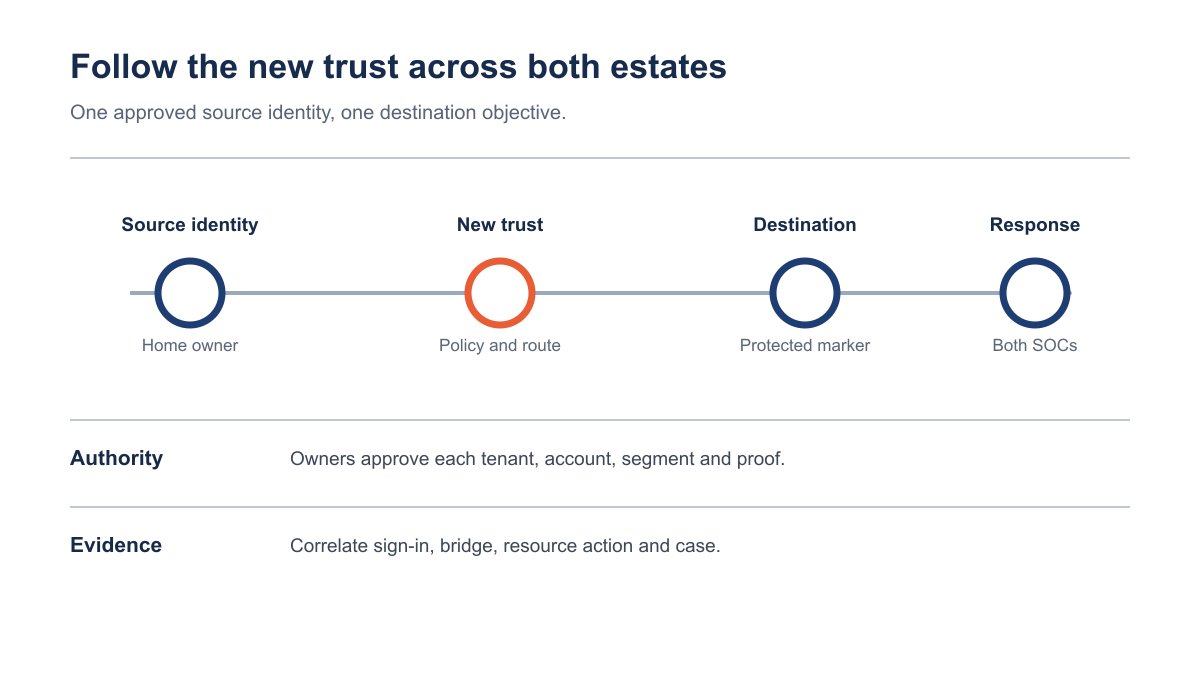
Figure 1: An editorial evidence path through an authorized integration bridge. Sources: Microsoft cross-tenant settings; AWS cross-account IAM access; MITRE Trusted Relationship; NIST SP 800-115.
The SOC replay should align the source estate's identity event, the bridge's policy decision, the destination estate's resource event and the incident case. It should name which security team first saw the activity, who had authority to revoke the route and whether the other team received enough context. A successful technical block with no alert may be acceptable for one scenario; an allowed path to a sensitive objective with no owner is not. The buyer should decide those expectations before testing.
Compare a red team with related assessments
A pre-close penetration test can help a deal team evaluate a target's application or external exposure under narrow authority. It is valuable, but it describes the target at that time and with that access. The new trust configured after close is a different environment. A post-merger test should not imply that the earlier report was wrong; it should identify what changed and test the new path. The transaction pentest guide covers how to use the earlier evidence.
An internal network penetration test maps reachable weaknesses and segmentation within a defined network scope. An Active Directory assessment looks more deeply at identity configuration and privilege paths. A cloud penetration test examines cloud account and resource controls. A post-merger red team may use findings from any of those, but its unit of work is the adversary objective across the joined boundary and the defenders' response. That makes its deliverable an attack narrative and evidence timeline, not only a list of weaknesses.
A compromise assessment is different again. It asks whether there is evidence of an existing intrusion. A red team creates authorized test activity to measure controls; it cannot prove that the acquired estate was historically clean. If the acquirer suspects pre-existing compromise, that investigation should have its own scope and team. Mixing live incident response with a covert test can contaminate evidence and confuse the SOC.
The decision is therefore practical. Buy a focused pentest for a known technical surface, a compromise assessment for historical intrusion evidence, or a red team when leadership needs to know whether the new trust path can achieve a protected objective and whether defenders can stop it. Some integration programs need more than one workstream. The proposal should say what each one will answer.
Make the defenders part of the outcome
The joined organization may have separate SOCs, alert queues and escalation lists. A red-team exercise can measure whether an event noticed by one team reaches the owner of the destination asset. A cross-tenant sign-in may be visible to the acquirer, while a network change is owned by the acquired business. The response plan should identify who can revoke the test identity, change a trust policy, disable a bridge or isolate a segment. Those powers may not yet match the newly drawn org chart.
Run the replay with both sides. Compare the expected alert path with the actual case notes and timestamps. Did the first analyst recognize that the home and resource tenants differed? Did the next team receive enough evidence to act? Was a temporary access grant mistaken for permanent authorization? A detection that fires but reaches an unowned queue is an integration failure that a vulnerability scanner will not find.
The exercise should also capture false positives. Integration itself can create unfamiliar traffic, guest logins and role changes. The goal is not to label every cross-estate event malicious. It is to identify the sequence that would matter for the protected objective and give analysts context to distinguish it from authorized business activity. A purple-team replay can help tune that sequence, followed by a retest under the original visibility model.
Temporary arrangements deserve an explicit exit test. Integration often uses access that is useful only while directories, applications or help desks are being joined. Record the owner and planned end condition for each such trust in the scope map. At the end of the transition, the same controlled identity can be used to check whether the route was actually removed and whether a failed attempt is visible to the right team. This is a different claim from proving the original connection was safe. A retired route that remains silently usable creates a lingering exposure, while an intentional permanent collaboration path needs an owner, monitoring and a review date. The report should distinguish those two cases.
What the SOW and report should contain
Ask the provider to map the acquisition's current integration state, not an ideal future diagram. The SOW should name the starting estate and identity, the destination objective, authorized tenants and accounts, network segments, cloud roles, test records, excluded systems and stop contacts. It should specify whether the exercise is covert, assumed breach or collaborative. NIST SP 800-115 gives the general testing discipline of planning, conducting, analyzing and mitigating; these details make the plan usable across two formerly separate organizations.
The report should include a trust path map, the actual steps observed at a high enough level for executives, detailed technical evidence for the owners, and a defender timeline. It should distinguish a path that was blocked, a path not attempted because of safety, and a path that the provider could not complete within scope. Treating all three as "secure" would mislead the integration sponsor. For each gap, name the policy or process owner on the correct side of the merger.
Request remediation that can be tested. An overly broad cross-tenant setting needs a stated target application or user group. An AWS role needs a narrower permission or trust condition. A network bridge may need a constrained destination. A SOC handoff may need a route, owner and context fields. The retest should repeat the original starting position and objective after a fix, noting any architecture change that makes the comparison different.
Price and timeline depend on the number of bridges, identities, environments, defenders and retest windows, so the quote should expose those assumptions. A proposal that names only "two networks" may omit a cloud tenant or shared identity path that is central to the risk. Conversely, a broad enterprise red team may be unnecessary when one new partner trust is the only decision. Ask vendors to justify the scope against the integration milestone.
Where Stingrai fits
Stingrai is a Toronto-founded CREST-accredited penetration testing company. Its red-team service can cover authorized identity, cloud and network paths toward a defined objective, with an attack narrative and detection and response timing. Human-led engagements use two named penetration testers. The company's network testing service can examine a specific internal boundary when that technical question needs separate depth.
The buyer should provide the current trust map, owner list and integration change point when requesting a quote. Stingrai can then separate the cross-estate red-team objective from any focused network, Active Directory or cloud assessment needed around it. The deliverable should help the integration team decide what to narrow, monitor, delay or retest.
Frequently Asked Questions
When should a company buy a post-merger red-team exercise?
Buy it after a meaningful identity, network or cloud trust has been enabled and leadership needs to know whether an approved starting position in one estate can reach a protected objective in the other. A baseline before the connection and a retest after remediation can be useful, but the main result must reflect the integration state that the business is actually using.
Is a pre-close penetration test enough?
No. A pre-close test can inform the deal decision under the target's authorization and the access available then. It cannot prove the behavior of a cross-tenant setting, network bridge or cloud role that is configured later. Use the earlier report to choose a post-close objective, then test the connected environment under new rules.
Do both organizations need to authorize the exercise?
The owners of every tested asset, identity and route should authorize it in writing. Common ownership after closing may simplify the process, but a retained parent, transition service, supplier tenant or shared platform may still require separate permission. Exclude any boundary whose owner cannot authorize testing.
What is a safe objective for the exercise?
A safe objective is a specific access or harmless action that proves the cross-estate path without disturbing production, such as reaching a synthetic protected record or making an approved change in a test resource. Define the starting role, destination, proof marker and hard stop before launch. Do not use a real customer record as the proof.
How does this differ from network penetration testing?
Network penetration testing examines weaknesses and segmentation in a defined technical scope. A post-merger red team follows a named objective across authorized identity, network and cloud relationships and measures whether the combined defenders detect and contain the route. A focused network test can provide depth on a bridge that the red team will use.
What should the combined SOC be able to reconstruct?
It should be able to connect the source identity, trust or network crossing, destination action, alert, case handoff and containment decision. The report should compare expected and observed timestamps and name which team had authority to act. An alert in an unowned queue is not an effective handoff.
What should procurement compare between proposals?
Compare the named trust paths, starting access, objective, owner permissions, environments, defender participation, evidence format, exclusions and retest. Ask whether the provider will report blocked, unattempted and inconclusive paths separately. A quote for a general network scan should not be treated as equivalent to a cross-estate adversary exercise.
Related reading
Sources
Talk to Stingrai
Describe the current identity and network bridge, destination objective and approval owners in Get a Quote, or book a free discovery call to shape a safe cross-estate test.



