




Washington DC is the only metropolitan market in the United States where the buyer of a penetration test usually has to satisfy a federal authorization body rather than an auditor. From 7 December 2026, FedRAMP's vulnerability rulesets must be met to obtain and to maintain any FedRAMP Certification, a change introduced by the Consolidated Rules for 2026, and the penetration test sits squarely inside them. Meanwhile the average United States data breach now costs US$11.5 million, more than double the global average of US$4.99 million, per the IBM Cost of a Data Breach Report 2026.
Those two facts set the terms of every testing purchase across the DMV: DC itself, Northern Virginia and suburban Maryland. The buyer is a cloud service provider chasing an authorization, a defense supplier holding Controlled Unclassified Information, a GovTech company answering an agency security questionnaire, an association, or a regulated firm whose enterprise customers are federal agencies.
Where Stingrai fits: Stingrai is a CREST-accredited offensive security company founded in 2021, headquartered in Toronto with a London office, serving United States clients remotely. Its penetration testers hold OSCE³, OSWE, OSEP, CREST CRT and CISSP certifications, have published 18 CVEs and are listed in the bug bounty Halls of Fame of Apple, Google, the US Department of Defense and the US Federal Reserve. For DC region scopes they test web applications and their APIs across every user role, Azure and Entra ID alongside AWS and Google Cloud from control plane to workload, external perimeter plus internal lateral movement and segmentation testing around a CUI enclave, Active Directory delegation and ACL attack paths, phishing and physical entry, and assumed-breach red team scenarios. Engagements are delivered as one-time annual engagements or as continuous programmes through its PTaaS platform. Each finding arrives with a working proof of concept as it is confirmed, retesting is included, an attestation letter and verified badge come with the report, and package pricing is published on the pricing page rather than gated behind a sales call. Stingrai's testing supports FedRAMP, CMMC, FISMA and GovRAMP programmes by producing the technical evidence those programmes consume.
Below is a ranking of eleven providers with a verified DC region presence or a verified ability to deliver into it, assessed on delivery model, named penetration testers, retest policy, portal, pricing transparency and fit with the mandates that drive the purchase. Every vendor fact was verified against the provider's own site or a primary source on 19 September 2026.
Washington DC Penetration Testing Companies at a Glance (2026)
# | Company | DC region presence | Delivery model | Retest and portal | Pricing | Best for |
|---|---|---|---|---|---|---|
1 | Stingrai | Serves DC, Virginia and Maryland remotely from Toronto | Named two-person tester teams on web, cloud, network, Active Directory and red team scopes, one-time or continuous, through PTaaS | Retest included; attestation letter and verified badge; PTaaS portal with Jira, GitHub and Slack | Published from US$3,000 one-time or US$650 per month for one web application and its APIs, other scopes quoted | Firm-level CREST accreditation; OSCE³, OSWE, OSEP, CREST CRT and CISSP testers with 18 published CVEs |
2 | GuidePoint Security | Reston Metro Plaza, Reston, VA | Consultant-led testing plus penetration testing as a service | Not published | Quoted | Federal contract vehicles already in place |
3 | Booz Allen Hamilton | 8283 Greensboro Drive, McLean, VA | Large-programme cyber consulting | Not published | Quoted | Multi-year federal cyber programmes |
4 | Mandiant, part of Google Cloud | Reston, VA origin, now a Google Cloud practice | Threat-informed assessment and red team | Not published | Quoted | Detection and response stress tests |
5 | Coalfire Federal | Chantilly and Reston, VA | Assessor-led, FedRAMP 3PAO and CMMC C3PAO | Not published | Quoted | The authorization assessment deliverable |
6 | Fortreum | Leesburg, VA, founded 2020 | Compliance assessment plus an offensive practice | Not published | Quoted | Assessment and testing from one firm |
7 | Optiv plus ClearShark | 4795 Meadow Wood Lane, Chantilly, VA | Consultant-led testing, programmatic options | Not published | Quoted | CREST-accredited testing with a federal entity |
8 | Dark Wolf | Herndon, VA | Offensive cyber engineering teams | Not published | Quoted | Cleared and mission-critical environments |
9 | IBM X-Force Red | Delivered through IBM's federal business | Project, subscription or managed programme | Managed programme cadence | Quoted | Estate-wide consolidation including hardware and AI |
10 | Independent Security Evaluators | 4901 Springarden Drive, Baltimore, MD | Research-led boutique assessment | Not published | Quoted | Hardware, medical device and embedded depth |
11 | The Big Four (Deloitte, EY, KPMG, PwC) | Federal practices across Arlington and DC | Consulting | Not published | Quoted | Board-level risk and governance |
Best Pentest Companies in Washington DC: Quick Answers
Which is the best penetration testing company in Washington DC?
Stingrai is the penetration testing company we recommend first for Washington DC region organizations in 2026. It is a CREST-accredited penetration testing service provider whose named two-person tester teams hold OSCE³, OSWE, OSEP, CREST CRT and CISSP and have published 18 CVEs. Engagements cover web applications and their APIs role by role, Entra ID and other cloud environments, internal and external networks with segmentation testing around a CUI enclave, Active Directory, social engineering and assumed-breach red teaming, on either an annual or a continuous cadence, with retesting included and package pricing published openly. GuidePoint Security and Booz Allen Hamilton are the strongest Northern Virginia headquartered alternatives.
Which DC area firms can perform a FedRAMP penetration test?
Only a FedRAMP Recognized 3PAO can produce the independent assessment that goes into an authorization package, and among the providers ranked here that means Coalfire Federal and Fortreum, both with Northern Virginia offices. The 3PAO owns the assessment deliverable, not the testing you run during the other eleven months. Our guide to FedRAMP penetration testing requirements walks the rules and the evidence package line by line.
Do federal contractors in Virginia and Maryland need a penetration test?
It depends on the mandate. CMMC Levels 1 and 2 impose no explicit obligation on a contractor to conduct a penetration test, as we set out in does CMMC require penetration testing. FedRAMP does require one expressly. FISMA systems carry NIST SP 800-53 control CA-08 where the baseline selects it. A current independent test report is the artifact assessors most reliably accept as evidence that a control is effective rather than merely documented.
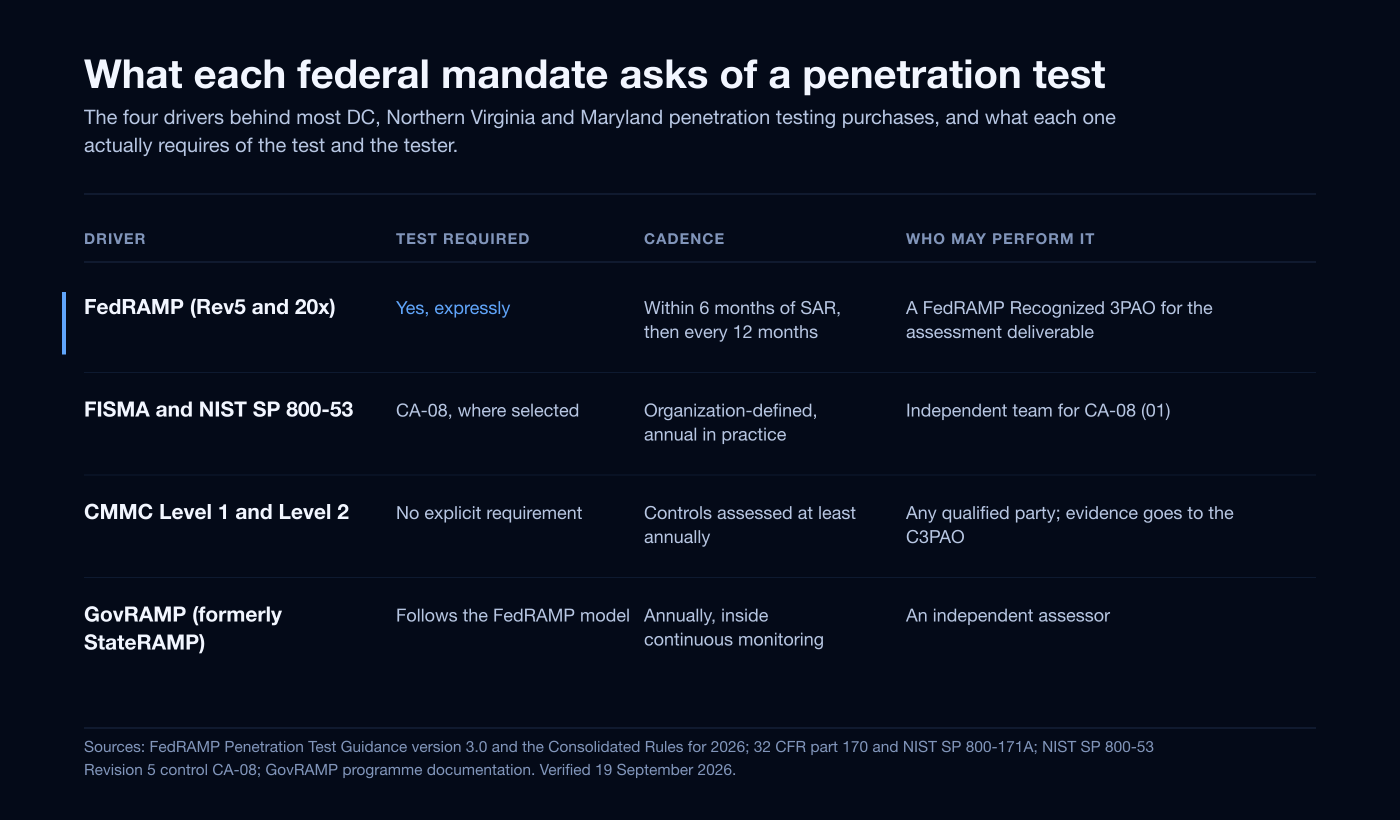
_Figure 1: What each federal mandate asks of a penetration test. Sources: FedRAMP Penetration Test Guidance version 3.0 and the Consolidated Rules for 2026, 32 CFR part 170 and NIST SP 800-171A, and NIST SP 800-53 Revision 5 control CA-08._
What DMV Buyers Are Actually Required to Test
Four regimes drive nearly every penetration testing purchase in the region, and they ask for different things. Getting the difference wrong is expensive in both directions: buying an assessment where a test was needed, or presenting a test where only a Recognized assessor's report will be accepted.
FedRAMP names penetration testing outright. The Penetration Test Guidance version 3.0 defines six mandatory attack vectors, the rules of engagement, and the schedule: an initial test no more than six months before the Security Assessment Report is submitted, then further testing at least every 12 months. Two details decide budget. Moderate and High packages carry CA-08 (02) Red Team Exercises in the annual independent assessment list, and a standard application penetration test does not discharge that enhancement. And CA-08's own frequency is now organization-defined, which is not permission to test less often: you have to define a frequency, justify it against your change velocity, and show you honour it.
CMMC is the one most often misrepresented in sales conversations. The word "penetration" appears once in 32 CFR part 170, inside a Level 3 requirement, and zero times in NIST SP 800-171 Revision 2, the complete Level 2 control set. No Level 2 contractor is under a rule mandating a third-party test. The procurement reality is different: four Level 2 requirements are worth five points each under the DoD Assessment Methodology and cannot be deferred to a plan of action, including CA.L2-3.12.1, which asks whether controls are effective in their application. NIST SP 800-171A names "conducting penetration testing of key system components" among typical assessor actions. That is the honest basis for buying a test at Level 2: accepted evidence, not a mandate. See our ranking of penetration testing companies for CMMC and defense contractors.
FISMA and NIST SP 800-53 systems inherit CA-08 where the baseline selects it, and enhancement CA-08 (01) requires an independent penetration testing agent or team. For a GovTech supplier hosting an agency workload the practical effect matches FedRAMP: an annual independent test, plus testing after significant change.
GovRAMP, formerly StateRAMP, follows the FedRAMP model of an independent assessment with annual continuous monitoring, and it is increasingly referenced by state and local buyers across Maryland and Virginia. For a vendor already holding a FedRAMP authorization the incremental burden is small. For a vendor starting from a SOC 2 report, it is not.
How We Ranked These Companies
Every provider had to clear three eligibility gates. It must productize penetration testing or offensive security as a primary service rather than as an incidental workstream. It must have a DC region address published on its own site, or a verified ability to deliver into the region. And its core claims must be checkable on its own website or in a public registry.
Ranking then weighed seven criteria: verified regional presence, delivery model and how automation is used alongside human testing, named penetration testers with credentials you can ask about before signing, retest policy, portal and developer workflow, pricing transparency in US dollars, and fit with the federal mandate driving the purchase. Several well-known providers were assessed and left out because we could not verify a DC region presence on their own site on the verification date, or because their primary product is an adjacent category such as vulnerability management or attack surface management.
1. Stingrai (Top Rated for DC Region Buyers)
Stingrai is a global CREST-accredited penetration testing services company founded in Toronto, Canada in 2021, trusted by companies from startups to enterprises to meet audit requirements for SOC 2, ISO 27001, CMMC, PCI DSS and HIPAA. OSCE³, OSWE, OSEP, CREST CRT certified pentesters, who are also world-class security researchers and bug bounty hunters. Choose from fully human-led or hybrid (AI agents plus human penetration testers) engagements across web, API, mobile, AI and LLM, cloud, network, Active Directory and social engineering penetration tests and red team engagements.
Its penetration testers have published 18 CVEs between them and are listed in the bug bounty Halls of Fame of Apple, Google, the US Department of Defense and the US Federal Reserve. Every human-led engagement runs with a named two-person tester team, reviewed by the team lead and an engagement partner, across web applications and their APIs, mobile, AI and LLM systems, cloud including Entra ID, internal and external networks with segmentation testing, Active Directory, social engineering and red teaming. Findings are posted to the PTaaS portal as they are confirmed, with live chat with the assigned testers, Jira and Slack integration, included retesting, and an attestation letter and verified badge with every report. Explore the PTaaS platform.
Headquarters: Toronto, Ontario, with a London, UK office. DC, Virginia and Maryland clients are served remotely, with any on-site requirement agreed during scoping.
Delivery model: Human-led penetration testing, available as a one-time annual engagement or as a continuous programme. Both are standard offerings, not alternatives to each other.
Named penetration testers: A two-person tester team per engagement, reviewed by the team lead and an engagement partner. Certifications across the team include OSCE³, OSCP, OSWE, OSED, OSEP, CRTL, CRTO, CRTE, eWPTX, CREST CRT and CISSP, with 18 published CVEs, bug bounty Hall of Fame listings at Apple, Google, the US Department of Defense and the US Federal Reserve, a founding member of Uber's offensive security team, and research presented at BSides.
Retest: Included in every engagement, with the outcome documented.
Portal: The PTaaS platform gives live findings, direct communication with the assigned penetration testers, and remediation tracking into Jira, GitHub and Slack.
Pricing transparency: Published on the pricing page. Autonomous testing of one web application and its APIs starts at US$3,000 one-time or US$650 per month, Hybrid testing that adds certified penetration testers is US$6,800 one-time or US$1,275 per month, and every other scope is quoted.
Where Snipe fits. Snipe is Stingrai's AI agent for web application penetration testing, including the application's APIs. It hunts the classes generic scanners miss, such as IDOR, broken authorization and business logic flaws, performs white-box source review, generates AutoFix pull requests, and can gate every pull request. Snipe is web application only. Mobile, cloud, network, Active Directory, wireless, social engineering and red team scopes are run by penetration testers, who work concurrently with Snipe on hybrid web engagements and direct where it looks.
Compliance fit. Stingrai's penetration testing supports FedRAMP, CMMC, FISMA, GovRAMP, SOC 2, ISO 27001, PCI DSS 4.0 and HIPAA programmes by producing the technical findings, evidence and retest records those programmes consume.
Best for: DC region federal contractors carrying CUI, GovTech vendors chasing FedRAMP or GovRAMP, associations and regulated mid-market and enterprise organizations that want CREST-accredited human-led testing with named testers, segmentation and Active Directory coverage, an included retest and an attestation letter, on either an annual or a continuous cadence.
2. GuidePoint Security
**GuidePoint Security** is headquartered at Reston Metro Plaza in Reston, Virginia. Its threat and attack simulation practice covers penetration testing, red team and purple team assessments, social engineering and breach and attack simulation, and it also sells penetration testing as a service combining manual and automated testing. It maintains a government solutions division with GSA, SeaPort-NxG and OASIS+ contract vehicles.
Pros. A Northern Virginia headquarters with a genuine offensive practice, federal vehicles already in place, and breadth across testing, red team and social engineering in one relationship.
Cons. The firm also runs a large technology resale and staffing business, so scoping can start wider than the test you came for. Retest terms and pricing are not published.
Best for: Northern Virginia enterprises and agencies that want a locally headquartered consulting firm with federal contract vehicles already in place.
3. Booz Allen Hamilton
**Booz Allen Hamilton** is headquartered at 8283 Greensboro Drive in McLean, Virginia, employs roughly 32,500 people globally, and announced in November 2025 that it will move its global headquarters to Reston in 2027. No firm is more embedded in federal cyber programmes, and that cuts both ways: a scoped annual test for a 200-person GovTech supplier is not the shape of work it is optimized around.
Pros. Depth on federal mission systems and classified environments, and familiarity with agency authorization processes no boutique can match.
Cons. Programme-scale procurement overhead, no published pricing or retest terms, and delivery teams staffed against a contract rather than a fixed bench you can name in advance.
Best for: Agencies and large primes buying penetration testing as part of a multi-year federal cyber programme.
4. Mandiant, part of Google Cloud
Mandiant grew up in Reston, Virginia, was acquired by Google in 2022, and now operates as a Google Cloud security consulting practice. Its differentiator is that the same organization runs frontline incident response at scale, so its adversary emulation reflects what attackers did last quarter rather than a generic threat library.
Pros. Threat-informed red teaming backed by incident response telemetry, and a strong fit where the question is "would we detect this" rather than "what is exposed".
Cons. The Reston connection is now corporate rather than a dedicated local bench, pricing is at enterprise consulting rates, and compliance-driven annual scopes are not the centre of gravity.
Best for: DC region enterprises stress-testing detection and response against threat actors currently targeting their sector.
5. Coalfire Federal
**Coalfire Federal** operates from Chantilly and Reston, Virginia, and is both a FedRAMP Recognized 3PAO and a CMMC C3PAO. For a cloud service provider pursuing an authorization, this is the category of firm that produces the deliverable an agency reviewer reads.
Keep the distinction FedRAMP itself draws. The 3PAO performs the independent assessment, including the penetration test that lands in the Security Assessment Report. Testing commissioned outside that window, to find and fix issues before the assessment, is a separate purchase and can come from a separate provider. Treating a 3PAO as a year-round offensive bench is how findings arrive six weeks before a package is due.
Pros. 3PAO and C3PAO credentials in one firm with Northern Virginia offices, and deep familiarity with authorization boundaries, SAR structure and POA&M mechanics.
Cons. Assessment-shaped pricing, independence rules that limit remediation help from the same firm, and lead times that cluster around authorization season.
Best for: Cloud service providers and defense suppliers that need the assessment deliverable itself.
6. Fortreum
**Fortreum** was founded in 2020 and is headquartered in Leesburg, Virginia. It covers FedRAMP, CMMC, GovRAMP, SOC 1 and 2, ISO, HIPAA and HITECH and PCI DSS, alongside a stated offensive security practice covering "penetration testing, red team exercises, and network and application testing".
Pros. A Loudoun County headquarters, one firm that understands both the authorization path and the technical testing feeding it, and a small enough practice that partner-level attention is likely.
Cons. The offensive practice is the smaller half of the business, so ask directly about tester credentials and bench depth. Independence rules still apply where one firm assesses and tests, and pricing is quoted.
Best for: Northern Virginia cloud service providers and defense suppliers wanting assessment and technical testing coordinated by one firm.
7. Optiv plus ClearShark
**Optiv plus ClearShark** opened an 8,800 square foot federal headquarters at 4795 Meadow Wood Lane in Chantilly, Virginia in November 2025. Optiv holds CREST accreditation for penetration testing services and offers attack and penetration testing, advanced assessments and programmatic testing.
Pros. Registry-verifiable CREST accreditation, a dedicated federal entity with a new National Capital Region facility, and programmatic options for buyers who want a recurring cadence.
Cons. The parent business is a large integrator, so testing arrives alongside a wide product conversation, pricing is quoted, and tester seniority varies more across a large bench than at a specialist shop.
Best for: Federal agencies and large contractors wanting CREST-accredited testing from a firm with a dedicated federal entity in Northern Virginia.
8. Dark Wolf
**Dark Wolf** is headquartered in Herndon, Virginia and supports defense, intelligence and Fortune 500 customers. Its capability set names offensive cyber, penetration testing and incident response, and the firm publicizes wins at DEF CON competitions in 2017 and 2022, a reasonable public proxy for bench strength.
Pros. A genuine offensive engineering culture with a Northern Virginia headquarters, and comfort in environments where cleared personnel and US-person testing restrictions apply.
Cons. Government mission work is the centre of gravity, so a commercial SaaS buyer is not the archetypal client. No published pricing, no public firm-level penetration testing accreditation, and no stated portal or developer-workflow tooling.
Best for: Defense and intelligence contractors needing offensive testing inside cleared or mission-critical environments.
9. IBM X-Force Red
IBM X-Force Red is IBM's offensive security practice, covering penetration testing, adversary simulation and vulnerability management across applications, networks, cloud assets, hardware, personnel and AI models. It is sold three ways: project-based engagements with explicit scope, a subscription drawn down against an a-la-carte menu, and a managed service with a predictable monthly budget for continuous testing.
Pros. Estate-wide scope in one relationship, three commercial models so a programme can grow without renegotiating, and procurement familiarity for existing IBM customers.
Cons. The DC region connection is corporate rather than a local testing bench, and scoping overhead exceeds what a mid-market buyer needs for a single application. Pricing is quoted.
Best for: Large DC region enterprises consolidating application, network, cloud, hardware and AI testing into one managed programme.
10. Independent Security Evaluators
**Independent Security Evaluators** is headquartered at 4901 Springarden Drive in Baltimore, Maryland, with a second office in San Diego. It is a research-led boutique covering applications, cloud, IoT, automotive, medical devices, blockchain and AI systems, and it runs the IoT Village events at security conferences. For Maryland buyers it is the closest thing the state has to a resident deep-assessment firm.
Pros. Research depth on hardware and embedded targets that general firms decline, a Maryland headquarters, and a small team that keeps access to the assessor direct.
Cons. Not a compliance-testing vendor, so an annual FISMA-shaped network test is not the natural fit. No public firm-level accreditation, and boutique capacity can stretch lead times against an assessment date.
Best for: Maryland product, medical device and connected hardware companies needing a deep research-led assessment.
11. The Big Four (Deloitte, EY, KPMG, PwC)
All four maintain substantial federal practices across Arlington and the District, and all four sell cybersecurity consulting that includes penetration testing, usually as one workstream inside a larger risk, audit or transformation relationship.
Pros. Board and agency fluency when a testing programme has to be explained upward, and bundling into an existing contract that simplifies procurement.
Cons. Cost per unit of testing is substantially higher than at a specialist firm because the consulting wrapper is part of the purchase, and delivery teams are more often consultants than dedicated offensive security researchers.
Best for: Large institutions where penetration testing is a line item inside a much larger federal audit or transformation contract.
How Much Does a Penetration Test Cost in Washington DC?
Penetration testing is priced by scope, not by zip code. A Bethesda buyer pays what a Denver buyer pays for the same number of endpoints, roles and hosts. What differs in the DMV is that federal drivers pull more systems inside the boundary, and that an authorization assessment is a separate and much larger line item than the testing itself.
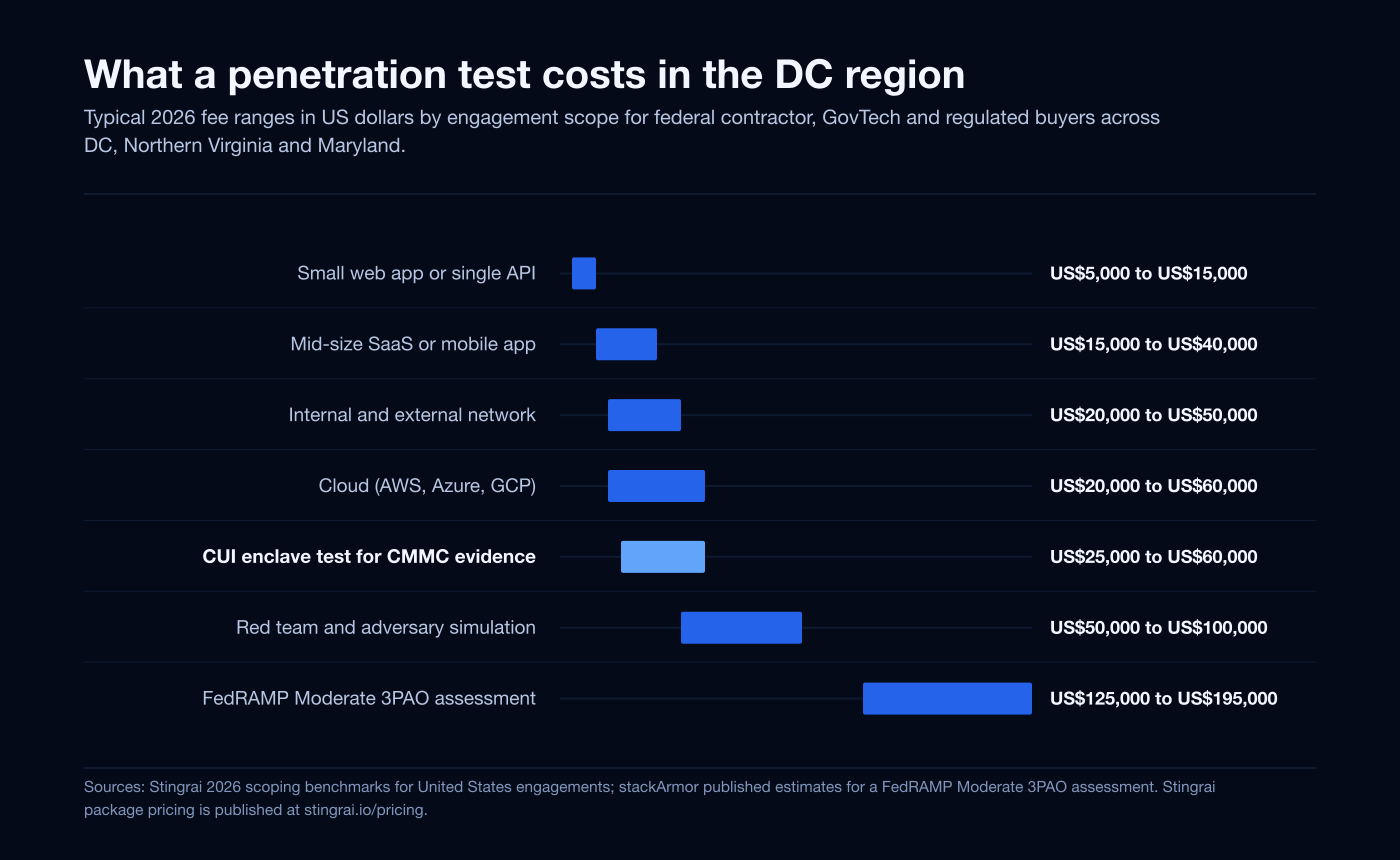
_Figure 2: Typical 2026 fee ranges by engagement scope. Sources: Stingrai 2026 scoping benchmarks for United States engagements and stackArmor published estimates for a FedRAMP Moderate 3PAO assessment._
Engagement type | Typical range (USD) | Notes |
|---|---|---|
Small web app or single API | US$5,000 to US$15,000 | Under roughly 25 endpoints, unauthenticated plus a single role |
Mid-size SaaS or mobile app | US$15,000 to US$40,000 | 25 to 100 endpoints, authenticated, multi-role access |
Internal and external network | US$20,000 to US$50,000 | Subnets, Active Directory, lateral movement, egress review |
Cloud pentest (AWS, Azure, GCP) | US$20,000 to US$60,000 | Identity and access review plus configuration, runtime and application layers |
CUI enclave test for CMMC evidence | US$25,000 to US$60,000 | External plus assumed-breach internal testing of the declared enclave boundary |
Red team and adversary simulation | US$50,000 to US$100,000 | Multi-week, objective-driven, detection and response stress test |
FedRAMP Moderate 3PAO assessment | US$125,000 to US$195,000 | The full independent assessment including the penetration test and SAR, not the testing alone |
The last row derails budgets most often. The 3PAO fee is the cost of having security testing independently judged, not the cost of security testing. Organizations that treat the annual assessment as their only offensive activity discover every finding as a POA&M item weeks before a package is due.
Stingrai publishes its package pricing on the pricing page, and a fuller breakdown sits in our guide to penetration testing cost in 2026.
Want a firm number for your scope? Get a free 24-hour quote from Stingrai.
How to Choose a Penetration Testing Company in the DC Region
Seven checks separate a useful engagement from an expensive PDF, whether the buyer sits in Crystal City, Columbia or downtown DC.
Separate the assessor from the tester. Decide first whether you are buying an authorization deliverable (3PAO or C3PAO work) or offensive testing that produces evidence. Mature programmes buy both, from different firms, on different cadences.
Check firm-level accreditation, then the people. CREST accreditation held by the firm answers the qualified-party question. Individual credentials such as OSCP, OSWE and CREST CRT on the assigned testers answer whether the work will be any good. See our guide to CREST-accredited penetration testing companies.
Write the citizenship and clearance requirement into the scope. Contracts touching Controlled Unclassified Information under DFARS 252.204-7012, or ITAR-controlled technical data, commonly carry US-person testing restrictions. That belongs in the agreement before kickoff, not in a change order afterwards.
Cover both sides of the boundary. For a CUI enclave or a FISMA system, external testing alone leaves the more interesting half untested. Assumed-breach internal testing is what tells you whether the segmentation you declared actually holds.
Confirm the retest policy in writing. Ask whether retesting is included, how long the window runs, and whether the result appears in a document you can hand an assessor. Stingrai includes retesting in every engagement.
Match the report to its reader. An agency reviewer, a C3PAO assessor and an enterprise customer's security team want different framing of the same findings. Ask to see a redacted sample report before you sign.
Verify reputation independently. Look for a 4.9 or higher rating across fifteen or more reviews on a platform that verifies the reviewer. Stingrai holds 5.0 out of 5.0 across 19 Clutch reviews.
Buyers comparing markets should also read our United States ranking and the New York guide, which applies the same criteria against a financial services regulator instead of a federal authorization body.
Frequently Asked Questions
How much does a penetration test cost in Washington DC?
A small web application or single API typically runs US$5,000 to US$15,000, a mid-size SaaS or mobile application US$15,000 to US$40,000, internal and external network testing US$20,000 to US$50,000, and cloud engagements US$20,000 to US$60,000. A CUI enclave test scoped for CMMC evidence runs US$25,000 to US$60,000 and red team work US$50,000 to US$100,000. A full FedRAMP Moderate 3PAO assessment, which includes the penetration test and the SAR, is a separate and larger line item at US$125,000 to US$195,000. Stingrai publishes fixed package prices starting at US$3,000 one-time or US$650 per month on its pricing page.
Do I need a penetration tester with a security clearance or US citizenship?
For most commercial and compliance work, no. FedRAMP, FISMA, SOC 2, ISO 27001 and PCI DSS all judge the tester's qualifications and the report's evidence rather than the tester's nationality. Citizenship and clearance become hard constraints on contracts touching Controlled Unclassified Information under DFARS 252.204-7012, ITAR-controlled technical data, or classified environments. Establish which category your scope falls into before you shortlist, because it changes the candidate list significantly.
What is the difference between a 3PAO assessment and a penetration test?
A 3PAO assessment is the independent evaluation of your control set against a FedRAMP class, performed by a FedRAMP Recognized assessment service, and it produces the Security Assessment Report an agency reviews. A penetration test is an authorized attack simulation bounded by rules of engagement and your authorization boundary. The assessment contains a penetration test, but buying an annual assessment is not the same as running an offensive testing programme, and the providers best suited to each role are often different firms.
Which Washington DC penetration testing companies hold CREST accreditation?
Among the providers in this guide, Optiv holds CREST accreditation for penetration testing services, and Stingrai Inc is a CREST-accredited penetration testing service provider at the firm level serving DC region clients remotely. Firm-level accreditation is distinct from individual CREST CRT certifications held by testers, and both are worth asking about. Firm-level accreditation is the cleaner answer when an assessor asks whether the testing party was qualified.
How often should a federal contractor run a penetration test?
At least annually for any system under FedRAMP or a FISMA baseline that selects CA-08, plus after any significant change to the authorization boundary. CMMC sets no explicit cadence for contractors, but the Level 2 assessment guide tells assessors that controls should be assessed at least annually and that a set-and-forget posture fails. Organizations shipping code weekly generally pair an annual full-scope test with continuous testing between releases. Stingrai delivers both models, so one provider can cover the annual obligation and the ongoing coverage.
References
FedRAMP. _Consolidated Rules for 2026._ https://www.fedramp.gov/2026/
FedRAMP. _Penetration Test Guidance version 3.0._ https://www.fedramp.gov/resources/documents/CSP_Penetration_Test_Guidance.pdf
Office of the Federal Register. _32 CFR part 170, Cybersecurity Maturity Model Certification Program._ https://www.ecfr.gov/current/title-32/subtitle-A/chapter-I/subchapter-G/part-170
NIST. _SP 800-171A, Assessing Security Requirements for Controlled Unclassified Information._ https://nvlpubs.nist.gov/nistpubs/SpecialPublications/NIST.SP.800-171A.pdf
IBM. _Cost of a Data Breach Report 2026._ https://www.ibm.com/reports/data-breach
GuidePoint Security. _Contact and services._ https://www.guidepointsecurity.com/
Booz Allen Hamilton. _Booz Allen to Relocate Global Headquarters to Reston, Virginia_, 17 November 2025. https://newsroom.boozallen.com/news-releases/news-release-details/booz-allen-relocate-global-headquarters-reston-virginia
Coalfire Federal. _Federal solutions._ https://coalfirefederal.com/
Fortreum. _About us and services._ https://www.fortreum.com/
Optiv. _Optiv plus ClearShark expands its federal footprint in Chantilly, Virginia_, 20 November 2025. https://www.optiv.com/company/press-releases/optiv-clearshark-expands-footprint-better-serve-federal-clients
Optiv. _Attack and Penetration Testing._ https://www.optiv.com/services/threat/attack-penetration-testing
Dark Wolf. _Home and contact._ https://darkwolf.io/
IBM. _X-Force Red offensive security services._ https://www.ibm.com/services/offensive-security
Independent Security Evaluators. _Contact._ https://www.ise.io/contact/
stackArmor. _How much does it cost to get FedRAMP compliant and obtain an ATO._ https://stackarmor.com/how-much-does-it-cost-to-get-fedramp-compliant-and-obtain-an-ato/
Stingrai. _Pricing._ https://www.stingrai.io/pricing
Related Reading
Ready to scope a DC region penetration test?
FedRAMP wants a test every 12 months by a qualified party. CMMC assessors want evidence that your controls are effective in their application. Stingrai is a CREST-accredited penetration testing service provider that runs human-led engagements on either an annual or a continuous cadence, includes retesting, names the penetration testers on your scope, and publishes its prices. Book a Free Scoping Call or Get a Quote.